Korean Journal of Microbiology (2019) Vol. 55, No. 4, pp. 419-421 pISSN 0440-2413
DOI https://doi.org/10.7845/kjm.2019.9094 eISSN 2383-9902
Copyright ⓒ 2019, The Microbiological Society of Korea
Complete genome sequence of Pseudarthrobacter sp. NIBRBAC000502771 isolated from shooting range soil in Republic of Korea
Min-Kyu Park
1,2, Yeong-Jun Park
1, Min-Chul Kim
1, Gi-Ung Kang
1, MinJi Kim
1, YoungJae Jo
1, Hyuk-Joon Kwon
2, Myung-Suk Kang
2, Min-Ha Kim
2, Soo-Young Kim
2, and Jae-Ho Shin
1*
1
School of Applied Biosciences, College of Agriculture and Life Sciences, Kyungpook National University, Daegu 41566, Republic of Korea
2
National Institute of Biological Resources, Incheon 22689, Republic of Korea
한국의 사격장 토양에서 분리된
Pseudarthrobacter sp. NIBRBAC000502771의 유전체 서열
박민규
1,2・ 박영준
1・ 김민철
1・ 강기웅
1・ 김민지
1・ 조영재
1・ 권혁준
2・ 강명석
2・ 김민하
2・ 김수영
2・ 신재호
1*
1
경북대학교,
2국립생물자원관
(Received August 16, 2019; Revised September 18, 2019; Accepted October 30, 2019)
*For correspondence. E-mail: [email protected];
Tel.: +82-53-950-5716; Fax: +82-53-953-7233
Pseudarthrobater sp. NIBRBAC000502771 is a Gram-positive, aerobic, rod-shaped and auxin producing bacterium which was isolated from shooting range soil in Hongcheon, Republic of Korea. We report the complete genome sequence of the strain.
A whole genome contig was composed of 4,495,979 bp length with 66.1% of G + C contents and 4,295 genes. The complete genome contains genes to produce auxin and genes resist to heavy metals.
Keywords: Pseudarthrobacter sp., auxin, heavy metal resistance
The genus of Pseudarthrobacter is an aerobic, motile, Gram- positive bacterium. The member of genus Pseudarthrobacter has been found in metal habitats (Fekih et al., 2018) such as copper and arsenic conditions. In this study, we report the isolation and taxonomic characterization of Pseudarthrobacter sp. strain NIBRBAC000502771 from shooting range soil at Hongcheon, Republic of Korea. The strain NIBRBAC000502771 was grown in tenfold diluted Luria-Bertani (LB + Arc) medium,
that comprises 370 ppm of arsenate, and used to grow heavy metal resistant bacteria (Abbas et al., 2014). The systematic analysis of 16S rRNA gene sequence revealed that strain NIBRBAC000502771 has the highest identity to Pseudarthrobacter phenanthrenivorans Sphe3 (98.9%) hence, belongs to the genus Pseudarthrobacter. A colony of the isolated strain was grown in of LB at 30°C with 200 RPM and the genomic DNA was isolated by Qiagen MagAttract high molecular weight DNA isolation kit as described by the manufacturer (Qiagen).
Genome sequencing was performed using a third-generation, long-read sequencer PacBio RSII as described by Jung et al.
(2019). Approximately, 10 µg of high-quality, RNA-free ge- nomic DNA was used to construct 20-kb SMRTbell library using the DNA Templated Prep kit 1.0 (PacBio). Later on, used PacBio RSII machine at DNA Link, Inc..
The HGAP protocol 3.0 software was considered for the
genome annotation and assembly. The resulting whole genome
sequence of the strain NIBRBAC000502771 has been deposited
in the GenBank with the accession numbers of CP041187. A
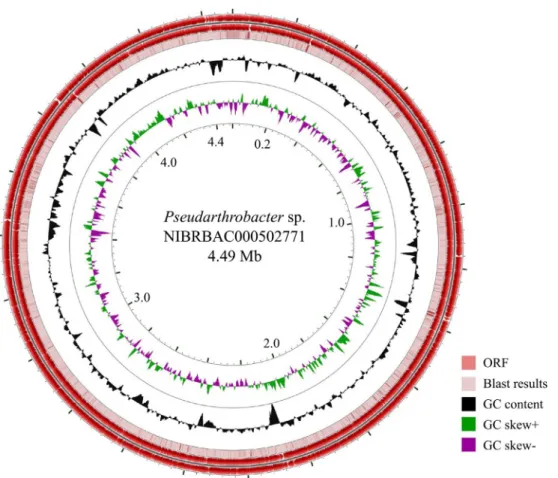
circular map of the genome of strain NIBRBAC000502771
420
∙ Park et al.미생물학회지 제55권 제4호
Fig. 1. Graphical circular maps of the chromosome of Pseudarthrobacter sp. NIBRBAC000502771. From the center to the outside: genome size label, GC skew (green and purple), G + C contents (Black), Blast results (Pink), ORF (Red).
Table 1. Genome features of Pseudarthrobacter sp. NIBRBAC000502771
Genomic features Value
GenBank accession CP041187
Genome size (bp) 4,495,979
G + C contents (%) 66.1
No. of contig 1
Total genes 4,295
Protein-coding genes 4,228
tRNA 52
(Fig. 1) was created by using the CGview software (Stothard and Wishart, 2004).
The Rapid Annotations using subsystem technology (RAST) server (Aziz et al., 2008) and NCBI Prokaryotic Genome annotation pipeline (PGAP) (Tatusova et al., 2016) were used for the functional annotation of predicted genes. The Pseudarthrobacter sp. NIBRBAC000502771 genome size was 4,495,979 bp with 66.1% of G + C contents (Table 1). Several genes were reported
that are putatively involved in auxin producing and heavy metal tolerance, especially arsenate. The heavy metal resistome containing several ars clusters such as 15 of arsR, and 3 copies of arsC genes encoding arsenate reductases were found. Two copies of acr3 genes that encode arsenate permease were also found. Along with it, two copies of copC and copD were also found and are implied in copper efflux system. Above all, several other copper metabolism related genes that play a significant role in copper resistance such as multicopper oxidase, copper metallochaperone PCu(A)C, and copper chaperone were found.
The other agriculturally most required secondary metabolite
synthesizing genes such as Indol-3-glycerol phosphate synthase
which makes catalytic action 1-(2-carboxyphenylamino)-1-
deoxy-D-ribulose 5-phosphate into 1-C-(indol-3-yl)-glycerol
3-phosphate to synthesize the tryptophan as a precursor for
auxin were also found. The most essential enzymes that play a
significant part in the tryptophan synthesis such as tryptophan
synthase alpha and beta subunit were also observed. The power to
Complete genome sequence of Pseudarthrbacter sp. NIBRBAC000502771∙
421
Korean Journal of Microbiology, Vol. 55, No. 4 synthesize plant hormones suggests the agricultural availability
of this strain (Ibal et al., 2018).
Nucleotide sequence accession numbers
The whole genome sequence was deposited in GenBank under accession number CP041187. As well, the strain was deposited in the National Institute of Biological Resources (NIBR) under accession number NIBRBAC000502771.
적 요
한국 홍천의 사격장 토양에서 분리된 Pseudarthrobacter sp. NIBRBAC000502771 균주는 그람양성의 호기성 간균이 다. 이 균주의 유전체는 4,495,979 bp의 길이와 66.1%의 G + C 비율을 가지고 있으며, 총 4,295개의 유전자가 발견되었다. 또 한 옥신과 중금속 내성 관련 유전자도 완전 해독한 유전체에 존재하였다.
Acknowledgements
This research was supported by a grant from the National Institute of Biological Resources (NIBR201913102), funded by the Ministry of Environment (MOE) of the Republic of Korea.
The authors thank the National Institute of Biological Resources
(NIBR) for providing DNA samples of Pseudarthrobacter sp.
NIBRBAC000502771 (DNA no. NIBRGR0000604031).
References
Abbas SZ, Riaz M, Ramzan N, Zahid MT, Shakoori FR, and Rafatullah M. 2014. Isolation and characterization of arsenic resistant bacteria from wastewater. Braz. J. Microbiol. 45, 1309–1315.
Aziz RK, Bartels D, Best AA, DeJongh M, Disz T, Edwards RA, Formsma K, Gerdes S, Glass EM, Kubal M, et al. 2008. The RAST server: rapid annotations using subsystems technology.
BMC Genomics 9, 75.
Fekih IB, Ma Y, Herzberg M, Zhang C, Li YP, Mazhar SH, Bello SK, Yang N, Su J, Xu J, et al. 2018. Draft genome sequence of Pseudarthrobacter sp. strain AG30, isolated from a gold and copper mine in China. Microbiol. Resour. Announc. 7, e01329–
18.
Ibal JC, Jung BK, Park CE, and Shin JH. 2018. Plant growth- promoting rhizobacteria used in South Korea. Appl. Biol. Chem.
61, 709–716.
Jung Y, Jung BK, Park CE, Ibal JC, Kim SJ, and Shin JH. 2019.
Complete genome sequence of Microbacterium aurum strain KACC 15219T, a carbohydrate-degrading bacterium. Korean J.
Microbiol. 55, 164–166.
Stothard P and Wishart DS. 2005. Circular genome visualization and exploration using CGView. Bioinformatics 21, 537–539.
Tatusova T, DiCuccio M, Badretdin A, Chetvernin V, Nawrocki EP, Zaslavsky L, Lomsadze A, Pruitt KD, Borodovsky M, and Ostell J. 2016. NCBI prokaryotic genome annotation pipeline. Nucleic Acids Res. 44, 6614–6624.