Prevalence and Clinical Factors of Anxiety and Depression in Neurally Mediated and Unexplained Syncope
Sung Ho Lee, Seung-Jung Park, Kyeongmin Byeon, Young Keun On, Hye Ran Yim, and June Soo Kim
Division of Cardiology, Department of Medicine, Cardiac and Vascular Center, Samsung Medical Center, Sungkyunkwan University School of Medicine, Seoul, Korea.
Received: February 29, 2012 Revised: July 12, 2012 Accepted: July 13, 2012
Corresponding author: Dr. June Soo Kim, Division of Cardiology, Department of Medicine, Cardiac and Vascular Center, Samsung Medical Center,
Sungkyunkwan University School of Medicine, 50 Irwon-dong, Gangnam-gu,
Seoul 135-710, Korea.
Tel: 82-2-3410-3414, Fax: 82-2-3410-3417 E-mail: [email protected]
∙ The authors have no financial conflicts of interest.
© Copyright:
Yonsei University College of Medicine 2013 This is an Open Access article distributed under the terms of the Creative Commons Attribution Non- Commercial License (http://creativecommons.org/
licenses/by-nc/3.0) which permits unrestricted non- commercial use, distribution, and reproduction in any medium, provided the original work is properly cited.
Purpose: Several studies have demonstrated that psychiatric disorders such as anxiety, depression and panic attack are associated with syncope, especially vaso- vagal and unexplained syncope (US). The aim of this study was to compare the prevalence of anxiety and depression between patients with neurally mediated syncope (NMS) and US and to investigate the clinical factors associated with anx- iety and depression. Materials and Methods: Between January 2009 and March 2010, 383 patients with syncopal episodes completed a Hospital Anxiety and De- pression Scale questionnaire to assess symptoms of anxiety and depression. Inclu- sion criteria were NMS and US. Exclusion criteria were cardiac syncope, ortho- static hypotension and other disorders mimicking syncope. After exclusion, 199 patients were included. Results: There were 176 (88.4%) NMS patients and 23 (11.6%) US patients. The prevalence of abnormal anxiety and depression were not significantly different between the NMS and US groups (10.2% vs. 8.7%, p=0.99;
8.5% vs. 17.4%, p=0.24). Clinical factors associated with anxiety were female gender (p=0.01) and six or more recurrent syncopal episodes (p=0.01) by univari- ate analysis. The only factor associated with abnormal anxiety score (OR=20.26, 95% CI: 1.4-291.6, p=0.01) was more than six recurrent syncopal episodes, while a positive head-up tilt table testing response was inversely associated with abnor- mal depression score (OR=0.28, CI: 0.08-0.97, p=0.04) in the multiple logistic re- gression analysis. Conclusion: Anxiety was associated with frequent syncopal epi- sodes. Thus, anxiety might be considered in the management of syncope patients.
Key Words: Anxiety, depression, syncope
INTRODUCTION
Syncope is defined as a transient loss of consciousness and postural tone caused by global cerebral hypoperfusion. Recovery is spontaneous, complete, and rapid. The incidence of syncope ranges from 3% to 35% over a person’s lifetime.1,2 However, a substantial number of patients experience recurrent syncopal episodes. Recurrent syncope can cause functional impairment in addition to physical and psychiatric impairment.3 Recurrent syncope may also increase the incidence of anxiety or mood disorders.4 Several studies have demonstrated that psychiatric disorders are
cular reflex occurs in response to a trigger, resulting in syn- cope. NMS is classified into VVS, situational syncope, ca- rotid sinus syncope, and atypical forms of syncope, based on the trigger. VVS is the most common cause of NMS.
Clinical features indicating NMS for this study were ab- sence of heart disease, long history of recurrent syncope, occurrence of syncope after sudden unexpected unpleasant sight, sound, smell or pain, prolonged standing or crowd- ing, hot places, or presence of prodromal symptoms such as nausea or vomiting associated with syncope. After cardiac syncope and orthostatic hypotension were excluded by a complete work up, NMS was diagnosed based these clini- cal features. Situational syncope was diagnosed if syncope occurred during or immediately after specific triggers such as coughing, sneezing, gastrointestinal stimulation, micturi- tion. Clinical features indicating US for this study were syn- cope without apparent trigger and/or lack of prodromal symptoms, irrespective of HUT results. When a thorough medical history did not suggest NMS, US was diagnosed if the exact mechanism of syncope was still unknown or un- certain at the end of a complete work-up. Syncope-related injury was defined as any physical trauma secondary to syncope that was sufficiently clinically relevant to be men- tioned in the patient’s medical records. Syncope related to minor injury was defined as swelling, ecchymosis or bruis- ing, abrasion or laceration, and hematoma or minor bleed- ing. Syncope-related major injury was defined as a major bone segment fracture such as of the skull, causing intracra- nial hemorrhage and tooth subluxation. Prodromal symp- toms were defined as symptoms of autonomic activation that occurred before unconsciousness such as sweating and pallor; cardiopulmonary symptoms such as dyspnea, palpi- tation or chest discomfort; gastrointestinal symptoms such as indigestion, nausea, vomiting, sensation of defecation, and abdominal pain or discomfort; and cerebral hypoperfu- sion symptoms such as dizziness, weakness, extreme fa- tigue and vertigo.
Head-up tilt test protocol
HUT was performed in patients who fasted for 4 hours in a quiet room. After 10 min of supine rest, the patient was tilt- ed upright to 70 degrees for 30 minutes with a footboard used for weight bearing. Blood pressure and electrocardio- graphic rhythm were monitored at baseline and during HUT.
If syncope or presyncope were not induced, an isoprotere- nol infusion was started at a rate of 1 µg/min without re- turning the patient to the supine position; infusion rate was especially associated with recurrent vasovagal syncope
(VVS) or unexplained syncope (US).4-8 The prevalence of psychiatric disorders in patients with VVS or US is report- ed to be higher than average and these psychiatric disorders affect the response to treatment for syncope as well as pre- dicting syncopal recurrence in US8,9 and VVS.4,6,10 Howev- er, little evidence is available for evaluating the prevalence of anxiety and depression between neurally-mediated syn- cope (NMS) and US, or pursuing related clinical factors in Korean patients with syncope.
The aim of this study was to compare the prevalence of anxiety and depression between people with NMS and US and to investigate the clinical factors associated with anxi- ety and depression in affected patients.
MATERIALS AND METHODS
Study population
Three hundred and eighty-three consecutive patients with syncopal episodes who visited the emergency room or out- patient department of Samsung Medical Center, Seoul, Ko- rea were prospectively enrolled between January 2009 and March 2010. Inclusion criteria were NMS syncope (includ- ing VVS and situational syncope) and US. Exclusion criteria were cardiac syncope or orthostatic hypotension; another dis- ease causing transient unconsciousness such as cerebrovas- cular disease including acute cerebral infarction and transient ischemic attacks; seizure; hypoglycemia; drug intoxication;
benign paroxysmal positional vertigo; and hyperventilation syndrome. Among the 383 enrolled patients, 86 were ex- cluded because of cardiac syncope (23 patients), orthostatic hypotension (36 patients), lack of a complete evaluation (24 patients), or lack of true syncope (3 patients). In addition, 98 patients declined participation in the questionnaire survey.
Therefore, 199 patients were included in this study. Informed consent was obtained from each patient before participation.
The study was approved by the regional ethics committee in medical research for the evaluation of syncope.
Evaluation of syncope
All patients underwent detailed medical history documenta- tion and a complete physical examination. An electrocardio- gram, echocardiography, head-up tilt table testing (HUT), and 24-hour ambulatory holter monitoring were performed when clinically indicated. According to ESC guidelines,11 NMS refers to conditions in which an abnormal cardiovas-
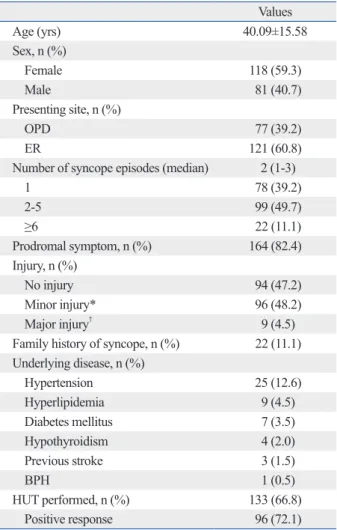
female, 59.3%) with a mean age of 40±15 years (range 16- 77). The median number of syncopal episodes was two (1- 3). One hundred and twenty-one patients (60.8%) had at least one recurrent syncopal episode. In addition, 121 pa- tients (60.8%) visited the emergency room as the initial pre- senting site, and the other patients visited the outpatient de- partment. Prodromal symptoms were frequently observed in 164 patients (82.4%). Specifically, 94 patients (47.2%) had no injury, 96 (48.2%) had a minor injury, and nine pa- tients (4.5%) had a major injury. A family history of synco- pe was noted for 22 patients (11.1%). HUT was performed for 133 (66.8%) patients-of whom 96 (72.1%) showed a positive HUT reponse. Underlying diseases were hyperten- sion (12.6%), hyperlipidemia (4.5%), diabetes mellitus (3.5%), hypothyroidism (2.0%), benign prostate hypertro- phy (0.5%) and previous history of stroke (1.5%).
increased every 3 minutes to achieve an increase of 20%
above the baseline heart rate for 15 minutes. A positive HUT was defined as induction of presyncope or syncope associated with a systemic hypotension (decrease in systol- ic blood pressure ≤80 mm Hg or a fall in systolic blood pressure from a baseline value ≥20 mm Hg) and/or brady- cardia (heart rate <45/min or heart rate <60/min during iso- poterenol infusion).12
Evaluation of anxiety and depression
All patients completed the self-administered Hospital Anxi- ety and Depression Scale (HADS) questionnaire13 of 14 items measuring the severity of current anxiety and depression, which is used extensively in medical settings. The HADS questionnaire consists of two subscales, one that measures anxiety (HADS-A) and another that measures depression (HADS-D). Each subscale is composed of seven items that are individually scored on a four-point scale from 0 to 3.
Scores for each scale range from 0 to 21; higher scores indi- cate greater anxiety and depression. Total scores were divid- ed into three categories: normal (0-7), borderline (8-10) and abnormal (11-21).
Statistical analysis
Data are expressed as the median with an interquartile range or mean with standard deviation. Comparisons between groups were performed with a Student’s t-test for continu- ous variables and a chi-square test for categorical data. To determine the independent predictors for abnormal anxiety and depression according to the HADS, multivariate logis- tic regression analysis was performed. Clinical variables as- sociated with abnormal anxiety and depression with a p≤0.2 in the univariate analysis and could be related with psychi- atric disorders such as syncope related injury, age, family history of syncope, and HUT response were introduced into the multivariate model. Bonferroni correction was used to adjust for multiple comparisons. Values of p<0.05 were considered significant. Statistical analyses were performed with SPSS 18.0 (SPSS Interactive Graphics, Version 18.0, SPSS Inc., Chicago, IL, USA).
RESULTS
Clinical characteristics of study subjects
The clinical baseline characteristics of the study population are in Table 1. The study population was 199 patients (118
Table 1. Baseline Clinical Characteristics of the Study Popu- lation
Values
Age (yrs) 40.09±15.58
Sex, n (%)
Female 118 (59.3)
Male 81 (40.7)
Presenting site, n (%)
OPD 77 (39.2)
ER 121 (60.8)
Number of syncope episodes (median) 2 (1-3)
1 78 (39.2)
2-5 99 (49.7)
≥6 22 (11.1)
Prodromal symptom, n (%) 164 (82.4)
Injury, n (%)
No injury 94 (47.2)
Minor injury* 96 (48.2)
Major injury† 9 (4.5)
Family history of syncope, n (%) 22 (11.1) Underlying disease, n (%)
Hypertension 25 (12.6)
Hyperlipidemia 9 (4.5)
Diabetes mellitus 7 (3.5)
Hypothyroidism 4 (2.0)
Previous stroke 3 (1.5)
BPH 1 (0.5)
HUT performed, n (%) 133 (66.8)
Positive response 96 (72.1)
OPD, outpatient department; ER, emergency room; BPH, benign prostatic hypertrophy; HUT, head up tilt table test.
*Contusion, laceration, bruise.
†Bone fracture, tooth subluxation, brain hemorrhage.
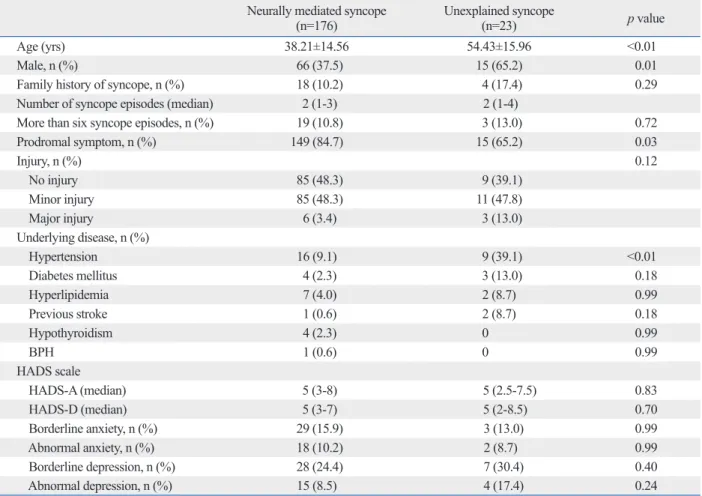
had borderline anxiety, four (17.4%) had an abnormal de- pression score, and seven (30.4%) had borderline depres- sion. The prevalence of abnormal anxiety and depression were not significantly different between the two groups (10.2% vs. 8.7%; p=0.99, 8.5% vs. 17.4%; p=0.24). Com- pared to the general Korean population, in previous stud- ies,14 the prevalence of anxiety (8.9% vs. 10.2% vs. 8.7%;
p=0.70) was not significantly different in patients with NMS and US. However the prevalence of depression was lower in the NMS group than in the general Korean population (8.5% vs. 16.1%; p=0.02).
Clinical factors associated with anxiety
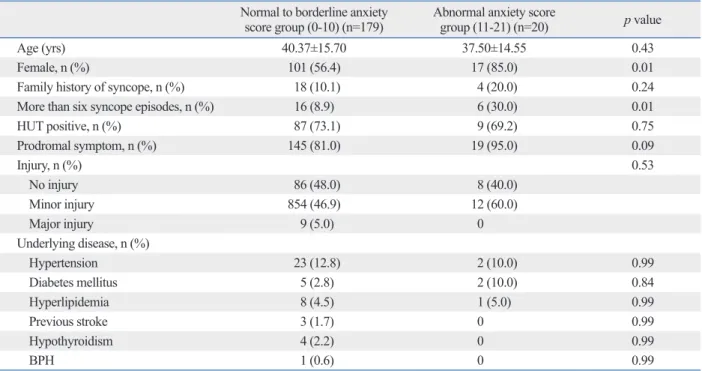
The clinical factors of age, sex, family history of syncope, number of syncope episodes, HUT response, syncope-relat- ed injury, and underlying disease were analyzed between abnormal and normal-to-borderline anxiety groups. Com- pared to the normal-to-borderline group, patients with ab- normal anxiety scores were generally younger, female, more likely to have a family history of syncope, more prodromal symptoms, and had more recurrent episodes of syncope.
Comparison of anxiety and depression between NMS and US
Of the 199 patients in the study population, 176 (88%) were diagnosed with NMS and 23 (12%) were diagnosed with US. Clinical variables and HADS scores in the NMS and US groups are shown in Table 2. Patients with US tended to be older (54±15 vs. 38±14; p<0.01) and male (65% vs. 37.5%; p=0.01). In addition, patients with US had fewer prodromal symptoms (65.2% vs. 84.7%; p=0.03) and a higher prevalence of hypertension (39.1% vs. 9.1%; p<0.01) compared to the NMS group.
The median HADS scores for anxiety and depression were five (3-8) and five (3-7) in the NMS group and five (2.5-7.5) and five (2-8.5) in the US group, respectively. The median HADS scores were not significantly different for anxiety (p=0.83) or depression (p=0.70) between the NMS and US groups. In the NMS group, 18 patients (10.2%) had an abnormal anxiety score, 29 (15.9%) had borderline anxi- ety, 15 (8.5%) had an abnormal depression score, and 28 (24.4%) had borderline depression. In the US group, two pa- tients (8.7%) had an abnormal anxiety score, three (13.0%)
Table 2. Comparison of Clinical Variables in Neurally Mediated and Unexplained Syncope Neurally mediated syncope
(n=176) Unexplained syncope
(n=23) p value
Age (yrs) 38.21±14.56 54.43±15.96 <0.01
Male, n (%) 66 (37.5) 15 (65.2) 0.01
Family history of syncope, n (%) 18 (10.2) 4 (17.4) 0.29
Number of syncope episodes (median) 2 (1-3) 2 (1-4)
More than six syncope episodes, n (%) 19 (10.8) 3 (13.0) 0.72
Prodromal symptom, n (%) 149 (84.7) 15 (65.2) 0.03
Injury, n (%) 0.12
No injury 85 (48.3) 9 (39.1)
Minor injury 85 (48.3) 11 (47.8)
Major injury 6 (3.4) 3 (13.0)
Underlying disease, n (%)
Hypertension 16 (9.1) 9 (39.1) <0.01
Diabetes mellitus 4 (2.3) 3 (13.0) 0.18
Hyperlipidemia 7 (4.0) 2 (8.7) 0.99
Previous stroke 1 (0.6) 2 (8.7) 0.18
Hypothyroidism 4 (2.3) 0 0.99
BPH 1 (0.6) 0 0.99
HADS scale
HADS-A (median) 5 (3-8) 5 (2.5-7.5) 0.83
HADS-D (median) 5 (3-7) 5 (2-8.5) 0.70
Borderline anxiety, n (%) 29 (15.9) 3 (13.0) 0.99
Abnormal anxiety, n (%) 18 (10.2) 2 (8.7) 0.99
Borderline depression, n (%) 28 (24.4) 7 (30.4) 0.40
Abnormal depression, n (%) 15 (8.5) 4 (17.4) 0.24
BPH, benign prostatic hypertrophy; HADS-A, Hospital Anxiety and Depression Scale-Anxiety; HADS-D, Hospital Anxiety and Depression Scale-Depression.
DISCUSSION
This study revealed that the prevalence of abnormal anxiety and depression measured using HADS were 10.2% and 8.5% for NMS and 8.7% and 17.4% for US, respectively.
The prevalence of abnormal anxiety and depression were not significantly different between these groups. Only a his- tory of more than six recurrent syncopal episodes was sig- nificantly associated with an abnormal anxiety score. A positive HUT response was inversely associated with an abnormal depression score.
When we compared the patients’ HADS scores to the general Korean population of 500 men and 500 women
≥20 years of age from a previous study,14 we found that syncopal patients had a similar prevalence of anxiety to the general Korean population. Additionaly, we found a lower Significant clinical factors associated with abnormal anxiety
were being female (85% vs. 56.4%; p=0.01) and more than six recurrent syncopal episodes (30% vs. 8.9%; p=0.01) in univariate analysis (Table 3). Furthermore, a history of more than six recurrent syncopal episodes (OR=20.26, CI: 1.4- 291.6, p=0.01) was a clinical factor associated with abnormal anxiety by multiple logistic regression analysis (Table 4).
Clinical factors associated with depression
Patients with abnormal depression scores were typically women with a greater family history of syncope, more pro- dromal symptoms, and decreased positive HUT response compared with the normal-to-borderline group. However, these clinical factors were not significant (Table 5). In the multivariate analysis, positive HUT response (OR=0.25, CI: 0.07-0.89, p=0.03) was inversely associated with the abnormal depression score (Table 6).
Table 3. Comparison of Clinical Factors between Normal-to-Borderline and Abnormal-Anxiety Groups (HADS-A) Normal to borderline anxiety
score group (0-10) (n=179) Abnormal anxiety score
group (11-21) (n=20) p value
Age (yrs) 40.37±15.70 37.50±14.55 0.43
Female, n (%) 101 (56.4) 17 (85.0) 0.01
Family history of syncope, n (%) 18 (10.1) 4 (20.0) 0.24
More than six syncope episodes, n (%) 16 (8.9) 6 (30.0) 0.01
HUT positive, n (%) 87 (73.1) 9 (69.2) 0.75
Prodromal symptom, n (%) 145 (81.0) 19 (95.0) 0.09
Injury, n (%) 0.53
No injury 86 (48.0) 8 (40.0)
Minor injury 854 (46.9) 12 (60.0)
Major injury 9 (5.0) 0
Underlying disease, n (%)
Hypertension 23 (12.8) 2 (10.0) 0.99
Diabetes mellitus 5 (2.8) 2 (10.0) 0.84
Hyperlipidemia 8 (4.5) 1 (5.0) 0.99
Previous stroke 3 (1.7) 0 0.99
Hypothyroidism 4 (2.2) 0 0.99
BPH 1 (0.6) 0 0.99
HUT, head up tilt table test; BPH, benign prostatic hypertrophy.
Table 4. Multiple Logistic Regression Analysis for Predicting Abnormal Anxiety
Odds ratio 95% confidence interval p value
Age 0.98 0.93-1.03 0.54
Female 3.94 0.66-23.37 0.13
Prodromal symptoms 1.48 0.10-21.53 0.77
More than six syncope episodes 20.26 1.40-291.64 0.01
HUT positive 0.74 0.16-3.36 0.70
Family history of syncope 2.90 0.61-13.64 0.17
Injury 1.28 0.34-4.85 0.70
HUT, head up tilt table test.
spond to previous studies reporting that anxiety might be associated with recurrent VVS and US,5,6,8,16,17 a psychiatric factor frequently reported in females6,15,18 and a risk factor for syncopal recurrence in US8 and VVS.7 Nevertheless, whether anxiety was a cause or consequence of recurrent syncope is unclear. We noted that anxiety of episode antici- pation was increased in patients with recurrent syncope, and hypothesized that this anxiety might be the cause of in- creased sympathetic tone through enhancement of catechol- amine release and direct central nervous system modulation,5 thereby triggering an excessive parasympathetic response as- sociated with bradycardia and inappropriate reflex vasodi- lation. This mechanism could explain how anxiety causes recurrent syncope, and vice versa. Thus, relief of anxiety might be a supportive treatment modality for this cycle.18
This study has several limitations. First, the degree of anx- iety and depression measured by HADS might not reflect prevalence of depression in the NMS group compared with
the general population, for whom abnormal anxiety oc- curred in 8.9% and depression was seen in 16.1%. These findings are contrary to the results of previous studies that found that the prevalence of psychiatric disease is higher than average in patients with either recurrent US8,9,15 or VVS.7 This difference might be due to the fact that the me- dian number of syncopal episodes in our study was only two, syncope-related major injury was not frequently ob- served, patients acknowledged their episodes of syncope as benign. This could be because education regarding aware- ness and possible avoidance of trigger and knowledge of maneuvers such as supine positioning at early recognition of prodromal symptoms were often successful.
Our results showed that female gender and a history of more than six syncopal episodes might be closely related to greater anxiety, by subgroup analysis. These results corre-
Table 5. Comparison of Clinical Factors between Normal-to-Borderline and Abnormal Depression Score Groups (HADS-D) Normal to borderline depression
score group (0-10) (n=180) Abnormal depression score
group (11-21) (n=19) p value
Age (yrs) 40.17±15.54 39.26±16.36 0.81
Female, n (%) 104 (57.8) 14 (73.7) 0.18
Family history of syncope, n (%) 19 (10.6) 3 (15.8) 0.44
More than six episodes of syncope, n (%) 20 (11.1) 2 (10.5) 0.99
HUT positive, n (%) 89 (75.40) 7 (50.0) 0.05
Prodromal symptom, n (%) 146 (81.1) 18 (94.7) 0.20
Injury, n (%) 0.63
No injury 86 (47.8) 8 (42.1)
Minor injury 85 (47.2) 11 (57.9)
Major injury 9 (5.0) 0
Underlying disease, n (%)
Hypertension 23 (12.8) 2 (10.5) 0.99
Diabetes mellitus 6 (3.3) 1 (5.3) 0.99
Hyperlipidemia 9 (5.0) 0 0.99
Previous stroke 3 (1.7) 0 0.99
Hypothyroidism 4 (2.2) 0 0.99
BPH 1 (0.6) 0 0.99
HUT, head up tilt table test; BPH, benign prostatic hypertrophy.
Table 6. Multiple Logistic Regression Analysis for Predicting Abnormal Depression
Odds ratio 95% confidence interval p value
Age 0.98 0.94-1.03 0.59
Female 1.47 0.40-5.41 0.55
Prodromal symptom 4.40 0.44-43.17 0.20
More than six syncope episodes 0.88 0.12-6.12 0.90
HUT positive 0.25 0.07-0.89 0.03
Family history of syncope 1.53 0.33-7.09 0.58
Injury 2.06 0.59-7.21 0.25
HUT, head up tilt table test.
Muhlen F. An association between anxiety and neurocardiogenic syncope during head-up tilt table testing. Pacing Clin Electro- physiol 2000;23:837-41.
6. D’Antono B, Dupuis G, St-Jean K, Lévesque K, Nadeau R, Guer- ra P, et al. Prospective evaluation of psychological distress and psychiatric morbidity in recurrent vasovagal and unexplained syn- cope. J Psychosom Res 2009;67:213-22.
7. Giada F, Silvestri I, Rossillo A, Nicotera PG, Manzillo GF, Ra- viele A. Psychiatric profile, quality of life and risk of syncopal re- currence in patients with tilt-induced vasovagal syncope. Euro- pace 2005;7:465-71.
8. Kouakam C, Lacroix D, Klug D, Baux P, Marquié C, Kacet S.
Prevalence and prognostic significance of psychiatric disorders in patients evaluated for recurrent unexplained syncope. Am J Cardi- ol 2002;89:530-5.
9. Ventura R, Maas R, Rüppel R, Stuhr U, Schuchert A, Meinertz T, et al. Psychiatric conditions in patients with recurrent unexplained syncope. Europace 2001;3:311-6.
10. Flint B, Baker C, Freeston M, Newton JL. Level of psychosocial impairment predicts early response to treatment in vasovagal syn- cope. Europace 2009;11:231-6.
11. Task Force for the Diagnosis and Management of Syncope; Euro- pean Society of Cardiology (ESC); European Heart Rhythm As- sociation (EHRA); Heart Failure Association (HFA); Heart Rhythm Society (HRS), Moya A, Sutton R, Ammirati F, Blanc JJ, Brignole M, Dahm JB, et al. Guidelines for the diagnosis and management of syncope (version 2009). Eur Heart J 2009;30:
2631-71.
12. Brignole M, Menozzi C, Gianfranchi L, Oddone D, Lolli G, Ber- tulla A. Carotid sinus massage, eyeball compression, and head-up tilt test in patients with syncope of uncertain origin and in healthy control subjects. Am Heart J 1991;122:1644-51.
13. Zigmond AS, Snaith RP. The hospital anxiety and depression scale. Acta Psychiatr Scand 1983;67:361-70.
14. Yun YH, Kim SH, Lee KM, Park SM, Kim YM. Age, sex, and comorbidities were considered in comparing reference data for health-related quality of life in the general and cancer populations.
J Clin Epidemiol 2007;60:1164-75.
15. Kapoor WN, Fortunato M, Hanusa BH, Schulberg HC. Psychiat- ric illnesses in patients with syncope. Am J Med 1995;99:505-12.
16. Gracie J, Newton JL, Norton M, Baker C, Freeston M. The role of psychological factors in response to treatment in neurocardiogenic (vasovagal) syncope. Europace 2006;8:636-43.
17. Linzer M, Varia I, Pontinen M, Divine GW, Grubb BP, Estes NA 3rd. Medically unexplained syncope: relationship to psychiatric illness. Am J Med 1992;92:18S-25S.
18. Linzer M, Felder A, Hackel A, Perry AJ, Varia I, Melville ML, et al. Psychiatric syncope: a new look at an old disease. Psychoso- matics 1990;31:181-8.
19. Runkewitz K, Kirchmann H, Strauss B. Anxiety and depression in primary care patients: predictors of symptom severity and devel- opmental correlates. J Psychosom Res 2006;60:445-53.
the incidence of clinical anxiety and depression. Although numerous studies have used HADS questionnaires to deter- mine the prevalence of anxiety and depression,10,14,16,19 wheth- er this diagnostic tool is reliable and accurate for measuring actual anxiety and depression remains uncertain. Second, the control group was not extracted from our study popula- tion. The control group was adapted from cases published in previous studies, and was used to compare reference data in general and cancerous populations.14 Finally, we focused on the influence of anxiety and depression in our study, however other psychiatric disorders related to syncope in- cluding panic disorder, mood disorder, and somatization were not considered.
In conclusion, the prevalence of anxiety and depression were not different for NMS and for US. However, anxiety was associated with frequent syncopal episodes. Thus, the addition of anxiety management in syncope patients could be beneficial in preventing future syncope episodes.
ACKNOWLEDGEMENTS
This study was supported by a grant from the Samsung Medical Center Clinical Research Development Program, # CRS-109-35-2.
REFERENCES
1. Savage DD, Corwin L, McGee DL, Kannel WB, Wolf PA. Epide- miologic features of isolated syncope: the Framingham Study.
Stroke 1985;16:626-9.
2. Ganzeboom KS, Mairuhu G, Reitsma JB, Linzer M, Wieling W, van Dijk N. Lifetime cumulative incidence of syncope in the gen- eral population: a study of 549 Dutch subjects aged 35-60 years. J Cardiovasc Electrophysiol 2006;17:1172-6.
3. Linzer M, Pontinen M, Gold DT, Divine GW, Felder A, Brooks WB. Impairment of physical and psychosocial function in recur- rent syncope. J Clin Epidemiol 1991;44:1037-43.
4. McGrady A, Kern-Buell C, Bush E, Khuder S, Grubb BP. Psycho- logical and physiological factors associated with tilt table testing for neurally mediated syncopal syndromes. Pacing Clin Electro- physiol 2001;24:296-301.
5. Cohen TJ, Thayapran N, Ibrahim B, Quan C, Quan W, von zur