Received January 13, 2017, Revised April 13, 2017, Accepted for publication May 10, 2017
Corresponding author: Kyu Han Kim, Department of Dermatology, Seoul National University Hospital, 101 Daehak-ro, Jongno-gu, Seoul 03080, Korea. Tel: 82-2-2072-2417, Fax: 82-2-742-7344, E-mail: kyuhkim@snu.
ac.kr
This is an Open Access article distributed under the terms of the Creative Commons Attribution Non-Commercial License (http://creativecommons.
org/licenses/by-nc/4.0) which permits unrestricted non-commercial use, distribution, and reproduction in any medium, provided the original work is properly cited.
Copyright © The Korean Dermatological Association and The Korean Society for Investigative Dermatology
Ann Dermatol Vol. 30, No. 1, 2018 https://doi.org/10.5021/ad.2018.30.1.20
ORIGINAL ARTICLE
The Prevalence and Risk Factors of Atopic Dermatitis and Clinical Characteristics according to Disease Onset in 19-Year-Old Korean Male Subjects
In Ho Kwon, Chong Hyun Won1, Dong Hun Lee2, Shin Woo Kim2, Gyeong Hun Park3, Sung Jun Seo4, Chun Wook Park3, Jin Wou Kim5, Kyu Han Kim2
PHD Dermatology Clinic, Seoul, 1Department of Dermatology, University of Ulsan College of Medicine, Ulsan, 2Department of Dermatology, Seoul National University College of Medicine and Institute of Human-Environment Interface Biology, Seoul National University Medical Research Center, Laboratory of Cutaneous Aging and Hair Research, Biomedical Research Institute, Seoul National University Hospital, Seoul, 3Department of Dermatology, Hallym University College of Medicine, Chuncheon, 4Department of
Dermatology, Chung-Ang University College of Medicine, 5Department of Dermatology, College of Medicine, The Catholic University of Korea, Seoul, Korea
Background: The natural course of atopic dermatitis (AD) in infancy, childhood, and adolescence is not yet completely known. Objective: To investigate the prevalence and risk factors of atopic dermatits among 19-year-old Korean male subjects. Methods: All 19-year-old Korean males must un- dergo medical examination for conscription. We precisely evaluated the prevalence of AD in three Korean provinces us- ing the information from this physical checkup. AD was diag- nosed by experienced dermatologists according to the Hanifin and Rajka criteria. The disease severity was assessed by the scoring of atopic dermatitis (SCORAD) index. In order to investigate the risk factors for AD, a questionnaire was ad- ministered to all subjects regarding parental atopic history, geographical characteristics of past habitation, past econom- ic status, number of siblings, parental occupation, etc.
Results: The point prevalence in the Korean provinces ranged from 1.15% to 1.44%. In multivariable analysis, a
parental history of AD was a significant risk factor in all 3 disease-onset groups (infancy, childhood, and adolescent onset). In the infancy-onset group, low economic status was also a significant risk factor for AD. The SCORAD index was significantly higher in AD subjects with early onset and those living in small-sized habitations. Moreover, erythema, ede- ma, lichenification, dryness of skin, and sleep loss appeared to be more severe in early-onset cases. Conclusion: The younger the age of disease onset, the more severe the clinical outcomes in 19-year-old male subjects. In addition, active AD treatment at younger ages might affect the prevalence and the severity of AD in adulthood. (Ann Dermatol 30(1) 20
∼28, 2018) -Keywords-
Adolescent, Atopic dermatitis, Prevalence, Risk factors
INTRODUCTION
The natural course of atopic dermatitis (AD) has not yet been completely described. Few studies have been con- ducted on the changing features of AD clinical character- istics through the adolescence and adulthood, or the final prognosis of AD with onset in infancy and childhood1,2. At the same time, few studies have investigated the epi- demiological characteristics of AD in adulthood. When the prevalence of AD has been reported, the method used by the survey of the International Study of Asthma and
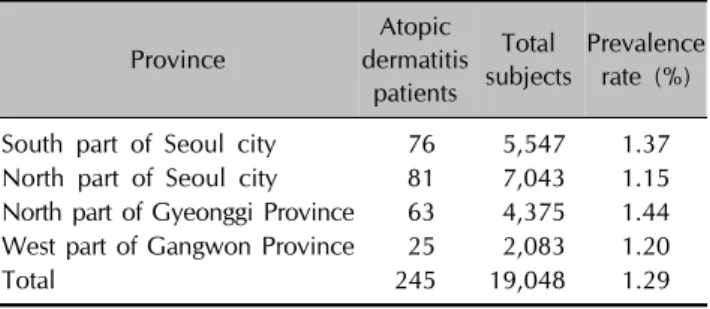
Table 1. Prevalence rates in each province of atopic dermatitis in the 19-year-old Korean male subjects
Province
Atopic dermatitis
patients
Total subjects
Prevalence rate (%)
South part of Seoul city 76 5,547 1.37 North part of Seoul city 81 7,043 1.15 North part of Gyeonggi Province 63 4,375 1.44 West part of Gangwon Province 25 2,083 1.20
Total 245 19,048 1.29
Allergies in Childhood (ISSAC) is commonly adopted3-5. However, a direct skin examination of large numbers of people by doctors, especially dermatologists, is rarely per- formed. Furthermore, some studies concerning the preva- lence of AD found in the literature do not include a sam- ple size sufficient to accurately estimate the real prevalence.
Few studies have been performed on the factors that could influence the prevalence of AD and its clinical severity during adolescence and adulthood6,7. One of the reasons is that the wide range of ages of the subjects makes it diffi- cult to find a matching control group. In Korea, in accord- ance with the conscription system, all 19-year-old male in- dividuals are mandated to receive a physical and medical examination in the local Military Manpower Administration (MMA). Medical specialists from all medical departments including dermatologists take part in the examination, and every examinee undergoes a thorough skin inspection.
Therefore, it is possible to precisely diagnose AD by using the Hanifin and Rajka criteria during the inspection course.
Moreover, many normal control subjects are available, providing the ability to matching AD and control groups.
Using this data system, we investigated the point preva- lence of AD in a cohort of 19-year-old Korean men. In ad- dition, we investigated the risk factors for AD in these study subjects by comparison with a normal control po- pulation. The disease severity in each subject diagnosed with AD was individually assessed by experienced derma- tologists in accordance with the severity scoring of atopic dermatitis (SCORAD) index. We also analyzed the factors that influence the clinical severity of AD and the differ- ences in its clinical characteristics according to the age of onset.
MATERIALS AND METHODS
Subject recruitment
Korean male subjects of 19-year of age who were required to undergo a medical examination within the conscription system were included in this study. About 400,000 boys
were born in Korea in 1989 and underwent the con- scription examination on different dates throughout 2008 at a local provincial MMA. We enrolled the young men who visited the following four MMAs from June to October 2008: Seoul North Province and Seoul South Province, Gyeonggi-do North Province (located in Ui- jeongbu) and Gangwon-do West Province (located in Chuncheon). A total population of 19,048 subjects was in- cluded in this study. In the course of the physical and medical examinations at the MMAs, the dermatologists performed a detailed skin examination and collected the relevant histories. Subsequently, the criteria of Hanifin and Rajika8 were used to diagnose AD.
Diagnosis of AD, data collection, and physical exami- nation
To assess the risk factors for AD, two control subjects were selected for each AD patient from the same day of examination (a 1:2 matching) at each MMA. A survey of the various risk factors for AD was conducted for both the patient and the control group including age of onset, pa- rental history of AD, asthma, and allergic rhinitis, pop- ulation of residential region, housing type, economic sta- tus, number of siblings, family size, parental educational status and professions. Moreover, the body mass index (BMI), calculated by using heights and weights measured during the physical examination, was also collected with the above risk factors.
For the purposes of our current analyses, it was most prac- tical to select subjects who underwent their MMA exami- nations on a single day between June and October 2008, making it not possible to apply a period prevalence rate.
Instead, the point prevalence was used as follows:
Pt=Ct÷Nt×100 (%)
where Pt represents the prevalence rate of t-point, Ct is the number of patients diagnosed with AD, Nt is the total sub- jects in the study at t-point, which is also the total number of 19-year-old male subjects who received the examina- tion from June to October. In addition, the AD prevalence values from the four different MMAs were compared using the chi-square test for homogeneity.
After diagnosing AD during the physical examination, the dermatologists estimated its clinical severity using the SCORAD index to measure the extent of AD as a percent- age (0%∼100%). These clinicians also calculated and re- corded the intensity score (0∼18 points) by evaluating the following items: erythema (0∼3 points), edema (0∼3 points), oozing (0∼3 points), excoriation (0∼3 points), li- chenification (0∼3 points), and dryness of uninvolved
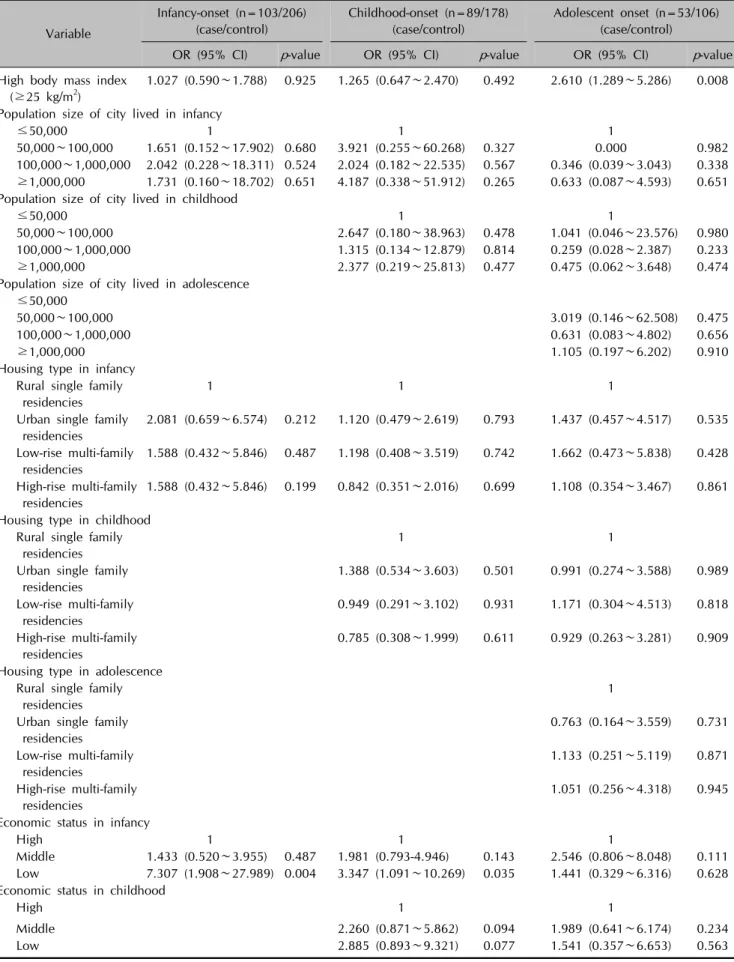
Table 2. Univariate conditional logistic regression analysis of the risk factors for AD in the 19-year-old Korean male study subjects
Variable
Infancy-onset (n=103/206) (case/control)
Childhood-onset (n=89/178) (case/control)
Adolescent onset (n=53/106) (case/control)
OR (95% CI) p-value OR (95% CI) p-value OR (95% CI) p-value High body mass index
(≥25 kg/m2)
1.027 (0.590∼1.788) 0.925 1.265 (0.647∼2.470) 0.492 2.610 (1.289∼5.286) 0.008
Population size of city lived in infancy
≤50,000 1 1 1
50,000∼100,000 1.651 (0.152∼17.902) 0.680 3.921 (0.255∼60.268) 0.327 0.000 0.982 100,000∼1,000,000 2.042 (0.228∼18.311) 0.524 2.024 (0.182∼22.535) 0.567 0.346 (0.039∼3.043) 0.338 ≥1,000,000 1.731 (0.160∼18.702) 0.651 4.187 (0.338∼51.912) 0.265 0.633 (0.087∼4.593) 0.651 Population size of city lived in childhood
≤50,000 1 1
50,000∼100,000 2.647 (0.180∼38.963) 0.478 1.041 (0.046∼23.576) 0.980
100,000∼1,000,000 1.315 (0.134∼12.879) 0.814 0.259 (0.028∼2.387) 0.233
≥1,000,000 2.377 (0.219∼25.813) 0.477 0.475 (0.062∼3.648) 0.474
Population size of city lived in adolescence ≤50,000
50,000∼100,000 3.019 (0.146∼62.508) 0.475
100,000∼1,000,000 0.631 (0.083∼4.802) 0.656
≥1,000,000 1.105 (0.197∼6.202) 0.910
Housing type in infancy Rural single family residencies
1 1 1
Urban single family residencies
2.081 (0.659∼6.574) 0.212 1.120 (0.479∼2.619) 0.793 1.437 (0.457∼4.517) 0.535
Low-rise multi-family residencies
1.588 (0.432∼5.846) 0.487 1.198 (0.408∼3.519) 0.742 1.662 (0.473∼5.838) 0.428
High-rise multi-family residencies
1.588 (0.432∼5.846) 0.199 0.842 (0.351∼2.016) 0.699 1.108 (0.354∼3.467) 0.861
Housing type in childhood Rural single family residencies
1 1
Urban single family residencies
1.388 (0.534∼3.603) 0.501 0.991 (0.274∼3.588) 0.989
Low-rise multi-family residencies
0.949 (0.291∼3.102) 0.931 1.171 (0.304∼4.513) 0.818
High-rise multi-family residencies
0.785 (0.308∼1.999) 0.611 0.929 (0.263∼3.281) 0.909
Housing type in adolescence Rural single family residencies
1
Urban single family residencies
0.763 (0.164∼3.559) 0.731
Low-rise multi-family residencies
1.133 (0.251∼5.119) 0.871
High-rise multi-family residencies
1.051 (0.256∼4.318) 0.945
Economic status in infancy
High 1 1 1
Middle 1.433 (0.520∼3.955) 0.487 1.981 (0.793-4.946) 0.143 2.546 (0.806∼8.048) 0.111 Low 7.307 (1.908∼27.989) 0.004 3.347 (1.091∼10.269) 0.035 1.441 (0.329∼6.316) 0.628 Economic status in childhood
High 1 1
Middle 2.260 (0.871∼5.862) 0.094 1.989 (0.641∼6.174) 0.234
Low 2.885 (0.893∼9.321) 0.077 1.541 (0.357∼6.653) 0.563
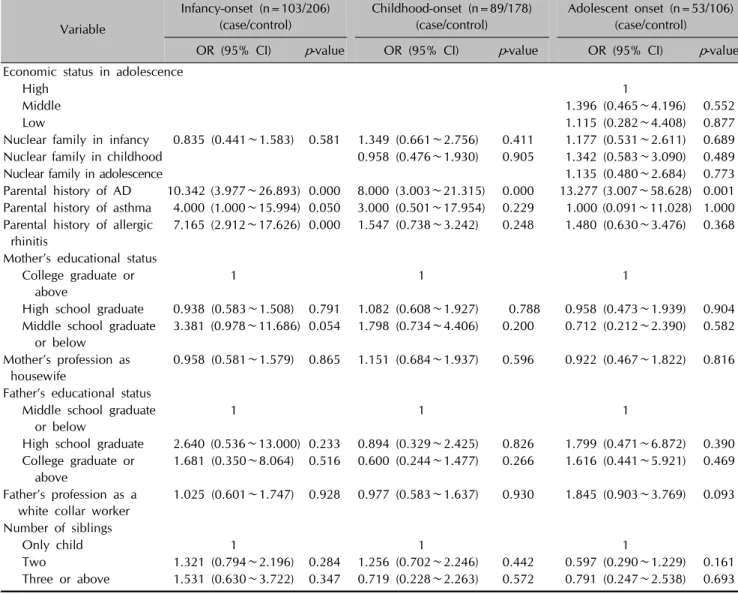
Table 2. Continued
Variable
Infancy-onset (n=103/206) (case/control)
Childhood-onset (n=89/178) (case/control)
Adolescent onset (n=53/106) (case/control)
OR (95% CI) p-value OR (95% CI) p-value OR (95% CI) p-value Economic status in adolescence
High 1
Middle 1.396 (0.465∼4.196) 0.552
Low 1.115 (0.282∼4.408) 0.877
Nuclear family in infancy 0.835 (0.441∼1.583) 0.581 1.349 (0.661∼2.756) 0.411 1.177 (0.531∼2.611) 0.689
Nuclear family in childhood 0.958 (0.476∼1.930) 0.905 1.342 (0.583∼3.090) 0.489
Nuclear family in adolescence 1.135 (0.480∼2.684) 0.773
Parental history of AD 10.342 (3.977∼26.893) 0.000 8.000 (3.003∼21.315) 0.000 13.277 (3.007∼58.628) 0.001 Parental history of asthma 4.000 (1.000∼15.994) 0.050 3.000 (0.501∼17.954) 0.229 1.000 (0.091∼11.028) 1.000 Parental history of allergic
rhinitis
7.165 (2.912∼17.626) 0.000 1.547 (0.738∼3.242) 0.248 1.480 (0.630∼3.476) 0.368
Mother’s educational status College graduate or above
1 1 1
High school graduate 0.938 (0.583∼1.508) 0.791 1.082 (0.608∼1.927) 0.788 0.958 (0.473∼1.939) 0.904 Middle school graduate
or below
3.381 (0.978∼11.686) 0.054 1.798 (0.734∼4.406) 0.200 0.712 (0.212∼2.390) 0.582
Mother’s profession as housewife
0.958 (0.581∼1.579) 0.865 1.151 (0.684∼1.937) 0.596 0.922 (0.467∼1.822) 0.816
Father’s educational status Middle school graduate or below
1 1 1
High school graduate 2.640 (0.536∼13.000) 0.233 0.894 (0.329∼2.425) 0.826 1.799 (0.471∼6.872) 0.390 College graduate or
above
1.681 (0.350∼8.064) 0.516 0.600 (0.244∼1.477) 0.266 1.616 (0.441∼5.921) 0.469
Father’s profession as a white collar worker
1.025 (0.601∼1.747) 0.928 0.977 (0.583∼1.637) 0.930 1.845 (0.903∼3.769) 0.093
Number of siblings
Only child 1 1 1
Two 1.321 (0.794∼2.196) 0.284 1.256 (0.702∼2.246) 0.442 0.597 (0.290∼1.229) 0.161 Three or above 1.531 (0.630∼3.722) 0.347 0.719 (0.228∼2.263) 0.572 0.791 (0.247∼2.538) 0.693 AD: atopic dermatitis, OR: odds ratio, CI: confidence interval.
skin (0∼3 points). The subjective symptoms of the pa- tients were also recorded with intensity scores: pruritus (0∼
10) and sleep loss (0∼10). The SCORAD index (0∼103 points) was calculated as follows:
SCORAD index=A/5+7B/2+C (A=total body surface area involved in %, B=intensity score, C=subjective symp- toms score)
Moreover, the objective findings of the skin lesions as well as the subjective symptoms reported by the subjects were recorded.
Statistical analysis
Statistical analyses were performed to investigate the fac- tors affecting the clinical characteristics. First, univariable
conditional logistic regression analysis of the risk factors for AD was conducted. Second, multivariable conditional logistic regression analysis was conducted to adjust for any confounding effects among the various factors. To identify factors affecting AD clinical manifestations, the correlation between disease severity and different varia- bles was estimated by multiple linear regression analysis.
The eight factors composing the SCORAD index were an- alyzed by one-way analysis of variance (ANOVA) to iden- tify significant differences according to the age of AD on- set (infancy-, childhood-, or adolescent onset).
This study was conducted in accordance with the ethical principles of the Declaration of Helsinki (2008). The study protocol was approved by the institutional review board of Seoul National University Hospital (IRB no. 0807-064- 251). Statistical analysis was performed using the PASW
Table 3. Multivariate conditional logistic regression analyses of the risk factors for AD in the 19-year-old Korean male study subjects
Variable OR (95% CI) p-value
Infancy-onset (n=103/206) (case/control) Economic status (0∼2 yr)
High 1
Middle 1.285 (0.423∼3.903) 0.658
Low 5.789 (1.357∼24.704) 0.018
Parental history of AD 6.967 (2.551∼19.030) <0.001
Parental history of allergic rhinitis 5.326 (1.996∼14.209) <0.001
Childhood-onset (n=89/178) (case/control)
Parental history of AD 8.000 (3.003∼21.315) <0.0001
Adolescent onset (n=53/106) (case/control)
Parental history of AD 13.277 (3.007∼58.628) 0.001
AD: atopic dermatitis, OR: odds ratio, CI: confidence interval. Multivariate conditional logistic regression analysis with forward conditional variable selection was performed with p<0.05 as the criterion for model inclusion using PASW Statistics ver. 18.0 software.
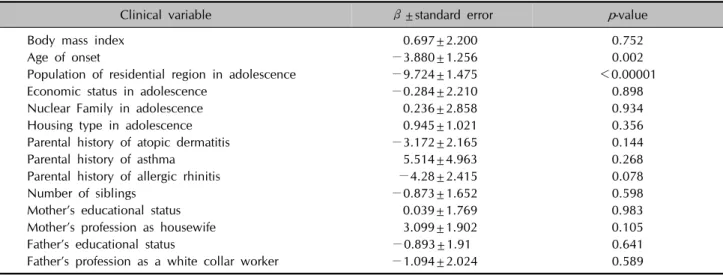
Table 4. Association of the severity scoring of atopic dermatitis index with clinical variables by multiple linear regression analysis
Clinical variable β±standard error p-value
Body mass index 0.697±2.200 0.752
Age of onset −3.880±1.256 0.002
Population of residential region in adolescence −9.724±1.475 <0.00001
Economic status in adolescence −0.284±2.210 0.898
Nuclear Family in adolescence 0.236±2.858 0.934
Housing type in adolescence 0.945±1.021 0.356
Parental history of atopic dermatitis −3.172±2.165 0.144
Parental history of asthma 5.514±4.963 0.268
Parental history of allergic rhinitis −4.28±2.415 0.078
Number of siblings −0.873±1.652 0.598
Mother’s educational status 0.039±1.769 0.983
Mother’s profession as housewife 3.099±1.902 0.105
Father’s educational status −0.893±1.91 0.641
Father’s profession as a white collar worker −1.094±2.024 0.589
Statistics ver. 18.0 (IBM Co., Armonk, NY, USA). A p-value<
0.05 was considered statistically significant.
RESULTS
Prevalence rate of AD in 19-year-old Korean male subjects
The point prevalence rates in each province ranged from 1.15% to 1.44%, as indicated in Table 1. The average prevalence in the four provinces was 1.29%; 245 exam- inees out of 19,048 19-year-old male subjects were diag- nosed with AD according to the Hanifin and Raijka criteria. The chi-square test did not show any statistically significant difference (p=0.519) between the prevalence rates in each province.
Risk factors for AD
The results of our univariate analysis of the risk factors for
AD are presented in Table 2. The significant risk factors in- cluded a low economic status in infancy, parental history of AD, and allergic rhinitis in the infancy-onset group, low economic status in infancy and parental AD history in the childhood-onset group, and BMI ≥25 kg/m2 and parental AD history in the adolescent onset group.
The results of our multivariate analysis are presented in Table 3. In all the three disease-onset groups, the parental AD history was a significant risk factor for AD in 19-year-old male subjects (p<0.001, p<0.0001, and p=0.001 for the infancy-, childhood-, and adolescent onset group, respec- tively). In addition, a low economic status (p=0.018) was a significant risk factor in the infancy-onset group.
Factors affecting the clinical severity of AD
Table 4 presents our analysis of the factors affecting the clinical severity (SCORAD index) of AD in the study subjects. The SCORAD index was progressively higher in
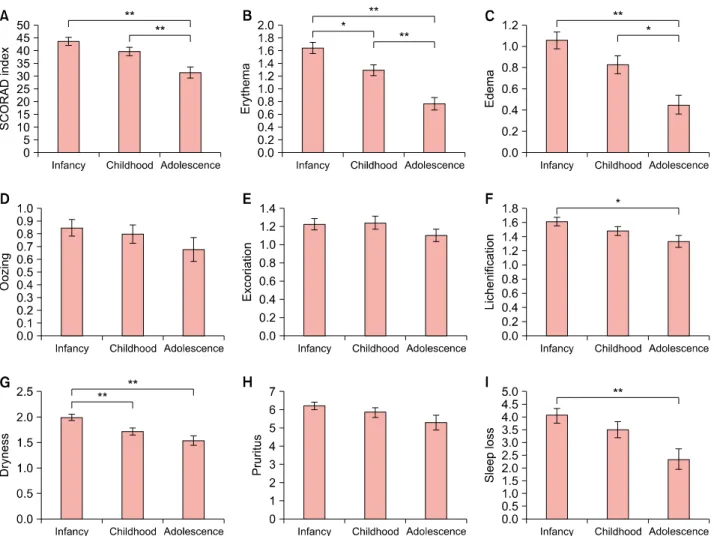
Fig. 1. Comparison of the severity of clinical manifestations according to the age of onset in patients with atopic dermatitis (AD), using analysis of variance (ANOVA). (A) Severity scoring of atopic dermatitis (SCORAD) index, (B) erythema, (C) edema, (D) oozing, (E) excoriation, (F) lichenification, (G) dryness, (H) pruritus, (I) sleep loss. *p<0.05, **p<0.01.
the groups with an earlier disease onset (adolescence
<childhood<infancy, p=0.002), and in those with smaller habitation size during adolescence (from above 1,000,000 to under 50,000), implying that the clinical severity of AD was higher in these groups (p<0.00001).
Differences in the clinical characteristics of the AD patients in the study series according to the age of disease onset
Fig. 1. presents the one-way ANOVA results for the SCORAD index and for each individual factor included in this index according to the age of disease onset. The over- all SCORAD index and the individual symptoms of eryth- ema, edema, lichenification, dryness of skin, and sleep loss were progressively more severe in the disease-onset groups from adolescence to infancy, and these differences were statistically significant (p<0.05 or p<0.01).
DISCUSSION
The point prevalence of adulthood AD is known to range from 1% to 3%, yet few real epidemiological studies of this disease can be found in the literature9-12. In our cur- rent study, the prevalence rates in adults over 19 years old were relatively similar to the 1%∼3% rates described previously. The National Health Insurance Corporation in Korea analyzed a large body of national statistical data in this regard in 2008 and reported a prevalence rate in 18-year-old male subjects of 1.9%10. The AD prevalence in our present study was lower than that in the afore- mentioned analyses because we measured the point-prev- alence instead of 1-year period prevalence. Moreover, it can be speculated that the low AD prevalence estimated in our present study (1.15% to 1.44%) could be attributed to the study design where the dermatologists involved in our series screened for AD directly and calculated the
prevalence rate on the basis of the Hanifin and Rajka criteria. We are thus convinced that our study gives an ac- curate estimate of the actual AD prevalence in young Korean men. In addition, as we included a large number of subjects without many factors that could potentially lead to selection bias, we are confident that our study pop- ulation is very representative of the actual male adolescent population in Korea.
In Korea from 1994 to 1995, some dermatologists tried to investigate the real prevalence of AD in infancy by analyz- ing the history of 6∼8-year-old subjects on the basis of the Hanifin and Rajka criteria. They reported prevalence rates of AD in the Seoul and Chuncheon areas of 17.5%±2.9% and 9.6%±2.6%, respectively, which re- ferred to patients born in 1989, i.e., close in age to the subjects of our current study9. Taken together, the results of that earlier study and our present analysis could help to reconstruct the natural course of AD: the prevalence rates in individuals born in 1989 in Seoul and Chuncheon was 17.5% and 9.6%, respectively, at the age of 6, but drop- ped to around 1% at the age of 19. In addition, the preva- lence rates at 6∼8 years of age were significantly different between Seoul (urban area) and Chuncheon (rural area) in the previous study, yet were not significant among North Seoul, South Seoul, and West Gangwon-do (Chuncheon) in our present analyses. This discrepancy suggests that dif- ferences between urban and rural areas affect the AD prevalence in infancy and childhood, whereas these differ- ences might decrease during adulthood.
The strength of our present epidemiological study on AD prevalence is that dermatologists directly took part in the physical examination of a large sampling group of 19,048 individuals. Our very large sample size of individuals of the same age and sex greatly increased the accuracy of our prevalence rate calculations when compared with pre- vious reports that used the ISSAC survey and also ensured that our study population was highly representative. An additional strength of our current study is that experienced dermatologists evaluated all the subjects according to the SCORAD index.
Another merit of our current case-controlled study was our ability to closely match subjects of the same age and sex.
In order to reduce socio-economic differences, which can vary between provinces, the control group was selected via a 1:2 matching in the same MMA on the same day when the corresponding AD patient was diagnosed. More- over, given that housing type, size of habitation, and eco- nomic status would not be consistent during 19 years of life, the collection of these various factors was stratified by infancy, childhood, and adolescence. Therefore, in the childhood-onset group, the various factors present in in-
fancy and childhood were used for the analysis, whereas in cases of adolescent onset disease, the factors were tak- en into account separately in each life period.
Peters et al.7 aimed in their previous study to describe the course of AD over puberty and prospectively determine the risk factors for the incidence, recurrence, and persis- tence of AD until adolescence in a population-based co- hort study. The significant predictors of AD course in that study were found to be a high socioeconomic status, fe- male sex, asthma symptoms, positive skin prick test re- sponse at baseline, parental history of rhinitis/AD, and having worked in a high-risk job. Although it is difficult to directly compare that study with our current analyses be- cause our present study design was a retrospective inves- tigation of the natural course of AD from the periods of in- fancy and childhood to the age of 19, our results con- firmed that a parental history of AD is a risk factor in all of the disease-onset groups, and that parental history of rhini- tis is a significant risk factor in the infancy-onset group.
A strong familial component has always been a feature of AD, and previous twin studies have pointed to a strong in- fluence of genetic factors13. Our present study findings were consistent with these earlier data. A parental history of AD was found in our analysis to be a risk factor in all of the disease-onset groups, a parental history of allergic rhi- nitis was a risk factor only in the infancy-onset AD group, and the parental history of asthma was not a risk factor re- gardless of the disease-onset age. Our study findings show some support for a previous report that the portion of AD related to allergy increases with a younger age of onset. A hygiene-related hypothesis has also been proposed for AD. Factors including a high economic status, high paren- tal education, urban living, and small number of siblings would provide an environment which prevents children from coming in contact with various antigens during their younger age, ultimately contributing to the risk of AD14,15. This hypothesis has been confirmed by many studies.
However, our current case-control study led to the differ- ent conclusion that a low economic status during infancy was a risk factor for AD, and that the clinical severity of AD correlated with a smaller regional population for ado- lescent AD patients. In light of our present results, we hy- pothesize that low economic status may lead to a delay in the diagnosis of AD and low adherence to therapy, con- sequently resulting in a more severe clinical course. As the risk factors for AD in infancy and childhood were ret- rospectively investigated in 19-year-old subjects in our current analyses, it is possible that a different conclusion could be drawn because the treatment behaviors in in- fancy have reciprocal actions. Conversely, active treat- ment behavior and the use of better facilities in families
with a high economic status in more populated residential regions could have a protective effect against the onset of AD and its clinical severity.
Garmhausen et al.1 have reported that adolescent and adult patients with AD can be classified into five main groups according to the clinical course. The total immu- noglobulin E (IgE) number, number of sensitizations, Diep- gen criteria, prevalence of flexural lichenification and ec- zema, and portion of allergic form are higher in early-on- set disease with a chronic persisting course until adult- hood than in adolescent-onset disease with a chronic per- sisting course until adulthood. Similarly, our present anal- yses indicated that the SCORAD index and the scores for erythema, edema, lichenification, dryness of skin, and sleep loss, all variables included in the index, progres- sively reduce from the infancy-onset through to the child- hood-onset and adolescent onset group. A further study is necessary to elucidate the reasons for this finding and its relevance to the data in previous studies.
There were some limitations of our present study of note.
First, the results we obtained from questionnaires were subject to a recall bias; in particular, memories of various social factors at the age of 0∼2 may not be exact.
Likewise, such experiences as breastfeeding or exposure to pet animals during infancy cannot be investigated. In addition, the responses to the questions regarding eco- nomic status at a certain period of the subjects’ lives could be arbitrary and purely based on memory recall. For refer- ence, the average annual household income for a family ranking in the top 30% according to annual income was US$12,400, whereas the average annual household in- come for a family ranking in the bottom 30% was US$5,100.
The overall average annual household income was US$8,100 in Korea 1998, when the subjects were 10 years of age.
Similarly in 1990, when the subjects were two years old, the annual household income for a family ranking in the top 30%, bottom 30% and the overall average income were US$5,450, US$2,570, and US$3,750, respectively.
And in 2004, when the subjects were sixteen, the annual household income for a family ranking in the top 30%, bot- tom 30% and the overall average income were US$18,700, US$7,690, and US$12,440, respectively16.
Additionally, the time lag between the various factors in infancy-childhood and the incidence of AD in adolescence makes a risk evaluation difficult. In addition, our study subjects comprised only male subjects, which may not give an accurate estimate of the overall AD prevalence in the entire population. Moreover, as this was an epidemio- logical study of physical examinations at an MMA, clinical tests such as skin prick test and serum IgE level test could not be conducted. Conditional logistic regression analysis
was not possible for our whole cohort of 245 AD patients, because of possible discrepancies in the chronology of the risk factors and of the time of AD onset (for example, eco- nomic status in adolescence and infancy-onset AD).
ACKNOWLEDGMENT
We would like to thank three dermatologists (Soo-Jung Park, MD., Tach-Hun Kim, MD., Joong-Geun Kim, MD.) who contributed to this epidemiological research in 2008 at local Military Manpower Administration centers (MMA:
Seoul North MMA, Seoul South MMA, Gyeonggi South MMA, and Gangwon West MMA).
CONFLICTS OF INTEREST
The authors have nothing to disclose.
REFERENCES
1. Garmhausen D, Hagemann T, Bieber T, Dimitriou I, Fimmers R, Diepgen T, et al. Characterization of different courses of atopic dermatitis in adolescent and adult patients.
Allergy 2013;68:498-506.
2. Katsarou A, Armenaka M. Atopic dermatitis in older patients: particular points. J Eur Acad Dermatol Venereol 2011;25:12-18.
3. Duhme H, Weiland SK, Rudolph P, Wienke A, Kramer A, Keil U. Asthma and allergies among children in West and East Germany: a comparison between Münster and Greif- swald using the ISAAC phase I protocol. International Study of Asthma and Allergies in Childhood. Eur Respir J 1998;
11:840-847.
4. Williams H, Robertson C, Stewart A, Aït-Khaled N, Anabwani G, Anderson R, et al. Worldwide variations in the prevalence of symptoms of atopic eczema in the International Study of Asthma and Allergies in Childhood. J Allergy Clin Immunol 1999;103:125-138.
5. Björkstén B, Dumitrascu D, Foucard T, Khetsuriani N, Khaitov R, Leja M, et al. Prevalence of childhood asthma, rhinitis and eczema in Scandinavia and Eastern Europe. Eur Respir J 1998;12:432-437.
6. Ziyab AH, Raza A, Karmaus W, Tongue N, Zhang H, Matthews S, et al. Trends in eczema in the first 18 years of life: results from the Isle of Wight 1989 birth cohort study.
Clin Exp Allergy 2010;40:1776-1784.
7. Peters AS, Kellberger J, Vogelberg C, Dressel H, Windstetter D, Weinmayr G, et al. Prediction of the incidence, re- currence, and persistence of atopic dermatitis in adole- scence: a prospective cohort study. J Allergy Clin Immunol 2010;126:590-595.e1-3.
8. Rudzki E, Samochocki Z, Rebandel P, Saciuk E, Gałecki W, Raczka A, et al. Frequency and significance of the major and minor features of Hanifin and Rajka among patients with atopic dermatitis. Dermatology 1994;189:41-46.
9. Kim CW, Park CJ, Kim JW, Koo DW, Kim KW, Kim TY.
Prevalence of atopic dermatitis in Korea. Acta Derm Venereol 2000;80:353-356.
10. Yu JS, Lee CJ, Lee HS, Kim J, Han Y, Ahn K, et al.
Prevalence of atopic dermatitis in Korea: analysis by using national statistics. J Korean Med Sci 2012;27:681-685.
11. Mortz CG, Andersen KE, Dellgren C, Barington T, Bindslev-Jensen C. Atopic dermatitis from adolescence to adulthood in the TOACS cohort: prevalence, persistence and comorbidities. Allergy 2015;70:836-845.
12. Roduit C, Frei R, Loss G, Büchele G, Weber J, Depner M, et al. Development of atopic dermatitis according to age of onset and association with early-life exposures. J Allergy Clin Immunol 2012;130:130-136.e5.
13. Thomsen SF, Ulrik CS, Kyvik KO, Hjelmborg Jv, Skadhauge LR, Steffensen I, et al. Importance of genetic factors in the etiology of atopic dermatitis: a twin study. Allergy Asthma Proc 2007;28:535-539.
14. Strachan DP. Family size, infection and atopy: the first decade of the "hygiene hypothesis". Thorax 2000;55 Suppl 1:S2-S10.
15. Grammatikos AP. The genetic and environmental basis of atopic diseases. Ann Med 2008;40:482-495.
16. Korean Statistical Information Service. National statistics on household income and expenditure [Internet]. Daejeon:
Korean Statistical Information Service; 2015 Sep 20 [cited 2015 Sep 20]. Available from: http://kosis.kr/statHtml/
statHtml.do?orgId=101&tblId=DT_1L6E001&conn_path=I2.