INTRODUCTION
Among the antiviral agents available for treatment-naïve ch- ronic hepatitis B (CHB) patients, entecavir (ETV) and tenofo- vir (TDF) exhibit potent antiviral effects and low resistance rates.1-3 Telbivudine (LdT) also deserves consideration as an initial antiviral agent due to its relatively strong antiviral effect
and reports of efficacy when used as an initial treatment for appropriate patient groups based on the roadmap treatment concept.4,5 However, LdT is currently not recommended as a first-line drug because of concern over possible treatment fail- ure in patients with a suboptimal response and the higher re- sistance compared to ETV and TDF.6 Nonetheless, LdT has several advantages including its cost and usability in clinical practice. According to a recent report,7-9 in patients with a sub- optimal response to LdT or adefovir (ADV), rescue therapy with ETV produced a high complete virologic response (CVR) rate.
Among those who did not respond to a nucleos(t)ide analogue (NA) or who had mutant resistance to LdT, the efficacy of TDF rescue therapy was outstanding.10-17 Thus, these studies sug- gest that, when the effects of initial treatment with LdT are insuf- ficient, treatment with a rescue antiviral agent may be success- ful. However, in patients with CHB treated with LdT, little is known about the treatment modification rates or long-term out- comes in real world experience.
Received: October 30, 2017 Revised: January 9, 2018 Accepted: February 14, 2018
Corresponding author: Dr. Chun Kyon Lee, Department of Internal Medicine, National Health Insurance Service Ilsan Hospital, 100 Ilsan-ro, Ilsandong-gu, Goy- ang 10444, Korea.
Tel: 82-31-900-0275, Fax: 82-31-900-0049, E-mail: [email protected]
*Jong Won Choi and Se Hyun Kim contributed equally to this work.
•The authors have no financial conflicts of interest.
© Copyright: Yonsei University College of Medicine 2018
This is an Open Access article distributed under the terms of the Creative Com- mons Attribution Non-Commercial License (http://creativecommons.org/licenses/
by-nc/4.0) which permits unrestricted non-commercial use, distribution, and repro- duction in any medium, provided the original work is properly cited.
Real World Experience of Telbivudine Versus Entecavir in Patients with Chronic Hepatitis B, Including
Long-Term Outcomes after Treatment Modification
Jong Won Choi*, Se Hyun Kim*, Jeong Hun Seo, Yong Suk Cho, Sun Young Won, Byung Kyu Park, Han Ho Jeon, Yong Kang Lee, and Chun Kyon Lee
Department of Internal Medicine, National Health Insurance Service Ilsan Hospital, Goyang, Korea.
Purpose: To estimate long-term outcomes after treatment modification in patients with chronic hepatitis B (CHB) treated with entecavir (ETV) and telbivudine (LdT).
Materials and Methods: The study enrolled 131 nucleos(t)ide analogue (NA)-naïve CHB patients treated with ETV or LdT. Dur- ing the 3-year study, NA treatment history including the incidence, the type of treatment modification, reasons for the modifica- tion, and overall complete virologic response (CVR) rate were retrospectively evaluated using the patients’ medical records.
Results: Among the 131 patients, 84 and 47 were initially treated with ETV and LdT, respectively. During the course of 3-year study, 82 patients in the ETV group (97.6%) maintained initial treatment whereas only 19 in the LdT group (40.4%). In the LdT group, 26 patients (92.9%) switched to another NA and another NA was added in 2 (7.1%) patients. An assessment of the CVR rate at 3 years, including treatment modification, showed that 89.3% and 95.7% of patients in the ETV and LdT groups, respectively, had undetectable serum hepatitis B virus DNA levels (p=0.329). Among LdT patients with treatment modification, the cumulative incidence rate of a CVR for rescue therapy was significantly higher in the tenofovir than in the ETV group (p=0.009).
Conclusion: During the 3-year study, there were no significant differences in the CVR between the ETV and LdT groups if appro- priate rescue therapy was considered.
Key Words: Entecavir, telbivudine, tenofovir, chronic hepatitis B
pISSN: 0513-5796 · eISSN: 1976-2437 Yonsei Med J 2018 May;59(3):383-388
https://doi.org/10.3349/ymj.2018.59.3.383
Therefore, in this 3-year retrospective study, we analyzed the virologic and biochemical responses in patients initially treat- ed with LdT, including those who were maintained on the ini- tial LdT treatment and those who required treatment modifica- tion for various reasons. The responses of these patients and those in an ETV initial treatment group were compared.
MATERIALS AND METHODS
Patients
In this retrospective study, the data from 131 antiviral-treat- ment-naïve Korean CHB patients who started antiviral therapy with 0.5 mg ETV or 600 mg LdT between February 2007 and June 2012 in the National Health Insurance Service Ilsan Hos- pital were analyzed. Patients with electronic medical records who charted a 3-year clinical course of their disease and its treatment were included. Patients who previously received an oral NA or interferon, those with co-infection by hepatitis C vi- rus, hepatitis D virus, or human immunodeficiency virus, and those with decompensated liver cirrhosis were excluded. The antiviral agent was selected according to the physician’s dis- cretion and patient’s preference. Baseline patient data, includ- ing age, gender, medical history, hepatitis B virus (HBV) DNA level, aspartate aminotransferase (AST), and alanine amino- transferase (ALT), were evaluated. Patients were followed up every 3 months for clinical assessments including compliance, adverse effects of the NA, and serum levels of HBV DNA, AST, and ALT. Treatment modification occurrence, type of treatment modification (switch to another NA, addition of another NA, or dose modification), reason for treatment modification [par- tial virologic response (PVR), viral resistance, and adverse event induced by the NA], CVR occurrence, and ALT normalization were investigated.
Study endpoints
The primary endpoints were a CVR at 3 years and cumulative incidence of a CVR during 3 years of treatment. Secondary end- points were treatment maintenance at 3 years, types of and rea- sons for treatment modification, rate of ALT normalization, and the cumulative incidence of a CVR to rescue antiviral therapy.
Definition
A CVR was defined as a decrease in serum HBV DNA to <20 IU/
mL, and a PVR defined as a decrease in HBV DNA >1 log10 IU/
mL but still detectable HBV DNA after 6 months of antiviral therapy. ALT normalization was defined as a decrease in serum ALT to <40 IU/L. Viral breakthrough was defined as an HBV DNA increase >1 log10 IU/mL from the nadir level during anti- viral treatment and confirmation of a resistance mutation by genetic analysis. Treatment maintenance was defined as the maintenance of initial antiviral agent for 3 years without treat- ment modification, and treatment modification was defined
as a change in treatment including a switch to or the addition of another antiviral agent.
Statistical analysis
Continuous data were analyzed with Student’s t-test and are presented as mean±standard deviation or as a proportion. Cat- egorical variables were analyzed in a chi-square test or with Fisher’s exact test. The tests were used to identify differences between the ETV and LdT groups in the CVR and treatment maintenance rates at 3 years. The cumulative incidence of a CVR during 3 years of treatment, ALT normalization during 3 years of treatment, and a CVR after rescue therapy were as- sessed using Kaplan-Meier method. The difference between cumulative curves was evaluated using the log-rank test. A p value <0.05 was considered statistically significant. All of the statistical analyses were performed using SPSS version 22.0 (IBM Corp., Armonk, NY, USA). Approval for our study, includ- ing research conducted within the database, was obtained from the Ethics Committee of National Health Insurance Ilsan Hospital (IRB No. 2015-02-001).
RESULTS
Patient characteristics
Among the 131 patients enrolled in the study, 84 were treated with ETV and 47 with LdT (Fig. 1). The baseline characteristics of the patients are shown in Table 1. The mean age was 47.0±
10.6 years in the ETV group and 50.4±11.4 years in the LdT group (p=0.086). The proportion of males in the two groups was 63.4%
and 61.7%, respectively; the difference was not significant (p=
0.982). There were also no statistically significant differences in age, gender, liver cirrhosis, initial serum AST, initial serum ALT, and initial serum total bilirubin between the ETV and LdT groups. However, patients in the ETV group had higher serum HBV DNA levels than those in the LdT group (7.10±1.27 log10
IU/mL vs. 5.92±1.91 log10 IU/mL, p<0.001) and higher propor- tion of hepatitis B e antigen (HBeAg) positive patients than those in the LdT group (100% vs. 53.2%, p<0.001).
Rate of treatment maintenance and types of and reasons for treatment modification
Patients in the ETV group had a significantly higher rate of treat- ment maintenance during 3 years of the study than patients in the LdT group (97.6% vs. 40.4%, p<0.001).
Treatment modification was required in 30 (22.9%) patients:
only 2 (2.4%) in the ETV group, but 28 (59.4%) in the LdT group.
In the ETV group, treatment modification consisted of a switch to another NA for both patients. The patient with a PVR was switched to TDF, and the patient with viral resistance was switched first to ADV and lamivudine combination therapy, and then to TDF. In the LdT group, a switch to another NA was required in 26 (92.9%) patients, and NA was added in 2 (7.1%)
other patients (Table 2). In the LdT group, the reasons for treatment modification were a PVR in 14 patients, resistance in 10 patients, and an adverse event in 4 patients (Fig. 1). Among the 10 patients with resistance, 8 had M204I mutations and 2 had L80I and M204I mutation. The specific types of drug switches and additions are summarized in Table 2.
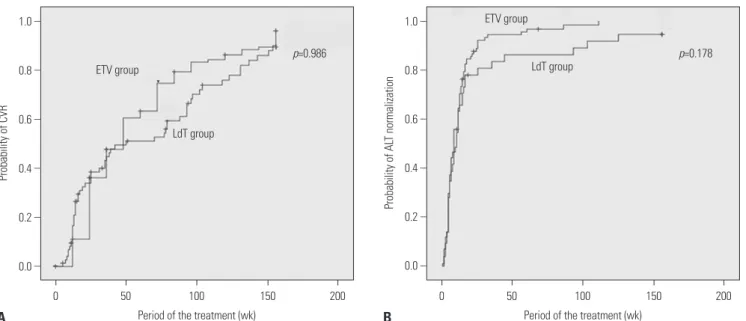
Virologic and biochemical responses during treatment In the ETV and LdT groups, 75 of 84 (89.3%) and 45 of 47 (95.7%) patients, respectively, including those who required treatment modification, demonstrated a CVR at the year 3. The differ- ence between the two groups was not significant (odds ratio=
0.370, p=0.326). The cumulative incidence rate of a CVR was also not significantly different (p=0.986) (Fig. 2A). The ETV and LdT groups did not differ in their biochemical responses, as demonstrated by the cumulative incidence rate of ALT nor- malization (p=0.178) (Fig. 2B).
Complete virologic response in patients with treatment modification
In the ETV group, two patients switched from ETV to another antiviral agent (Table 2). In both patients, the switch was im- plemented 30 months after ETV initiation, but a CVR was not
achieved until 3 years after the initiation. In the LdT group, 14 patients required treatment modification due to a PVR (Fig. 1).
Three of these patients were switched to TDF, and all of them achieved a CVR. A total out of 9 of 14 patients were switched to ETV, 8 of whom achieved a CVR. In 2 of the 14 patients, two drug switches were necessary (LdT→ETV→TDF). Both of the pa- tients were treated with ETV for 12 months but were switched back to TDF because of a PVR. One of the patients had a CVR 16 months after switching to TDF, and the other patient had a CVR at 3 months.
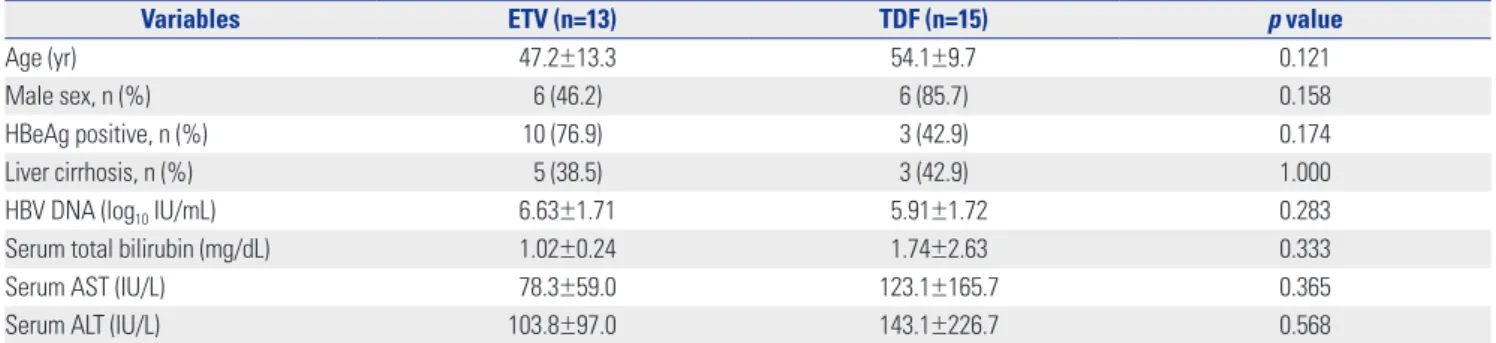
Ten patients in the LdT group required treatment modifica- tion due to resistance. Two of these patients were switched to ADV monotherapy or combination therapy; one of these pa- tients achieved a CVR. Eight of ten patients were switched to TDF monotherapy or combination therapy, and all of them achieved a CVR. In the LdT group, 4 patients required treat- ment modification due to an adverse event (2 with myopathy and 2 with abdominal pain). After a switch to ETV, all of them achieved a CVR. A comparison of the virologic response to ETV and TDF as rescue therapies showed that all 15 patients who received TDF rescue therapy and 10 of 13 patients who received ETV rescue therapy achieved a CVR (Table 3). The cumulative CVR incidence following rescue therapy was sig- Table 1. Baseline Characteristics of Patients with Chronic Hepatitis B
Variables ETV (n=84) LdT (n=47) p value
Age (yr) 47.0±10.6 50.4±11.4 0.086
Male sex, n (%) 52 (63.4) 29 (61.7) 0.982
HBeAg positive, n (%) 84 (100) 25 (53.2) <0.001
Liver cirrhosis, n (%) 23 (27.4) 17 (36.2) 0.295
HBV DNA (log10 IU/mL) 7.10±1.27 5.92±1.91 <0.001
Serum total bilirubin (mg/dL) 1.53±1.71 1.28±1.52 0.412
Serum AST (IU/L) 175.5±254.0 102.8±129.7 0.070
Serum ALT (IU/L) 217.2±320.7 119.4±175.7 0.055
HBeAg, hepatitis B e antigen; HBV, hepatitis B virus; AST, aspartate aminotransferase; ALT, alanine aminotransferase; ETV, entecavir; LdT, telbivudine.
Patients enrolled ETV: 84, LdT: 47, Total: 131
ETV continue n=82 (CVR: 75)
PVR n=1 (CVR: 0)
Switch to another NA n=2 (CVR=0)
Resistance n=1 (CVR: 0)
LdT continue n=19 (CVR: 19)
PVR n=14 (CVR: 13)
Resistance n=8 (CVR: 7) Switch to another NA
n=26 (CVR: 24) ETV patients
n=84
LdT patients n=47
Adverse event n=4 (CVR: 4)
Resistance n=2 (CVR: 2) Addition to another NA
n=2 (CVR: 2)
Fig. 1. Flow diagram of the 3-years study. ETV, entecavir; LdT, telbivudine; NA, nucleos(t)ide analogue; CVR, complete virologic response; PVR, partial virologic response.
nificantly higher in the TDF group than in the ETV group (p=
0.009) (Fig. 3).
DISCUSSION
A favorable outcome was expected with LdT treatment be- cause of its relatively strong antiviral effect. It is particularly ef- fective for patients with a low baseline HBV DNA level (HBeAg- positive patients with baseline HBV DNA <9 log10 copies/mL, HBeAg-negative patients with baseline HBV DNA <7 log10 cop-
ies/mL, and ALT >2×upper limit of normal).5 Therefore, long- term treatment with LdT should be considered in appropriate patients. In fact, a recent meta-analysis that compared the effi- cacy of ETV with that of LdT reported similar virologic and bio- chemical responses with the two drugs.5,18,19
However, LdT is not recommended as a first-line antiviral agent for CHB because of relatively high risks of treatment failure due to resistance and a PVR. Instead, ETV and TDF are currently recommended as first-line antiviral agents for CHB, based on their outstanding antiviral effects and very low rates of resistance despite long-term use. ETV and TDF have also 1.0
0.8
0.6
0.4
0.2
0.0
1.0
0.8
0.6
0.4
0.2
0.0 –
–
–
–
–
–
–
–
–
–
–
–
Probability of CVR Probability of ALT normalization
Period of the treatment (wk) Period of the treatment (wk)
0 50 100 150 200 0 50 100 150 200
ETV group
ETV group
LdT group
LdT group
p=0.986 p=0.178
A B
Fig. 2. Cumulative incidence of CVR and ALT normalization in response to ETV and LdT including treatment modification. (A) Cumulative incidence of CVR in patients with CHB. (B) Cumulative incidence of ALT normalization in patients with CHB. CVR, complete virologic response; ALT, alanine amino- transferase; ETV, entecavir; LdT, telbivudine; HBV, hepatitis B virus.
Table 2. Treatment Modification in Patients with Chronic Hepatitis B Treated in a 3-Year Period
Variables Total (n=30) ETV (n=2) LdT (n=28)
Type of treatment modification, n (%)
Switch to another NA 28 (93.3) 2 (100) 26 (92.9)
ETV → TDF 1 (3.3) 1 (50) 0
ETV → ADV+LAM → TDF 1 (3.3) 1 (50) 0
LdT → TDF 7 (23.3) 0 7 (25)
LdT → ETV 13 (43.3) 0 13 (46.4)
LdT → ETV → TDF 2 (6.7) 0 2 (7.1)
LdT → ADV 1 (3.3) 0 1 (3.6)
LdT → ADV+LAM 1 (3.3) 0 1 (3.6)
LdT → ADV → LAM+TDF 1 (3.3) 0 1 (3.6)
LdT → ADV+LAM → TDF 1 (3.3) 0 1 (3.6)
Addition of another NA 2 (6.7) 0 2 (7.1)
LdT+TDF 2 (6.7) 0 2 (7.1)
Reason for treatment modification, n (%)
Partial virologic response 15 (50) 1 (50) 14 (50)
Resistance 11 (36.7) 1 (50) 10 (35.7)
Adverse event 4 (13.3) 0 4 (14.3)
NA, nucleos(t)ide analogue; ETV, entecavir; TDF, tenofovir; ADV, adefovir; LAM, lamivudine; LdT, telbivudine.
been evaluated as rescue therapies. In a recent study,7 rescue therapy with ETV resulted in a CVR in 80% of patients who had a PVR to LdT; for patients who did not respond to a NA, rescue therapy with TDF resulted in a CVR in 90%.10 Some stud- ies have also shown that, TDF, when used as a rescue therapy, has excellent antiviral activity in most patients who develop antiviral resistance to LdT.11-17 However, little is known about treatment modification rates and long-term outcomes after treatment modification in patients with CHB treated with LdT in real world experience.
In the present study, we compared the virologic and bio- chemical responses (including after treatment modification) obtained in patients treated with LdT versus ETV as the first-line antiviral agent during a 3-year period. The initial treatment maintenance rate at 3 years was significantly higher in the ETV than in the LdT group (97.6% vs. 40.7%), similar to the results reported by Chien, et al.6
In the ETV group, most patients maintained their initial an- tiviral agent during the 3-year treatment period, whereas, there was a relatively high rate of treatment modification in the LdT group because of a partial response, resistance, or adverse reac- tion. However, an analysis of data, including a CVR after treat- ment modification, failed to show a significant difference be- tween the two groups during the 3 years in the CVR rate, the cumulative incidence of a CVR, or the cumulative incidence of ALT normalization. This could be attributed to the effects of the rescue antiviral agent. Roughly 90% of the study patients who failed to show a complete response to a first-line antiviral agent achieved a CVR after switching to a rescue antiviral agent.
It is thus possible that a CVR can be obtained following effec- tive treatment modification.
On the other hand, a comparison of the efficacy of TDF and ETV as rescue therapies revealed that 100% of patients who received TDF achieved a CVR, compared to 77% of patients treated with ETV. For all of the patients who had a PVR to ETV rescue therapy, TDF rescue therapy yielded a CVR, which dem- onstrated greater efficacy of TDF than ETV as a rescue antivi- ral agent, as reported in a recent study.7,20,21 We were unable to assess the factors affecting the efficacy of ETV or TDF rescue therapy. However, these results were based on small-scale retro- spective data. To compare ETV and TDF as a rescue therapy,
clinical study with high quality of evidence is needed.
There are a few limitations to our study. First, because this study was conducted at a single center, the number of study pa- tients was small; in addition, considering the nature of CHB treatment, a 3-year period is insufficient to fully determine the efficacy of an antiviral agent. Multicenter randomized con- trolled study is needed to confirm the efficacy of LdT therapy with treatment modification, but it is difficult in Korea. Second, many patients did not complete the 3-year follow-up, a short- coming of the retrospective design of the study patients treated in real clinical practice. Finally, for a statistically valid compari- son of the efficacy of rescue antiviral agents and a determina- tion of the factors related to their efficacy, the number of cases was too small.
Nonetheless, our results showed significantly superior main- tenance rate of ETV compared to LdT, although there were no differences in virologic or biochemical response at 3 years be- tween patients initially treated with either drug, after rescue treatment modification. Therefore, LdT merits consideration as a first-line antiviral agent for CHB. When initial LdT treatment Table 3. Comparison of Patients Treated with ETV and TDF after Initial Telbivudine Treatment at Treatment Modification
Variables ETV (n=13) TDF (n=15) p value
Age (yr) 47.2±13.3 54.1±9.7 0.121
Male sex, n (%) 6 (46.2) 6 (85.7) 0.158
HBeAg positive, n (%) 10 (76.9) 3 (42.9) 0.174
Liver cirrhosis, n (%) 5 (38.5) 3 (42.9) 1.000
HBV DNA (log10 IU/mL) 6.63±1.71 5.91±1.72 0.283
Serum total bilirubin (mg/dL) 1.02±0.24 1.74±2.63 0.333
Serum AST (IU/L) 78.3±59.0 123.1±165.7 0.365
Serum ALT (IU/L) 103.8±97.0 143.1±226.7 0.568
HBeAg, hepatitis B e antigen; HBV, hepatitis B virus; AST, aspartate aminotransferase; ALT, alanine aminotransferase; ETV, entecavir; TDF, tenofovir.
1.0
0.8
0.6
0.4
0.2
0.0 –
–
–
–
–
–
Probability of CVR
Period of the treatment (wk)
0 25 50 75 100 125
ETV group TDF group
p=0.009
Fig. 3. Cumulative incidence of a CVR according to ETV and TDF as res- cue therapy in patients with initial telbivudine therapy. CVR, complete virologic response; ETV, entecavir; TDF, tenofovir.
fails, TDF may be a more effective rescue antiviral agent than ETV.
ORCID
Jong Won Choi https://orcid.org/0000-0001-9546-7313 Se Hyun Kim https://orcid.org/0000-0002-7154-1029 Chun Kyon Lee https://orcid.org/0000-0002-8492-2883
REFERENCES
1. Buti M, Tsai N, Petersen J, Flisiak R, Gurel S, Krastev Z, et al. Sev- en-year efficacy and safety of treatment with tenofovir disoproxil fumarate for chronic hepatitis B virus infection. Dig Dis Sci 2015;60:
1457-64.
2. Idilman R, Gunsar F, Koruk M, Keskin O, Meral CE, Gulsen M, et al.
Long-term entecavir or tenofovir disoproxil fumarate therapy in treatment-naïve chronic hepatitis B patients in the real-world set- ting. J Viral Hepat 2015;22:504-10.
3. Lampertico P, Chan HL, Janssen HL, Strasser SI, Schindler R, Berg T. Review article: long-term safety of nucleoside and nucleotide analogues in HBV-monoinfected patients. Aliment Pharmacol Ther 2016;44:16-34.
4. Zeuzem S, Gane E, Liaw YF, Lim SG, DiBisceglie A, Buti M, et al.
Baseline characteristics and early on-treatment response predict the outcomes of 2 years of telbivudine treatment of chronic hepa- titis B. J Hepatol 2009;51:11-20.
5. Wang Y, Thongsawat S, Gane EJ, Liaw YF, Jia J, Hou J, et al. Efficacy and safety of continuous 4-year telbivudine treatment in patients with chronic hepatitis B. J Viral Hepat 2013;20:e37-46.
6. Chien RN, Peng CY, Kao JH, Hu TH, Lin CC, Hu CT, et al. Higher adherence with 3-year entecavir treatment than lamivudine or telbivudine in treatment-naïve Taiwanese patients with chronic hepatitis B. J Gastroenterol Hepatol 2014;29:185-92.
7. Lo AO, Wong VW, Wong GL, Chan HY, Cheung CM, Chan HL. Ef- ficacy of entecavir switch therapy in chronic hepatitis B patients with incomplete virological response to telbivudine. Antivir Ther 2013;18:671-9.
8. Sheen E, Trinh HN, Nguyen TT, Do ST, Tran P, Nguyen HA, et al.
The efficacy of entecavir therapy in chronic hepatitis B patients with suboptimal response to adevofir. Aliment Pharmacol Ther 2011;34:767-74.
9. Zoutendijk R, Reijnders JG, Brown A, Zoulim F, Mutimer D, De- terding K, et al. Entecavir treatment for chronic hepatitis B: adap- tation is not needed for the majority of naïve patients with a par- tial virological response. Hepatology 2011;54:443-51.
10. Huang M, Li X, Wu Y, Tao L, Jie Y, Li X, et al. [Efficacy of 48-week tenofovir disoproxil fumarate therapy in patients who were unre- sponsive to nucleoside-analogue treatments]. Zhonghua Gan Zang Bing Za Zhi 2014;22:266-71.
11. Lee YB, Jung EU, Kim BH, Lee JH, Cho H, Ahn H, et al. Tenofovir monotherapy versus tenofovir plus lamivudine or telbivudine combination therapy in treatment of lamivudine-resistant chron- ic hepatitis B. Antimicrob Agents Chemother 2015;59:972-8.
12. Choi K, Lee HM, Jun BG, Lee SH, Kim HS, Kim SG, et al. [Efficacy of tenofovir-based rescue therapy for patients with drug-resistant chronic hepatitis B]. Korean J Gastroenterol 2015;65:35-42.
13. Kim HJ, Cho JY, Kim YJ, Gwak GY, Paik YH, Choi MS, et al. Long- term efficacy of tenofovir disoproxil fumarate therapy after multi- ple nucleos(t)ide analogue failure in chronic hepatitis B patients.
Korean J Intern Med 2015;30:32-41.
14. Kim BG, Jung SW, Kim EH, Kim JH, Park JH, Sung SJ, et al. Teno- fovir-based rescue therapy for chronic hepatitis B patients who had failed treatment with lamivudine, adefovir, and entecavir. J Gastroenterol Hepatol 2015;30:1514-21.
15. Lee S, Park JY, Kim DY, Kim BK, Kim SU, Song K, et al. Prediction of virologic response to tenofovir mono-rescue therapy for multi- drug resistant chronic hepatitis B. J Med Virol 2016;88:1027-34.
16. Lim YS, Yoo BC, Byun KS, Kwon SY, Kim YJ, An J, et al. Tenofovir monotherapy versus tenofovir and entecavir combination thera- py in adefovir-resistant chronic hepatitis B patients with multiple drug failure: results of a randomised trial. Gut 2016;65:1042-51.
17. Wang HM, Hung CH, Lee CM, Lu SN, Wang JH, Yen YH, et al.
Three-year efficacy and safety of tenofovir in nucleos(t)ide ana- log-naïve and nucleos(t)ide analog-experienced chronic hepatitis B patients. J Gastroenterol Hepatol 2016;31:1307-14.
18. Liang J, Jiang MJ, Deng X, Xiao Zhou X. Efficacy and safety of tel- bivudine compared to entecavir among HBeAg+ chronic hepati- tis B patients: a meta-analysis study. Hepat Mon 2013;13:e7862.
19. Zhang Y, Hu P, Qi X, Ren H, Mao RC, Zhang JM. A comparison of telbivudine and entecavir in the treatment of hepatitis B e anti- gen-positive patients: a prospective cohort study in China. Clin Microbiol Infect 2016;22:287.e1-9.
20. Lu L, Yip B, Trinh H, Pan CQ, Han SH, Wong CC, et al. Tenofovir- based alternate therapies for chronic hepatitis B patients with partial virological response to entecavir. J Viral Hepat 2015;22:
675-81.
21. Pan CQ, Hu KQ, Yu AS, Chen W, Bunchorntavakul C, Reddy KR.
Response to tenofovir monotherapy in chronic hepatitis B pa- tients with prior suboptimal response to entecavir. J Viral Hepat 2012;19:213-9.