Protective Effects of Female Reproductive Factors on Lauren Intestinal-Type Gastric Adenocarcinoma
Su Mi Kim
1, Byung-Hoon Min
2, Jeeyun Lee
3, Ji Yeong An
1, Jun Ho Lee
1, Tae Sung Sohn
1, Jae Moon Bae
1, Jae J. Kim
2, Won Ki Kang
3, Sung Kim
1, and Min-Gew Choi
11Department of Surgery, Divisions of 2Gastroenterology and 3Hematology-Oncology, Department of Medicine, Samsung Medical Center, Sungkyunkwan University School of Medicine, Seoul, Korea.
Purpose: Gastric cancer shows a male predominance that might be explained by protective effects from estrogens in females.
Two Lauren classification histological subtypes, intestinal and diffuse, have distinct carcinogeneses. The purpose of this study was to estimate the effects of sex hormone on female gastric cancer according to Lauren classification.
Materials and Methods: We reviewed medical records for and administered questionnaires, surveying reproductive and hor- monal factors, to 758 patients who underwent gastrectomy for gastric cancer at Samsung Medical Center from May 2012 to No- vember 2014. Clinicopathological characteristics were compared between females and males. The incidence of intestinal-type gastric cancer was compared between females subgroups, consist of premenopausal women and three groups of postmenopaus- al women (five-year intervals after menopause), and males. The association between reproductive factors and intestinal-type gastric cancer was analyzed by multivariate models for the female group.
Results: In total, 227 females (29.9%) and 531 males (70.9%) were included in the analysis. Undifferentiated adenocarcinoma and diffuse-type histology were more frequent in female patients than male patients. While 221 (41.6%) male patients had intestinal- type gastric cancer, no premenopausal female patient had this type of gastric cancer. The incidence of intestinal-type gastric can- cer increased with time after menopause, and was similar to males after 10 years from menopause. Parity was associated with an increased risk of intestinal-type gastric cancer in menopausal women.
Conclusion: These findings support that female sex hormones might be protective against intestinal-type gastric cancer.
Key Words: Female, sex hormone, gastric cancer
INTRODUCTION
Gastric cancer is the fifth most common cancer and the third leading cause of cancer related death worldwide.1 Gastric can- cer shows male dominance at a male-to-female ratio of about 2:1.2 This male predominance cannot be clearly explained by
known risk factors.
Several studies have reported that the female sex hormone estrogen may be associated with gastric carcinogenesis.3,4 17β-estradiol (E2) down-regulates E-cadherin through Estro- gen Receptor (ER)-α,5 which may initiate diffuse-type gastric cancer. However, the significance or mechanism of estrogen in gastric cancer has not been established.
Gastric cancer can be classified into two histologic subtypes, intestinal and diffuse, which are distinct in their microscopic and gross appearance, epidemiology, pathogenesis, and prog- nosis.6 Diffuse-type gastric cancer occurs more in female, young- er patients and in patients who are diagnosed at an advanced stage, and the prognosis is worse, compared to intestinal-type gastric cancer.7 Diffuse-type gastric cancer shows different patterns, such as TP53 mutation and ERBB2 or ERBB3 overex- pression in gastric cancer signaling pathway, from intestinal type. Gastric cancer also shows distinct features according to pISSN: 0513-5796 · eISSN: 1976-2437 Yonsei Med J 2018 Jan;59(1):28-34
https://doi.org/10.3349/ymj.2018.59.1.28
Received: August 1, 2017 Revised: October 23, 2017 Accepted: October 24, 2017
Corresponding author: Dr. Min-Gew Choi, Department of Surgery, Samsung Medi- cal Center, Sungkyunkwan University School of Medicine, 81 Irwon-ro, Gangnam-gu, Seoul 06351, Korea.
Tel: 82-2-3410-0919, Fax: 82-2-3410-6981, E-mail: [email protected]
•The authors have no financial conflicts of interest.
© Copyright: Yonsei University College of Medicine 2018
This is an Open Access article distributed under the terms of the Creative Com- mons Attribution Non-Commercial License (http://creativecommons.org/licenses/
by-nc/4.0) which permits unrestricted non-commercial use, distribution, and repro- duction in any medium, provided the original work is properly cited.
age. A study revealed that early onset gastric cancers are dif- ferent from cases diagnosed in older adults in terms of clini- copathological factors and molecular profiles in each type of Lauren classification.8 The different patterns of gastric cancers according to gender and age imply the possible role of sex hor- mones in carcinogenesis, and it should be considered in dif- fuse and intestinal type. The purpose of this study was to esti- mate the effects of sex hormone on female gastric cancer ac- cording to Lauren classification.
MATERIALS AND METHODS
Study cohort and data sources
A total of 3791 patients had undergone gastrectomy for gastric cancer at Samsung Medical Center from May 2012 to Novem- ber 2014 (Fig. 1). We screened 1506 patients, and 722 patients had refused to participate in the survey. Twenty-six female pa- tients who did not complete the reproductive factor-related qu- estionnaires were excluded. We reviewed medical records for 758 patients who completed a questionnaire including men- strual and reproductive history. Patients who met the follow- ing criteria were included in analysis: histologically confirmed adenocarcinoma of the stomach; radical resection of the tu- mor; and females who provided obstetric and menstruation history. All information was obtained with the appropriate In- stitutional Review Board waivers, and data were collected with- out revealing any personal information (IRB File No. 2012-05-096).
Clinical data
All patient characteristics were obtained from retrospective re- view of a prospectively maintained database. Sociodemogra- phic characteristics included age, sex, body mass index, and sm- oking and drinking history. Clinicopathological characteristics included tumor size, tumor location, depth of invasion, lymph node metastasis, TNM stage at diagnosis, lymphatic invasion,
vascular invasion, perineural invasion, differentiation, and Lauren classification. Stage at diagnosis was determined in ac- cordance with the seventh edition of the Union International Centre Cancer/American Joint Committee on Cancer classifi- cation system.9 Reproductive factors included age at menarche, menopausal status, and if relevant, age at menopause, num- ber of full-term pregnancies and woman’s age at birth of first child, breastfeeding history, postmenopausal hormonal ther- apy, oral contraceptives, hysterectomy, and oophorectomy.
Outcomes
The primary endpoint of the study was the association be- tween female reproductive factors and intestinal-type gastric cancer by Lauren classification.6 Lauren classification divides gastric cancer into intestinal or diffuse types according to pa- thologic findings. Mixed type showing both intestinal and dif- fuse types was regarded as diffuse type.
Statistical considerations
Chi-squared test and Fisher’s exact test were used to evaluate the associations among categorical variables, and Student’s t- test was used for continuous variables including age and tu- mor size. Multivariate analysis was carried out using a logistic regression method. All statistical analyses were performed us- ing SPSS version 23.0 for Windows (IBM Corp., Armonk, NY, USA), and p-values less than 0.05 were considered significant.
RESULTS
Patients and tumor characteristics
Seven hundred and fifty-eight patients with gastrectomy for gastric cancer were included in the final analysis: 227 were fe- males (29.9%) and 531 were males (70.9%). Baseline character- istics according to sex are shown in Table 1. Most female patients had no drinking history (75.8%) or smoking history (95.1%), wh- ereas there were 435 male patients (81.9%) who had drinking history and 432 male smokers (81.4%). For past and current smokers, tobacco exposure was higher in male than female pa- tients. 446 patients (58.8%; 137 female and 309 male) had ear- ly gastric cancer, and 312 patients (41.2%; 90 female and 222 male) had advanced gastric cancer. Male patients showed more frequent lower located gastric cancer and vascular invasion, compared to female patients. Undifferentiated adenocarcino- ma and diffuse-type histology were more frequent in female patients, compared to male patients. Of male patients, 41.6%
(221/531) had gastric cancer classified as intestinal type and 58.4% (310/531) had gastric cancer classified as diffuse type ac- cording to Lauren classification. Of female patients, 21.6% (49/
227) had gastric cancer specified as intestinal type and 78.4%
(178/227) as diffuse type. There were 115 patients with mixed- type gastric cancer (81 in male and 34 in female).
3791 patients with gastrectomy for gastric cancer
Final analysis (n=758)
Excluded 722 patients who refused to participate
Excluded 26 female patients who did not complete questionnaires about reproductive factors
Fig. 1. Flow diagram of patient recruitment.
1506 patients screened
784 patients in participant
Proportion of diffuse type in female gastric cancer patients
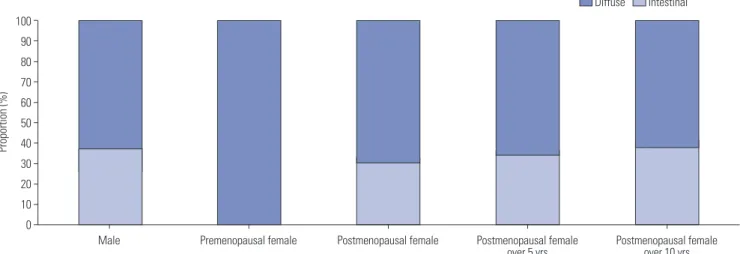
The proportions of gastric cancer subtypes in female subgroups classified by five-year intervals after menopause are shown in Fig. 1. 66 premenopausal women and 98 women with meno- pause over 10 years were included in this analysis. No premeno- pausal women had intestinal-type gastric cancer; in contrast, 37.8% (37/98) women with menopause over 10 years had intes- tinal-type gastric cancer (Fig. 2). Intestinal-type gastric cancer increased in postmenopausal female gastric cancer patients with time after menopause (Fig. 3).
Of male patients, 221 (41.6%) had intestinal-type gastric can- cer, while no premenopausal female patients did (Fig. 4). The incidence of intestinal-type histology was higher in postmeno- pausal female patients, however. The proportions of diffuse- type gastric cancer in male and female groups are presented in Fig. 5. The proportions of intestinal-type gastric cancer showed an upward trend with time after menopause in female patients with gastric cancer. Intestinal-type gastric cancer was signifi- cantly less frequent in premenopausal female (p<0.001), post- menopausal women (p<0.001), and women who had finished menstruation more than five years previously (p=0.013), com- pared to male gastric cancer patients. No significant differ- ence was detected between men and women who went through menopause more than 10 years prior (p=0.310).
Subgroup analysis of female gastric cancer patients We examined the association between reproductive factors and intestinal-type gastric cancer using multivariate models adjusted for categorical variables for all females and two sub- groups: parous women and postmenopausal women. For all female patients with gastric cancer, only smoking history was associated with intestinal-type gastric cancer (Table 2). Alco- hol history (p=0.009), menopause (p<0.001), and parity (p<
0.001) were significantly associated with gastric cancer sub- type in univariate analysis, although they had no significant association in multivariate analysis.
For parous women, smoking history also had a relationship with intestinal-type gastric cancer in multivariate analysis (Table 3). Menopause and reproductive factors, including pari- ty and breast feeding, were related to intestinal-type gastric cancer in univariate analysis, although they did not have sig- nificant effects in multivariate analysis.
For postmenopausal women, an increased risk of intestinal type gastric cancer was observed for those with smoking his- tory or parity on uni- and multivariate analysis. No significant associations were observed for other menstrual and repro- ductive factors (Table 4).
DISCUSSION
Estrogens regulate the growth, differentiation, and function of Table 1. Clinicopathological Features of Patients with Gastric Cancer
Characteristics Female (n= 227)
Male
(n=531) p value
Age (years) 57.1±13.8 57.7±10.7 0.545
BMI (kg/m2) 25.7±36.9 23.7±3.0 0.241
Drinking history <0.001
No drinking 172 (75.8) 96 (18.1)
Past drinking 17 (7.5) 208 (39.2)
Frequency (/week) 2.9±4.8 1.8±3.5 Current drinking 38 (16.7) 227 (42.7) Frequency (/week) 1.2±2.5 3.8±5.1
Smoking history <0.001
Nonsmoker 216 (95.1) 99 (18.6)
Past smoker 9 (4.0) 285 (53.7)
Exposure value (pack years) 18.5±17.3 21.6±13.0
Current smoker 2 (0.9) 147 (27.7)
Exposure value (pack years) 21.5±3.5 30.3±16.0
Tumor size (cm) 4.2±3.0 4.0±2.5 0.529
Tumor location <0.001
Lower 90 (39.6) 253 (47.6)
Middle 128 (56.4) 208 (39.2)
Upper 9 (4.0) 70 (13.2)
T stage 0.662
T1 137 (60.4) 309 (58.2)
T2 26 (11.5) 53 (10.0)
T3 32 (14.1) 76 (14.3)
T4 32 (14.1) 93 (17.5)
N stage 0.517
N0 137 (60.4) 340 (64.0)
N1 37 (16.3) 71 (13.4)
N2 24 (10.6) 45 (8.5)
N3 29 (12.8) 75 (14.1)
Stage 0.096
I 137 (60.4) 328 (61.8)
II 45 (19.8) 80 (15.1)
III 39 (17.2) 117 (22.0)
IV 6 (2.6) 6 (1.1)
Lymphatic invasion 0.868
Absent 145 (63.9) 344 (64.8)
Present 82 (36.1) 187 (35.2)
Vascular invasion 0.026
Absent 219 (96.5) 488 (91.9)
Present 8 (3.5) 43 (8.1)
Perineural invasion 0.243
Absent 174 (76.6) 385 (72.5)
Present 53 (23.3) 146 (27.5)
Tumor histologic type <0.001
Differentiated 44 (19.4) 203 (38.2) Undifferentiated 183 (80.6) 328 (61.8)
Lauren <0.001
Intestinal 49 (21.6) 221 (41.6)
Diffuse 178 (78.4) 310 (58.4)
BMI, body mass index.
Data are mean±standard deviation or number (percentage).
several tissues, and their effects are mediated by ER-α and ER- β. ER-α is expressed in female sex organs, such as the breast, uterus, and ovaries, while ER-β is more widely distributed in the body than ER-α.10 The oncologic significance of estrogens and ERs in cancers arising in breast, ovary, and uterine endo- metrium has been well described.11-13 Estrogen is associated with an increased risk for breast14 and endometrial15 cancer and a decreased colon cancer risk.16
Estrogen and estrogen receptor have been suspected as playing a role in gastric cancer because of a global pattern of male predominance that is unique for intestinal-type gastric cancer. Some investigators have regarded estrogen as preven- tive against gastric cancer, as men who receive estrogen for prostate cancer show a reduced risk of gastric cancer.17 Studies show that tamoxifen exposure is a risk factor for gastric can- cer, further supporting the hypothesis.18 Furukawa, et al.19 had reported that the carcinogenic N-methyl-N0-nitro-N-nitroso- guanidine added to drinking water induced gastric cancer in male rats but not in female rats, and castrated or estrogen-treat- ed male rats had a lower incidence of gastric cancer than un-
treated male rats in in vitro experiments. In addition, some studies propose that estrogen has a protective role, since meno- pause at older age is associated with decreased gastric cancer.3
It has been reported that diffuse-type gastric cancer is pre- dominant in younger gastric cancer patients. Nevertheless, it is worthy to note that we could not find any intestinal-type gas- tric cancer in premenopausal females in this study. Although the sample size was small, this finding strongly suggests that intestinal-type gastric cancer is infrequent in women until menopause. The incidence of intestinal-type gastric cancer in- creased with time after menopause and became similar to that for men at 10 years after menopause. In addition, parity, which results in lower lifelong estrogen exposure than null-parity, was associated with an increased risk of intestinal-type gastric cancer for menopausal women. This finding suggests that estro- gen might protect women against intestinal-type gastric cancer.
Several studies demonstrated sex disparities in different age groups and histological differentiation groups of patients with gastric cancer.20,21 Sipponen, et al.20 suggested that a delay in the appearance and onset of intestinal-type gastric cancer in fe- 600
500 400 300 200 100 0
Number
Male Premenopausal female Postmenopausal female Postmenopausal female
over 5 yrs Postmenopausal female over 10 yrs 221
310
49 p<0.001*
112 0
p<0.001*
66 43
p=0.013*
83
37 p=0.310*
61 Diffuse Intestinal
Diffuse Intestinal
Fig. 2. Number of intestinal and diffuse subtype gastric cancers in male and female subgroups classified according to cumulative 5-year intervals af- ter menopause. *p-value was calculated compared to male groups.
100 90 80 70 60 50 40 30 20 10 0
Proportion (%)
Male Premenopausal female Postmenopausal female Postmenopausal female
over 5 yrs Postmenopausal female over 10 yrs
Fig. 3. Proportion of intestinal and diffuse subtype gastric cancers in male and female subgroups classified according to cumulative 5-year intervals after menopause.
males relative to males results in male predominance, raising the hypothesis that female sex hormones potently prevent or inhibit carcinogenesis of intestinal-type gastric cancer. Chan- danos, et al.,22 in a population-based cohort study, reported that endogenous estrogen exposure is associated with a lower frequency of intestinal-type cancers. Patients were categorized into three groups: exposed women (aged younger than 50), unexposed men (aged younger than 50), and unexposed wom- en (aged over 70) according to age. In our study, we adminis- tered a questionnaire designed to survey detailed information on menstrual status, including time from menopause, so sex hormone effects could be analyzed by time after menopause.
To the best of our knowledge, this is the first study to address the study topic with a prospective survey of reproductive fac- tors for gastric cancer patients.
We found that smoking was associated intestinal-type gastric cancer in females, including both parous women and meno- pausal women. Although several studies suggest an effect of smoking on gastric cancer, published evidence is insufficient
to draw conclusions. In addition, the smoking effect might not be acceptable in this study, because of the small number of fe- male smokers (8/221 patients). In our study, undifferentiated type cancers were more frequent in the female population, probably because most of diffuse-type cancers would be cate- gorized into undifferentiated type adenocarcinoma in WHO classification. Vascular invasion was more frequent in the male population; however, it was significantly associated with Lauren intestinal-type cancer but not with males in multivari- ate analysis (data not shown).
Helicobacter pylori (H. pylori) infection is a well-established risk factor and shows male-dominant features. Despite a high prevalence in Korea, we were unable to adjust for H. pylori in- fection because of the lack of H. pylori array for gastric cancer patients in this institution. However, Freedman, et al.3 reported pylori cytotoxin-associated gene A (CagA) seropositivity is not a confounding factor in a large prospective study of reproduc- tive factors and gastric cancer risk. Recent meta-analysis has supported the little contribution of sex differences in the prev-
Diffuse Intestinal
Diffuse Intestinal 600
500 400 300 200 100 0
Number
Male Premenopausal female Postmenopausal female (< 5 yrs)
Postmenopausal female (5–10 yrs)
Postmenopausal female (>10 yrs) 221
310
296 660
226
37 61
Fig. 4. Number of intestinal and diffuse subtype gastric cancers in male and female subgroups classified according to 5-year intervals after meno- pause.
100 90 80 70 60 50 40 30 20 10 0
Proportion (%)
Male Premenopausal female Postmenopausal female (< 5 yrs)
Postmenopausal female (5–10 yrs)
Postmenopausal female (>10 yrs)
Fig. 5. Proportion of intestinal and diffuse subtype gastric cancers in male and female subgroups classified according to 5-year intervals after meno- pause.
alence of H. pylori infection to the male predominance of gas- tric cancer.23 Further research is needed to clarify the effect of H. pylori according to gastric cancer subtype.
This study had the limitation of being a clinicoepidemiolog- ical study without investigating the molecular mechanism of female sex hormones. Further studies are also needed to elu- cidate the biological role of estrogen or estrogen receptor in the development of female gastric cancers. However, estrogen receptor has not been found to be well expressed in gastric cancer tissue, and no validated ER-α immunohistochemistry protocol or interpretation guidelines exist for gastric cancer.24
Future study should focus on subtypes and the genomic path-
ways of estrogen and its receptors on gastric cancer. Also, long- term outcomes including recurrence or survival could provide more information for effects of reproductive factors on gastric cancer. In addition, mixed type gastric cancer should be clas- sified separately in a large volume database.
In conclusion, female sex hormones might be protective against intestinal-type gastric cancer. Further studies including large cohort surveys and molecular experiments will be nec- essary to clarify the significance and mechanism of estrogen in gastric cancer.
ORCID
Su Mi Kim https://orcid.org/0000-0003-0272-4662 Min-Gew Choi https://orcid.org/0000-0003-3394-5177
REFERENCES
1. Ferlay J, Soerjomataram I, Dikshit R, Eser S, Mathers C, Rebelo M, et al. Cancer incidence and mortality worldwide: sources, meth- ods and major patterns in GLOBOCAN 2012. Int J Cancer 2015;
136:E359-86.
2. Forman D BF, Brewster DH, Gombe Mbalawa C, Kohler B, Piñe- ros M, Steliarova-Foucher E, et al. Cancer incidence in five conti- nents, CI5plus. IARC CancerBase No. 9. Lyon: International Agency for Research on Cancer; 2014.
3. Freedman ND, Chow WH, Gao YT, Shu XO, Ji BT, Yang G, et al.
Menstrual and reproductive factors and gastric cancer risk in a large prospective study of women. Gut 2007;56:1671-7.
4. Chandanos E, Lindblad M, Jia C, Rubio CA, Ye W, Lagergren J.
Tamoxifen exposure and risk of oesophageal and gastric adeno- carcinoma: a population-based cohort study of breast cancer pa- tients in Sweden. Br J Cancer 2006;95:118-22.
5. Helguero LA, Lindberg K, Gardmo C, Schwend T, Gustafsson JA, Haldosén LA. Different roles of estrogen receptors alpha and beta in the regulation of E-cadherin protein levels in a mouse mam- mary epithelial cell line. Cancer Res 2008;68:8695-704.
6. Lauren P. The two histological main types of gastric carcinoma:
diffuse and so-called intestinal-type carcinoma. An attempt at a histo-clinical classification. Acta Pathol Microbiol Scand 1965;64:
31-49.
7. Ribeiro MM, Sarmento JA, Sobrinho Simöes MA, Bastos J. Prog- nostic significance of Lauren and Ming classifications and other pathologic parameters in gastric carcinoma. Cancer 1981;47:780-4.
8. Gurzu S, Kadar Z, Sugimura H, Bara T, Bara T Jr, Halmaciu I, et al.
Gastric cancer in young vs old Romanian patients: immunoprofile with emphasis on maspin and mena protein reactivity. APMIS 2015;
123:223-33.
9. Edge SB, Byrd DR, Compton CC, Fritz AG, Greene FL, Trotti A.
AJCC cancer staging manual. 7th ed. New York: Springer; 2010.
10. Yang H, Sukocheva OA, Hussey DJ, Watson DI. Estrogen, male dominance and esophageal adenocarcinoma: is there a link? World J Gastroenterol 2012;18:393-400.
11. Beral V; Million Women Study Collaborators. Breast cancer and hormone-replacement therapy in the Million Women Study. Lan- cet 2003;362:419-27.
12. Beral V, Bull D, Reeves G; Million Women Study Collaborators.
Endometrial cancer and hormone-replacement therapy in the Mil- lion Women Study. Lancet 2005;365:1543-51.
13. Lacey JV Jr, Mink PJ, Lubin JH, Sherman ME, Troisi R, Hartge P, et Table 4. Multivariate Analysis for Intestinal-Type Gastric Cancer Risk in
Postmenopausal Women with Gastric Cancer
HR 95% CI p value
Smoking 13.72 1.26–149.66 0.032
Menarche ≤15 years old 1.11 0.41–3.01 0.842
Menopause ≤49 years old 1.70 0.54–5.41 0.367 Fertility days (months) 2.72 0.87–8.54 0.086
Parity 1.41 1.05–1.90 0.022
Breast feeding 3.83 0.40–36.16 0.242
Breast feeding duration (months) 1.00 0.96–1.05 0.888
Oral contraceptive 0.18 0.02–1.55 0.119
HR, hazard ratio; CI, confidence interval.
Table 3. Multivariate Analysis for Intestinal-Type Gastric Cancer Risk in Parous Women with Gastric Cancer
HR 95% CI p value
Age 1.44 0.72–2.87 0.302
Smoking 14.99 1.92–117.20 0.010
Alcohol 0.32 0.07–1.46 0.139
Menarche ≤14 years old 1.08 0.43–2.74 0.864
Menopause 2.78 0.20–39.26 0.448
Fertility days (months) 1.67 0.62–4.51 0.309
Parity 1.21 0.88–1.66 0.245
Breastfeeding 2.13 0.37–12.37 0.399
Breast feeding duration (months) 1.00 0.95–1.05 0.882
Oophorectomy 2.86 0.47–17.46 0.255
HR, hazard ratio; CI, confidence interval.
Table 2. Multivariate Analysis for Intestinal-Type Gastric Cancer Risk in All Female Gastric Cancer Patients
HR 95% CI p value
Age (years) 1.11 0.59–2.08 0.744
BMI (kg/m2) 1.07 0.95–1.19 0.280
Smoking 15.70 2.20–112.18 0.006
Alcohol 0.30 0.07–1.32 0.110
Menarche ≤15 years old 1.80 0.76–4.30 0.183
Menopause 7.77 0.59–103.04 0.120
Fertility days (months) 1.47 0.62–3.48 0.381
Parity 1.23 0.90–1.69 0.194
HR, hazard ratio; CI, confidence interval; BMI, body mass index.
al. Menopausal hormone replacement therapy and risk of ovarian cancer. JAMA 2002;288:334-41.
14. Poulter NR, Meirik O, Chang CL, Farley TMM, Kelaghan J, Marmot MG, et al. Acute myocardial infarction and combined oral contra- ceptives: results of an international multicentre case-control study. WHO Collaborative Study of Cardiovascular Disease and Steroid Hormone Contraception. Lancet 1997;349:1202-9.
15. Grady D, Gebretsadik T, Kerlikowske K, Ernster V, Petitti D. Hor- mone replacement therapy and endometrial cancer risk: a meta- analysis. Obstet Gynecol 1995;85:304-13.
16. Grodstein F, Newcomb PA, Stampfer MJ. Postmenopausal hor- mone therapy and the risk of colorectal cancer: a review and meta- analysis. Am J Med 1999;106:574-82.
17. Lindblad M, Ye W, Rubio C, Lagergren J. Estrogen and risk of gas- tric cancer: a protective effect in a nationwide cohort study of pa- tients with prostate cancer in Sweden. Cancer Epidemiol Bio- markers Prev 2004;13:2203-7.
18. Curtis RE, Boice JD Jr, Shriner DA, Hankey BF, Fraumeni JF Jr.
Second cancers after adjuvant tamoxifen therapy for breast cancer.
J Natl Cancer Inst 1996;88:832-4.
19. Furukawa H, Iwanaga T, Koyama H, Taniguchi H. Effect of sex hor-
mones on the experimental induction of cancer in rat stomach-a preliminary study. Digestion 1982;23:151-5.
20. Sipponen P, Correa P. Delayed rise in incidence of gastric cancer in females results in unique sex ratio (M/F) pattern: etiologic hy- pothesis. Gastric Cancer 2002;5:213-9.
21. Qiu MZ, Wang ZQ, Zhang DS, Luo HY, Zhou ZW, Wang FH, et al.
Clinicopathological characteristics and prognostic analysis of gastric cancer in the young adult in China. Tumour Biol 2011;32:
509-14.
22. Chandanos E, Rubio CA, Lindblad M, Jia C, Tsolakis AV, Warner M, et al. Endogenous estrogen exposure in relation to distribution of histological type and estrogen receptors in gastric adenocarci- noma. Gastric Cancer 2008;11:168-74.
23. Ibrahim A, Morais S, Ferro A, Lunet N, Peleteiro B. Sex-differenc- es in the prevalence of Helicobacter pylori infection in pediatric and adult populations: systematic review and meta-analysis of 244 studies. Dig Liver Dis 2017;49:742-9.
24. Yi JH, Do IG, Jang J, Kim ST, Kim KM, Park SH, et al. Anti-tumor efficacy of fulvestrant in estrogen receptor positive gastric cancer.
Sci Rep 2014;4:7592.