INTRODUCTION
The prognosis for early-stage endometrial cancer is excel- lent, but some patients within this group will have risk factors
such as age, tumor grade, depth of myometrial invasion, and lymphovascular space invasion (LVSI) that will place the risk of 5-year disease recurrence as high as 20% to 25%. Three sig- nificant phase III randomized controlled trials (RCTs) including the Post Operative Radiation Therapy in Endometrial Cancer (PORTEC)-1,2 and Gynecologic Oncology Group (GOG)-99 defined high-intermediate risk (HIR) group of surgically staged endometrial cancer patients and demonstrated decreasing recurrence rates following adjuvant radiotherapy (RT) in these population without altering overall survival (OS) [1-3]. In the
Risk group criteria for tailoring adjuvant treatment in patients with endometrial cancer: a validation study of the Gynecologic Oncology Group criteria
Tae Wook Kong1,2, Suk-Joon Chang1,2, Jiheum Paek1,2, Yonghee Lee1,3, Mison Chun1,4, Hee-Sug Ryu1,2
1Gynecologic Cancer Center, Departments of 2Obstetrics and Gynecology, 3Pathology, and 4Radiation Oncology, Ajou University School of Medicine, Suwon, Korea
Received Apr 30, 2014, Revised Oct 19, 2014, Accepted Oct 21, 2014 Correspondence to Suk-Joon Chang
Gynecologic Oncologic Center, Department of Obstetrics and Gynecology, Ajou University School of Medicine, 206 World cup-ro, Yeongtong-gu, Suwon 443-721, Korea. E-mail: [email protected]
Copyright © 2015. Asian Society of Gynecologic Oncology, Korean Society of Gynecologic Oncology
Objective: The purpose of this study is to validate the Gynecologic Oncology Group (GOG) criteria for adjuvant treatment in a different cohort of patients and to evaluate the simplified risk criteria predicting the prognosis and tailoring adjuvant treatment in patients with surgically staged endometrial cancer.
Methods: We performed a retrospective analysis of 261 consecutive patients with surgically staged endometrial cancer between January 2000 and February 2013. All patients had complete staging procedures and were surgically staged according to the 2009 International Federation of Gynecology and Obstetrics staging system. Clinical and pathologic data were obtained from medical records. We designed the simplified risk criteria for adjuvant treatment according to the risk factors associated with survival. The patients were divided into low and low-intermediate, high-intermediate, and high-risk groups according to the GOG criteria and simplified criteria and their survivals were compared. Receiver-operating characteristic curve analysis was used to evaluate the prognostic significance of both criteria.
Results: Median follow-up time was 48 months (range, 10 to 122 months). According to the GOG criteria, we identified 197 low and low-intermediate risk patients, 20 high-intermediate risk patients, and 44 high-risk patients. There were significant differences in disease-free (p<0.001) and overall survival (p<0.001) among the three groups. Using the simplified risk criteria, we identified 189 low and low-intermediate risk patients, 28 high-intermediate risk patients, and 44 high-risk patients. There were significant differences in disease-free (p<0.001) and overall survival (p<0.001) among the three groups. The performance of the simplified criteria (area under the curve [AUC]=0.829 and 0.916 for disease recurrences and deaths, respectively) was as good as the GOG criteria (AUC=0.836 and 0.921 for disease recurrences and deaths, respectively).
Conclusion: The simplified criteria may be easily applicable and offer useful information for planning strategy of adjuvant treatment in patients with surgically staged endometrial cancer as the GOG criteria.
Keywords: Chemotherapy, Adjuvant; Disease-free Survival; Endometrial Neoplasms; Radiotherapy, Adjuvant; Risk Factors
pISSN 2005-0380·eISSN 2005-0399
first PORTEC trial, the risk criteria for locoregional relapse were grade 3, age older than 60 years, and outer 50% myometrial invasion. HIR group in GOG-99 was defined based on the prognostic factors including age, tumor grade, myometrial in- vasion, and the presence of LVSI (Table 1). Thus, HIR criteria of GOG-99 seem to be so complicated and difficult to employ in practice and PORTEC criteria seem to be incomplete because these lack LVSI and lymph node (LN) status [1,2]. In addition, the International Federation of Gynecology and Obstetrics (FIGO) staging system was revised in 2009 [4]. A recent study, furthermore, has shown LVSI to have similar predictability on survival outcomes as the HIR criteria used in GOG-99 [5]. Thus, LVSI might be one of the most important prognostic indica- tors for survival.
Although age is associated with disease recurrence for early stage, high-risk subgroups of endometrial cancer, there have been some debates in determining adjuvant therapy. The PORTEC-1 found that locoregional relapse rate was threefold higher for patients age 60 and over [1]. Similarly, GOG-99 identified increasing age, including age 70 and over, in addi- tion to other high-risk pathologic features as poor prognostic factors [2]. However, these studies evaluated age as a prog- nostic factor in all histologic types. Hoffmann et al. [6] found that tumor virulence such as clear cell and papillary serous carcinoma predisposed patients to a worse prognosis, and their incidence was related to increasing age. While several studies reported that age was a significant variable affecting survival after adjusting for other prognostic factors in early stage endometrial cancer, others suggested that age was not an independent prognostic factor for recurrence in surgically staged endometrial cancer patients, even in patients with early stage endometrioid adenocarcinoma [7-10]. Thus, there
was no general agreement concerning age as a prognostic factor for recurrence in patients with endometrial cancer.
To our knowledge, there was no report evaluating the validity of the GOG criteria and investigating the simpler model in the English literature. The purpose of this study was to validate the previous risk criteria for adjuvant therapy and to evaluate the simplified risk criteria predicting the prognosis and tailoring adjuvant treatment.
MATERIALS AND METHODS
We performed a retrospective analysis of 261 consecutive patients with surgically staged endometrial cancer between January 2000 and February 2013. All patients were histologi- cally confirmed as endometrioid, serous papillary, and mixed carcinoma. Clinical and pathologic data were obtained from medical records after obtaining approval from the Institutional Review Board at Ajou University Hospital.
All patients had complete staging procedures-total hys- terectomy, adnexectomy, peritoneal cytology, bilateral pelvic lymphadenectomy, and para-aortic lymphadenectomy-and were surgically staged according to the 2009 FIGO staging system [4]. Patients were classified into three groups based on the GOG criteria: (1) low and low-intermediate risk (LIR) group;
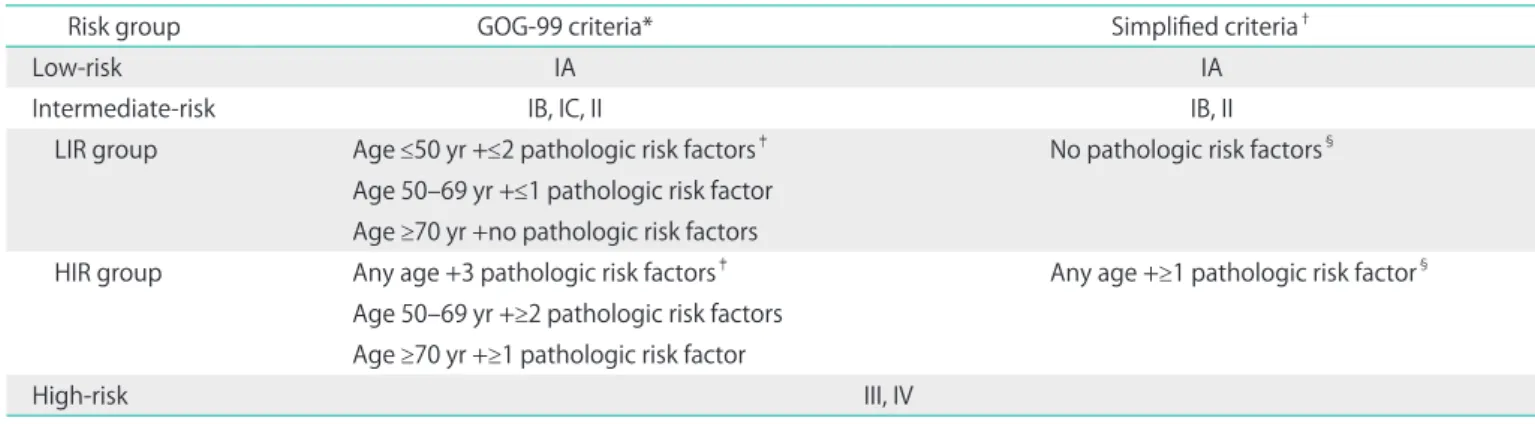
(2) HIR group; and (3) high-risk group [2,11]. As described in Table 1, low-risk tumors are confined to the uterus with less than 50% myometrial invasion. Intermediate risk tumors are limited to the uterus with greater than 50% myometrial inva- sion or cervical metastasis. According to the pathologic risk factors (grade 2 or 3 histology, positive LVSI, and myometrial invasion to outer 1/3) and advanced age, intermediate risk
Table 1. Comparison of low-, intermediate-, and high-risk groups in patients with surgically staged endometrial cancer according to the GOG and simplified criteria
Risk group GOG-99 criteria* Simplified criteria†
Low-risk IA IA
Intermediate-risk IB, IC, II IB, II
LIR group Age ≤50 yr +≤2 pathologic risk factors‡ No pathologic risk factors§ Age 50–69 yr +≤1 pathologic risk factor
Age ≥70 yr +no pathologic risk factors
HIR group Any age +3 pathologic risk factors‡ Any age +≥1 pathologic risk factor§ Age 50–69 yr +≥2 pathologic risk factors
Age ≥70 yr +≥1 pathologic risk factor
High-risk III, IV
GOG, Gynecologic Oncology Group; HIR, high-intermediate risk; LIR, low-intermediate risk.
*Based on 1988 International Federation of Gynecology and Obstetrics (FIGO) staging system. †Based on 2009 FIGO staging system. ‡(1) Grade 2 or 3 histology; (2) positive lymphovascular space invasion; (3) myometrial invasion to outer 1/3. §(1) Grade 2 or 3 histology; (2) positive lymphovascular space invasion.
group was categorized into LIR (age ≥70 years, no risk factors;
age 50 to 69 years, ≤1 risk factor; age ≤50 years, ≤2 risk factors) and HIR (any age, 3 risk factors; age 50 to 69 years, ≥2 risk fac- tors; age ≥70 years, ≥1 risk factor) subgroups. High-risk tumors have metastasis to the ovaries, vagina, LNs, or distant organs.
In our institution, vaginal brachytherapy has been considered as the standard adjuvant therapy for HIR patients. Systemic chemotherapy was used for high-risk patients.
Pearson chi-square test and Fisher exact test were used for categorical data, and the Student t-test and Mann-Whitney U statistics for continuous data according to normality. Disease- free survival (DFS) and OS was estimated by the Kaplan- Meier method. Univariate analysis of prognostic factors was performed with the log-rank test for categorical variables.
Multivariate analysis was performed using Cox proportional hazards model to assess the influence of prognostic factors on survival and to adjust the effect of confounding variables, and a backward stepwise selection was used to construct an optimum model. We designed the simplified risk criteria for adjuvant treatment according to the results of multivariate analysis. Using these criteria, patients were divided into low and LIR, HIR, and high-risk groups and their survivals were compared. In addition, we used the receiver operating charac- teristic (ROC) curve for disease recurrence and death in order to compare the new criteria with the GOG’s. Statistical analysis was performed using SPSS ver. 12.0 (SPSS Inc., Chicago, IL, USA). A significant level of 0.05 was used for all tests.
RESULTS
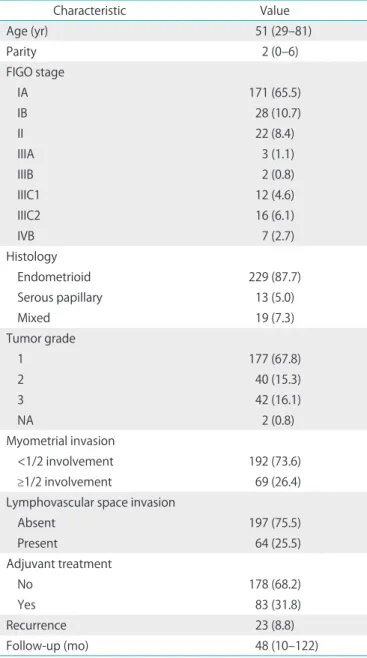
Table 2 shows clinical and pathologic characteristics of pa- tients. Median follow-up time was 48 months (range, 10 to 122 months). Of the 261 patients, 199 patients presented with stage I (171 IA, 28 IB), 22 had stage II, 33 had stage III (3 IIIA, 2 IIIB, 12 IIIC1, 16 IIIC2), and 7 had stage IV diseases. The majority of patients had endometrioid adenocarcinoma (87.7%) and others (12.3%) had serous adenocarcinoma or mixed carcinoma.
Twenty-three patients (8.8%) experienced disease recurrence.
The results of univariate and multivariate analyses are shown in Table 3. Using univariate analysis, non-endometrioid histol- ogy, tumor grade, myometrial invasion, peritoneal cytologic result, LVSI, lower uterine segment involvement, and adjuvant treatment were related to DFS. The Cox proportional hazards model found that the tumor grade 2 to 3 (odds ratio [OR], 4.49;
95% confidence interval [CI], 1.59 to 12.67) and LVSI (OR, 6.43;
95% CI, 1.97 to 21.06) were independently associated with DFS.
Using these two pathologic risk factors (tumor grade and LVSI), we determined the simplified criteria for tailoring adjuvant
therapy (Table 1). Based on our simplified criteria, patients were grouped as follows: (1) low-risk patients who had tumors confined to the uterus with less than 50% myometrial invasion and LIR patients who had tumors limited to the uterus with greater than 50% myometrial invasion or cervical metastasis, but no pathologic risk factors; (2) HIR patients whose tumors were confined to the uterus with greater than 50% myometrial invasion or cervical metastasis (2009 FIGO stage IB or II) and one or two pathologic risk factors, irrespective of age; (3) high-
Table 2. Patients’ characteristics (n=261)
Characteristic Value
Age (yr) 51 (29–81)
Parity 2 (0–6)
FIGO stage
IA 171 (65.5)
IB 28 (10.7)
II 22 (8.4)
IIIA 3 (1.1)
IIIB 2 (0.8)
IIIC1 12 (4.6)
IIIC2 16 (6.1)
IVB 7 (2.7)
Histology
Endometrioid 229 (87.7)
Serous papillary 13 (5.0)
Mixed 19 (7.3)
Tumor grade
1 177 (67.8)
2 40 (15.3)
3 42 (16.1)
NA 2 (0.8)
Myometrial invasion
<1/2 involvement 192 (73.6)
≥1/2 involvement 69 (26.4)
Lymphovascular space invasion
Absent 197 (75.5)
Present 64 (25.5)
Adjuvant treatment
No 178 (68.2)
Yes 83 (31.8)
Recurrence 23 (8.8)
Follow-up (mo) 48 (10–122)
Values are presented as median (range) or number (%).
FIGO, International Federation of Gynecology and Obstetrics; NA, not available.
risk patients with metastasis to the ovaries, vagina, LNs, or distant organs (2009 FIGO stage III or IV).
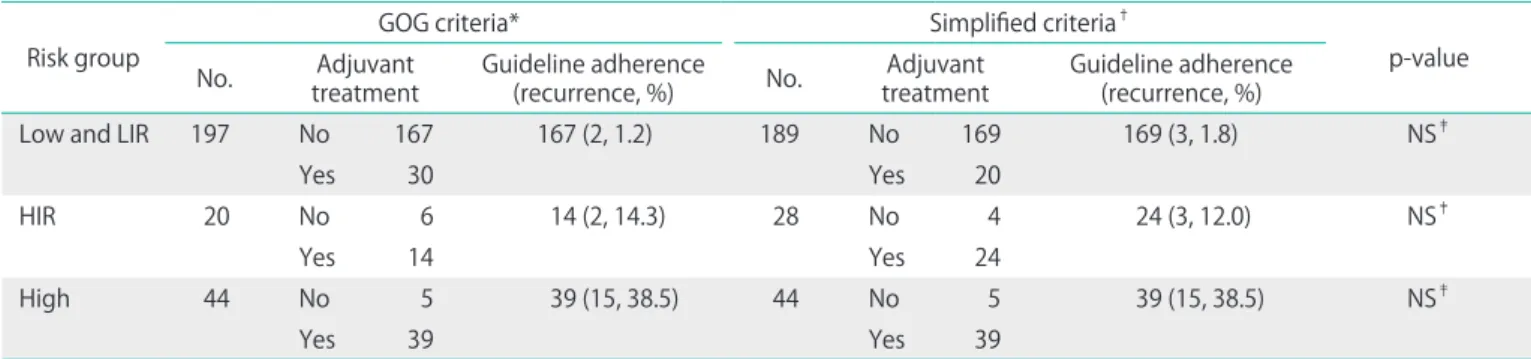
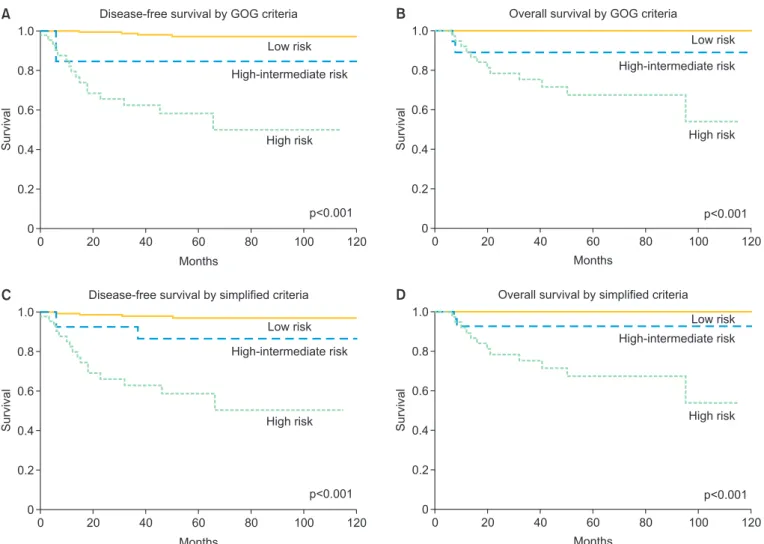
Table 4 shows comparison of patients group, adjuvant treat- ments, and recurrences according to the GOG and simplified criteria. Based on the GOG criteria, four patients (2.0%) in the low and LIR groups and three patients (15.0%) in the HIR group had recurrent disease. On the other hand, four patients (2.1%) in the low and LIR groups and three patients (10.7%) in the HIR group had disease recurrence according to our criteria. For the patients who adhered to these two guidelines; thus, there was no significant difference in the rate of disease recurrence (Table 4). According to the GOG criteria, we identified 197 low and LIR patients, 20 HIR patients, and 44 high-risk patients. There were significantly differences in DFS (p<0.001) and OS (p<0.001)
among the three groups (Fig. 1). Using the simplified criteria, we identified 189 low and LIR patients, 28 HIR patients, and 44 high-risk patients. There were significantly differences in DFS (p<0.001) and OS (p<0.001) among the three groups (Fig. 1). Using the Kaplan-Meier method, we found that low and LIR patients by each of the above-noted criteria had best DFS and OS than HIR and high-risk patients. These differences were statistically significant. Thus, the simplified criteria can discriminate patients as well as the GOG criteria.
ROC curves were obtained to evaluate the performance of two criteria for disease recurrence and deaths in patients who underwent surgical staging (Fig. 2). The performance of the simplified criteria (disease recurrences: area under the curve [AUC], 0.829 [95% CI, 0.732 to 0.926]; deaths: AUC, 0.916 [95%
Table 3. Univariate and multivariate analyses of clinicopathologic factors for disease-free survival in surgically staged endometrial cancer patients
Variable No. Univariate analysis Multivariate analysis
p-value OR (95% CI) p-value
Age (continuous) 261 0.07 0.99 (0.95–1.05) 0.91
Non-endometrioid histology 32 0.01 1.13 (0.20–6.50) 0.89
Grade
1 177
2–3 82 <0.01 4.49 (1.59–12.67) 0.01
Myometrial invasion ≥1/2 69 <0.01 1.88 (0.60–5.93) 0.28
Positive peritoneal cytology 11 <0.01 3.90 (0.87–17.56) 0.08
Lymphovascular invasion
Absent 197
Present 64 <0.01 6.43 (1.97–21.06) <0.01
Lower uterine segment involvement 42 <0.01 1.07 (0.36–3.19) 0.90
Adjuvant treatment 83 <0.01 0.43 (0.10–1.86) 0.43
CI, confidence interval; OR, odds ratio.
Table 4. Comparison of patients group, adjuvant treatments, and recurrences according to the Gynecology Oncology Group and simplified cri- teria
Risk group
GOG criteria* Simplified criteria†
p-value
No. Adjuvant
treatment Guideline adherence
(recurrence, %) No. Adjuvant
treatment Guideline adherence (recurrence, %)
Low and LIR 197 No 167 167 (2, 1.2) 189 No 169 169 (3, 1.8) NS‡
Yes 30 Yes 20
HIR 20 No 6 14 (2, 14.3) 28 No 4 24 (3, 12.0) NS‡
Yes 14 Yes 24
High 44 No 5 39 (15, 38.5) 44 No 5 39 (15, 38.5) NS‡
Yes 39 Yes 39
GOG, Gynecologic Oncology Group; HIR, high-intermediate risk; LIR, low-intermediate risk; NS, not significant.
*Based on 1988 International Federation of Gynecology and Obstetrics (FIGO) staging system. †Based on 2009 FIGO staging system. ‡For the patients who adhered to the GOG and simplified criteria, there was no significant difference in the rate of disease recurrence.
Fig. 2. Receiver-operating characteristics curve on (A) disease-free survival and (B) overall survival. GOG, Gynecologic Oncology Group.
Sensitivity
A
1.00
0.00 0.25 0.50 0.75 1.00
1-Specificity 0.00
0.75
0.50
0.25
Reference line New criteria GOG criteria Source of the curve
Sensitivity
B
1.00
0.00 0.25 0.50 0.75 1.00
1-Specificity 0.00
0.75
0.50
0.25
Reference line New criteria GOG criteria Source of the curve
p=0.872 p=0.806
Fig. 1. (A) Disease-free survival and (B) overall survival by the Gynecologic Oncology Group (GOG) criteria and (C) disease-free survival and (D) overall survival by the simplified criteria.
B
1.0
0.8
0.6
0.4
0.2
0 20 40 60 80 100 120
0
Low risk High-intermediate risk
High risk
Months
Survival
p<0.001
Survival
A
1.0
0.8
0.6
0.4
0.2
0 20 40 60 80 100 120
0
Low risk High-intermediate risk
High risk
D
1.0
0.8
0.6
0.4
0.2
0 20 40 60 80 100 120
0
Low risk High-intermediate risk
High risk Months
Months
Survival
p<0.001
C
1.0
0.8
0.6
0.4
0.2
0 20 40 60 80 100 120
0
Low risk High-intermediate risk
High risk
Months
Survival
p<0.001 p<0.001
Overall survival by GOG criteria Disease-free survival by GOG criteria
Disease-free survival by simplified criteria Overall survival by simplified criteria
CI, 0.877 to 0.956]) was as good as the GOG’s (disease recur- rences: AUC, 0.836 [95% CI, 0.740 to 0.931]; deaths: AUC, 0.921 [95% CI, 0.883 to 0.958]). There were no statistical differences between ROC curves of both criteria on DFS (p=0.806) and OS (p=0.872).
DISCUSSION
The objective of our study was to determine whether the GOG criteria are still valid in a different cohort of patients. Keys et al. [2] suggested the HIR criteria for adjuvant RT in surgically staged endometrial cancer patients with HIR based on the 1998 FIGO staging system and showed that there was a significant improvement of DFS in patients receiving adjuvant pelvic RT. We adopted the GOG criteria to classify patients into low and LIR, HIR, and high-risk groups and compared survivals among three groups. In our study, low and LIR patients had best DFS and OS than HIR and high-risk patients. This suggests that the GOG criteria could be well applicable to different co- horts and patients who would benefit from adjuvant therapy be properly selected. However, it is difficult to adopt the GOG criteria easily because of their complicated combinations.
Tumor grade, depth of myometrial invasion, and cervical stromal invasion of endometrial cancer have been shown to be significant indicators, hence their inclusion in the FIGO staging system. During the last 20 years, age has become one of the most debated topics determining adjuvant therapy for early stage, high-risk subgroups of endometrial cancer. The PORTEC trial found that locoreginal recurrence rate was three- fold higher for patients age 60 and over [1]. Similarly, the GOG 99 identified increasing age, including age ≥70 years, as poor prognostic factors [2]. However, several factors, including more aggressive histologic type, poor immunological defense against cancer, or less cancer-directed therapy in the elderly, may affect this analysis. First, these RCTs evaluated age as a prognostic factor in early stage endometrial cancer patients with all histologic types including papillary serous and clear cell. Hoffman et al. [6] showed that endometrial cancer in the elderly (75 to 92 years of age) is more aggressive, histologically less differentiated, and often nonendometrioid compared with endometrial cancer in the general population.
Furthermore, age greater than 70 in patients with endome- trioid endometrial cancers was not a statistically significant predictor of poor outcomes for OS after adjusting for other poor prognostic variables [9,10]. Second, the poor prognosis associated with advanced age may be in part related to the decreased frequency of surgical treatment [12]. Third, Truong et al. [13] reported that reduced use of postoperative RT in
stage IC disease was observed among women with advanced age and high comorbidity index. Therefore, age might be a less meaningful prognostic factor in women with endometrial cancer. Our study also showed that age was not a significant prognostic factor for disease recurrence.
LVSI has been shown repeatedly to be an independent poor pro gnostic factor for recurrence among patients with endo- metrial cancer [14-18]. Several studies suggested that poor outcome in histology, myometrial invasion, and LN metastasis might relate to their LVSI status. First, in the absence of LVSI, patients with endometrioid, serous, and clear cell histology would have a similar prognosis [17]. Second, Honore et al. [19]
noted that there was a significant increase in the risk of LVSI as the depth of myometrial invasion increases, with the relative risk being highest with full-thickness myometrial invasion.
Lastly, the presence of LVSI has been reported to be associ- ated with pelvic and/or para-aortic LN metastases, which are the most important prognostic factors in endometrial cancer [20,21]. In addition to these findings, Gadducci et al. [22]
analyzed the histopathologic variables predictive of the risk of local, distant, and retroperitoneal LN recurrence. Cervical involvement was an independent predictor of local relapse, while LVSI, myometrial invasion, and tumor grade were an independent predictor of distant failure. Therefore, among revised 2009 FIGO stage IB or II patients who showed invasion equal to or more than half of the myometrium or cervical stro- mal invasion, LVSI and tumor grade may serve as risk factors for recurrence. Using multivariate analysis in our study, LVSI and tumor grade were independent risk factors for prognosis.
Thus, we included these factors (LVSI and tumor grade) for formulating the simplified criteria.
We applied the GOG criteria and simplified criteria to our patients and compared survivals according to different criteria. Using the Kaplan-Meier method, we found that low and LIR patients by each of the above-noted criteria had best DFS and OS than HIR and high-risk patients. These differences were statistically significant. Thus, this simplified model can discriminate patients as well as the GOG’s. Our simplified criteria are simpler and more convenient to apply than the GOG criteria. Using ROC curves, we demonstrated that the performance of the simplified criteria was equal to that of the GOG criteria. Moreover, to our knowledge, this is the first study to validate the GOG criteria and investigate the simplified criteria for tailoring adjuvant RT.
Adjuvant external beam pelvic radiotherapy (EBRT) prevents the majority of pelvic disease recurrence, but many patients still die of distant metastatic disease [1,2,23]. Thus, there were several reports on adjuvant therapy to improve OS and decrease toxicity in endometrial cancer patients with HIR
features. PORTEC-2 showed that vaginal brachytherapy would be equally efficacious and less toxic than EBRT in patients with early stage endometrial cancer [3]. Our group suggested that complete pelvic and para-aortic lymphadenectomy followed by tailored adjuvant vaginal brachytherapy in HIR patients reduces locoreginal recurrence and also increases survival as the level of low-risk patients [24]. In addition, recent studies suggested a possible role for adjuvant chemotherapy in asso- ciation with RT for patients with HIR factors [25-28]. Therefore, the ongoing PORTEC-3 may verify and extend previous works.
Some limitations of the current study are the relatively small sample size and inherent drawbacks from its retrospective design. Despite being in the low and LIR groups, 12 patients received adjuvant therapy because of high-grade histologic features (grade 2 to 3) and deep myometrial invasion. Also, all HIR and high-risk patients did not receive adjuvant treat- ment despite our recommendations. Thus, adjuvant therapy was not given to the same number of patients according to the GOG and our simplified criteria because the results of adjuvant therapy were retrospectively compared and this may influence our results. However, the difference was relatively small and adjuvant therapy did not influence the prognosis as described in the results of multivariate analysis in this study.
In conclusion, the current study suggests the possibility that the new simplified criteria could be established, which predict prognosis and select proper candidates for adjuvant treatment in surgically staged endometrial cancer patients.
Our simplified criteria may be easily applicable and offer use- ful information for planning strategy of adjuvant treatment in patients with endometrial cancer as the GOG criteria.
CONFLICT OF INTEREST
No potential conflict of interest relevant to this article was reported.
REFERENCES
1. Creutzberg CL, van Putten WL, Koper PC, Lybeert ML, Jobsen JJ, Warlam-Rodenhuis CC, et al. Surgery and postoperative radio- therapy versus surgery alone for patients with stage-1 endometrial carcinoma: multicentre randomised trial. PORTEC Study Group.
Post Operative Radiation Therapy in Endometrial Carcinoma.
Lancet 2000;355:1404-11.
2. Keys HM, Roberts JA, Brunetto VL, Zaino RJ, Spirtos NM, Bloss JD, et al. A phase III trial of surgery with or without adjunctive external pelvic radiation therapy in intermediate risk endometrial adeno- carcinoma: a Gynecologic Oncology Group study. Gynecol Oncol
2004;92:744-51.
3. Nout RA, Smit VT, Putter H, Jurgenliemk-Schulz IM, Jobsen JJ, Lutgens LC, et al. Vaginal brachytherapy versus pelvic external beam radiotherapy for patients with endometrial cancer of high- intermediate risk (PORTEC-2): an open-label, non-inferiority, randomised trial. Lancet 2010;375:816-23.
4. Pecorelli S. Revised FIGO staging for carcinoma of the vulva, cervix, and endometrium. Int J Gynaecol Obstet 2009;105:103-4.
5. Guntupalli SR, Zighelboim I, Kizer NT, Zhang Q, Powell MA, Thaker PH, et al. Lymphovascular space invasion is an independent risk factor for nodal disease and poor outcomes in endometrioid endometrial cancer. Gynecol Oncol 2012;124:31-5.
6. Hoffman K, Nekhlyudov L, Deligdisch L. Endometrial carcinoma in elderly women. Gynecol Oncol 1995;58:198-201.
7. Sutton GP, Geisler HE, Stehman FB, Young PC, Kimes TM, Ehrlich CE.
Features associated with survival and disease-free survival in early endometrial cancer. Am J Obstet Gynecol 1989;160:1385-91.
8. Grigsby PW, Perez CA, Kuten A, Simpson JR, Garcia DM, Camel HM, et al. Clinical stage I endometrial cancer: prognostic factors for local control and distant metastasis and implications of the new FIGO surgical staging system. Int J Radiat Oncol Biol Phys 1992;22:905- 11.
9. Mundt AJ, Waggoner S, Yamada D, Rotmensch J, Connell PP. Age as a prognostic factor for recurrence in patients with endometrial carcinoma. Gynecol Oncol 2000;79:79-85.
10. Fleming ND, Lentz SE, Cass I, Li AJ, Karlan BY, Walsh CS. Is older age a poor prognostic factor in stage I and II endometrioid endometrial adenocarcinoma? Gynecol Oncol 2011;120:189-92.
11. Fanning J. Long-term survival of intermediate risk endometrial cancer (stage IG3, IC, II) treated with full lymphadenectomy and brachytherapy without teletherapy. Gynecol Oncol 2001;82:371-4.
12. Ahmed A, Zamba G, DeGeest K, Lynch CF. The impact of surgery on survival of elderly women with endometrial cancer in the SEER program from 1992-2002. Gynecol Oncol 2008;111:35-40.
13. Truong PT, Kader HA, Lacy B, Lesperance M, MacNeil MV, Berthelet E, et al. The effects of age and comorbidity on treatment and outcomes in women with endometrial cancer. Am J Clin Oncol 2005;28:157-64.
14. Briet JM, Hollema H, Reesink N, Aalders JG, Mourits MJ, ten Hoor KA, et al. Lymphvascular space involvement: an independent pro- gnostic factor in endometrial cancer. Gynecol Oncol 2005;96:799- 804.
15. Nofech-Mozes S, Ackerman I, Ghorab Z, Ismiil N, Thomas G, Covens A, et al. Lymphovascular invasion is a significant predictor for distant recurrence in patients with early-stage endometrial endometrioid adenocarcinoma. Am J Clin Pathol 2008;129:912-7.
16. O'Brien DJ, Flannelly G, Mooney EE, Foley M. Lymphovascular space involvement in early stage well-differentiated endometrial cancer is associated with increased mortality. BJOG 2009;116:991-4.
17. Narayan K, Khaw P, Bernshaw D, Mileshkin L, Kondalsamy- Chennakesavan S. Prognostic significance of lymphovascular space invasion and nodal involvement in intermediate- and high- risk endometrial cancer patients treated with curative intent using
surgery and adjuvant radiotherapy. Int J Gynecol Cancer 2012;
22:260-6.
18. Weinberg LE, Kunos CA, Zanotti KM. Lymphovascular space in- vasion (LVSI) is an isolated poor prognostic factor for recurrence and survival among women with intermediate- to high-risk early- stage endometrioid endometrial cancer. Int J Gynecol Cancer 2013;23:1438-45.
19. Honore LH, Hanson J. Statistical analysis of pathologic risk factors for intramyometrial lymphvascular space involvement in myoinvasive endometrial carcinoma. Int J Gynecol Cancer 2006;16:1330-5.
20. Akbayir O, Corbacioglu A, Goksedef BP, Numanoglu C, Akca A, Guraslan H, et al. The novel criteria for predicting pelvic lymph node metastasis in endometrioid adenocarcinoma of endometrium.
Gynecol Oncol 2012;125:400-3.
21. Chang SJ, Kong TW, Kim WY, Yoo SC, Yoon JH, Chang KH, et al.
Lymph-vascular space invasion as a significant risk factor for isolated para-aortic lymph node metastasis in endometrial cancer: a study of 203 consecutive patients. Ann Surg Oncol 2011;18:58-64.
22. Gadducci A, Cosio S, Fabrini MG, Fanucchi A, Barsotti C, Cristofani R, et al. Patterns of failures in endometrial cancer: clinicopathological variables predictive of the risk of local, distant and retroperitoneal failure. Anticancer Res 2011;31:3483-8.
23. Scholten AN, van Putten WL, Beerman H, Smit VT, Koper PC, Lybeert ML, et al. Postoperative radiotherapy for Stage 1 endo- metrial carcinoma: long-term outcome of the randomized PORTEC
trial with central pathology review. Int J Radiat Oncol Biol Phys 2005;63:834-8.
24. Kong TW, Paek J, Chang SJ, Chun M, Chang KH, Ryu HS. Com pre- hensive staging surgery including complete pelvic and para-aortic lymphadenectomy followed by adjuvant vaginal brachytherapy improves survival rates for intermediate-risk endometrial cancer patients. Gynecol Obstet Invest 2012;74:68-75.
25. Susumu N, Sagae S, Udagawa Y, Niwa K, Kuramoto H, Satoh S, et al.
Randomized phase III trial of pelvic radiotherapy versus cisplatin- based combined chemotherapy in patients with intermediate- and high-risk endometrial cancer: a Japanese Gynecologic Oncology Group study. Gynecol Oncol 2008;108:226-33.
26. Kuoppala T, Maenpaa J, Tomas E, Puistola U, Salmi T, Grenman S, et al. Surgically staged high-risk endometrial cancer: randomized study of adjuvant radiotherapy alone vs. sequential chemo- radiotherapy. Gynecol Oncol 2008;110:190-5.
27. Hogberg T, Signorelli M, de Oliveira CF, Fossati R, Lissoni AA, Sorbe B, et al. Sequential adjuvant chemotherapy and radiotherapy in endometrial cancer: results from two randomised studies. Eur J Cancer 2010;46:2422-31.
28. Landrum LM, Nugent EK, Zuna RE, Syzek E, Mannel RS, Moore KN, et al. Phase II trial of vaginal cuff brachytherapy followed by chemotherapy in early stage endometrial cancer patients with high-intermediate risk factors. Gynecol Oncol 2014;132:50-4.
█ █ █