- 33 -
Journal of Clinical Neurology / Volume 4 / March, 2008
Case Report
A Case Report of Painless Moving Toes Syndrome
Seon-Joo Kwon, MD, Jong-Min Kim, MD, Beom S. Jeon, MD
Department of Neurology, SNU Medical Research Center, Clinical Research Institute, Seoul National University College of Medicine, Seoul, Korea
This is the first report of a case of painless moving toes syndrome with radiculopathy. The patient presented with bilateral painless moving toes and unilateral subclinical sacral (S1) radiculopathy. Bilateral movements with the unilateral lesion, and fluctuation with postural changes and distant muscle contraction suggest that the underlying pathomechanism was a central reorganization in the spinal level.
J Clin Neurol 4(1):33-35, 2008
Key Words: Moving toes, Painless leg, Painful leg
Received: August 14, 2007 / Accepted: February 11, 2008 / Address for correspondence: Beom S. Jeon, MD, PhD
Department of Neurology, Seoul National University College of Medicine, 28 Yeongondong, Jongno-gu, Seoul, 110-744, Korea Tel: +82-2-2072-2876, Fax: +82-2-3672-4949, E-mail: [email protected]
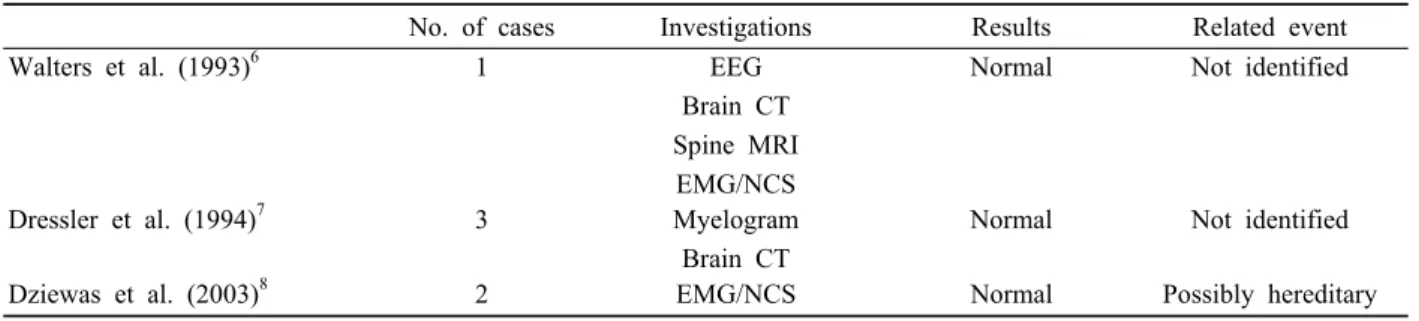
Table 1. Summary of reported cases of painless leg and moving toes syndrome
No. of cases Investigations Results Related event
Walters et al. (1993)6 1 EEG
Brain CT Spine MRI
EMG/NCS
Normal Not identified
Dressler et al. (1994)7 3 Myelogram
Brain CT
Normal Not identified
Dziewas et al. (2003)8 2 EMG/NCS Normal Possibly hereditary
Moving toes syndrome comprises involuntary sinuous, quivering, writhing, or wriggling contractions of the toes.1-5 This syndrome can occur with or without pain.
Painful leg and moving toes syndrome (PLMT) is more common than painless leg and moving toes syndrome (PoLMT), and is usually associated with peripheral nerve lesions such as radiculopathy and peripheral neuropathy.2,3 Damaged peripheral nerves are thought to give rise to ectopic or ephaptic impulses, triggering involuntary movements of the toe via a local network of interneurons.1,2
PoLMT is very rare. There are only six reported PoLMT cases in the literature (Table 1).6-8 Even though
the characteristic movements are similar, peripheral neuropathy has not been reported in PoLMT patients.
Here we describe a PoLMT patient with radiculo- pathy, whose characteristics provide evidence that PoLMT and PLMT are different manifestations of the same disorder.
CASE REPORT
A 24-year-old female had noticed involuntary move- ments in the right toes since the age of 12. The involun- tary movements of her right toes began insidiously,
Journal of Clinical Neurology: Vol. 4, No. 1, 2008
- 34 - Figure. T2-weighted MR image of the lumbosacral sacral cord showed mild protrusion and signal changes at the L5-S1 intervertebral disc.
worsened until the age of 18, and plateaued there- after. Pain and other sensory symptoms were absent.
The movements did not interfere with her daily activities, and she was not receiving any medications.
She visited the hospital due to the cosmetic nature of the movements.
There was no clinical history of trauma or family history of such movements. On examination, there were no abnormal findings except for the involuntary movements of the toes. The movements were 1-1.5 Hz, semirhythmic, and multidirectional (side-to-side/
adduction/flexion and extension/intorsion), with a sinusoidal, writhing, and wriggling appearance. They were nearly continuous, and intermittently increased in amplitude. Even though they could not be supp- ressed completely, they fluctuated in amplitude with postural changes and distant muscle contraction such as repetitive hand-gripping. The movements were mainly observed in the right toes, but similar move- ments appeared in the left toes intermittently, which had not been previously appreciated by the patient.
On electromyography, giant motor unit potentials were present in the S1 myotome of the right medial gastrocnemius. The findings of nerve conduction studies including of the H-reflex were normal. MRI of the
lumbosacral spine showed mild protrusion and signal changes at the L5-S1 intervertebral disc (Fig.). She had no symptoms suggestive of radiculopathy.
DISCUSSION
Previously reported cases of PoLMT did not have radiculopathy or peripheral neuropathy. Our patient is the first case of PoLMT associated with subclinical radiculopathy. The cause of the S1 radiculopathy in the patient was unclear. Her involuntary movements included activity of the S1 myotome, which is affected by radiculopathy. Therefore radiculopathy was assumed to be a cause of the involuntary movements.
The involuntary movements appeared bilaterally in the toes in our patient, which suggests that central reorganization (especially in the spinal level) is the cause of PoLMT, as it is in PLMT.11 After nerve injury, functional deficits may be compensated for by plasticity of the central nervous system. However, such plasticity is not perfect, and may result in maladaptive changes such as involuntary movements.12 Bilateral involvement has also been reported in PLMT associated with unilateral lesions.1-5 The altera- tions in the amplitudes of toe movements in our patient by postural changes and distant muscle contrac- tions also supports a central pathomechanism. Spinal oscillators have been proposed as the aberrant pacemaker in PLMT.13
REFERENCES
1. Spillane JD, Nathan PW, Kelly RE, Marsden CD. Painful legs and moving toes. Brain 1971;94:541-556.
2. Nathan PW. Painful legs and moving toes: evidence on the site of the lesion. J Neurol Neurosurg Psychiatry 1978;41:934-939.
3. Schott GD. “Painful legs and moving toes”: the role of trauma. J Neurol Neurosurg Psychiatry 1981;44:344-346.
4. Schoenen J, Gonce M, Delwaide PJ. Painful legs and moving toes: a syndrome with different pathophysiologic mechanisms. Neurology 1984;34:1108-1112.
5. Wulff CH. Painful legs and moving toes. A report of
Kwon SJ, et al. Painless Moving Toes Syndrome
- 35 - 3 cases with neurophysiological studies. Acta Neurol Scand 1982;66:283-287.
6. Walters AS, Hening WA, Shah SK, Chokroverty S.
Painless legs and moving toes: a syndrome related to painful legs and moving toes? Mov Disord. 1993;8:377- 379.
7. Dressler D, Thompson PD, Gledhill RF, Marsden CD.
The syndrome of painful legs and moving toes. Mov Disord 1994;9:13-21.
8. Dziewas R, Kuhlenbäumer G, Okegwo A, Lüdemann P. Painless legs and moving toes in a mother and her daughter. Mov Disord 2003;18:718-722.
9. Schott GD. Mechanisms of causalgia and related clinical conditions. The role of the central and of the
sympathetic nervous system. Brain 1986;109:717-738.
10. Ochoa JL, Torebjörk HE. Paraesthesiae from ectopic impulse generation in human sensory nerves. Brain 1980;103:835-853.
11. Verhagen WI, Horstink MW, Notermans SL. Painful arm and moving fingers. J Neurol Neurosurg Psychiatry 1985;48:384-385.
12. Navarro X, Vivó M, Valero-Cabré A. Neural plasticity after peripheral nerve injury and regeneration. Prog Neurobiol 2007;82:163-201.
13. Ebersbach G, Schelosky L, Schenkel A, Scholz U, Poewe W. Unilateral painful legs and moving toes syndrome with moving fingers evidence for distinct oscillators. Mov Disord 1998;13:965-968.