105
논문접수일 :2013년 3월 28일논문수정일 :2013년 4월 16일 심사완료일 :2013년 5월 24일
교신저자 :왕수건, 602-739 부산광역시 서구 아미동 1가 10 부산대학교 의과대학 부산대학교병원 이비인후과학교실 전화 :(051) 240-7335・전송:(051) 246-8668
E-mail:[email protected]
Introduction
Although a great variety of foreign bodies lodged in the tracheobronchial tree have been reported, the metallic tracheostomy tube as a foreign body is rarely found. Aspiration of various tracheostomy tubes into main bronchi has been described in patients given a tracheostomy, most of which were unilateral or PVC (polyvinyl chloride) tubes even if bilateral.
1-3)In this case, two separate fragments of metallic tracheosto- my tube were lodged in the bilateral main bronchi.
And then, two fragments of metallic tracheostomy tube lodged in bilateral main bronchi were successfully re- moved under local anesthesia for the first time in the
worldwide. So we report the first case of successful removal of two fragments of metallic tracheostomy tubes lodged in the bilateral main bronchi, with the review of relevant the literature.
Case Report
A 52-year-old male presented with cough and ex- cessive purulent sputum as the chief complaints. This patient had experienced glottic stenosis after giving a tracheostomy which was performed due to a stab wound of neck 30 years ago. At that time, metallic tra- cheostomy tube was placed for the patient. The metal- lic tracheostomy tube was broken by blunt trauma and lodged in the right main bronchus 20 years ago. How- ever, a metallic tracheostomy tube was reinserted without removing the fragment of broken tube from the bronchus because he had no specific complaints.
After the tube was reinserted, it was destructed by his own mistake, to make matters worse, it was subse- quently lodged in the left main bronchus 3 years lat-
A Case of Metallic Tracheostomy Tubes as Foreign Bodies Broken for a Long Time and Lodged in the Bilateral Main Bronchi
Seok-Hwan Lee, MD, Chan Hwi Park, MD, Il Woo Lee, MD and Soo-Geun Wang, MD Department of Otorhinolaryngology-Head & Neck Surgery, Pusan National University Hospital,
Pusan National University School of Medicine, Busan, Korea - ABSTRACT -
The case that fragments of metallic tracheostomy tubes lodged in bilateral main bronchi as foreign bodies rarely occurs. A 52-year-old male presented with excessive cough and purulent sputum induced by fragments of metal- lic tracheostomy tube in both main bronchi and the left pleural effusion. With the assistance of anesthesiologist with abundant experience, ventilating bronchoscopy under local anesthesia was attempted, and both the frag- ments of tubes were removed by the order of the right and the left. The patient showed the rapid improvement of symptoms after ventilating brochoscopy. This case is the first report in the world literatures that successful remov- al of fragments of metallic tracheostomy tube lodged in the both main bronchi as foreign bodies was done under local anesthesia maintaining self-respiration. (J Clinical Otolaryngol 2013;24:105-108)
KEY WORDS : Foreign bodyㆍTracheostomy tubeㆍBronchus.
臨床耳鼻:第 24 卷 第 1 號 2013
• • • • • • • • • • • • • • • • • • • • • • • • • • • • • • • • • • • • • • • • • • • • • • • • • • • • • • • • • • • • • • • • • • • • • • • • • • • • • • • • • • • • • • • • • • • • • • • • • • • • • • • • • • • • • • • • • • • • • • • • • • • • • • • • • • • • • • • • • • • • • • • • • • • • • • • • • • • • • • • • • • • • • • • • • • • • • • • • • • • • • • • • • • • • • • • • • • • • • • • • • • • • • • • • • • • • • • •
J Clinical Otolaryngol 2013;24:105-108
증 례
online©MLComm
J Clinical Otolaryngol 2013;24:105-108
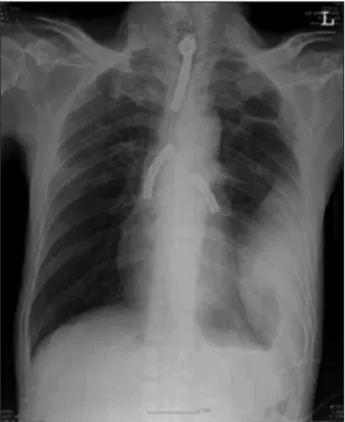
106 er. Even though he had not complained dyspnea or any other special symptoms for about 15 years, exces- sive cough and sputum were increased from 1 week prior to the visit. The radio-opaque shadows like de- stroyed metallic tubes in both main bronchi and the left pleural effusion were shown in chest radiologic findings (Fig. 1). In chest computed tomography, for- eign bodies were observed in both main bronchi. In laryngoscopy, both vocal cords fixation with the glot- tic web were observed (Fig. 2). Secretion was greatly increased within the tube settled at both main bronchi, which made it difficult to insert an endoscope into the tube. By diagnostic thoracentesis, gross pus was de- tected through the chest tube, but dyspnea became more severe. We’ve decided to surgical intervention.
With the assistance of anesthesiologist with abundant experience, ventilating bronchoscopy under local an- esthesia (with xylocaine) was attempted.
And then, both fragments of metallic tracheostomy tubes (foreign body) were removed using grasping forcep by the order of the right and the left through
ventilating bronchoscope maintaining self-respiration (Fig. 3).
After the removal of foreign bodies, the patient showed the rapid improvement of the symptoms and empyema. He was discharged 21 days after surgery.
Until now, he is under the regular follow up observa- tion without special complications during 16 months.
While glottic web remains with both vocal cords fix- ation, we have no idea whether or not nerve palsy is present because electromyogram was not checked.
The patient refused follow-up examinations recom-
Fig. 1. Chest plain film reveals the radio-opaque destroyed metal shaped shadow in both main bronchi and the left pleural effusion.
Fig. 2. Laryngoscopic finding shows both vocal cords fix- ation and glottic web.
Fig. 3. It demonstrates removed fragments of metallic
tracheostomy tubes.
Seok-Hwan Lee, et al : Metallic Tracheostomy Tubes in the Bilateral Main Bronchi
107 mended by physicians, so we checked only larynx CT scan that he wanted. Larynx CT scan revealed no specific abnormal findings other than glottis stenosis.
Although we recommended further treatments, he re- fused any other treatment. The case has been studied with the approval of the Institutional Research Com- mittee of the Pusan National University School of Medicine.
Discussion
Although bilaterally developing foreign bodies in the airway are uncommon, foreign bodies in the bi- lateral main bronchus represent 3.1% of the cases re- ported.
4)This case, distinct from other cases, shows that bilateral foreign bodies were developed with the time difference of several years. Because it was met- al foreign bodies with soft surface, air ventilation was allowed through the tube lumen in some degrees. Con- sequently, the patient could endure the symptoms rel- atively for a long time. Several factors for the break- age of metal tubes have been considered. Bowdler et al. reported the breakage caused by frequent washing, repeated insertion, and other physical compressions.
5)Maru et al. reported that it was caused by the erosion of the zinc and copper alloy area of metallic tube by alkaline bronchial secretion.
6)This case shows that ir- regular washing and repeated exchanging of tube caused the erosion, the erosion seems to be one of the important factors which cause the breakage. Recent years have seen an increase in the use of synthetic tubes (e.g. PVC tube) that can be easily exchanged by guard- ians. The most important advantage of synthetic tubes is the characteristic of thermoplastic, which makes the tube shape adjustable to the contour of bronchus depending on temperature.
7)Gupta reported a case of fractured tracheostomy tube which involved an 8-years- old male having metallic tracheostomy tube for laryn- geal diphtheria.
8)Two fractured flanges revealed in chest X-ray, one was in the right main bronchus and the other was in the posterior basal segment of the left lung. However, the tube in the left lung could not be
removed because of deep anatomical location, mild symptom, and refusal of thoracotomy. Although sev- eral cases of fractured metallic tracheostomy tubes have been reported after 2000, all of them were uni- lateral fractured tubes.
1,2)Apart from other cases pre- viously reported, this report deserves the first success- ful removal case of fragments of metallic tracheostomy tube lodged in bilateral main bronchi for a long time.
In addition, when the ventilating rigid bronchoscope is inserted through mouth, general anesthesia should be performed because of uncooperation of patients during procedure. Although, general anesthesia is ad- ministrated for bronchoscopy, remaining of spontane- ous respiration is better for preventing acute airway obstruction. If thick secretions through rigid brochos- copy block the airway, jet ventilation might be need- ed. In this case, general anesthesia was difficult be- cause of purulent sputum and dyspnea due to metallic tube in both main bronchus.
However, topical anesthesia could be administrat- ed easily because tracheostomy was made earlier.
Therefore, we could complete the removal of foreign bodies while remifentanil was infused and spontane- ous respiration was kept. In conclusion, we recom- mend that the patients with metallic tracheostomy tube should cleanse and manage gently not to be broken and not to be eroded.
This work was supported by the year 2013 clinical research grant from Pusan National University Hospital.
REFERENCE
1) Qureshi SS, Chaukar D, Dcruz A. Fractured tracheosto-
my tube in the tracheobronchial tree. J Coll Physicians Surg Pak 2006;16(4):303-4.
2) Hajipour A, Khan ZH. Fractured and aspiration of metal-
lic tracheostomy tube. Saudi Med J 2007;28(3):468.
3) Gana PN, Takwoingi YM. Fractured tracheostomy tubes
in the tracheobronchial tree of a child. Int J pediatr Otorhi- nolaryngol. 2000;53(1):45-8.
4) Banerjee A, Rao KS, Khanna SK, Narayanan PS, Gupta BK, Sekar JC, et al. Laryngo-tracheo-bronchial foreign
bodies in children. J Laryngol Otol 1988;102(11):1029-32.
5) Bowder DA, Emery PJ. Tracheostomy tube fatigue: an un-
usual cause of inhaled foreign body. J laryngol Otol 1985;
J Clinical Otolaryngol 2013;24:105-108
108 99(5):517-21.
6) Maru YK, Puri ND, Majid A. An unusual foreign body
in the tracheobronchial tree. J Laryngol Otol 1978;92(11):
1045-8.
7) Rogers JH. Tracheostomy and decannulation. In: Adams
DA, Cinnamond MJ, editors. Scott Brown, 6th ed. Butter- worth Heinemann;1997. p.5/7/1-5/7/20.
8) Gupta SC. Fractured tracheostomy tube: an overlooked