Research Article Open Access
Effects of Pressure Sense Perception Training on Unstable Surface on Somatosensory, Balance and Gait Function in Patients with Stroke
Bo-seul Kim, PT⋅Dae-hyouk Bang, PT, MSc
1⋅Won-seob Shin, PT, PhD
1,2†Department of Physical Therapy, Graduate School of Health and Medical, Daejeon University
1
Department of Physical Therapy, Daejeon University Graduate School
2
Department of Physical Therapy, Collage of Health and Medical Science, Daejeon University
Received: June 29, 2015 / Revised: July 1, 2015 / Accepted: July 21, 2015
ⓒ 2015 J Korean Soc Phys Med
| Abstract |
1)PURPOSE: This study aimed to investigate the effects of pressure sense perception training (PSPT) on various surfaces on the somatosensory system, balance, and walking ability in chronic stroke patients.
METHODS: Thirty patients with stroke participated in this study and were randomly assigned to one of three groups;
group 1 received the general physical therapy and the PSPT on a stable surface, group 2 received the general physical therapy and the PSPT on an unstable surface, and group 3 received the general physical therapy alone. Participants in group 1 and group 2 underwent 30 min/session, 3 days per week, for 4 weeks. Pressure error (PE) was used to evaluate changes of proprioception. The Balancia, Functional reach test (FRT), and Timed Up and Go (TUG) were used to assess the balance ability, and the 10m Walking Test (10-MWT) was used to assess walking ability.
RESULTS: Experimental groups (group 1 and group 2) showed significant differences in PE, FRT, TUG, and
†Corresponding Author: [email protected]
This is an Open Access article distributed under the terms of the Creative Commons Attribution Non-Commercial License (http://creativecommons.org/licenses/by-nc/3.0) which permits unrestricted non-commercial use, distribution, and reproduction in any medium, provided the original work is properly cited.
10-MWT compared to the control group (p <0.05). Group 2 (PSPT on an unstable surface) was significantly different in PE, FRT, and 10-MWT from group 1 (p <0.05). No significant differences were observed for other measures.
CONCLUSION: Pressure sense perception training on an unstable surface might be a significantly more effective method for improving somatosensory function, balance, and walking ability, than PSPT on a stable surface.
Key Words: Sensorimotor training, Balance ability, Walking ability, Pressure sense perception
Ⅰ. Introduction
Most stroke survivors suffer from impaired motor
function in the lower extremities (Bang et al, 2014). The
impaired lower limb is typically weak, slow, lacks coordina-
tion, and may show spasticity. What patients desire most
among the limitations of activities of daily living (ADL)
is improvement in walking ability (Rosen et al, 2005), since
it is necessary for daily life and social participation (Macko
et al, 2008). Balance ability is an important factor for
independent walking in stroke patients (Kusoffsky et al,
2001), as previous studies on walking intervention in stroke
have in stroke have reported (Mentiplay et al, 2015;
Rodrigues-Baroni et al, 2014). Various walking intervention protocols based on balance ability have been designed and evaluated (Park and Hwangbo, 2015).
Balance is divided into static and dynamic balance. Static balance is maintained without movement. Dynamic balance is maintained through stimulation from the external environment (Geurts et al, 2005; Ragnarsdóttir, 1996).
Sensory disturbance, and limited motor control may determine asymmetrical walking or standing, leading to decreased balance ability and increased risk of falling (Cheng et al, 2001). Thus, improvement of balance ability improves the quality of life and social participation (Hendrickson et al, 2014; Marigold and Eng, 2006).
Typically, individuals derive sensory input from the visual, vestibular, and somatosensory systems for balance control (Cheng et al, 2001). Weight bearing ability of stroke patients was less for the affected side compared with the less affected side. Also sensory problems are difficult to weight shifting (Eng and Chu, 2002; Goldie et al, 1996).
In the previous studies, the most effective method for improving the balance ability in patients with stroke was to improve the impaired somatosensory system (Ju and Yoo, 2014; Silva et al, 2015). The method of somatosensory improvement consists of the affected side on a stable surface while the less affected side is on an unstable surface (Ju and Yoo, 2014). In a study by Ahmed (2011), the training protocol was composed of a step by step regimen of sitting, standing, and standing with one leg on an unstable surface.
This study showed improvement in balance. Proprioception is involved position, movement, force, weight, pressure et al (Stillman, 2002). Proprioceptive training is focus on proprioceptive sense. Proprioceptive training is an intervention that the improved of sensorimotor or somato- sensory performance (Aman et al, 2014). The purpose of pressure sense perception training (PSPT) is to acquire postural stability during rest and motion. Sway around the center of gravity is the index thought to most directly reflect
postural stability.
However, little is known about the effects of PSPT on an unstable surface on the changes in somatosensory ability of stroke patients. The purpose of this study was to investigate and evaluate the effects of PSPT on somatosensory system, balance, and walking ability in chronic stroke patients, on various surfaces.
Ⅱ. Methods
1. Participants
All subjects were patients with chronic stroke undergoing hospital rehabilitation, and independent standing maintenance.
The analysis included thirty patients (20 men and 10 women) with no missing data on the outcome measure.
Table 1 outlines the baseline characteristics of the participants.
The inclusion criteria were: (1) experienced a unilateral stroke at least 6 months post event or more, (2) able to maintain a standing position on the balance mat over 30 seconds, (3) capable of standing without any assistance over 30 seconds, (4) not training in any interventions from other institutions, and (5) sufficient cognition to participate in the training, that is, a Mini-Mental State Exam (MMSE) score of 24 or higher (Park and Kwon, 1989), (6) Semmes-Weinstein monofilaments test, size up to 5.07 discrimination of the foot pressure. The 5.07 monofilament is detected protect sense of threshold (Feng et al, 2009).
The exclusion criteria were: (1) any comorbidity or disability other than the stroke that precludes training, and (2) any uncontrolled health conditions for which training is contradicted. The study was approved by the Daejeon University institutional review board, and all participants provided informed consent.
2. Study design
This study was a double-blinded, randomized controlled
design. Participants were randomized into three groups
(directly after the test) by a physical therapist not involved in the study. All of the enrolled patients were randomly assigned to 1 of 3 groups using a table of random numbers;
group 1 received general physical therapy and the PSPT on a stable surface, group 2 received general physical therapy and the PSPT on an unstable surface, and group 3 received general physical therapy alone.
3. Procedure
Subjects in the three groups participated in a rehabilitation program consisting of physiotherapy and occupational therapy during a 60-min session, 5 days per week, for 4 weeks. In addition, the experimental group (group 1 on the stable surface and group 2 on the unstable surface (balance pad) participated in the PSPT described below. Participants in experimental groups (group 1 and group 2) underwent 30 min/session, 3 days per week, for 4 weeks.
1) Pressure sense perception training
The therapist measured the minimum and maximum pressure of the more affected side before training, for the subjects of the experimental groups (group 1 and group 2). Participants were asked to keep both feet parallel at 100 mm distance, and to conduct a forward weight shift in the standing position. Participants were then asked to shift weight forward to the more affected side. After weight shifting, this position was maintained for 5 seconds. When the participants were tired, they had a break of 3 minutes in the sitting position (Goldie et al, 1996). The forefoot on both sides was attached to foam (50 cm × 41 cm × 6 cm) (group 1 was assigned stable foam and group 2 was assigned balance pad). The foam (stable and unstable) was considered to be equal to the height:weight ration.
Pressure is measured into the heel in order to avoid compensatory plantar flexion. Knee joint of the more affected side shows slight flexion. Immediately after the subject’s response, verbal feedback was obtained if it fail
to test reproduced the pressure. Each training session was performed step by step. For the PSPT, we used the pressure error (stage 1 and stage 2). Before training, participants were measured both at minimum and maximum pressure.
Minimum pressure was measured when training in a standing position. Maximus pressure was measured when training position with weight bearing to affected side.
Therapists set up the target weight which was between minimum pressure and maximum pressure. Stage 1 is trained by pressing the scales lower than the average of the minimum and maximum pressure. Stage 2 is trained by pressing the scales higher than the average of the minimum and maximum pressure. In case that the error from the target weight was within 1kg, it was marked as 60% successful and proceeded to the next stage (Byun, 2014).
2) General physical therapy
Subjects in the three groups participated in a rehabilitation program consisting of physiotherapy, which included ordinary postural control exercises, such as maintenance of standing, and shift of the weight loads to both sides.
4. Outcome measures
Pressure error was used to evaluate the changes in proprioception. The Balancia, Functional reach test (FRT), and Timed Up and Go (TUG) were used to assess the balance ability; the 10-M Walking Test (10-MWT) was used to assess walking ability.
Pressure error (PE) (stage 1 and stage 2) was measured using a hand-held Dynamometer. Pressure error in stage 1 and stage 2 was measured 3 times and the mean of pressure error was recorded. Measurements were done while participants kept their eyes closed in supine position (Kang et al, 2013). Kim et al. (2014) studies method were used joint position sense, force sense to proprioception measurement.
The Balancia uses the Wii balance board (WBB)
PSPT on a stable surface group (n=10)
PSPT on an unstable surface group (n=10)
Control group (n=10) χ2/F Gender (n)
Male 4 8 8
Female 6 2 2 0.01
Side of stroke (n)
Right 3 4 5
Left 7 6 5 0.66
Type of stroke (n)
Infarction 4 4 3
Hemorrhage 6 6 7 0.87
Time after stroke (month) 42.20(21.61) 37.80(22.40) 50.70(13.83) 0.34
Age (years), mean (SD) 54.70(3.09) 59.40(8.63) 56.40(11.87) 0.48
MMSE (scores), mean (SD) 26.10(1.96) 26.60(1.71) 26.30(2.03) 0.85
NOTE. Baseline demographic data for participants include in the three different groups and significance level at p<0.05 for difference between the groups.
Abbreviations: PSPT, pressure sense perception training; MMSE, mini-mental state examination.
(Nintendo, Kyoto, Japan). The WBB was used to measure static balance. The WBB collects Center of Pressure (COP) information of the load cell located at the four corners of a 50 cm × 50 cm rectangle and transfers the information to a computer via Bluetooth. The Balancia program (Balancia 2.0, Mintosys, Korea) was used in standing position to analyze the COP of the path-length and velocity average. Participants were asked to take up a comfortable standing position, with a distance between heels of 5~6cm, during WBB measurements (Lisiński et al, 2012; Park et al, 2013). The measurements were taken 3 times in the standing position, with each measurement lasting 30 seconds.
The FRT is measured by the maximal reaching distance in the front and metacarpal phalangeal joint (Newton, 2001). If participants could not reach, the acromion distance was measured. The participants were asked to stand 3 times, and the average forward distance time was recorded.
The TUG was used as a dynamic balance test. This test records the time taken to rise from a chair (height:
50 cm), walk 3 m, turn around a marker, walk back to the chair, and sit down. The participants were asked to
walk 3 times, and the average round-trip time was recorded.
A 10-MWT was performed by walking 10 m to measure the gait speed (Van Loo et al, 2004). The walkway was 14 m long, including a 2-m section for acceleration and a 2-m section for deceleration, and it has been used in other studies. The participants were asked to walk as fast and as safely as they could. Gait speed was measured with a stop watch. The participants were asked to walk 3 times, and the mean round-trip time was recorded.
5. Data analysis
SPSS 18.0 for Windows (Chicago, IL, USA) was used
for statistical analysis. The Kruskal-Wallis test or a 1-way
analysis of variance was used to assess the homogeneity
between groups before the study. Because outcome
measurement data showed parametric distributions, the
paired t-test was used to compare data obtained before
and after treatment in each group. The 1-way analysis of
variance was followed by a Scheffe post-hoc test for
comparison of significant differences among groups. All
statistical tests were completed at the 0.05 alpha level.
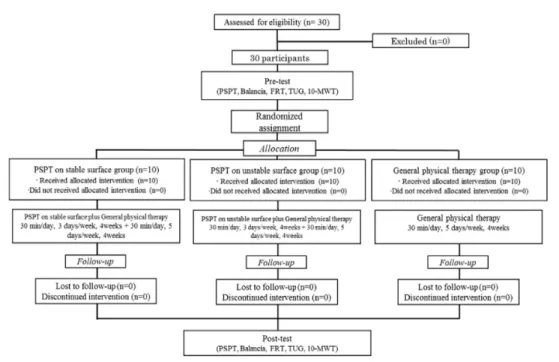
Fig. 1. Flow diagram
Balancia conclude the static balance (path-length, velocity average).
Abbreviations: PSPT, pressure sense perception training; FRT, functional reach test; TUG, time up and go test; 10-MWT, 10m walk test.
Ⅲ. Results
Thirty people fulfilled the criteria and voluntarily agreed to participate in this study. All participants completed the entire study. There were no significant differences in the age, duration of onset, sex, side of stroke, type of stroke, and MMSE (Table 1). The three groups were not significantly different in the pressure error (PE) (stage 1 F=2.95, p>0.05 and stage 2 F=0.76, p>0.05), Balancia (path-length F=1.43, p>0.05 and velocity average F=0.18, p>0.05), FRT (F=0.31, p>0.05), TUG (F=1.87, p>0.05), and 10-MWT (F=3.32, p>0.05) in the pre-test (Table 2).
The study was conducted 30 min/day, 3 days a week, for 4 weeks. All procedures are shown in the flow diagram (Fig. 1). There were significant differences among the groups for all tests between the pre- and post- test. Table 2 shows the results of participants in PE, Balancia, FRT,
TUG, and 10-MWT. The experimental groups (group 1 and group 2) had significantly higher differences than the control group in PE, Balancia, FRT, and 10-MWT (p<0.05) (Table 2). Group 2 showed a significant difference from group 1 in PE, Balancia (velocity average), FRT, TUG, and 10-MWT (p<0.05).
Ⅳ. Discussion
This study was conducted to investigate the effect of PSPT on various surfaces in patients with chronic stroke.
PSPT is a special program aimed at motor control through
sensory input to improve balance. The study revealed that
experimental groups (group 1 and group 2) showed
significant differences in the pressure error (PE), Balancia
(path-length, velocity average), FRT, TUG, and 10-MWT,
Variables Group 1 (n=10) Group 2(n=10) Group 3 (n=10) Pre-test Post-test Pre-test Post-test Pre-test Post-test F
Stage 1 Pressure error 6.85(2.28) 1.90(1.90)*† 8.71(1.95) 1.55(1.33)*§ 6.85(1.64) 5.44(1.63)*‡ 32.79 Stage 2 Pressure error 6.99(2.46) 1.88(1.06)*† 8.17(3.23) 2.39(1.60)*§ 8.32(2.09) 6.76(2.36)*‡ 8.50
Balanacia
Path-Length (cm) 85.30(7.54) 71.59(6.95)* 92.37(12.79) 73.08(10.21)*§ 78.94(26.94) 84.36(10.87)*‡ 7.69 Velocity average (cm/s) 8.54(1.52) 4.49(0.97)*† 9.05(1.67) 2.61(0.75)*§ 8.76(2.51) 6.77(1.61)*‡ 35.05
FRT (cm) 5.99(2.40) 9.99(2.53)*† 6.90(3.53) 14.28(4.26)*§ 7.05(3.75) 8.93(4.68)*‡ 46.64 TUG(m/s) 28.36(12.69) 24.75(12.17)*† 19.90(3.78) 13.15(3.78)*§ 27.09(12.43) 24.87(11.37)* 25.45 10-MWT(m/s) 27.56(9.86) 23.17(10.01)*† 17.74(3.10) 11.90(3.16)*§ 25.33(11.52) 23.96(11.26)*‡ 34.03
aMeans (SD); *Significant difference within groups(p<0.05); †Significant difference between Group1 and Group2 (p<0.05.);
‡Significant difference between Group1 and Group3 (p<0.05); §Significant difference between Group2 and Group3 (p<0.05).
Pre-test was performed before the intervention, and post-test was performed after 4 weeks.
Abbreviations: FRT, Functional reaching test; TUG, Time up and go test; 10-MWT, 10m walk test; Group1, Pressure sense perception on stable surface group; Group2, Pressure sense perception on unstable surface group; Group3, General physical therapy group; Stage 1 Pressure error, pressing error in lower range than the average value; Stage 2 Pressure error, pressing error in higher range than the average value.