• 검색 결과가 없습니다.

치매 진단도구로서 치매노인의 보행능력 평가에 대한 연구 이한숙

N/A
N/A
Protected

Academic year: 2021

Share "치매 진단도구로서 치매노인의 보행능력 평가에 대한 연구 이한숙"

Copied!
8
0
0

로드 중.... (전체 텍스트 보기)

전체 글

(1)

Research Article Open Access

치매 진단도구로서 치매노인의 보행능력 평가에 대한 연구

이한숙⋅박선욱 1†

을지대학교 물리치료학과, 1 삼성서울병원 물리치료실

Assessment of Gait as a Diagnostic Tool for Patients with Dementia

Han-Suk Lee, PT, Ph.D⋅Sun-Wook Park, PT, Ph.D 1†

Dept. of Physical Therapy, Eulji University

1 Dept. of Physical Therapy, Samsung Medical Center

Received: May 10, 2017 / Revised: May 10, 2017 / Accepted: May 15, 2017

ⓒ 2017 J Korean Soc Phys Med

| Abstract |

1)

PURPOSE: The purpose of this study was to compare the gait of elderly patients with and without dementia to investigate the possibility of an ambulation assessment test as a diagnostic tool for dementia.

METHODS: A total of 96 subjects were included with 60 participants without dementia (control group) and 36 patients with dementia (dementia group). To compare the walking ability of the two groups, a 4-m walking test (4MWT) and Groningen Meander Walking Test (GMWT) were conducted.

The GMWT is graded by amount of time in seconds and by number of oversteps outside the track. Mann-Whitney U test was used to compare the gait between the groups and the area under the curve (AUC) with Received Operating Characteristic (ROC) curve was analyzed. Statistical significance was considered at a p<.05, with a 95% confidence interval.

†Corresponding Author : [email protected]

This is an Open Access article distributed under the terms of the Creative Commons Attribution Non-Commercial License (http://creativecommons.org/licenses/by-nc/3.0) which permits unrestricted non-commercial use, distribution, and reproduction in any medium, provided the original work is properly cited.

RESULTS: There were statistically significant differences (p<.05) between the dementia group and the control group for the 4MWT, GMWTSEC, and GMWTSTEP scores. The AUC was .95 for 4MWT, .92 for GMWTSEC, and .96 for GMWTSTEP with the 95% confidence interval. The cut-off values of the ROC curve were 1.03m/s for 4MWT, 10.8 second for GMWTSEC, and 3.75 steps for GMSTEP.

CONCLUSION: In our study, we investigated the utility of ambulatory assessment tools to predict dementia. The results of this study suggest that the 4MWT and the GMWT used in this study are appropriate assessment tools for dementia prediction.

Key Words: Dementia, Assessment, Gait, ROC

Ⅰ. 서 론

전 세계적으로 노인 인구의 증가와 함께 향후 몇

십 년 동안 치매 환자수는 극적으로 증가하게 될 것으로

예측되고 있다(Mura 등, 2010). 최근 연구에 의하면 치

매 발병율은 매 20년마다 거의 2배로 증가 하였고 2020

년에는 4천 80만 명, 2040년에는 9천 30만명이 될 것으

(2)

로 추산하고 있으며 (Prince 등, 2013), 실제로 노인 인구 의 증가와 노화 관련된 치매 환자 수의 증가는 거의 유사한 형태를 보이는 것으로 보고 되었다(Ferri 등, 2006; Prince 등, 2013; Lee와 Hwang, 2014). 국내에서도 2012년 65세 이상 노인의 치매 유병률은 9.18%로, 환자 수는 2012년 약 54만 명에서 2030년에는 약 127만 명, 2050년에는 약 271만 명으로 증가할 것으로 예상하고 있다(Jung과 Kim, 2014).

인간의 보행은 운동, 감각, 감각 및 신경인지 경로를 포함한 말초 및 중추 신경계와 관련하여 매우 복잡한 과정으로 이루어진다(Snijders 등, 2007; Kim과 Oh, 2010). 보행 장애는 노인들에게서 흔히 발생할 수 있는 문제로, 나이에 비해 매우 느린 보행을 하거나 혹은 보행 시작이나 균형 잡는데 문제가 있어 이동하는데 있어 질적인 이상이 있는 경우를 말하는 용어이다 (Jahn 등 , 2010). 보행과 인지 사이의 관련성은 복잡한 것으로 알려져 있다(Atkinson 등, 2007; Leffondré 등, 2013). 이 전 단면 연구에서 느린 보행 속도는 인지 기능 저하 (Verlinden 등, 2014), 경도 인지 장애(Verghese 등, 2008), 치매(Munoz 등, 2010)와 높은 관련이 있다고 보고하였 고 , 보행속도에 대한 종단적 연구에서는 느린 보행속도 를 가진 사람들에서 더 빠른 인지 능력 저하가 있다고 보고하였다(Mielke 등, 2013; Callisaya 등, 2015). 또한 치매환자의 경우 보행속도 감소가 인지 손상의 발병보 다 앞서 나타날 수 있다고 알려져 있다(van Iersel 등, 2004; Waite 등, 2005). 보행장애를 보이는 비치매 노인 의 자기공명 영상 검사에서 뇌의 여러 영역에서 백질과 회백질 부피의 감소 그리고 백질에서 높은 신호강도를 보이고 있는데 이 현상은 보행속도 감소와 매우 관련이 높다고 하였다(Callisaya 등, 2013).

치매환자는 명확한 임상증상 없이 뇌에서 이미 질환 이 시작된 전임상 단계(preclinical phase)부터 시작되며, 경도 인지 장애(MCI)를 특징으로 하는 단계를 거쳐 최 종적으로 치매 진단에 이르게 된다(DeCarli 등, 2012).

여러 연구 결과들은 치매의 병태 생리학적 과정이 치매 최종 진단 전에 수년 또는 수십 년에 시작될 수 있음을 시사하고 있다(Morris 등, 2012; Sperling 등, 2013).

현재 치매에 대한 효과적인 치료는 알려져 있지 않

다 . 따라서 치매질환 관리의 핵심 전략으로는 조기 진 단, 치매 발병 지연 및 치매 진행 속도 저하가 매우 중요하다고 할 수 있다(de la Torre, 2010; Imtiaz 등, 2014). 최근에는 보행 기능과 관련해 치매를 예측할 수 있는 표식(marker)을 확인할 수 있는 다양한 방법에 대한 연구가 이루어 지고 있는데(Kikkert 등, 2016). 만약 치매의 초기 표식(marker)을 사전에 알 수 있다면 치매 고위험 노인을 미리 식별하여 더 나은 평가와 치료를 하는데 도움이 될 수 있을 것이다(Verghese 등, 2007).

그러나 국내에서는 치매 노인에 대한 보행능력을 확인한 연구는 매우 부족하다. 또한, 치매에 대한 예측 인자로 보행에 대한 요인을 분석한 연구는 없었다 . 따 라서 , 본 연구에서는 정상 노인과 치매노인의 보행능력 을 비교하고 또한 치매의 예측인자로써 보행평가 도구 의 절단값 (cut-off value)을 확인함으로써 임상에서 치매 예측 검사도구로서 보행능력 평가를 사용할 수 있는 타당성을 제공하고자 한다.

Ⅱ. 연구방법

1. 대상자 및 표본

정상 노인 집단은 경기도 소재의 노인복지관 및 경로 당 2곳에서, 치매 집단은 치매로 진단을 받고 주간보호 센터 3곳, 요양병원 2곳을 이용하는 환자들 중 본 연구 의 선정 기준에 부합하는 자에 한하여 편의 표집을 실시 하였다. 검사를 위한 대상자의 수는(Bruce-Keller 등, 2012)의 연구를 참조로 하여 Lehr의 공식을 이용하여 표본의 크기를 산출하였다 . 검정력 90%로 하였을 경우 각 집단 별 23명이 산출되었다. 하지만, 노인과 치매대 상자의 특성을 고려하여 최소 인원을 23명을 기준으로 하여 좀 더 많은 대상자가 참여하도록 하여 최종 치매대 상자 40명, 정상노인 60명을 동원하였다.

대상자들은 지역사회에 거주하는 치매환자와 정상 노인들로 본인 혹은 보호자에게 연구목적에 대한 충분 한 설명을 하였고, 연구참여에 서면동의를 받았으며, 을지대학교 윤리위원회의 승인을 받았다(EU 16-48).

연구참여자의 선정 기준은 다음과 같다. 1) 검사자의

(3)

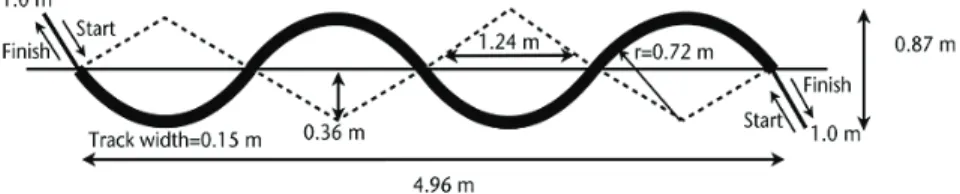
Fig. 1. Dimension of the Groningen Meander Walking Test (GMWT) 지시를 이해하고 검사를 수행할 수 있는 자, 2) 보행이

가능한 자 중 FAC (Functional Ambulation Classification) 이 4점(다른 사람 없이 평지에서 보행가능)이상인 자, 3) 60세 이상인 자, 4) MMSE-DS가 24점 이상인 자(정상 인의 경우)로 하였다. 제외기준은 1) 치매 이외 뇌졸중 이나 파킨슨과 같은 신경학적 문제가 있는 것으로 진단 을 받은 자 2) 최근에 골절과 같은 급성 상해가 있는 자 3) 의사소통에 문제가 심하게 있는 자는 제외하였다.

2. 연구절차 및 일정

2016년 11월부터 2017년 5월까지 연구자들은 성별, 나이, 우세발 및 최근의 상해 경험에 대한 것은 대면 (face-to-face) 인터뷰로 정보를 얻었으며, 치매 어르신의 경우 시설의 종사자로부터 정보를 얻었다. 참여자의 의 식수준(mental status)은 치매 선별용 간이 정신상태 검사 (MMSE-DS)를 이용하여 평가하였고, 보행능력은 FAC를 이용하여 사전검사를 하였다 . 사전검사를 통하여 연구에 참여가능 한 자에 한하여 3명의 연구자가 검사를 실시하 였으며, 치매 어르신들의 경우 이동은 시설의 근무자들 의 보조를 받았다. 연구자들은 검사법에 대한 표준 메뉴 얼을 따라 연습을 한 후 검사를 실시하였으며, 한 명의 연구자는 대상자의 키, 몸무게, 5회 반복 일어서기 검사 (FTSST: Five temes sit to stand test)를 하였고, 다른 한 명의 연구자는 4m 보행검사(4MWT)를 하였으며 또 다른 검사자는 Groningen Meander Walking Test (GMWT)를 각 각 측정하였다. 대상자의 검사순서는 무작위 할당을 통 하여 대상자가 검사에 대하여 학습을 할 수 없도록 하였 으며, 피로가 없도록 검사중간에 휴식을 취할 수 있도록 하였다 . 치매 어르신의 경우 구두적인 지시를 주고 이해 를 잘 하지 못할 경우 연구자가 직접 시연을 하여 지시를 이해할 수 있도록 한 후 검사를 실시하였다.

3. 측정도구

1) 4m 보행 검사(4MWT)

4m의 거리를 대상자의 보행 속도로 편안하게 걷게 하고 두 번 시행 중 가장 좋은 속도를 기록 하는 것으로 신뢰도는 .90으로 높은 편이다(Bohannon, 1997).

2) Groningen Meander Walking Test (GMWT) 너비 15cm, 길이 6m, 그리고 4개의 커브로 되어 있는 선을 따라 걷는 검사이며 , 소요되는 시간과(GMWTSEC) 선에서 대상자가 벗어난 걸음 수(GMWTSTEP)를 측정 한다. 앞으로 걷는 것과 다시 되돌아가는 동안의 시간 을 분리해서 기록하고 두 개의 보행의 평균속도와 벗어 난 걸음 수를 기록한다. 속도가 빠른 것은 기능이 더 좋다는 것을 의미하며(Fig. 1)(Bossers 등, 2014), 신뢰도 는 .89이다(Jones 등, 1999).

4. 분석방법

자료는 SPSS 24 (SPSS Inc, IBM, Korea)를 이용하여

분석하였으며, 일반적인 특성은 빈도분석을 실시하

였다. 두 집단의 Kolmogorov-Smirnov 정규성 검증을

한 결과, 키는 치매군만 몸무게는 치매군과 정상군

모두, 인지능력은 치매군만 정상분포를 따르고 나머

지는 정상분포를 따르지 않음으로 두 집단의 비교는

Mann-Whitney U검증을 사용하였다. 통계적 유의수준

은 .05로 하였다. 치매노인군과 정상군의 차이에 대한

보행능력을 보는 것이 타당한지에 대한 것을 살펴보기

위하여 Received Operating Characteristic (ROC) 커브 분

석을 이용하여 95% 신뢰구간과 Area Under the curve

(AUC)면적을 살펴보았다. AUC에 대한 통계적 유의수

준은 .05로 정하였다. 최적의 절단값(cutt-off value)을

(4)

찾기 위하여 민감도와 특이도 값을 합하였을 때 가장 큰 것을 찾았다.

Ⅲ. 연구결과

1. 일반적인 특징

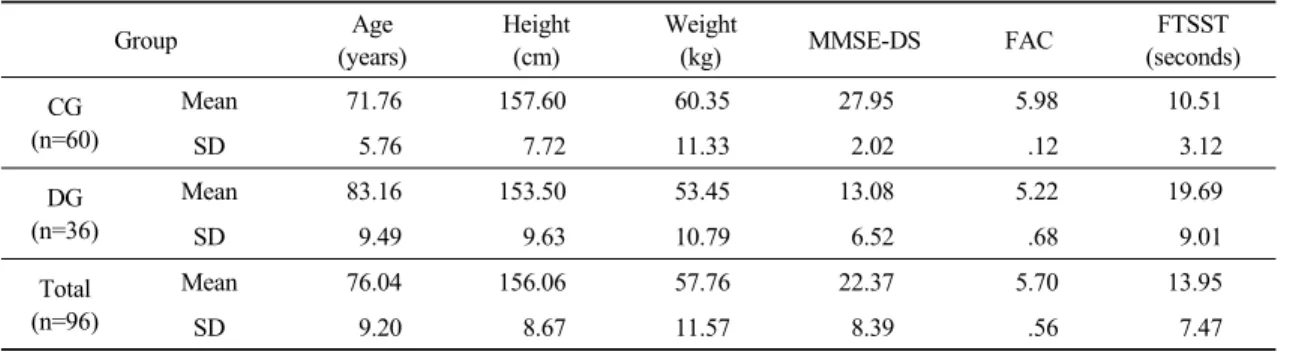
대상자의 일반적인 특징을 알아보기 위하여 키, 몸 무게, 악력을 측정하였고 인지능력을 확인하기 위하여 MMSE-DS를 평가하였고 보행능력을 살펴보기 위하여 FAC를 측정하였으며, 보행과 관련된 하지의 근력을 살펴보기 위하여 5회 반복 일어서기 검사(FTSST) 측정 하였다. 100명이 연구에 참여하기로 동의 하였으나, 치 매군의 경우 검사당일 감기로 시설에 결석, 시설에 왔 지만 급작스러운 감정변화로 검사거부, 검사 전 급작스

런 팔 골절사고로 인하여 인하여 4명이 참여를 하지 못하였다. 일반적인 특징은 Table 1과 같다.

2. 치매노인과 정상노인의 보행능력 비교

두 집단의 보행능력을 살펴보기 위하여 4MWT, GMWTSEC, GMWTSTEP를 검사한 결과, 두 집단에 서 모두 통계적으로 유의미한 차이가 있었다(p<.05) (Table 2).

3. 보행능력의 최적치

곡선 아래 영역의 AUC는 95%의 신뢰구간에서 4MWT의 경우 .95이며, GMWTSEC의 경우 .92이며, GMWTSTEP의 경우 .96으로 나타났고, 근사 유의확 률을 보면 모든 항목에서 .05 이하로 작게 나타났다 (Table 3).

Group Age

(years)

Height (cm)

Weight

(kg) MMSE-DS FAC FTSST

(seconds) CG

(n=60)

Mean 71.76 157.60 60.35 27.95 5.98 10.51

SD 5.76 7.72 11.33 2.02 .12 3.12

DG (n=36)

Mean 83.16 153.50 53.45 13.08 5.22 19.69

SD 9.49 9.63 10.79 6.52 .68 9.01

Total (n=96)

Mean 76.04 156.06 57.76 22.37 5.70 13.95

SD 9.20 8.67 11.57 8.39 .56 7.47

CG: Control group, DG: Dementia group

MMSE-DS: Mini-mental state examination-dementia scale

FAC: Functional Ambulation Classification, FTSST: Five times sit to stand test Table 1. Descriptive statistics for participants

Variables CG (n= 60) DG (n=36)

z p

Mean SD Mean SD

4MWT .86 .26 1.70 .85 -7.45 .00*

GMWTSEC 7.83 3.44 15.99 6.96 -6.88 .00*

GMWTSTEP 1.50 2.93 12.09 6.71 -7.63 .00*

* p<.05

CG: Control group, DG: Dementia group 4MWT: 4 meter walking test

GWWTSEC: Groningen meander walking test second GWWTSTEP: Groningen meander walking test step

Table 2. The Comparison of walking ability between control group and dementia group

(5)

Variables Area Standard Error p 95% confidence interval Upper limit Lower limit

4MWT .95 .02 .00 .90 1.00

GMWTSEC .92 .02 .00 .86 .97

GMWTSTEP .96 .01 .00 .92 1.00

4MWT: 4 meter walking test

GWWTSEC: Groningen meander walking test second GWWTSTEP: Groningen meander walking test step

Table 3. The AUC of walking ability for discrimination between control group and dementia group

Fig. 2. ROC of walking ability for discrimination between control group and dementia group

ROC 커브의 좌표를 이용하여 절단값을 살펴본 결과 각 항목당 민감도와 특이도가 가장 높은 점수들은 4MWT 의 경우 1.03m/s, GMWTSEC는 10.8초, GMWTSTEP은 3.75 발자국 임을 알 수 있었다(Fig. 2).

Ⅳ. 고 찰

본 연구의 목적은 치매환자의 보행능력을 측정하는 데 있어 이미 신뢰도가 증명된 4MWT와 GMWT를 사 용하여 치매 예측 및 진단을 위한 방법으로 이러한

보행 평가 도구가 활용 가능한지를 증명하는 것이다.

정상인과 치매환자의 보행 능력을 비교하였고, 기능저 하의 적절한 위치를 찾기 위해 검사방법의 유용성 및 절단값 산정을 위해 사용하는 ROC 커브를 사용하여 분석하였다.

양분된 결과를 예측하는 테스트의 정확도는 민감도

(sensitivity)와 특이도(specificity)를 사용하여 일반적으

로 평가하는데 , 어떤 질환을 가지고 있는 경우(민감도)

와 그렇지 않은 경우(특이도)를 얼마나 잘 구분할 수

있는 지를 의미한다. 또한 검사방법의 유용성 및 절단

값 (cut-off value) 판단을 위해 ROC 커브를 사용하는데,

(6)

ROC 커브는 진단 테스트의 각각 다른 가능한 절단점에 대한 위양성율(1-특이도; X축)과 그에 대한 실제 양성 률(민감도 또는 1-위음성률; Y축)을 그래프로 표현한 것이다(Swets, 1988). 진단의 정확도는 ROC 커브 아래 의 면적(AUC)에 의해 측정될 수 있는데, 면적이 1이라 면 완벽한 진단 검사임을 의미한다. 보통 AUC 수치는 비정보적(AUC=.5), 덜 정확한(.5<AUC≤.7), 중등도의 정확한(.7<AUC≤.9), 매우 정확한(.9<AUC<1) 그리고 완벽한 검사(AUC=1)로 분류한다. 즉, 그려진 커브가 좌측 위쪽 모서리에 가까울수록 좀 더 정확한 검사법이 라고 해석할 수 있는데, 실제 양성률(true positive rate)은 높고 위양성률(false positive rate)은 낮음을 의미한다 (Swets, 1988; Greiner 등, 2000).

본 연구결과 곡선 아래 영역의 AUC는 95%의 신뢰구 간에서 4MWT의 경우 .956, GMWTSEC의 경우 .921, GMWTSTEP의 경우 .964으로 나타나 보행검사가 치매 를 예측하는데 AUC 분류상 매우 정확한 검사임을 확인 할 수 있었다 . 또한 근사 유의확률을 보면 모든 항목에 서 .05이하로 작게 나타나기 때문에 두 집단의 차이가 확실하며, 모든 항목들이 두 집단을 구분하는 검사로서 가치가 있다고 할 수 있다 . 4MWT와 같은 양적인 보행 측정방법을 통해 비치매 노인의 초기에 인지감소 및 치매 위험을 예측할 수 있고 (Verghese 등, 2007), GMWT 와 같은 동적 보행능력 측정도구는 집행기능, 보행속 도 , 보폭 감소가 특징인 치매환자를 측정하기 위한 최 적화된 도구라고 할 수 있다(Bossers 등, 2014).

곡선의 좌표를 이용하여 절단값을 살펴본 결과 민감 도와 특이도가 가장 높은 점수는 4MWT의 경우 1.03 m/s, GMWTSEC는 10.8초, GMWTSTEP은 3.75 발자국 임을 알 수 있었는데, 보행관련 측정에서 이 기준을 넘어서면 치매로 의심이 가능하다는 의미로 해석할 수 있겠다.

치매환자들의 보행속도를 연구한 신뢰도 문헌을 보 면 치매환자의 경우 평균 .41~1.07m/s의 느린 평균 보행 속도를 보였는데 본 연구결과에서 제시한 절단값인 1.03m/s 기준에 거의 부합한다고 할 수 있다(van Iersel 등 , 2007; Wittwer 등, 2008; Wittwer 등, 2013; Fox 등, 2014).

Bossers 등(2014)은 치매환자를 대상으로 GMWT를

사용한 보행 연구에서 GMWTSEC은 평균 16.93초를 제시하였고 본 연구결과에서 제시한 절단값인 10.8초 이상에 포함되어 기준에 포함됨을 알 수 있었다. 그러 나 GMWTSTEP은 2.11 발자국으로 본 연구에서 제시한 3.75 발자국 보다 작은 수를 보였다. 이는 Bossers 등 (2014) 연구의 대상자가 본 연구 대상자보다 인지기능 이 높아서 검사방법에 대한 이해가 더 좋았기 때문에 발생한 차이라고 생각된다. 본 연구는 단면적 연구로 실시하였으나 추후에는 종단적(longitudinal)한 연구를 통해 실제로 보행 속도의 변화가 추후 치매로 발전되는 지에 대한 확인 연구가 필요할 것으로 사료된다. 또한, 치매 노인들에게 다양한 평가도구를 사용하여 가장 민 감한 평가도구를 선별할 필요가 있을 것이다.

Ⅴ. 결 론

본 연구에서는 정상 노인과 치매노인의 보행능력을 비교하고 또한 치매의 예측인자로써 보행평가 도구의 절단값을 확인함으로써 임상에서 치매 예측 검사도구 로서 보행능력 평가를 사용할 수 있는 타당성을 제공하 고자 하였다 . 치매 예측을 위한 보행 평가도구의 유용 성을 평가해본 결과 보행평가가 매우 타당하다고 할 수 있으며, 본 연구에서 사용한, 4MWT와 GMWT가 치매 예측을 위한 평가 도구로 적절하다고 할 수 있다 .

Acknowledgements

이 논문은 2016년도 을지대학교 교내 연구비에 의해 수행되었음.

References

Atkinson HH, Rosano C, Simonsick EM, et al. Cognitive

function, gait speed decline, and comorbidities: the

health, aging and body composition study. The

(7)

Journals of Gerontology Series A: Biological Sciences and Medical Sciences. 2007;62(8):844-50.

Bohannon RW. Comfortable and maximum walking speed of adults aged 20—79 years: reference values and determinants. Age and ageing. 1997;26(1):15-9.

Bossers WJ, van der Woude LH, Boersma F, et al. The Groningen Meander Walking Test: a dynamic walking test for older adults with dementia. Phys Ther.

2014;94(2):262-72.

Bruce-Keller AJ, Brouillette RM, Tudor-Locke C, et al.

Relationship between cognitive domains, physical performance, and gait in elderly and demented subjects.

Journal of Alzheimer's Disease. 2012;30(4):899-908.

Callisaya ML, Beare R, Phan TG, et al. Brain structural change and gait decline: a longitudinal population- based study. J Am Geriatr Soc. 2013;61:1074–9.

Callisaya ML, Blizzard CL, Wood AG, et al. Longitudinal relationships between cognitive decline and gait slowing: the Tasmanian Study of Cognition and Gait.

J Gerontol A Biol Sci Med Sci. 2015;70(10):1226-32.

de la Torre JC. Alzheimer's disease is incurable but preventable.

Journal of Alzheimer's disease. 2010;20(3):861-70.

DeCarli C, Kawas C, Morrison JH, et al. Session II: Mechanisms of age-related cognitive change and targets for intervention: neural circuits, networks, and plasticity.

J Gerontol A Biol Sci Med Sci. 2012;67(7):747-53.

Ferri CP, Prince M, Brayne C, et al. Global prevalence of dementia: a Delphi consensus study. The lancet.

2006;366(9503):2112-7.

Fox B, Henwood T, Neville C, et al. Relative and absolute reliability of functional performance measures for adults with dementia living in residential aged care.

Int Psychogeriatr. 2014;26(10):1659-67.

Greiner M, Pfeiffer D, Smith R. Principles and practical application of the receiver-operating characteristic analysis for diagnostic tests. Preventive veterinary medicine. 2000;45(1):23-41.

Imtiaz B, Tolppanen A-M, Kivipelto M, et al. Future directions

in Alzheimer's disease from risk factors to prevention.

Biochemical pharmacology. 2014;88(4):661-70.

Jahn K, Zwergal A, Schniepp R. Gait disturbances in old age. Dtsch Arztebl Int. 2010;107(17):306-16.

Jones CJ, Rikli RE, Beam WC. A 30-s chair-stand test as a measure of lower body strength in community- residing older adults. Research quarterly for exercise and sport. 1999;70(2):113-9.

Jung EJ, Kim WB. The Effects of Task Oriented Circuit Exercise on Balance and Cognition in Mild Dementia Patients.

J Korean soc phys med. 2014;9(1):83-91.

Kikkert LH, Vuillerme N, van Campen JP, et al. Walking ability to predict future cognitive decline in old adults:

A scoping review. Ageing Res Rev. 2016;27:1-14.

Kim JH, Oh TY. The Comparison of Characteristics of Foot pressure between Treadmill and Ground walking in Normal person. J Korean soc phys med. 2010;5(1):

53-61.

Lee H, Hwang K. The Effects of CogPack program on LOTCA and ADL in Elderly with Alzheimer's Dementia. Journal of The Korean Society of Integrative Medicine. 2014;2(3):1-7.

Leffondré K, Touraine C, Helmer C, et al. Interval-censored time-to-event and competing risk with death: is the illness-death model more accurate than the Cox model? International journal of epidemiology.

2013;42(4):1177-86.

Mielke MM, Roberts RO, Savica R, et al. Assessing the temporal relationship between cognition and gait: slow gait predicts cognitive decline in the Mayo Clinic Study of Aging. J Gerontol A Biol Sci Med Sci. 2013;

68(8):929-37.

Morris JC, Aisen PS, Bateman RJ, et al. Developing an international network for Alzheimer’s research: the Dominantly Inherited Alzheimer Network. Clinical investigation. 2012;2(10):975-84.

Munoz VM, van Kan GA, Cantet C, et al. Gait and balance

impairments in Alzheimer disease patients. Alzheimer

(8)

Disease & Associated Disorders. 2010;24(1):79-84.

Mura T, Dartigues JF, Berr C. How many dementia cases in France and Europe? Alternative projections and scenarios 2010-2050. Eur J Neurol. 2010;17(2):252-9.

Prince M, Bryce R, Albanese E, et al. The global prevalence of dementia: a systematic review and metaanalysis.

Alzheimer's & Dementia. 2013;9(1):63-75.

Snijders AH, Van De Warrenburg BP, Giladi N, et al.

Neurological gait disorders in elderly people: clinical approach and classification. The Lancet Neurology.

2007;6(1):63-74.

Sperling RA, Karlawish J, Johnson KA. Preclinical Alzheimer disease—the challenges ahead. Nature Reviews Neurology. 2013;9(1):54-8.

Swets JA. Measuring the accuracy of diagnostic systems.

Science. 1988;240(4857):1285.

van Iersel MB, Benraad CE, Rikkert MG. Validity and reliability of quantitative gait analysis in geriatric patients with and without dementia. J Am Geriatr Soc. 2007;55(4):

632-4.

van Iersel MB, Hoefsloot W, Munneke M, et al. Systematic review of quantitative clinical gait analysis in patients with dementia. Zeitschrift für Gerontologie und

Geriatrie. 2004;37(1):27-32.

Verghese J, Robbins M, Holtzer R, et al. Gait dysfunction in mild cognitive impairment syndromes. Journal of the American Geriatrics Society. 2008;56(7):1244-51.

Verghese J, Wang C, Lipton RB, et al. Quantitative gait dysfunction and risk of cognitive decline and dementia.

J Neurol Neurosurg Psychiatry. 2007;78(9):929-35.

Verlinden VJ, van der Geest JN, Hofman A, et al. Cognition and gait show a distinct pattern of association in the general population. Alzheimer's & Dementia.

2014;10(3):328-35.

Waite L, Grayson D, Piguet O, et al. Gait slowing as a predictor of incident dementia: 6-year longitudinal data from the Sydney Older Persons Study. Journal of the neurological sciences. 2005;229:89-93.

Wittwer JE, Webster KE, Andrews PT, et al. Test-retest reliability of spatial and temporal gait parameters of people with Alzheimer's disease. Gait Posture.

2008;28(3):392-6.

Wittwer JE, Webster KE, Hill K. Reproducibility of gait

variability measures in people with Alzheimer's

disease. Gait Posture. 2013;38(3):507-10.

수치

Fig. 1. Dimension of the Groningen Meander Walking Test (GMWT) 지시를 이해하고 검사를 수행할 수 있는 자, 2) 보행이
Table 2. The Comparison of walking ability between control group and dementia group
Table 3. The AUC of walking ability for discrimination between control group and dementia group

참조

관련 문서

The purpose of this study was to investigate the effects of a disability awareness program on improving the attitudes of regular elementary school

The purpose of this study was to compare the remineralization effect of Silver Diamine Fluoride (SDF) on demineralized enamel over time with those of fluoride varnish..

The purpose of this study was to investigate the impact of social capital and positive psychology capital on the will of start-up according to experience

Purpose: This study was aimed to compare the functional outcomes of the continuous and discontinuous fractures, retrospectively, in multiple thoracolumbar

The purpose of this study was to identify the frequency and related factors of advanced airway management for patients with cardiac arrest by the

The purpose of this study was to investigate the change of body composition and physical fitness after 12 weeks of practice with middle-aged women centered

Objectives: The purpose of this study was to investigate the relationship between mental health and experience of falling in some local elderly people using the 2013

The purpose of this study was to investigate the relationship between vocabulary learning strategies and vocabulary ability of Korean middle school students