INTRODUCTION
Preeclampsia is a condition unique to human pregnancy.
Occurring in 5-7% of pregnancies, it is the major cause of maternal and perinatal morbidity and mortality, but the patho- genesis of this disorder has not been clearly established.
Recently, an excessive maternal systemic inflammatory response to pregnancy has been proposed to be responsible for endothelial dysfunction leading to cellular activation and/
or damage (1). Endothelial dysfunction is considered to be central in the pathogenesis of preeclampsia (2, 3). The inflam- matory process is the adhesion of leukocytes to endothelial cells followed by transmigration of these cells into perivascu- lar tissue. Leukocyte endothelial adhesion is governed largely by the interaction of adhesion molecules and their ligands on these cells. A number of the molecules which mediate leuko- cyte-endothelial adhesion have been identified; these include vascular cellular adhesion molecule-1 (VCAM-1), intracellular adhesion molecule-1 (ICAM-1) and E-selectin (4-6). In vitro studies have shown that the expression of these molecules on the endothelial surface is tightly regulated, and that this reg- ulation may have a crucial role in the nature of leukocyte re- cruitment during the course of an inflammatory response (7).
Soluble forms of these molecules may be released to the cir-
culation, and increased serum levels of these molecules may indicate endothelial dysfunction (8). Interestingly, several studies have reported that levels of these adhesion molecules appeared to be increased in the serum of pregnant women with preeclampsia (9-11). Indeed, abnormal levels of these adhesion molecules may be considered to be markers of pree- clampsia (9). However, reports are not always in agreement.
Lyall et al. (12) reported that serum levels of VCAM-1 and E-selectin were not significantly different between normal and preeclamptic pregnancies. Chaiworapongsa et al. (13) suggest- ed that serum levels of ICAM-1 were no differences between normal and preeclamptic pregnancies.
In the present study, we compared the levels of soluble VCAM-1 (sVCAM-1, CD106), ICAM-1 (sICAM-1, CD54) and E-selectin (sE-selectin, CD62E) in the maternal serum of normal and preeclamptic pregnancies.
MATERIALS AND METHODS Study subjects
The study population consisted of 63 women with normal pregnancy, 33 women with mild preeclampsia, and 82 women
Shin-Young Kim, Hyun-Mee Ryu*, Jae Hyug Yang*, Moon-Young Kim*, Hyun-Kyong Ahn*, Ha-Jung Lim*, Joong-Sik Shin*, Hyuk-Jun Woo*, So-Yeon Park, Young-Mi Kim, Jin-Woo Kim, Eun Hee Cho
Laboratory of Medical Genetics, Department of Obstetrics and Gynecology*, Samsung Cheil Hospital and Women’s Healthcare Center, Sungkyunkwan University School of Medicine, Seoul, Korea
Address for correspondence Hyun-Mee Ryu, M.D.
Laboratory of Medical Genetics, Samsung Cheil Hospital & Women’s Healthcare Center, Sungkyunkwan University School of Medicine, 1-19 Mookjung-dong, Jung-gu, Seoul 100-380, Korea
Tel : +82.2-2000-7683, Fax : +82.2-2278-4574 E-mail : [email protected]
688
Maternal Serum Levels of VCAM-1, ICAM-1 and E-selectin in Preeclampsia
Endothelial dysfunction is thought to be a central pathogenic feature in preeclampsia on the basis of elevated adhesion molecules. The aim of the present study was to compare the levels of soluble vascular cell adhesion molecule-1 (sVCAM-1), inter- cellular adhesion molecule-1 (sICAM-1) and E-selectin (sE-selectin) in sera of normal and preeclamptic pregnancies. We studied the serum levels of sVCAM-1, sICAM-1 and sE-selectin in normal pregnant women (n=63), mild preeclampsia (n=33) and severe preeclampsia (n=82). Concentrations of soluble adhesion molecules were determined with enzyme-linked immunoassay (ELISA). Serum concentrations of sVCAM-1 were significantly higher in both mild (p=0.004) and severe preeclampsia (p=0.000) than normal pregnancy. There were also significant differences in sVCAM- 1 levels between mild and severe preeclampsia (p=0.002). sICAM-1 levels of severe preeclampsia were statistically different from those of normal pregnancy (p=0.038).
Levels of sE-selectin were elevated in both mild (p=0.011) and severe preeclamp- sia (p=0.000) compared to normal pregnancy, but no statistical difference between the mild and severe preeclampsia (p=0.345). These results suggest that all three soluble adhesion molecules are increased in severe preeclampsia, and sVCAM-1 among them may be useful in predicting the severity of preeclampsia.
Key Words : Pre-Eclampsia; Cell Adhesion Molecules; Vasurlar Cell Adhesion Molecule-1, Intercellular Adhe- sion Molecule-1, E-Selectin
Received : 8 March 2004 Accepted : 28 May 2004
with severe preeclampsia. The clinical characteristics of the study groups are shown in Table 1. Cases complicated by ch- ronic hypertension, diabetes, chronic renal disease and autoim- mune disorders were not included in the study. Preeclampsia was defined as hypertension (systolic blood pressure ≥140 mmHg and diastolic blood pressure ≥90 mmHg after 20 weeks’ gestation) and proteinuria (≥300 mg in a 24 hr urine collection or one dipstick measurement of ≥1+) according to the Committee of Terminology of ACOG definition (14).
Severe preeclampsia was diagnosed on the basis of diastolic blood pressure ≥110 mmHg or significant proteinuria (dip- stick measurement of ≥2+) or the presence of severity evi- dences such as headache, visual disturbances, upper abdom- inal pain, oliguria, convulsion, elevated serum creatinine, thrombocytopenia, marked liver enzyme elevation, and pul- monary edema. Normal pregnant women had no hyperten- sion, proteinuria, and edema.
Serum samples and assays of soluble adhesion molecules
Peripheral venous blood samples were collected in sterile tubes containing ethylenediamine-tetraacetic acid (EDTA).
No drugs were taken by these patients for 24 hr before the blood sampling. Blood collected in EDTA was immediately stored at 4℃and further processed within 48 hr. Samples were centrifuged at 800 g for 15 min and the supernatant was stored in 200 L aliquots at -70℃. Serum levels of sVCAM- 1, sICAM-1 and sE-selectin were measured by commercial ELISA assay (R&D Systems, Heidelberg, Germany) according to the manufacture’s instructions. All experiments were per- formed by an investigator blinded to the study groups assign- ment. Samples were checked by serial dilution, and measure- ments were performed at least in duplicate.
Statistical analysis
All data analyses were performed by means of the Statisti- cal Package for the Social Science (SPSS version 10.0). Results
were expressed as a mean±standard deviation (SD). Differ- ences among the three groups were compared with one-way analysis of variance (ANOVA) and the post-hoc Bonferroni correction method for multiple comparisons. Statistical sig- nificance was assumed at a p value less than 0.05.
RESULTS
The clinical characteristics of the study groups are summa- rized in Table 1. There were no differences in the maternal age and platelet count among three groups. The gestational ages at delivery (p=0.005 for mild preeclampsia; p=0.000 for severe preeclampsia) and birth weights of the newborns (p=
0.000 for both) were significantly different between normal pregnancy and preeclampsia groups. As expected, the blood pressures were significantly higher in the preeclampsia groups than in normal pregnancy (p=0.000, respectively).
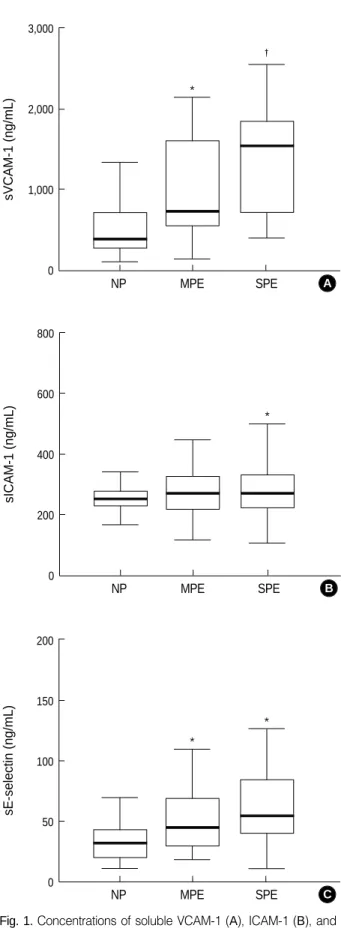
The serum concentrations of soluble adhesion molecules are shown in Fig. 1. Level of sVCAM-1 was significantly higher in both mild (960.71±364.7 ng/mL, p=0.004) and severe preeclampsia (1,376.75±451.5 ng/mL, p=0.000) com- pared with normal pregnancy (570.33±222.56 ng/mL) (Fig.
1A). Serum levels of sICAM-1 were not different statistically between the mild preeclamptic pregnancies (282.38±121.14 ng/mL, p=0.181) and normal pregnancies (243.27±57.56 ng/mL), but the concentration was higher in severe preeclam- psia (291±108.73 ng/mL, p=0.038) compared with nor- mal pregnancy (Fig. 1B). For sE-selectin level, the mean value was significantly elevated in both mild (52.40±27.42 ng/mL, p=0.011) and severe preeclampsia (61.94±36.8 ng/
mL, p=0.000) compared with normal pregnancy group (33.94
±16) (Fig. 1C). In preeclampsia groups, levels of sICAM-1 and sE-selectin were not different statistically between mild and severe preeclamptic pregnancies (p=1.000 for sICAM-1;
p=0.345 for sE-selectin). Only sVCAM-1 level was different significantly between the mild and severe preeclampsia (p=
0.002).
Characteristics Preeclampsia p p* p�
NP (n=63) MPE (n=33) SPE (n=82)
Maternal age (yr) 30.8±3.0 29.8±3.6 30.8±4.0 0.558 1.000 0.551
Gestational age
at delivery (wk) 39.2±1.0 37±2.9 35.3±4.2 0.005 0.000 0.041
Birth weight (g) 3372.2±382.3 2654.4±818.5 2167.3±855.4 0.000 0.000 0.024
Maximum systolic blood
pressure (mm Hg) 127.9±10.5 147.3±17.3 162.8±15.9 0.000 0.000 0.036
Maximum diastolic blood
pressure (mm Hg) 76.8±9.6 95.3±10.9 110.1±12.7 0.000 0.000 0.015
Platelet count (×103/ L) 242.3±47.2 236.6±76.7 227.91±82.6 1.000 0.699 1.000
Table 1.Clinical characteristics of normal pregnancy (NP), mild preeclampsia (MPE) and severe preeclampsia (SPE)
Data are given as mean±SD and were analyzed by ANOVA with multiple comparisons using the Bonferroni correction method. p, comparison between normal pregnancy and mild preeclamsia; p*, comparison between normal pregnancy ad severe preeclampsia; p�, comparison between mild and severe preeclampsia.
DISCUSSION
Preeclampsia is a pregnancy-specific disorder that is clini- cally characterized by hypertension, proteinuria and edema which remits after delivery. Despite the still unexplained pathogenesis, preeclampsia is thought to be resulted from gen- eralized endothelial dysfunction (15). Recently, increased lev- els of cell adhesion molecules are believed to be indicators of endothelial dysfunction in preeclampsia (16). The cell adhesion molecules play a role in leukocyte-endothelial interaction and are divided into three groups according to their structure: selec- tins, integrins and members of the immunoglobulin gene super- family. The selectins mediate the early steps (‘‘rolling’’) of leukocyte adhesion to activated endothelial cell, while integrins and the immunoglobulin gene superfamily regulate the sub- sequent steps (firm adhesion followed by transmigration) (17).
VCAM-1 is a cell adhesion molecule and a member of the immunoglobulin superfamily (18). VCAM-1 has a single chain glycoprotein structure and functions as a transmembrane receptor in vascular endothelial cell membranes. VCAM-1 is present on a number of activated cells, including activated endothelial cells. Increased concentrations of VCAM-1 may reflect increased expression of this molecule on the endothe- lial surface. The expression of VCAM-1 on cells is regulated, at least in part, by multiple microenvironmental influences, such as changes in cytokine concentrations (19). For example, VCAM-1 expression on endothelial cells is induced by inter- leukin-1 , interleukin-4, tumor necrosis factor- , and inter- feron gamma (20). VCAM-1 is important for recruiting leu- kocytes to sites of inflammation because it mediates the adhe- sion of lymphocytes, monocytes, and eosinophils to endothe- lium (20). Our results indicated that circulating sVCAM-1 levels were significantly increased in severe preeclampsia com- pared with mild preeclampsia or normal pregnancy. Lyall et al.
(21) were the first to show that sVCAM-1 was elevated in the serum of preeclamptic patients. Krauss et al. (9) also found significantly elevated levels of VCAM-1 in the plasma of preg- nant women who subsequently developed preeclampsia, 3-15 weeks earlier before the onset of clinical symptoms. In con- trast to these reports, Haller et al. (22) reported that ICAM-1 expression was increased in serum from preeclamptic patients but VCAM-1 expression was not.
ICAM-1 is a member of the immmunoglobulin superfamily that mediates its functional activity through binding to leuko- cyte 2-integrins (23). The ICAM-1 molecule is functionally involved in the regulation of adhesion of leukocytes to the endothelium as well as leukocyte migration (24). The molecule expression is also essential for MHC (main histocompatibil- ity complex) and non-MHC restricted cytotoxicity, interac- tions between T and B lymphocytes, and mitogen and anti- gen-induced lymphocyte proliferation (25). The shed soluble form (sICAM) is also present in plasma and interferes as a reg- ulatory factor in ICAM-1/ 2-integrin interactions (25). In this study, sICAM-1 levels were elevated in severe preeclamp-
sVCAM-1 (ng/mL)
3,000
2,000
1,000
0
NP MPE SPE
Fig. 1.Concentrations of soluble VCAM-1 (A), ICAM-1 (B), and E-selectin (C) in normal pregnancy (NP), mild preeclampsia (MPE) and severe preeclampsia (SPE). *p<0.05, comparison with normal pregnancy; �p<0.05, comparison with both normal pregnancy and mild preeclampsia.
*
�
sE-selectin (ng/mL)
200
150
100
50
0
NP MPE SPE
*
*
sICAM-1 (ng/mL)
800
600
400
200
0
NP MPE SPE
*
A
C B
sia compared with normal pregnancy but no difference bet- ween mild preeclampsia and normal pregnancy. There were no statistical differences in the levels of sICAM-1 between mild and severe preeclampsia. Austgulen et al. (8) reported significantly elevated ICAM serum levels in women with preeclampsia. Djurovic et al. (23) also described that concen- trations of ICAM-1 were slightly increased in preeclampsia.
Contrary to these reports, Phocas et al. (26) could not detect an increased ICAM-1 serum level in preeclampsia.
E-selectin is a member of the selectin family that is cytokine inducible and largely restricted to endothelial cells. It medi- ates the adhesion of various leukocytes, including neutrophils, monocytes, eosinophils, natural killer cells, and a subset of T cells, to activated endothelium (27). The expression of E- selectin is induced in human endothelium in response to cytokines such as interleukin-1 and tumor necrosis factor- through transcriptional upregulation (28). We found that serum concentrations of sE-selectin were significantly higher in both mild and severe preeclampsia than normal pregnancy.
There were no statistical differences in the levels of sE-selectin between mild and severe preeclampsia. Bersinger et al. (29) suggested that the level of E-selectin in the serum of preeclam- ptic women was within normal pregnancy ranges, whereas Bretelle et al. (30) reported that sE-selectin was significantly increased in preeclampsia compared with the normal controls.
In summary, we have determined the serum concentrations of soluble adhesion molecule VCAM-1, ICAM-1 and E-selec- tin in normal pregnancy and preeclampsia. All three adhesion molecules are elevated in severe preeclampsia compared with normal pregnancy, and sVCAM-1 among them may be use- ful in predicting the severity of preeclampsia. The clinical validity of the monitoring levels of these molecules needs to be established in further studies.
REFERENCES
1. Redman CW, Sacks GP, Sargent IL. Preeclampsia: an excessive maternal inflammatory response to pregnancy. Am J Obstet Gynecol 1999; 180: 499-506.
2. Roberts JM, Taylor RN, Goldfien A. Clinical and biochemical evi- dence of endothelial cell dysfunction in the pregnancy syndrome preeclampsia. Am J Hypertens 1991; 4: 700-8.
3. Dekker GA, Sibai BM. Etiology and pathogenesis of preeclampsia:
current concepts. Am J Obstet Gynecol 1998; 179: 1359-75.
4. Budak E, Madazli R, Aksu MF, Benian A, Gezer A, Palit N, Yildizfer F. Vascular cell adhesion molecule-1 (VCAM-1) and leukocyte acti- vation in pre-eclampsia and eclampsia. Int J Gynaecol Obstet 1998;
63: 115-21.
5. Dustin ML, Rothlein R, Bhan AK, Dinarello CA, Springer TA. Induc- tion by IL 1 and interferon-gamma: tissue distribution, biochemistry, and function of a natural adherence molecule (ICAM-1). J Immunol 1986; 137: 245-54.
6. Bevilacqua MP, Stengelin S, Gimbrone MA Jr, Seed B. Endothelial
leukocyte adhesion molecule 1: an inducible receptor for neutrophils related to complement regulatory proteins and lectins. Science 1989;
243: 1160-5.
7. Gearing AJ, Newman W. Circulating adhesion molecules in disease.
Immunol Today 1993; 14: 506-12.
8. Austgulen R, Lien E, Vince G, Redman CW. Increased maternal plasma levels of soluble adhesion molecules (ICAM-1, VCAM-1, E- selectin) in preeclampsia. Eur J Obstet Gynecol Reprod Biol 1997;
71: 53-8.
9. Krauss T, Kuhn W, Lakoma C, Augustin HG. Circulating endothe- lial cell adhesion molecules as diagnostic markers for the early iden- tification of pregnant women at risk for development of preeclampsia.
Am J Obstet Gynecol 1997; 177: 443-9.
10. Krauss T, Azab H, Dietrich M, Augustin HG. Fetal plasma levels of circulating endothelial cell adhesion molecules in normal and pree- clamptic pregnancies. Eur J Obstet Gynecol Reprod Biol 1998; 78:
41-5.
11. Kim HS, Yang JI, Kim JY, Kwon HC, Oh KS. The clinical implica- tions of cellular adhesion molecules in patients with pregnancy in- duced hypertension. Korean J Obstet Gynecol 1998; 41: 559-63.
12. Lyall F, Hayman RG, Ashworth JR, Duffie E, Baker PN. Relation- ship of cell adhesion molecule expression to endothelium-dependent relaxation in normal pregnancy and pregnancies complicated with preeclampsia or fetal growth restriction. J Soc Gynecol Investig 1999;
6: 196-201.
13. Chaiworapongsa T, Romero R, Yoshimatsu J, Espinoza J, Kim YM, Park K, Kalache K, Edwin S, Bujold E, Gomez R. Soluble adhesion molecule profile in normal pregnancy and pre-eclampsia. J Matern Fetal Neonatal Med 2002; 12: 19-27.
14. Cuningham FG, Gant NF, Leveno KJ, Gilstrap III LC, Hauth JC, Wen- strom KD. Williams Obstetrics. 21st Ed. McGraw-Hill 2001; 568-9.
15. Friedman SA, Taylor RN, Roberts JM. Pathophysiology of preeclamp- sia. Clin Perinatol 1991; 18: 661-82.
16. Roberts JM. Endothelial dysfunction in preeclampsia. Semin Reprod Endocrinol 1998; 16: 5-15.
17. Albelda SM, Smith CW, Ward PA. Adhesion molecules and inflam- matory injury. FASEB J 1994; 8: 504-12.
18. Osborn L, Hession C, Tizard R, Vassallo C, Luhowskyj S, Chi-Rosso G, Lobb R. Direct expression cloning of vascular cell adhesion mo- lecule 1, a cytokine-induced endothelial protein that binds to lympho- cytes. Cell 1989; 59: 1203-11.
19. Pigott R, Dillon LP, Hemingway IH, Gearing AJ. Soluble forms of E-selectin, ICAM-1 and VCAM-1 are present in the supernatants of cytokine activated cultured endothelial cells. Biochem Biophys Res Commun 1992; 187: 584-9.
20. Carlos TM, Harlan JM. Membrane proteins involved in phagocyte adherence to endothelium. Immunol Rev 1990; 114: 5-28.
21. Lyall F, Greer IA, Boswell F, Macara LM, Walker JJ, Kingdom JC.
The cell adhesion molecule, VCAM-1, is selectively elevated in serum in pre-eclampsia: does this iπndicate the mechanism of leucocyte activation? Br J Obstet Gynaecol 1994; 101: 485-7.
22. Haller H, Ziegler EM, Homuth V, Drab M, Eichhorn J, Nagy Z, Bus- jahn A, Vetter K, Luft FC. Endothelial adhesion molecules and leuko- cyte integrins in preeclamptic patients. Hypertension 1997; 29: 291-6.
23. Djurovic S, Schjetlein R, Wisloff F, Haugen G, Berg K. Increased levels of intercellular adhesion molecules and vascular cell adhesion molecules in pre-eclampsia. Br J Obstet Gynaecol 1997; 104: 466-70.
24. Airoldi L, Gaffuri B, Rossi G, Iurlaro E, Nozza A, Vigano P, Vignali M. Soluble intercellular adhesion molecule-1 serum profile in phys- iologic and preeclamptic pregnancy. Am J Reprod Immunol 1998;
39: 183-8.
25. Gaffuri B, Vigano P, Nozza A, Gornati G, Di Blasio AM, Vignali M.
Expression of intercellular adhesion molecule-1 messenger ribonu- cleic acid and protein in human term placental cells and its modula- tion by pro-inflammatory cytokines (interleukin-1beta and tumor necrosis factor alpha). Biol Reprod 1998; 58: 1003-8.
26. Phocas I, Rizos D, Papoulias J, Xyni K, Sarandakou A, Salamalekis E. A comparative study of serum soluble vascular cell adhesion mo- lecule-1 and soluble intercellular adhesion molecule-1 in preeclamp-
sia. J Perinatol 2000; 20: 114-9.
27. Bevilacqua MP, Nelson RM. Selectins. J Clin Invest 1993; 91: 379- 87.
28. Montgomery KF, Osborn L, Hession C, Tizard R, Goff D, Vassallo C, Tarr PI, Bomsztyk K, Lobb R, Harlan JM. Activation of endothe- lial-leukocyte adhesion molecule 1 (ELAM-1) gene transcription. Proc Natl Acad Sci USA 1991; 88: 6523-7.
29. Bersinger NA, Smarason AK, Muttukrishna S, Groome NP, Redman CW. Women with preeclampsia have increased serum levels of preg- nancy-associated plasma protein A (PAPP-A), inhibin A, activin A and soluble E-selectin. Hypertens Pregnancy 2003; 22: 45-55.
30. Bretelle F, Sabatier F, Blann A, D’Ercole C, Boutiere B, Mutin M, Boubli L, Sampol J, Dignat-George F. Maternal endothelial soluble cell adhesion molecules with isolated small for gestational age fetuses:
comparison with pre-eclampsia. BJOG 2001; 108: 1277-82.