RESEARCH ARTICLE
Received: May 27, 2021, Revised: June 7, 2021, Accepted: June 11, 2021 eISSN 2233-7679
†Correspondence to: Jin-ha Lee, https://orcid.org/0000-0002-3062-8216
Department of Dental Hygiene, Kyungbok University, 425, Kyeongbokdae-ro, Jinjeop-eup, Namyangju 12051, Korea Tel: +82-31-570-9625, Fax: +82-31-570-9568, E-mail: [email protected]
Copyright © The Korean Society of Dental Hygiene Science.
Impact of Conventional and Electronic Cigarette Use on the Adolescents’ Experience of Periodontal Disease Symptoms
Eunsuk Ahn
1and Jin-ha Lee
2,†1
Division of Climate Change and Health Protection, Korea Disease Control and Prevention Agency, Cheongju 28161,
2Department of Dental Hygiene, Kyungbok University, Namyangju 12051, Korea
Background: Smoking in adolescence leads to an intensified addiction to nicotine when physical and mental growth has not yet
been completed. With the advent of e-cigarettes, the rate of e-cigarette use among Korean adolescents has been steadily increasing. To date, studies on e-cigarettes and oral health, especially on the relationship between smoking styles and oral health in adolescents, are limited. Therefore, this study aimed to identify the risk factors for oral health problems caused by the repeated use of conventional cigarettes and e-cigarettes.
Methods: This explanatory research study compared the adolescents’ experiences of periodontal disease symptoms according
to smoking type through a secondary analysis of the original data from the 15th Adolescent Health Behavior Survey (2019).
Cross-analysis was performed to compare the smoking patterns according to the adolescents’ general characteristics. Finally, a binary logistic regression analysis was performed to determine how smoking characteristics affect the adolescents’ experience of periodontal disease symptoms.
Results:
In terms of patients’ general characteristics, significant differences were observed in sex, school level, grades, household economic status, type of residence, and father’s education level between adolescents who smoked conventional cigarettes alone and those who smoked both conventional cigarettes and e-cigarettes (p<0.05). After checking the factors affecting the smoking pattern and the experience of periodontal disease symptoms in adolescents, it was found that the duplicate smoking group was more likely to experience periodontal disease symptoms (odds ratio, 1.20) than the group that smoked conventional cigarettes alone (p<0.05).
Conclusion:
Duplicate smokers experienced more symptoms of periodontal disease than those who smoked cigarettes alone.
Based on the findings of this study, smoking cessation counseling according to the smoking type and differentiated education for oral health promotion should be provided.
Key Words: Adolescent, E-cigarette, Periodontal disease, Smoking cessation
Introduction
Smoking is the direct cause of various diseases such as lung cancer and oral cancer, and has long-term adverse effects such as mental health problems, environmental pollution, and economic damage
1). Smoking in adolescence leads to an increase in addiction to nicotine when physical and mental growth has not yet been completed; hence, the damage caused by smoking is inevitably increased
2,3).
With the advent of liquid e-cigarettes in 2003, the rate of
e-cigarette use among Korean adolescents is steadily
increasing. This is perceived as a result of the misconception
that e-cigarettes are smoking cessation tools and products
that are less harmful to health than conventional cigarettes
4).
In particular, e-cigarette smoking in adolescents can have
a negative effect on brain development, and adolescents
who do not smoke conventional cigarettes are persuaded
to increase e-cigarette smoking
5). According to previous
studies, 80.8% of e-cigarette smokers use it along with
conventional cigarettes, and the duplicate smoking rate is
increasing
6).
Smoking is an act performed in the oral cavity, and it directly affects the soft and hard tissues, causing various oral diseases such as tooth staining, bad breath, periodontal disease, and oral cancer. It has a detrimental effect on oral health
7,8). The longer the smoking period, the higher the rate of dental utilization; moreover, the higher the cost of dental treatment, the higher the expenses incurred
9). Compared with conventional cigarettes, due to the high viscosity and flavor of the liquid used in e-cigarettes, the environment in the oral cavity changes, causing an imbalance in the oral flora and the adherence of these bacteria to the tooth surface, eventually causing dental caries
10,11). This event was found to increase the plaque index, which is one of the major causes of dental caries and periodontal disease
12).
Smoking cessation not only reduces the risk of oral disease but also increases the effectiveness of dental treatments. Therefore, dental healthcare workers should be actively involved in promoting smoking cessation. The rate of e-cigarette use among adolescents is dramatically increasing due to the misconception regarding the safety of e-cigarettes; the rate of duplicate smoking among conventional cigarette smokers and e-cigarette smokers continues to increase as well. It has been reported to be much higher than the rate of conventional smoking
5,8). However, there is a lack of studies on e-cigarettes and oral health, especially regarding the relationship between the type of smoking and oral health among adolescents.
Therefore, this study aimed to identify the risk factors affecting smoking type and the adolescents’ experience of periodontal disease symptoms, a frequent oral disease in adolescents, by assessing the demographic characteristics and obtaining basic data on the interventions used to reduce smoking among adolescents and the different strategies adopted to promote oral health.
Materials and Methods
1. Study population
This explanatory survey compared the oral health of adolescents according to smoking type by performing a secondary analysis of the data from the 15th Adolescent
Health Behavior Survey (2019). The Youth Health Behavior Survey is a government-approved statistical survey (approval number: 117058) and has been conducted every year since 2005. It is an anonymous, self-written online survey to determine the health behaviors of Korean adolescents, such as smoking. It was carried out after receiving approval from the Korea Disease Control and Prevention Agency for the use of raw data. A total of 60,100 adolescents from 400 middle schools and 400 high schools were invited to participate in the survey. Among them, only 57,303 adolescents from the 800 schools responded to the survey, which accounts for 95.3% of the total study population. The study included 3,817 adolescents who smoked cigarettes. Among them, 1,903 adolescents smoked conventional cigarettes alone, while 1,914 who repeatedly used e-cigarettes.
2. Study variables
As the dependent variable of this study, the question of
“Have your gums hurt or bleed in the last 12 months?” was used to determine the patients’ experience of periodontal disease symptoms. Smoking type was used as an explanatory variable. Adolescents who answered “more than 1 day” to the question “In the last 30 days, how many days did you smoke even one cigarette?” were classified as current smokers. Among the current smokers, those who answered
“none” to the question “How many days did you use the e-cigarette in the last 30 days?” were classified as “con- ventional smokers.” In addition, adolescents who answered
“more than 1 day” were classified as “duplicate smokers”
who used both conventional cigarettes and e-cigarettes. In addition, the other variables assessed in this study were sex (male/female), family economic status (high/middle/
low), school achievement (high/middle/low), living area (county/small and medium-sized city/large city), residence type (living with families/living with relatives/living apart from one’s own families [housing, self-catering, dormitory]/
living in a childcare facility), school grade (middle
school/high school [general]/high school [characterization]),
and parents’ education level (below high school/above
college/unknown).
Table 1. General Characteristics of Study Population
Variable n %
Sex Male 2,731 71.55
Female 1,086 28.45
School grade Middle school 959 25.46
High school (general) 1,797 47.72 High school
(characterization)
1,010 26.82
School achievement
High 368 9.64
Middle 2,532 66.33
Low 917 24.02
Living area Country 336 8.80
Middle and small city 1,847 48.39
Large city 1,634 42.81
Family economic status
High 475 12.44
Middle 3,134 82.11
Low 208 5.45
Residence type Living with families 3,511 91.98 Living with relatives 50 1.31 Living apart from one’s
own families
199 5.21
Living in a childcare facility
57 1.49
Father’s education Below high school 790 20.70
Above college 987 25.86
Unknown 2,040 53.45
Mather’s education
Below high school 830 21.74
Above college 945 24.76
Unknown 2,042 53.50
Type of cigarette Conventional cigarette user
1,903 49.86
Duplicate cigarette user 1,914 50.14 Oral symptoms
experience
No 2,985 78.20
Yes 832 21.80
3. Statistical analysis
In this study, a frequency analysis was performed to assess the general characteristics of the study participants, and a cross-analysis was performed to confirm the differences in smoking types according to the participants’
general characteristics. Finally, a binary logistic regression analysis was performed to determine the effect of smoking type on periodontal disease symptom experience. STATA software (version 14.0; StataCorp, College Station, TX, USA) was used to perform all statistical analyses, and the statistical significance level was set at 0.05.
Results
1. General characteristics of the study population
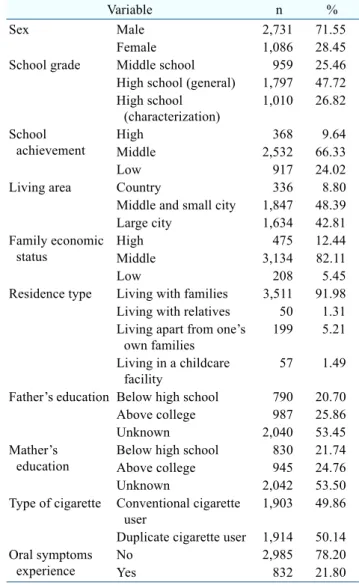
Table 1 shows the general characteristics of the study population who smoked. Approximately 71.55% of the participants were males, which is higher than the proportion of females (28.45%). The “middle” group had the highest percentage of adolescents with data on school achievement (66.33%). In terms of smoking type, 49.86% of adolescent smokers only used conventional cigarettes, while 50.14%
of duplicate smokers used both conventional cigarettes and e-cigarettes.
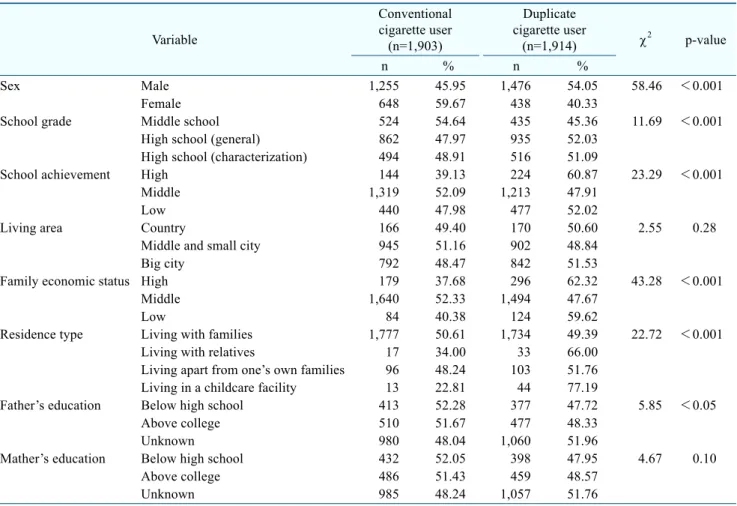
2. Differences in smoking types according to the participants’ general characteristics Table 2 shows the results of the analysis of the differences between conventional cigarette smokers and duplicate smokes according to the general characteristics of the study population. Significant differences were observed in the smoking types according to sex, school grade, school achievement, family economic status, residence type, and father’s educational level (p<0.05). In particular, the rate of duplicate smoking was high among adolescents with higher school achievements, and 62.32%
of smokers in the “high” household economic status group smoked repeatedly. In addition, 77.19% of adolescents living in childcare facilities were found to be duplicate smokers.
3. Factors affecting the experience of periodontal disease symptoms
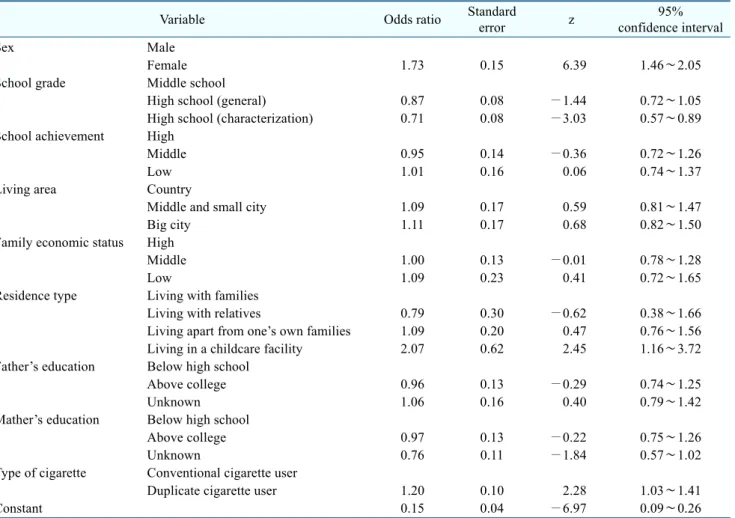
Table 3 shows the results of the logistic regression analysis to determine the factors influencing the smoking patterns and periodontal disease symptom experience in adolescents. The factors that had a significant influence on the experience of periodontal disease symptoms were sex, school grade, residence type, and smoking type (p<0.05).
Among them, females were more likely to experience
periodontal disease symptoms than males (odds ratio,
1.73). Depending on the school grade, compared with
middle school students, specialized high school students
experienced fewer symptoms of periodontal disease. In
terms of residence type, the group living in a childcare
Table 2. Comparison of Type of Cigarette Usage according to General Characteristics
Variable
Conventional cigarette user
(n=1,903)
Duplicate cigarette user
(n=1,914)
2p-value
n % n %
Sex Male 1,255 45.95 1,476 54.05 58.46 <0.001
Female 648 59.67 438 40.33
School grade Middle school 524 54.64 435 45.36 11.69 <0.001
High school (general) 862 47.97 935 52.03
High school (characterization) 494 48.91 516 51.09
School achievement High 144 39.13 224 60.87 23.29 <0.001
Middle 1,319 52.09 1,213 47.91
Low 440 47.98 477 52.02
Living area Country 166 49.40 170 50.60 2.55 0.28
Middle and small city 945 51.16 902 48.84
Big city 792 48.47 842 51.53
Family economic status High 179 37.68 296 62.32 43.28 <0.001
Middle 1,640 52.33 1,494 47.67
Low 84 40.38 124 59.62
Residence type Living with families 1,777 50.61 1,734 49.39 22.72 <0.001
Living with relatives 17 34.00 33 66.00
Living apart from one’s own families 96 48.24 103 51.76
Living in a childcare facility 13 22.81 44 77.19
Father’s education Below high school 413 52.28 377 47.72 5.85 <0.05
Above college 510 51.67 477 48.33
Unknown 980 48.04 1,060 51.96
Mather’s education Below high school 432 52.05 398 47.95 4.67 0.10
Above college 486 51.43 459 48.57
Unknown 985 48.24 1,057 51.76
p-value of chi-squared test.
facility experienced more symptoms of oral disease than the group living with the family (odds ratio, 2.07).
Depending on the type of smoking, the duplicate smoking group experienced more symptoms of periodontal disease than the group that only smoked conventional cigarettes (odds ratio, 1.20).
Discussion
In this study, the factors influencing the experience of periodontal disease symptoms in adolescents were analyzed by dividing them into conventional cigarette smokers and duplicate smokers who used e-cigarettes. In 50.14% of adolescent smokers in the study, duplicate smokers who used both conventional and electronic cigarettes were identified. This value is somewhat lower than the adult’s duplicate smoking rate
6); however, in adolescents, due to
the misconception that e-cigarettes are safer than conventional cigarettes, more attention should be paid to decreasing the rate of e-cigarette use among this group
13); an increase in the use of e-cigarettes can lead to an increase in the rate of duplicate smoking
14,15). The active publicity and education on factors that have a negative impact on health and the risk of duplicate smoking among adolescents are necessary.
As a result of examining the factors influencing the
periodontal symptom experience, significant differences
were observed according to sex, which is due to differences
in socioeconomic status such as smoking rate, education
level, and economic level. This is thought to be due to the
changes in the physiological balance between anabolic
and catabolic mechanisms associated with smoking. In
addition, it appears to support the results of existing studies
showing some differences in plaque control and periodontal
Table 3. Factors Affecting Experience of Periodontal Disease Symptoms