http://dx.doi.org/10.4174/astr.2015.88.6.318 Annals of Surgical Treatment and Research
Effect of visceral fat area on outcomes of laparoscopy- assisted distal gastrectomy for gastric cancer: subgroup analysis by gender and parameters of obesity
Ji-Eon Go, Min-Chan Kim1, Ki-Han Kim1, Jong-Young Oh2, Yoo-Min Kim3
Dong-A University College of Medicine, Busan, Departments of 1Surgery and 2Radiology, Dong-A University College of Medicine, Busan, 3Department of Surgery, CHA Bundang Medical Center, CHA University, Seongnam, Korea
INTRODUCTION
According to World Health Organization, gastric cancer is one of the most common cancers worldwide. In Korea, the use of laparoscopy has led to the majority of the patients being diagnosed as early gastric cancer (EGC), which can be successfully treated using surgical resection alone [1,2]. Sur
geons have noticed that surgical outcomes are associated with the quality of life after gastrectomy [3]. Because laparoscopic
surgery has improved operative outcomes, such as shorter convalescent time, less postoperative pain, and faster return to social life, it has become popular for treating gastric cancer [4].
The increasing prevalence of obesity has also become an im
portant problem worldwide [5]. Obesity initially was a relative contraindication for laparoscopic surgery. However, with the refinement of laparoscopic technology and the increasing ex
perience of surgeons, the use of laparoscopic surgery for obese patients has been widely accepted. There have been several Purpose: The aim of this study was to investigate the impact of the visceral fat area (VFA) of patients with gastric cancer un dergoing laparoscopic surgery on operative outcomes such as number of retrieved lymph nodes (LNs) and operative time.
Methods: We retrospectively reviewed the medical records and the CT scans of 597 patients with gastric cancer who underwent laparoscopy assisted distal gastrectomy (LADG) with partial omentectomy and LN dissection (>D1 plus beta).
Patients were stratified by gender, VFA, and body mass index (BMI), and the clinicopathologic characteristics and operative outcomes were evaluated. Multiple linear regression analysis was used to assess the effects of VFA and BMI on the num
ber of retrieved LNs and operative time in male and female patients.
Results: The mean number of retrieved LNs was significantly decreased for both male and female patients with high VFA.
The operative time was significantly longer for both male and female patients with high VFA. The number of retrieved LNs had a statistically significant negative correlation with VFA in both men and women, but not with BMI. The operative time had a statistically significant positive correlation with VFA in men, whereas the operative time had a statistically significant positive correlation with BMI in women.
Conclusion: The preoperative VFA of male patients with gastric cancer who undergo LADG may affect the number of re
trieved LNs and operative time. VFA was more useful than BMI for predicting outcomes of LADG.
[Ann Surg Treat Res 2015;88(6):318-324]
Key Words: Stomach neoplasms, Laparoscopy, Visceral fat, Body mass index
Reviewed January February March April May June July August September October November December
Received September 24, 2014, Revised November 12, 2014, Accepted December 1, 2014
Corresponding Author: Min-Chan Kim
Department of Surgery, Dong-A University Hospital, Dong-A University College of Medicine, 26 Daesingongwon-ro, Seo-gu, Busan 602-715, Korea Tel: +82-51-240-2643, Fax: +82-51-247-9316
E-mail: [email protected]
Copyright ⓒ 2015, the Korean Surgical Society
cc Annals of Surgical Treatment and Research is an Open Access Journal. All articles are distributed under the terms of the Creative Commons Attribution Non- Commercial License (http://creativecommons.org/licenses/by-nc/4.0/) which permits unrestricted non-commercial use, distribution, and reproduction in any medium, provided the original work is properly cited.
randomized clinical trials examining surgical outcomes that have verified its safety for these patients [6,7].
However, surgeons still find that laparoscopic surgery for obese patients is challenging. The retrieval of lymph nodes (LNs) is difficult because they are embedded in thick fat tissue and are hard to distinguish surrounding fat [8]. Therefore, the operative time is prolonged. Some studies have investigated that the association between obesity and operative outcomes [8
13]. Surgical procedures performed on patients with high body mass index (BMI) have been found to be of longer duration [9,10].
Other studies have reported that the visceral fat area (VFA) was a better predictor of surgical outcomes than a BMI indicating obesity [1113].
There have been few large studies investigating the impact of VFA on the outcome of laparoscopyassisted distal gastrectomy (LADG). The aim of our retrospective study was to investigate the impact of VFA on the operative outcomes of LADG per
formed on a large number of gastric cancer patients who, for purposes of analysis, were divided into 4 subgroups based on gender and 2 parameters of obesity, BMI and VFA.
METHODS
Patients
The medical records and CT scans of 597 patients with gastric cancer who underwent LADG with partial omentectomy and LN dissection (>D1 plus beta), between March 2003 and July 2013 were retrospectively reviewed. These patients included our initial cases of LADG. We excluded patients who underwent robotic surgery or combined surgery during LADG and patients whose CT scans could not be to measure the VFA. All of the operations were performed by a single surgeon.
Quantification of VFA
All patients underwent abdominal CT scans before surgery to assess the extent of disease. The CT scanner was linked to a medical imaging network, through which images could be electronically transferred to a centralized data system and retrieved at a workstation. Imaging software, Aquarius iNtui
tion, TeraRecon (TeraRecon Inc., Foster City, CA, USA), was used to acquire the preprocessed images. The CT scan at the umbilical level was used to measure VFA [14]. The contours of the subcutaneous layer of fat and the VFA were defined auto
matically by the fat scan, and then we can obtain VFA through fat analysis. To elaborate, the process of drawing the contour manually was added before fat analysis.
Definition of obesity
The patients were divided into 4 subgroup based on gender and obesity criteria from the Japan Society for the Study of Obesity [15]. Patients with a VFA ≥ 100 cm2 were classified as high VFA and patients with a VFA < 100 cm2 were low VFA.
Likewise, patients with a BMI ≥ 25 kg/m2 were classified as high BMI and patients with a BMI < 25 kg/m2 were classified as low BMI.
Definition of complications
We analyzed retrospectively the complications from pro
spectively designed gastric cancer database. We classified by our list of complications list (17 lists): 1. wound problems (infection, seroma, bleeding, evisceration); 2. intraabominal fluid collection or abscess; 3. intraabdominal bleeding; 4.
in traluminal bleeding; 5. intestinal obstruction; 6. Ileus; 7.
Stenosis; 8. Leakage; 9. Fistula; 10. Pancreatitis; 11. pulmonary disease; 12. urinary complications; 13. renal complications; 14.
hepatic complications; 15. cardiac complications; 16. endocrine
Fig. 1. Distribution of the values of the visceral fat area of gastric cancer patients (n = 597) according to gender. Both genders have normal distribution, with mean values in men (A) and women (B) of 100.3 cm2 and 78.9 cm2, respectively (Axis x = distribution of the values of the visceral fat area, axis y = number of patients).
0
Distribution of the values of the visceral fat area 40
30
20
0
50 300
10
100 150 200 250 0
Distribution of the values of the visceral fat area 30
20
0
50 10
100 150 200 250
No.ofpatients No.ofpatients
A B
complications; 17. others.
Statistical analysis
All statistical analyses were performed using IBM SPSS Statistics ver. 20.0 (IBM Co., Armonk, NY, USA). The Pearson chisquare test was used to compare categorical variables. An independent ttest or analysis of variance were used for con
tinuous variables if the data for groups satisfied the criteria for normality; otherwise, the MannWhitney Utest or Kruskal
Wallis test were used. Multiplelinear regression analysis was used to assess the effects of visceral fat on operative outcomes.
Pvalues less than 0.05 were considered to indicate statistical significance. All reported Pvalues are twotailed and have not been adjusted for multiple comparisons.
RESULT
Distribution of VFA
Fig. 1 depicts the distribution of VFA in male patients and female patients. The VFA values of both men and women were normally distributed. The mean VFA values for men and wo
men were 100.3 cm2 and 78.9 cm2, respectively.
Clinicopathologic characteristics of patients accor- ding to VFA values of 4 subgroups
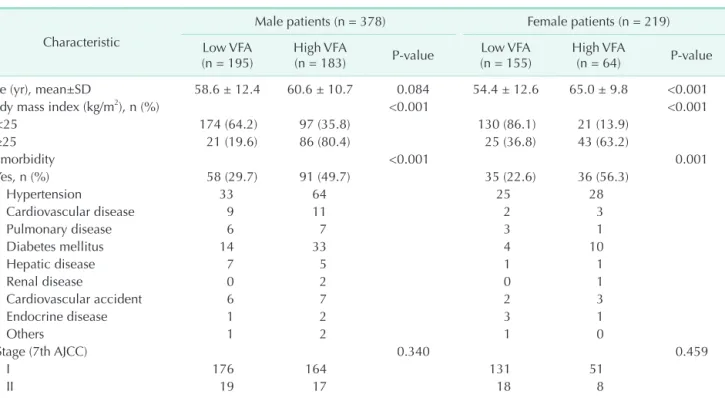
All patients were assigned to one of 4 groups according to gender and high and low VFA. Table 1 lists the clinicopa
thological characteristics of the patients divided into subgroups.
For both men and women, increased age tended to associate with high VFA women, the difference in age between low and high VFA was significant (P < 0.001). BMI was significantly higher in both male and female patients with high VFA than in patients with low VFA (both P < 0.001). Of the male and female patients with high BMI, 86 men (80.4%, n = 107) and 43 women (63.2%, n = 68) also had high VFA. Of male patients with low BMI, 97 (35.8%, n = 271) had high VFA whereas of female patients with high BMI, 25 (36.8%, n = 68) had low VFA.
Significantly more male and female patients with high VFA had comorbid conditions than those with low VFA (both P < 0.001).
Operative outcomes according to VFA values of 4 subgroups
The total number of retrieved LNs was significantly decreased in both male and female patients with high VFA (men, P <
0.001; women, P = 0.001). The operative time was significantly longer for both men and women with high VFA (men, P < 0.001;
women; P = 0.033). The time to first flatus was significantly
Table 1. The clinicopathological characteristics of patients with gastric cancer who underwent LADG according to gender and visceral fat area
Characteristic
Male patients (n = 378) Female patients (n = 219) Low VFA
(n = 195) High VFA
(n = 183) P-value Low VFA
(n = 155) High VFA
(n = 64) P-value
Age (yr), mean±SD 58.6 ± 12.4 60.6 ± 10.7 0.084 54.4 ± 12.6 65.0 ± 9.8 <0.001
Body mass index (kg/m2), n (%) <0.001 <0.001
<25 174 (64.2) 97 (35.8) 130 (86.1) 21 (13.9)
≥25 21 (19.6) 86 (80.4) 25 (36.8) 43 (63.2)
Comorbidity <0.001 0.001
Yes, n (%) 58 (29.7) 91 (49.7) 35 (22.6) 36 (56.3)
Hypertension 33 64 25 28
Cardiovascular disease 9 11 2 3
Pulmonary disease 6 7 3 1
Diabetes mellitus 14 33 4 10
Hepatic disease 7 5 1 1
Renal disease 0 2 0 1
Cardiovascular accident 6 7 2 3
Endocrine disease 1 2 3 1
Others 1 2 1 0
Stage (7th AJCC) 0.340 0.459
I 176 164 131 51
II 19 17 18 8
III 0 2 6 5
LADG, laparoscopic-assisted distal gastrectomy; VFA, visceral fat area; SD, standard deviation; AJCC, American Joint Committee on Cancer.
longer in male patients with high VFA (P = 0.013) (Table 2).
There were no significant differences in length of postoperative hospital stay and complication rate based on VFA values of either men or women.
Number of retrieved LNs of 8 subgroups based on gender and low and high BMI and VFA value
When the male patients and female patients were each divided into 4 subgroups (low BMI/low VFA, low BMI/high VFA, high BMI/low VFA, high BMI/high VFA), there was a statistically significant difference in the mean number of retrieved LNs
between the subgroups of both men and women (men, P <
0.001; women, P = 0.013) (Fig. 2). Post hoc analysis found that a statistically significant difference in the number of retrieved LNs between the low BMI/low VFA and high BMI/high VFA groups of both the men and women (men, P = 0.005; women;
P = 0.028). There was also a statistically significant difference in the number of retrieved LNs between the male patient with low BMI/low VFA and low BMI/high VFA (P < 0.001).
Operative times of 8 subgroups based on gender and low and high BMI and VFA values
When the male patients and female patients were each Fig. 2. The mean number of retrieved lymph nodes (LNs)
according to gender, body mass index (BMI), and visceral fat area (VFA) of patients with gastric cancer undergoing laparoscopic surgery. There was a statistically significant difference in the mean number of retrieved lymph nodes bet- ween the 4 subgroups of both men and women (men, P <
0.001; women, P = 0.013). BMI_L, low BMI; BML_H, high BMI; VFA_L, low VFA; VFA_H, high VFA.
50 45 40 35 30 25 20 15 10 5 0
Men Women
BMI_H & VFA_L
BMI_L & VFA_H BMI_L & VFA_L
BMI_H & VFA_H
41.0 33.6 37.0 35.4
P = 0.013
44.5 37.7 42.7 38.0
P < 0.001
MeannumberofretrievedLNs
Fig. 3. The mean operative time according to gender, body mass index (BMI), and visceral fat area (VFA) of patients with gastric cancer undergoing laparoscopic surgery. There was a statistically significant difference between 4 subgroups in men, only. BMI_L, low BMI; BML_H, high BMI; VFA_L, low VFA; VFA_H, high VFA.
200
180
160
140
Men Women
BMI_H & VFA_L
BMI_L & VFA_H BMI_L & VFA_L
BMI_H & VFA_H
179.3 191.5 173.4 197.7
P = 0.001
166.6 168.5 168.0 183.4
P = 0.076
Meanoperativetime(min)
Table 2. Operative outcomes of patients with gastric cancer who underwent LADG according to gender and visceral fat area Variable
Male patients (n = 378) Female patients (n = 219) Low VFA
(n = 195) High VFA
(n = 183) P-value Low VFA
(n = 155) High VFA
(n = 64) P-value Resection margin (cm)
Proximal 5.0 ± 3.0 4.8 ± 2.8 0.275 5.0 ± 2.8 4.9 ± 2.7 0.885
Distal 6.1 ± 3.4 6.2 ± 3.1 0.766 7.1 ± 3.9 6.5 ± 3.3 0.313
No. of retrieved LNs 40.6 ± 13.3 34.4 ± 12.0 <0.001 44.2 ± 13.4 37.8 ± 11.9 0.001 Operative time (min) 178.7 ± 39.1 194.4 ± 41.7 <0.001 166.8 ± 34.6 178.5 ± 41.3 0.033
Time, first flatus (POD) 3.0 ± 0.8 3.2 ± 0.9 0.013 3.1 ± 0.7 3.1 ± 0.8 0.640
Hospital stay (POD) 6.9 ± 1.7 8.3 ± 11.6 0.103 7.1 ± 1.5 7.4 ± 3.7 0.462
Complications 0.527 0.198
No 174 (89.2) 159 (86.9) 144 (92.9) 56 (87.5)
Yes 21 (10.8) 24 (13.1) 11 (7.1) 8 (12.5)
Values are presented as mean ± standard deviation or number (%).
LADG, laparoscopic-assisted distal gastrectomy; VFA, visceral fat area; LNs, lymph nodes; POD, postoperative day.
divided into 4 subgroups (low BMI/low VFA, low BMI/high VFA, high BMI/low VFA, and high BMI/high VFA) there was a statistically significant difference in the mean operative times between the 4 subgroups of men (P = 0.001) (Fig. 3). Al though for women there seemed to be an obvious difference for the patients with high BMI/high VFA, post hoc analysis did not find statistical significance. For men, although the VFA seemed to affect the operative time regardless of BMI level, post hoc analysis found that there was a statistically significant di
fference in operative time between those with low BMI/low VFA and high BMI/high VFA (P = 0.004).
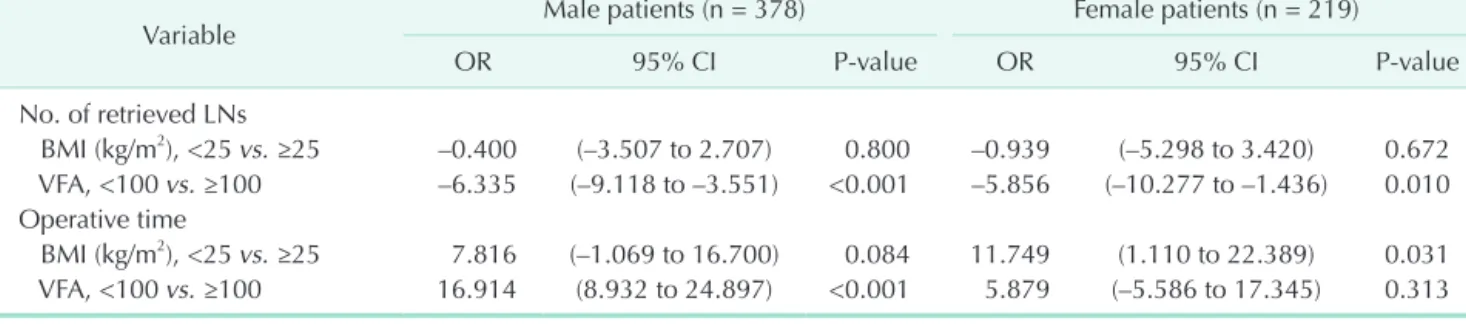
Effect of BMI and VFA on the number of retrieved LNs and operative time according to multiple regression analysis
Table 3 shows the results of multiple regression analysis of BMI and VFA on the number of retrieved LNs and operative time. The number of retrieved LNs had a statistically significant negative correlation with VFA in both men and women (men, P < 0.001; women, P = 0.010), but not with BMI. The operative time had a statistically significant positive correlation with VFA in men (P < 0.001), whereas the operative time had a statistically significant positive correlation with BMI (P = 0.031) in women.
DISCUSSION
In Korea and Japan, gastric cancer is now detected in the early stages because of the expansion of their National Health Screening Systems and advanced endoscopic techniques [2].
EGC is usually treated using laparoscopic subtotal gastrectomy [1]. Laparoscopic surgery is now popular because it is minimally invasive surgery and has been proven by several clinical studies to be safe, compared with open surgery for gastric cancer [3]. Now, also obese patients undergo LADG. It is widely known that laparoscopic surgery for obese patients is difficult, and there have been many studies evaluating the surgical outcomes of laparoscopic surgery for these patients. The safety and feasibility of laparoscopic surgery for these patients are
proven to be no different from open surgery [6,7], but the surgical outcomes of obese patients undergoing LADG remains debatable.
Some studies of LADG have used BMI as the indicator of obesity. Kim et al. [10] reported that male patients with a BMI
≥ 23 kg/m2 had longer operative time. Ojima et al. [12] found that the operative time of male patients with a large fat volume and high abdominal shape index was longer. Both studies confirmed significant correlations for obese male patients, but not for female patients.
There have been some studies on VFA. Yoshikawa et al.
[11] reported that the rate of postoperative complications was higher, the mean volume of blood loss was larger, and the mean number of retrieved LNs was smaller all significantly in patients was high VFA value suggesting that VFA might be a useful parameter for predicting the risks of LADG. Miyaki et al. [13]
reported that the operative time was significantly longer and volume of blood loss was significantly larger in patients with high VFA value, but that stratification base on BMI did not show significant differences. Hence, they concluded that VFA was a more accurate predictor of operative time and postoperative complications. Although the reports by Yoshikawa et al. [11]
and Miyaki et al. [13] concluded that VFA reflected surgical outcomes better than BMI, they only evaluated small numbers of patients, 64 and 84, respectively.
Ishii et al. [16] evaluated the effect of visceral obesity on surgical outcomes of patients with rectal cancer, and reported that patients with high VFA had a longer operative time and high frequency of complication. By univariate analysis, male gender and visceral obesity, but not general obesity, were signi
ficant independent factors associated with complications.
Mat sumoto et al. [17] reported that VFA did affect significantly intra operative bleeding, the number of retrieved LNs, and post operative complications, whereas BMI did not. They also de scribed that both BMI and VFA were not related to surgical out comes, such as operative time, intraoperative bleeding, retri
eved LNs and postoperative surgical complications in rectal cancer.
Length of operation could be overcome as the surgical expe
Table 3. Multiple regression analysis: effect of BMI and VFA on the number of retrieved LNs and operative time
Variable Male patients (n = 378) Female patients (n = 219)
OR 95% CI P-value OR 95% CI P-value
No. of retrieved LNs
BMI (kg/m2), <25 vs. ≥25 –0.400 (–3.507 to 2.707) 0.800 –0.939 (–5.298 to 3.420) 0.672 VFA, <100 vs. ≥100 –6.335 (–9.118 to –3.551) <0.001 –5.856 (–10.277 to –1.436) 0.010 Operative time
BMI (kg/m2), <25 vs. ≥25 7.816 (–1.069 to 16.700) 0.084 11.749 (1.110 to 22.389) 0.031 VFA, <100 vs. ≥100 16.914 (8.932 to 24.897) <0.001 5.879 (–5.586 to 17.345) 0.313 BMI, body mass index; VFA, visceral fat area; LNs, lymph nodes; OR, odd ratio; CI, confidence interval.
riences increased even in the high VFA cases. In our study, both male and female patients with high VFA value had significantly decreased mean numbers of retrieved LNs and prolonged operative times. Men with high VFA value had a smaller num
ber of retrieved LNs and longer operative time than men with low VFA by multiple regression analysis. Women with high VFA had a smaller number of retrieved LNs, but operative time was longer in women with high BMI. These results suggest that LN retrieval is affected by VFA regardless of gender, whereas the operative time was longer in the female patients, whose overall fat volume was large, regardless of visceral obesity. This can be accounted for by the fact that women have more subcutaneous fat than visceral fat compared with men, and therefore VFA cannot be an independent predictive factor of the operative time in female patients.
We performed subgroup analysis according to gender, BMI, and VFA for surgical outcome. Regarding LN retrieval, the num
bers of retrieved LNs between 4 subgroups of men and women were significantly different. There were significant differences in the operative time of male patients only. In female patients, the difference of operation time between high BMI and high VFA group and the other groups was not statistically significant,
but operation time itself differ each other distinctly.
This was a large, singlecenter retrospective study evaluating the VFA of patients with gastric cancer who underwent LADG.
The results of the gender, VFA, and BMI subgroup analyses of the operative outcomes might, in practice, be helpful in practice for inexperienced surgeons.
In conclusion, the preoperative VFA of male patients with gastric cancer who undergo LADG may affect the number of retri eved LNs and operative time. The preoperative VFA of fe male patients with gastric cancer did not appear to affect operative time. However, VFA was more useful than BMI in pre
dicting operative outcomes.
CONFLICTS OF INTEREST
No potential conflict of interest relevant to this article was reported.
ACKNOWLEDGEMENTS
This work was supported by the DongA University research fund.
1. van de Velde CJ, Peeters KC. The gastric cancer treatment controversy. J Clin Oncol 2003;21:22346.
2. Hyung WJ, Kim SS, Choi WH, Cheong JH, Choi SH, Kim CB, et al. Changes in treatment outcomes of gastric can cer sur
gery over 45 years at a single insti tution.
Yonsei Med J 2008;49:40915.
3. Koeda K, Nishizuka S, Wakabayashi G. Mi
nimally invasive surgery for gastric can cer:
the future standard of care. World J Surg 2011;35:146977.
4. Hur H, Xuan Y, Ahn CW, Cho YK, Han SU.
Trends and outcomes of minimally inva
sive surgery for gastric cancer: 750 conse
cutive cases in seven years at a single cen
ter. Am J Surg 2013;205:4551.
5. Perez Rodrigo C. Current mapping of obe
sity. Nutr Hosp 2013;28 Suppl 5:2131.
6. Ohno T, Mochiki E, Ando H, Ogawa A, Yanai M, Toyomasu Y, et al. The benefits of laparoscopically assisted distal gastrec
tomy for obese patients. Surg Endosc 2010;24:27705.
7. Yamada H, Kojima K, Inokuchi M, Ka
wano T, Sugihara K. Effect of obesity on technical feasibility and postoperative out comes of laparoscopyassisted distal gastrectomy: comparison with open distal gastrectomy. J Gastrointest Surg 2008;12:9971004.
8. Lee JH, Paik YH, Lee JS, Ryu KW, Kim CG, Park SR, et al. Abdominal shape of gastric cancer patients influences shortterm surgical outcomes. Ann Surg Oncol 2007;
14:128894.
9. Shim JH, Song KY, Kim SN, Park CH. La
paroscopyassisted distal gastrectomy for overweight patients in the Asian po
pulation. Surg Today 2009;39:4816.
10. Kim KH, Kim MC, Jung GJ, Kim HH. The impact of obesity on LADG for early gas
tric cancer. Gastric Cancer 2006;9:3037.
11. Yoshikawa K, Shimada M, Kurita N, Iwa ta T, Nishioka M, Morimoto S, et al. Visce ral fat area is superior to body mass in dex as a predictive factor for risk with lapa
roscopyassisted gastrectomy for gastric
cancer. Surg Endosc 2011;25:382530.
12. Ojima T, Iwahashi M, Nakamori M, Naka
mura M, Takifuji K, Katsuda M, et al.
The impact of abdominal shape index of pa tients on laparoscopyassisted distal gas trectomy for early gastric cancer. Lan
genbecks Arch Surg 2012;397:43745.
13. Miyaki A, Imamura K, Kobayashi R, Ta
kami M, Matsumoto J. Impact of visce ral fat on laparoscopyassisted distal gas
trectomy. Surgeon 2013;11:7681.
14. Sottier D, Petit JM, Guiu S, Hamza S, Ben
hamiche H, Hillon P, et al. Quantifi cation of the visceral and subcutaneous fat by computed tomography: interob server correlation of a single slice techni que.
Diagn Interv Imaging 2013;94:87984.
15. Examination Committee of Criteria for 'Obesity Disease' in Japan; Japan Society for the Study of Obesity. New criteria for 'obesity disease' in Japan. Circ J 2002;
66:98792.
16. Ishii Y, Hasegawa H, Nishibori H, Wata
nabe M, Kitajima M. Impact of visceral
REFERENCES
obesity on surgical outcome after laparo
scopic surgery for rectal cancer. Br J Surg 2005;92:12612.
17. Matsumoto N, Shimada M, Kurita N, Iwata T, Nishioka M, Morimoto S, et al.
The role of body mass index and visceral fat area in colorectal cancer patients treat
ed with laparoscopicassisted surgery [abstract]. In: Society of American Gastro
intestinal and Endoscopic Surgeons 2010;
2010 Apr 1417. Los Angeles (CA): So ciety of American Gastrointestinal and Endo
scopic Surgeons; 2010.