Background : Procedures for rapid identification and susceptibility testing by direct inoculation (DI) from positive blood culture bottles into an automated system have not been standardized. This study was purposed to evaluate DI from BACTEC 9240 blood culture system (BD, USA) into MicroScan (Dade Behring, USA) or Phoenix (BD, USA).
Methods : From May to June 2006, bacterial pellets from positive aerobic bottles showing gram- positive cocci (GPC) or gram-negative rods (GNR) of single morphology were directly inoculated to MicroScan PosCombo1A and NegCombo32 and to Phoenix PMIC/ID-107 and NMIC/ID-53. In addi- tion, the automated instruments were also inoculated from subcultures (standard inoculations, SI).
Species identification and susceptibilities were compared between DI and SI and between MicroScan and Phoenix.
Results : A total of 108, 104, and 78 specimens were tested with MicroScan, Phoenix, and both, respectively. When DI and SI were matched, 94.8% of GPC were correctly identified with MicroScan, compared to 80.7% with Phoenix, and 93.9% of GNR were correctly identified with MicroScan, com- pared to 95.7% with Phoenix. DI with MicroScan and Phoenix showed correct susceptibilities in 94.6% of 1,150 and 96.5% of 660 tests (with very major error [VME] of 1.1% and 1.1%), respective- ly, among GPC and in 94.4% of 942 and 96.3% of 781 tests (with VME of 0.6% and 0%), respec- tively, of GNR. Correlation of identification/susceptibilities between MicroScan and Phoenix using DI were 81.8%/98.0% for Staphylococcus aureus and 100.0%/95.6% for Escherichia coli.
Conclusions : DI warrants a reliable method for identification and susceptibility testing of both GPC and GNR in MicroScan, and those of only GNR in Phoenix. (Korean J Lab Med 2009;29:25-34)
Key Words : Blood culture, Direct inoculation, Identification, Susceptibility, MicroScan, Phoenix
서 론
혈액배양은 균혈증을 확진하고, 원인균을 규명하는 진단법으 로서 신속한 결과보고가 이환율과 사망률에 결정적인 영향을 준 다[1]. 따라서 혈액배양검사는 임상미생물배양검사 중 가장 신
25 DOI 10.3343/kjlm.2009.29.1.25
25 25 25 Received :August 28, 2008 Manuscript No :KJLM2158 Revision received :December 10, 2008
Accepted :December 10, 2008 Corresponding author :Mi-Na Kim, M.D.
Department of Laboratory Medicine, University of Ulsan College of Medicine and Asan Medical Center, 388-1 Pungnap-2dong, Songpa-gu, Seoul 138-736, Korea
Tel : +82-2-3010-4511, Fax : +82-2-478-0884 E-mail : [email protected]
BACTEC 혈액배양병 양성검체에서 직접접종법에 의한 균종동정과 항균제감수성검사를 위한 MicroScan과 Phoenix 시스템의 평가
Evaluation of MicroScan and Phoenix System for Rapid Identification and Susceptibility Testing Using Direct Inoculation from Positive BACTEC Blood Culture Bottles
Jae-Woo Chung, M.D., Hong-Seon Jeon, M.S., Heungsup Sung, M.D., and Mi-Na Kim, M.D.
Department of Laboratory Medicine, University of Ulsan College of Medicine and Asan Medical Center, Seoul, Korea
정재우∙전홍선∙성흥섭∙김미나
울산의대 서울아산병원 진단검사의학과
속성을 강조하는 종목이다[2]. 1990년대 이후 혈액배양검사의 검사소요시간을 단축하는데 완전 자동화되고 민감도를 높인 연 속모니터링 혈액배양시스템과 동정 및 감수성기기의 도입이 중 요한 역할을 하였다[3, 4] 국내 임상검사실에서도 최근 BACTEC 9240 시스템(BD, Sparks, MD, USA)과 BacT/Alert 시스템 (bioMerieux, Marcy l’Etoile, France) 등 전자동혈액배양시스 템이 확산되고, MicroScan Walkaway (Dade Behring, West Sacramento, CA, USA), Vitek 2 (bioMerieux, Marcy I’
Etoile, France), Phoenix (BD, Sparks, MD, USA) 등 자동 화된 동정 및 감수성검사기기가 널리 사용되고 있다[5]. 검사소 요시간을 더 단축하기 위해 1979년 Edberg 등[6]이 배양양성병 에서 균침사를 얻어서 자동화기기에 직접 접종하는 방법을 시도 한 이후, Vitek 2, MicroScan, Phoenix 등을 이용하여 평가가 이루어졌고, 종동정은 기기 간에, 균종에 따라 다양한 수행능을 보였으나 항균제감수성은 대체로 우수한 결과를 얻었다[7-11].
이들 논문들에서 직접접종법의 수행능이 다른 데는 동정 및 감 수성검사시스템의 차이가 기여했을 것으로 추정되었지만, 기기 별 차이를 비교 평가한 논문은 없었다.
본 연구는 BACTEC 9240 시스템을 이용한 혈액배양에서 직 접접종법으로 동정과 감수성검사를 실시하고자 MicroScan과 Phoenix 시스템의 수행능을 평가하였다.
재료 및 방법 1. 연구 대상
2006년 5월 2일부터 6월 21일까지 서울아산병원 임상미생물 검사실에서 혈액배양양성배양병 100개 이상씩을 MicroScan과 Phoenix 시스템으로 균동정과 항균제감수성검사를 실시하였다.
각 검체는 해당 기기에 직접접종법(직접법)과 표준접종법(표준 법)의 짝을 맞춰 비교 검사를 실시하였다.
성인의 경우 BACTEC PLUS Aerobic/F와 BACTEC LYTIC Anaerobic/F Bactec Plus를 세트로, 소아의 경우 BACTEC PEDS PLUS/F와 BACTEC LYTIC Anaerobic/F Bactec Plus 를 세트로 하여 혈액배양을 실시하였다. BACTEC 9240 시스템 에서 배양하면서 균 자람 신호가 검출되면 균액을 도말하여 그람 염색을 시행하였다. 그람양성알균이나 그람음성막대균 단일종 이 관찰되면서, 혐기성균이 아니라고 판단될 때 배양액 5 mL를 취해서 직접접종에 사용하였고, 동시에 혈액한천배지와 Mac- Conkey배지에 계대배양하였다. 계대배양에서 혼합배양이 확 인된 배양병과 검체는 추후 평가 대상에서 제외하였다.
2. 직접법
양성 신호가 관찰된 혈액배양병에서 멸균주사기로 검체 5 mL 를 취하여 serum separator tube (SST; BD, Sparks, MD, USA)에 옮긴 후 2,000 g, 실온에서 10분간 원심분리하여 균침 사를 얻었다. 얻어진 균침사를 MicroScan의 경우 inoculum water에, Phoenix의 경우 ID broth와 AST broth에 희석하여 균액이 0.5 McFarland가 되도록 맞춘 후, 제조회사의 지침에 따라서 그람양성알균은 MicroScan PosCombo Panel Type 1A와 Phoenix PMIC/ID-107 패널에, 그람음성막대균은 Micro- Scan NegCombo Panel Type 32와 Phoenix NMIC/ID-53 패 널에 접종한 후, 각각 MicroScan WalkAway96와 Phoenix 100 에 장착하여 균동정과 항균제감수성검사를 실시하였다.
3. 표준법
양성인 혈액배양병에서 무균적으로 100 μL 정도의 배지를 혈 액한천배지에 접종한 후, 37℃ 5% CO2배양기에서 하룻밤 키웠 다. 순수 분리된 균집락을 따서 MicroScan inoculum water와 Phoenix ID broth 및 AST broth에 각각 0.5 McFarland로 맞추고, 직접법과 같은 방법으로 균동정과 항균제감수성검사를 시행하였다.
4. 결과 해석 및 비교
표준법의 결과를 기준으로 하여, 각 기기 별로 직접법과 표준 법의 일치도를 비교평가하였다. 종 수준까지 같은 결과가 나왔을 때를 일치한 것으로 분류하되, coagulase negative staphylo- cocci (CoNS)의 경우에는 속 수준의 결과가 같은 경우를, strep- tococci의 경우 Facklam의 분류[12]가 같은 경우까지 일치한 것으로 판단하였다. 두 기기간 결과를 비교할 때, 기기간의 표준 법 균동정결과가 일치하지 않는 경우에는 추가로 생화학검사, Pastrorex Staph plus (BIO-RAD, Marnes-la-Coquette, France), Streptex (Remel Inc., Lenexa, KS, USA) 등의 라 텍스응집검사 및 RapID (Remel Inc., Lenexa, KS, USA) 등의 검사를 추가하여, 균종의 확인을 시도하였다.
항균제감수성결과는 균종동정결과에서 종 수준 또는 일부 속 수준까지 일치하는 균주를 대상으로 각 기기의 직접법접종결과 를 표준법에 대한 항균제 감수성 결과와 비교하였다. 각 균종별 로 CLSI M100-S17 지침[13]에 감수성 판독 기준이 있는 감수 성 결과를 감수성, 중간, 내성의 결과로 분류하여 판독일치도를
조사하였고, enterococci의 경우 gentamicin 상승작용검사와 streptomycin 상승작용검사의 판독일치도를 추가로 확인하였 다. 직접법과 표준법에서 항균제감수성결과가 불일치한 경우는 1) 표준법에서 내성이고 직접법에서 감수성이면 중대오류(very major error, VME), 2) 표준법에서 감수성이고 직접법에서 내 성이면 대오류(major error, ME), 3) 표준법과 직접법 둘 중 하 나가 중간이고, 다른 하나가 내성 혹은 감수성인 소오류(minor error, mE) 등 세 가지로 분류하였다.
기기간 항균제감수성결과의 비교는
Staphylococcus aureus
의 경우, 두 기기에 공통적으로 포함된 ampicillin, amoxicillin/clavulanate, chloramphenicol, clindamycin, cefazolin, ciprofloxacin, erythromycin, fusidic acid, nitrofurantoin, gentamicin, oxacillin, penicillin, rifampin, quinupristin/
dalfopristin, trimethoprim/sulfamethoxazole, teicoplanin, vancomycin 등 17가지 항균제에 대해,
Escherichia coli
는 amikacin, ampicillin, aztreonam, ceftazidime, cefotaxime,ciprofloxacin, cefepime, cefuroxime, gentamicin, imipen- em, levofloxacin, piperacillin, piperacillin/tazobactam, trimethoprim/sulfamethoxazole, tobramycin 등 15가지 항 균제를 대상으로 하였으며, 결과의 일치도 판단은 기기 내 감수 성결과를 평가할 때와 동일하게 진행하였고, CLSI 지침에 판독 기준이 정립되어 있지 않은 fusidic acid의 경우 최소억제농도 를 통해 비교하였다.
결 과 1. 연구 대상
MicroScan은 108검체, Phoenix의 경우 104검체에 대해 직 접법 및 표준법으로 균동정과 항균제감수성검사를 시행하였다.
Phoenix 장비에서 검사를 늦게 시작해서 두 기기 모두에서 동 시에 직접법과 표준법검사가 이루어진 검체는 78개였다.
2. MicroScan 의 직접법과 표준법의 동정결과 일치도
S. aureus
12주, CoNS 29주, streptococci 9주, entero- cocci 6주와 표준법에서Leuconostoc
spp.와Micrococcus
spp.로 동정된 2주를 포함하여 그람양성알균 총 58주와E. coli
16주,Klebsiella pneumoniae
15주,Acinetobacter
spp. 7주,Pseudomonas
spp. 4주,Stenotrophomonas maltophilia
2 주 및Salmonella
serotype Typhi,Citrobacter freundii
,Bur- kholderia cepacia
,Vibrio cholerae
,Achromobacter
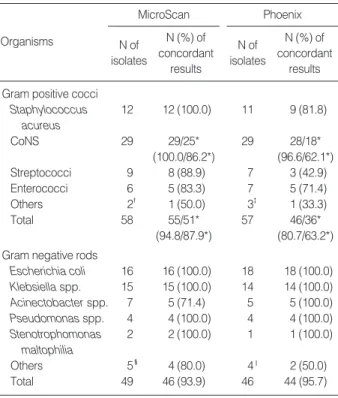
spp.각각 1주 등 그람음성막대균 총 49주를 대상으로 직접법과 표 준법으로 동정이 이루어졌다. 그람양성알균의 직접법과 표준법 의 동정 일치율은 94.8%로, CoNS의 종수준 일치도를 기준으 로 할 경우에는 87.9%이었다(Table 1). 그람음성막대균에서의 직접법과 표준법의 동정일치율은 93.9%로,
C. freundii
와S.
serotype Typhi를 포함한
Enterobacteriaceae
33주는 모두 일치된 균동정결과를 나타내었으나, 비발효균 16주의 직접법과 표준법의 동정결과 일치율은 81.3%로 낮게 나타났다.3. Phoenix 의 직접법과 표준법의 동정결과 일치도
S. aureus
11주, CoNS 29주, streptococci 7주, enterococci 7주 및Leuconostoc
spp.,Kocuria
spp. 및Micrococcus
spp.각각 1주 등 그람양성알균 총 57주와
E. coli
19주,K. pneu- moniae
14주,Acinetobacter
spp. 5주,Pseudomonas
spp.*Based on species level; �including Leuconostoc spp. and Micrococ- cus spp.; �including Leuconostoc spp., Kocuria spp. and Micrococcus spp.; �including Salmonella Typhi, Citrobacter freundii, Burkholderia cepacia, Vibrio cholerae, Achromobacter spp.; ‖including Achromobac- ter spp, Ochrobactrum anthropi, Burkholderia cepacia, Aeromonas sobria.
Abbreviation: CoNS, coagulase negative staphylococci.
Organisms
MicroScan N of isolates
N (%) of concordant
results
Phoenix N of isolates
N (%) of concordant
results Gram positive cocci
Staphylococcus 12 12 (100.0) 11 9 (81.8) acureus
CoNS 29 29/25* 29 28/18*
(100.0/86.2*) (96.6/62.1*)
Streptococci 9 8 (88.9) 7 3 (42.9)
Enterococci 6 5 (83.3) 7 5 (71.4)
Others 2� 1 (50.0) 3� 1 (33.3)
Total 58 55/51* 57 46/36*
(94.8/87.9*) (80.7/63.2*) Gram negative rods
Escherichia coli 16 16 (100.0) 18 18 (100.0) Klebsiella spp. 15 15 (100.0) 14 14 (100.0) Acinectobacter spp. 7 5 (71.4) 5 5 (100.0)
Pseudomonas spp. 4 4 (100.0) 4 4 (100.0)
Stenotrophomonas 2 2 (100.0) 1 1 (100.0) maltophilia
Others 5� 4 (80.0) 4‖ 2 (50.0)
Total 49 46 (93.9) 46 44 (95.7)
Table 1. Concordance rate of species identification between direct inoculation and standard inoculation methods in Micro- Scan and Phoenix
4주,
S. maltophilia
1주 및Achromobacter
spp,Ochrobac- trum anthropi
,B. cepacia
,Aeromonas sobria
각각 1주 등 총 47주의 그람음성막대균에 대한 직접법 및 표준법으로 동정을 하였다. 그람양성알균에서의 동정 일치도는 80.7%로 CoNS의 종수준 일치도를 기준으로 할 경우에는 63.2%이었다(Table 1).그람음성막대균에서의 직접법과 표준법의 동정 일치율은 95.7%
이었고,
Enterobacteriaceae
32검체는 모두 일치된 균종동정 결과를 나타내었고, 비발효균 15주의 직접접과 표준법의 동정결과 일치율은 86.7%로 나타났다.
4. 기기 간 직접법 동정결과 일치도
MicroScan 직접법으로 동정한
S. aureus
11주, CoNS 30주, streptococci 7주, enterococci 7주 및Leuconostoc
spp.,Mic- rococcus
spp. 각각 1주 등 그람양성알균 총 57주 중, Micro- Scan과 Phoenix의 동정결과가 종 수준까지 일치하는 경우는Species MicroScan
Direct Standard
Phoenix
Direct Standard
Gram positive cocci
Staphylococus aureus S. aureus S. aureus Alloiococcus otitidis S. aureus
S. aureus S. aureus A. otitidis S. aureus
CoNS Staphylococus auricularis Staphylococus lugdunensis Staphylococus haemolyticus S. haemolyticus Staphylococus capitis S. capitis Staphylococus hominis Staphylococus warneri
S. capitis S. capitis Staphylococus kloosii S. capitis
S. capitis S. capitis S. capitis Staphylococus cohnii
Staphylococus epidermidis NT Bacillus cereus S. epidermidis
S. epidermidis S. epidermidis NT NT
S. epidermidis Staphylococus simulans NT NT
S. epidermidis S. epidermidis S. hominis S. hominis
S. epidermidis NT S. hominis S. hominis
S. epidermidis S. epidermidis Staphylococus saprophyticus S. epidermidis
S. epidermidis S. epidermidis S. saprophyticus S. epidermidis
S. epidermidis S. epidermidis S. saprophyticus S. epidermidis
S. epidermidis NT S. saprophyticus S. saprophyticus
S. haemolyticus S. haemolyticus S. haemolyticus S. lugdunensis
S. hominis S. hominis S. epidermidis S. epidermidis
S. hominis S. hominis S. saprophyticus S. hominis
S. hominis S. hominis S. saprophyticus S. hominis
S. warneri S. capitis S. warneri S. lugdunensis
Streptococcus Streptococcus anginosus group S. pneumoniae NT NT
pneumoniae S. pneumoniae S. pneumoniae Streptococcus mitis group S. pneumoniae
Group C streptococci Streptococcus agalactiae S. agalactiae Streptococcus pyogenes S. pyogenes Viridans streptococci S. viridans group S. viridans group S. acidominimus S. mitis group Streptococcus mutans group S. mutans group S. mutans group Streptococcus chromogenes S. mutans group
Streptococcus anginosus S. anginosus group NT S. pyogenes Streptococcus dysgalactiae
group subsp. equisimilis
Enterococcus faecium E. faecium Enterococcus gallinarum Aerococcus spp. E. faecium
E. faecium E. faecium Aerococcus spp. E. faecium
Leuconostoc spp. Leuconostoc spp. Leuconostoc spp. Bacillus circulans Leuconostoc spp.
Micrococcus spp. Staphylococcus sciuri Micrococcus spp. S. capitis Kocuria spp.
Gram negative rods
Klebsiella spp. Klebsiella oxytoca NT Klebsiella pneumoniae K. pneumoniae
Acinetobacter spp. Acinetobacter baumannii Acinetobacter lwoffii NT NT
K. oxytoca A. baumannii/haemolyticus Acinetobacter spp. Acinetobacter spp.
Achromobacter spp. Achromobacter xylosoxidans A. xylosoxidans Moraxella spp. Achromobacter spp.
Ochrobactrum spp. Ochrobactrum anthropi NT Pasteurella pneumotropica O. anthropi
Unidentified Aeromonas hydrophila group Vibrio cholerae Aeromonas sobria A. sobria
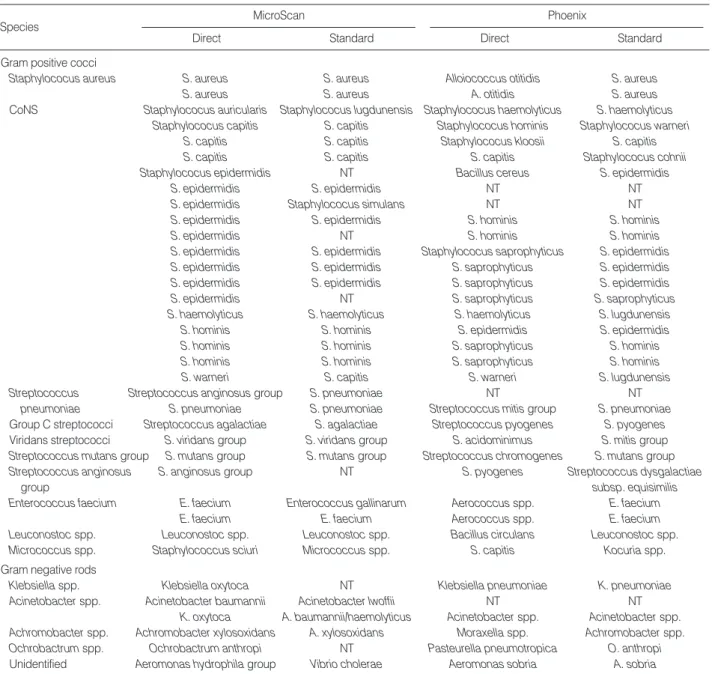
Table 2. 36 discrepant results of species identification between direct inoculation and standard inoculation methods in MicroScan and Phoenix
Abbreviations: CoNS, coagulase negative staphylococci; NT, not tested.
33주(59.7%)이었고, CoNS를 속 수준까지의 일치도를 보면 46 주(80.7%)이었다. 각 균종별 동정 일치도를 보면,
S. aureus
81.8% (9/11), CoNS 53.3% (16/30), streptococci 28.6% (2/7), enterococci 71.4% (5/7)이었고, MicroScan에서S. aureus
로 동정된 11주 중 2주는 Phoenix에서Alloiococcus otitidis
로 동 정되었다.그람음성막대균은 MicroScan 직접법에서
E. coli
로 동정된 18주,K. pneumoniae
12주,Klebsiella oxytoca
3주Acine- tobacter
spp. 4주,Pseudomonas
spp. 4주 및S. maltophi- lia
,B. cepacia
,Aeromonas
spp.,Achromobacter
spp.,Och- robactrum
spp. 각각 1주 등 총 46주 중 두 기기간 종수준의 일치를 나타내는 경우는E. coli
18주(100.0%),K. pneumoni- ae
12주(100.0%),K. oxytoca
1주(33.3%),Acinetobacter
spp 4주(100.0%),Pseudomonas
spp 4주(100.0%)와S. malto- philia
,B. cepacia
로, 총 41주(89.1%)이었다.Aeromonas
spp.1주와
K. oxytoca
1주는 표준법에서 각각V. cholerae
와Aci- netobacter baumannii
로 동정되어 수기법과 API NE (bio- Merieux, Marcy I’Etoile, France), API E (bioMerieux, Marcy I’Etoile, France) 등으로 재검하여 확인하였을 때,Aeromonas
spp.로 동정된 균은V. cholerae
는 아니었으나Vibrio
spp.와 정확히 감별되지 않았으며,K. oxytoca
는A. baumannii
가 잘 못 동정된 것이었다.직접법에 의한 균동정에서 기기간 차이를 나타낸 그람양성알 균 24주와 그람음성막대균 4주 및 각각의 기기 내에서 직접법과
간접법 간의 불일치한 동정을 나타낸 그람양성알균 6주와 그람 음성막대균 2주는 Table 2와 같다.
5. MicroScan 에서 표준법과 직접법의 항균제감수성검사 결과의 일치도
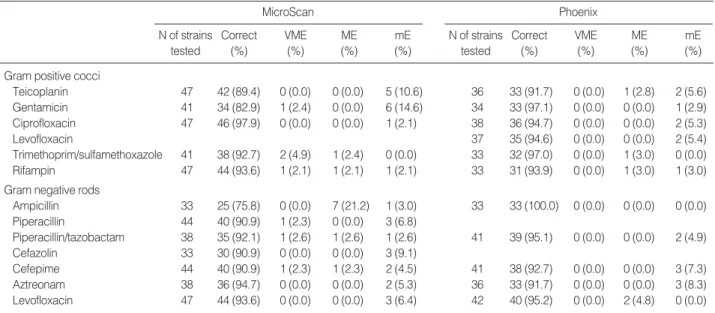
그람양성알균에 대한 총 1,150균주-항균제조합 중, 1,088 조 합(94.6%)에서 일치된 감수성 양상을 나타내었고, 불일치한 결 과의 경우, VME가 13개(1.1%), ME가 13개(1.1%), mE가 36개 (3.1%)였다. CLSI 지침에 판독 기준이 명시된 항균제에 대해서 gentamicin의 일치율 82.9% (34/41)를 비롯하여 cefazolin 85.4% (35/41), ampicillin 89.4% (42/47), teicoplanin 89.4%
(42/47) 등이 90% 미만의 일치율을 보였다. 각 균종별로 일치도 는
S. aureus
는 95.5% (298/312), CoNS는 95.0% (716/754),Enterococcus
spp.는 88.1% (81/96)이었다.Enterococcus
spp.에서 낮은 일치율은 glycopeptides 계열의 항균제에 대한 감수 성검사가 오류가 많았기 때문인데, 1주의 vancomycin 내성균을 놓치는 VME와 teicoplanin에 대한 mE가 6주 중 4중에 달했다.
그람음성막대균에 대한 총 942개의 균주-항생제 조합 중 일 치율은 94.4% (889/942)이었고, VME, ME 및 mE는 각각 0.6%
(6/942), 1.9% (18/942), 3.1% (29/942)이었다. 대부분의 항균 제에서 90% 이상의 일치율을 나타냈으나, ampicillin 75.8%, ticarcillin/clavulanic acid 89.4%, cefuroxime 87.9% 등에서 90% 미만의 일치율을 보였다.
Enterobacteriaceae
의 경우,E.
MicroScan N of strains
tested
Correct (%)
VME (%)
ME (%)
mE (%)
Phoenix N of strains
tested
Correct (%)
VME (%)
ME (%)
mE (%) Gram positive cocci
Teicoplanin 47 42 (89.4) 0 (0.0) 0 (0.0) 5 (10.6) 36 33 (91.7) 0 (0.0) 1 (2.8) 2 (5.6)
Gentamicin 41 34 (82.9) 1 (2.4) 0 (0.0) 6 (14.6) 34 33 (97.1) 0 (0.0) 0 (0.0) 1 (2.9)
Ciprofloxacin 47 46 (97.9) 0 (0.0) 0 (0.0) 1 (2.1) 38 36 (94.7) 0 (0.0) 0 (0.0) 2 (5.3)
Levofloxacin 37 35 (94.6) 0 (0.0) 0 (0.0) 2 (5.4)
Trimethoprim/sulfamethoxazole 41 38 (92.7) 2 (4.9) 1 (2.4) 0 (0.0) 33 32 (97.0) 0 (0.0) 1 (3.0) 0 (0.0)
Rifampin 47 44 (93.6) 1 (2.1) 1 (2.1) 1 (2.1) 33 31 (93.9) 0 (0.0) 1 (3.0) 1 (3.0)
Gram negative rods
Ampicillin 33 25 (75.8) 0 (0.0) 7 (21.2) 1 (3.0) 33 33 (100.0) 0 (0.0) 0 (0.0) 0 (0.0)
Piperacillin 44 40 (90.9) 1 (2.3) 0 (0.0) 3 (6.8)
Piperacillin/tazobactam 38 35 (92.1) 1 (2.6) 1 (2.6) 1 (2.6) 41 39 (95.1) 0 (0.0) 0 (0.0) 2 (4.9)
Cefazolin 33 30 (90.9) 0 (0.0) 0 (0.0) 3 (9.1)
Cefepime 44 40 (90.9) 1 (2.3) 1 (2.3) 2 (4.5) 41 38 (92.7) 0 (0.0) 0 (0.0) 3 (7.3)
Aztreonam 38 36 (94.7) 0 (0.0) 0 (0.0) 2 (5.3) 36 33 (91.7) 0 (0.0) 0 (0.0) 3 (8.3)
Levofloxacin 47 44 (93.6) 0 (0.0) 0 (0.0) 3 (6.4) 42 40 (95.2) 0 (0.0) 2 (4.8) 0 (0.0)
Table 3. Results for antimicrobial susceptibilities with low correlation (<95%) between direct inoculation and standard inoculation method in MicroScan and Phoenix
Abbreviations: VME, very major error; ME, major error; mE, minor error.
coli
96.5%,K. pneumoniae
96.0%, 그 외C. freundii
와Sal- monella
Typhi 91.3% 등 95.9%의 일치율을 나타냈고, 대부분 의 항균제에 대해 90% 이상의 일치율을 보였으나, cefuroxime 은 87.9%, ampicillin은 75.8%을 나타냈으며, 특히 ampicillin 의 항균제감수성결과가 불일치한 대부분은 ME였다. 비발효균 은Acinectobacter
spp. 91.1%,Pseudomonas
spp. 79.7%을 포함 총 88.0%의 낮은 일치율을 보였다(Table 3).6. Phoenix 에서 표준법과 직접법의 항균제감수성검사 결과의 일치도
종동정이 적절한 경우만 항균제감수성결과를 비교했기 때문 에 Phoenix는 상대적으로 적은 수에서만 결과를 비교할 수 있었 다. 그람양성알균에 대한 총 660 항균제패널과 그람음성막대균 에 대한 총 781 항균제패널에 대해 분석하였다. 그람양성알균에 서 637 패널조합이 정확한 결과를 보였고, VME가 7패널조합, ME가 5패널조합, mE가 11패널조합이었고, 검사가 이뤄진 패널 조합 중 CLSI 지침에 판독기준이 명시된 항균제에 대해서 모두 90% 이상의 일치율을 나타냈다. 각 균종별로 일치도는
S. aureus
는 98.8%, CoNS는 96.3%,Enterococcus
spp.는 90.3%이었 다.Enterococcus
spp.의 경우 vancomycin, teicoplanin에 대해 각 1건씩 mE가 있어서 일치율이 80.0%였고, fosfomycin 에 대한 일치율은 40.0%로 특히 낮았다.그람음성막대균에서는 96.3%의 패널조합이 정확한 결과였 고, VME는 없었으며, ME 및 mE는 각각 0.9%, 2.8%이었다.
대상 항균제 모두에서 90% 이상의 일치율을 나타냈으며,
Enter- obacteriaceae
의 경우,E. coli
98.1%,K. pneumoniae
97.1%등 97.7%의 일치율을 나타냈다. 비발효균에서는 92.2%의 항균 제감수성결과일치율을 보였고, 주요 균종별 일치율은
Acinec- tobacter
spp. 100.0%,Pseudomonas
spp. 79.5% 등 전체적 으로 92.2%의 일치율을 보였다(Table 3).7. 기기 간 직접법 항균제감수성 결과 일치도
S. aureus
9주와E. coli
18주는 MicroScan 직접법과 Phoenix 직접법의 항균제감수성결과를 비교하였다.S. aureus
는 98.0%,E. coli
는 95.6%의 일치율을 보였고,S. aureus
의 경우 cefa- zolin에 대해 MicroScan은 감수성, Phoenix는 내성으로 판독 한 1예, chloramphenicol과 clindamycin에서 mE로 판단할 수 있는 차이가 확인된 반면,E. coli
의 경우 MicroScan은 내성, Phoenix는 감수성으로 판독한 6예가 발견되었는데, cefepime1예를 제외하고는 모두 ampicillin에서 차이가 발생하였다.
고 찰
직접법에 의한 균동정능은 그람음성막대균에서 그람양성알 균에 비해 우수한 정확도를 보였다. 그람음성막대균은 Micro- Scan에서 93.9%, Phoenix에서 95.7%가 표준법과 일치하여 두 시스템 모두 우수하였다. 특히
Enterobacteriaceae
의 일치율은 MicroScan 97.1%, Phoenix 100%로,E. coli
와Klebsiella
spp.의 경우 두 기기 모두에서 100%의 일치율을 나타내었다. 이는 Phoenix를 평가한 연구에서 Enterobacteriaceae 종동정 능력 이 매우 우수하고,
E. coli
,Klebsiella
spp.,Enterobacter
spp.는 100% 직접법과 일치하였다는 보고와 일치하고[8], MicroScan 의 overnight 패널에 대한 연구에서도 99%의 종동정 정확도를 보였기 때문에[11, 14]
Enterobacteriaceae
는 직접법에 의한 종동 정은 두 시스템 모두 문제가 없을 것으로 판단하였다. 비발효균 에 대한 종동정 일치율은 Phoenix 시스템에서 84.6%로, Micro- Scan의 86.7%로Enterobacteriaceae
보다 떨어졌다. 하지만,P. aeruginosa
,Acinectobacter
spp.와S. maltophilia
등 혈 액에서 분리 빈도가 높은 비발효균은 Phoenix에서는 100% 종동 정이 일치하였고, MicroScan에서도 표준법에서A. bauman- nii
로 동정된 1주가 직접법에서K. oxytoca
로 동정된 경우 외에 는 모두 일치하였다. 이 불일치는 결과보고 전 계대배양한 집락 의 성상과 oxidase 검사로 확인하는 과정에서K. oxytoca
동정 이 오류임을 발견하여 결과를 정정하였던 경우였다. 현재까지 MicroScan에서A. baumannii
가K. oxytoca
로 잘못 동정된 경우는 경험하지 못해서, 오류가 균접종 과정에서 잘못 분주하 였거나, 오염에 의해 발생하였을 가능성이 높다고 판단하였으나, 이를 증명하지는 못하였다. 기존의 보고에서도 Phoenix는 직접 법에 의한 비발효균에 대한 종동정에 우수한 수행능을 보였다는 보고가 있었고[8], MicroScan 또한P. aeruginosa
2주와A.
baumannii
1주를 포함하여 그람음성막대균이 100% 동정되었 던 보고가 있다[14]. NegCombo type 15로 평가한 연구가 일치 율이 85%로 이번 연구와 비슷한 결과를 보였는데 2주의A.
baumannii
, 1주의P. aeruginosa
, 1주의S. maltophilia
가 직 접법과 일치하지 않았다. 3주는 매우 드문 생화학 반응형(very rare biotype)이었고, 1주는 동정결과의 확률이 낮은 다른 비발 효균으로 동정되어 결과를 확인해야만 하기 때문에 실제 상황에 서 잘못된 동정결과가 나갈 위험은 없었다[11]. Vitek 2로 평가 한 연구에서도P. aeruginosa
종동정 정확도가 78%에 불과했 던 보고가 있고[7], 비발효균 전체에 대해 정확도가 82.2%이면서
A. baumannii
,P. aeruginosa
,S. maltophilia
의 동정 정 확도가 낮았다는 보고 등으로 볼 때[10] 그람음성막대균은 기기 간, 균종 간 직접법에 의한 동정능에 차이가 있을 것으로 판단하 였다.P. aeruginosa
,Acinectobacter
spp.와S. maltophilia
등은 MicroScan과 Phoenix 시스템의 직접법 동정결과를 신뢰 할 만하고, 양성배양배지의 도말 그람염색결과, 계대배양한 집락 성상, oxidase 검사 등을 확인하면 직접법 결과를 진단검사로 서 보고할 수 있을 것으로 판단하였다.그람양성알균에서는 직접법과 표준법의 균동정 일치율이 MicroScan과 Phoenix 시스템 각각 94.8%, 80.7%로 그람음 성막대균에 비해 낮았고, 두 시스템 간 직접법으로 동정한 그람 양성알균의 종동정 일치율은 57.9%에 불과하여 종동정에 큰 차 이를 보였다. Phoenix에서는
S. aureus
2주를 직접법에서All- oiococcus otitidis
로 동정한 예가 있었다. CoNS에서 종 수준 의 일치율은 MicroScan 86.2%, Phoenix 62.1%로 낮았고, 이 러한 낮은 CoNS의 동정 일치율은 지금까지 보고와 일치하였다 [11, 15]. Phoenix의Staphylococcus
spp.에 대한 직접법의 동 정 정확도는 평가가 부족하고, Huang 등[16]이S. aureus
가 75.0%, CoNS가 40.0%의 동정 일치도를 보였다는 발표가 유일 하다. 이로 볼 때 Phoenix 시스템은 그람양성알균의 종동정에 직접법을 사용하기에는 부족하다고 판단하였다. 1998년 논문에 서 MicroScan overnight 패널이 82.0%, rapid 패널은 52.0%의 동정 일치도를 나타내어 overnight 패널이 rapid 패널에 비 해
Staphylococcus
spp.의 종동정능이 훨씬 우수하였는데[11], 본 연구에서 사용한 MicroScan PosCombo 1A는 당시 연구에 사용된 Type 6 패널보다 더 우수한 성능을 보였다. 이는 10년간 패널 조성, MicroScan 장비와 소프트웨어가 개선되었기 때문 일 수 있다. CoNS의 종수준 동정은 표준법을 사용하여도 부정 확하기 때문에[17-21], 직접법에서 CoNS를S. aureus
로 잘못 동정하지 않았고,Staphylococcus epidermidis
를 모두 정확 히 동정한 MicroScan은Staphylococcus
spp.의 종 동정에 이 용할 수 있을 것으로 판단하였다.Streptococcus
spp.에 대해 MicroScan은 88.9%, Phoenix는 42.9%,Enterococcus
spp.에 대해 MicroScan은 83.3%, Phoenix는 71.4% 등
Staphylo- coccus
spp.에 비해 낮은 일치율을 나타냈는데, 특히 Phoenix 는Enterococcus faecium
2주를Aerococcus
spp.로 동정하 는 심각한 오류였다. 이에 비해, MicroScan은Enterococcus gallinarum
1주를E. faecium
으로 동정한 오류만 있어서, 가 장 우수한 동정능을 보였는데, 과거 MicroScan overnight 패 널은Enterococcus
spp.와Staphylococcus agalactiae
에 대 한 동정결과가 모두 정확했다는 보고와 일치한다[11].항균제감수성검사는 MicroScan이 94.5%의 일치율, Phoenix 가 96.4%의 일치율을 나타냈다. 그람음성막대균의 항균제감 수성결과 일치율은
Enterobacteriaceae
의 일치율이 MicroScan 과 Phoenix 각각 95.9%, 96.9%로 비발효균에서 MicroScan의 83.8%, Phoenix의 92.2%보다 높았다. 이전의 연구에서 그람 음성균에 대한 항균제감수성검사의 정확도는 Vitek 2, Phoenix 는 균종-항균제 조합수로 계산할 때 99.2%, 99.0%의 정확도를 보인데 비해[7, 8], 이번 연구는 감수성검사의 정확도가 낮은 편 이다. 특히 비발효균에 대한 일치도가 낮은 점은 감수성 정확도 를 따로 분석한 보고가 없어서 비교할 수 없었지만, 과거 그람 음성균 평가에서 비발효균이 소수였던 점을 고려할 때[7, 8, 10, 15], 비발효균에 대한 평가가 더 필요할 것이다. MicroScan에 서Enterobacteriaceae
의 일치도가 Phoenix보다 낮았던 것은E. coli
의 ampicillin에 대한 ME가 6개나 발생하여 일치율이 62.5%에 불과한 것이 크게 작용하였다. 두 검사법 간의 불일치 한 항균제감수성결과의 원인으로 직접법에서 균액접종 시의 접 종량효과 등을 고려할 수 있다[22, 23]. 실제로 McFarland 0.5 로 맞춘 균부유액으로 실험했던 한 연구에서도 직접법은 23%에 서 접종량이 부족했다는 보고가 있고[15], 똑같은 레진함유 배 지라도 혐기성배지에서 균침사를 얻을 때 호기성배지보다 균농 도가 낮았다는 보고가 있는 등[8], 표준법보다 직접법의 균접종 량이 적어서 VME가 발생할 위험이 있다. 하지만, 균접종량효 과는 이처럼 일관되게 더 내성인 쪽으로 치우치는 ME에 대해 서는 설명할 수 없다. 또한 Phoenix의 경우 같은 항균제에 대 해 100%의 감수성일치율을 보여, MicroScan에서 ME가 일어 나는 원인을 추가적으로 분석할 필요가 있었다.Pseudomonas
spp.에 대한 항균제감수성결과의 일치율이 두 기기 모두에서 80% 미만으로 낮게 나타났는데 이는 두 기기에서 항균제감수 성결과 일치율이 43.8% (7/16)와 46.2% (6/13)이었던 한 균주 로 인한 것이었다. 이 균주는 순수계대배양해서 재검을 해도 계 속 불일치하는 소견이 나타나 균주의 특성이 작용했을 것으로 판단하였다.그람양성알균에 대해서 오류의 종류를 분석했을 때 Micro- Scan의 경우 VME 1.1%, ME 1.1%, mE 3.1%, 그람음성막대균 에 대해서 VME 0.6%, ME 1.9%, mE는 3.1%인데 비해, Phoenix 의 경우 그람양성알균에 대해서 VME는 1.1%, ME 0.8%, mE 1.7%, 그람음성막대균은 VME 0.0%, ME 0.9%, mE 2.8%로 Phoenix에서 VME가 더 적었다. 하지만, Phoenix는 동정이 잘못된 검체 다수를 감수성검사분석에서 제외하여 항균제감수 성검사의 정확도를 높였을 것으로 추정된다. 두 시스템 모두 총 오류 10% 미만, VME 1.5% 미만, ME 3.0% 미만을 기준[24]으
로 했을 때는 감수성검사로서 적절한 방법이라고 할 수 있다. 하 지만, MicroScan이
Staphylococcus
spp.의 oxacillin 내성을 1주(8.3%)에서 놓친 VME는 심각한 오류로서 이전 보고에서도 문제가 되었다[23]. 이는 MRSA 검출이 접종량효과에 민감하기 때문에 표준법을 써도 VME에 취약한 것과 상관성이 있을 것이 다[25]. 본 연구에서 VME를 보인S. aureus
1주는 다약제내성 을 보여서 oxacillin 선별한천배지검사를 추가로 적용할 필요가 있는 대상이었기 때문에[13], 이 지침을 따르면 VME를 방지할 수 있을 것이다.Enterococcus
spp.는 MicroScan에서 gly- copeptide 감수성검사가 부정확하였는데 특히 vancomycin 내 성을 놓치는 VME가 발생하여 직접법에서 감수성인 경우 그대 로 결과를 보고하기 어려울 것으로 생각하였다. 하지만Ente- rococcus
spp.에서 표준법으로 vancomycin 내성을 검출하는 경우도 VME가 문제가 되기 때문에[26], 민감도가 높은 van- comycin 내성선별한천배지를 사용하는 확인 검사가 권장된다 [13]. 본 검사실은 vancomycin 내성선별한천배지를 병용하고 있어서 직접법에서 vancomycin 내성을 놓치는 VME를 보완 할 수 있을 것으로 판단하였다.혼합 배양이 되면 동정과 감수성검사 둘 다에 영향을 주는데 [11, 23, 27], 본 연구에서는 혼합배양된 것이 포함되지 않았다.
그람염색에서 단일한 형태로 나타나도 계대배양에서 6-10%가 혼합배양으로 나타날 수 있다고 알려졌으나[11, 15, 23, 28], 계 대배양에서 집락성상은 모두 단일하였다. 하지만, 동일균종이 라고 해도 감수성 양상이 다른 균주가 혼합되었을 가능성을 배 제할 수 없기 때문에 이에 의한 직접법과 표준법 간의 결과 불 일치의 가능성은 배제할 수 없다.
직접법 결과가 어느 정도의 수행능을 보일 때 표준법으로 다시 확인할 필요가 없는지에 대한 기준은 아직 정립되어 있지 않다.
본 검사실에서 직접법을 사용한 경험으로는 의료기관서비스평 가에서 요구하는 질지표 중 하나인
S. aureus
가 양성인 혈액배 양결과는 4일 이내 보고하라는 기준을 100% 만족시킬 수 있었 다(unpublished data). 따라서 신속보고에 대한 요구가 높을 때 는 정확도가 표준법과 동등하지 않더라도 직접법을 도입하고 해당 기기에 대한 철저한 평가를 통해 수행능이 떨어지는 부분 을 찾아내어 보완하면 진단검사로 이용할 수 있을 것이다.MicroScan의 직접법은 주요 균종에 고른 동정능을 보이고, 항균제감수성의 정확도는 94.5%로서, 혈액배양검사에 이용할 수 있을 것으로 판단하였다. 하지만, 그람염색상과 집락판독, 산화효소검사,
S. aureus
동정 라텍스검사법 등 즉석검사를 통 해 동정을 보완하고, glycopeptide 계열의 감수성검사는 van- comycin 내성선별검사로 보완해야 할 것이다. Phoenix의 직접법은 그람양성알균에는 사용할 수 없고, 그람음성막대균에는 사용할 수 있을 것이다.
요 약
서론 : 혈액배양에서 직접접종법은 아직 표준화되어 있지 않 다. 본 연구는 BACTEC 9240 시스템(BD, USA)을 이용한 혈액 배양의 종동정과 감수성검사에서 MicroScan (Dade Behring, USA)과 Phoenix (BD, USA)의 직접접종법 수행능을 평가하였다.
방법 : 2006년 5월부터 6월까지 BACTEC 9240에서 양성인 혈액배양병 중 그람양성알균(gram positive cocci, GPC)이나 그람음성막대균(gram negative rods, GNR) 한 종만이 관찰된 검체의 균 침사를 GPC은 MicroScan PosCombo Panel Type 1A와 Phoenix PMIC/ID-107에, GNR은 MicroScan Neg- Combo Panel Type 32와 Phoenix NMIC/ID-53에 직접 접종 하였고, 표준접종법은 양성배양액을 혈액한천배지에 하룻밤 계 대배양한 집락을 이용하여 동일한 조건으로 검사하였다. 각 기 기 내 및 두 기기 간에서 직접법의 표준법에 대한 균동정과 항 균제감수성결과 일치율을 알아보았다.
결과 : MicroScan 108검체, Phoenix 104검체에 대해 평가 가 이루어졌고, 두 기기 모두에서 평가가 이루어진 경우는 78검 체였다. GPC에서 직접법의 종동정 일치율은 MicroScan 94.8%, Phoenix 80.7%, GNR에서는 각각 93.9%, 95.7%이었다. GPC 의 항균제감수성결과의 일치율은 MicroScan은 1,150 균주-항 균제조합에 대해 94.6%, Phoenix는 660조합에 대해 96.5%의 일치율을 보였고, 중대오류(very major error, VME)는 각각 1.1씩이었다. GNR은 MicroScan이 942조합에서 94.4%, Phoe- nix는 781조합에서 96.3%의 일치율을 나타냈고, VME는 각각 0.6%, 0% 등이었다. 기기간 직접법 종동정/항균제감수성결과를 비교할 때
Staphylococcus aureus
81.8%/98.0%,Escherichia coli
100.0%/95.6%가 일치하였다.결론 : MicroSan은 GPC와 GNR의 종동정이 신뢰할 만 하 였고, Phoenix 직접법은 GNR에는 우수하였으나, GPC에 적용 하기는 어려웠다.
참고문헌
1. Trenholme GM, Kaplan RL, Karakusis PH, Stine T, Fuhrer J, Lan- dau W, et al. Clinical impact of rapid identification and susceptibil- ity testing of bacterial blood culture isolates. J Clin Microbiol 1989;27:
1342-5.
2. Moore DF, Hamada SS, Marso E, Martin WJ. Rapid identification and antimicrobial susceptibility testing of gram-negative bacilli from blood cultures by the AutoMicrobic system. J Clin Microbiol 1981;
13:934-9.
3. Mylotte JM and Tayara A. Blood cultures: clinical aspects and con- troversies. Eur J Clin Microbiol Infect Dis 2000;19:157-63.
4. Weinstein MP. Current blood culture methods and systems: clini- cal concepts, technology, and interpretation of results. Clin Infect Dis 1996;23:40-6.
5. Sung H, Kim MN, Pai CH. The clinical relevance of four-day blood cultures with the BACTEC 9240 system. Korean J Clin Pathol 2001;
21:193-8. (성흥섭, 김미나, 배직현. BACTEC 9240 시스템에서4일혈액 배양의평가. 대한임상병리학회지 2001;21:193-8.)
6. Edberg SC, Clare D, Moore MH, Singer JM. Rapid identification of Enterobacteriaceae from blood cultures with the Micro-ID system. J Clin Microbiol 1979;10:693-7.
7. Bruins MJ, Bloembergen P, Ruijs GJ, Wolfhagen MJ. Identification and susceptibility testing of Enterobacteriaceae and Pseudomonas aeruginosa by direct inoculation from positive BACTEC blood cul- ture bottles into Vitek 2. J Clin Microbiol 2004;42:7-11.
8. Funke G and Funke-Kissling P. Use of the BD PHOENIX Automat- ed Microbiology System for direct identification and susceptibility testing of gram-negative rods from positive blood cultures in a three- phase trial. J Clin Microbiol 2004;42:1466-70.
9. Kerremans JJ, Goessens WH, Verbrugh HA, Vos MC. Accuracy of identification and susceptibility results by direct inoculation of Vitek 2 cards from positive BACTEC cultures. Eur J Clin Microbiol Infect Dis 2004;23:892-8.
10. Ling TK, Liu ZK, Cheng AF. Evaluation of the VITEK 2 system for rapid direct identification and susceptibility testing of gram-nega- tive bacilli from positive blood cultures. J Clin Microbiol 2003;41:
4705-7.
11. Waites KB, Brookings ES, Moser SA, Zimmer BL. Direct bacterial identification from positive BacT/Alert blood cultures using Micro- Scan overnight and rapid panels. Diagn Microbiol Infect Dis 1998;
32:21-6.
12. Facklam R. What happened to the streptococci: overview of taxo- nomic and nomenclature changes. Clin Microbiol Rev 2002;15:613-30.
13. Clinical and Laboratory Standards Institute. Performance standards for antimicrobial susceptibility testing. Seventeenth informational supplement (M100-S17). Wayne, PA: Clinical and Laboratory Stan-
dards Institute, 2007.
14. Dipersio JR, Ficorilli SM, Varga FJ. Direct identification and suscep- tibility testing of gram-negative bacilli from BACTEC bottles by use of the MS-2 system with updated bacterial identification soft- ware. J Clin Microbiol 1984;20:1202-4.
15. de Cueto M, Ceballos E, Martinez-Martinez L, Perea EJ, Pascual A.
Use of positive blood cultures for direct identification and suscepti- bility testing with the vitek 2 system. J Clin Microbiol 2004;42:3734-8.
16. Huang TD, Laurent C, Gigi J, Simon A. Direct identification and susceptibility testing of gram-positive cocci from positive Bactec blood cultures with BD Phoenix Automated Microbiology System.
Clin Microbiol Infect 2006;12(S):S442.
17. Grant CE, Sewell DL, Pfaller M, Bumgardner RV, Williams JA. Eval- uation of two commercial systems for identification of coagulase- negative staphylococci to species level. Diagn Microbiol Infect Dis 1994;18:1-5.
18. Ieven M, Verhoeven J, Pattyn SR, Goossens H. Rapid and economi- cal method for species identification of clinically significant coagu- lase-negative staphylococci. J Clin Microbiol 1995;33:1060-3.
19. Perl TM, Rhomberg PR, Bale MJ, Fuchs PC, Jones RN, Koontz FP, et al. Comparison of identification systems for Staphylococcus epider- midis and other coagulase-negative Staphylococcus species. Diagn Microbiol Infect Dis 1994;18:151-5.
20. Poyart C, Quesne G, Boumaila C, Trieu-Cuot P. Rapid and accurate species-level identification of coagulase-negative staphylococci by using the sodA gene as a target. J Clin Microbiol 2001;39:4296-301.
21. Renneberg J, Rieneck K, Gutschik E. Evaluation of Staph ID 32 sys- tem and Staph-Zym system for identification of coagulase-negative staphylococci. J Clin Microbiol 1995;33:1150-3.
22. Hayward NJ. Effect of inoculum size on ampicillin and amoxycillin susceptibility determined by gas-liquid chromatography for mem- bers of the family Enterobacteriaceae. J Clin Microbiol 1986;23:755-9.
23. Waites KB, Brookings ES, Moser SA, Zimmer BL. Direct susceptibil- ity testing with positive BacT/Alert blood cultures by using Micro- Scan overnight and rapid panels. J Clin Microbiol 1998;36:2052-6.
24. Murray P, Baron E, et al. eds. Manual of clinical microbiology. 7th ed. Washington, D.C.: American Society for Microbiology, 1999;
1593-600.
25. Donay JL, Mathieu D, Fernandes P, Pregermain C, Bruel P, Wargnier A, et al. Evaluation of the automated phoenix system for potential routine use in the clinical microbiology laboratory. J Clin Microbiol
2004;42:1542-6.
26. Tenover FC, Swenson JM, O’Hara CM, Stocker SA. Ability of com- mercial and reference antimicrobial susceptibility testing methods to detect vancomycin resistance in enterococci. J Clin Microbiol 1995;33:1524-7.
27. Fontanals D, Salceda F, Hernandez J, Sanfeliu I, Torra M. Evalua- tion of wider system for direct identification and antimicrobial sus-
ceptibility testing of gram-negative bacilli from positive blood cul- ture bottles. Eur J Clin Microbiol Infect Dis 2002;21:693-5.
28. Putnam LR, Howard WJ, Pfaller MA, Koontz FP, Jones RN. Accura- cy of the Vitek system for antimicrobial susceptibility testing Enter- obacteriaceae bloodstream infection isolates: use of “direct”inocula- tion from Bactec 9240 blood culture bottles. Diagn Microbiol Infect Dis 1997;28:101-4.