ISSN 2234-3806 • eISSN 2234-3814
352 www.annlabmed.org https://doi.org/10.3343/alm.2017.37.4.352 Ann Lab Med 2017;37:352-354
https://doi.org/10.3343/alm.2017.37.4.352
Letter to the Editor
Diagnostic Genetics
Hemoglobin Kansas: First Korean Family and Literature Review
Irene Jo, M.D.1, Woori Jang, M.D.1,2, Hyojin Chae, M.D.1,2, So-Young Kim, M.D.3, Myungshin Kim, M.D.1,2, Yonggoo Kim, M.D.1,2, and Kyungja Han, M.D.1
Department of Laboratory Medicine1, Seoul St. Mary’s Hospital, College of Medicine, The Catholic University of Korea; Catholic Genetic Laboratory Center2, Seoul St. Mary’s Hospital, College of Medicine, The Catholic University of Korea; Department of Pediatrics3, Yeouido St. Mary’s Hospital, College of Medicine, The Catholic University of Korea, Seoul, Korea
Dear Editor,
Hb variants may lower oxygen saturation levels and induce cya- nosis. One such variant, Hb Kansas, is unstable with a tendency for dissociation. We present the first Korean family with Hb Kan- sas, and review the literature related to Hb variants in the Korean population.
A 34-yr-old woman experienced low oxygen saturation during her first pregnancy. At that time, her complete blood count was normal. Oxygen saturation was 65.8% according to a pulse ox- imeter; however, arterial blood gas analysis was normal. After ruling out cardiac and respiratory causes, no further evaluation was conducted. Eight years later, she was transferred to our hos- pital for a recurrence of low oxygen saturation during pregnancy before delivery. Since other vital signs were normal, her delivery was safely achieved without intervention. However, the oxygen saturation of her newborn fell to 92%. After oxygen supply, the saturation increased to 98%. Once discontinuing the oxygen supply, the saturation went up and down with normal vital signs.
The pediatrician suspected hemoglobinopathy, which causes low oxygen affinity.
The history of low oxygen saturation of the patient’s family is shown in Fig. 1. She recalled that her grandmother (I-2) and fa- ther (II-2) had experienced low oxygen saturation. Her Hb elec-
trophoresis showed an increased Hb F level to 41.1% of total Hb;
Hb A1 was 57.8%, and Hb S was 0%. The result of Hb electro- phoresis allowed us to suspect thalassemia or hemoglobinopa- thy. Therefore, we conducted direct Sanger sequencing of HBB.
We found a c.308A >C point variant of HBB exon 2, which results in a change of the 103th amino acid from asparagine to threonine. This single point variant causes Hb Kansas. It is as- sociated with low oxygen affinity and it rarely causes cyanosis or other signs. The patient did not want genetic evaluation of HBB of her baby and the clinically affected family members.
Hb Kansas was first reported in 1961 [1]. Since then, four more patients with Hb Kansas have been reported worldwide, in Japan, Brazil, and Turkey. This is the first case of Hb Kansas in Korea.
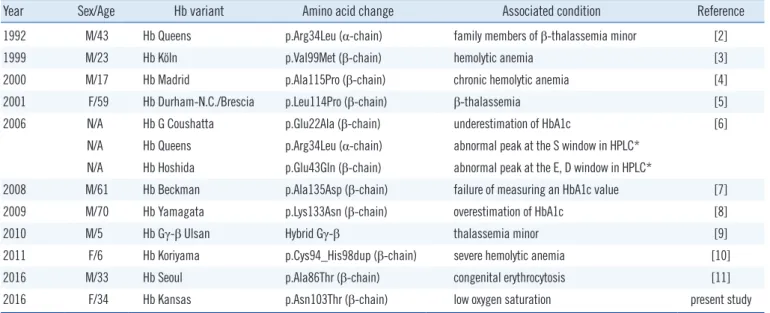
Since 1992, several Hb variants have been reported in Korea (Table 1). There were total 12 variants of Hb and details of each variants were described in the Table 1. The first Hb variant in Korea was Hb Queens which was detected from family mem- bers of β-thalassemia minor in 1992 [2]. After that, two more Hb variants were founded in hemolytic anemia patients [3, 4].
In 2001, a Korean family with β-thalassemia due to Hb Durham- N.C./Brescia was reported [5]. Hb G Coushatta, Hb Hoshida, Hb Beckman and Hb Yamagata have been revealed through
Received: November 3, 2016 Revision received: December 30, 2016 Accepted: March 7, 2017
Corresponding author: Myungshin Kim
Department of Laboratory Medicine, Seoul St. Mary’s Hospital, 222 Banpo-daero, Seocho-gu, Seoul 06591, Korea
Tel: +82-2-2258-1645, Fax: +82-2-2258-1719 E-mail: [email protected]
© Korean Society for Laboratory Medicine.
This is an Open Access article distributed under the terms of the Creative Commons Attribution Non-Commercial License (http://creativecommons.org/licenses/by-nc/4.0) which permits unrestricted non-commercial use, distribution, and reproduction in any medium, provided the original work is properly cited.
1 / 1 CROSSMARK_logo_3_Test
2017-03-16 https://crossmark-cdn.crossref.org/widget/v2.0/logos/CROSSMARK_Color_square.svg
Jo I, et al.
Hb Kansas in a Korean family
https://doi.org/10.3343/alm.2017.37.4.352 www.annlabmed.org 353
HPLC assay. Other variants of Hb were also reported in patients of thalassemia minor and severe hemolytic anemia [9, 10]. The latest Hb variant, Hb Seoul, was reported in Korea in 2016, caus- ing congenital erythrocytosis [11].
Although Hb Kansas is a neutral substitution, it differs from normal Hb with respect to its equilibrium with oxygen and chro- matographic behavior [12]. The amino acid substitution removes the only hydrogen bond that stabilizes the oxygenated quater- nary conformation of the Hb molecule, thereby shifting the equi- librium between the oxy and deoxy conformation toward deoxy.
Moreover, isolated β-chains of Hb Kansas have low oxygen af- finity [12, 13]. In general, patients with Hb of low oxygen affinity have slightly decreased Hb levels [13], including the cases of Hb Kansas reported in 1961 [1] and 1983 [14]. This trend might be due to the enhanced oxygen release that diminishes the eryth- ropoietin-mediated stimulus to erythropoiesis. However, the cases in Japan and Brazil showed Hb Kansas with polycythemia, whose cause has not yet been revealed. In the present case, the patient showed an Hb level of 10.9 g/dL and an Hct level of 33.7%, in line with the earlier cases. None of the previous cases showed signs or symptoms except for cyanosis.
Some Hb variants might be screened in the presence of signs or symptoms, but not all variants can be detected through Hb electrophoresis. Therefore, sequencing based on genetic analy- sis would be helpful to discover or confirm Hb variants, includ- ing novel variants. We report the first Korean family with Hb Kan- sas who had low oxygen saturation, using direct sequencing of HBB.
Fig. 1. (A) Pedigree of a family with low oxygen saturation. Black symbols indicate clinically affected family members and white sym- bols indicate unaffected family members. The black arrowhead in- dicates the proband with the HBB variant. (B) Sequencing chroma- togram of the proband demonstrating the HBB c.308A>C (p.Asn- 103Thr) variant (NM_000518.4 version of the HBB reference se- quence).
I
II
III
IV
1
1 1
1
2
2 2
2
3
3 3
4
4
5 6
A
B
Table 1. Summary of 12 cases of Hb variants in the Korean population
Year Sex/Age Hb variant Amino acid change Associated condition Reference
1992 M/43 Hb Queens p.Arg34Leu (α-chain) family members of β-thalassemia minor [2]
1999 M/23 Hb Köln p.Val99Met (β-chain) hemolytic anemia [3]
2000 M/17 Hb Madrid p.Ala115Pro (β-chain) chronic hemolytic anemia [4]
2001 F/59 Hb Durham-N.C./Brescia p.Leu114Pro (β-chain) β-thalassemia [5]
2006 N/A Hb G Coushatta p.Glu22Ala (β-chain) underestimation of HbA1c [6]
N/A Hb Queens p.Arg34Leu (α-chain) abnormal peak at the S window in HPLC*
N/A Hb Hoshida p.Glu43Gln (β-chain) abnormal peak at the E, D window in HPLC*
2008 M/61 Hb Beckman p.Ala135Asp (β-chain) failure of measuring an HbA1c value [7]
2009 M/70 Hb Yamagata p.Lys133Asn (β-chain) overestimation of HbA1c [8]
2010 M/5 Hb Gγ-β Ulsan Hybrid Gγ-β thalassemia minor [9]
2011 F/6 Hb Koriyama p.Cys94_His98dup (β-chain) severe hemolytic anemia [10]
2016 M/33 Hb Seoul p.Ala86Thr (β-chain) congenital erythrocytosis [11]
2016 F/34 Hb Kansas p.Asn103Thr (β-chain) low oxygen saturation present study
*ion-exchange HPLC.
ion-exchange HPLC during measurements of the HbA1c [5-8].
Similar to these cases, some Hb variants can induce a falsely low or high level of glycohemoglobin when using the ion-exchange
Jo I, et al.
Hb Kansas in a Korean family
354 www.annlabmed.org https://doi.org/10.3343/alm.2017.37.4.352
Authors’ Disclosures of Potential Conflicts of Interest
No potential conflicts of interest relevant to this article were re- ported.
Acknowledgments
This study was supported by a grant from the Korea Health Tech- nology R&D Project, Ministry of Health and Welfare, Republic of Korea (A120175).
REFERENCES
1. Reissmann KR, Ruth WE, Nomura T. A human hemoglobin with low- ered oxygen affinity and impaired heme-heme interactions. J Clin Invest 1961;40:1826-33.
2. Lee NY, Cho HI, Kim SI, Kim BK, Ohba Y, Hattori Y. A Family Case of β-Thalassemia Minor and Hemoglobin Queens: α34 (B15) Leu-Arg. Jour- nal of Korean Medical Science 1992;7:385-8.
3. Chang YH, Hur M, Lee DS, Park SS, Kim BK, Park S, et al. The first case of Hb Koln [beta98(FG5)Val-->Met] in Korea. Hemoglobin 1999;23:287-9.
4. Kim JY, Park SS, Jung HL, Keum DH, Park H, Chang YH, et al. Hb Ma- drid [beta115(G17)Ala-->Pro] in a Korean family with chronic hemolytic anemia. Hemoglobin 2000;24:133-8.
5. Kim JY, Park SS, Yang SH, Joo SI, Lee YJ, Ra EK, et al. A Korean family
with a dominantly inherited beta-thalassemia due to Hb Durham-N.C./
Brescia. Hemoglobin 2001;25:79-89.
6. Lee S-T, Kim MS, Choi DY, Kim SK, Ki C-S. Incidence of Variant Hemo- globin (Hb) and Increased Fetal Hb Concentrations and Their Effect on Hb A1c Measurement in a Korean Population. Clin Chem 2006;52:1445-6.
7. Kim SY, Kim GY, Jo SA, Lee EH, Cho EH, Hwang SH, et al. A novel he- moglobin variant beta135(H13) Ala > Asp identified in an asymptomatic Korean family by direct sequencing: suggesting a new insight into Hb Beckman mutation. Int J Lab Hematol 2010;32:e175-8.
8. Jung CL, Kwon KJ, Hong KS, Sung YA, Lee ST, Ki CS, et al. Hemoglobin Yamagata: hemoglobin variant detected by HbA1c test. Korean J Lab Med 2009;29:536-40.
9. Kim SY, Lee SH, Cho SI, Song SH, Hattori Y, Park SK, et al. Molecular identification of the novel Ggamma-beta hybrid hemoglobin: Hb Ggam- ma-beta Ulsan (Ggamma through 13; beta from 19). Blood Cells Mol Dis 2010;45:276-9.
10. Park S, Park JE, Cho SI, Jeon Y, Park SS, Seong MW. The first study on nucleotide-level identification of Hb Koriyama in a patient with severe hemolytic anemia. Ann Lab Med 2012;32:99-101.
11. Shin SY, Bang SM, Kim HJ. A Novel Hemoglobin Variant Associated with Congenital Erythrocytosis: Hb Seoul [l [iyama in a patient with se- vere hemolytic anemia. Ann oratory Science 2016;46:312-4.
12. Bonaventura J and Riggs A. Hemoglobin Kansas, a human hemoglobin with a neutral amino acid substitution and an abnormal oxygen equilib- rium. J Biol Chem 1968;243:980-91.
13. Morita K, Fukuzawa J, Onodera S, Kawamura Y, Sasaki N, Fujisawa K, et al. Hemoglobin Kansas found in a patient with polycythemia. Ann He- matol 1992;65:229-31.
14. Ishiguro K, Ohba Y, Hattori Y, Miyaji T, Oshida Y, Tachinami T, et al. He- moglobin Kansas in a Japanese family. Hemoglobin 1983;7:573-9.