http://dx.doi.org/10.5090/kjtcs.2013.46.2.117 ISSN: 2233-601X (Print) ISSN: 2093-6516 (Online)
Department of Thoracic and Cardiovascular Surgery,
1Research Institute of Clinical Medicine, Chonbuk National University Medical School,
2
Wonkwang University School of Medicine
†A part of this article was presented at the 41st Autumn Academic Meeting of the Korean Society for Thoracic and Cardiovascular Surgery.
Received: July 30, 2012, Revised: October 9, 2012, Accepted: October 17, 2012
Corresponding author: Jong Bum Choi, Department of Thoracic and Cardiovascular Surgery, Chonbuk National University Hospital, Chonbuk National University Medical School, 20 Geonji-ro, Deokjin-gu, Jeonju 561-712, Korea
(Tel) 82-63-250-1486 (Fax) 82-63-250-1480 (E-mail) [email protected]
C
The Korean Society for Thoracic and Cardiovascular Surgery. 2013. All right reserved.
CC
This is an open access article distributed under the terms of the Creative Commons Attribution Non-Commercial License (http://creative- commons.org/licenses/by-nc/3.0) which permits unrestricted non-commercial use, distribution, and reproduction in any medium, provided the original work is properly cited.
Predictive Factors of Sustained Sinus Rhythm and Recurrent Atrial Fibrillation after the Maze Procedure
Jong Bum Choi, M.D.
1, Hyun Kyu Park, M.D.
1, Kyung Hwa Kim, M.D.
1, Min Ho Kim, M.D.
1, Ja Hong Kuh, M.D.
1, Mi-Kyung Lee, M.D.
2, Sam Youn Lee, M.D.
2Background: We examined perioperative predictors of sustained sinus rhythm (SR) in patients undergoing the Cox maze operation and concomitant cardiac surgery for structural heart disease. Materials and Methods: From October 1999 to December 2008, 90 patients with atrial fibrillation (AF) underwent the Cox maze operation and other concomitant cardiac surgery. Eighty-nine patients, all except for one postoperative death, were followed-up with serial electrocardiographic studies, 24-hour Holter monitoring tests, and regular echocardiographic studies.
Results: Eighty-nine patients undergoing the maze operation were divided into two groups according to the pres- ence of SR. At the time of last follow-up (mean follow-up period, 51.0±30.8 months), 79 patients (88.8%) showed SR (SR group) and 10 patients (11.2%) had recurrent AF (AF group). Factors predictive of sustained SR were the immediate postoperative conversion to SR (odds ratio, 97.2; p=0.001) and the presence of SR at the 6th month postoperatively (odds ratio, 155.7; p=0.002). Duration of AF, mitral valve surgery, number of valves undergoing sur- gery, left atrial dimension, and perioperative left ventricular dimensions and ejection fractions were not predictors of postoperative maintenance of SR. Conclusion: Immediate postoperative SR conversion and the presence of SR at the 6th postoperative month were independent predictors of sustained SR after the maze operation.
Key words: 1. Arrhythmia surgery 2. Recurrence
3. Outcome assessment
INTRODUCTION
Atrial fibrillation (AF) is present in up to 50% of patients undergoing mitral valve surgery and in 1% to 6% of patients undergoing coronary artery bypass grafting or aortic valve surgery [1-3]. Since the maze operation for the treatment of AF was introduced in 1987 [4], it has been simplified by re- placing most incisions for making the mazes with cryoa- blation or radiofrequency (RF) ablation [5]. Some randomized
trials have demonstrated an excellent conversion rate of the
sinus rhythm (SR) with RF ablation [6], but, 20% to 30% of
those undergoing the maze operation showed recurrent AF
during the follow-up period [7]. An enlarged left atrium (LA)
was a major factor in the initiation and maintenance of AF
[8] and LA volume reduction was helpful for the elimination
of AF in patients undergoing mitral valve surgery [9]. We
identified perioperative factors predictive of maintenance of
SR without recurrent AF during the follow-up period in the
Table 1. Patient characteristics (n=89)
Characteristic Value
Age (yr) Male gender Duration AF (mo)
Duration AF (median, range, mo) Left atrial dimension (mm) Giant left atrium
a)Persistent/permanent AF (%) Mitral valve lesion
MS dominant MR dominant
Single mitral valve disease Single aortic valve disease Double and triple valve disease Non-valve lesion
57.1±9.8 (25–75) 38/89 (42.7)
41.8±37.7 36 (6–240) 55.4±9.4 (32–86)
4/89 (4.5) 11/78 (12.4/87.6)
82/89 (92.1) 51/89 (57.3) 31/89 (34.8) 54/89 (60.7) 2/89 (2.2) 28/89 (31.5)
5/89 (5.5) Values are presented as mean±standard deviation or number (%).
AF, atrial fibrillation; MS, mitral stenosis; MR, mitral regur- gitation.
a)
Left atrial dimension >65 mm.
Fig. 1. The Cox-maze procedure. (A) Epicardial view of the atria.
(B) Endocardial view of the right atrium. ‘C’: cryoablation at coro- nary sinus (inner and outer atrial walls), two junctions of tricuspid annulus and ablation lines, and one junction of mitral annulus and ablation line; excision of both atrial appendages. Dotted lines:
cut-and-suture lines or bipolar radiofrequency ablation lines. MV, mitral valve; TV, tricuspid valve; LAA, left atrial appendage; RAA, right atrial appendage; SVC, superior vena cava; IVC, inferior vena cava; FO, fossa ovalis.
patients undergoing the Cox maze operation and concomitant cardiac surgery.
MATERIALS AND METHODS 1) Study population
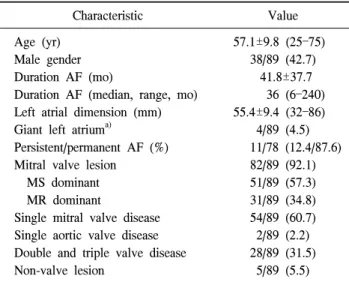
From October 1999 to December 2008, 90 patients with permanent or persistent AF underwent the Cox maze oper- ation and concomitant cardiac surgery. Eighty-nine patients (38 men and 51 women; mean age, 57.1±9.8 years), that is, all except one who experienced surgical death, were included in the study (Table 1).
They had structural heart disease, which was the primary surgical indication. Mitral valve disease was found in 82 pa- tients (92.1%) and non-left heart valve disease in 5 patients (5.5%), which included two with myxoma, two with an atrial septal defect, and one with coronary artery disease. Twenty- eight patients (31.5%) underwent multi-valve surgery. Seven- ty-eight patients (87.6%) had permanent AF and 11 patients (12.4%) had persistent AF. The mean atrial dimension was 55.4±9.5 mm (range, 32 to 86 mm) in a two-dimensional parasternal long-axis view.
All of the data were retrospectively analyzed from the
medical records, including the surgical records, standard 12-lead electrocardiograms, and transthoracic and trans- esophageal echocardiograms. “Recurrent AF” was defined as the presence of AF at the last follow-up. “Immediate post- operative SR conversion” was defined as the conversion to SR that occurred immediately after the patient was weaned from cardiopulmonary bypass and that remained present at discharge. “Early SR conversion” was defined as SR that was present at the postoperative 6th month. “Sustained SR” was defined as SR that had been maintained by the final fol- low-up visit.
2) Surgical procedure
We performed the Cox maze operation with the cut-and-
sew (CS) technique in 36 patients and with the RF ablation
technique in 53 patients, as previously described (Fig. 1)
[10,11]. In both techniques, a left atriotomy was made
through Sondergaard’s groove, a vertical right atriotomy was
made in the lower 1/3 of the right atrium, and both atrial ap-
pendages were amputated. In the CS technique, the mazes
were made with incisions and sutures and cryoablation was
applied to two incision ends in the tricuspid annulus and on
one incision end in the mitral annulus. Cryoablation was per- formed with a cryoprobe (Cooper Surgical Inc., Trumbull, CT, USA). In the RF technique, the mazes were made with a bipolar RF electrode (Medtronic Inc., Minneapolis, MN, USA), which was applied for 40 seconds more even after the cryoablation was finished for each lesion, and cryoablation was applied in the same annular portions of the mitral and tricuspid valves. The bases of both atrial appendages were closed with a continuous 4-0 or 5-0 Prolene suture.
3) Echocardiography
Transthoracic echocardiographic images were obtained by using commercially available echocardiography machines (Vivid 7 system; GE Medical Systems, Milwaukee, WI, USA) equipped with 2.5 MHz transducers. LA dimensions were measured on an M-mode tracing taken from a para- sternal long axis view. The left ventricular ejection fraction was calculated by using the modified Simpson’s method.
4) Postoperative follow-up
Electrocardiography was performed in bed during admis- sion, and at the first and the third week after discharge, and then every month or every 1.5 months for 1 year.
Echocardiographic studies were performed before the oper- ation, immediately after the operation, the postoperative sec- ond week, the postoperative sixth month, and then yearly. In patients with SR usually but suspicious paroxysmal palpita- tion, a 24-hour Holter monitoring test was performed to eval- uate the paroxysmal AF waves. Neither cardioversion nor class I or III antiarrhythmic drugs were used during the fol- low-up period. A low dose of beta-blockers was used for rate control in patients with early postoperative tachyarrhythmia.
Angiotensin receptor blocker was used to maintain the sys- tolic blood pressure within 110 to 120 mmHg and to re-re- model the LA. Anticoagulation therapy was given for at least 3 months and discontinued in patients who had postoperative SR conversion and underwent valve repair or tissue valve replacement. The patients with recurrent AF continued or re-started anticoagulation.
5) Statistical analysis
All data were expressed as the mean and standard
deviation. Multivariable logistic regression analysis was per- formed to test independent associations between several peri- operative variables and postoperative midterm maintenance of SR. Categorical variables were compared using the chi-squared test or Fisher’s exact tests. The Mann-Whitney U-test was used for the comparison of nonparametric samples. For all statistical calculations, the SPSS ver. 12.0 program (SPSS Inc., Chicago, IL, USA) was used. A con- fidence level of 95% was considered statistically significant.
RESULTS 1) Preoperative data
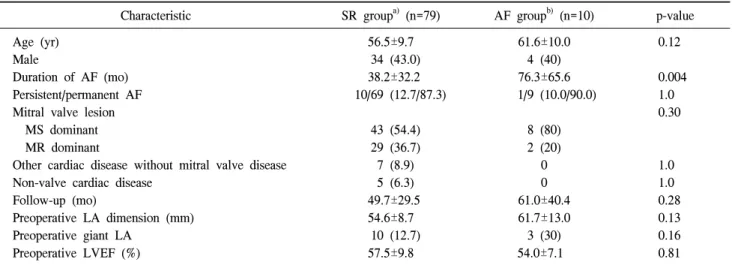
Eighty-nine patients undergoing the maze operation were separated into two groups according to the presence of SR at the last follow-up time (Table 2). Group SR consisted of 79 patients (88.8%) (mean age, 56.5±9.7 years) who had SR at the last follow-up, and group AF consisted of 10 patients (11.2%) (mean age, 61.6±10.0 years) who had AF at the last follow-up. Between the two groups, there were no differences in distribution of age and sex, follow-up period, type of AF, mitral valve lesions, or preoperative LA dimension and left ventricular ejection fraction. The mean duration of AF was longer in the AF group than the SR group (76.3±65.6 months vs. 38.2±32.2 months; p=0.004).
2) Operative data
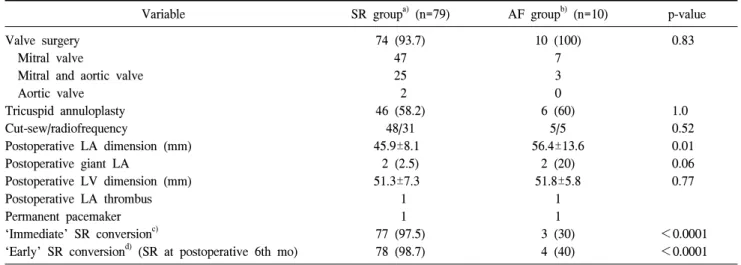
Between the two groups, there were no differences in whether valve surgery was performed (aortic, mitral, or mul- ti-valve surgery), the ablation technique, or the postoperative left ventricular dimension. The mean postoperative LA di- mension was larger in the AF group than the SR group (56.4±13.6 years vs. 45.9±8.1 mm; p=0.014). The ‘immedi- ate’ SR conversion had been present in 77 (97.5%) of 79 pa- tients in the SR group but only in 3 (30%) of 10 patients in the AF group (p<0.0001). ‘Early’ SR conversion had been identified in 78 (98.7%) of 79 patients in the SR group, but only in 4 (40%) of 10 patients in the AF group (p<0.0001).
Two patients (one for each group) had postoperative left at-
rial thrombi during the follow-up period. Two patients (one
for each group) underwent permanent pacemaker implantation
for sick sinus syndrome during the follow-up period.
Table 2. Preoperative characteristics of patients undergoing the maze procedure
Characteristic SR group
a)(n=79) AF group
b)(n=10) p-value
Age (yr) Male
Duration of AF (mo) Persistent/permanent AF Mitral valve lesion MS dominant MR dominant
Other cardiac disease without mitral valve disease Non-valve cardiac disease
Follow-up (mo)
Preoperative LA dimension (mm) Preoperative giant LA
Preoperative LVEF (%)
56.5±9.7 34 (43.0) 38.2±32.2 10/69 (12.7/87.3)
43 (54.4) 29 (36.7) 7 (8.9) 5 (6.3) 49.7±29.5
54.6±8.7 10 (12.7)
57.5±9.8
61.6±10.0 4 (40) 76.3±65.6 1/9 (10.0/90.0)
8 (80) 2 (20)
0 0 61.0±40.4 61.7±13.0 3 (30) 54.0±7.1
0.12
0.004 1.0 0.30
1.0 1.0 0.28 0.13 0.16 0.81 Values are presented as mean±standard deviation or number (%).
SR, sinus rhythm; AF, atrial fibrillation; MS, mitral stenosis; MR, mitral regurgitation; LA, left atrium; LVEF, left ventricular ejec- tion fraction.
a)
SR at the last follow-up time.
b)
Recurrent AF at the last follow-up time.
3) Postoperative data
During a mean follow-up of 51.0±30.8 months (median follow-up, 39.0 months; range, 18 to 134 months), 17 pa- tients (18.9%) were lost during the followed-up period and their follow-up periods were at least 28 months. Neither pri- mary cardiac surgery, presence of mitral valve surgery, type of AF, or duration of AF was predictive of recurrent AF. SR, atrial rhythm, or an atrial-based paced rhythm was present in 80 patients (89.9%) at discharge, in 82 patients (92.1%) at 6 months, and in 79 patients (88.8%) at the last follow-up visit (Fig. 1). At the last follow-up, 10 patients (11.2 %) had AF (group AF) (Table 3). All of the 7 patients (7.9%) with non-mitral valve surgery as a concomitant surgery had SR conversion and all of the 5 patients (5.5%) with non-valve surgery as a concomitant surgery also had SR conversion by the last follow-up time; the difference between the groups with the two types of surgery was not statistically significant.
4) Predictive factors of sinus rhythm after the maze operation
Factors predictive of ‘sustained SR’ (SR at the last fol- low-up visit) were ‘immediate postoperative SR conversion’
(odds ratio, 97.2; 95% confidence interval, 6.0 to 1,570.3;
p=0.001) and ‘early SR conversion’ (odds ratio, 155.7; 95%
confidence interval, 6.0 to 4,016.4; p=0.002) (Table 4). ‘Early SR conversion’ was associated with a high incidence of sus- tained SR at the time of the final follow-up. Factors pre- dictive of ‘early SR conversion’ were young age (odds ratio, 0.77; 95% confidence interval, 0.66 to 0.99; p=0.031) and
‘immediate SR conversion’ (odds ratio, 15.3; 95% confidence interval, 1.4 to 168.7; p=0.026) (Table 5).
DISCUSSION
In the study of 89 patients undergoing follow-up after a maze operation and concomitant cardiac surgery, ‘immediate postoperative SR conversion’ and ‘early SR conversion’ were independent predictors of ‘sustained SR’ after the maze operation. Underlying cardiac lesion, duration of AF, type of mitral valve disease, LA dimension, and preoperative and postoperative left ventricular dimensions and ejection fractions were not factors significantly predictive of ‘sustained SR’.
In many studies, risk factors for the failure of SR con-
version after the maze operation have been found to be the
LA size and volume, age, AF duration, limited ablation pro-
Table 3. Operative procedures and perioperative findings of SR group and AF group
Variable SR group
a)(n=79) AF group
b)(n=10) p-value
Valve surgery Mitral valve
Mitral and aortic valve Aortic valve
Tricuspid annuloplasty Cut-sew/radiofrequency
Postoperative LA dimension (mm) Postoperative giant LA
Postoperative LV dimension (mm) Postoperative LA thrombus Permanent pacemaker
‘Immediate’ SR conversion
c)‘Early’ SR conversion
d)(SR at postoperative 6th mo)
74 (93.7) 47 25 2 46 (58.2)
48/31 45.9±8.1
2 (2.5) 51.3±7.3 1 1 77 (97.5) 78 (98.7)
10 (100) 7 3 0 6 (60)
5/5 56.4±13.6
2 (20) 51.8±5.8
1 1 3 (30) 4 (40)
0.83
1.0 0.52 0.01 0.06 0.77
<0.0001
<0.0001 Values are presented as number (%) or mean±standard deviation.
SR, sinus rhythm; AF, atrial fibrillation; LA, left atrium; LV, left ventricle.
a)
SR at the last follow-up time.
b)
Recurrent AF at the last follow-up time.
c)
SR conversion immediately after maze operation and the presence of SR at discharge.
d)