• 검색 결과가 없습니다.

An Aggressive Large Epithelioid Hemangioendothelioma of the Anterior Mediastinum in a Young Woman

N/A
N/A
Protected

Academic year: 2021

Share "An Aggressive Large Epithelioid Hemangioendothelioma of the Anterior Mediastinum in a Young Woman"

Copied!
4
0
0

로드 중.... (전체 텍스트 보기)

전체 글

(1)

ISSN: 2233-601X (Print) ISSN: 2093-6516 (Online)

− 419 −

Received: August 23, 2018, Revised: October 3, 2018, Accepted: October 16, 2018, Published online: December 5, 2018

Corresponding author: Harish Pal, Department of General and Minimal Access Surgery, Max Super Speciality Hospital, W-3, Vaishali Sector 1, Delhi-NCR, 201012, India

(Tel) 91-0120-4173000 (Fax) 91-1204173010 (E-mail) [email protected]

© The Korean Society for Thoracic and Cardiovascular Surgery. 2018. All right reserved.

This is an open access article distributed under the terms of the Creative Commons Attribution Non-Commercial License (http://creativecommons.org/

licenses/by-nc/4.0) which permits unrestricted non-commercial use, distribution, and reproduction in any medium, provided the original work is properly cited.

An Aggressive Large Epithelioid Hemangioendothelioma of the Anterior Mediastinum in a Young Woman

Roman Dutta 1 , Harish Pal 2 , Garima Garg 3 , Sambit Mohanty 3

1
Department of Thoracic Surgery, Nayati Medicity,

Departments of

2

General and Minimal Access Surgery and

3

Pathology, Max Super Speciality Hospital

Hemangioendothelioma is a rare vascular tumor with involvement of the liver, brain, long bones, and lung.

Among the 6 histological subtypes, epithelioid hemangioendothelioma (EHE) is the most aggressive. Its occur- rence in the mediastinum is quite rare, and very few cases have been documented. The reported cases in the literature have described difficulties in the preoperative diagnosis due to the unusual histological appear- ance of the tumor. Immunohistochemistry remains the mainstay for a definitive diagnosis. Due to its low in- cidence, there is no standard treatment for mediastinal EHE, but curative resection is the preferred treat- ment option where possible, with chemotherapy used as an adjuvant treatment or in cases of widespread in- operable disease. The present case study describes an aggressive EHE occurring in an 18-year-old woman in the anterior mediastinum.

Key words: 1. Hemangioendothelioma 2. Mediastinum

3. Vascular neoplasms

Case report

Vascular tumors of the mediastinum are very rare, accounting for fewer than 1%–1.5% of all mediastinal tumors. Vascular tumors of the mediastinum show atypical histological features. Epithelioid hemangio- endothelioma (EHE) is a form of hemangioendo- thelioma. No more than 20 cases of EHE occurring in the mediastinum have been reported in the litera- ture. In 1982, Weiss and Enzinger [1] were the first to describe EHE. They described the clinical and his- tological features of EHE as intermediate between angiosarcoma and benign hemangioma [1].

An 18-year-old woman from Kabul, Afghanistan at- tended Thoracic Surgical Clinic with chief complaints of low-grade fever, generalized weakness, and cough

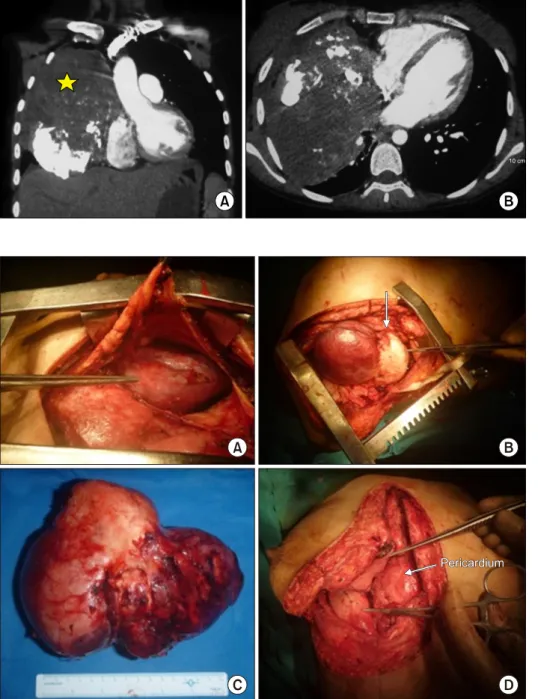
that had lasted for 1 month. There was no history of loss of weight, appetite or night sweats. The patient denied any history of hemoptysis or breathing difficulty. The general physical examination was normal. A systemic examination showed decreased breath sounds on right side of the chest. Contrast-en- hanced chest computed tomography (CT) revealed a large anterior mediastinal mass compressing the right lung (Fig. 1). Malignant germ cell tumor mark- ers were negative. The cervical lymph node seen on the CT scan was reactive on an excision biopsy.

CT-guided Tru-cut biopsy of the tumor indicated that it was a spindle-cell neoplasm.

In view of the unifocal nature of the tumor, the patient was offered resection of the tumor. Surgical exposure of the tumor was achieved through right

Korean J Thorac Cardiovasc Surg 2018;51:419-422 □ CASE REPORT □

https://doi.org/10.5090/kjtcs.2018.51.6.419

(2)

Roman Dutta, et al

− 420 −

Fig. 1. Chest computed tomography shows lage anterior medidastinal mass with calcification and col- lapsed right lung (star).

Fig. 2. Operative photographs showing large anterior mediastinal mass with venous channel connect- ing to right internal thoracic vein (A). Tumour with calified lower half (B). Excised tumour of size 20x15 cm (arrow) (C). Completely expanded lung lobes post resection (D).

thoracosternotomy (hemi-clamshell). Intraoperative findings revealed a large anterior mediastinal mass measuring 20×15 cm that compressed the entire right lung and was adherent to the pericardium. The tumor appeared to arise from the anterior media- stinal tissue and was connected to the right internal thoracic vein (Fig. 2A). The tumor mass was lobu- lated, with variegated consistency. Areas of bony hard and soft consistency were present (Fig. 2B). No evidence of tumor adhesion to the lung or pleural ef-

fusion was found. The patient had an uneventful postoperative course and was discharged from the hospital on the fifth postoperative day.

Histopathologically, sections showed a tumor with

a mixed spindle and epithelioid cell morphology. The

tumor cells displayed moderate to marked nuclear

pleomorphism, prominent nucleoli, and areas of

necrosis. The tumor cells were positive for vimentin

and CD31. The Ki67 labeling index was as high as

60%. Smooth muscle actin, S-100, desmin, cytoker-

(3)

Epithelioid Hemangioendothelioma of Anterior Mediastinum

− 421 −

Fig. 3. Photomicrographs (A, B) showing epithelioid cells in nests and cords separated by thin walled blood vessels (H&E, x200, x400).

Photomicrographs of high power view (x400) showing the tumor cells were positive for vimentin (C) and CD31 (D).

atin 7, thyroid transcription factor-1, leukocyte com- mon antigen, anaplastic lymphoma kinase-1, human melanoma black-45, and CD30 were negative in the tumor cells. In view of the morphological and im- munohistochemical findings, a final diagnosis of EHE was made (Fig. 3).

The case was discussed at a multidisciplinary tu- mor board and adjuvant chemotherapy was recom- mended. The patient travelled back to her native country where she received adjuvant chemotherapy.

The patient developed multiple distant-site metastasis 7 months after the surgical excision of the tumor and died while receiving follow-up from a medical oncologist. In this case, “written informed consent for academic using photography from the surgery” was provided by patient. So, institutional review board (IRB) review was waived by IRB.

Discussion

Hemangioendothelioma is a rare vascular neoplasm that may exist in benign or malignant form. Six his- topathological variants of it have been described:

papillary intralymphatic hemangioendothelioma, reti- form hemangioendothelioma, kaposiform hemangio- endothelioma, EHE, pseudomyogenic hemangioendo-

thelioma, and composite hemangioendothelioma. EHE may present in soft tissue, bone, lungs, liver, and, on rare occasions, in other locations (central nervous system, lymph nodes, or breast). A mediastinal loca- tion is very rare, and few such cases have been re- ported in the literature. Patients with EHE of the me- diastinum may present as asymptomatic or sympto- matic.

Lamovec et al. [2] reported EHE of the anterior mediastinum in a 40-year-old female patient that was diagnosed by a chest X-ray and CT scan. An upper partial sternotomy was done. The tumor, measuring 5 cm, was seen to be quite extensive, involving the azygos vein anteriorly and the superior vena cava posteriorly.

Patrini et al. [3] reported EHE of the mediastinum in a 58-year-old male patient who presented with palpitations and chest discomfort. Liu et al. [4] ob- served EHE of the mediastinum attached to the pleura in a 29-year-old asymptomatic male patient.

Isowa et al. [5] reported a case of EHE arising from

the left brachiocephalic vein in the anterior superior

mediastinum in a 41-year-old male patient. The tu-

mor was resected by the Hemi-Plastron window

technique. The patient received regular follow-up for

28 months, and there was no recurrence of the

(4)

Roman Dutta, et al

− 422 − lesion.

Suster et al. [6] reported 12 cases of EHE of the anterior mediastinum and observed that the mean age of occurrence was 49.2 years, and the patients comprised 9 males and 3 females. They found 5 asymptomatic patients and 7 who experienced symp- toms due to compression of surrounding structures.

In 5 cases, the tumors were locally infiltrative and in 7 cases, they were well circumscribed and encap- sulated. In 9 cases, resection was performed, while in 2 cases, resection along with radiation therapy was performed, and in 1 case, radiation therapy, chemo- therapy, and resection were performed [6]. Li et al.

[7] reported a case of EHE encompassing the in- nominate vein in a 38-year-old male. The patient was treated with surgical resection and adjuvant chemo- therapy and remained recurrence-free at 18 months of postoperative follow-up.

Histologically, EHE of the mediastinum shows epi- thelioid cells with intracytoplasmic vacuoles in a hya- linized or mucinous stroma. Spindle cells or osteo- clast-like giant cells can occasionally be seen. The prognosis of EHE is uncertain. Some cases show in- dolent behavior, while others may show a more ag- gressive character, leading to death within a short time after diagnosis. Although chemotherapy was also initiated after surgical excision of the tumor mass, the patient in our case died within 7 months after surgery. The authors believe that the prognosis might be related to mitotic activity and the degree of cel- lular pleomorphism [5-8].

The treatment of EHE depends on the site and ex- tent of tumor involvement, the site of metastasis, and specific individual factors. Surgical resection, radio- therapy, and chemotherapy all have been used to treat these masses. If the tumor is unifocal, then it should be entirely removed surgically, and if it exists at multiple sites, several medications, such as an- ti-angiogenic agents, vincristine, interferon, rapamy- cin, and radiation should be recommended to slow the growth of the tumor mass [7,8].

In conclusion, the mediastinum is an uncommon site of EHE, but EHE should be considered in the dif- ferential diagnosis of mediastinal tumors. In cases of EHE, the tumor can vary in size from very small to huge. The only currently available treatment is surgi- cal excision.

Conflict of interest

No potential conflict of interest relevant to this ar- ticle was reported.

References

1. Weiss SW, Enzinger FM. Epithelioid hemangioendothelio- ma: a vascular tumor often mistaken for a carcinoma.

Cancer 1982;50:970-81.

2. Lamovec J, Sobel HJ, Zidar A, Jerman J. Epithelioid he- mangioendothelioma of the anterior mediastinum with osteoclast-like giant cells: light microscopic, immunohis- tochemical, and electron microscopic study. Am J Clin Pathol 1990;93:813-7.

3. Patrini D, Scolamiero L, Khiroya R, et al. Mediastinal he- mangioendothelioma: case report and review of the literature. Respir Med Case Rep 2017;22:19-23.

4. Liu Y, Jiang YF, Wang YL, et al. Epithelioid hemangioendo- thelioma of the anterior mediastinum: a case report. Int J Clin Exp Pathol 2016;9:5746-52.

5. Isowa N, Hasegawa S, Mino M, Morimoto K, Wada H.

Mediastinal epithelioid hemangioendothelioma resected by hemi-plastron window technique. Ann Thorac Surg 2002;74:567-9.

6. Suster S, Moran CA, Koss MN. Epithelioid hemangioendo- thelioma of the anterior mediastinum: clinicopathologic, immunohistochemical, and ultrastructural analysis of 12 cases. Am J Surg Pathol 1994;18:871-81.

7. Li XM, Lin XY, Xu HT, et al. Mediastinal epithelioid he- mangioendothelioma with abundant spindle cells and os- teoclast-like giant cells mimicking malignant fibrous histiocytoma. Diagn Pathol 2013;8:103.

8. Ferretti GR, Chiles C, Woodruff RD, Choplin RH. Epithe- lioid hemangioendothelioma of the superior vena cava:

computed tomography demonstration and review of the

literature. J Thorac Imaging 1998;13:45-8.

수치

Fig. 1. Chest computed tomography  shows lage anterior medidastinal  mass with calcification and  col-lapsed right lung (star).
Fig. 3. Photomicrographs (A, B)  showing  epithelioid cells in nests  and cords separated by thin walled  blood vessels (H&E, x200, x400)

참조

관련 문서

Popular music in the lives of youth and popular music occupies a large portion of the preference for youth is high throughout the survey were more clearly. Survey for

First, the machine squat allowed higher load on the knee ligament due to the significant shorter distance between the patella and anterior tibia and induced

 In the present study, as a preliminary study, a LACC-based Compton CT was developed to estimate the activity of the spot inside the radioactive waste drum. To

ƒ The amount of a compound per unit cell mass (or cell The amount of a compound per unit cell mass (or cell volume).

After the vehicle has become a large-formation and high-speed, loud noise from an express highway is coming to be higher and the number of large-scale

Chest X-ray: Posterio-anterior (PA) View - Left Anterior Oblique

a prospective analysis of 50 cases. Preoperative staging of non-small-cell lung cancer with positron-emission tomography. Staging of non- small-cell lung cancer

1 John Owen, Justification by Faith Alone, in The Works of John Owen, ed. John Bolt, trans. Scott Clark, "Do This and Live: Christ's Active Obedience as the