Case Report
ISSN 1738-5997 (Print) • ISSN 2092-9935 (Online) Electrolyte Blood Press 14:31-34, 2016 https://doi.org/10.5049/EBP.2016.14.2.31Copyright © 2016 The Korean Society of Electrolyte Metabolism
A Case Report of Syndrome of Inappropriate Antidiuretic Hormone Induced by Pregabalin
Youn Joo Jung, Dong-Young Lee, Hae Won Kim, Hyun Sun Park, Beom Kim Department of Internal Medicine, Veterans Health Service Medical Center, Seoul, Korea Received: November 11, 2016
Accepted: January 23, 2017
Corresponding Author: Beom Kim, M.D., Ph.D., Department of Internal Medicine, Veterans Health Service Medical Center, 61 Gil 53, Jinhwang-ro, Gangdong-gu, Seoul 05368, Korea
Tel: +82-2-2225-1111, Fax: +82-2-2225-4348 E-mail: [email protected]
The syndrome of inappropriate antidiuretic hormone secretion (SIADH) is the most common cause of euvolemic hyponatremia, and many medications have been associated with SIADH. Pregabalin is a drug used for the treatment of neuropathic pain, though common adverse effects include central nervous sys- tem disturbance, peripheral edema, and weight gain. However, hyponatremia caused by pregabalin has been rarely reported. Here we report a patient with pregabalin-induced hyponatremia who met the criteria for SIADH; after dis- continuation of the drug, his condition rapidly improved. This case can help clini- cians diagnose and treat new-onset hyponatremia in patients who recently ini- tiated pregabalin therapy.
Key Words: Drug associated syndrome of inappropriate antidiuretic hormone secretion, Hyponatremia, Pregabalin
This is an Open Access article distributed under the terms of the Creative Commons Attribution Non-Commercial License(http://creativecommons.org/licenses/by-nc/4.0/) which permits unrestricted non-commercial use, distribution, and reproduction in any medium, provided the original work is properly cited.
Introduction
Hyponatremia is the most frequent electrolyte distur- bance among hospitalized patients1,2). In addition, the syn- drome of inappropriate antidiuretic hormone secretion (SIADH) is the most common cause of euvolemic hypona- tremia3). SIADH is characterized by either the sustained release of antidiuretic hormone (ADH) in the absence of stimuli, or by the enhanced action of ADH on the kidney4). Causes of SIADH include malignant disease, pulmonary disorders, central nervous system disorders, and a number of medications1). Several drugs are known to cause this syndrome; however, there are only few reported cases in which SIADH was induced by pregabalin. Therefore, here we report a patient with pregabalin-induced SIADH.
Case Report
A 69-year-old man presented with general weakness
and fever. A chest computed tomography (CT) revealed consolidation in both lower lobes of the lungs, and he was diagnosed with pneumonia. The patient had been treated with numerous drugs, including an angiotensin-conver- ting enzyme inhibitor, metformin, a DPP-IV inhibitor, and thioctacid, for management of type 2 diabetes mellitus and hypertension. Several weeks prior to hospital admission, he had a severe ulcer on his right heel caused by arterio- sclerosis obliterans. Shortly before admission, he initiated pregabalin therapy to relieve the pain of the right heel.
On admission, the patient’s blood pressure was 128/58 mmHg, and his pulse rate was 76 beats per minute. His body temperature was 37.8℃, and crackles were heard on both sides of the lung field. Physical examination did not reveal any neurologic dysfunctions or other symp- toms, except mild dyspnea. Hematological analysis dem- onstrated a white blood cell count of 11,150/mm3(refe- rence range, 400-10,000/mm3), and a hemoglobin level of 9.6 g/dL (reference range, 13-17.5 g/dL). Biochemical analysis demonstrated a sodium level of 138 mEq/L (refe-
32 YJ Jung, et al•Pregabalin Induced SIADH
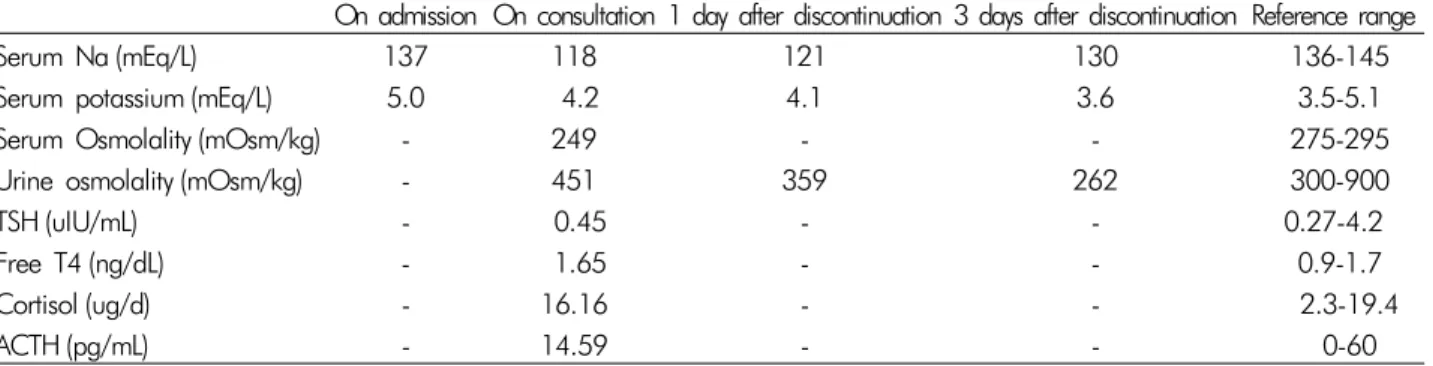
Copyright © 2016 The Korean Society of Electrolyte Metabolism Table 1. Laboratory data
On admission On consultation 1 day after discontinuation 3 days after discontinuation Reference range
Serum Na (mEq/L) 137 118 121 130 136-145
Serum potassium (mEq/L) 5.0 4.2 4.1 3.6 3.5-5.1
Serum Osmolality (mOsm/kg) - 249 - - 275-295
Urine osmolality (mOsm/kg) - 451 359 262 300-900
TSH (uIU/mL) - 0.45 - - 0.27-4.2
Free T4 (ng/dL) - 1.65 - - 0.9-1.7
Cortisol (ug/d) - 16.16 - - 2.3-19.4
ACTH (pg/mL) - 14.59 - - 0-60
TSH, thyroid stimulating hormone; ACTH, adrenocorticotropic hormone; Free T4, free thyroxine.
Table 2. The Naranjo adverse drug reaction (ADR) probability scale
Yes No Do Not Know Score
1. Are there previous conclusive reports on this reaction? +1 0 0 0
2. Did the adverse event occur after the suspected drug was administered? +2 -1 0 +2 3. Did the adverse reaction improve when the drug was discontinued or a specific antagonist
was administered? +1 0 0 +1
4. Did the adverse reaction reappear when the drug was readministerd? +2 -1 0 0 5. Are there alternative causes (other than the drug) that could have on their own caused
the reaction? -1 +2 0 +2
6. Did the reaction reappear when a placebo was given? -1 +1 0 0
7. Was the blood detected in the blood (or other fluids) in concentrations known to be toxic? +1 0 0 0 8. Was the reaction more severe when the dose was increased or less severe when the dose
was decreased? +1 0 0 0
9. Did the patient have a similar reaction to the same or similar drugs in any previous
exposure? +1 0 0 0
10. Was the adverse event confirmed by any objective evidence? +1 0 0 +1
Total +6
The ADR is assigned to a probability category from the total score as follows: definite if the overall score is 9 or greater, probable for a score of 5-8, possible for 1-4 and doubtful if the score is 0.
rence range, 136-145 mEq/L) and a potassium level of 5.0 mEq/L (reference range, 3.5-5.1 mEq/L). There was no abnormality in the results of the liver function tests or renal function tests. As previously stated, the patient was diagnosed with pneumonia; thus, we initiated admin- istration of ceftriaxone and clarithromycin to treat the pneumonia. The patient’s condition improved, and anti- biotic therapy was ceased after 2 weeks of administration.
At the point of termination of pneumonia treatment, the patient was found to be hyponatremic, with a sodium level of 122 mEq/L. His serum sodium level further de- creased to 118 mEq/L. Chest radiography revealed an im- provement in pneumonia. Additional endocrinologic stu-
dies that evaluated hyponatremia excluded hypothyroi- dism and adrenal insufficiency. Laboratory studies revea- led a reduced serum osmolality (249 mOsm/kg). Addi- tionally, the patient’s random spot urine sodium and os- molality levels were 91 mEq/L (reference range, 40-220 mEq/L), and 451 mOsm/kg (reference range, 300-900 mOsm/kg), respectively. Based on the patient’s clinical euvolemia and the biochemical data, SIADH was diag- nosed. The patient received no other medications, except antibiotics for pneumonia treatment. He was then placed on fluid restriction, but it was unsuccessful for correction of the serum sodium level. Subsequently, 3% saline was supplied; however, laboratory findings indicated a serum
Electrolyte Blood Press 14:31-34, 2016 • https://doi.org/10.5049/Ebp.2016.14.2.31 33
Copyright © 2016 The Korean Society of Electrolyte Metabolism sodium level of 116 mEq/L. Therefore, he was referred
to the nephrology clinic for the treatment and evaluation of SIADH.
The endocrinologic tests and his medications were reviewed. Tests for thyroid and adrenal function did not show any abnormalities. Therefore, we presumed that SIADH might be induced by pregabalin, and decided to stop its administration. The serum sodium and urine os- molality were again evaluated, followed by administra- tion of 0.9% isotonic saline. After the pregabalin discon- tinuance, the serum sodium level increased to 121 mEq/L with a decreased urine osmolality of 389 mEq/L. Two days later, the serum sodium level of the patient increased to a near-normal level of 130 mEq/L (Table 1). To deter- mine whether an adverse drug reaction was caused by pregabalin, we used the Naranjo algorithm (Table 2). The total score was 6, which equates to “probable” as the probability that an adverse event was related to the drug therapy. The patient remained asymptomatic, even when his sodium level was decreased to 116 mEq/L. His bioche- mical findings improved after stopping pregabalin the- rapy without any side effects.
Discussion
Drug-induced SIADH can occur owing to an increased sensitivity to ADH in the nephron or an increase in ADH production4). Increased ADH activity impairs the ability of the kidney to dilute urine, resulting in decreased ex- cretion of ingested water and a highly concentrated and decreased urine volume5,6). Patients with SIADH present with a euvolemic status because the excess water distrib- utes evenly throughout the body’s fluid compartments5). Selective serotonin reuptake inhibitors (SSRIs), various chemotherapeutic agents (e.g., cyclophosphamide, cispla- tin, and vinca alkaloids), carbamazepine, and antipsycho- tics appear to be most strongly associated with drug-in- duced SIADH5,6).
Pregabalin is an analog of the neurotransmitter gam- ma-aminobutyric acid (GABA) that has analgesic, anticon- vulsant, and anxiolytic properties7). It is now widely used
in the management of diabetic peripheral neuropathy, post-herpetic neuralgia, generalized anxiety disorder, and social anxiety disorder. The most common adverse events associated with pregabalin include dizziness and somno- lence, followed by peripheral edema and weight gain8). Hyponatremia is an uncommon side effect of pregabalin.
Several articles have reported decompensation of pa- tients with chronic heart failure, edema, and weight gain, all caused by pregabalin7,8). The decompensated heart fai- lure was resolved after discontinuation of the drug. Altho- ugh the mechanism of pregabalin is not well known, the calcium channel relationship may cause these side effects.
Pregabalin is an alpha2-delta ligand that has analgesic, anticonvulsant, and anxiolytic activity. Alpha2-delta is an auxiliary protein associated with voltage-gated calcium channels. They potently bind to the subunit, resulting in modulation of calcium channels and reduction in the re- lease of several neurotransmitters9). The effect of alpha2- delta type 1 and 2 subunits on calcium channel functions and conventional calcium channel subtypes are not clear10). This calcium channel relationship, however, may lead to peripheral edema with peripheral vasodilation and fluid leakage into the interstitial space. It is thought that un- explained weight gain may be a sign of fluid retention, which may exacerbate congestive heart failure11). In addi- tion, it is inferred that SIADH can develop as a result of this fluid leakage into the interstitial space and fluid retention.
Although a large number of drugs are known to poten- tially induce SIADH, pregabalin-induced SIADH has rare- ly been reported. Only two cases have been reported pre- viously. In one case, a patient without underlying disease was administered pregabalin 75 mg once daily for neuro- pathic pain secondary to L4-L5 radiculopathy; hypona- tremia developed two weeks later12). In another case, a patient with type II diabetes mellitus, nephropathy, neu- ropathy, and ischemic cardiomyopathy with congestive heart failure (left ventricular function, 27%) was given pregabalin for neuropathic pain. One week later, he pre- sented with disorientation secondary to hyponatremia13). In both cases, the patients were treated with pregabalin
34 YJ Jung, et al•Pregabalin Induced SIADH
Copyright © 2016 The Korean Society of Electrolyte Metabolism to alleviate neuropathic pain, and the hyponatremia im-
proved after discontinuation of pregabalin.
Pregabalin is considered among the first-line treat- ments for neuropathic pain, along with tricyclic antide- pressants (TCA), SSRIs, and serotonin norepinephrine re- uptake inhibitors (SNRI). TCAs, SSRIs, and SNRIs are well known causes of SIADH. We thought that pregabalin might enhance ADH release, or have an effect similar to the aforementioned drugs. ADH secretion results in a concentrated urine, leading to reduced urine volume.
In most patients with SIADH, ingestion of water does not adequately suppress ADH, and the urine remains concentrated. This leads to water retention, which in- creases total body water (TBW). This increase in TBW lowers the serum sodium concentration by dilution6). In addition, the increase in TBW transiently expands the extracellular fluid (ECF) volume, and it is thought that this increased ECF volume might cause peripheral edema and weight gain. Increased ECF volume also triggers in- creased urinary sodium excretion, which both returns the ECF volume towards normal and further lowers the se- rum sodium concentration. This accounts for the euvole- mic status of drug-induced SIADH.
Many medications have been associated with SIADH, and the only definitive treatment for drug-induced SIADH is the removal of the suspicious agent. Here we presented a case of SIADH that was improved by discontinuation of pregabalin. This is the first case reported in South Korea. However, we speculate that pregabalin-induced SIADH occurs more frequently than has been reported, because it appears to present with asymptomatic and mild hyponatremia. Therefore, it may be difficult to detect in the absence of laboratory studies.
In conclusion, hyponatremia should be considered and closely monitored when initiating pregabalin therapy. In addition, it is important for clinicians to suspect the drug as a potential cause of hyponatremia, particularly in the absence of another causative explanation, even though the agent is not generally known to induce SIADH.
Conflict of Interest Disclosure: The authors have no conflicts of interest to declare.
References
1. Ellison DH, Berl T: The syndrome of inappropriate atidiuresis. N Engl J Med 356(20):2064-2072, 2007 2. Palmer BF, Gates JR, Lader M: Causes and management
of hyponatremia. Ann Pharmacother 37:1694-1702, 2003 3. Bartter FC, Schwartz WB: The syndrome of inappro-
priate secretion of antidiuretic hormone. Am J Med 42:
790-806, 1967
4. Spigset O, Hedenmalm K: Hyponatremia and the syn- drome of inappropriate antidiuretic horemone secretion (SIADH) induced by psychotropic drugs. Drug Saf 12:
209-225, 1995
5. Foote EF: Syndrome of inappropriate antidiuretic hor- mone secretion and diabetes insipidus. In: Tisdale JE, Millder DA (eds). Drug-induced diseases, prevention de- tection and management. Bethesda, MD: American Society of Health-System Pharmacists 611-624, 2005
6. Rose BD: Causes of the SIADH. In: Rose BD, ed. UpTo Date [electronic database]. Waltham, MA, 2007 7. Page RL, Cantu M, Lindenfeld J, Hergott LJ, Lowes BD:
Possible heart failure exacerbation associated with pre- gabalin: case discussion and literature review. J Cardiovasc med 9(9):922-925, 2008
8. De Smedt RHE, Jaarsma T, van den Broek SAJ, Haaijer- Ruskamp FM: Decompensation of chronic heart failure associated with pregabalin in a 73-year-old patient with post-herpetic neuralgia: a case report. Br J Clin Pharma- col 66(2):327-328, 2008
9. JH Shim: Clinical Application of Alpha2-Delta Ligand.
Hanyang Medical Reveiws 31(2):55-62, 2011
10. Sills GJ: The mechanism of action of gabapentin and pregabalin. Curr Opin Pharmacol 6(1):108-113, 2006 11. Messerli FH: Vasodilatory edema: a common side effect
of antihypertensive therapy. Am J Hypertens 14(9):978- 979, 2001
12. Sudhagar M, Aneesh B, Nayyar I: Syndrome of inappro- priate antidiuretic hormone secretion and pregabalin.
Journal of Case Report 4(2):408-411, 2014
13. Arnon B, Claudia S, Imad T: Hyponatremia and confu- sion caused by pregabalin. Isr Med Assoc J. 11:699-700, 2009