Most of osteochondroma is asymptomatic and is initially noticed by non-tender palpable mass. It can affect any part of the body, but the common affected sites are distal femur, proximal humerus and proximal tibia. Sometimes repeated stimulation around mass causes painful idiopathic bursitis.1-5) Also in rare cases repetitive pressure and stimulation on nearby vessels cause pseudoaneurysm, acute ischemia, phlebitis, and if it develops in posterior lamina cord can be compressed.6-8) Authors are reporting a case of 6th decade female patient, without history of coagulopathy or vascular disease, who had
soft tissue mass subscapularly which caused pain and crepitus associ- ated with scapular motion which is thought to be closely related with left 6th rib osteochondroma.
Case Report
A fifty-one year old nonsmoking house wife visited out-patient clinic complaining of large palpable soft tender mass on medial margin of left scapula accompanying intermittent subscapular
Copyrights © 2014 by The Korean Bone and Joint Tumor Society
“This is an Open Access article distributed under the terms of the Creative Commons Attribution Non-Commercial License (http://creativecommons.org/licenses/by-nc/3.0/) which permits unrestricted non-commercial use, distribution, and reproduction in any medium, provided the original work is properly cited.”
대한골관절종양학회지:제20권 제1호 2014
Painful Snapping Shoulder Complicating Soft Tissue Pseudotumor Secondary to Rib Osteochondroma: A Case Report
Myung-Sang Moon, Dal-Jae Jeon, Sung-Soo Kim, and Min Geun Yoon
Department of Orthopedic Surgery and Traumatology, Cheju Halla General Hospital, Jeju, Korea
Osteochondromadevelop most commonly at distal femur, proximal humerus and proximal tibia, but the rib osteochondroma was reported less commonly. In this report, scapular snapping syndrome complicated by adventitious bursa and soft tissue pseudotumor surrounding the osteochondroma of the 6th rib body was treated successfully by surgical excision of them. We report this rare case with reviewing the rel- evant literature.
Key words: rib, osteochondroma, scapular snapping, soft tissue pseudotumor, adventitious bursa
Received March 3, 2014 Revised May 30, 2014 Accepted June 4, 2014 Correspondence to: Min Geun Yoon
Department of Orthopedic Surgery and Traumatology, Cheju Halla General Hospital, Dorhyungro 65, Jeju 690-766, Korea
TEL: +82-64-740-5030 FAX: +82-64-743-3110(hospital), + 82-64-740-5410(orthopedics) E-mail: [email protected], [email protected]
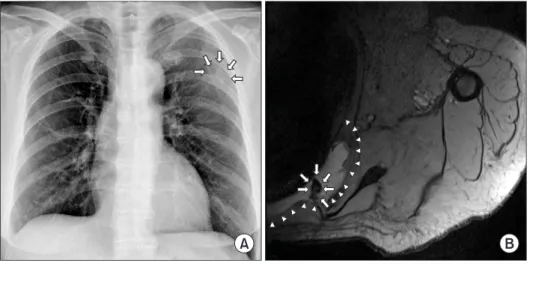
Figure 1. On preoperative x-ray about 1.2 cm size exophyticbony mass (white arrow) is noted on the middle part ofthe left 6th rib (A). On MRI about 1.2×1 cm sized exophytic bony lesion (white arrow) in posterolateral arc of the left 6th rib with surrounding loculated fluid-signal like collection (white arrow head) is seen (B).
28
Myung-Sang Moon, et al.
crepitus associated with scapular motion over a month. Laboratory studies disclosed no coagulopathy or abnormal platelet count, and there was no family history of bone tumor nor thrombophlebitis.
On plain radiograph, a 1.2 cm sized nonpedunculatedosteochon- droma was found on mid-posterior junction area of left 6th rib, but punctuated calcification was not seen around it (Fig. 1A). On T1 and T2-weighted images of MRI, mass had high signal intensity, and separately 10×13 cm sized soft tissue mass containing liquefied ma- terial around the mass was found (Fig. 1B). There was no neurologic symptom.
For excisional surgery the patients was placed on prone position.
Dissection was carried out along the medial border of trapezius and inferior margin of scapula. When the soft mass was reached, it was excised together with osteochondroma. On gross examination, 10
×10 cm sized soft tissue mass with well demarcated border was seen which adhered to surrounding tissue minimally (Fig. 2). It was speculated that osteochondroma on left 6th rib, rubbing the sub- scapular muscles and gave damage the muscles with repeated bleed- ing and hematoma formation. Bleeding and resulting maturation of hematoma led to the non-infectious inflamed mass. Based on these findings it was thought that soft tissue lesion initially developed in subscapular region and expanded to extra- scapular space.
Histologically, lining cells of bursa showed inflammation, and soft tissue mass was found to be scarring mass with inflammation. Wide and irregular tidemark of the cartilaginous cap of osteochondroma was observed (Fig. 3). At three weeks after operation, the patient did not complain of pain nor crepitus.
Discussion
Osteochondroma precipitates variable clinical symptoms. Osteo- chondromadevelop most commonly at distal femur, proximal hu- merus and proximal tibia, but the rib osteochondroma was relatively reported less commonly. Clinical problems of most of the rib osteo- chondroma develop in the thoracic cage such as hemothorax, pneu- mothorax and spinal cord compression (Table 1). Although snapping scapula complicated by scapular osteochondroma has been often re- ported, that caused by rib osteochondroma has not been reported in the literature yet. The current authors' case is thought primarily re- lated with left 6th rib osteochondroma, and caused snapping scapula complicating subscapular soft tissue pseudotumor.1-8)
Painful scapulothoracic crepitus and bursitis have been rarely re- ported, but are the examples of complications that can develop in thoracic joint.7-10) It is important to know that there are two types of crepitus-precipitating conditions which are slightly different in char- acter. Milch has divided scapulathoracic crepitus in two categories.3,4) The first one is a bony lesion in scapulothoracic space accompany- ing pain with crepitus of high tone and squeaking sound.4) Milch named this state as snapping scapula, and on another subtype is the scapulothoracic crepitus which causes more mild symptoms by soft tissue abnormality like bursa.9) But it is important to understand that painful scapulothoracic bursitis can have no crepitus, and that scapu- lothoracic crepitus can be heard physiologically. It can be helpful in diagnosing and providing treatment for these two diseases if a doctor can keep in mind that they are related but different pathologic find- Figure 2. Excised osteochondroma (white arrow) with surrounding soft
tissue (dark arrow head) is shown. The surrounding soft tissue has soft and amorphous shape bursal sac and relatively hard pseudotumor, which
cannot be demarcated well. Figure 3. Histologic section shows thickened bone and cartilage fragment. The mature bone stalk is covered with well differentiated cartilagenuous cap with irregular tidemark (H&E, ×40).
ings. Mauclaire has classified crepitus as three subtypes -froissement (physiologic friction rub), frottment (friction rub that can be more pathologic) and craquement (pathologic friction rub).3)
In most cases of bursitis symptomatic improvement was shown after conservative care, but for bony lesion operative procedures has shown better prognosis compared to conservative treatment.
The current authors' case was an example of typical bony snapping
scapula with painful uncomfortable symptoms that needed operative procedures.
Histologically, the soft mass in the current case was found to be the inflamed scar tissue, associated with bursa. Normal bursas in thoracoscapular joint are located in supraserratus and subserratus, and these can be easily found on arthroscope. Adventitious bursa is not a normal structure, but can be developed over the cartilaginous Table 1. Review of the Cases Reported in the International Literature with Rib Osteochondroma
Case Author Age Type Location Clinical problem
1 Pelc HJ, Pediatr Surg Int. 2014 2 Hereditary multiple Rt. 8th rib Asymptomatic deformity
2 Simpson JF, J Clin Diagn Res. 2014 1st rib Horner’s syndrome
3 Liu W, J Pediatr Orthop B 2013 42 Hereditary multiple Lt. 4th rib Kyphosis, pain
4 Chen J, Skeletal Radiol. 2013 7 Solitary Lung injury after trauma
5 Amritanand R, BMC Musculoskelet Disord. 2012 Hereditary multiple Lt. 2nd rib Spinal cord compression, scoliosis 6 Shim JH, Bol Asoc Med P R. 2011 58 Solitary 12th rib Spinal cord compression 7 Marino-Nieto J, H Vasc Surg. 2011 7 Solitary Lt. 4th rib Painless swelling 8 O’Brien PJ, Gen Thorac Cardiovasc Surg. 2010 Solitary 1st rib Thoracic outlet syndrome
9 Kikuchi R, J Pediatr Surg. 2010 73 Solitary Rt. 4th rib Asymptomatic
10 Khosla A, Spine 2008 17 Solitary Lt. 5th rib Pneumothorax
11 Mannoji C, Rev Mal Respir. 2008 10 Hereditary Lt. 8th rib Paraparesis
12 Codron F, J Pediatr Surg. 2005 22 Hereditary 7th rib Hemothorax
13 Pham-Duc ML, J Pediatr Surg. 2005 15 Solitary Hemothorax
14 Cowles RA, Pediatr Radiol. 2005 6 Hereditary 3 Lt. rib Hemothorax, pericardial effusion 15 Jin W, Eur J Cardiothorax Surg. 2003 11 Solitary Lt. 6th rib Hemothorax, Lacerated left
hemidiaphragm 16 Alifano M, Ann Thorac Surg. 2003 15 Solitary Lt. 4th rib Hiccup, chest pain
17 Hajjar WM, Eur J Cardiothorac Surg. 2001 Hemorrhagic shock
Repetitive chest infection 18 Buchan KG, Acta Chir Orthop Traumatol Cech. 2000 21 Solitary Lt. 4th rib Hemothorax
19 Steno B, Rev Chir Orthop Reparatrice Appar Mot. 1998 21 Solitary 1st rib Asymptomatic
20 Cottalorda J, Spine 1998 15 Hereditary Chest pain
11 Solitary Asymptomatic
21 Tang WM, J Bone Joint Surg. 1997 15 Hereditary Rt. 12th rib Spinal cord compression 22 Wright JM, Ann Thorac Surg. 1997 19 Hereditary Lt. 2nd rib Haemothorax
23 Simansky DA, Ann Thorac Surg. 1996 17 Solitary Haemothorax, Lacerated diaphragm
24 Gupta NK, Thorax. 1994 1st rib Exostosis bursa
25 Harrison NK, Surg. Neurol. 1994 36 Solitary Lt. 4th rib Haemothorax
26 Kane PJ, Nihon Kyobu Geka Gakkai Zasshi. 1991 Spinal cord compression
27 Suzuki T, Rev Chir Orthop Reparatrice Appar Mot. 1990 21 Hereditary Rt. 6th, 7th rib Pneumothorax
28 Rosset P, Ann Thorac Surg. 1989 Solitary 1st rib Thoracic outlet syndrome
29 Teijeira FJ, Kyobu Geka. 1989 7 Hereditary Lt. 6th rib Hemothorax
30 Koike R, Orthopedics. 1984 51 1st rib Asymptomatic
31 Cain PR, Can Med Assoc J. 1948 1st rib Pseudoarthrosis with clavicle
30
Myung-Sang Moon, et al.
cap of the osteochondroma and it can be inflamed in thoracoscapu- lar joint.10) Commonly affected site issuperomedial aspect of scapula.
In the current case, repetitive movement of scapula over osteochon- droma of the 6th rib caused injury of subscapular muscles and repeti- tive bleeding, which formed hematoma and adventitious bursa, and finally resulted in pseudotumor development. Histologically osteo- chondroma had irregular tidemark implying that it is not a normal articular cartilage but osteochondroma.
References
1. Milch H. Snapping scapula. Clin Orthop. 1961;20:139-50.
2. McCluskey GM III, Bigliani LU. Surgical management of re- fractoryscapulothoracic bursitis. Otrhop Trans. 1991;15:801.
3. Milch H. Partial scapulectomy for snapping of the scapula. J Bone Joint Surg Am. 1950;32-A:561-6.
4. Milch H, Burman MS. Snapping scapula and humerusvarus Report of six cases. Arch Surg. 1933;26:570-88.
5. Parsons TA. The snapping scapula and subscapular exostoses.
J Bone Joint Surg Br. 1973;55:345-9.
6. Cuomo F, Blank K, Zuckerman JD, Present DA. Scapular os- teochondroma presenting with exostosis bursata. Bull Hosp Jt Dis. 1993;52:55-8.
7. Shogry ME, Armstrong P. Case report 630: Reactive bursa formation surrounding an osteochondroma. Skeletal Radiol.
1990;19:465-7.
8. Michelle AA, Davies JJ, Krueger FJ, Lichtor JM. Scientific ar- ticles. N Y State J Med. 1950;50:1353-6.
9. Merolla G, Cerciello S, Paladini P, Porcellini G. Snapping scap- ula syndrome: current concepts review in conservative and surgical treatment. Muscles Ligaments Tendons J. 2013;380- 90.
10. Kuhn JE, Plancher KD, Hawkins RJ. Symptomatic scapu- lothoracic crepitus and bursitis. J Am Acad Orthop Surg.
1998;6:267-73.
Copyrights © 2014 by The Korean Bone and Joint Tumor Society
“This is an Open Access article distributed under the terms of the Creative Commons Attribution Non-Commercial License (http://creativecommons.org/licenses/by-nc/3.0/) which permits unrestricted non-commercial use, distribution, and reproduction in any medium, provided the original work is properly cited.”
The Journal of the Korean Bone and Joint Tumor Society Vol. 20, No. 1 (June 2014)
늑골의 골연골종에 속발된 가성 연부조직 종괴에 합병한 통증성발음성 견갑증상증후군
문명상 • 전달재 • 김성수 • 윤민근
제주한라병원 정형외과
골연골종은원위 대퇴골, 근위 상완골, 근위 경골에 흔히 발생한다고 알려져 있으며 늑골에 발생한 골연골종은 상대적으로 드물게 보고 되고 있다. 본 증례에서는 좌측 제6늑골 체부에 생긴 골연골종에 의한 우발성 점액낭과 그 주변에 생긴 연부조직 가성 종류가 발음성 견갑골 증후를 야기하여 관혈적 제거수술을 시행한 1례를 문헌 고찰과 함께 보고하고자 한다.
색인단어: 늑골, 골연골종, 발음성 견갑, 연부조직 가성 종류, 우발성 점액낭
접수일 2014년 3월 3일 심사수정일 2014년 5월 30일 게재확정일 2014년 6월 4일 교신저자 윤민근
제주도 제주시 도령로 65번지, 제주한라병원 정형외과
TEL 064-740-5030, FAX 064-743-3110(hospital), 064-740-5410(orthopedics), E-mail [email protected], [email protected]