Humidified High Flow Nasal Cannula versus Nasal Continuous Positive Airway Pressure as an Initial Respiratory Support in Preterm Infants with Respiratory Distress: a Randomized, Controlled Non-Inferiority Trial
Heated, humidified, high-flow nasal cannula (HHFNC) is frequently used as a noninvasive respiratory support for preterm infants with respiratory distress. But there are limited studies that compares HHFNC with nasal continuous positive airway pressure (nCPAP) only as the initial treatment of respiratory distress in preterm infants immediately after birth.
The aim of this study is to assess the effectiveness and safety of HHFNC compared to nCPAP for the initial treatment of preterm infants with respiratory distress. Preterm infants at between 30 and 35 weeks of gestational age were randomized to HHFNC or nCPAP when they showed respiratory distress in less than 24 hours of age postnatally. Preterm infants who needed invasive respiratory supports were excluded. Primary outcome was the incidence of treatment failure (defined as need for the intubation or mechanical
ventilation). Eighty-five infants were analyzed. Sixteen of 42 infants randomized to HHFNC showed treatment failure compared to 9 of 43 infants using nCPAP (Risk difference 17.17 [−1.90–36.23]; P = 0.099). In terms of the reason for treatment failure, the frequency of hypoxia was significantly higher in the HHFNC group than in the nCPAP group (P = 0.020). There was no difference between the 2 groups in terms of respiratory and clinical outcomes and complications. Although HHFNC is safe compared to nCPAP, it is not certain that HHFNC is effective compared to nCPAP non-inferiorly as an initial respiratory support in preterm infants with respiratory distress.
Keywords: High Flow Nasal Cannula; Continuous Positive Airway Pressure; Preterm Infants; Noninvasive Ventilation
Jeonghee Shin,1 Kyuhee Park,2 Eun Hee Lee,1 and Byung Min Choi1
1Department of Pediatrics, Korea University College of Medicine, Seoul, Korea; 2So Pediatric Clinic, Seoul, Korea
Received: 14 July 2016 Accepted: 7 January 2017 Address for Correspondence:
Byung Min Choi, MD, PhD
Department of Pediatrics, Korea University Ansan Hospital, Korea University College of Medicine, 123 Jeokgeum-ro, Danwon-gu, Ansan 15355, Republic of Korea E-mail: [email protected]
https://doi.org/10.3346/jkms.2017.32.4.650 • J Korean Med Sci 2017; 32: 650-655
INTRODUCTION
Non-invasive respiratory support, including nasal continuous positive airway pressure (nCPAP), was shown to be effective in treating infants in the initial phase of respiratory distress (1).
Recently, heated, humidified high-flow nasal cannula (HHF- NC) is frequently used as an alternative mode of noninvasive respiratory support in the neonatal intensive care unit. Because HHFNC has a simpler interface with the infant and smaller prongs than nCPAP, the cannula is perceived as easier to use, more com- fortable for the infant, and advantageous for mother–infant bond- ing (2).
Recent Cochrane review of HHFNC use in preterm infants (3) concluded that HHFNC is effective as other forms of non-inva- sive respiratory support in preterm infants for preventing treat- ment failure, death and chronic lung disease. But these results were from the evidence for the use of HHFNC as a post-extuba- tion support. Although some randomized trial (4,5) support the
notion that HHFNC is as effective as nCPAP in the early stages of respiratory distress syndrome of newborn (RDS), the evidence for HHFNC for the primary treatment of RDS is still insufficient.
The aim of this study was to assess the clinical effectiveness and safety of HHFNC compared to nCPAP as a noninvasive respira- tory support for the initial respiratory management of respira- tory distress in preterm infants.
MATERIALS AND METHODS
We conducted a randomized study in 87 preterm infants, who were admitted to a tertiary care neonatal intensive care unit (NICU) of Korea University Medical Center Ansan Hospital, Ansan city, Korea from August 2010 to August 2013, and were delivered at more than 30 weeks and less than 35 weeks of ges- tational age (Fig. 1).
Preterm infants who did not meet the invasive respiratory support (intubation and positive pressure ventilation) criteria Pediatrics
after birth, but required non-invasive respiratory support for respiratory distress within 24 hours after birth were enrolled in this study. Preterm infants less than 30 weeks of gestational age or infants weighted 1,250 g or under at birth were excluded from this study because they were usually given prophylactic surfac- tant via an endotracheal tube in the delivery room or operation room. Infants were resuscitated according to the guidelines of the Neonatal Resuscitation Program.
The non-invasive respiratory support criteria were defined as follows: clinical signs of respiratory distress characterized by re- traction, moaning sound and/or nasal flaring, pH < 7.25 and/
or partial pressure carbon dioxide (pCO2) > 65 mmHg, apnea (≥ 4 episodes/hour or need for mask ventilation ≥ 1 times/hour) and need for additional oxygen supply for maintenance of pe- ripheral oxygen saturation (SpO2) of 88%–94%. And, invasive respiratory support criteria after birth were defined as need for prolonged positive pressure ventilation during neonatal resus- citation at birth.
Infants with congenital anomalies of the upper airway tract, major congenital or chromosomal abnormalities, presence of air leak or cardiovascular instability, and infants whose parents did not provide consent or refused to allow their participation before randomization were excluded.
Study intervention
Randomization was performed by using random-number, com- puter-generated randomization (Excel; Microsoft Corp., Red- mond, WA, USA), and sequentially numbered sealed opaque envelopes that contained the group assignments were prepared.
When the infants were admitted to the NICU and had fulfilled
the inclusion criteria, the envelopes were opened. The allocated treatment, HHFNC or nCPAP, was started immediately. The as- signed mode of support was continued until the infant was ready to be placed in room air.
HHFNC
HHFNC support was delivered using the Optiflow System (Fish- er & Paykel Optiflow System, Healthcare, Auckland, New Zea- land). We used the short binasal prongs as interface with differ- ent sizes according to weight. Infants on HHFNC received a flow of 5 L/min initially and it was adjusted between 3–7 L/min ac- cording to the infant’s respiratory condition (to ensure blood gas analysis results within normal ranges). A fraction of inspired oxygen (FiO2) of 0.4 was initiated and it was adjusted until SpO2
of 88%–94% was maintained. Weaning was started with a pro- gressive reduction of the set FiO2 (minimum 0.25), followed by a reduction of the flow to 3 L/min and then a reduction of FiO2
to 0.21.
nCPAP
nCPAP was provided by the Infant Flow CPAP system (in CPAP mode only, not for BiPAP; CareFusion, Yorba Linda, CA, USA) or Millennium ventilator (Sechrist Industries, Inc., Anaheim, CA, USA) using short binasal prongs with different sizes accord- ing to weight. Infants on nCPAP received positive end expirato- ry pressure (PEEP) of 5 cmH2O initially and it was adjusted be- tween 4–7 cmH2O according to the infant’s respiratory condi- tion (to ensure blood gas analysis results within normal ranges).
FiO2 of 0.4 was initiated and it was adjusted until SpO2 of 88%–
94% was maintained. Weaning was started with a progressive Fig. 1. Flowchart for describing enrollment.
HHFNC = heated, humidified, high flow nasal cannula, nCPAP = nasal continuous positive airway pressure.
Delivered infants with 30 ≤ and < 35 weeks
(n = 324)
HHFNC (n = 43)
Analysed (n = 42)
Excluded from analysis (later diagnosed congenital heart disease (n = 1)
Analysed (n = 43)
Excluded from analysis (applied other device) (n = 1) nCPAP (n = 44)
Excluded (n = 237)
Not meeting inclusion criteria (n = 176) No respiratory distress (n = 129) Intubated at birth (n = 39) Congenital anomaly (n = 8) Declined to participate (n = 20) Not approached (n = 41)
Randomized (n = 87)
reduction of the set FiO2 (minimum 0.25), followed by a reduc- tion of the PEEP to 4 cmH2O and then a reduction of FiO2 to 0.21.
Weaning
Respiratory supports were stopped when the infants showed no signs of respiratory distress with room air and SpO2> 88%, PCO2< 60 mmHg with FiO2 of 0.21 and HHFNC flow rate of 3 L/min or nCPAP PEEP of 4 cmH2O.
Treatment failure
Once an infant reached the following criteria for treatment fail- ure, intubation and mechanical ventilation were started. Crite- ria for treatment failure included any of the following: respira- tory acidosis (PaCO2> 65 mmHg with pH < 7.2 at maximum setting of the allocated device [flow 7 L/min or PEEP 7 cmH2O]), hypoxia (FiO2> 0.4 to maintain SpO2 88 to 94%) or apnea (> 2–3 episodes of apnea/hour requiring repeated stimulation or bag- and-mask ventilation) despite adequate prong fixation and flow or PEEP delivery.
Although an infant meets the above criteria, application of other type of non-invasive respiratory support device (from HH- FNC to nCPAP and from nCPAP to Bilevel CPAP) was consid- ered when the physician decided that the patient did not need to be intubated on a limited basis. This process reflected the clin- ical practice at many centers where these treatments are com- monly available.
Outcomes
Newborns were monitored by SpO2 monitoring. For each infant, the following variables were recorded; gestational age, birth wei- ght, gender, mode of delivery, maternal obstetric history, and the Apgar scores at 1 and 5 minutes. At study entry, the main suspected causes of respiratory distress were recorded includ- ing RDS, apnea, transient tachypnea of newborn, pneumonia, or spontaneous pneumothorax. When it was difficult to distin- guish the cause, we determined it based on the chest X-ray find- ings.
The primary outcome was the incidence of treatment failure with these 2 non-invasive respiratory support devices. Second- ary outcomes were incidence of invasive ventilation, weaning rate by the time, duration of total respiratory support, incidence of air leak or nasal trauma, occurrence of respiratory distress syndrome treated with surfactant, bronchopulmonary dyspla- sia (BPD), incidence of symptomatic patent ductus arteriosus (PDA), intraventricular hemorrhage (IVH, ≥ grade III), periven- tricular leukomalacia (PVL), bacteremia, necrotizing enteroco- litis (NEC, ≥ stage 2), caffeine use, and days to full enteral feeds.
BPD was defined according to the National Institutes of Health consensus definition (6), PDA was confirmed by echocardiog- raphy and symptomatic PDA was defined as PDA requiring phar- macological or surgical treatment. IVH was classified according
to Papile et al. (7), and PVL as described by De Vries et al. (8).
NEC was classified according to Bell’s classification, modified by Kliegman and Walsh (9).
Statistical analysis
For the calculation of sample size, we used the incidence of treat- ment failure from allocated devices as the main primary out- come. We estimated that the initial respiratory support would have a failure rate of 16% for preterm babies on the basis of a review of the recent 2 years of data from our unit. We prespeci- fied the margin of noninferiority for high flow nasal cannula as 20 percentage points above the failure rate for nCPAP (10). At a confidence level α = 0.05 and power level of 0.80, we needed 42 patients in each group.
All analyses were performed on per-protocol basis, and in- fants remained in their assigned groups for analysis of all out- comes. For the primary outcome, we calculated risk difference and 95% confidence intervals (CIs). We used the χ2 test or Fish- er exact test to compare categorical variables and the appropri- ate parametric test (Student’s t-test) or nonparametric test (Mann- Whitney U 2-sided tests) to compare continuous variables. A P value below 0.05 was considered statistically significant. All anal- yses were performed with the use of SPSS version 20 (IBM SPSS, Armonk, NY, USA).
Ethics statement
The present study protocol was reviewed and approved by the Institutional Review Board of Korea University Ansan Hospital (Reg. No. AS 10046). Written informed consent was obtained during the first hour of life from the parents of the patients be- fore enrollment in this study.
RESULTS
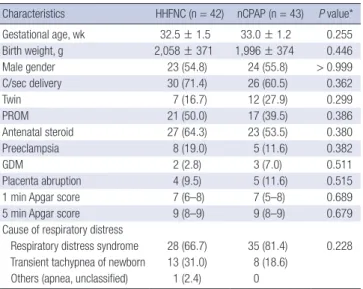
The baseline demographic characteristics of enrolled infants were similar between the 2 groups in terms of gestational age, birth weight, gender, incidence of cesarean delivery, occurrence of multiple pregnancies, premature rupture of membranes, ad- ministrations of antenatal glucocorticoid prophylaxis, incidence of preeclampsia, abruptio placenta, Apgar scores at 1 and 5 min- utes, and the cause of respiratory distress (Table 1). There was no significant difference in terms of the main suspected causes of respiratory distress between the 2 groups (HHFNC, RDS 66.7%
and transient tachypnea of the newborn [TTN] 31.0% vs. nCPAP, RDS 81.4% and TTN 18.6%; P = 0.228).
Primary outcome
The risk difference comparing the treatment failure rate between the nCPAP and HHFNC groups was 17.17 percentage points (95% CI, −1.90–36.23), which crossed the margin of the bound- ary of 20%. It is not certain that HHFNC is non-inferior to nC-
PAP although the difference was not significant (HHFNC, 38.1%
vs. nCPAP, 20.9%; P = 0.099) (Table 2).
The reasons for treatment failure were hypoxia (HHFNC, n=15;
nCPAP, n = 6) and respiratory acidosis (HHFNC, n = 2; nCPAP, n = 4). In terms of the reason for treatment failure, the frequen- cy of hypoxia was significantly higher in the HHFNC group than in the nCPAP group (P = 0.020). Most infants who showed treat- ment failure with the assigned ventilator were finally intubated (HHFNC, 31.0% vs. nCPAP 18.6%; P = 0.216). One patient was intubated urgently because of development of tension pneumo- thorax. Three infants in the HHFNC group who met the treat- ment failure criteria were switched to nCPAP and 1 infant in the nCPAP group who met the treatment failure criteria was switched to Bilevel CPAP as a rescue therapy. They recovered from respi-
ratory distress without intubation and mechanical ventilation.
Respiratory outcomes
The number of infants who recovered from respiratory distress with HHFNC was less than the number of infants who recov- ered from respiratory distress with nCPAP; however, there was no statistically significant difference between the 2 groups (62.9%
vs. 79.1%, respectively; P = 0.099) (Table 3). Weaning rate from the assigned device by the time and the duration of using the assigned devices in case of success did not differ between the studied groups. Also, the duration of total respiratory support between the 2 groups was not significantly different (HHFNC, 67 [40–106.75] hours vs. nCPAP, 52 [34–88] hours; P = 0.179). In Table 1. Perinatal characteristics of HHFNC and nCPAP groups
Characteristics HHFNC (n = 42) nCPAP (n = 43) P value*
Gestational age, wk 32.5 ± 1.5 33.0 ± 1.2 0.255
Birth weight, g 2,058 ± 371 1,996 ± 374 0.446
Male gender 23 (54.8) 24 (55.8) > 0.999
C/sec delivery 30 (71.4) 26 (60.5) 0.362
Twin 7 (16.7) 12 (27.9) 0.299
PROM 21 (50.0) 17 (39.5) 0.386
Antenatal steroid 27 (64.3) 23 (53.5) 0.380
Preeclampsia 8 (19.0) 5 (11.6) 0.382
GDM 2 (2.8) 3 (7.0) 0.511
Placenta abruption 4 (9.5) 5 (11.6) 0.515
1 min Apgar score 7 (6–8) 7 (5–8) 0.689
5 min Apgar score 9 (8–9) 9 (8–9) 0.679
Cause of respiratory distress
Respiratory distress syndrome 28 (66.7) 35 (81.4) 0.228 Transient tachypnea of newborn 13 (31.0) 8 (18.6)
Others (apnea, unclassified) 1 (2.4) 0
Values are expressed as mean ± standard deviation or median (IQR) for continuous variables, as number (%) for categorical variables.
HHFNC = heated, humidified, high flow nasal cannula, nCPAP = nasal continuous positive airway pressure, C/sec = Cesarean section, PROM = premature rupture of membrane, GDM = gestational diabetes mellitus, IQR = interquatile range.
*P values were calculate by the χ2 test, the Fisher exact test or Mann-Whitney U 2-sid- ed test.
Table 2. Primary outcome for infants assigned to receive either HHFNC or nCPAP for the initial respiratory support
Outcomes HHFNC
(n = 42) nCPAP
(n = 43) Risk difference (95%
CI)* percentage points P value† Treatment failure 16 (38.1) 9 (20.9) 17.17 (−1.90–36.23) 0.099 Reasons
Hypoxia 15 (35.7) 6 (14.0) - 0.020
Respiratory acidosis 2 (4.8) 4 (9.3) - 0.676 Additional management
Endotracheal intubation 13 (31.0) 8 (18.6) 13.17 (−4.72–31.07) 0.216 Noninvasive devices 3 (7.1) 1 (2.3) 4.82 (−4.18–13.82) 0.360 Values are expressed as number (%) for categorical variables.
HHFNC = heated, humidified, high flow nasal cannula, nCPAP = nasal continuous positive airway pressure, CI = confidence interval.
*Positive values favor the nCPAP group, and negative values favor the HHFNC group;
†P values were calculated by the χ2 test or the Fisher exact test.
Table 3. Outcomes including weaning rate by the time, period needed respiratory support and respiratory outcomes
Outcomes HHFNC (n = 42) nCPAP (n = 43) P value*
Weaned from the assigned device† 26 (61.9) 34 (79.1) 0.099 Rate by the time†
Within 24 hr 8 (19.0) 10 (23.3) 0.635
Within 48 hr 12 (28.6) 17 (39.5) 0.286
Within 72 hr 20 (47.6) 27 (62.8) 0.104
Within 7 day 26 (61.9) 32 (74.4) 0.215
7 days– 26 (61.9) 34 (79.1) 0.082
Using the assigned device 49.5 (23.8–70.3) 47.5 (23.3–65.6) 0.923 Total respiratory support 67 (40.0–106.8) 52 (34.0–88.0) 0.179 RDS treated with surfactant 12 (28.6) 7 (16.3) 0.201
Bronchopulmonary dysplasia 1 (2.4) 0 (0.0) -
Air leak 2 (4.8) 0 (0.0) -
Values are expressed as median (IQR) for continuous variables, as number (%) for categorical variables.
HHFNC = heated, humidified, high flow nasal cannula, nCPAP = nasal continuous positive airway pressure, RDS = respiratory distress syndrome of newborn, IQR = interquatile range.
*P values were calculated by the χ2 test, the Fisher exact test or Mann-Whitney U 2- sided test; †Cumulative number of patients (%) weaned from the allocated ventilators.
Table 4. Clinical outcomes associated with caring preterm infants
Clinical outcomes HHFNC (n = 42) nCPAP (n = 43) P value*
Symptomatic PDA 7 (16.7) 2 (4.7) 0.073
IVH (grade ≥ III) 0 (0.0) 0 (0.0) -
PVL 0 (0.0) 1 (2.3) 0.506
Bacteremia 0 (0.0) 0 (0.0) -
NEC (stage ≥ 2) 0 (0.0) 0 (0.0) -
Apnea, treated with caffeine 11 (26.2) 9 (20.9) 0.616 Total parenteral nutrition 7 (16.7) 4 (9.3) 0.351 Time to full feeds from birth, day 6 (5.0–9.5) 6 (5.0–9.0) 0.470 Time to full oral feed, day 14 (7–23) 13 (6–23) 0.651 Length of stay, day 20 (15.8, 28.3) 21 (16.0, 32.0) 0.765 Values are expressed as median (IQR) for continuous variables, as number (%) for categorical variables.
HHFNC = heated, humidified, high flow nasal cannula, nCPAP = nasal continuous posi- tive airway pressure, PDA = patent ductus arteriosus, IVH = intraventricular hemor- rhage, PVL = periventricular leukomalacia, NEC = necrotizing enterocolitis, IQR = in- terquatile range.
*P values were calculated by the χ2 test, the Fisher exact test or Mann-Whitney U 2- sided test.
term of the respiratory outcome, no significant differences were found between the 2 groups in terms of the need for surfactant and developments of BPD and air leak.
Complications
Air leak occurred in 2 cases of the HHFNC group and 1 of them was intubated because of pneumothorax. During this study pe- riod, there were no cases of injury to the nasal septum (redness, excoriation, bleeding, or crusting) due to nasal prongs.
Clinical outcomes
There were no significant differences in the incidence of symp- tomatic PDA, IVH, PVL, bacteremia, NEC, time to full enteral feeding from birth or length of hospital stay (Table 4).
DISCUSSION
This trial intended to assess the noninferiority of HHFNC as compared with nCPAP for the initial treatment of respiratory distress in preterm infants (30 ≤ and < 35 weeks of gestational age). It is not certain that HHFNC is non-inferior to nCPAP al- though the difference was not significant (11). A few random- ized, controlled prospective studies have compared HHFNC with nCPAP (4,5,12). One of the studies compared HHFNC with nCPAP for treatment of early respiratory distress or post-extu- bation of preterm infants (12). But, this study did not analyze the results of indications separately. This study exhibited simi- lar efficacy and safety between HHFNC and nCPAP overall. Oth- er studies compared HHFNC with nCPAP for the treatment of RDS, and they showed similar efficacy between 2 groups (4,5).
Although these results support for the use of HHFNC as an ini- tial mode of ventilation in infants with respiratory distress, the evidence for HHFNC for the primary treatment of RDS is still insufficient. In our study, infants with respiratory distress after birth (who needed initial respiratory support) were recruited into the study, and infants who did well on the assigned mode were not exposed to endotracheal ventilation or surfactant.
HHFNC and nCPAP act physiologically differently and need to be set accordingly in a different manner. HHFNC was not de- signed originally to deliver PEEP, but to washout the anatomical and physiological dead space. This results in improving gas ex- change and decreasing the work of breathing (13). When using nCPAP we occlude the nares to create a PEEP. But proper posi- tioning of the nasal cannula to maintain an adequate seal is dif- ficult in preterm infants and requires frequent adjustment. In contrast, HHFNC does not require a close fit of nasal prongs with nares. Ease of HHFNC use has helped to increase its popularity among preterm infants.
HHFNC probably create PEEP (14-16). HHFNC provides in- spiratory support, and if the flow rate of the device exceeds the inspiratory flow rate generated by the patient, then there will be
unquantified positive respiratory support during inspiration.
During expiration, the patient has to expire air against the high flow and PEEP may be generated depending on the size of the leak (17). This concept would theoretically lead us to assume that HHFNC could supports functional residual capacity dur- ing in the initial treatment of respiratory distress of preterm in- fants. But, limited evidence is available about the use of HHF- NC as an initial mode of ventilation in infants with respiratory distress.
Our study included only preterm infants between 30 and 35 weeks of gestational age. Hence, we cannot generalize this find- ing to other smaller preterm infants, or infants presenting with more severe respiratory distress. We assume that the use of HH- FNC as an initial treatment would not be suitable for treatment of initial respiratory distress in smaller preterm infants although there was no significant difference in the incidence of RDS treat- ed with surfactant between the 2 groups.
In the initial phase of RDS or TTN, uneven ventilation is com- mon and the infants experience respiratory distress and increased work of breathing. Thus, the risk of air leak is relatively high. Be- cause pressures were not monitored during HHFNC, there was a concern of increased risk of air leak. One of our enrolled pa- tients was intubated because of development of pneumothorax during support by HHFNC. However, in the previous studies, the incidence of air leak was very low after HHFNC and nCPAP (< 1% vs. 2% in the study by Yoder et al. [12], 0% vs. 2% in the study by Collins et al. [18] and 0% vs. 0.7% in the study by Man- ley et al. [10]) for early treatment and post-extubation.
Nasal trauma can occur after nCPAP (19). However, we did not encounter a case of nasal trauma in both groups. This dis- crepancy could be due to the different nature of the studies, in which we treated the initial phase of respiratory distress and pro- vide support for a shorter period. Also, the gestational age of in- fants in our study were older compared to that in other studies (10,18). Less trauma could be due to different routines of nasal prongs handling and fixation.
Our study limitation is that randomized mode of support could not be blinded to the medical team. Although we used the ob- jective failure criteria and management protocols, the possibili- ty of a bias might exist. Also, as there was no previous study on the initial treatment with HHFNC, determination of margin of noninferiority for the statistical analysis was somewhat arbitrary.
Therefore, the sample size of this study may not have been large enough to compare the effectiveness between the 2 devices.
We conclude that there is no evidence to support the nonin- feriority of HHFNC compared to nCPAP as an initial manage- ment of respiratory distress in premature infants at between 30 and 35 weeks gestational age. The difference in failure rate is not significant without an increase in the incidence of compli- cations; further randomized controlled studies are required to assess the effectiveness and safety of HHFNC as an initial treat-
ment in preterm infants with respiratory distress.
ACKNOWLEDGMENT
We thank the physicians and nursing staff working in the neo- natal intensive care unit of Korea University Ansan Hospital for their enthusiastic support and cooperation.
DISCLOSURE
The authors have no potential conflicts of interest to disclose.
AUTHOR CONTRIBUTION
Conceptualization: Park K, Choi BM. Investigation: Shin J, Park K, Choi BM. Data curation: Shin J, Lee EH. Formal analysis: Shin J, Lee EH. Writing - original draft: Shin J, Choi BM.
ORCID
Jeonghee Shin http://orcid.org/0000-0003-3718-968X Kyuhee Park http://orcid.org/0000-0001-8640-3211 Eun Hee Lee http://orcid.org/0000-0002-1539-8184 Byung Min Choi http://orcid.org/0000-0003-0931-2353
REFERENCES
1. Schmölzer GM, Kumar M, Pichler G, Aziz K, O’Reilly M, Cheung PY. Non- invasive versus invasive respiratory support in preterm infants at birth:
systematic review and meta-analysis. BMJ 2013; 347: f5980.
2. Dani C, Pratesi S, Migliori C, Bertini G. High flow nasal cannula therapy as respiratory support in the preterm infant. Pediatr Pulmonol 2009; 44:
629-34.
3. Wilkinson D, Andersen C, O’Donnell CP, De Paoli AG, Manley BJ. High flow nasal cannula for respiratory support in preterm infants. Cochrane Database Syst Rev 2016; 2: CD006405.
4. Ciuffini F, Pietrasanta C, Lavizzari A, Musumeci S, Gualdi C, Sortino S, Colnaghi M, Mosca F. Comparison between two different modes of non- invasive ventilatory support in preterm newborn infants with respiratory distress syndrome mild to moderate: preliminary data. Pediatr Med Chir 2014; 36: 88.
5. Iranpour R, Sadeghnia A, Abari SS. High flow nasal cannula in the treat-
ment of respiratory distress syndrome in one day-old neonate. Br J Med Med Res 2016; 15: 1-7.
6. Jobe AH, Bancalari E. Bronchopulmonary dysplasia. Am J Respir Crit Care Med 2001; 163: 1723-9.
7. Papile LA, Burstein J, Burstein R, Koffler H. Incidence and evolution of subependymal and intraventricular hemorrhage: a study of infants with birth weights less than 1,500 gm. J Pediatr 1978; 92: 529-34.
8. de Vries LS, Eken P, Dubowitz LM. The spectrum of leukomalacia using cranial ultrasound. Behav Brain Res 1992; 49: 1-6.
9. Kliegman RM, Walsh MC. Neonatal necrotizing enterocolitis: pathogene- sis, classification, and spectrum of illness. Curr Probl Pediatr 1987; 17:
213-88.
10. Manley BJ, Owen LS, Doyle LW, Andersen CC, Cartwright DW, Pritchard MA, Donath SM, Davis PG. High-flow nasal cannulae in very preterm in- fants after extubation. N Engl J Med 2013; 369: 1425-33.
11. Piaggio G, Elbourne DR, Pocock SJ, Evans SJ, Altman DG; CONSORT Group.
Reporting of noninferiority and equivalence randomized trials: extension of the CONSORT 2010 statement. JAMA 2012; 308: 2594-604.
12. Yoder BA, Stoddard RA, Li M, King J, Dirnberger DR, Abbasi S. Heated, humidified high-flow nasal cannula versus nasal CPAP for respiratory support in neonates. Pediatrics 2013; 131: e1482-90.
13. Lavizzari A, Veneroni C, Colnaghi M, Ciuffini F, Zannin E, Fumagalli M, Mosca F, Dellacà RL. Respiratory mechanics during NCPAP and HHHF- NC at equal distending pressures. Arch Dis Child Fetal Neonatal Ed 2014;
99: F315-20.
14. Dysart K, Miller TL, Wolfson MR, Shaffer TH. Research in high flow ther- apy: mechanisms of action. Respir Med 2009; 103: 1400-5.
15. Kubicka ZJ, Limauro J, Darnall RA. Heated, humidified high-flow nasal cannula therapy: yet another way to deliver continuous positive airway pressure? Pediatrics 2008; 121: 82-8.
16. Locke RG, Wolfson MR, Shaffer TH, Rubenstein SD, Greenspan JS. Inad- vertent administration of positive end-distending pressure during nasal cannula flow. Pediatrics 1993; 91: 135-8.
17. Sivieri EM, Gerdes JS, Abbasi S. Effect of HFNC flow rate, cannula size, and nares diameter on generated airway pressures: an in vitro study. Pe- diatr Pulmonol 2013; 48: 506-14.
18. Collins CL, Holberton JR, Barfield C, Davis PG. A randomized controlled trial to compare heated humidified high-flow nasal cannulae with nasal continuous positive airway pressure postextubation in premature infants.
J Pediatr 2013; 162: 945- 954 e1.
19. Collins CL, Barfield C, Horne RS, Davis PG. A comparison of nasal trau- ma in preterm infants extubated to either heated humidified high-flow nasal cannulae or nasal continuous positive airway pressure. Eur J Pedi- atr 2014; 173: 181-6.