Printed in the Republic of Korea
네이피어 풀줄기의 혐기성 분해: 외부에서 가해준 철과 니켈의 효과
Christian Agatemor*, Patricia Ogbonyealu Ogbunnefi†, and Uzuazokaro Mark-Maria Agatemor‡ Department of Chemistry, Faculty of Physical Science, University of Benin, Benin City, Nigeria
†Environmental Science Unit, Faculty of Life Science University of Benin, Benin City, Nigeria
‡Department of Biochemistry, Faculty of Life Science, University of Benin, Benin City, Nigeria (2008. 7. 5 접수)
Anaerobic Digestion of Napiergrass Stem: the Effect of Exogenous Iron and Nickel
Christian Agatemor*, Patricia Ogbonyealu Ogbunnefi†, and Uzuazokaro Mark-Maria Agatemor‡ Department of Chemistry, Faculty of Physical Science, University of Benin, Benin City, Nigeria
†Environmental Science Unit, Faculty of Life Science University of Benin, Benin City, Nigeria
‡Department of Biochemistry, Faculty of Life Science, University of Benin, Benin City, Nigeria (Received July 5, 2008)
요 약. 네이피어 풀줄기의 메탄 전환수율에 대한 니켈과 철의 효과(각기 독자적 사용 또는 혼합사용 경우)를 조사
하기 위해 실험실 규모의 혐기성 분해 실험을 수행하였다. 철(iron (III) chloride, FeCl3), 니켈(nickel (II) chloride, NiCl2), 및 철-니켈 혼합물(a 1:1 FeCl3 and NiCl2 molar mixture)을 기질에 첨가하였다. 분해실험을 진행하기 위해 사 용한 미생물은 새로 도축한 5년생 숫소의 첫째위장액에서 얻은 것을 사용하였다. 생분해로부터 얻어진 가스를2일 간격 으로 30일간 채집하였고 메탄 수율을 기체크로마토그래피를 사용하여 측정하였다. 이 실험결과로부터 누적메탄수율, 메 탄생성속도(메탄생성 이전) 시간 지연 등은 철, 니켈, 철-니켈 혼합물을 가함에 의해 촉진된다는 것을 알았다. 네이피어 풀줄기의 누적메탄수율은 이들 무기화합물들의 첨가양의 증가함에 따라 증가함을 또한 발견하였다. 게다가 니켈이온을 첨가하였을 때 최고의 메탄수율이 얻어졌다. 철과 니켈 이온들을 각기 기질에 가하였을 때 메탄생성 이전 시간 지연이
8일에서 6일로 감소하였고, 철-니켈 혼합물의 경우 4일로 더욱 감소하였다.
주제어: 네이피어풀, 메탄 수율, 철, 니켈, 혐기성 분해
ABSTRACT. Batch laboratory-scale anaerobic digestion experiments were carried out with the aim of investigating the effect of nickel and iron, singly and in combination, on the methane yield of napiergrass stem. Iron, nickel and an iron-nickel mixture were added to the substrate as iron (III) chloride (FeCl3), nickel (II) chloride (NiCl2), and a 1:1 FeCl3 and NiCl2 molar mixture, respectively. The inoculum used to inoculate the digestion experiments was obtained from the rumen fluid of a freshly slaughtered 5 year old male bovine. The biogas produced was collected for 30 days by 2 days intervals and the methane yield was measured using gas chromatography (GC). The results obtained show that the cumu- lative methane yield, rate of methane production, and time lag before methane production were enhanced with the addi- tion of iron, nickel, and the iron-nickel mixture. The study also show that the cumulative methane yield of the napiergrass stem increased as the amount of added FeCl3, NiCl2, and FeCl3-NiCl2 mixture increased. Furthermore, the cumulative methane yield was highest when nickel ion was added. Addition of iron and nickel ions to substrate reduced the time lag before methane production from 8 days to 6 days and addition of the iron-nickel ions mixture to substrate reduced the time lag to 4 days.
Keywords: Napiergrass, Methane Yield, Iron, Nickel, Anaerobic Digestion
INTRODUCTION
It has long been known that energy can be derived from biorenewable resources. Towards the end of the last century, the production of energy from biorenewable resources has changed from a play- ground of few researchers to a proven technology.
This change is due to record-high oil, gasoline, and natural gas prices, couples with a steady stream of blistering news accounts of real or possible global- warming emergencies.1 One of the premier energy potentials of biorenewable resources is the produc- tion of methane from energy crops.2,3 Literature search reveals that the production of methane via anaerobic digestion of energy crops is one of the most energy-efficient and environmentally benign ways of generating energy.4
Napiergrass, Pennisetum purpureum, is one of the most important energy crops producing high herbage yield per unit area of land.5 Napiergrass is a tall, predominantly vegetative-propagated, perennial indigenous to sub-Saharan Africa, which can pro- duce biomass of 20~30 tons per hectare per year.6 Methane production potential of napiergrass via anaerobic digestion is documented.7 The production of methane via anaerobic digestion of napiergrass, like other biomethanation processes, is a complex group of biochemical reactions, which rely on the interaction of different groups of microorganisms and enzymes. Various factors affect these biochem- ical reactions, microbial interactions and enzymic activities. These factors, which have profound impact on methane yield, include type of inoculum, pH and temperature of substrate, carbon – nitrogen ratio of substrate, volatile fatty acid content of sub- strate, pretreatment of substrate, presence of salts, and trace metals ions, etc..7-14
The importance of trace metals ions, singly or in combination, in anaerobic digestion of energy crops has been reported.13,14 The results of these previous studies suggest that trace metals ions substantially increase the methane yield of biomass by activat- ing the metalo-enzymes presence during the diges- tion process.15,16 Whilst the importance of trace metals ions in anaerobic digestion is documented in
literature, the body of literature reporting the effect of trace metals ions on the methane yield of energy crops during anaerobic digestion is scanty. In fact, research on the significance of these ions on meth- ane yields of energy crops during anaerobic diges- tion has been neglected. This neglect is due to the presence of seemingly adequate trace metals in energy crops and/or the practice of blending poor- quality energy crops with trace metals-rich animal manure or sewage. The main purpose of this work was to evaluate the effect of iron and nickel ions, singly and in combination, on the methane yield of napiergrass stem. Sub-objectives include (i) com- pare the effect of iron and nickel ions, singly and in combination, on the methane yield of napiergrass stem; (ii) investigate the effect of varying amounts of iron and nickel ions on methane yield of napier- grass; and (iii) determine the chemical characteris- tics of napiergrass.
MATERIALS AND METHODS
Chemicals
All the chemicals used in the study were analyti- cal grade, purchased from Merck (Darmstadt, Ger- many), and used without further purification.
Source of substrate
The stems of the 6 month old napiergrass used in this study were obtained in October 2007 from a private farm in Benin City, Nigeria. The napiergrass stems were taken to the laboratory and chopped to approximately 3 cm particle size. The chopped samples were dried at room temperature to a con- stant weight and ground in a Wiley mill to pass through a 1 mm screen. The ground sample was frozen and stored at -20oC. Before analyses and anaerobic digestion experiments, the samples were allowed to thaw overnight at 4oC.
Pre-treatment of substrate
A 20 g of the ground sample and 4 g of sodium hydroxide pellet were put into a 250 mL conical flask. Deionised water was then introduced into the flask until the sample was submerged. The slurry
was thoroughly stirred with a magnetic stirrer at 250 rpm to ensure complete dissolution of sodium hydroxide pellet. The conical flask containing the slurry was corked and left to stand for 24 h in a water bath maintained at 35oC. At the end of the pre-treatment process, 40 mL of 2.5 M hydrogen chloride acid was added to bring the pH of the slurry to 7.0. The neutralized slurry was further stirred and left to stand for another 24 h at room temperature before the anaerobic digestion experi- ment; after which the slurry was filtered and then air-dried to obtain the substrate.
Source of inoculum
The inoculum used for the anaerobic digestion of substrate was obtained from rumen compartment of a freshly slaughtered 5 year old male bovine that weighed 178 kg. The bovine, which was main- tained on a steady meal of napiergrass and ground- nut residue for 3 months, was slaughtered at the Edo State Abattoir, Ikpoba, Benin City, Nigeria. A 40 mL of the rumen fluid was filtered through a glass wool into conical flask and 30 mL of 1:4 potas- sium dihydrogen phosphate/potassium bicarbonate buffered solution of pH 7.2 was added. The buff- ered inoculum was stirred and incubated at 37±1oC until digestion experiment.
Anaerobic digestion of substrate
The digestion of the substrate was carried out in a laboratory-scale batch experiments. The digestion experiments were conducted in duplicate in a 500 mL glass bottles on a shaking water bath (70 rpm) at 37±1oC. A 50 mL of the inoculum and 0.5 g of the substrate were added to the bottles. 0.1 g FeCl3 was added to the content in the bottle. The experi- ment was also carried out with different masses (0.2 g, 0.3 g, and 0.4 g, respectively) of FeCl3. The con- tents of the bottles were flushed with N2/CO2 gas mixture for 10 minutes and the bottles sealed with rubber stoppers. The bottles were connected to a calibrated wet gas meter to collect biogas produced.
The methane content of the biogas was measured for 30 days by 2 days intervals. The digestion was also carried out with different masses (0.1, 0.2, 0.3,
and 0.4 g) of NiCl2, and 1:1 molar mixture of FeCl3 and NiCl2. The digestion experiment was also car- ried on a substrate without added trace metal salts, which served as control. Assay with inoculum only was carried to minus the methane yield of inocu- lum from that of the substrate.
Methane analyses and calculations
Biogas samples were taken with a pressure lock syringe and their methane content was measured with gas chromatography (Perkin Elmer Model Clarus 500). The GC was equipped with a flame-ionisa- tion detector and 30 m × 0.53 mm Perkin Elmer alumina column. The carrier gas was argon and its flow rate was 0.8 mL min-1, oven temperature was 100oC, injection port temperature was 250oC and detector temperature was 225oC. The methane yield of substrate was calculated as m3 CH4 kg-1 VSadded minus the methane yield of the inoculum.
Determination of chemical characteristics of napiergrass stem
Volatile fatty acids (VFAs) were measured with a GC (Perkin Elmer Autosystem XL) equipped with flame-ionisation detector. The GC’s column was 30 m × 0.32 mm × 25 µm PE FEAP column, car- rier gas was helium and its flow rate was 0.8 mL min-1, injection port and detector temperature were 225oC, while the oven temperature was 100~160oC (20oC/min). Total solids and volatile solids were determined according to the Standard Methods17 and Metrohm 774 pH-meter was used in pH mea- surement. pH of sample was measured from slurry of substrate and deionised water. Carbon and nitro- gen were analyzed with elemental analyzer
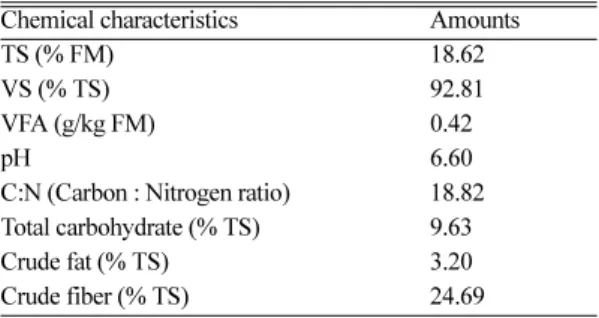
Table 1. Chemical characteristic data of napiergrass
Chemical characteristics Amounts
TS (% FM) 18.62
VS (% TS) 92.81
VFA (g/kg FM) 0.42
pH 6.60
C:N (Carbon : Nitrogen ratio) 18.82 Total carbohydrate (% TS) 9.63
Crude fat (% TS) 3.20
Crude fiber (% TS) 24.69
(CHN2400, Perkin-Elmer, Wellesley, MA, USA).
Crude fats, crude fiber and carbohydrates were determined according to the Standard Methods.18 The results of the chemical characteristics of napi- ergrass stem are given in Table 1.
RESULTS AND DISCUSSION
The results of the study concord with results of previous studies that metal ions enhance methane yield of biomasses undergoing anaerobic diges- tion.13,15,16,19 The results of the study, which are pre- sented in Figs. 1-4, show that iron and nickel, which were added as FeCl3 and NiCl2, respectively, can have effect on the methane yield and rate of methane production during anaerobic digestion of napiergrass stem.
Generally, the study shows that iron and nickel, either singly or in combination, improved the meth- ane yield of napiergrass stem. The rate of methane production was also enhanced during the digestion.
The study also shows that the metal ions reduced the time lag before methane production. Overall, it was observed that addition of nickel to the sub- strate during anaerobic digestion was more benefi- cial to methane production than addition of iron or the iron-nickel mixture. The role of these metals in improving the methane yield of napiergrass was not
surprising as metals have been reported to increase methane yield during anaerobic digestion of biom- ass.13,15,16,19 Geetha et al., attributed enhanced meth- ane yield during anaerobic digestion in the presence of metal ions to activation of metalo-enzymes by the metal ions.16 These metalo-enzymes catalyze biomethanation of biomasses.
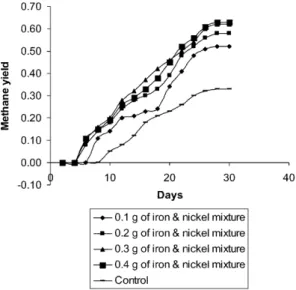
The results as presented in Figs. 1-3 indicate that Fig. 1. Effect of various amounts of FeCl3 on the mean
cumulative methane yield (m3 CH4 kg-1 VSadded) of napiergrass stem collected for 30 days by 2 days intervals.
Fig. 2. Effect of various amounts of NiCl2 on the mean cumulative methane yield (m3 CH4 kg-1 VSadded) of napiergrass stem collected for 30 days by 2 days intervals.
Fig. 3. Effect of various amounts of FeCl3 and NiCl2 mixture on the mean cumulative methane yield (m3 CH4 kg-1 VSadded) of napiergrass stem collected for 30 days by 2 days intervals.
the methane yield increased as the amount of added metal ions increased. Compared with the control, addition of 0.1 g of FeCl3 to the substrate resulted in an increase of 6.06% in methane yield. This rela- tive increase was further increased to 15.15 and 36.00% when the amount of added FeCl3 was increased to 0.2 and 0.3 g, respectively. Further increase did not increase the methane yield beyond the relative percent increase of 36.00%. The effect of the amount of metal ions was more remarkable with nickel than with iron and iron-nickel salts mix- ture. The relative percent increase was 84.85%
when 0.1 g of NiCl2 was added to the substrate; this relative percent increase rose to 121.21% and 154.55%
when the amount of added NiCl2 was increased to 0.2 and 0.3 g, respectively. A trend similar to that obtained with FeCl3 was observed with the FeCl3- NiCl2 mixture except that the relative percent increase in methane yield was higher with the mix- ture. The effect of amount of trace metals added on methane yield suggested that an optimum quantity of trace metal is needed to obtain the best yield of methane.
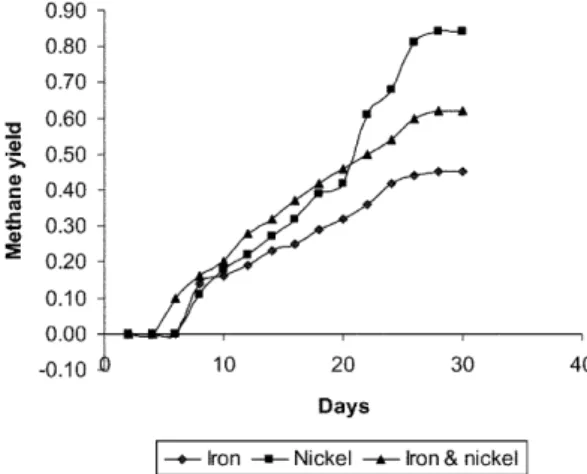
Fig. 4 shows the comparision of the rate of meth- ane production and methane yield of the substrate when 0.3 g of FeCl3, NiCl2 and FeCl3-NiCl2 mix- ture were respectively added to the substrate. The results indicate that the addition of 0.3 g of NiCl2 to the substrate gave higher methane yield than the addition of either 0.3 g of FeCl3 or 0.3 g of FeCl3- NiCl2 mixture. The order of increasing methane yield due to presence of 0.3 g of these metal ions was Fe < Fe-Ni mixture < Ni. Geetha and co-work- ers in their study of anaerobic digestion of water hyacinth and cattle waste blend observed that addi- tion of nickel to biomass enhanced biogas yield bet- ter than addition of iron.16 Jain et al. reported similar findings in their study of anaerobic digestion of Azolla pinnata R. Br. and Lemna minor L.; in fact, Jain and his co-workers showed that iron did not influence the yield of biogas.19 The effect of nickel on the yield increase of methane better than iron suggests that the metalo-enzymes may have been more activated in the presence of nickel than in the presence of iron. The results in Fig. 4 also show
that the addition of iron to substrate increased the rate of methane production faster than the addition of the iron-nickel mixture to the substrate. The addition of iron to substrate also gave higher rate of methane production than the addition of nickel to substrate until the day 20 of digestion after which a steep rise in rate of methane production and meth- ane yield of the substrate was observed with nickel.
The observations concord with the report of Preeti Rao and Seenayya that addition of iron to biomass during anaerobic digestion gave faster biogassifica- tion than the addition of nickel.20 In addition, the time lag before methane production was shorter in the presence of iron-nickel mixture than in the pres- ence of nickel and iron. This shorter time suggests that iron and nickel may have had a synergistic effect on the metalo-enzymes activation.
CONCLUSION
This study describes the influence of iron and nickel on methane production potentials of napier- grass stem. Largely, the addition of iron and nickel, either singly or in combination, to napiergrass dur- ing anaerobic digestion enhanced the methane yield. While the addition of nickel gave higher methane yield than the addition of iron or iron- nickel mixture, the addition of iron-nickel mixture Fig. 4. Effect of 0.3 g of different metals salts on the mean cumulative methane yield (m3 CH4 kg-1 VSadded) of napiergrass stem collected for 30 days by 2 days intervals.
reduced the time lag before methane production better than the addition of nickel and iron. The find- ings are important since FeCl3 and NiCl2 would be simple, low-cost, nutritional additives to biomass anaerobic digestion. This is particularly important for biomasses that are deficient in micronutrients.
REFERENCE
1. Johnson, J. Chemical and Engineering News 2006, 84(35), 13.
2. Lemmer, A.; Oechsner, H., Ag. Eng. Budapest, 2002;
No. 02–SE–007.
3. Gunaseelan, V. N. Biomass Bioenergy 1997, 13(1/2), 83.
4. Lbs, L. B. Systemtechnik Gmbtt; Ottobrunn, Germany, 2002; p 133.
5. Orodho, A. B. Proceedings of the first joint workshop held in Lilongwe, PANESA/ARNAB: Addis Ababa, Ethiopia, 1990; p 833.
6. Orodho, A. B. FAO; Science Publisher Inc., 2005; pp 433-459.
7. Chynoweth, D. P.; Turick, C. E.; Owens, J. M.; Jerger, D. E.; Peck, M. W. Biomass Bioenergy 1993, 5, 95.
8. Pavlostathis, S. G.; Gosseth, J. M. Biotech. Bioeng.
1985, 27, 334.
9. Heiermann, M.; Plöchl, M.; Linke, B.; Schelle, H., Proc. World Renewable Energy Congress VII; Sayigh,
A.A.M., Ed.; Pergamon, Cologne, 2002.
10. Fox, M.; Noike, T. Biores. Technol. 2004, 91, 273.
11. Rani, D. S.; Nand, K. Waste Manage., 2004, 24, 523.
12. Neureiter, M.; dos Santos, J. T. P.; Lopez, C. P.; Pichler, H.; Kirchmayr, R.; Brauu, R. Proc. 4th Int. Symp. On Anaerobic Digestion of Solid Waste; Ahring, B. K. and Hartmann, H.; Biocentrum – DTU: Copenhagen, 2005;
Volume 1, pp 109-115.
13. Wilkie, A.; Goto, M.; Bordeaux, F. M.; Smith, P. H.
Biomasss 1986, 11, 135.
14. ANL1 CNSV-TM-167; Speece, R. E., Parkin, G. F., Antonopoulos, A. A., Eds.; Argonne National Labora- tory, Argonne, Illinois., 1985; pp 195-221.
15. Smith, P. H.; Bordeaux, F. M.; Goto, M.; Shiralipour, A.; Wilkie, A.; Andrews, J. F. ; Ide, S.; Barnett, M. W.;
Smith W. H., Frank, J. R., Eds.; Elsevier Applied Sci- ence Publishers Ltd.: London, England, 1988; pp 291- 334.
16. Geetha, G. S.; Jagadeesh, K. S.; Reddy, T. K. R. Bio- mass 1990, 21, 157.
17. APHA, 20th ed.; American Public Health Association:
Washington DC. USA, 1998.
18. TAPPI; Technical Association of the Pulp and Paper Industry: Atlanta, USA, 2000; TAPPI Test Methods 2000-2001.
19. Jain, S. K.; Gujral, G. S.; Jha, N. K.; Vasudevan, P. Biores.
Technol. 1992, 41, 273.
20. Preeti Rao, P.; Seenayya, G. World J. Microbiol. Bio- technol. 1994, 10, 211.