- 410 -
서 론1)
청국장은 대두를 원료로 한 발효 식품으로 간장 된장 , , 고추장 등과 함께 오늘날까지 상용되어온 전통 장류의 하나 로서 대두 발효 식품 중에서 가장 짧은 기간에 발효가 완성 되며 특이한 풍미와 우수한 영양 성분을 포함하는 고유한 전통 발효 식품의 하나이다 (1). 대두 중에는 아미노산 (2), 불포화 지방산 (3) 등이 풍부하여 영양적 측면에서도 우수한 특성을 가지고 있다 (4). 또한 Bacillus natto와 Bacillus subtilis가 생산하는 효소의 작용으로 대두의 여러 단백질이 분해되어 가용성 질소 화합물인 peptone, polypeptide 및 등이 생성되어 소화되기 쉽고 청국장 특유의 amino acid
†
Corresponding author. E-mail : [email protected], Phone : 82-53-950-5774, Fax: 82-53-950-6772
구수한 맛을 형성한다 (2). 동시에 청국장에는 끈끈한 점질 물이 생성되면서 특유의 향을 내게 되는데 이 끈적끈적한 점질물의 성분은 Bacillus sp. 가 대두의 당질과 단백질들을 기질로 하여 합성한 levan 형 fructan 과 polyglutamate 의 혼 합 물질로 알려져 있다(5-8).
최근 단백질과 지방 공급원 같은 청국장의 영양적 측면 이외에도 발효 중에 형성되는 각종 생리활성물질의 기능성 에 관한 관심이 높아지고 있다 (9). 그리고 phenolic acids,
및 등이
saponin, trypsin inhibitor, phytic acid oligosaccharide 청국장에 다량 함유되어 있음이 규명되면서 청국장의 다양 한 기능성에 대한 연구보고가 있다 특히 청국장의 혈전 . , 용해능 (10-11), 항산화효과 (12), 항돌연변이성 및 항암성
항염증작용 혈중 저하효과에 따른 항당뇨
(13), (14), glucose
작용 (15-17), 혈압강하 및 지질대사 개선 기능 (18) 등에 관
청국장으로부터 고 비활성 세포외 Protease 생산 세균의 분리 및 동정
박희진1․박희동1,2†
경북대학교 식품공학과
1, 경북대학교 발효생물공학연구소
2Isolation from Chungkookjang and Characterization of a Bacterium Producing an Extracellular Protease of High Specific Activity
Hee-Jin Park1 and Heui-Dong Park1,2†
1
Department of Food Science and Technology, and
2
Institute of Fermentation Biotechnology, Kyungpook National University, Deagu 702-701, Korea
Abstract
Several extracellular protease-producing bacteria were isolated from Chungkookjang, a traditional Korean food of fermented soybeans, on skim milk agar plates. Among these bacteria, strain D14 exhibited the highest production (15.2 U/mL) and specific activity (40.0 U/mg protein) of extracellular protease activity as assessed on growth in a protease induction medium composed of 1% (w/v) soluble starch, 1.5% (w/v) skim milk, 0.5% (w/v) yeast extract, and 2% (w/v) NaCl. The bacterium was identified as Bacillus subtilis based on morphological and physiological characteristics and 16S rDNA sequence. A BLAST search of 16S rDNA sequences revealed that the isolate was most closely related to Bacillus subtilis subsp. subtilis strain NCIB 3610. The 16S rDNA sequence homology was 99.9%. Our isolate produced the highest level of protease when grown in a protease induction medium containing 1% (w/v) sorbitol and 0.5% (w/v) yeast extract. Fructose and glucose reduced enzyme production to 12.7% and 35.9%, respectively, of the level seen when the strain was grown in medium containing soluble starch. Soytone also reduced enzyme production to 61.4% of the level noted when the strain was grown in medium containing yeast extract.
Key words:Bacillus subtilis, Chungkookjang, extracellular protease, fermented soybean
심이 집중되고 있다 또한 대두중의 항산화 물질인 . 류는 삶은 대두 된장 및 간장보다 함량이 높다는 isoflavone ,
보고가 있어 이에 따른 청국장의 기능성 식품으로서 그 우수성과 중요성이 재조명되고 있다 (19-21). 이러한 이유로 청국장의 대량 생산 기능성 및 관능성 증대개선에 따른 , 소비 증대에 많은 연구가 이루어지고 있다(22-23).
는 조미료 제조 식육의 연화 맥주청주의 혼탁
Protease , , ․
방지 및 치즈의 숙성 등의 식품 공업과 소염진통제 소화제 , , 피혁 가공 및 세제 공업 등 여러 분야에 걸쳐 널리 이용되고 있다 (24). Protease 는 여러 종류의 미생물이 생산하는 유용 한 효소로서 구조와 작용 기전의 유사성 등으로 나눈다.
가 최초로
Peckman(25) Aspergillus sp. 에서 분리한 이후 그 기능과 활성면에서 Massaki 등 (26) 에 의해 serine protease,
및 등으로 분류되었으며
thiol protease metal protease
와 등 은 그 작용 의 영향에
Kageyma(27) Nunokzwra (28) pH
따라 acid protease, neutral protease 및 alkaline protease 로 분류하였다 . Protease 생산능이 가장 강한 세균으로 알려진 B. subtilis가 분비하는 세포외 총 protease 는 종류로서 이들 7 효소 생산 유전자는 chromosome 상의 위치가 조금씩 다른 것으로 알려져 있다 (29). 이들 효소는 다양한 기질에 반응하 는 성질을 이용하여 다양한 단백질들의 분해에 사용되는데 어떤 B. subtilis protease 들은 여러 개의 active form 을 가지고 있기도 하며 (30) 어떤 protease 는 세균의 단백질 품질을 결 정하는데 관여하고 있다고 보고되고 있다(31).
의 산업적 생산을 위하여 세포 외 효소 생산능이 Protease
높으며 다른 단백질의 분비가 적은 효소 즉 고 비활성의 효소를 생산하는 균주를 사용하는 것이 유리하다 이는 높 . 은 비활성을 가지는 세포외 효소가 대량 정제가 용이하고 정제 비용을 줄일 수 있기 때문이다 . Protease 생산성 B.
subtilis 균주는 청국장 (32-33), 간장 (34), 멸치젖 (35), 토양
등으로부터 이미 분리되었으며 최근에도 고생
(36) protease
산성 균주가 된장 (37) 과 고추장 (38) 으로부터 분리된 바 있 다 이들의 . protease 활성은 대부분이 2-13 U/mL 로서 낮은 수준이나 최근 된장에서 분리된 DH3 균주의 활성이 15.3 로서 높게 나타났다는 보고 가 있을 뿐 고 비활성
U/mL (37)
의 protease 생산성 균주에 관한 연구는 많지 않은 실정이다 . 따라서 본 연구에서는 우리나라 대표적 전통 식품의 하나인 청국장으로부터 비활성이 강할 뿐 아니라 protease 의 생성 능이 우수한 균주를 분리하고 그 특성을 조사하였다.
재료 및 방법
사용 배지 및 균의 배양
본 실험에서 protease 생산 세균의 분리를 위한 배지로는 분리배지(0.1% glucose, 0.1% soybean powder, 1.5% skim
와 의 생산을
milk, 0.1% yeast extract, 2.0% NaCl) protease
위한 배지로는 protease 생산 배지 (1% soluble starch, 1.5%
를 사용하였다 skim milk and 0.5% yeast extract, 2% NaCl) . 균의 배양은 분리배지에 균을 한 백금이 접종한 후 37℃ 에 서 24 시간 동안 150 rpm 의 속도로 진탕하면서 배양하였다 . 균의 단기 보관은 균의 증식 정도를 확인한 배양액을 4℃ 에 보관하면서 실험에 사용하였으며 균주의 변이를 방지하기 위한 장기보존은 분리 균주의 배양액에 glycerol 을 최종농 도가 15% 되게 첨가한 후 -70 ℃ 에 냉동 보관하였다 .
고 비활성 세포외 protease 생산 세균의 분리
청국장 시료를 생리식염수 (0.85% NaCl) 로 희석한 후
의 분리배지에 의 한천을 첨가하여 만든 분리용
Table 1 2.0%
고체배지에 100 L μ 를 도말하고 37 ℃ 에서 24 시간 배양하여 생성되는 독립 colony 를 분리하였다 분리한 균주들은 같은 . 평판배지에서 재차 획선도말 접종한 후 37 ℃ 에서 24 시간 배양하여 단백질의 분해로 인하여 투명환을 강하게 생성하 는 균주들을 protease 생산균주로 차 선별하였다 차 선별 1 . 1 한 균주를 분리용 액체배지를 사용하여 37 ℃ 에서 150 rpm 으로 24 시간 진탕 배양한 다음 배양액을 원심분리하여 얻 은 상징액의 단백질 함량과 protease 활성을 측정하여 활성 이 우수한 균주를 최종 선별하였다.
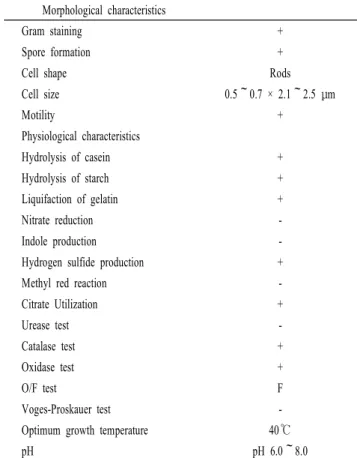
Table 1. Morphological and physiological characteristics of the isolate D14
Morphological characteristics
Gram staining +
Spore formation +
Cell shape Rods
Cell size 0.5 0.7 × 2.1 2.5 m~ ~ μ
Motility +
Physiological characteristics
Hydrolysis of casein +
Hydrolysis of starch +
Liquifaction of gelatin +
Nitrate reduction -
Indole production -
Hydrogen sulfide production +
Methyl red reaction -
Citrate Utilization +
Urease test -
Catalase test +
Oxidase test +
O/F test F
Voges-Proskauer test -
Optimum growth temperature 40℃
pH pH 6.0~8.0
+ : positive, - : negative
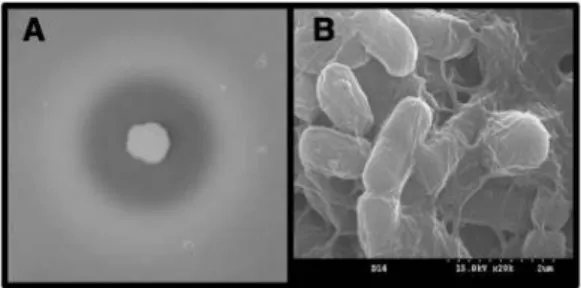
Fig. 1. Proteolytic activity of the isolate D14 on the skim milk agar plate (A) and its cell morphology observed on a scanning electron microscope (B).
세균의 동정
분리 세균의 동정은 균의 형태학적 특성, API 20E kit, 의 염기서열 결정 및 상동성 검색을 통하여 행하 16S rDNA
였다 . API kit (bioMerieux, France) 를 이용한 동정은 배양된 분리균을 API kit 에 100 L μ 를 접종하고 30 ℃ 에서 24 시간 반응시킨 후 biochemical test, assimilation test 그리고
를 하였다 는 생리식염수
fermentation test . Biochemical test
에 시험균을 현탁하여 건조된 기질이 들어있는 kit 의 cupule 에 접종하여 배양 후 발색시약을 첨가하여 물질의 대사유무 를 색의 변화로써 판정하였다 . Assimilation test 는 최소배지 에 현탁한 시험균을 탄수화물이 유일한 탄소원으로 들어있 는 kit 의 cupule 에 접종 배양한 후 시험균이 이들 당을 이용 할 수 있는지 여부를 탁도 변화로 알아보았다. Fermentation 는 당으로부터 산의 생산에 따른 의 변화로 판정하였
test pH
다 세균의 동정은 이상의 결과들을 토대로 하여 . Bergey's 의 기준에 따라 동정하였 Manual of Systematic Bacteriology
다(39).
전자현미경 관찰
분리균의 배양액을 분리용 액체배지에 1% 가 되게 접종 하여 일간 3 30 ℃ 에서 배양한 균체를 사용하였다 세포의 . 고정은 Sheehan 과 Hrapchak 의 방법 (40) 에 따라 배양액에
시약을 균체와 로 혼합해 약한
Karnovsky 1:1(v/v) vacuum
상태에서 시간 동안 균을 고정시키고 2 0.05 M cacodylate
로 세척한 후 에서 분간 방치하였다
buffer (pH 7.2) hood 20 .
여기에 0.5% uranyl acetate 용액을 혼합하여 4 ℃ 에서 16 시간 동안 prestaining 하고 30, 50, 70, 80 및 90% ethanol 로 각각
분씩 탈수한 후 다시 로 분씩 회 탈수
20 100% ethanol 20 3
하였다 다음으로 . hood 에서 propylene oxide 용액으로 20 분 간 2 회 탈수한 후 , propylene oxide 와 isoamylacetate 를
로 섞은 용액을 넣어 시간 방치한 다음
1:1(v/v) 2 , 100%
용액을 넣어 진공 에서 시간 동안
isoamylacetate desicator 16
방치하였다 임계점 건조기로 건조시킨 다음 건조된 시료 . 를 Knutton 의 방법 (41) 에 따라 gold coating 한 후 주사전자현 미경 (Hitachi Co. S-4300, Tokyo, Japan) 으로 관찰하였다 .
을 이용한 의 증폭 및 염기서열의 분석
PCR 16S rDNA
을 위한 세균의 염색체 는
PCR DNA Dneasy Tissue
를 사용하여 분리하였다 분리 균주의
Kit(Quigen, U.S.A.) .
단편을 증폭한 로는 정방향
16S rDNA PCR primer (5'-AGA
및 역방향
GTT TGA TCM TGG CTC AG-3') (5'-TAC GGY 의 올리고뉴클레오타이드 TAC CTT GTT ACG ACT T-3')
를 20 mer 내외로 합성하여 사용하였다 (42). PCR 반응은
의 완충용액 의
10 L μ Taq DNA polymerase (× 10), 8 L μ 2.5
혼합용액 의 주형 의
mM dNTP , 2 L μ DNA ( 1 g), 2 L < μ μ
정방향 및 역방향 의
100 pmol primer primer, 0.5 L μ Taq DNA polymerase (5 units/ L; Takara Co., Japan) μ 및 75.5
의 멸균증류수를 혼합하여 사용하였다 반응은 에서
L . 94
μ ℃
분간 하고 다시 에서 분 에서 분
5 denaturation 94 ℃ 1 , 55 ℃ 1 ,
에서 분의 을 회 반복하였다 염기
72 ℃ 1 cycle 30 (43). DNA
서열 결정을 위하여 PCR 산물은 Dynabeads PCR Clean 를 사용하여 정제하였 Up Kit (Dynal Biotech ASA, Norway)
다 염기서열의 결정은 주 마크로젠 . ( ) (www.macrogen.co.kr) 에 의뢰하여 양방향 염기서열을 분석하였으며 염기서열의 상동성 검색은 NCIB 의 (www.ncib.nlm.nih/gov/) 의 BLAST
를 통하여 행하였다
search .
Fig. 2. Analysis of 16S rDNA sequences of the isolate D14 producing an extracellular protease.
DNA fragments containing 16S rDNA were amplified by PCR from the chromosomal DNAs of the isolate D14. The 16S rDNA DNA sequences were determined and aligned with those of B. subtilis type strain NCIB 3610 obtained from NCBI (http://www.ncbi.nlm.nih.gov/).
Fig. 3. Phylogenetic tree based on the 16S rDNA sequences of the isolate D14 and other related bacteria.
The tree was constructed by using the neighbor-joining method and the Kimura two-parameter calculation model.
비활성 측정 Protease
조효소액의 조제는 분리 균주를 영양배지에 접종하여
에서 시간 배양한 종 배양액을 분리용 액체배지
37 ℃ 24
에 가 되게 접종하여 배양한 후 배양액을
1,000 mL 1%(v/v)
에서 분간 원심 분리하여 얻은 상징액을 조효 10,000 × g 30
소액으로 사용하였다 단백질의 함량은 소의 혈청 알부민 . (bovine serum albumin, Sigma, USA) 을 표준 단백질로 하여
방법 에 따라 분광광도계
Bradford (44) (Shimazu, UV-1601,
를 사용하여 에서 비색 정량하였다
Japan) 595 nm . Ion
및 에 의한 분획의 단백
exchange gel filtration chromatograph
질 정량은 280 nm 의 흡광도를 측정하여 행하였다 . Protease 의 활성 측정은 Hull 의 방법 (45) 을 수정하여 다음과 같이 측정하였다 조효소액은 상기의 방법으로 조제하고 기질 . 용액은 50 mM sodium phosphate 완충용액 (pH 7.2) 에 기질 인 2% casein 용액을 사용 직전에 용해하여 사용하였다 . 기질용액 (2.5 mL) 을 40 ℃ 에서 분간 예열하고 조효소액 2
를 첨가하여 시간 반응시킨 다음
0.5 m 1 0.4 M trichloroacetic
를 첨가하여 여과한 후 여과액 를
acid 3 mL 1 mL 0.4 M
Na
2CO
3용액 5 mL 와 5 배 희석한 phenol reagent 1 mL 를 첨가하여 40 ℃ 에서 30 분간 발색 시킨 후 660 nm 에서 흡광 도를 측정하였다 효소의 활성 단위는 상기의 반응조건에 . 서 1 g μ 의 tyrosine 을 생성하는 효소의 양을 1 unit 로 하였다 .
결과 및 고찰
고 비활성 protease 생산 세균의 분리 및 선별
청국장 시료를 멸균 생리 식염수에 단계별 희석 후 분리 용 고체배지에 도말한 다음 37 ℃ 에서 24 시간 배양한 후 균체 집락 주변에 skim milk 를 분해하여 투명환이 형성된 를 차로 선별하였다 이 균주들을 분리용 고체배지
colony 1 .
에 획선도말하여 동일 조건에서 배양한 후 투명환이 상대적
으로 큰 균주 17 주를 차 분리하였다 차 분리된 균주들을 2 . 2 영양 배지에 접종하여 37 ℃ 에서 150 rpm 으로 24 시간 배양 한 배양액을 protease 생산 배지에 1% 되게 접종한 다음 37℃
에서 150 rpm 으로 진탕하면서 24 시간 재배양하여 상징액 의 protease 활성을 비교한 결과 분리한 17 균주 가운데 균주 D14 의 protease 활성이 15.2 U/mL 로서 강하였으며 비활성 또한 40.0 U/mg protein 으로서 가장 강하게 나타나 균주 D14 를 최종 선별하였다 (data not shown). D14 균주는 분리용 고체배지에서 skim milk 의 강한 분해능에 따른 커다 란 투명환의 형성능을 나타내었으며 주사전자현미경으로 관찰한 결과 대표적인 간균으로 관찰되었다 (Fig. 1). 현재까 지 간장 유래 B. subtilis 균주의 세포외 protease 정제 과정 중 나타난 효소의 비활성이 31.3 U/mL 로 보고된 바 있을 뿐 고 비활성 protease 를 생산하는 B. subtilis 균주의 분리에 관한 보고는 거의 없는 실정이다 (34). 본 연구에서 분리한 균주의 비활성은 이 균주보다도 27.8% 정도 높게 나타나 다른 세포외효소에 비하여 상대적으로 protease 분비능이 큰 것으로 추정된다.
Table 2. Acid and gas production from varoius carbohydrates by the isolate D14
Carbohydrate Acid production Gas production
Glucose + -
Sucrose + -
Lactose - -
Fructose + -
Galactose - -
Arabinose - -
Mannose + -
Ribose - -
Rhamnose - -
Sorbose + -
Maltose + -
Raffinose + -
Trehalose - -
Dextran - -
Starch + -
Sorbitol + -
Inositol - -
Xylitol - -
Mannitol + -
Inulin + -
+ : positive, - : negative 분리 균주의 동정
균주의 동정을 위하여 형태 및 배양학적 특성을 조사한
결과 (Table 1) 분리균인 D14 는 Gram 양성 간균으로서 분열 에 의해 증식하였으며 크기는 0.5-0.7 × 2.1-2.5 m μ 로서 운동 성이 있으며 포자를 형성하였다 생리학적 특성으로서는 .
분해능 액화능 및 황화수소 생성능이 있었으
casein , gelatin
며 indole 생성능은 음성이었다 또한 . catalase 시험 , citrate 이용성 및 oxidase 시험에 있어서 양성을 나타내었으나
시험 시험 및 시험에서
methyl red , urease Voges-Proskauer
는 음성을 나타내었다 탄소원 이용성을 조사한 결과 . glucose, sucrose, fructose, mannose, sorbose, maltose, sorbose, maltose, raffinose, starch, sorbitol, mannitol 및 inulin 등에서는 탄소원을 이용하여 산을 생성하였으나 lactose, galactose, arabinose, ribose, rhamnose, trehalose, dextran,
및 등에서는 산을 생성하지 않았으며 이상의
inositol xylitol
모든 탄소원으로부터 가스를 생성하지 않았다 (Table 2). 이 와 같은 특성들은 Bacillus subtilis의 특성과 유사한 것으로 나타나 분리 균주 D14 를 B. subtilis 유연균으로 동정하였다.
염기서열 결정 및 상동성 분석 16S rDNA
분리 균주 D14 의 16S rDNA 단편을 증폭하기 위하여
를 사 에 의뢰하여 합성하
primer Bioneer (Bioneer Co., Korea)
고 이를 primer 로 사용하여 분리 균주의 염색체 DNA 를 주형으로 PCR 을 행하였다 이 증폭된 . DNA 단편의 염기서 열을 결정한 후 D14 의 염기서열과 상동성을 가진 균주들을 알아보기 위하여 NCIB(www.ncib.nlm.nih/gov/) 의 BLASTn 으로 분석한 결과 D14 균주는 B. subtilis subsp. subtilis NCIB 과 가장 높은 상동성을 나타내었다 분리 균주 의
3610 . D14
경우 균주 NCIB 3610 에 비하여 1 bp 의 염기가 결손되어 있는 것을 제외하고는 동일하였으며 두 균주 사이의 상동성 은 99.9% 로 나타났다 (Fig. 2). 또한 B. subtilis 근연균과의
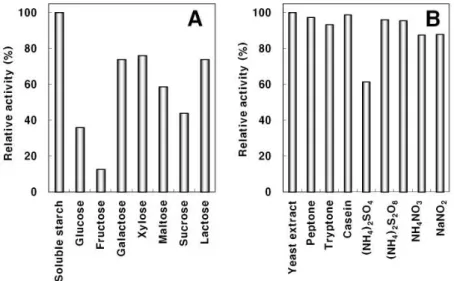
Fig. 4. Effects of various carbon (A) and nitrogen sources (B) on the production of extracellular protease by B. subtilis D14.
The bacteria were grown in protease producing media (1% soluble starch, 1.5% skim milk and 0.5% yeast extract, 2% NaCl) supplemented with 1.0% carbon and 0.5% nitrogen sources shown below the figure. The enzyme activity of the culture supernatant obtained from the supplemented media was calculated as a relative activity compared with that (14.2 Unit/mL) obtained by the protease producing media.
상관관계를 조사하여 작성한 phylogenetic tree 는 Fig. 3 과 같다 다른 . Bacillus sp. 균주들에 비하여 B. subtilis subsp.
균주에 가장 유전적으로 근연관계에 subtilis NCIB 3610
있음을 알 수 있었다 청국장으로부터 . B. subtilis 등의 Bacillus sp. 균주의 분리는 이미 보고된 바 있다 (7,11). 어떤 균주는 강력한 poly-gamma-glutamate 를 생산하기도 하며
어떤 균주는 혈전용해 기능을 가지고 있다 현재
(7) (11).
본 연구에서 분리한 균주가 이러한 생리활성을 가지고 있는 지에 대하여는 현재 연구 중에 있다.
B. subtilis
D14에 의한 세포외protease의 생산B. subtilis D14 의 protease 활성에 미치는 탄소원의 영향 을 조사하기 위하여 protease 생산 배지에 각종 탄소원의 최종 농도가 1% 가 되게 첨가하여 37 ℃ 에서 150 rpm 으로
시간 배양하여 활성을 측정하였다 그 결과 실험
24 protease .
에 사용한 탄소원 중에서 soluble starch 를 1% 첨가한 경우에 활성이 가장 높았으며 그 외의 탄소원들을 첨가한 protease
경우에는 활성이 낮게 나타났다 특히 . fructose 를 첨가한 경우에 protease 활성이 대조구의 12.7% 로서 가장 낮게 나 타났으며 glucose 의 첨가구에서도 약 35.9% 로서 다른 탄소 원에 비하여 활성이 낮게 나타났다 또한 . fructose 와 glucose 복합체인 sucrose 를 첨가한 경우에도 그 활성이 낮았으며 그 다음으로 maltose 를 첨가한 경우 활성이 낮게 나타나
및 에 의한 의 생산이 억제됨을 짐작
fructose glucose protease
할 수 있으나 이에 대하여는 후속 연구가 필요한 것으로 판단된다 (Fig. 4A). Protease 생산 배지에 각종 질소원의 최 종 농도가 0.5% 가 되게 첨가하여 균을 배양한 후 상징액의 활성을 측정한 결과 실험에 사용한 질소원 중에서 protease
첨가구의 경우 대조구의 약 로서 가장 낮은
soytone 61.4%
수준의 활성을 나타내었다 그 외 . peptone, casein, tryptone 등의 유기태 질소원이나 암모늄염 및 질산염 형태의 무기태 질소원을 사용한 경우에는 유사한 수준의 효소 활성을 나타 내었다(Fig. 4B).
요 약
우리나라 전통발효식품의 하나인 청국장으로부터 고 비 활성 세포외 protease 생산능이 우수한 균주를 분리하고 그 특성을 조사하였다 분리된 균주 중 . D14 균주 배양 상징 액의 protease 활성이 15.2 U/mL 로서 가장 강하였으며 비활 성 또한 40.0 U/mg protein 으로서 가장 강하게 나타났다 . 이 균주의 특성을 조사한 후 Bergey's Manual of Systematic
에 준하여
Bacteriology Bacillus subtilis로 동정하였다 균주 .
의 염기서열을 분석하여
D14 16S rDNA B. subtilis subsp.
subtilis NCIB 3610 균주와 99.9% 의 상동성을 가짐을 확인 하였다 또한 . 16S rDNA 의 염기서열을 토대로 계통분석을 통하여 다른 Bacillus sp. 의 균주들보다 NCIB 3610 균주와 유전적으로 매우 가까운 관계에 있음을 확인하였다.
는 사용한 탄소원 중 가장 높은 수준의 Soluble starch
생산능을 보였으나 단당류 이당류 등은 모두 효소
protease ,
생산능에 대하여 저해효과를 나타내었다 특히 . fructose 를 첨가한 경우에는 12.7%, glucose 를 첨가한 경우에는 35.9%
수준의 효소 생산능을 나타내었다 질소원의 경우는 .
의 첨가구에서 대조구에 비하여 약 수준의
soytone 61.4%
효소활성을 나타내어 저해효과가 가장 높았으며 다른 질소 원은 효소 생산에 크게 영향을 미치지 않았다.
참고문헌
1. National Rural Living Science Institute, R.D.A. (1996) Food Composition Table, 5, 324-325
2. Kim, S.Y. and Kim, W.U. (1967) Studies on the changes of protein, peptide and amino acid during preparation.
Korean J. Agric. Chem., 8, 11-20
3. Kim, J.G., Kim, S.K. and Lee, J.S. (1988) Fatty acid composition and electrophoretic patterns of protein of Korean soy beans. Korean J. Food Sci. Technol., 20, 263-271
4. Landers, R.E. and Rathmann, D.M. (1981) Vegetable oils:
Effect of processing storage and use on nutritional values.
J. Am. Oil Chem., 58, 255-259
5. Onishi, R., Keiko, A., Seiichi, H. and Ko, A. (1987) Studies on a viscous substance of the natto. Nippon Kasei Gakkaishi., 10, 871-875
6. Lee, Y.L., Kim, S.H., Choung, N.H. and Yim, M.H.
(1992) A study on the production of viscous substance during Chungkookjang fermentation J. Korean Soc.
Agric. Chem. Soc., 35, 202-209
7. Ashiuchi, M., Kamei, T., Baek, D.H., Shin, S.Y., Sung, M.H., Soda, K. Yagi, T. and Misono, H. (2001) Isolation of Bacillus subtilis (chungkookjang), a poly-gamma- glutamate producer with high genetic competence. Appl.
Microbiol. Biotechnol., 57, 764-769
8. Lee, B.Y., Kim, D.M. and Kim, K.H. (1991) Physico-chemical properties of viscous substance extracted from Chungkookjang. Korean J. Food Sci.
Technol., 23, 500-506
9. Lee, J.O., Ha, S.D., Kim, A.J., Yuh, C.S., Bang, I.S.
and Park, S.H. (2005) Industrial application and physiological function of Chongkukjang. Food Sci. Ind., 38, 69-78
10. Heo, S., Lee S.K. and Joo H.K. (1998) Isolation and identification of fibrinolythic bacteria from Korean traditional Chungkookjang. Agric. Chem. Biotechnol., 41, 119-124
11. Kim, W.K., Choi, K.H., Kim, Y.T., Park, H.H., Choi, J.Y., Lee, Y.S., OH, H.I., Kwon, I.B. and Lee, S.Y. (1996) Purification and characterization of fibrinolytic enzyme produced from Bacillus sp. strains CK11-4 screened from chungkookjang. Appl. Environ. Microbiol., 62, 2482-2488
12. Kim, N.Y., Song, E.J., Kwon, D.Y., Kim, H.P. and Heo, M.Y. (2008) Antioxidant and antigenotoxic activities of Korean fermented soybean. Food Chem. Toxicol., 46, 1184-1189
13. Yoon, K.D., Kwon, D.J., Hong, S.S., Kim, S.I. and Chung, K.S. (1996) Inhibitory effect of soybean and fermented soybean products on the chemically induced mutagenesis. Korean J. Appl. Microbiol. Biotechnol., 24, 525-528
14. Choi, Y.H., Lim, H., Heo, M.Y., Kwon, D.Y. and Kim, H.P. (2008) Anti-inflammatory activity of the ethanol extract of Chungkukjang, Korean fermented bean:
5-lipoxygenase inhibition. J. Med. Food, 11, 539-543 15. Kim, D.J., Jeong, Y.J., Kwon, J.H., Moon, K.D., Kim, H.J., Jeon, S.M., Lee, M.K., Park, Y.B. and Choi, M.S.
(2008) Beneficial effect of chungkukjang on regulating blood glucose and pancreatic beta-cell functions in C75BL/KsJ-db/db mice. J. Med. Food, 1, 215-223 16. Kwon, D.Y., Daily, J.W. 3rd, Kim, H.J. and Park, S.
(2010) Antidiabetic effects of fermented soybean
products on type 2 diabetes. Nutr. Res., 30, 1-13 17. Kim, J.I., Kang, M.J. and Kwon, T.W. (2003) Antidiabetic
effects of soybean and chungkookjang. Korean Soybean Digest., 20, 44-52
18. Yang, J.L., Lee, S.H. and Song, Y.S. (2003) Improving effect of powders of cooked soybean and chungkookjang on blood pressure and lipid metabolism in spontaneously hypertensive rats. J. Korean Soc. Food. Sci. Nutr., 32, 899-905
19. Choi, Y.B. and Sohn, H.S. (1998) Isoflavone content in Korean fermented and unfermented soybean foods.
Korean J. Food Sci. Technol., 30, 745-750
20. Naim, M., Gestetner, B., Bond, A. and Birk, Y. (1976) Antioxidative and antihemolytic activity of soybean isoflavones. J. Agric. Food Chem., 22, 806-810 21. Messina, M. and Messina, V. (1991) Increasing use of
soyfoods and their potential role in cancer prevention.
J. Am. Diet Assoc., 91, 836-841
22. Youn, K.C., Kim, D.H., Kim, J.O., Park, B.J., Yook, H.S., Cho, J.M. and Byun, M.W. (2002) Quality characteristics of the chungkookjang fermented by the mixed culture of Bacillus natto and B. licheniformis. J.
Korean Soc. Food Sci. Nutr., 31, 204-210
23. Lee, O.K., Ha, S.D., Kim, A.J., Yuh, C.S., Bang, I.S.
and Park, S.H. (2005) Industrial application and physiological functions of Chongkukjang. Food Sci. Ind., 38, 69-78 24. Godfrey, T. and Reichelt, J. (1983) Industrial enzymology : The application of enzyme in industry. The Nature's Press Co., Mercer, U.S.A., pp127-172
25. Peckman, E.V. (1951) Aspergillus protease. Biochemistry, 5, 321-325
26. Masaaki, Y., Kazuo, S. and Mitsuo, M. (1984) Purification and properties of acid protease from Monascus sp. No.
3405. Agric. Biol. Chem., 48, 1637-1645
27. Kageyama, K. (1955) Studies on Aspergillus oryzae strain for sake brewing. J. Ferment. Technol., 33, 53-57 28. Nunokawa, Y., Namba, Y. and Watanabe, S. (1961) A
study of the rice Koji protease. J. Soc. Brew., 53, 930-933 29. Kang, S.M., Cha, M.K., Kim, S.J. and Kwon, Y.J. (2006) The effect of quality improvement for wool and silk treated with protease produced by B. subtilis K-54. J.
Korean Soc. Cloth. Ind., 8, 239-244
30. Bruckner, R., Shoseyov, O. and Doi, R.H. (1990) Multiple active forms of a novel serine protease from B. subtilis. Mol. Gen. Genet., 221, 486-490
31. Molière, N. and Turgay, K. (2009) Chaperone-protease systems in regulation and protein quality control in
Bacillus subtilis. Res. Microbiol., 160, 637-644 32. Park, C.S., Min, D.K., Ahn, Y.S., Lee, J.H., Hong, S.K.,
Kim, J.H. and Kang, D.K. (2002) Isolation and characteristics of soy protein-degrading strain, Bacillus subtilis EB464. Korean J. Microbiol. Biotechnol., 30, 210-215
33. Ahn, Y.S., Kim, Y.S. and Shin, D.H. (2006) Isolation, identification and fermentation characteristics of Bacillus sp. with high protease activity from traditional Cheonggukjang. Korean J. Food Sci. Technol., 38, 82-87 34. Kim, D.Y., Lee, E.T. and Kim, S.D. (2003) Purification and characterization of fibrinolytic enzyme produced by Bacillus subtilis K7 isolated from Korean traditional soy sauce. J. Korean Soc. Agric. Chem. Biotechnol., 46, 176-182
35. Kim, K.P., Kim, N.H., Lee, C.H., Woo, C.J. and Bae, D.H. (2002) Isolation and characterization of protease producing bacteria from soil. J. Korean Soc. Food Sci.
Nutr., 31, 754-759
36. Cha, Y.J., Lee, K.H. and Chang, D.S. (1988) Characterization of the strong proteolytic bacteria isolated from low salt fermented anchovy and of protease produced by that strain. Bull. Korean Fish. Soc., 21, 71-79 37. Jung, H.K., Jeong, Y.S., Youn, K.S., Kim, D.I. and Hong, J.H. (2009) Quality characteristics of soybean paste (Doejang) prepared with Bacillus subtilis DH3 expressing high protease levels and deep-sea water. Korean J. Food Preserv., 16, 348-354
38. Jung, S.T., Kim, M.H., Shin, D.H. and Kim, Y.S. (2008) Isolation and identification of Bacillus sp. with high protease and amylase activity from Sunchang traditional Kochujang. Food Sci. Biotechnol., 17, 519-526 39. Murray, R.G.E., Brenner, D.J., Bryant, M.P., Holt, J.G.,
Kreig, N.R., Moulder, J.W., Pfenning, N., Sneath, P.H.A.
and Staley, J.T. (1986) Bergey's Mannual of Systematic Bacteriology, 2, 1104-1139
40. Sheehan, D. and Hrapchak, B. (1980) Theory and practice of histotechnology. Battelle Press, Columbus, U.S.A., pp.330-331
41. Knutton, S. (1995) Electron microscopical methods in adhesion. Method. Enzymol., 253, 145-158
42. Hayashi, H., Sakamoto, M. and Benno, Y. (2004) Evaluation of three different forward primers by terminal restriction fragment length polymorphism analysis for determination of fecal Bifidobacterium spp. in health subjects. Microbiol. Immunol., 48, 1-6
43. Sambrook, J. and Russell, D.W. (2001) Molecular
cloning, a laboratory manual, 3rd ed. Cold Spring Harbor Laboratory Press, Cold Spring Harbor, U.S.A., p.8.18-8.24
44. Bradford, M.M. (1964) A rapid and sensitive method for the quantitation of microorganism quantities of protein
utilizing the principle of protein-dye binding. Anal.
Biochem. 72, 248-254
45. Hull, M.E. (1974) Studies on milk proteins Ⅱ . Colorimetric determination of the partial hydrolysis of the proteins in milk. J. Dairy Sci., 30, 881-884
접수 년 월 일 수정 년 월 일 채택 년 월 일
( 2009 12 16 , 2010 5 20 , 2010 5 28 )