1)
†
To whom correspondence should be addressed.
National Institute of Agricultural Sciences, RDA E-mail: [email protected](Jinkwan, Son) E-mail: [email protected](Hongsik, Nam)
The Effect Analysis of Vegetation Diversity on Rice-Fish Mixed Farming System in Paddy Wetland
Minjae Kong・Changhyun Kim * ・Sangmin Lee・Kwanglai Park・Nanhee An・Junglai Cho・
Bongrae Kim
**・ Jongahk Lim
***・ Changwon Lee
****・ Hyeongsu Kim
*****・ Hongsik Nam
†・ Jinkwan Son
******,†Dept. of Agricultural Environment, National Institute of Agricultural Sciences, RDA
*
Department of Landscape Architecture, Dankook University
**
Company limited by shares, Jinsolwon
***
Jeollanam-do Ocean & Fisheries Science Institute
****
Jeollabuk-do Agricultural Research and Extension Services
*****
Inland Aquaculture Research Center, National Institute of Fisheries Science
******
Dept. of Agricultural Engineering, National Institute of Agricultural Sciences, RDA
벼-담수어 복합생태농업이 논습지 식생다양성에 미치는 영향 분석
공민재・김창현*
・이상민・박광래・안난희・조정래・김봉래
**・임종악
***・이창원
****・김형수
*****・남홍식
†・손진관
******,†농촌진흥청 국립농업과학원 농업환경부
*단국대학교 녹지조경학과
**진솔원
***전라남도 해양수산과학원
****전라북도 수산기술연구소
*****국립수산과학원 중앙내수면연구소 내수면양식연구센터
******농촌진흥청 국립농업과학원 농업공학부
(Received : 26 October 2018, Revised: 13 November 2018, Accepted: 13 November 2018)
Abstract
Organic farming practices including loach based ecosystem-farming have been demonstrated to be effective in conjunction with rice farming to increase yield and quality. This new form of farming combines agriculture and fishery and is quickly developing into a new industry. The current study investigated the effect of rice-fish mixed farming system on the vegetation-diversity function. Vegetation within the four study sites was surveyed and analyzed based on plant taxonomy. The vegetation survey demonstrated that 127 taxa of 38 families, 100 genera, 107 species, and 20 varieties occurred within the study sites. A total of 15 plant species taxa occurred in the rice-fish mixed paddy fields with a fish habitat and did not occur in the conventional paddy field lacking fish habitat. This difference is thought to arise from differences in moisture requirements for vegetation. Life form analysis demonstrated differences in hemicryptophytes, therophytes, and hydrophytes according to fish habitat. The naturalized plants identified were also determined to be species widely distributed throughout Korea. Frequency analysis demonstrated that the rice-fish mixed paddy fields with a fish habitat had a high ratio of both obligate and facultative wetland plants relative to the conventional paddy field. Based on the study results, it is likely that vegetation-diversity will increase with environment diversity. However, no statistical significance was observed according to paddy types. Future research should aim to identify additional environmental factors, including the existence of fish habitat, habitat area, depth of fish habitat, hydrological parameters, water quality, and paddy soil environment, to enhance vegetation-diversity and biocultural diversity.
Key words : Organic Rice, freshwater fish, Mixed ecological agriculture, Vegetation-Diversity
1. Introduction
Korea agriculture and rural areas is currently threatened by a number of factors, including decreased number of full-time farmers, an aging population, and reduction of farmland scale.
To tackle these problems, a range of measures are currently being implemented, including: expanding welfare in rural areas, training new farmers, increasing farm income, controlled- environment agriculture, alternative crop cultivation, and reviving rural economies (Park et al., 2016; Woo et al., 2018;
Han et al., 2017; You, 2001; Shin, 2016; Choi and Hwang, 2013). Beginning in the first decade of the 21st century, the Korea rice industry has been problems by shrinking consumption (Kim et al., 2018).
Organic farming is considered an important alternative to conventional agriculture. This is due to the importance of sustainable development, income assurance, securing rice safety, environmental conservation, and recovery of natural ecosystems (An et al., 2012; Jung, 2000). Organic agriculture has brought many positive effects, including environmental conservation, increases in soil microbial composition, habitat for aquatic life, and improvement in soil physical properties. Although Korea is considered to have achieved remarkable advances in implementing organic farming practices, organic produce accounts for only 0.7% of total produce(Lee et al., 2010; An et al., 2012; Jung, 2007).
In recent years, organic farming has increased in practice across Korea. Ecosystem-farming using loach is highly valued, together with rice farming, for quality and nutritional value.
This new form of ecological farming combines agriculture and fishery and is rapidly emerging as a next-generation industry (Lee et al., 2014; RNIFS, 2015). Studies on rice-fish mixed farming system(RFMF) in Korea began with loach production in the early 2000s. Research is currently in progress in many cities across Korea including Namwon, Sanchung, Chungnam, Jeonbuk, Jeonnam, and Gyeongnam, using a wide range of
fish species. Nonetheless, few studies exist on rice-fish mixed farming system(RFMF) processes for rice and freshwater fish production.
Therefore, this study surveyed and analyzed vegetation diversity in the rice-fish mixed paddies of organic rice using freshwater fish, in an attempt to demonstrate ecological and environmental improvement, and to explore measures to improve vegetation-diversity.
2. Materials and methods
2.1 Study sites.
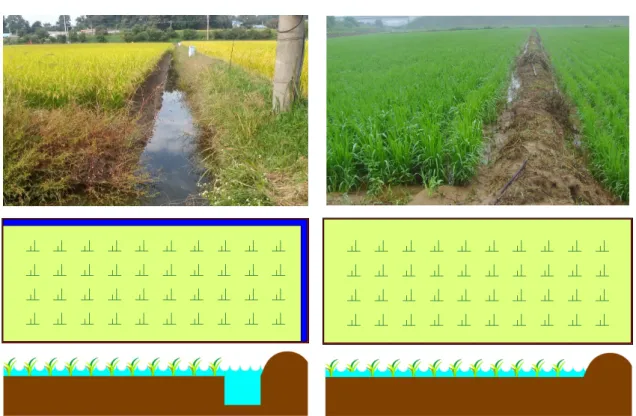
The study sites were organic rice farms based in Mundang-ri Hongdong-myun Hongsung Chungnam. The survey comprised four paddy fields. Rice-fish mixed farming system(RFMF) paddy fields(Catfish, Loach, Crucian) formed fishway-style fish habitats along the paddy levees, containing freshwater during the winter. The conventional paddy field was an organic paddy fields lacking fish habitat. It was left without reserved freshwater throughout the winter and was irrigated beginning in June for paddy management. Rice was grown using the pot seedling and transplantation method. In the organic rice-fish mixed paddies, rice was transplanted at the end of May to coincide with the entry of freshwater fish. Freshwater fish was put in the paddy fields in mid-June to facilitate the rooting of rice (Fig. 1).
2.2 Vegetation survey and analysis methods Flora and current vegetation in the four study sites were surveyed 5 times from May to September 2018. Scientific names of plants were identified using multiple pictorial books of flora (Lee, 1993, 2006; Park, 2009; Lee, 1996, 2006; Lee, 2003).
A quadrat survey was 1*4m, 3times conducted using the Braun-Blanquet method (1964). The number of species was counted according to plant taxonomy including family, genus, species, and variety. Life forms were classified into therophytes,
요 약
최근 유기농법이 확산되며 벼농사와 더불어 맛과 영양소 측면에서 월등하게 높은 가치를 평가받는 미꾸리를 활용한 생태농법이 농업과 어업이 결합된 차세대 산업으로 급부상하고 있는 추세이다. 본 연구는 복합생태농업이 식생다양성 기능에 미치는 영향을 알아보기 위해 수행하였다. 연구방법은 식생조사를 통한 식물학적 분류를 통해 분석하였다. 전체 연구대상지에서 식생조사 결과 38과 100속 107종 20변종 127종류가 출현하였다. 둠벙이 있는 복합생태논에서는 출현하였으나 둠벙이 없는 대조논에서 출현하지 않은 종은 총 15종류(Taxa)의 차이로 확인되어 둠벙의 유무에 따라 식생의 수분요구도 차이로 나타난 결과로 판단된다. 또한 생활형 분석결과 둠벙의 유무에 따라 접지, 일년생, 수생식물의 차이도 확인되었다. 출현한 귀화식물도 전국적으로 널리 분포하는 종으로 분석되었다. 습지출현빈도 분석결과 둠벙이 있는 복합생태논이 대조논에 비해 절대습지식물과 임의습지식물의 비율이 높게 나타났다. 본 연구결과 생육환경이 다양할수록 식생다양성은 높아질 것으로 판단된다. 하지만 유형별 통계적 유의성은 확인되지 않아 식생다양성 및 생물다양성 증진을 위해서 향후 둠벙의 유무, 면적, 둠벙의 깊이, 수문, 수질환경, 토양환경 등 다양한 환경적 요인 찾는 추가적인 연구가 필요하다고 판단된다.
핵심용어 : 유기농 벼, 담수어, 복합생태농업, 식생다양성
hydrophytes, hemicryptophytes, chamaephytes, geophytes, nanophanerophytes, and megaphanerophytes according to Raunkiær's classification (1934), and their ecological differences were examined. Naturalized plants were analyzed according to 321 taxa, the standard given by Lee et al. (2011).
Degree of naturalization (ND), introduced period (Int-p), life form (LF), naturalized ratio (NR), urbanization index (UI), and origin (Orig) were calculated to investigate the development characteristics of naturalized plants according to types (Kariyama and Kobatake, 1998; Park, 2002; Numata, 1996;
Yim and Jeon, 1980). Frequency was classified according to the vascular plant standards of the Center for Aquatic Ecosystem Restoration (2012). Collected data was analyzed through ANOVA using the SPSS (WIN 19.0) program to demonstrate the difference in varying vegetation types, and to explore improvement measures.
3. Results and Discussion
3.1 Analysis of vegetation characteristics
The numbers of species in each study site are presented in Appendix 1. The results showed that a total of 127 taxa from 38 families, 100 genera, 107 species, and 20 varieties occurred across all study sites. By the number of species, 24 plants were from the family Gramineae (18.9%); 20 from Compositae (15.7%), 9 from Polygonaceae (7.1%), 8 from Cyperaceae (6.3%), 6 from Cruciferae and Scrophulariaceae (4.7%), 5 from Leguminosae (3.9%), 5 from Caryophyllaceae (3.9%), and 4 from Labiatae (3.1%).
Plants from Gramineae and Compositae dominated all four study sites. Thus, the flora of the study sites was similar to that of the conventional agriculture and rural villages, where
Mixed farming system paddy field Conventional paddy field
Fig. 1. The cross section of two rice paddy fields.
Table 1. Analysis of the vegetation classification methods.
Analysis Method Explanation
Taxanomic Quotation The classification of family, generic, species, forma, variety, subspecies, taxa
Life form Raunkiær(1934) The classification of Nanophanerophytes, Megaphanerophytes, Chamaephytes, Hemicryptophytes, Geophytes, Hydrophytes, Therophytes
Naturalized Ratio
× N1:Number of survey species,
N2:Number of naturalized plant species in korea, n :Number of naturalized plant species.
Urbanization Index
×
Gramineae and Compositae plants are dominant (Kang and Son, 2011; Son et al., 2012).
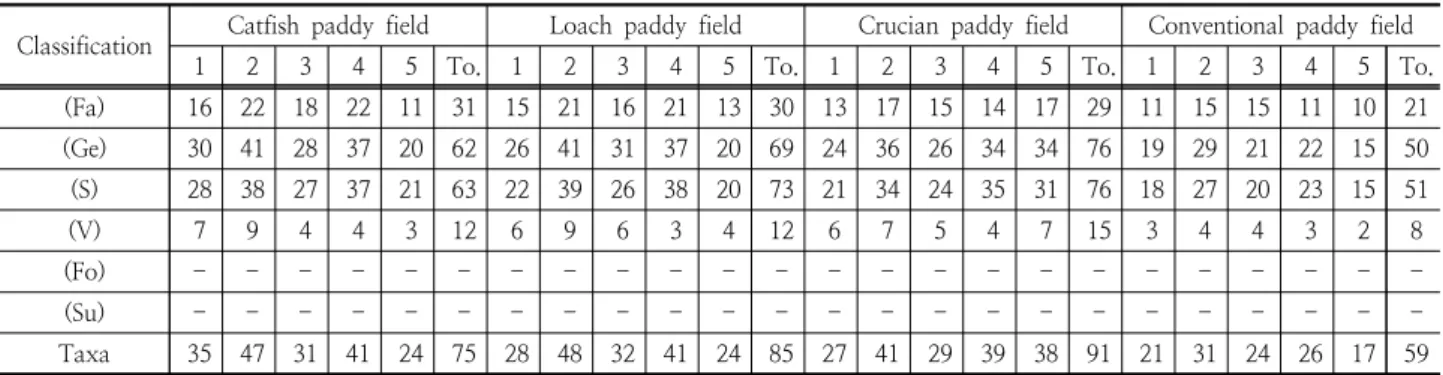
In the vegetation analysis according to RFMF types (Table 2), the numbers of plant species in the catfish paddy field were 75 taxa of 31 families, 62 genera, 63 species, and 12 varieties; 85 taxa of 30 families, 69 genera, 73 species, and 12 varieties in the loach paddy field. The largest diversity of vegetation occurred in the crucian paddy field, with a total of 91 taxa of 29 families, 76 genera, 76 species, and 15 varieties.
Conversely, the least diverse vegetation occurred in the conventional paddy field without any fish habitat. 59 taxa of 21 families, 50 genera, 51 species, and 8 varieties.
Species commonly occurring across all study sites were:
11 plants of the family Gramineae, 6 of Compositae, 4 of Polygonaceae, 4 of Caryophyllaceae, 2 of Lemnaceae, and 1 each of Oxalidaceae, Pontederiaceae, and Ranunculaceae, totaling 39 taxa. Of these, the ratios of Artemisia princeps var. orientalis, Persicaria thunbergii, Persicaria hydropiper, Digitaria sanguinalis, Oenanthe javanica, Humulus japonicus, and Trifolium repens were high.
On the other hand, 15 taxa occurred in the catfish, loach, and crucian paddy fields with a fish habitat but not in the conventional paddy field lacking fish habitat. Identified species include Juncus effusus var. decipiens, Bidens frondosa, Ixeris japonica, Youngia japonica, Taraxacum officinale, Lactuca
indica var. laciniata, Commelina communis, Acalypha australis, Oenothera odorata, Setaria glauca, and Trigonotis peduncularis.
This is thought to be the result of differences in moisture requirements for vegetation in fish habitats.
Life form analysis (Table 4) identified: 2 megaphanerophytes, 2 nanophanerophytes, 6 geophytes, 1 chamaephytes, 44 hemicryptophytes, 62 therophytes, and 10 hydrophytes.
Life form frequency was analyzed according to a RFMF model. Life form frequencies within catfish, loach, and crucian paddy fields with a fish habitat were: 0.4±0.6 megaphanerophytes, 0.1±0.4 nanophanerophytes, 1.4±0.7 geophytes, 0.9±0.3 chamaephytes, 11.9±3.7 hemicryptophytes, 17.3±4.3 therophytes, and 2.9±2.0 hydrophytes. Life form frequencies within conventional paddy fields were: 1.6±1.3 geophytes, 1.0 chamaephytes, 7.8±2.2 hemicryptophytes, 11.2±2.7 therophytes, and 2.2±1.1 hydrophytes. Differences between the rice-fish mixed paddy fields and the conventional paddy field were approximately: 4.1 hemicryptophytes, 6.1 therophytes, and 0.7 hydrophytes. A difference in hemicryptophyte, therophytes, and hydrophytes, depending on the existence of a fish habitat, was observed. Hydrophytes occurring in all study sites were:
Spirodela polyrhiza, Leersia japonica, Monochoria vaginalis var. plantaginea, Lemna paucicostata, and Zizania latifolia.
This is identified as the most typical type of paddy vegetation in summer paddy fields growing rice across Korea (Kim and
Table 2. The number of taxa surveyed at four investigation sites
Classification Catfish paddy field Loach paddy field Crucian paddy field Conventional paddy field
1 2 3 4 5 To. 1 2 3 4 5 To. 1 2 3 4 5 To. 1 2 3 4 5 To.
(Fa) 16 22 18 22 11 31 15 21 16 21 13 30 13 17 15 14 17 29 11 15 15 11 10 21 (Ge) 30 41 28 37 20 62 26 41 31 37 20 69 24 36 26 34 34 76 19 29 21 22 15 50 (S) 28 38 27 37 21 63 22 39 26 38 20 73 21 34 24 35 31 76 18 27 20 23 15 51
(V) 7 9 4 4 3 12 6 9 6 3 4 12 6 7 5 4 7 15 3 4 4 3 2 8
(Fo) - - - - - - - - - - - - - - - - - - - - - - - -
(Su) - - - - - - - - - - - - - - - - - - - - - - - -
Taxa 35 47 31 41 24 75 28 48 32 41 24 85 27 41 29 39 38 91 21 31 24 26 17 59
* Fa : Family, Ge : Generic, S : Species, V : Variety, Fo : Forma, Su : Subspecies, To. : Total.
Table 3. Life form analysis at organic and conventional farming sites.
Classification Catfish paddy field Loach paddy field Crucian paddy field Conventional paddy field
1 2 3 4 5 To. 1 2 3 4 5 To. 1 2 3 4 5 To. 1 2 3 4 5 To.
(M) - - - - - - - 1 - 1 - 2 - - 1 1 2 2 - - - - - -
(N) - - - 1 - 1 - - - - - - - - - - 1 1 - - - - - -
(G) 1 2 2 3 1 4 1 2 1 2 1 3 1 2 1 1 - 3 1 3 3 1 - 4
(CH) 1 1 1 1 1 1 1 1 1 1 - 1 1 1 1 1 1 1 1 1 1 1 1 1
(H) 15 18 7 13 6 26 10 16 10 10 10 28 13 18 8 12 13 35 7 11 6 9 6 21 (Th) 16 22 16 19 14 38 14 26 15 21 13 43 12 18 12 23 19 41 10 14 10 14 8 28
(HH) 2 4 5 4 2 5 2 2 5 6 - 8 - 2 6 1 2 8 2 2 4 1 2 5
* M : Megaphanerophytes, N: Nanophanerophytes, G : Geophytes, CH : Chamaephytes, H : Hemicryptophytes, Th : Therophytes,
HH. : Hydrophytes.
Nam, 1998). In no-till farming, a larger diversity of plants along with more perennial plants were present compared to tillage (Kwon et al., 2002; Lee et al., 1998). Likewise, the ratio of therophytes was high in all study sites, likely due to tillage conducted in preparation for rice production.
3.2 Analysis of the characteristics of naturalized plants
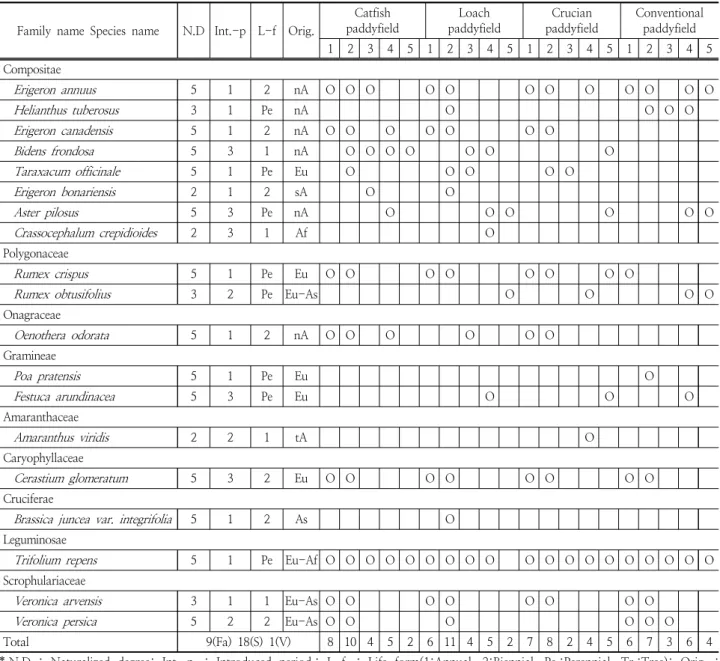
In the analysis of naturalized plant characteristics, a total of 19 taxa representing 9 families, 15 genera, 18 species, and 1 variety were observed (Table 4). Among the 19 taxa of naturalized plants observed, 8 taxa of Compositae (42.1%) recorded the highest ratio, which is similar to the study of
Park et al. (2012). In addition, the largest number of naturalized plants occurred in June during the survey period.
Degrees of naturalization were: 3 taxa of 2 degree (15.8%) and 3 taxa of 3 degree (15.8%) with the highest number of 13 taxa of 5 degree (68.4%). Plants with higher degrees tend to be more widespread (Park et al., 2002). Naturalized plants occurring in this study are considered to be species widely throughout Korea. In the analysis of naturalized ratio and urbanization index (Table 5), the naturalized ratio for the catfish paddy field was 16.0%, the loach paddy field 20.0%, and the crucian paddy field 14.3%. The rice-fish mixed paddy field naturalized ratio was average 16.8%, while the conventional paddy field showed a naturalized ratio of 18.6%, higher than
Table 4. Naturalized plants at organic and conventional farming site.*.
Family name Species name N.D Int.-p L-f Orig.
Catfish paddyfield
Loach paddyfield
Crucian paddyfield
Conventional paddyfield 1 2 3 4 5 1 2 3 4 5 1 2 3 4 5 1 2 3 4 5 Compositae
Erigeron annuus 5 1 2 nA O O O O O O O O O O O O
Helianthus tuberosus 3 1 Pe nA O O O O
Erigeron canadensis 5 1 2 nA O O O O O O O
Bidens frondosa 5 3 1 nA O O O O O O O
Taraxacum officinale 5 1 Pe Eu O O O O O
Erigeron bonariensis 2 1 2 sA O O
Aster pilosus 5 3 Pe nA O O O O O O
Crassocephalum crepidioides 2 3 1 Af O
Polygonaceae
Rumex crispus 5 1 Pe Eu O O O O O O O O
Rumex obtusifolius 3 2 Pe Eu-As O O O O
Onagraceae
Oenothera odorata 5 1 2 nA O O O O O O
Gramineae
Poa pratensis 5 1 Pe Eu O
Festuca arundinacea 5 3 Pe Eu O O O
Amaranthaceae
Amaranthus viridis 2 2 1 tA O
Caryophyllaceae
Cerastium glomeratum 5 3 2 Eu O O O O O O O O
Cruciferae
Brassica juncea var. integrifolia 5 1 2 As O
Leguminosae
Trifolium repens 5 1 Pe Eu-Af O O O O O O O O O O O O O O O O O O O
Scrophulariaceae
Veronica arvensis 3 1 1 Eu-As O O O O O O O O
Veronica persica 5 2 2 Eu-As O O O O O O
Total 9(Fa) 18(S) 1(V) 8 10 4 5 2 6 11 4 5 2 7 8 2 4 5 6 7 3 6 4
* N.D : Naturalized degree; Int.-p. : Introduced period.; L-f. : Life-form(1:Annual, 2:Biennial, Pe.:Perennial, Tr.:Tree); Orig. :
Origin(nA.:north America, sA.:south America, tA.:tropical America, As.:Asia, tAs.:tropical Asia, Eu.:Europe, Eu-As.:Europe-Asia,
Eu-Af.:Europe-Africa).
that of the rice-fish mixed paddies. The urbanization index of the rice-fish mixed paddies was 4.4%, and that of conventional paddy 3.4%. These values represent high urbanization indices within the study sites.
In agreement with the results of Choi et al. (2008), the naturalized ratio was demonstrated to increase in the presence of human intervention. Naturalized plants had a high ratio within all study sites. Naturalized plants adapt better to the environment relative to native species. Therefore, continual management is needed, as these species will be dominant (Son et al., 2015; Lee et al., 2011).
3.3 Analysis of the characteristics of wetland plants In the frequency analysis, a total of 127 taxa were represented.
Obligate wetland plants constituted 16 of the identified taxa (12.6%), 19 taxa were facultative wetland plants (15.0%), 8
taxa were facultative plants (6.3%), 6 taxa were facultative upland plants (4.7%), 75 taxa were obligate upland plants (59.1%), and cultivated species represented 3 taxa (2.4%).
Obligate upland plants demonstrated the highest ratio.
127 taxa were identified as summer-green plants whose leaves sprout in the spring and drop in fall. The ratios of obligate and facultative wetland plants were higher in the rice-fish mixed paddy fields with a fish habitat relative to conventional paddy fields without a fish habitat.
Habitat analysis for the 127 taxa identified was as follows.
3 taxa occurred in the forest habitat which is formed with the growth of trees, 80 taxa occurred in meadow and shrublands which are dry habitats consisting of shrubs and herbs, 27 taxa occurred in wet meadows consisting of herbs where the underground water runs close to the ground, 14 taxa occurred in an aquatic environment comprised of aquatic plants, and
Table 5. Comparison of naturalized ratio and urbanization index of different organic farming sites and conventional farming site.
Classification Catfish paddy field Loach paddy field Crucian paddy field Conventional paddy field
1 2 3 4 5 To. 1 2 3 4 5 To. 1 2 3 4 5 To. 1 2 3 4 5 To.
PT 35 47 31 41 24 75 28 48 32 41 24 85 27 41 29 39 38 91 21 31 24 26 17 59
NP 8 10 4 5 2 12 6 11 4 5 2 17 7 8 2 4 5 13 6 7 3 6 4 11
NR(%) 22.9 21.3 12.9 12.2 8.3 16.0 21.4 22.9 12.5 12.2 8.3 20.0 25.9 19.5 6.9 10.3 13.2 14.3 28.6 22.6 12.5 23.1 23.5 18.6 UI(%) 2.5 3.1 1.2 1.6 0.6 3.7 1.9 3.4 1.2 1.6 0.6 5.3 2.2 2.5 0.6 1.2 1.6 4.0 1.9 2.2 0.9 1.9 1.2 3.4
* PT : Plant Taxa, NP : Naturalized Plant, NR : Naturalized Ratio, UI : Urbanization Index.
Table 6. Plant frequencies at organic farming and conventional farming sites.
Classification Catfish paddy field Loach paddy field Crucian paddy field Conventional paddy field
1 2 3 4 5 To. 1 2 3 4 5 To. 1 2 3 4 5 To. 1 2 3 4 5 To.
OBW 5 8 8 7 3 10 4 5 7 9 - 12 2 3 7 2 4 12 3 5 6 2 2 9
FACW 5 6 9 11 7 14 5 8 10 9 5 15 1 5 6 10 11 14 5 5 3 6 2 11
FAC 2 2 1 - - 2 1 3 2 3 - 5 3 4 3 3 2 7 2 2 2 - - 4
FACU 2 2 1 - 2 3 2 2 2 1 2 3 2 3 - 2 - 5 1 1 1 2 2 3
OBU 20 28 12 23 12 45 16 29 10 19 17 48 19 26 12 22 20 51 10 18 12 16 11 32
1 1 1 - - - 1 - 1 1 - - 2 - - 1 - 1 2 - - - - - -
Total 35 47 31 41 24 75 28 48 32 41 24 85 27 41 29 39 38 91 21 31 24 26 17 59
* OBW : Obligate wetland plant, FACW : Facultative wetland plant, FAC : Facultative plant, FACU : Facultative upland plant, OBU : Obligate upland plant, 1 : Cultivated species.
Table 7. Plant habitats at organic and conventional farming sites.
Classification Catfish paddy field Loach paddy field Crucian paddy field Conventional paddy field
1 2 3 4 5 To. 1 2 3 4 5 To. 1 2 3 4 5 To. 1 2 3 4 5 To.
Fo - - - 1 - 1 - - - - - - - 1 - - 1 2 - - - - - -
Md 23 31 14 22 14 48 18 32 13 21 19 53 22 29 13 25 19 56 12 20 14 18 13 36
Wm 7 8 10 12 8 17 7 12 12 12 5 20 4 9 8 12 14 21 6 7 5 6 2 16
Ae 4 7 7 6 2 8 3 3 6 8 - 10 1 2 7 2 3 10 3 4 5 2 2 7
1 1 1 - - - 1 - 1 1 - - 2 - - 1 - 1 2 - - - - - -
Total 35 47 31 41 24 75 28 48 32 41 24 85 27 41 29 39 38 91 21 31 24 26 17 59
* Fo : Forest, Md: Meadow and shrubland, Wm : Wet meadow, Ae : Aquatic environment, 1 : Cultivated species.
3 taxa were cultivated species.
The habitat ratio of dry habitat meadow and shrubland was generally high. In the wet meadow growth environment, the frequencies of plant taxa occurrence were 9.0±2.0 in the catfish paddy field; 9.6±3.4 in the loach paddy field; and 9.4±3.8 in the crucian paddy field. In contrast, 5.2±1.9 taxa occurred in the conventional paddy field, with a difference of approximately 3.8-4.4 taxa. These results suggest that vegetation-diversity will be greater in a diverse growth environment.
3.4 Statistical analysis of study sites
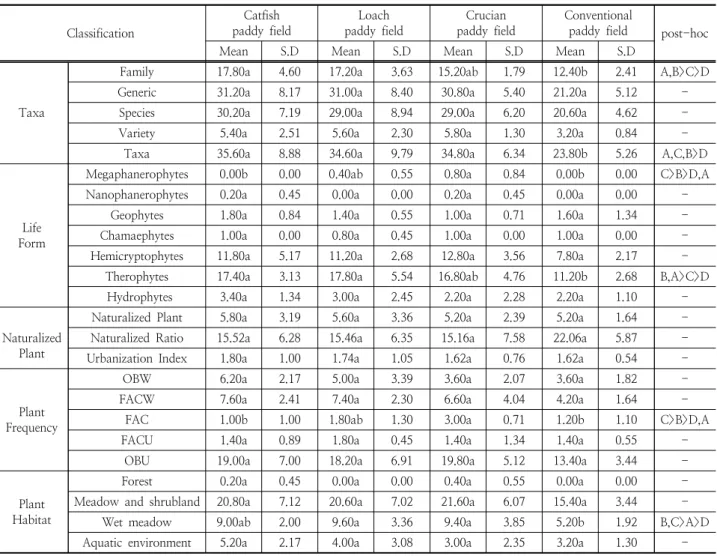
ANOVA analysis was conducted based on the data collected from the four study sites (Table 8). The results of ANOVA based on the number of species in vegetation showed that 34.60±9.79-35.60±8.88 taxa occurred in the catfish, loach, and crucian paddy fields with a fish habitat, whereas 23.80±5.26 taxa occurred in the conventional paddy field without a fish habitat. A difference of approximately 10.8-11.8 taxa was observed, but the results were not statistically significant. Similar patterns were observed in life form and
naturalized plant analyses. In the analysis of number of wetland species, a statistically significant difference was observed for facultative plants across study sites, at a 95% significance level.
This difference did not occur as a result of fish habitat, however, and was likely due to differences in freshwater fish species (catfish, loach, and crucian). Additional research will be necessary to uncover the underlying cause.
The ratio of vegetation occurrence was generally high in the rice-fish mixed paddy fields, but in general did not represent statistically significant differences. Further research is required to identify additional environmental factors, including the existence of fish habitat, habitat area, depth of fish habitat, hydrological parameters, water quality, and environment of paddy soil, in order to enhance vegetation- and bio-cultural diversity.
4. Conclusion
Organic farming practices including loach-based ecosystem- farming have been demonstrated to be effective in conjunction with rice farming. This new agricultural practice, which
Table 8. Statistical analysis of study sites (ANOVA).
Classification
Catfish paddy field
Loach paddy field
Crucian paddy field
Conventional
paddy field post-hoc
Mean S.D Mean S.D Mean S.D Mean S.D
Taxa
Family 17.80a 4.60 17.20a 3.63 15.20ab 1.79 12.40b 2.41 A,B>C>D Generic 31.20a 8.17 31.00a 8.40 30.80a 5.40 21.20a 5.12 - Species 30.20a 7.19 29.00a 8.94 29.00a 6.20 20.60a 4.62 - Variety 5.40a 2.51 5.60a 2.30 5.80a 1.30 3.20a 0.84 -
Taxa 35.60a 8.88 34.60a 9.79 34.80a 6.34 23.80b 5.26 A,C,B>D
Life Form
Megaphanerophytes 0.00b 0.00 0.40ab 0.55 0.80a 0.84 0.00b 0.00 C>B>D,A Nanophanerophytes 0.20a 0.45 0.00a 0.00 0.20a 0.45 0.00a 0.00 -
Geophytes 1.80a 0.84 1.40a 0.55 1.00a 0.71 1.60a 1.34 - Chamaephytes 1.00a 0.00 0.80a 0.45 1.00a 0.00 1.00a 0.00 - Hemicryptophytes 11.80a 5.17 11.20a 2.68 12.80a 3.56 7.80a 2.17 -
Therophytes 17.40a 3.13 17.80a 5.54 16.80ab 4.76 11.20b 2.68 B,A>C>D Hydrophytes 3.40a 1.34 3.00a 2.45 2.20a 2.28 2.20a 1.10 -
Naturalized Plant
Naturalized Plant 5.80a 3.19 5.60a 3.36 5.20a 2.39 5.20a 1.64 - Naturalized Ratio 15.52a 6.28 15.46a 6.35 15.16a 7.58 22.06a 5.87 - Urbanization Index 1.80a 1.00 1.74a 1.05 1.62a 0.76 1.62a 0.54 -
Plant Frequency
OBW 6.20a 2.17 5.00a 3.39 3.60a 2.07 3.60a 1.82 -
FACW 7.60a 2.41 7.40a 2.30 6.60a 4.04 4.20a 1.64 -
FAC 1.00b 1.00 1.80ab 1.30 3.00a 0.71 1.20b 1.10 C>B>D,A
FACU 1.40a 0.89 1.80a 0.45 1.40a 1.34 1.40a 0.55 -
OBU 19.00a 7.00 18.20a 6.91 19.80a 5.12 13.40a 3.44 -
Plant Habitat
Forest 0.20a 0.45 0.00a 0.00 0.40a 0.55 0.00a 0.00 - Meadow and shrubland 20.80a 7.12 20.60a 7.02 21.60a 6.07 15.40a 3.44 -
Wet meadow 9.00ab 2.00 9.60a 3.36 9.40a 3.85 5.20b 1.92 B,C>A>D Aquatic environment 5.20a 2.17 4.00a 3.08 3.00a 2.35 3.20a 1.30 -
* A : Catfish paddy field;, B : Loach paddy field, C : Crucian paddy field, D : Conventional paddy field.
combines agriculture and fishery, represents a next-generation approach to organic farming. Unfortunately, few studies have been performed to determine the ecological impacts of RFMF.
This study surveyed and analyzed the vegetation-diversity in RFMF paddy fields growing organic rice using freshwater fish.
The results demonstrate an improved growth environment, with improved vegetation-diversity.
In the vegetation survey of the four study sites, 127 taxa of 38 families, 100 genera, 107 species, 20 varieties occurred.
Plants of families Gramineae and Compositae were dominant in all four study sites. 15 taxa occurred only in the catfish, loach, and crucian paddy fields with a fish habitat and not in the conventional paddy field lacking fish habitat. This is likely due to differences in the moisture requirement of vegetation. Life form analysis frequency demonstrated a difference in hemicryptophytes, therophytes, and hydrophytes by fish habitat. 19 taxa of naturalized plants comprising 9 family, 15 genera, 18 species and 1 variety were identified to be distributed across Korea.
The ANOVA analysis of plant species numbers by paddy types demonstrated that 34.60±9.79 ~ 35.60±8.88 of taxa occurred in the catfish, loach, and crucian paddy fields with a fish habitat, whereas 23.80±5.26 taxa occurred in the conventional paddy field without any fish habitat. The difference in number of species was approximately 10.8-11.8 taxa, but the difference was not statistically significant. As for the number of wetland species, a statistical significance was observed for facultative plant type between study sites at a 95% significance level. This difference did not arise as a result of fish habitat, however.
This study was conducted to investigate the effect of RFMF on paddy wetland vegetation-diversity. Although there was a difference in vegetation-diversity according to fish habitat, no statistical significance was observed. Further research will be required to identify additional environmental factors including existence of fish habitats, habitat area, depth of fish habitat, hydrological parameters, water quality, and environment of paddy soil in order to enhance vegetation- diversity and biodiversity.
Acknowledgement
This work was carried out with the support of "Cooperative Research Program for Agriculture Science & Technology Development (Project No. PJ012684)" Rural Development Administration, Republic of Korea
References
Ahn, I, Park, JS, Kim, SH, Maeng, WY and Lee, IE (2012).
Comparative Analysis of Technical System by Six Organic Rice Cultivation Type in the Southern Provinces,
Korean J.
of organic agriculture
, 20(4) : 535-542.[Korean Literature][DOI http://dx.doi.org/10.11625/KJOA.2012.20.4.535]
Braun-Blanquet, J (1964). Pflanzensoziologie. Grundzuge der Vegetationskunde.
Springer-Verlag
, New York.Center for Aquatic Ecosystem Restoration(CAER) (2012).
Categorizing vascular plant species occurring in wetland ecosystems of the Korean peninsula.
Choi, GL, Jo, YM, Sim, JG, Guk, YI, and Shin, DY (2008).
Naturalized plants in the area of Bonghwa mountain in Suncheon.
Published in the fall academic conference of the Plant Resources Society of Korea
, 94-94.1. [Korean Literature]Choi, YJ and Hwang, JI (2013). A Study on the Welfare Service for Rural Elderly,
The Korea Society of Community Living Science Conference Catalog
, pp. 130-130.[Korean Literature]Han, KH, Cho, HJ, Cho, HR, Lee, HS, Ok, JH, Seo, MJ, Jung, KH, Zhang, YS and Seo, YH (2017). Effects of Alternative Crops Cultivation on Soil Physico-chemical Characteristics and Crop Yield in Paddy Fields,
Korean J. of Environmental Agriculture
, 36(2): 67-72.[Korean Literature][DOI https://doi.org/10.5338/KJEA.2017.36.2.11]Jung, M.C (2007) Analysis of Economic Effects and Distribution Structure for Environment-friendly Rice's Production,
Korean J. of organic agriculture
, 15(1) : 43-58.[Korean Literature]Kang, BH, Son, JK (2011). The Study on the Evaluation of Environment Function at Small Stream -In the Case of Hongdong Stream in Hongsung gun,
J. of Korea Society of Environmental Restoration Technology
, 14(5), pp.81-101. [Korean Literature]
Kim, JJ, Cho, NW, and Kim, JI (2018). New government rice industry policy supply and demand forecast,
Korea Rural Economic Institute and other research reports
, pp.401~421.[Korean Literature]
Kim, JW and Nam, HY (1998). Syntaxomical and Synecological Characteristics of Rice Field Vegetation,
Korea J. Ecol
, 21(3), pp. 203-215.[Korean Literature]Kwon, OD, Kuk, YI and Shin, HR (2002). Ecological Variation of Rice and Weeds in Direct Seeding on Flooded Paddy Surface of No-Tillage,
Kor. J. Weed. Sci
, 22(2), pp.100-107.[Korean Literature]
Lee TB (2003).
Illustrated flora of Korea
. Hyangmunsa.[Korean Literature]Lee, CB (1993, 2006).
Coloured Flora of Korea
. Hyangmunsa.[Korean Literature]Lee, ST, Lee, YH, Kim, ES, and Song, WD (2010). Influence of Cultivated Regions for Rice Organic Farming,
Proceedings of the 2010 Conference of the Korean Journal of Soil Science and Fertilizer,
Korean J. of Soil Science and Fertilizer
, pp.103.[Korean Literature]Lee, WH, Choi, CD, Won, JG, Kim, CR, Choi, BS, and Yeo, SK (1998). Characteristics of growth and weed occurrence in no-tillage rice culture,
Book of research papers on edible plants
, 40, pp. 1-6. [Korean Literature]Lee, YM, Park, SH, Jung, SY, Oh, SH and Yang JC (2011).
Study on the current status of naturalized plants in South Korea.
Korean J. Pl. Taxon
. 41(1), pp. 87-101. [Korean Literature]Lee, YN (1996, 2006).
New flora of Korea
. Gyohaksa.[Korean Literature]Numata, M (1996).
Landscape Ecology
. Asakura Shoten.[Japanese Literature]
Park SH (2009).
New illustrations and photographs of naturalized plants of Korea
, pp. 1-575, Ilchokak, Korea.[Korean Literature]Park, SH, Park, MH, Uhm, JY, Lim, JE, Lim, KS, Lim, HB, and Jang, JC (2016). A strategy to increase farm income through community activation,
Policy Research Report, Korea Rural Economic Institute
, pp. 1-199. [Korean Literature]Park, SH, Shin, JH, Lee, YM, Lim, JH and Moon, JS. (2002).
Distributions of naturalized alien plants in Korea.
KFRI research bulletin No. 193
, Korea forest research institute/Korea national arboretum Ukgo Press Seoul, Korea.Raunkiær, C (1934).
The life forms plants and statistical plant geography
, Clarendon Press. Oxford.RNIFS (2015).
Technology development of eco-culture by using paddy field
. [Korean Literature]Shin, DC (2016). Industrial Trend of Domestic and International Controlled Horticulture,
Horticulture abstracts
, 36.[Korean Literature]Son, JK, Kong, MJ, Kang, DH and Lee, SY. (2015). A study on the improvement of Ecosystem Service Function for the Protected Horticulture Complex in Agricultural Landscape.
J. of the Korean Society of Rural Planning
, 21(4), pp. 45-53. [Korean Literature]Son, JK, Kong, MJ, Kang, DH, Nam, HS and Kim, NC (2015).
The Comparative Studies on the Urban Park and Rural Landscape for the Improvement Ecosystem Service Function in Pond Wetland.
J. of Wetlands Research
, 17(1), pp. 62-74.[Korean Literature]Woo, B.J., Lee, H.Y. and Han, B.H. (2018).
Agricultural Structure and Farming Economy, How It's Changing?
, Korea Rural Economic Institute and other research reports, pp. 69~93. [Korean Literature]Yim, YJ and Jeon, ES (1980). Distribution of Naturalized Plants in the Korean Peninsula.
J. f Korean Botany
, 23(3-4).pp. 69-83. [Korean Literature]
You SO (2001). A Study on the Development of Rural Areas and Methods of Envrionmental Equipment according to Green Tourism,
J. of Rural Tourism
, 8(2), pp.32-56.[Korean Literature]