상호작용 이동통신 사용자에 대한 비직교 다중접속 시스템의 BER 성능 향상: ML 검출 관점
정규혁*
Improved BER Performance of Non-Orthogonal Multiple Access System for Interactive Mobile Users: Maximum Likelihood Detection Perspective
Kyu-Hyuk Chung*
요 약
5G 이동통신 네트워크에서, 비직교 다중접속은 채널 용량을 높일 수 있는 기술로 각광받고 있다. 비직교 다 중접속에서는, 다수 사용자가 채널 자원을 공유하여 신호를 동시에 전송 가능하다. 최근, 강 채널에 대해, 상호 작용 이동통신 사용자의 성능이 비상호작용 이동통신 사용자 비해, 저하되는 연구가 보고되었다. 본 논문에서
는, 이러한 문제를 해결하기 위해 ML 수신기를 제안한다. 먼저, ML 수신기의 BER의 폐쇄형 표현식을 유도
하고, 이상적인 완벽한 SIC 수신기의 BER과 비교하여, ML 수신기의 BER이 향상되었음을 보여준다. 또한,
이론적인 분석에 기초한 모의실험을 진행하고 ML 수신기의 성능 우수성을 입증한다.
ABSTRACT
In the fifth generation (5G) mobile networks, non-orthogonal multiple access (: NOMA) has been considered as a promising technology, to increase the channel capacity. In NOMA, the multiple users share the channel resources and multiplex simultaneously. Recently, for the stronger channel user, it was reported that the bit-error rate (: BER) performance with interactive mobile users is degraded, compared to the BER of non-interactive users. In this paper, in order to improve such degraded BER performance, we propose the maximum-likelihood (: ML) receiver. First, the closed-form expression for the BER of the ML receiver is derived, and then it is shown that the BER of the ML receiver is improved, compared with the BER of the ideal perfect successive interference cancellation (: SIC) receiver.
Additionally, based on the analytical expression, Monte Carlo simulations validates the above-mentioned results.
키워드
NOMA, Superposition coding, SIC, Power Allocation, Correlation Coefficient 비직교 다중 접속, 중첩 코딩, SIC, 전력 할당, 상관 관계 계수
* 교신저자 : 단국대학교 소프트웨어학과 ㆍ접 수 일 : 2020. 08. 20
ㆍ수정완료일 : 2020. 09. 17
ㆍReceived : Aug. 20, 2020, Revised : Sep. 17, 2020, Accepted : Oct. 15, 2020 ㆍCorresponding Author : Kyu-Hyuk Chung
Dept. Software Science, Dankook University,
Ⅰ. Introduction
Non-orthogonal multiple access (: NOMA) has received significant attention as a promising
technique for future fifth-generation (: 5G) radio multiple access (MA), owing to its superior spectral efficiency and low latency [1, 2], compared to orthogonal multiple access (: OMA) [3-5]. The key http://dx.doi.org/10.13067/JKIECS.2020.15.5.865
idea of NOMA is that signals from several users can share and multiplex the same channel resources and the power is allocated based on their channel conditions [6, 7]. At the receiving end, users with weaker channel gains treat other user's messages as interference when they decode their own messages, whereas users with better channel gains can eliminate other users' messages by applying successive interference cancellation (: SIC) before decoding their own messages [8]. Also, NOMA was combined with underwater visible light communication [9]. A modified NOMA scheme for a multi-antenna base station was considered, based on the absolute correlation coefficient between the channels [10]. The bit-error rate (: BER) performance for NOMA networks was investigated in [11]. The impact of local oscillator imperfection for NOMA was considered in [12].
Recently, the authors of this paper analyzed the BER performance for NOMA with correlated information sources (: CIS), and showed that for the weaker channel user, the BER of CIS is better than that of independent information sources (: IIS), whereas for the stonger channel user, the BER of CIS is worse than that of IIS [13]. Thus we try to improve the BER of the stronger channel user with CIS. In this paper, we propose the maximum-likelihood (: ML) receiver, instead of the ideal perfect SIC receiver. First, we derive the analytical expression for the BER of the ML receiver, and we show that the BER of the stronger channel user is improved. Additionally, Monte Carlo simulations validates the results.
The remainder of this paper is organized as follows. In Section II, the system and channel model are described. The analytical expression of the BER for NOMA with CIS is derived in Section III. The results are presented and discussed in Section IV. Finally, the conclusions are presented in Section V.
Ⅱ. System and Channel Model We consider a cellular downlink NOMA transmission system, in which two users are paired from a base station within the cell. The Rayleigh fading channel between the mth user and the base station is denoted by ∼, , where represents the distribution of circularly-symmetric complex Gaussian (: CSCG) random variable (: RV) with mean and variance
. The channels are sorted as . The base station transmits the superimposed signal
, where is the message for the mth user with unit power,
, where represents the expectation of RV , is the power allocation factor, with ≤ ≤ , and is the total allocated power. The correlation coefficient is
. Owing to correlation, the power of the superimposed signal is larger than . Therefore, for the constant total transmitted power
at the base station, is effectively scaled down [14]
(1)
where is the real part of a complex number
. It should be noted that for IIS, . The observation at the mth user is given by
(2)
where ∼ is additive white Gaussian noise (: AWGN). The notaion represents the distribution of Gaussian RV with mean and variance . For the interactive mobile users, a joint probability mass function (PMF) for CIS is given by [13]
(3)
Then, the correlation coefficient is calculated as [13]
(4)
In this paper, we assume the positive correlation,
, and the binary phase shift keying (: BPSK) modulation, ∈ , and to ensure the user fairness, we consider the power allocation range,
≤ . Then, if the perfect SIC is assumed, the received signal is given by
∣∣ (5)
Thus, the perfect SIC BER performance of the first user with CIS is simply that of the BPSK modulation, which is given by [13]
(6) And for second user, the optimal ML BER performance with CIS is given by [13]
(7)
where
(8)
For comparison, we include the BER for IIS, which, for the first user, is given by [13]
(9) and for second user, is given by [13]
(10)
It shoud be noted that
≤ (11)
whereas
≤ (12)
Thus, in this paper, we attempt to improve further the BER for the first user.
Ⅲ. BER Derivation for ML Receiver Based on the observation in the previous section, we propose the ML receiver, instead of the ideal perfect SIC receiver, for the first user. The likelihood for the first user is expressed as
∣ ∣
(13)
Based on the ML, the optimum detection is expressed as
argmax
∈
∣ ∣ (14) Then we solve the equal likelihood equation
∣ ∣ ∣ ∣ (15) which is given by
(16)
It should be noted that at ,
≃
(17) and
≃
(18)
Then, the one exact decision boundary and the two approximate decision boundaries are given by
± (19)
where
log
(20)
Then, the decision regions are given by
(21)
Thus, the average BER expression can be obtained by
∣
(22)
However, there is no analytical expression for the integration of the following form
(23) Therefore, we approximate as the average value
≃
log
(24)
Then, the approximate average BER can be expressed as
≃
(25)
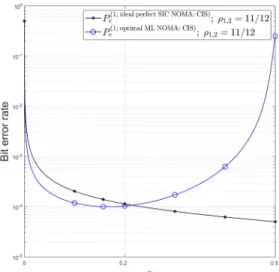
Fig. 1 Comparison of BER for IIS and CIS for
first user. Fig. 2 Comparison of BER for ideal perfect SIC receiver and proposed ML receiver for first user.
The above-mentioned approximation is validated by the BER obtained by Monte Carlo simulations in the next section.
Ⅳ. Results and Discussions
It is assumed that and , and
, (
). First, we consider the constant total transmitted signal power to noise power ratio (: SNR) dB. In Fig. 1, we depict the BER of the ideal perfect SIC receiver with IIS and CIS, to confirm the previous research results. As shown in Fig. 1, for the ideal perfect SIC receiver, the BER performance with CIS is worse than that with IIS. Therefore, in this paper, we improve the BER with CIS, by the ML receiver.
Second, the improved BER performance of the ML receiver is shown in fig. 2, compared to that of the ideal perfect SIC receiver, over the power allocation range, about . It should be
noted that for the power allocation range, about
, the ML receiver’s BER is worse than the ideal perfect SIC receiver’s BER, owing to the inter user interference. However, to ensure the user fairness in NOMA, the power allocation factor should be much less than about . In that case, the ML receiver outperforms the ideal perfect SIC receiver.
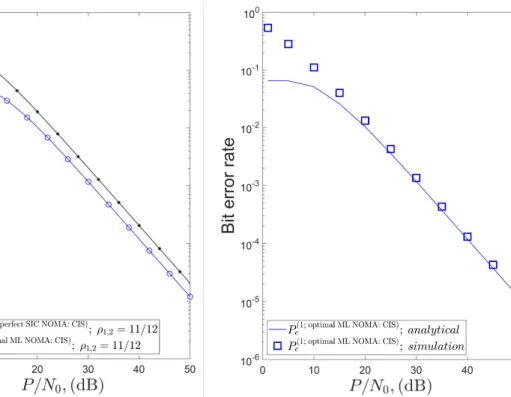
Third, to investigate the superiority of the ML receiver over the ideal perfect SIC receiver, we plot the BER versus the SNR, ≤≤ (dB), with the fixed power allocation, , in Fig. 3. As shown in Fig. 3, we observe the SNR gain of 3 dB at the BER of .
Lastly, we validate the approximated BER expression of the ML receiver by Monte Carlo simulations, in Fig. 4. As shown in Fig. 4, the Monte Carlo simulation results are well agreed with the approximate BER performance, except the low SNR, dB.
Fig. 3 Comparison of BER for ideal perfect SIC receiver and proposed ML receiver for first user.
Fig. 4 Comparison of BER for analytical expression and Monte Carlo simulation for first user.
Ⅴ. Conclusion
In this paper, we proposed the ML receiver for the stronger channel user in NOMA with CIS.
First, the analytical expression for the BER of the ML receiver was derived, and then it was is shown that the BER of the ML receiver is improved, compared with that of the ideal perfect SIC receiver. Additionally, based on the analytical expression, Monte Carlo simulations validated the improved BER performance.
References
[1] Y. Saito, Y. Kishiyama, A. Benjebbour, T.
Nakamura, A. Li, and K. Higuchi,
“Non-orthogonal multiple access (NOMA) for cellular future radio access,” in Proc. IEEE 77th Veh. Technol. Conf. (VTC Spring), Dresden, Germany, June 2013, pp. 1.5.
[2] Z. Ding, Y. Liu, J. Choi, Q. Sun, M. Elkashlan, C.-L. I, and H. V. Poor, ``Application of non-orthogonal multiple access in LTE and 5G networks,'' IEEE Commun. Mag., vol. 55, no. 2, Feb. 2017, pp. 185-191.
[3] M.-C. Yang, "An adaptive tone reservation scheme for PAPR reduction of OFDM signals," J. of the Korea Institute of Electronic Communication Sciences, vol. 14, no. 5, Oct.
2019, pp. 817-824.
[4] H.-J. Ahn and M.-C. Yang, "Analysis of Automatic Neighbor Relation Technology in Self Organization Networks of LTE," J. of the
Korea Institute of Electronic Communication Sciences, vol. 14, no. 5, Oct. 2019, pp. 893-900.
[5] K. Zhang and H.-J. Suh, "An analysis of multiuser diversity technology in the MIMO-OFDM system," J. of the Korea Institute of Electronic Communication Sciences, vol. 14, no. 6, Dec. 2019, pp. 1121-1128.
[6] L. Dai, B. Wang, Y. Yuan, S. Han, C.-L. I, and Z. Wang, "Non-orthogonal multiple access for 5G: Solutions, challenges, opportunities, and future research trends," IEEE Commun. Mag., vol. 53, no. 9, Sept. 2015, pp. 74-81.
[7] Q. Wang, R. Zhang, L.-L. Yang, and L. Hanzo,
"Non-orthogonal multiple access: A unified perspective," IEEE Wireless Commun., vol. 25, no. 2, Apr. 2018, pp. 10-16.
[8] D. Wan, M. Wen, F. Ji, H. Yu, and F. Chen,
"Non-orthogonal multiple access for cooperative communications: Challenges, opportunities, and trends," IEEE Wireless Commun., vol. 25, no. 2, May 2018, pp.
109-117.
[9] M. Jain, N. Sharma, A. Gupta, D. Rawal, and P. Garg, “Performance analysis of NOMA assisted underwater visible light communication system,” IEEE Wireless Commun. Lett., vol. 9, no. 8, Aug. 2020, pp.
1291-1294.
[10] Z. Sun, Y. Jing, and X. Yu, “NOMA design with power-outage tradeoff for two-user systems,” IEEE Wireless Commun. Lett., vol. 9, no. 8, Aug. 2020, pp. 1278-1282.
[11] M. Aldababsa, C. Göztepe, G. K. Kurt, and O. Kucur, "Bit error rate for NOMA network," IEEE Commun. Lett., vol. 24, no. 6, June 2020, pp. 1188-1191.
[12] A.-A.-A. Boulogeorg, N. D. Chatzidiamantis, and G. K. Karagiannid, "Non-orthogonal multiple access in the presence of phase noise," IEEE Commun. Lett., vol. 24, no. 5, May 2020, pp. 1133-1137.
[13] K. Chung, “Optimal Detection for NOMA
systems with correlated information sources of interactive mobile users,” J. of the Korea Institute of Electronic Communication Sciences, vol. 15, no.
4, Aug. 2020, pp. 651-657.
[14] K. Chung, "On power of correlated superposition coding in NOMA," J. Institute of Korean Electrical and Electronics Engineers, vol. 24, no. 1, Mar. 2019, pp. 360-363.
저자 소개
정규혁(Kyu-Hyuk Chung) 1997년 성균관대학교 전자공학과 졸업(공학사)
1998년 Univ. of Southern California 전기공학과 졸업(공학석사)
2003년 Univ. of Southern California 전기공학과 졸업 (공학박사)
2005년 ~현재 단국대학교 SW융합대학 소프트웨어학 과 교수
※ 관심분야 : 5G이동통신시스템, 비직교다중접속