Research Report
차광방법에 따른 고온기 절화용 스프레이 장미의 생장 및 절화 생산성
정동춘*, 이진재, 최창학, 송영주, 김희준, 정종성
전라북도농업기술원
Growth and Cut-Flower Productivity of Spray Rose as Affected by Shading Method during High Temperature Period
Dong-Chun Cheong
*, Jin-Jae Lee, Chang-Hak Choi, Young-Ju Song, Hee-Jun Kim, and Jong-Sung Jeong
Jeollabuk-do Agricultural Research and Extension Services, Iksan 570-704, Korea
Abstract: This experiment was carried out to investigate the effects of shading materials (aluminum specific-shading screen and polypropylene non-woven fabric) and shading ratio (50% and 70%) on climatic changes, cut-flower quality, and yield of spray rose cultivars for export during high temperature periods. The daily cumulative solar radiations were higher with the aluminum specific-shading screen, especially with 50% shading compared to polypropylene non-woven fabric. Air temperature and root zone temperature within rockwool media greatly decreased with the aluminum specific-shading screen, but relative air humidity was not different among shading methods. Chlorophyll contents (SPAD values) were slightly higher with aluminum-specific shading screen than with polypropylene non-woven fabric, and were higher with 50% than with 70% aluminum specific-shading screen.
Except for ‘Lovely Lydia’, marketable and exportable yields of all cultivars were higher with 50% than with 70% aluminum shading treatment. In addition, flower stalk length, stem diameter, number of node and 7 ea-leaflet, and floret number tended to be better with aluminum specific-shading screen. Flower stalk length was higher with 70% than with 50% aluminum shading treatment. Chromaticity of petals slightly increased, and vase life was 0.5-2.5 days longer for each cultivar with aluminum specific-shading screen than with polypropylene non-woven fabric.
Additional key words: aluminum specific-shading screen, chromaticity, exporting rose, polypropylene, vase life
*Corresponding author: [email protected]
※ Received 8 September 2014; Revised 2 December 2014; Accepted 3 December 2014.
Ⓒ 2015 Korean Society for Horticultural Science
서 언
국내 장미는 1990년대 양액재배 시스템 도입과 더불어 재 배면적이 늘어나면서 2006년 863ha까지 증가되었다가 난방 비용과 원자재 값 상승에 따른 경영비 증가와 장미꽃 소비 감소 등으로 점차 하향 안정화로 2013년 현재 352ha로 국화 에 이어 두 번째를 점유하고 있으나, 생산액은 786억원으로 절화류 중 가장 높은 비중을 차지하고 있다(MIFAFF, 2014).
수출액에 있어서도 주 수출국인 일본의 최근 경제 상황으로 인해 주춤하고 있지만, 2000년 이후 꾸준히 증가하여 2013 년 15,064천 달러 수출을 달성하였다(KITA, 2014). 한편 국
내 장미꽃 수요는 겨울철 특히 졸업, 입학 시즌에 가장 많고, 시장 가격도 높게 형성되기 때문에 2-3월 절화 생산을 목표 로 집중 관리되고 있다. 하지만 화훼 소비 패턴이 한 시기에 편중되는 예전과 달리 수요가 연중 지속적으로 유지되며, 수출 작목으로도 정착되기 위해서는 균일한 품질의 절화를 연중 안정적으로 생산하고 출하할 수 있는 주년 생산시스템 이 필요하다. 그런데 사계절이 뚜렷하여 겨울은 춥고 여름 에는 고온 다습한 우리나라 기후 조건에서는 제약조건이 많 다. 대부분 농가에서는 겨울철 난방비용을 절감하기 위해 보온 위주의 부직포를 2-3중으로 설치하여 철저히 대비하고 있으나, 여름철 강광, 고온에 대한 대책은 미흡한 실정이다.
여름철 재배는 고온과 강광에 의한 과도한 호흡, 증산 및 스트레스로 생육 불량, 상품성 저하 및 수량 감소로 이어져 차광이나 냉방 등 적극적인 재배방법이 요구된다. 하지만 장미 재배농가에 설치되어 있는 보온용 부직포는 차광 정도 가 심하여 일사량 부족과 더운 공기가 상층부로 빠져 나가 지 못하여 시설 내 온도 상승으로 줄기가 가늘어지고 소화 수가 적어지는 절화 품질 저하와 생산성 감소가 우려되고 있다. 지나친 차광은 광도가 낮아져 순광합성량 감소에 의 한 영양생장 부족으로 초장, 측지수, 엽장, 엽면적 및 건물중 등의 감소가 심하며, 결국에는 수량에까지도 영향을 미친다 (Brand, 1997; Cheong et al., 2005; Hong et al., 1996). 장미 는 광포화점이 800-1,000µmol・m-2・s-1로 광 요구도가 높고 주간 온도 25-27°C, 야간 16-18°C, 대기습도 60-70% 재배조 건에서 최고 생장량을 나타낸다(Hoog, 2001). 또한 장미 절 화 생산성은 식물체가 받는 수광량과 생육 온도에 의해 좌 우되는데(Kim et al., 2002; Kwon et al., 2007; Lee et al., 2001; Lee et al., 2004), 그에 따른 재배시설, 피복자재 및 차광 자재별로 생육 및 개화에 큰 차이를 나타낸다(Cheong et al., 2008; Chun et al., 2002). 따라서 본 연구는 절화용 스프레이 장미의 연중 안정적인 절화생산을 위하여 고온기 차광방법에 따른 기상 환경, 생육, 절화품질 및 절화 생산성 등을 조사하고자 수행하였다.
재료 및 방법
절화용 스프레이 장미 고온기 차광방법에 따른 생장 및 절화 생산성을 구명하고자 2011-2012년 2년 동안 전북농업 기술원(익산 소재) 단동형 polyethylene 플라스틱 하우스에 서 시험을 실시하였다. 시험재료로는 스프레이 계열의 품종 인 ‘Orange Jam’, ‘Fresh Night’, ‘Lovely Lydia’, ‘Ilsebronze’
와 ‘Bellina’의 삽목묘를 사용하였다. 차광방법은 폴리프로 필렌 부직포(100g・m-2)를 대조구로, 차광률 50%와 70% 알 루미늄 차광 전용 스크린을 1중 수평커튼 형태로 설치하였 다. 배지는 암면 slab(한국유알미디어, 한국, 크기-100 × 150
× 1,000mm)를 이용하였고, 2011년 5월 18일에 slab 당 6 주씩 2열로 정식하고, 8월 4일에 최종 절곡하고 아칭하여 재배하였다. 양액은 일사량에 따라 하루에 식물체 주당 280-600mL을 배액식으로 공급하였고, 급액 pH는 5.5-6.0, EC는 1.2-1.5dS・m-1이었으며, 나머지 관리방법은 표준 장미 재배법에 준하였다. 차광방법에 따른 7-9월 기상, 엽록소 함 량, 절화품질(품종별 절화장과 소화수 등)과 절화생산성(주
당 발생 줄기 수, 상품수량, 수출 가능한 수량)을 조사하였다.
기상은 데이터 로거(WatchDog 1450, Spectrum Technologies Inc, USA)를 이용하여 시간당 적산 일사량(Photosynthetically Active Radiation, PAR)을 조사하여 일일 최고와 적산 일사 량으로 나타냈고, 대기 온도, 근권 온도 및 대기 습도도 일 최고, 최저 및 평균으로 나타냈다. 차광방법별 엽온은 Spot thermometer(Minolta, Japan)를 이용하여 정단에서부터 첫 번째 5매 소엽의 상위 엽 중앙에서 측정하였다. 엽록소 함량 은 정단에서부터 첫 번째 5매 소엽의 상위 엽 중앙에서 Chlorophyll meter(SPAD 502, Minolta, Japan)를 이용하여 SPAD unit으로 나타냈다. 절화 품질과 생산성 및 꽃잎의 색 도는 2012년 7월과 9월에 절화작형에서 조사한 결과로 절화 품질(절화장, 소화수 및 경경 등)과 색도는 2작기 평균값으 로, 절화 생산성은 두 작기의 합으로 나타냈다. 상품수량은 2개 이상의 소화가 분화된 줄기의 수로, 수출 수량은 소화수 4개 이상이 분화된 줄기를 주당 본 수로 나타냈다. 꽃잎의 색도(Lab 값)는 만개한 소화의 바깥에서 3번째 잎을 색차계 (CT-300, Minolta, Japan)을 이용하여 측정하였다. 절화수명 은 수확한 절화를 증류수가 든 시험관에 꽂아 28°C로 조절 된 실험실에서 꽃목이 구부러지거나 꽃잎이 시들었을 때까 지로 조사하였다.
결과 및 고찰
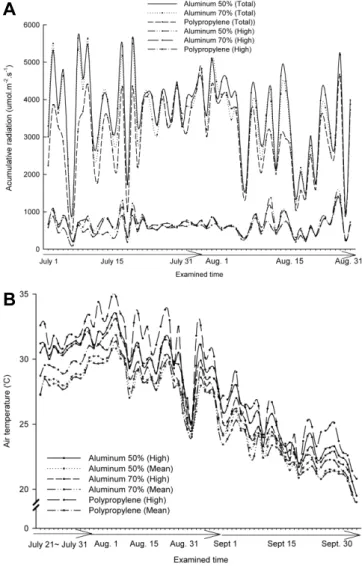
차광방법에 따른 일사량, 대기 온・습도 및 근권 온도를 조사한 결과 Fig. 1, 2와 같다. 시간당 최고 일사량과 일일 적산 일사량은 부직포 차광보다 알루미늄 차광 전용 스크린 처리에서 높았고, 70% 차광보다 50% 처리에서 더 높았다.
폴리프로필렌 부직포 처리는 m2당 100g 중량의 재질로서 농가 관행인 다겹이 아닌 1중 수평커튼 형태로 설치하였기 때문에 햇빛 투과가 대체로 많아 알루미늄 차광 전용 처리 와 큰 차이를 보이지 않았다. 농가에 설치된 부직포는 1년 정도 경과하면 결로, 과습 및 곰팡이 발생으로 차광 정도가 심해져 장미 생육에 부정적인 영향을 미친다. 대기와 근권 최고, 평균 온도는 알루미늄 차광 전용처리에서 낮았고, 50%
차광보다 70% 처리에서 더 낮은 경향이었으며, 대기 습도는 처리 간 차이가 없었다. 알루미늄 차광 전용 스크린은 상하 로 공기 이동이 자유로워 스크린이 닫혀 있어도 더운 공기 가 상층부로 빠져 나가기 때문에 부직포보다 대기와 근권 온도 모두 낮았다. 대기 습도의 경우는 시험을 수행한 시설 이 폭 6.5m 단동형 polyethylene 플라스틱 하우스로 측창을
A
B
Fig. 1. Changes of cumulative radiation (umol・m
-2・s
-1, A) and air temperature (B) within a plastic greenhouse as affected by shading method during the experimental period in 2012.
Aluminum 50%, 70% and polypropylene (high, mean, and total) represent high, mean, and total values observed within plastic greenhouse with 50%, 70% shading ratio of aluminum material and polypropylene (100 g・m
-2) non-woven fabric, respectively.
A
B
Fig. 2. Changes of root zone temperature (A) and relative air humidity (B) within a plastic greenhouse as affected by shading method during the experimental period in 2012.
Explanatory notes are explained in detail in the legend of Fig. 1.
개방하여 관리하였기 때문에 차광방법별로 큰 차이가 없었 던 것으로 생각된다. 농가 재배시설과 같은 1-2W 연동형 시 설의 경우 알루미늄 전용 차광 시설이 부직포가 설치된 시 설보다 온도와 습도 모두 낮았다(Cheong et al., 2013). 차광 방법별로 측정한 엽온은 부직포보다 알루미늄 전용 차광 처 리에서 높았고, 70% 차광보다 일사량이 높게 관리된 50%
차광처리에서 더 높았다(Fig. 3). 차광방법에 따른 시험품종 별 엽록소 함량(SPAD unit) 역시 알루미늄 차광 전용 스크 린 처리가 부직포보다 약간 높았으며, 70% 차광보다 50%
처리에서 더 높은 경향이었다(Fig. 4). 장미는 호광성 작물로 서 알루미늄 차광 전용 처리에서 일사량이 높게 관리되어 엽록소 함량도 높은 것으로 생각된다. 호광성인 안개초의 경우도 차광기간이 길수록 엽록소 함량(SPAD)이 높았고 (Cheong et al., 2005), 옥수수, 시금치, 상추, 배추 등에서도 차광률이 높을수록 엽록소 함량이 낮아진다고 하여(Hong et al., 1996) 본 시험과 유사한 결과를 보였다. 그러나 Kalmia latifolia(Brand, 1997)는 차광에 의해 엽록소 함량이 증가하 여 엽색이 진해진다고 하여 본 실험과는 다른 결과를 보였 다. 광도에 따른 엽록소 함량의 변화는 식물에 따라 다른 양상을 보이는데, 이는 식물의 종류별로 적응 광도가 다른 데서 오는 차이라고 할 수 있을 것이다(Cheong et al., 2005).
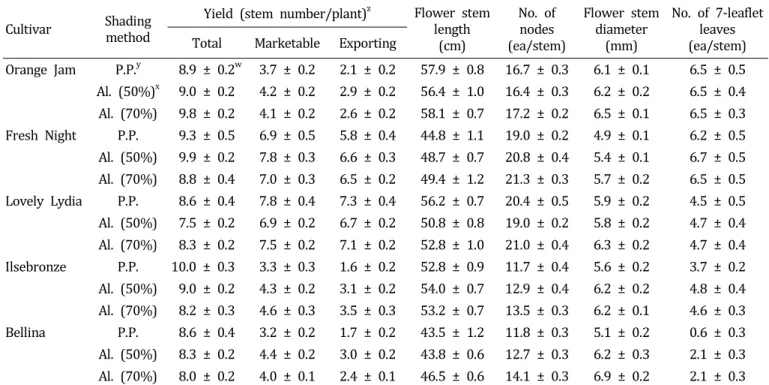
차광방법에 따른 품종별 7월과 9월 생산 작형에서 조사한 절화품질 및 생산성은 Table 1과 같다. 상품수량과 수출 가
Fig. 3. Leaf surface temperature as affected by shading materials and ratio. Temperature was investigated on the upper leaves of the first 5-leaflet from shoot apex. Error bars represent standard error of mean (n = 20-24). Shading material and ratio are explained in detail in the legend of Fig. 1.
Table 1. Yield and cut flower characteristics of spray cultivars as affected by shading method.
Cultivar Shading method
Yield (stem number/plant)
zFlower stem length
(cm)
No. of nodes (ea/stem)
Flower stem diameter
(mm)
No. of 7-leaflet leaves (ea/stem) Total Marketable Exporting
Orange Jam P.P.
y8.9 ± 0.2
w3.7 ± 0.2 2.1 ± 0.2 57.9 ± 0.8 16.7 ± 0.3 6.1 ± 0.1 6.5 ± 0.5 Al. (50%)
x9.0 ± 0.2 4.2 ± 0.2 2.9 ± 0.2 56.4 ± 1.0 16.4 ± 0.3 6.2 ± 0.2 6.5 ± 0.4 Al. (70%) 9.8 ± 0.2 4.1 ± 0.2 2.6 ± 0.2 58.1 ± 0.7 17.2 ± 0.2 6.5 ± 0.1 6.5 ± 0.3 Fresh Night P.P. 9.3 ± 0 .5 6.9 ± 0 .5 5.8 ± 0 .4 44.8 ± 1.1 19.0 ± 0 .2 4.9 ± 0 .1 6.2 ± 0 .5 Al. (50%) 9.9 ± 0.2 7.8 ± 0.3 6.6 ± 0.3 48.7 ± 0.7 20.8 ± 0.4 5.4 ± 0.1 6.7 ± 0.5 Al. (70%) 8.8 ± 0.4 7.0 ± 0.3 6.5 ± 0.2 49.4 ± 1.2 21.3 ± 0.3 5.7 ± 0.2 6.5 ± 0.5 Lovely Lydia P.P. 8.6 ± 0 .4 7.8 ± 0 .4 7.3 ± 0 .4 56.2 ± 0 .7 20 .4 ± 0 .5 5.9 ± 0 .2 4.5 ± 0 .5 Al. (50%) 7.5 ± 0.2 6.9 ± 0.2 6.7 ± 0.2 50.8 ± 0.8 19.0 ± 0.2 5.8 ± 0.2 4.7 ± 0.4 Al. (70%) 8.3 ± 0.2 7.5 ± 0.2 7.1 ± 0.2 52.8 ± 1.0 21.0 ± 0.4 6.3 ± 0.2 4.7 ± 0.4 Ilsebronze P.P. 10.0 ± 0.3 3.3 ± 0.3 1.6 ± 0.2 52.8 ± 0.9 11.7 ± 0.4 5.6 ± 0.2 3.7 ± 0.2 Al. (50 %) 9.0 ± 0 .2 4.3 ± 0 .2 3.1 ± 0 .2 54.0 ± 0 .7 12.9 ± 0 .4 6.2 ± 0 .2 4.8 ± 0 .4 Al. (70%) 8.2 ± 0.3 4.6 ± 0.3 3.5 ± 0.3 53.2 ± 0.7 13.5 ± 0.3 6.2 ± 0.1 4.6 ± 0.3 Bellina P.P. 8.6 ± 0.4 3.2 ± 0.2 1.7 ± 0.2 43.5 ± 1.2 11.8 ± 0.3 5.1 ± 0.2 0.6 ± 0.3 Al. (50%) 8.3 ± 0.2 4.4 ± 0.2 3.0 ± 0.2 43.8 ± 0.6 12.7 ± 0.3 6.2 ± 0.3 2.1 ± 0.3 Al. (70%) 8.0 ± 0.2 4.0 ± 0.1 2.4 ± 0.1 46.5 ± 0.6 14.1 ± 0.3 6.9 ± 0.2 2.1 ± 0.3
z
Total yield includes two harvesting times (July and Sept.) in 2012, marketable and exporting yield were investigated as stem numbers differentiating over two and four florets per stem, respectively.
y
One layer of polypropylene non-woven fabric.
x
One layer of 50% shading ratio aluminum material.
w
Mean ± standard error (n = 20-45).
Fig. 4. SPAD values of experimental cultivars as affected by shading method. The upper leaves of the first 5-leaflet from shoot apex were monitored. Error bars represent standard error of mean (n = 10 ). Notes are explained in detail in the legend of Fig. 1.
능한 수량은 ‘Lovely Lydia’를 제외한 나머지 시험품종 모두 알루미늄 차광 전용 처리에서 높았으며, 특히 50% 차광처리 에서 더 우수한 결과를 보였다. 절화장, 경경, 마디수 및 7매 엽수도 부직포보다 알루미늄 전용 차광처리에서 우수하였으
며, 절화장은 50% 차광보다 일사량이 약간 낮게 관리된 70%
처리에서 높은 경향이었다. 알루미늄 차광 전용 스크린에서 일사량이 많고 근권 온도가 낮아 소화 분화가 많아 상품수
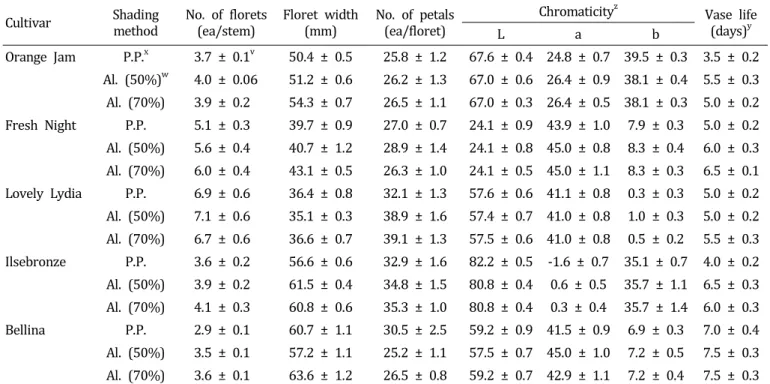
Table 2. Floret characteristics and vase life of spray cultivars as affected by shading method.
Cultivar Shading
method No. of florets
(ea/stem) Floret width
(mm) No. of petals (ea/floret)
Chromaticity
zVase life (days)
yL a b
Orange Jam P.P.
x3.7 ± 0.1
v50.4 ± 0.5 25.8 ± 1.2 67.6 ± 0.4 24.8 ± 0.7 39.5 ± 0.3 3.5 ± 0.2 Al. (50%)
w4.0 ± 0.06 51.2 ± 0.6 26.2 ± 1.3 67.0 ± 0.6 26.4 ± 0.9 38.1 ± 0.4 5.5 ± 0.3 Al. (70%) 3.9 ± 0.2 54.3 ± 0.7 26.5 ± 1.1 67.0 ± 0.3 26.4 ± 0.5 38.1 ± 0.3 5.0 ± 0.2 Fresh Night P.P. 5.1 ± 0.3 39.7 ± 0.9 27.0 ± 0.7 24.1 ± 0.9 43.9 ± 1.0 7.9 ± 0.3 5.0 ± 0.2 Al. (50%) 5.6 ± 0.4 40.7 ± 1.2 28.9 ± 1.4 24.1 ± 0.8 45.0 ± 0.8 8.3 ± 0.4 6.0 ± 0.3 Al. (70%) 6.0 ± 0.4 43.1 ± 0.5 26.3 ± 1.0 24.1 ± 0.5 45.0 ± 1.1 8.3 ± 0.3 6.5 ± 0.1 Lovely Lydia P.P. 6.9 ± 0.6 36.4 ± 0.8 32.1 ± 1.3 57.6 ± 0.6 41.1 ± 0.8 0.3 ± 0.3 5.0 ± 0.2 Al. (50%) 7.1 ± 0.6 35.1 ± 0.3 38.9 ± 1.6 57.4 ± 0.7 41.0 ± 0.8 1.0 ± 0.3 5.0 ± 0.2 Al. (70%) 6.7 ± 0.6 36.6 ± 0.7 39.1 ± 1.3 57.5 ± 0.6 41.0 ± 0.8 0.5 ± 0.2 5.5 ± 0.3 Ilsebronze P.P. 3.6 ± 0.2 56.6 ± 0.6 32.9 ± 1.6 82.2 ± 0.5 -1.6 ± 0.7 35.1 ± 0.7 4.0 ± 0.2 Al. (50%) 3.9 ± 0.2 61.5 ± 0.4 34.8 ± 1.5 80.8 ± 0.4 0.6 ± 0.5 35.7 ± 1.1 6.5 ± 0.3 Al. (70%) 4.1 ± 0.3 60.8 ± 0.6 35.3 ± 1.0 80.8 ± 0.4 0.3 ± 0.4 35.7 ± 1.4 6.0 ± 0.3 Bellina P.P. 2.9 ± 0.1 60.7 ± 1.1 30.5 ± 2.5 59.2 ± 0.9 41.5 ± 0.9 6.9 ± 0.3 7.0 ± 0.4 Al. (50%) 3.5 ± 0.1 57.2 ± 1.1 25.2 ± 1.1 57.5 ± 0.7 45.0 ± 1.0 7.2 ± 0.5 7.5 ± 0.3 Al. (70%) 3.6 ± 0.1 63.6 ± 1.2 26.5 ± 0.8 59.2 ± 0.7 42.9 ± 1.1 7.2 ± 0.4 7.5 ± 0.3
z
Investigated on the third petal from outer of floret in full blooming.
y
Examination carried out in 28°C controlled room from July 28 in 2012.
x,w
See Table 1.
v
Mean ± standard error (n = 3-12).
량 및 수출 가능한 수량이 높고 절화장 등 절화 품질이 우수 하였던 것으로 생각된다. 장미는 광포화점이 높은 호광성 작물로서 신초 발생수는 동화지의 크기, 즉 엽면적과 일사 량의 영향이 지배적이며(RDA, 2001), 일사량(photosynthetic photon flux density, PPFD)과 장미 절화량 및 절화품질은 정의 상관관계가 있고(Bredmore, 1997), 장미 재배시설에 따른 절화 생산성은 일반 유리온실보다 적산 일사량이 높게 관리된 1-2W 연동형 polyethylene 플라스틱 하우스에서 상 품수량과 수출 가능한 수량이 높았다는 보고(Cheong et al., 2012) 등과 동일한 결과로 생각된다.
차광방법별로 소화특성과 절화 수명을 조사한 결과는 Table 2와 같다. 소화수와 소화폭은 ‘Lovely Lydia’를 제외 한 나머지 시험품종 모두 알루미늄 차광 전용 처리에서 우 수한 경향이었으며, 꽃잎수는 뚜렷한 경향을 보이지 않았다.
신초수와 소화수 증진은 적절한 일사량 확보가 중요하기 때 문에(Kim and Lieth, 2012) 일사량이 높은 알루미늄 차광 전 용 처리에서 소화수가 많았던 것으로 생각된다. 화색의 명 도와 채도를 나타내는 L, a 및 b값은 차광방법별로 차이를 보여 부직포보다 알루미늄 차광 전용 처리에서 a, b값이 약
간 높게 조사되었다. a, b값이 클수록 채도가 높아 색상이 선명한데 차광 전용 스크린을 설치함으로써 화색이 더 선명 해짐을 알 수 있었다. 절화 수명은 실내 온도 28°C로 일정하 게 조절하여 조사한 결과 부직포보다 알루미늄 차광 전용 스크린 처리에서 품종별로 0.5-2.5일 정도 더 길었다. 이는 알루미늄 차광 전용 처리가 일사량이 높고 근권 온도가 낮 아 전체적인 식물체 활력이 높고 꽃대 줄기가 굵어 물올림 이 우수하였기 때문으로 생각된다.
이상의 결과 기후 온난화와 이상 기후에 대응하고 연중 안정적인 장미 절화생산을 위해서 차광률 50%의 차광 전용 알루미늄 스크린을 적어도 1중 수평커튼으로 설치하는 것이 시설 내 일사량 확보와 온도 및 습도 유지에 적합한 것으로 판단된다.
초 록
수출용 스프레이 장미 차광방법(차광률 50%와 70% 알루 미늄 차광 전용 스크린 및 부직포)에 따른 고온기 기상환경, 절화품질 및 생산성을 조사하였다. 차광방법에 따른 일일
최고와 적산 일사량은 부직포보다 알루미늄 전용 차광에서 높았고, 70%보다 50% 차광처리에서 더 높았다. 대기온도 및 근권 온도는 부직포보다 알루미늄 전용 차광에서 낮았고, 차광률 70%에서 더 낮은 경향이었으며, 대기습도는 처리 간 차이가 없었다. 엽온과 엽록소 함량(SPAD)은 알루미늄 차 광, 특히 50% 차광처리에서 약간 더 높았다. 차광방법별 상 품수량 및 수출가능 수량은 ‘Lovely Lydia’를 제외한 시험품 종 모두가 알루미늄 차광처리에서 높았으며, 특히 50% 차광 처리에서 더 높았다. 절화장, 경경 및 마디 수, 7매 엽수, 소 화수 및 소화폭도 알루미늄 차광처리에서 우수하였다. 절화 장의 경우는 50%보다 70% 알루미늄 차광처리에서 더 우수 한 경향이었다. 꽃잎 색도의 경우 부직포 차광보다 알루미 늄 차광처리에서 a, b값이 증가하였고, 절화 수명도 품종에 따라 0.5-2.5일 더 길었다.
추가 주요어 : 알루미늄 전용 차광 스크린, 색도, 수출장미, 폴리프로필렌, 절화수명