¶ Corresponding Author: Tae-Kyun Na, Dept. of Hotel Culinary Arts, Doowon Technical University, 159, Jurawi-gil, Paju-eup, Paju-si, Gyeonggi-do 10838, South Korea, Tel. +82-31-935-7351, Fax. +82-31-935-7297, E-mail: [email protected]
Culinary Science & Hospitality Research. 2016;22(1):141-152.
https://cshr.jams.or.kr/ ISSN 2466‐0752 (Print) ISSN 2466‐1023 (Online)
Development of the Instructional Design Guideline utilizing Goal-based Scenario for Culinary Practice Education
Beom-Seok Ko1 and Tae-Kyun Na2
1Dept. of Hotel & Food Service Industry, Daegu Health College, Korea
2¶Dept. of Hotel Culinary Arts, Doowon Technical University, Korea
ABSTRACT: Recently, not only development of curriculum associated directly with job, the development of new education model is in great need. So, the purpose of this study is to develop the instructional design guideline utilizing goal-based scenario(GBS) for college students who major in culinary arts. First, to achieve this goal, we recognized the 7 core elements(learning goal, mission, cover story, role activity, scenario operating, resource, feedback) composing GBS through literature review and case study. Second, we drew a conclusion about the problem and guideline for traditional culinary practice course by con- ducting inspection about culinary practice environment and needs with professors who are teaching culi- nary arts. Third, we applied the instructional design guideline for culinary practice to regular classes ac- cording to GBS’s factors, and then we did formative evaluation with content experts and educational technology expert. Finally, we designed the final instructional design guideline for culinary practice by modifying early model reflected the result of formative evaluation. The results of this study are as following. First, when we applied GBS to culinary practice, professors have to focus on process of material- ization by developing easy scenario to students. Also, they have to prepare the class circumstance to feel about sense of realism in advance. Second, to give a conjugally new skill at working, professors’s effort is important. culinary practice education at college has responsibility to carry out the vocational training that has competitiveness and difference with labor market’s needs. Therefore, it is necessary for us to develop the teaching and learning model for culinary practice which is suitable for major based on the manpower demand for industry without causing job mismatch from demand for industry.
Keywords: goal-based scenario, instructional design, guideline, culinary practice, culinary major
INTRODUCTION
Today, Korea’s college education market changed into oversupplied market because of decreasing number of new student due to reduction in the number of students and increasing number of uni- versity. In order to cope with this education circum- stance change and survive, it is necessary to have an interest and focus on qualitative improvement of education[1]. In this context, college education is
emphasizing on improving teaching method to get an employment competency of learner, reflecting change of industry and needs of learner. And col- lege education is pulling in both learner-centered in- struction than professor-centered instruction and doing than simply knowing to learner[2].
Culinary practice education has to change along with this education circumstance, but it's operated with the simply goal to complete the task with cer- tain method. And culinary practice has not been ope-
rating efficiently because it was operating according to condition of department' professors’s condition of organizing or operating convenience without accu- rate purpose, range, and standard of value[3].
Growth and change of food service industry is ask- ing all-out change to culinary practice education in education field. In addition, specialist who wants to work in kitchen after graduation has to acquire knowledge, skill, and attitude about cooking and de- velop work ability. In order to this, reasonable and systematic culinary practice education method in re- spect of competitiveness is surely necessary because culinary practice education is the basis of curricu- lum[3,4].
One of teaching methods that are learner-cen- tered is learning by doing. Learning by doing shows a practical task to learner and makes him or her to acquire some knowledge, skill, and attitude in the process of performing this task. Based on this course of experience, typical learning model is GBS[5].
Because GBS was a proper model to utilize acqui- sition of technology, it had been applied to enter- prise education in early stages. However, GBS has been applied to education field in recent and the range is gradually growing not only in elementary school, middle school, and high school but uni- versity education[6,7,8]. However, preceding resear- ch associated with culinary practice have mostly studied about practical contents and awareness[9, 10,11,12]. But research that suggests a development about process of culinary practice and a concrete al- ternative is lacking very much.
So, the purpose of this study in terms of this con- tent is to develop teaching and learning model uti- lizing GBS for culinary practice education. In order to achieve this purpose, first, we researched charac- ters of culinary practice education, GBS theory, and principles of plan. Second, based on theoretical ba- sis, we designed a draft of instructional design gui- deline utilizing GBS for culinary practice. Third, we suggested the last model of instructional design guideline utilizing GBS for culinary practice after do- ing formative evaluation of experts groups about a draft.
LITERATURE REVIEW Goal-Based Scenario
Past college education was professor-centered education of lecture and assignments for summative purpose. But it has changed into learner-centered education with active learning, assignments for for- mative purpose, collaborative learning, community service learning, online, asynchronous, self directed learning and problem based learning. Nowadays professors help all students to master the learning goals, take advantage of the classroom assessment and utilize the program evaluation for learning pro- gram improvement away from knowledge delivery education. And in traditional class, generally, learn- ers don’t know that when or how their knowledges and skills are used because most cases of learning new knowledge and skills are not used in real life.
One of proper teaching methods that can solve this problem practically is GBS.
GBS is an instructional design model which is con- creted by research including Shank. It focuses on a specific and clear goal. And in setting up a situation called scenario like learner activity, learning material, or feedback, learners are arranged. And they achieve given goals in a process of performing their job in role-playing situation[13]. The practice programs should be expanded its interpretation for learner to take active part in GBS lesson. It is effective only when applied to education program leading to ac- tive participation of learners based on their active- ness and responsibility. Team discussions, coopera- tive learning are very important in GBS program.
Therefore, it is emphasized the importance of learn- er-centered and self-directed learning[14]. The final objective of GBS is core technology and knowledge which were well designed in advance by teacher and the learning environment is promoted as the actual working environment so as to achieve the learning object. Therefore, this study is meaningful because GBS theory is applied to culinary practice to help to increase problem solving skills of stu- dents.
Application and Components of GBS Model
On the practical training class, offering GBS train- ing environment that shows achievement of goal like performing real task to knowledge and increas- ing of creativity is important. Therefore, so as to ap- ply GBS for culinary practice, we have to check out
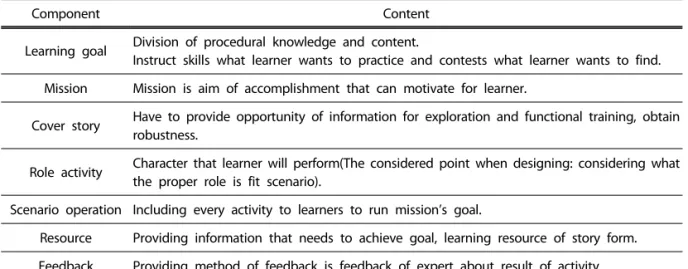
Component Content
Learning goal Division of procedural knowledge and content.
Instruct skills what learner wants to practice and contests what learner wants to find.
Mission Mission is aim of accomplishment that can motivate for learner.
Cover story Have to provide opportunity of information for exploration and functional training, obtain robustness.
Role activity Character that learner will perform(The considered point when designing: considering what the proper role is fit scenario).
Scenario operation Including every activity to learners to run mission’s goal.
Resource Providing information that needs to achieve goal, learning resource of story form.
Feedback Providing method of feedback is feedback of expert about result of activity.
Schank RC, Fano A, Bell B, Jona M (1993). The design of Goal-based scenarios. Journal of the Learning Sciences 3(4):305-345.
Table 1. Component to lay out GBS
various elements that consist of GBS, and then un- derstand how they relate to each other.
Core components presented by Schank et al [15]
contain learning goal, mission, cover story, role ac- tivity, scenario operations, resource, and feedback, and these become core element comprising learning process. The specific components of GBS are de- scribed in Table 1.
First, the learning goal means the degree of knowledge and skill that the learners should take and it can be divided by process knowledge and content knowledge. The former is the knowledge how the functions are practiced and the latter is the knowledge required for the achievement of the goal. Second, the mission is the task that the learn- ers should perform to achieve the established goals, and the mission should be practical to motivate the learners. Third, the cover story is the background story required to complete the mission, and fourth the role activity is the characters that the learners will take in the cover story. Fifth, the scenario oper- ation means all the detailed activities for the learn- ers to perform the mission. Sixth, the resource is to provide the required information when the learners accomplish the goals of mission. To help accomplish the mission successfully, well-organized information should be prepared and provided in advance. Lastly, the feedback is to provide the solution to overcome the challenges that may occur during the learning
process. The types of feedback include the sugges- tion of the performance results, coaching, and sug- gestion of the specialist’s experiences.
METHODS
Research Process
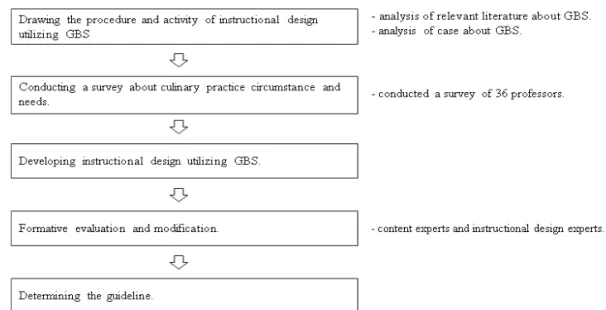
Development process of instructional design gui- deline utilizing GBS for culinary practice is as follows.
First, we draw the instructional design procedure and activity utilizing GBS by carrying out analysis of relevant literature and case study. Second, in order to figure out basic components of instructional de- sign guideline utilizing GBS for culinary practice, we conducted a survey of 36 professors who are teach- ing culinary practice in college. Third, based on liter- ature review, case study, result of survey, we devel- oped the instructional design guideline utilizing GBS for culinary practice, and content experts and in- structional design expert conducted a formative eva- luation about the draft. Finally, we modified the in- structional design guideline utilizing GBS for culinary practice, and determined the last guideline in ac- cordance with result of formative evaluation. Re- search process is shown in Figure 1.
Study Participants
To achieve the purpose of this study, participants consist of learner, expert on the scene, content ex-
Attendance Gender Degree
Content expert
J prof. Male Ph.D. Tourism.
L prof. Male Ph.D. Tourism.
Instructional design expert J prof. Female Ph.D. Education Engineering Table 2. Major career of attendances
Figure 1. Development process of instructional design guideline utilizing GBS for culinary practice.
pert, instructional design expert.
First, learners consisted of specialists who major in culinary arts in D university located in Daegu. This study was conducted from march 2013 to june 2013, and it was applied to "western cooking practice"
course among the major curriculums. We informed teaching method, a learning activity, and role to learner participating in study before class. In addi- tion, we analyzed the questionnaire received by 36 experts of the scene because we should know what is needed, and what problem occurs when applied to the scene. Second, Content experts consisted of specialists who had experience in designing teach- ing and learning methods among professors who are teaching culinary practice in college. And in- structional design expert consisted of professor who majored in educational technology to review GBS learning process in terms of systematic view. Major careers of content experts and instructional design expert are described in Table 2.
Focus Group Interview
A purpose of focus group interview is to get un- derstanding and insight about subject of research through discussion. We applied the instructional de- sign guideline utilizing GBS which is designed with literature review and case study for culinary practice.
And then we draw merits and demerits, advantage, and improvement point of model from content ex- perts and instructional design expert. Finally, while developing the last instructional design, we inter- viewed focus group, modified and made up model by focusing on the formative evaluation to instruc- tional design guideline draft utilizing GBS.
Reliability and Validity of Study
To get reliability and validity of study, this study concentrated on securing validity regarding various manners like literature review, case study, and sur- vey. In addition, we conducted a survey of 36 ex- perts on the scene about culinary practice circum-
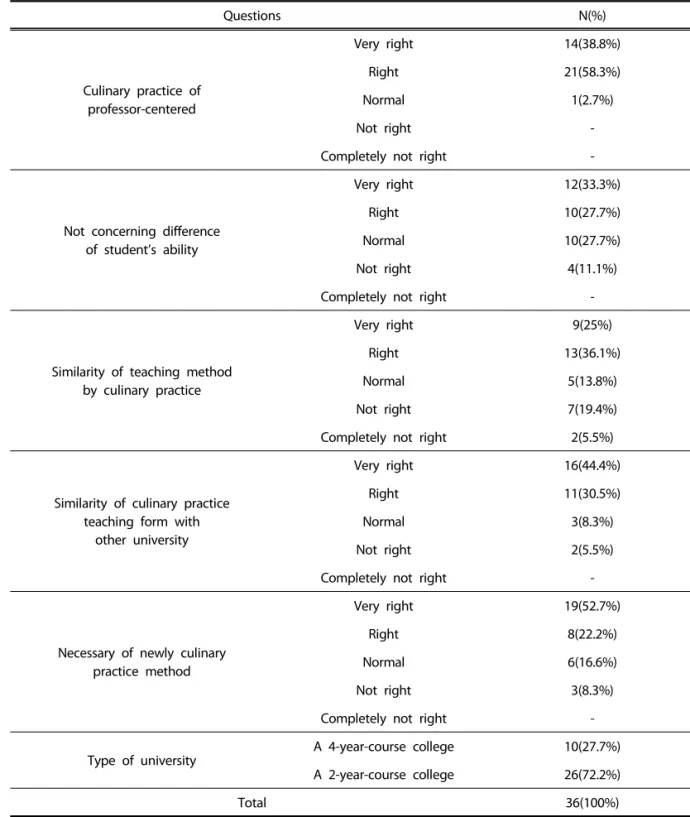
Questions N(%)
Culinary practice of professor-centered
Very right 14(38.8%)
Right 21(58.3%)
Normal 1(2.7%)
Not right -
Completely not right -
Not concerning difference of student’s ability
Very right 12(33.3%)
Right 10(27.7%)
Normal 10(27.7%)
Not right 4(11.1%)
Completely not right -
Similarity of teaching method by culinary practice
Very right 9(25%)
Right 13(36.1%)
Normal 5(13.8%)
Not right 7(19.4%)
Completely not right 2(5.5%)
Similarity of culinary practice teaching form with
other university
Very right 16(44.4%)
Right 11(30.5%)
Normal 3(8.3%)
Not right 2(5.5%)
Completely not right -
Necessary of newly culinary practice method
Very right 19(52.7%)
Right 8(22.2%)
Normal 6(16.6%)
Not right 3(8.3%)
Completely not right -
Type of university
A 4-year-course college 10(27.7%) A 2-year-course college 26(72.2%)
Total 36(100%)
Table 3. Results analyzed the questionnaire received by 36 experts of the scene
stance and needs. Also, we did formative evaluation about first guideline of 2 content experts and 1 in- structional design expert. Specifically, in order to exa- mine content validity, we checked that it would be proper discussion with study’s purpose and content by previewing a questionnaire in advance. Secondly,
research informed participants about interview’s goal and background explanation during interview faithfully. Third, we wanted to eliminate bias in br- eaking a single data and a single recorder by com- paring research’ scene note to materials which is shorthanded and audio material using triangular
Existing teaching method Improvement point Imitative culinary practice of profe-
ssor-centered Proceed self-learning practice through developmental work class Preparation ‣ rehearsal ‣
practice ‣ evaluation Provide thinking opportunity by giving principle Group practice not concerning prac-
tice ability difference
Categorize learner’s type, and give mission and assign role reflecting per- sonal character and provide equal activities
Simple culinary practice Parallel the three-dimensional learning through learning tool(recipe card and design of work card)
Skilled learner has advantage over its opponents
Method that all leaners can participate together through individual work complete
Need of using class outcome Make a portfolio using practice outcome Judging system of professor-cen-
tered Assure objectivity through assessment of professors and learners Table 4. Problem and improvement point with existing teaching and learning method
demonstration methodology[16].
RESULTS
Investigation for Culinary Practice Environment and Needs
We did a survey from 11 March 2013 to 19 April 2013 with professors who are teaching culinary prac- tice class in culinary arts department among uni- versities to understand culinary practice environ- ment and needs. Content of survey is developed through word modification of Kim[17], Jung[18], Paik[19] ’s preceding study in order to fit our study’s purpose. And we had sent an e-mail to 50 pro- fessors. Then we did frequency analysis using SPSS ver 18.0 with 36 surveys, remaining 14 surveys were not returned. The result is described in Table 3, and the summarizing problems of teaching method for culinary practice are described in Table 4.
The Instructional Design Guideline Draft utiliz- ing GBS for Culinary Practice
We designed the first draft of instructional design guideline utilizing GBS for culinary practice based on literature review, case study, survey received by ex- perts of the scene. In considering of learner’s charac- ter and leaning time, we made it faithfully learn- er-centered model according to introduction, devel-
opment, and result. GBS associated with strategy to improve cooking techniques and character of culi- nary arts major, and took the opportunity to explain about sober reflection on activities and expected failure. Then, it got accumulation of knowledge ex- perience and internalization of learning. The oper- ation process of GBS is described in Table 5.
Formative Evaluation Content of Draft by Sta- ges
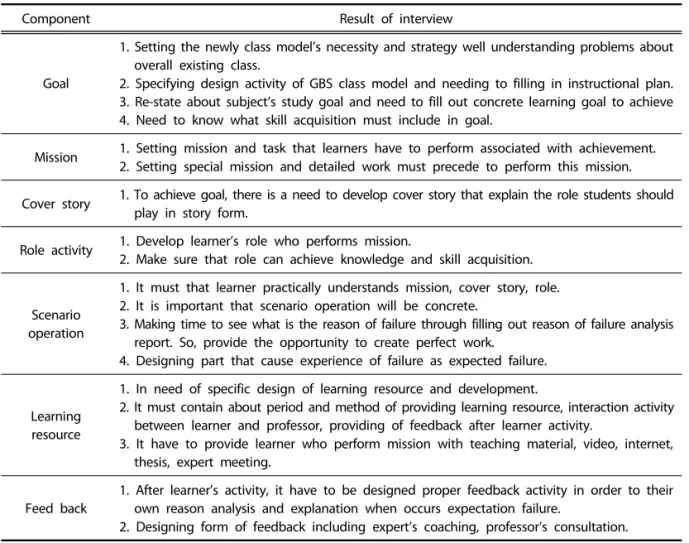
We did a focus group interview with 2 professors, 1 specialist who majors in educational technology theory. Experts evaluate application about draft and examine the field application possibility and general- izing ability in regards of this results. In putting to- gether interview’s analysis results, the items are de- scribed in Table 6.
The Last Modification of Instructional Design Gui- deline utilizing GBS for Culinary Practice
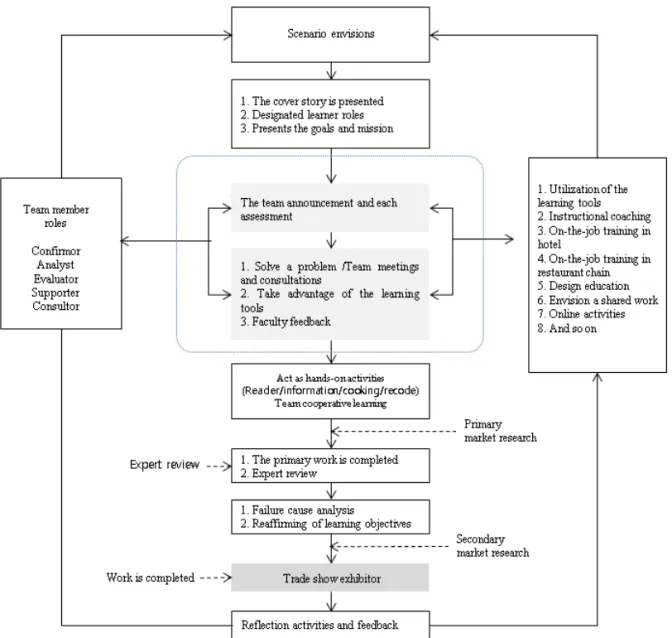
The final content about each component through formative evaluation is as follows, and culinary prac- tice process is shown in Figure 2.
Goal
The goal of culinary practice class utilizing GBS consists of acquisition of process knowledge by de- veloping a new menu and participating in cooking
Steps in
lesson GBS steps GBS activity content Learning resource
Before lesson
1. Education progress analysis 2. Design of learning goal 3. Design of mission 4. Develop of scenario
5. Make and add exhibition poster
1. Learning process analysis throu- gh western culinary major 2. Extracting learning goals by ea-
ch category
3. Setting a practice goal 4. Designing mission through lea-
rning goal
1. Providing excellent picture in culinary competition 2. Sharing information throu-
gh online communities
Introduction
1. Making motivation
2. Suggesting scenario (Cover story and mission)
1. Reminding exhibition
2. Understanding mission through scenario
1. Providing with various fo- rms of learning scenario
Development 1. Operating scenario 2. Arrangement of outcome
1. Selecting performed task and designing or perform
2. Solving perform task 3. Arrangement of outcome
1. Performing of team miss- ion
2. Performing of role mission
Result
1. Announcement of learning outcome
2. Announcement 3. Organization 4. Reviewing 5. Feedback
1. Announcement of team out- come
2. Announcement
3. Bilateral questions between te- ams and team members 4. Reviewing activity 5. Feedback
1. Writing an analysis report about reason of failure th- rough first draft work Table 5. Operation process of GBS
competitions. For learner’s motivation, at first week, we made a poster that printed learner’s name and attached it in the laboratory’s wall.
Mission
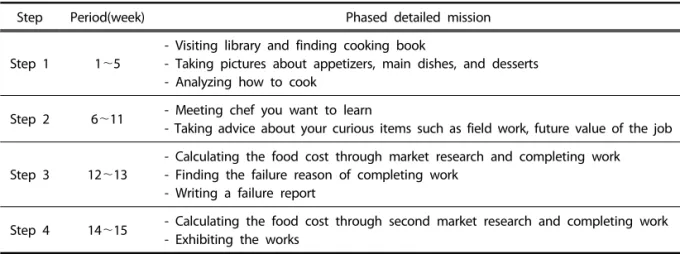
Mission is the task that leaners must perform to achieve goals. In this study, we suggested a step- by-step mission that is similar to learner’s real situa- tion. According to the content described in the ex- hibition poster, we applied that content which con- sists of action learning and detailed mission. All mis- sion was “Let’s display my own work” at the last class. Specific detailed mission is showed discrimi- natory according to situation for completion of work.
Cover Story
Cover story is a scenario that describes mission in more detail. Cover story in this study was con- structed in the form of a story associated with learn- ing goal that learner have to reach for not only com- pleting final work but improving vocational pride.
Content is that “Through this class, you are to be
a preliminary chef, and then get an opportunity to submit your own work. As a prepared chef, you hand in your works to your own exhibition in 2013.
You will find pride as an artistic chef and be a great person.”
Role Activities
Role activities is to perform the role set within cover story. So, we proposed that students must col- laborate to work such as work conception, partial practice, aspic coating and plating.
Operating Scenario
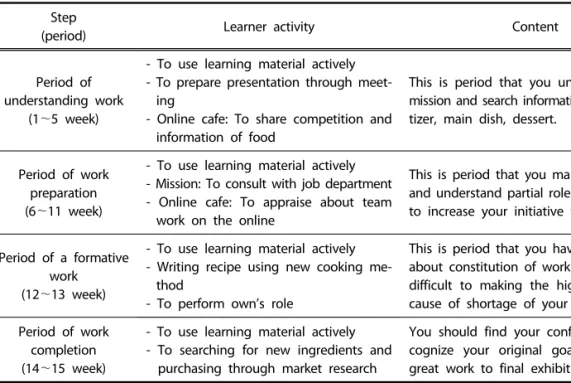
Our scenario about teaching and learning method utilizing GBS for culinary practice was suggested in 4 steps. It is more effective to systematic approach method to proceed every scenario more systematic.
Learning Resource
We selected best work pictures that help work conception and the creative guidance and supplied two pictures to each student. Learning resource was
Component Result of interview
Goal
1. Setting the newly class model’s necessity and strategy well understanding problems about overall existing class.
2. Specifying design activity of GBS class model and needing to filling in instructional plan.
3. Re-state about subject’s study goal and need to fill out concrete learning goal to achieve 4. Need to know what skill acquisition must include in goal.
Mission 1. Setting mission and task that learners have to perform associated with achievement.
2. Setting special mission and detailed work must precede to perform this mission.
Cover story 1. To achieve goal, there is a need to develop cover story that explain the role students should play in story form.
Role activity 1. Develop learner’s role who performs mission.
2. Make sure that role can achieve knowledge and skill acquisition.
Scenario operation
1. It must that learner practically understands mission, cover story, role.
2. It is important that scenario operation will be concrete.
3. Making time to see what is the reason of failure through filling out reason of failure analysis report. So, provide the opportunity to create perfect work.
4. Designing part that cause experience of failure as expected failure.
Learning resource
1. In need of specific design of learning resource and development.
2. It must contain about period and method of providing learning resource, interaction activity between learner and professor, providing of feedback after learner activity.
3. It have to provide learner who perform mission with teaching material, video, internet, thesis, expert meeting.
Feed back
1. After learner’s activity, it have to be designed proper feedback activity in order to their own reason analysis and explanation when occurs expectation failure.
2. Designing form of feedback including expert’s coaching, professor’s consultation.
Table 6. Summary of the interview result by factor components..
total 8 from A-1 to D-2, and learning resources given alphabet like A, B, C, D were given 4 kinds of each team, and then had to be analyzed part of each role.
Feedback
The learner who finished his part practice of role playing experienced first market research, and we proposed to submit their first draft until 31st, May.
In 13 week, we invited 2 professor experts and they provided feedback about strong point and weak point on learner’s work and practice attitude to the students after classroom observation.
CONCLUSIONS & IMPLICATIONS
Discussion of Findings
In the laboratory, education that follows pro- fessors’s content with limited time and restricted
material is not connected with context of practical problem solving since it is confined with skill ac- quisition. Also, as a result of this study, 97% of the respondents answered that the current culinary practice had been performed not by learners’ ini- tiatives but by trainers, and students who major in culinary arts demonstrated to demand the new and creative classes. To solve this problem and to ach- ieve the ultimate goals, this study is to develop teaching and learning model utilizing GBS for culi- nary practice education. In order to achieve this pur- pose, we designed first draft of instructional design guideline utilizing GBS, and suggested the final in- structional design guideline utilizing GBS for culinary practice through formative evaluation of experts groups.
The instructional design guideline utilizing GBS for culinary practice has meaning as following.
Part Role activities Practice role activity
A
1. Calling team meeting
2. Culinary practice activity aiding 3. Portfolio learning aiding
1. Being in charge of main ingredient
2. Showing and sharing how to apply main ingredient 3. Checking personal hygiene, practice tools
B
1. Being in charge of market research 2. Supporting learning for cooking word sheet
100
3. Benchmarking other team idea and sharing information
1. Being in a change of side dish or garnish 2. Showing and sharing how to apply side dish or
garnish
3. Checking the environment of laboratory, and floor and sink
C
1. Supporting learning for recipe card 2. Work completing and creative activity aiding 3. Search for desert date
1. Being in charge of sauce or herb
2. Showing and sharing how to apply sauce or herb 3. Checking practice table
D
1. Writing down work proceeding 2. Work design card learning aiding 3. Activity and administration of online cafe
1. Being in charge of decoration or crafts
2. Showing and sharing how to apply decoration or crafts
3. Checking the leftover and garbage can Table 8. Role activities for culinary practice
Step Period(week) Phased detailed mission
Step 1 1~5
- Visiting library and finding cooking book
- Taking pictures about appetizers, main dishes, and desserts - Analyzing how to cook
Step 2 6~11 - Meeting chef you want to learn
- Taking advice about your curious items such as field work, future value of the job
Step 3 12~13
- Calculating the food cost through market research and completing work - Finding the failure reason of completing work
- Writing a failure report
Step 4 14~15 - Calculating the food cost through second market research and completing work - Exhibiting the works
Table 7. Phased detailed mission
First, GBS learning process that was designed in this study can increase problem-solving ability because it includes what culinary arts specialist have to study, confirmation about mission, selection of per- form task, role checking and setting clear learning goal through mission, scenario operating, and pro- cess of self-examination about learned content. Th- rough performance of mission, learners are asked to their interest and motivation of performance activity and problem solving strategy by learning of prac- tical problem and skilled aspect at cooking situa- tion.
Second, selection of performance task and prac- tice is based on co-operative team. In the process
of practicing of mission performance assignment on the scenario, we can improve teamwork not only on-site practical ability asked in culinary arts major.
In other words, to increase effectiveness of creative thinking and transmission of technology through cu- linary practice process utilizing GBS, it is desirable that various instructions like personal guidance and team guidance are answered.
Third, as failure showed independent learning, the opportunity of explanation when we fail expectation is that occurring step associated with real culinary practice. In the process of this course, people can solve their conflict between team members.
Finally, the application of GBS can be new alter-
Figure 2. The last modification of instructional design guideline utilizing GBS for culinary practice.
native as a new teaching and learning method be- cause it can raise its skill of modification and supple- mentation concerned with changeable situation and limited condition by developing learner’s assign- ment performing skill.
Technical education in the universities should be performed with competitive and differentiated pro- grams to coincide with the demands in the job market. To do so, the practice education in the uni- versities should be harmonized with the demands of the industry and developed the appropriate educa- tional system for the majors based on the human resource demands of the industry. Hence, to in-
troduce the requirements from the industry to the classes, the efforts to enhance the students’ motiva- tion and self-directed completeness of the job per- formance with GBS application should be made.
Limitations and Future Research
Meanwhile, there are some propositions about the follow-up studies based on the limitation of this study. First, there should be a study about how we apply learner’s character in order to solve problems easily to culinary arts major. Second, in the compre- hensive level, professors have to focus on materiali- zation of thinking process by developing easy sce-
Step
(period) Learner activity Content
Period of understanding work
(1~5 week)
- To use learning material actively - To prepare presentation through meet-
ing
- Online cafe: To share competition and information of food
This is period that you understand every mission and search information about appe- tizer, main dish, dessert.
Period of work preparation (6~11 week)
- To use learning material actively - Mission: To consult with job department - Online cafe: To appraise about team
work on the online
This is period that you make partial thing and understand partial role. And you have to increase your initiative work force.
Period of a formative work
(12~13 week)
- To use learning material actively - Writing recipe using new cooking me-
thod
- To perform own’s role
This is period that you have a confidence about constitution of work. However, it is difficult to making the highest work be- cause of shortage of your experience.
Period of work completion (14~15 week)
- To use learning material actively - To searching for new ingredients and
purchasing through market research
You should find your confidence and re- cognize your original goal to complete great work to final exhibition.
Table 9. Phased scenario content
nario for student to understand. And then, a short- period scenario to appear short, clear effective to apply an universal using of GBS must be developed.
For example, we will take a view of learning effec- tiveness based on scenario to increase class effect in short-period. Third, class environment to know on-site feeling must be ready. Also, university and professor’s effort is important in transmitting new skill and aiding several learning tools. Finally, this study only developed the instructional design guide- line for western cooking practice, so it is difficult to apply in a variety of cooking classes. The follow-up studies should develope the instructional design guideline considering the type and nature of cook- ing classes. And the follow-up studies should verify the effectiveness of the guideline applying to the ac- tual culinary practice because we did not verify the effectiveness of the developed guideline.
REFERENCES
[1] Lee JH (2011). A study on student satisfaction with educational environment in a cooking and food service program. The Korean Journal of Culinary Research 17(2):74-84.
[2] Min HR (2012). Perception and need assessment
of faculties on faculty development program:
Focusing on faculties of S university. The Journal of Korean Teacher Education 29(3):95-219.
[3] Kim TH, Kim WM (2005). A study on the learning model for efficient culinary practice. The Korean Journal of Culinary Research 11(1):1-17.
[4] Jeong HJ, Cho HH (2012). An exploratory case study on satisfaction of culinary practicum using gamification program. Journal of Hospitality and Tourism Studies 14(4):173-186.
[5] Jeon YH, Chung HM (2014). Developing an in- structional design guideline for goal-based sce- nario in classroom settings. The Journal of Educa- tional Information and Media 20(3):373-397.
[6] Park SH, Lee SB (2009). A study on goal-based scenario(GBS) learning process for enhancing students' problem solving: In social study. The Journal of Elementary Education 22(4):379-403.
[7] Kang IA, Lee MS (2008). A study on how to apply GBS(goal-based scenario) to ‘ecology & environ- ment’ education in high school. The Environmen- tal Education 21(4):94-110.
[8] Cho YS, Lee SJ (2007). Design and implemen- tation of a GBS theory-based RPG edugame for low-achieved students in mathematics. The Jour- nal of Education 27(1):171-184.
[9] Lee JA (2013). A study on student satisfaction with educational environment, innovation con- figuration, and intervention demand of students in culinary practice education: Focusing on uni- versity students majoring in culinary arts. The Korean Journal of Culinary Research 19(4):77-93.
[10] Kang KS (2011). A study on the method to vital- ize culinary education based on recognition survey of culinary practice: Focused on univer- sities located in Daejeon ․ Chungnam areas. The Korean Journal of Culinary Research 17(2):126- 139.
[11] Na TK, Lee DK(2010). Culinary art students' adaptation to college life according to their sa- tisfaction with a culinary laboratory and their educational experience: Focus on the universi- ties in Chungcheong province. The Korean Journal of Culinary Research 16(2): 185-198.
[12] Park ES, Kim YN (2006). A study on stage of concern, level of use, innovation configuration, and intervention demand of teachers in culi- nary practice education. Journal of Korean Ho- me Economics Education Association 18(3):41- 60.
[13] Cho KL, Cho YH, Kim MK, Sung BS (2004). De- sign and development of WBI contents: A goal- based scenarios(GBS) model approach. The Jo-
urnal of Korean Association of Computer Educa- tion 7(5):9-21.
[14] Lee MS (2007). Ecology & environment learning case by GBS(goal-based scenario). The Environ- mental Education 20(3):31-44.
[15] Schank RC, Fano A, Bell B, Jona M (1993). The design of goal-based scenarios. Journal of the Learning Sciences 3(4):305-345.
[16] Guion AL, Diehl CD, McDonald D (2011). Trian- gulation: Establishing the Validity of Qualitative Studies. Florida: University of Florida Coopera- tive Extension Service.
[17] Kim GR (2010). The Effects of Practical Training in the Construction Technology Lesson in the Technology and Home Curriculum of the High School on Learning Performance. Seoul: Kyong- gi University.
[18] Jung YI (2006). The Effects oF Practical Training in the Automobile Management Lesson on Lea- rning Performance. Seoul: Kyonggi University.
[19] Paik EJ (2009). A Satisfaction Survey on Hands- on Cooking Education by e-learning. Seoul: Sook- myung Women's University.
Received: 14 DEC, 2015 Revised: 28 DEC, 2015 Accepted: 18 JAN, 2016