41(2), 221~226(2012) http://dx.doi.org/10.3746/jkfn.2012.41.2.221
국내산 복숭아 유과의 품종별 성분 분석 및 품질특성
김다미1⋅김경희1⋅최인자2⋅육홍선1†
1
충남대학교 식품영양학과
2
연기군 농업기술센터
Composition and Physicochemical Properties of Unripe Korean Peaches According to Cultivars
Da-Mi Kim1, Kyung-Hee Kim1, In-Ja Choi2, and Hong-Sun Yook1†
1Dept. of Food and Nutrition, Chungnam National University, Daejeon 305-764, Korea
2Yeongigun Agriculture Technology Center, Chungnam 339-814, Korea
Abstract
For the investigation of a possibility as a useful functional material, 6 cultivars (Takinosawa Gold, Kawanaka- wase Hakuto, Madoka, Yumefuji, Nagasawa Hakuho, Hong Bak) of Prunus persica L. Batsch were studied at unripe stage to determine the physicochemical properties and chemical compositions. The cultivars were picked in late May, and all samples were analyzed for external properties, physicochemical properties, pH, Brix value, Hunter's color value, hardness, vitamin C, and reducing sugar. The size of the fruit from all six cultivars was compared, and it was determined that cultivars, fruit from Madoka was the largest, while that from Yumefuji was the smallest. Comparing fresh weight, the fruit from Yumefuji was lowest in moisture contents (89.13~
89.96%), and that from Nagasawa Hakuho had significantly higher crude protein (1.02~1.62%). The contents of crude lipids (0.18~0.23%) and carbohydrates (8.00~9.35%) were not significantly different between cultivars and Madoka included higher crude ash contents (0.32~0.69%) than other cultivars. The pH of 6 cultivars from unripe peaches were significantly higher from Kawanakawase Hakuto, and the Brix value was also highest from Kawanakawase Hakuto, followed by Yumefuji, Madoka, Nagasawa Hakuho, Takinosawa Gold, and Hong Bak. In chromaticity, the L value, the indicator of brightness, was significantly higher in fruit from Nagasawa Hakuho. The a value, the indicator of redness, was the highest with Hong Bak and overall lower than -5. The b value, the indicator of yellowness, was the highest in fruit from Madoka and ranged from 16.51 to 18.33.
In physical characteristics, the hardness of the unripe peaches was the highest in fruit from Hong Bak, and overall, white peaches have a higher hardness value than yellow peaches. The vitamin C content of the fruit didn't show any significant differences between cultivars, and the reducing sugar showed a higher percent than 6.34% in fruit from all cultivars. These results suggest that unripe peaches were commensurate with the develop- ment of natural pigment and as a functional foods.
Key words: Korean unripe peaches, physicochemical properties, quality, chemical compositions
†
Corresponding author. E-mail: [email protected]
†
Phone: 82-42-821-6840, Fax: 82-42-821-8887
서 론
최근 국가경제의 성장으로 생활수준의 전반적인 질적 향 상과 함께 국민의 건강 장수에 대한 관심이 고조되고 있으며, 산업사회의 급속한 발전으로 야기되는 각종 질환 및 식생활 의 변화에 따른 성인병 등이 새로운 사회문제로 인식되면서 이에 대한 국민 각자의 해결 의지가 과거 어느 때보다 적극 적인 상황이다. 이에 따라 새로운 소재를 이용한 고부가가치 기능성식품 개발 기술의 확립에 대해 다양한 분야에 걸친 협동연구가 필요한 실정이다.
복숭아(
Prunus persicaL. Batsch)는 장미과(Rosaceae) 자두속(
Prunus) 복숭아아속(
Amygdalus)에 속하는 온대 낙
엽성 과수로 대표적인 여름과일이다. 주성분은 수분과 당분
이며 주석산, 사과산, 시트르산 등의 유기산이 함유되어 있
고, 말산와 개미산, 초산, 타르타르산 등의 에스테르와 알코
올류, 알데히드류 및 펙틴 등도 풍부하다. 과육에는 유리 아
미노산이 많이 함유되어 있고, 특히 아스파르트산 함량이
높다(1-3). 복숭아의 근연종으로는
P.
kansuenisisRehd.(감
숙도, 모도),
P.
davidiana(Carr.) Franch.(산도),
P.
miraKoehne(광핵도, 서장도),
P.
ferganensis(Kost. et Rjab)
Kov. et Kost(신강도, 대완도)가 있다. 국내 육성 품종으로는
백미조생, 원봉조생, 월미복숭아, 신백도 등을 포함하여 14
여종이 있으며, 최근 도입된 품종으로는 이즈미백도, 일천백
봉, 몽부사, 장택백봉 등이 있다(4).
농촌경제연구원의 조사에 의하면 2010년 복숭아 재배면 적은 전년보다 7% 증가한 1만 3,908 ha이다. 2011년 재배면 적은 2010년에 비해 6% 증가한 1만 4,795 ha로 전망된다(5).
그러나 복숭아는 재배과정에서 열매의 크기를 크고 고르게 하고 품질을 높여주기 위해 매년 4월 초순부터 5월 초순에까 지 3~4회에 걸쳐 적과를 하며, 전체 과실의 90% 이상을 차지하는 적과된 복숭아 유과는 전량 폐기되고 있는 실정이 다. 적과 시 발생하는 복숭아 유과는 성숙과와 비교하여 페 놀 함량, 섬유소, 비타민 등에 많은 차이가 있어(6) 생리활성 에서도 차이를 나타낼 것으로 생각된다.
복숭아 유과에 연구로 외국에서는 복숭아의 성숙에 따른 polygalacturonase 활성(7) 및 pectic 함량 변화(8), 복숭아 유과 섭취에 따른 용혈성 빈혈 개선(9) 등이 연구되어 있으 며, 국내 연구로는 복숭아 유과에 함유된 성분 연구(10), 복 숭아 유과를 이용한 미백특성 연구(11) 등이 있으나 품종간 의 성분 비교 등 식품학적 연구는 미흡한 실정이다.
따라서 본 연구는 그동안 농가에서 기호성 저하 등에 의해 폐기물로 처리되어 왔던 복숭아 유과 6품종을 채취하여 품 종간의 영양 성분 및 생리활성 성분의 함량을 비교․분석하 고 품질특성을 조사하여, 향후 가공이용 가능성의 기초자료 로 제시하고자 한다.
재료 및 방법
재료
본 실험에 사용된 복숭아는 총 6품종으로 용택골드 (Takinosawa Gold), 천중도백도(Kawanakawase Hakuto), 마도카(Madoka), 몽부사(Yumefuji), 장택백봉(Nagasawa Hakuho), 홍백(Hong Bak)으로서, 2011년 5월 하순에 충청 남도 연기군에서 적과된 복숭아 유과를 소재로 이용하였다.
시료 준비
시료는 1% Na
2HCO
3로 수세하여 털을 제거 후, 껍질을 포 함한 과육부만 실험에 사용하였다. pH, 색도, 경도, 당도, 수 분, 조단백, 조지방, 조회분, vitamin C는 생시료를 이용하였 고, 환원당 함량 측정은 생시료를 분쇄하여 동결건조 (SFDSM12-60Hz, Samwon Freezing Engineering Co., Seoul, Korea)한 후 분말화하여 밀봉 냉동 보관하면서 시료 로 사용하였다.
품종별 외형 특성
복숭아의 품종별 평균 중량은 크기가 비슷한 과실 20개를 사용하여 개당 중량, 직경 및 길이를 측정한 후 평균값으로 나타내었다.
일반성분
복숭아 유과의 품종별 일반성분은 수분, 조회분, 조단백, 조지방의 항목을 AOAC법(12)에 준하는 방법으로 분석하였 다. 수분함량은 상압가열건조법, 조회분은 직접회화법, 조단
백질은 Kjeldahl법 그리고 조지방은 Soxhlet법으로 측정하 였고 탄수화물은 이들 성분을 100에서 뺀 값으로 계산하였다.
pH, 당도, 색도 측정
pH는 시료 5 g을 증류수로 10배 희석하여 충분히 교반한 후 pH meter(PH-220L, iSTEK, Inc., Seoul, Korea)로 측정 하였으며, 당도는 과즙을 내어 굴절당도계(ATAGO N-1α, Antage, Tokyo, Japan)로 측정하였다.
과실의 색도는 Hunter 색도계(ND-300A, Nippon Den- shoku, Tokyo, Japan)로 명도(lightness), 적색도(redness), 황색도(yellowness)를 12회 반복 측정하여 평균값으로 나타 내었으며, 측정부위는 과실의 핵과 과피의 약 1/2이 되는 지 점을 절단하여 절단된 면을 측정하였다.
경도
과실의 경도는 texture analyzer(TA-XT2, Stable Micro System Co. Ltd., Surrey, England)를 사용하여 측정하였다.
지름 5 mm의 plunger를 이용하여 hardness를 측정하였으 며, 분석조건은 pre test speed: 2.0 mm/sec, test speed: 1.0 mm/sec, post test speed: 2.0 mm/sec, strain: 70%로 복숭아 유과 적도 부분의 과피 2 mm을 제거한 후 20회 반복 측정하 였다.
Vitamin C 함량 측정
Indophenol 적정법을 이용하여 시료 1 g을 메타인산․초 산용액(초산 80 mL, 메타인산 30 g을 1 L로 정용)에 녹여 100 mL로 정용한 후, 이를 10 mL 취해 Indophenol용액(2,6- dichlorophenol indophenol-Na염 200 mg을 100 mL로 정용) 으로 적정하였다. Blank는 vitamin C 표준용액(0.2 mg/mL) 으로 하였다.
환원당
환원당 함량은 Miller(13)를 참고하여 DNS법으로 측정하 였다. 복숭아 유과 분말을 증류수에 추출한 뒤 10 mg/mL의 농도로 맞춘 후 2시간 진탕하여 시료액으로 사용하였다. 시 료액 1 mL에 DNS 시약(dinitrosalicylic acid 0.5 g, NaOH 8 g, rochell salt 150 g을 500 mL로 정용) 2 mL을 가하여 98
oC에서 10분간 반응시킨 후 30분간 얼음물에 냉각시켰다.
반응액을 3,000 rpm에서 10분간 원심분리 후 상층액을 UV/
Vis-spectrophotometer(Shimadzu UV-1800, SHIMADZU Co., Kyoto, Japan)를 사용하여 550 nm에서 흡광도를 측정 하였다. 환원당 함량의 검량선은 glucose를 이용하여 작성하 였다.
통계처리
모든 실험은 3회 이상 반복 실시하였으며, 얻어진 결과들
은 SPSS Statistics 18.0 Network Version(on release 18.0.1
of PASW Statistics) software를 이용하여 유의적 차이가
있는 항목에 대해서 Duncan's multiple range test로 p<0.05
Table 1. Average weight and size of unripe peaches according to cultivars
Cultivars Weight (g) Width (cm) Depth (cm) Length (cm)
Takinosawa Gold Kawanakawase Hakuto Madoka
Yumefuji
Nagasawa Hakuho Hong Bak
12.95±1.12
1)a2)12.51±0.63
ab13.11±0.64
a10.57±0.76
c12.53±0.99
ab11.74±0.79
b2.68±0.08
a2.64±0.13
ab2.70±0.12
a2.42±0.11
b2.74±0.27
a2.58±0.18
ab3.34±0.15
a3.36±0.13
a3.24±0.05
a3.08±0.08
b3.24±0.05
a3.02±0.04
b2.96±0.09
a3.00±0.00
a3.00±0.10
a2.82±0.04
b2.94±0.05
a2.82±0.08
b1)
Mean±SD (n=20).
2)
Different letters (a-c) within a same column differ significantly (p<0.05).
Table 2. Proximate composition of unripe peaches according to cultivars (w/w%, fresh weight)
Cultivars Moisture Crude protein Crude lipid Carbohydrate Crude ash
Takinosawa Gold Kawanakawase Hakuto Madoka
Yumefuji
Nagasawa Hakuho Hong Bak
89.84±0.06
1)a2)89.48±0.27
b89.35±0.20
bc89.13±0.08
c89.88±0.10
a89.96±0.17
a1.45±0.11
ab1.51±0.12
ab1.02±0.18
c1.46±0.03
ab1.62±0.20
a1.22±0.07
bc0.19±0.04
a0.23±0.04
a0.19±0.06
a0.20±0.03
a0.18±0.02
a0.19±0.05
a8.11±0.23
a8.42±0.58
a9.35±1.45
a8.86±0.15
a8.00±0.38
a8.16±0.43
a0.41±0.02
b0.36±0.15
b0.69±0.01
a0.35±0.01
b0.32±0.06
b0.47±0.14
ab1)
Mean±SD (n=3).
2)
Different letters (a-c) within a same column differ significantly (p<0.05).
Table 3. pH and sugar content of unripe peaches according to cultivars
Cultivars pH Soluble solids
(°Brix) Takinosawa Gold
Kawanakawase Hakuto Madoka
Yumefuji
Nagasawa Hakuho Hong Bak
3.98±0.03
1)b2)4.26±0.03
a3.87±0.04
c3.86±0.02
c3.79±0.01
d3.85±0.02
c8.12±0.46
ab8.88±0.36
a8.52±0.36
a8.72±0.48
a8.48±0.87
a7.68±0.48
b1)
Mean±SD (n=5).
2)
Different letters (a-d) within a same column differ signifi- cantly (p<0.05).
수준에서 유의차 검정을 실시하였다.
결과 및 고찰
품종별 외형 특성
5월 초 적과된 품종별(용택골드, 천중도백도, 마도카, 몽 부사, 장택백봉, 홍백) 복숭아 유과의 외형적 특성은 Table 1과 같다. 실험에 사용한 복숭아 유과의 평균 중량은 10.57~
13.11 g으로 마도카에서 가장 높았으며 몽부사에서 가장 낮 은 중량을 나타냈다. 폭, 두께 및 길이는 각각 2.42~2.74 cm, 3.02~3.36 cm, 2.82~3.00 cm로 전체적으로 마도카가 가장 크고 몽부사가 가장 작은 것으로 나타났다.
일반성분
본 실험에 사용된 품종별 복숭아 유과의 일반성분을 측정 한 결과는 Table 2와 같다. 복숭아 유과의 수분함량은 89.13
~89.96% 범위로서 몽부사에서 가장 낮게 측정되었다. 조단 백 함량은 장택백봉이 1.62%로 조단백 함량이 가장 낮은 마도카(1.02%)에 비하여 유의적으로 높은 함량을 나타내었 다. 조지방 및 조탄수화물 함량에서는 품종 간 유의차를 보 이지 않았으며, 조회분 함량은 마도카에서 0.69%로 홍백 (0.47%), 용택골드(0.41%), 천중도백도(0.36%), 몽부사(0.35
%) 및 장택(0.32%)에 비하여 높은 함량을 나타내었다. 성숙 복숭아의 일반성분에 대해 식품성분표(14)는 황도에서 수분 92.2%, 조단백 0.9%, 조지방 0.2%, 회분이 0.4%이며, 백도 복숭아에서 수분 89.9%, 조단백 0.9%, 조지방 0.2%, 회분이 0.3%의 결과를 나타낸 바 있다. 본 실험에 사용한 여섯 품종 의 복숭아 유과 중 황도에 속하는 용택 골드와 백도에 속하 는 천중도백도의 경우 이들 연구결과에 비해 수분함량이 낮 고 단백질 함량이 높게 측정되었다. 이는 Jung 등(15)의 연
구에서 적과시기별 일반성분 비교 시 복숭아의 성숙에 따라 수분함량의 비율이 높아지며 상대적으로 조단백, 조지방 및 조회분의 비율이 감소한다는 연구결과와 일치하는 것으로 나타났다. 또한 Shim 등(16)이 보고한 5월초 수확한 매실의 수분함량 및 회분함량은 91.4% 및 0.59%로 본 연구에 비하 여 높게 나타났다. 따라서 복숭아 유과의 이용 시 성숙과 및 매실 유과와 비교하여 높은 영양성분을 이용할 수 있다고 사료된다.
pH, 당도, 색도 측정
품종별 복숭아 유과의 pH 및 당도는 Table 3에 나타내었
다. pH는 3.79~4.26 범위로 나타났으며 다른 품종과 비교하
여 천중도백도에서 유의적으로 높게 나타났다. 복숭아 유과
의 pH를 측정한 Lee와 Chung(10)의 pH에 대한 연구 결과는
4.17로 본 연구와 비교하여 비슷한 결과를 나타냈으며 성숙
복숭아의 pH를 측정한 Cho(17)의 연구에서는 3.59~3.88의
결과로 복숭아 유과의 pH에 비해 낮은 수치를 보였다. 이는
Shim 등(16)의 성숙에 따른 매실의 유기산 함량 증가에 따른
pH 감소와 비슷한 경향을 나타내었으나, 복숭아는 성숙에
Table 4. Hunter's color values of unripe peaches according to cultivars
Cultivars L
1)a
2)b
3)Takinosawa Gold Kawanakawase Hakuto Madoka
Yumefuji
Nagasawa Hakuho Hong Bak
57.18±4.44
4)ab5)52.74±1.48
c51.34±1.31
c55.31±0.88
b57.86±1.63
a55.45±2.70
b-6.03±1.60
abc-5.74±1.37
ab-6.65±0.76
bc-6.97±0.73
c-6.99±0.35
c-5.30±0.92
a18.04±1.91
ab18.15±1.39
ab18.33±0.74
a16.85±0.64
c17.04±0.74
bc16.51±1.14
c1)
L: Degree of lightness.
2)a: Degree of redness.
3)b: Degree of yellowness.
4)
Mean±SD (n=12).
5)Different letters (a-c) within a same column differ significantly (p<0.05).
Table 5. Hardness of unripe peaches according to cultivars (unit: g)
Cultivars Hardness
Takinosawa Gold Kawanakawase Hakuto Madoka
Yumefuji
Nagasawa Hakuho Hong Bak
5732.99±713.28
1)c2)6125.20±619.55
b5881.91±397.29
bc5661.97±528.81
c6781.73±298.98
a7018.18±495.61
a1)
Mean±SD (n=20).
2)
Different letters (a-c) within a same column differ signifi- cantly (p<0.05).
0.00 1.00 2.00 3.00 4.00 5.00 6.00 7.00 8.00 9.00
Takinosawa Gold
Kawanakawase Hakuto
Madoka Yumefuji Nagasawa Hakuho
Hong Bak Cultivar
V ita m in c o n te n ts ( m g /1 0 0 g ) .
nsFig. 1. Contents of vitamin C in unripe peaches according to cultivars. ns: not significant (p<0.05).
따라 유기산 함량이 감소하는 경향을 보이므로 복숭아에서 의 pH 변화는 유기산이 아닌 다른 무기질 및 산성을 나타내 는 물질의 함량 변화로 사료된다. 살구(18) 및 품종별 나무딸 기류 과일 과즙(19)의 pH 측정결과는 3.44 및 2.8~3.9로 복 숭아 유과와 비교하여 비슷한 수치를 나타내었으며, 품종별 오디(20) 및 품종별 수박(21)의 pH는 4.08~4.80 및 5.36~
5.68로 복숭아 유과보다 높은 값을 나타내었다.
성숙 중 채취시기의 지표가 되는 당 함량과 연계되는 당도 실험 결과 7.68~8.88°Brix로 홍백에서 유의적으로 낮게 나 타났으며, 이러한 당도 결과는 복숭아 유과 성분에서 유리당 의 영향이라고 사료되어진다. Seo 등(22)의 연구에서는 성 숙 홍백의 당도에서 10.8°Brix를 나타내었는데, 이는 복숭아 의 성숙 시기에 따른 당도를 측정한 Cascales 등(23)의 연구 에서 성숙에 따라 당도가 증가하는 결과와 비슷한 경향을 나타내었으며 이러한 성숙에 따른 당도의 차이는 당 함량의 증가에 의존적으로 나타난다고 사료된다(16,24). 또한 본 실 험과 비슷한 결과를 보이는 국내산 영귤(24) 및 살구(25)는 7.4 및 7.6°Brix의 수치를 보이며 가공품에 적용되고 있는 실정이다.
복숭아 유과 과육의 색도를 측정한 결과는 Table 4와 같 다. 색도 중 과실의 밝기를 나타내는 L값은 51.34~57.86을 보였고, 장택백봉에서 가장 높은 값을 나타내었다. 홍백의 L값을 성숙시기별로 비교해 보았을 때, 유과 및 성숙과의 L값은 55.45 및 54.00이었으며 유의차를 나타내지는 않았다 (22). 적색도 a값은 -6.99~-5.30의 범위로 모두 다음의 값 (녹색도)을 나타내었으며, 홍백에서 가장 녹색도가 낮았다.
황색도 b값은 16.51~18.33을 보이며 마도카, 천중도백도, 용 택골드, 장택백봉, 몽부사, 홍백 순으로 높았다.
경도
품종별 복숭아 유과의 경도를 측정한 결과(Table 5), 홍 백, 장택백봉, 천중도백도, 마도카, 용택골드, 몽부사가 각각 7,018.18, 6,781.73, 6,125.20, 5,881.91, 5,732.99 및 5,661.97 g 으로 용택골드 및 몽부사가 가장 낮았으며, 6품종 모두 5,500 g 이상의 단단한 경도를 지니고 있었다. 이는 매실의 경도 측정 결과인 5,404.00 g(26)에 비해 높은 수치이며, 성숙 복숭 아의 경도인 293.00 g보다는 매우 높은 수치임을 알 수 있었 다(27). 품종별 성숙 복숭아의 경도 측정에서는 전반적으로 황도가 백도에 비해 단단하게 측정되었으나, 본 연구는 전반
적으로 백도가 황도에 비해 높은 경도를 보여 결과에 차이를 보였다(28).
Vitamin C 함량 측정
Vitamin C는 대표적인 수용성 비타민으로 식품에 함유되 어 있는 다른 영양소와 비교하여 대표성을 나타내므로 영양 의 지표로도 종종 사용된다. Vitamin C는 또한 강력한 항산 화제이며 이것은 생존을 위해 필요한 성분이다(29).
Fig. 1은 품종별 복숭아 유과의 vitamin C 함량 변화이다.
측정 결과 복숭아 유과 내 vitamin C 함량은 천중도백도
(7.84 mg%), 마도카(7.47 mg%), 장택백봉(7.28 mg%), 몽부
사(7.28 mg%), 용택골드(6.55 mg%), 홍백(6.53 mg%) 순으
로 나타났으며, 품종에 따른 유의성은 보이지 않았다. Lee
등(24)이 연구한 매실 과육의 vitamin C 함량은 0.41 mg%로
본 연구에 비해 현저히 낮은데 이는 본 시료에 포함된 껍질
d bc ab
a ab cd
0 1 2 3 4 5 6 7 8 9 10
Takinosawa Gold
Kawanakawase Hakuto
Madoka Yumefuji Nagasawa Hakuho
Hong Bak
Cultivar
R e d u e in g s u g a r c o n te n ts ( % ) .
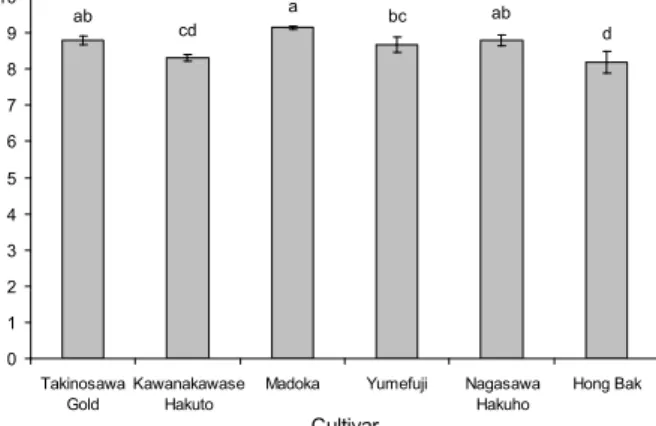
Fig. 2. Contents of reducing sugar in unripe peaches accord- ing to cultivars.
a-dValues with different superscript letters in the same solvent are significantly different (p<0.05).
에 다량 함유된 vitamin C의 영향으로 사료된다(30,31). 껍질 이 포함된 조건에서의 품종별 성숙 복숭아의 vitamin C 함량 은 황도에서 5.1~6.8 mg%, 백도에서 4.8~13.2 mg%로 전 반적으로 백도에서 더 높은 함량을 보였으며 이는 본 실험과 유사한 결과로 판단된다(28). 과실의 성숙에 따른 vitamin C 함량 변화를 살펴보면 성숙에 따라 감소하는 경우와 증가 하는 경우가 있는데, 블랙 라스베리의 과실 및 뜰보리수 과 실에서는 과실에 함유되어 있는 총 vitamin C의 함량이 과실 이 성숙함에 따라 감소함을 보였고, 완숙기에 뚜렷이 감소하 였다고 보고하였다(32,33). 이와는 반대로 딸기와 구아바에 함유되어 있는 vitamin C의 함량은 과실이 성숙함에 따라 점차로 증가하는 것으로 보고되어 있다(34,35).
환원당
품종에 따른 복숭아 유과의 환원당 함량은 Fig. 2와 같다.
환원당 함량은 마도카, 용택골드, 장택백봉, 몽부사, 천중도 백도, 홍백 순으로 평균 각 9.14, 8.79, 8.79, 8.66, 8.31, 8.19%
가 함유되어 있어, Shim 등(16)과 Lee 등(24)의 매실에서의 환원당 함량 측정 결과와 비교하여 높은 함량을 지니고 있었 다. 이는 살구, 사과 및 포도내 환원당 함량보다 높은 수치이 다(18,26,36,37). 일반적으로, 과일류의 환원당이 과일의 주 감미원이 됨은 널리 알려진 사실로써, 복숭아 유과내의 환원 당 함량도 조미성분으로서의 역할을 할 것으로 사료된다.
또한 본 실험에서 복숭아 유과는 성분 함량에 있어 산업적으 로 사용되고 있는 과실들과 차이가 없었기에 복숭아 유과의 여러 성분들은 복숭아 유과를 이용한 가공품 및 식품산업 소재로 사용되기에 부족함이 없다고 사료되었다. 이상의 결 과를 통하여 폐기되는 복숭아 유과의 유용가능성을 확인하 였으므로 이를 이용한 제조방향은 앞으로의 연구에서 연구 되어져야 할 부분이라 사료된다.
요 약
복숭아 유과의 이용 가능성 탐색을 위하여 복숭아 유과
과육의 품종에 따른 성분 함량 및 품질특성을 조사하여 비 교․분석하였다. 품종별 복숭아 유과(용택골드, 천중도백도, 마도카, 몽부사, 장택백봉, 홍백)의 외형적 특성을 비교한 결 과 전체적으로 마도카가 가장 크고 몽부사가 가장 작은 것으 로 나타났다. 일반성분을 측정한 결과 몽부사에서 수분함량 이 가장 낮았으며, 조단백 함량은 장택백봉 가장 높아 조단 백 함량이 가장 낮은 마도카와 유의적으로 차이를 나타내었 다. 조지방 및 조탄수화물 함량에서는 품종 간 큰 차이가 없었으며, 조회분 함량은 마도카에서 0.69%로 다른 품종에 비하여 높은 함량을 나타내었다. 품종별 복숭아 유과의 pH 를 측정한 결과 다른 품종과 비교하여 천중도백도에서 유의 적으로 높게 나타났으며, 당도 실험 결과에서는 홍백이 다른 품종에 비하여 유의적으로 낮은 당도를 나타냈다. 색도 중 L값은 장택백봉에서 가장 높았고, a값은 전체적으로 -5 이 하의 음의 값을 보이며 홍백에서 가장 높았으며, b값은 마도 카에서 가장 높았다. 품종별 복숭아 유과의 경도는 홍백, 장 택백봉, 천중도백도, 마도카, 용택골드, 몽부사 순으로 전반 적으로 백도가 황도에 비해 높은 경도를 보였다. Vitamin C 함량을 측정한 결과에서는 품종에 따른 유의성을 보이지 않았으며, 환원당 함량은 6.34% 이상의 높은 수치를 보여 가공품 및 식품산업 소재로 사용되기에 부족함이 없다고 사 료되었다. 따라서 현재 복숭아 유과가 거의 활용되지 못하고 전량 폐기되고 있는 실정을 감안해 볼 때 산업적 가치가 높 다 사료되므로, 복숭아 유과의 기능성 및 생리활성 규명 등 을 통한 미이용 폐자원의 활용도를 높일 수 있는 추가적인 연구가 필요할 것으로 생각된다.
감사의 글
본 연구는 연기군 농업기술센터(과제번호: pj907203)의 연구비 지원에 의하여 수행된 연구결과의 일부이며 이에 감 사드립니다.
문 헌