Caballeronia sordidicola strain PAMC 26577 was isolated from Cladonia sp., a lichen collected from Svalbard Archipelago in the Arctic Ocean. Draft genomic sequences of PAMC 26577 were determined using Illumina and 182 contigs were submitted to GenBank and N50 value was 159,226. The genome of PAMC 26577 was comprised of 8,334,211 base pairs and %G+C content was 59.4. The genome included 8 ribosomal RNA genes and 51 tRNA genes as non-coding sequences. Protein-coding genes were 8,065 in number and they included central meta- bolism genes as well as butanol/butyrate biosynthesis, poly- hydroxybutyrate metabolism, serine cycle methylotrophy genes, and glycogen metabolism. Membrane transporters were more than two-hundreds in number, but sugar phosphotransferase system and TRAP transporters were lacking. PAMC 26577 lacked CRISPR-associated sequences and proteins. No trans- posable elements were observed and there were only limited number of phage remnant regions with 11 phage-related genes.
Keywords: Caballeronia sordidicola, Cladonia, Arctic, genome, lichen
Cultivable sixty eight isolates from polar lichen species were investigated by 16S rRNA phylogenetic analysis and they were affiliated with the phyla Actinobacteria, Bacteroidetes, Deinococcus-Thermus, and Firmicutes and with the classes Alphaproteobacteria, Betaproteobacteria, and Gammaproteo- bacteria (Lee et al., 2014). The strain PAMC 26577 was originally deposited at Polar and Alpine Microbial Collection (Lee et al., 2012) and it was reported that the strain PAMC 26577 was identified as Burkholderia sordidicola in the class Betaproteobacteria based on 16S rRNA sequence analysis, and the strain was associated with a Cladonia species in previous study (Lee et al., 2014). Distinct phylogenetic lineage from the genus Burkholderia, Caballeronia has been proposed for isolates from soil, wastewater-treatment system, fungus, or moss (Dobritsa and Samadpour, 2016) and we will use Caballeronia sordidicola as a species name of the strain PAMC 26577 that was isolated from a lichen species (Lee et al., 2014).
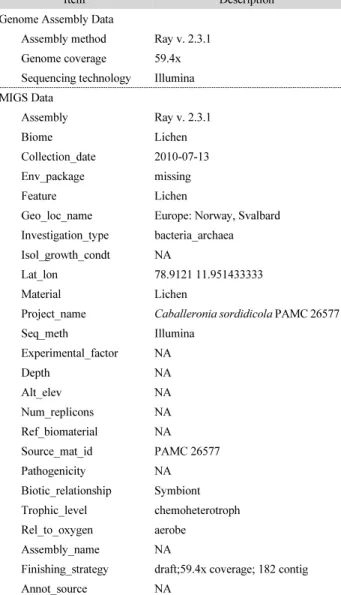
Here we report the draft genome sequence of the strain PAMC 26577 in this study (Table 1). Strain PAMC 26577 was isolated from a lichen, Cladonia sp. collected from Svalbard Archipelago in the Arctic Ocean (Lee et al., 2014). The draft
Korean Journal of Microbiology (2017) Vol. 53, No. 2, pp. 141-143 pISSN 0440-2413
DOI https://doi.org/10.7845/kjm.2017.7037 eISSN 2383-9902
Copyright ⓒ 2017, The Microbiological Society of Korea
Note (Genome Announcement)
Genome sequence of Caballeronia sordidicola strain PAMC 26577 isolated from Cladonia sp., an Arctic lichen species
Jhung Ahn Yang
1, Soon Gyu Hong
2, and Hyun-Myung Oh
1*
1
Department of Marine-Bio Convergence Science, Specialized Graduate School Science & Technology Convergence, Pukyong National University, Busan 48547, Republic of Korea
2
Division of Polar Life Sciences, Korea Polar Research Institute, Incheon 21990, Republic of Korea
북극 지의류 Cladonia 종에서 분리한 Caballeronia sordidicola 균주 PAMC 26577의 유전체 서열 분석
양정안
1・ 홍순규
2・ 오현명
1*
1
부경대학교 과학기술융합전문대학원,
2극지연구소
(Received June 8, 2017; Accepted June 8, 2017)
*For correspondence.
E-mail: [email protected];Tel.: +82-51-629-6869; Fax: +82-51-629-6865
142
∙ Yang et al.미생물학회지 제53권 제2호
genome sequence was determined using Illumina and assembly software was Ray software (v.2.3.1) as we used in previous methods (Kim et al., 2017); assembly of genome analysis were carried out with 23-mer search option with the longest N50 and largest contig numbers. Bedtools (bedtools genomecov; aka
“genomeCoverageBed” v. 2.25.0) (Quinlan and Hall, 2010) was used to calculate genome coverage; Illumina reads aligned in *.bam file corresponded to 59.4x coverage depth (Table 1).
Contigs with no CDS features and contigs shorter than 500 base pairs were excluded. Finally 182 contigs were submitted to GenBank and N50 value was 159,226. The draft genome of PAMC 26577 was comprised of 8,334,211 base pairs with
59.4% G+C content.
The genome included 8,065 protein coding sequences by the methods described in the previous study (Kim et al., 2017). The genome included 8 ribosomal RNA genes and 51 tRNA genes.
Numbers of metabolic genes involved in central metabolism of carbohydrate, amino acid, nucleotides, vitamins, and cofactors indicated that PAMC 2657 may be a metabolic generalist affi- liated with lichen species. More than seven-hundred carbohydrate- related genes could be annotated and genes for butanol/butyrate biosynthesis genes and polyhydroxybytyrate (PHB) metabolism were presented as it was found among some Betaproteobacteria (Garrity et al., 2005). Propionyl-CoA/propionate metabolism genes were well-conserved. Ribulose monophosphate pathway was missing but serine cycle methylotrophy genes existed for the ability to fix C
1-compound. Polysaccharide metabolism genes included glycogen utilization genes. PAMC 26577 genome presented glycogen synthases, glycogen phosphorylase, amy- lomaltase, branching and debranching enzymes of glycogen.
Chitinase could not be found but N-acetylglucosamine-6- phosphate gene could be annotated. Ammonia and nitrate assimilatory genes were presented. Stress genes included heat shock and cold shock protein encoding sequences as well as osmotic and oxidative stress genes were more than a hundred in number. Membrane transporter genes existed more than two hundreds in number and they included ABC transporters for branched amino acids and peptides, cation metal transporters (Mg, Ni, Co, and Cu ions), Ton and Tol transporter system, protein secretion system Type I,II,IV,V,VI,VII. Sugar phos- photransferase system and TRAP transporter were lacking.
By using the CRISPRDetect program analysis (Biswas et al., 2016), there were no contigs that have clustered regularly interspaced short palindromic repeat (CRISPR) sequence of the strain PAMC 26577. No CRISPR-associated proteins could be annotated and no transposable elements were observed. There are phage remnant regions demarcated with 11 phage-related genes and they included four independent of phage tail genes.
Nucleotide sequence accession number(s)
This Whole Genome Shotgun project Caballeronia sordidicola strain PAMC 26577 has been deposited at DDBJ/ENA/GenBank under the accession NBTZ00000000. The version described in this paper is version NBTZ01000000.
Table 1. Caballeronia sordidicola strain PAMC 26577 genome assembly and its general features
Item Description
Genome Assembly Data
Assembly method Ray v. 2.3.1 Genome coverage 59.4x Sequencing technology Illumina MIGS Data
Assembly Ray v. 2.3.1 Biome Lichen Collection_date 2010-07-13 Env_package missing Feature Lichen
Geo_loc_name Europe: Norway, Svalbard Investigation_type bacteria_archaea Isol_growth_condt NA
Lat_lon 78.9121 11.951433333
Material Lichen
Project_name Caballeronia sordidicola PAMC 26577 Seq_meth Illumina
Experimental_factor NA Depth NA
Alt_elev NA
Num_replicons NA Ref_biomaterial NA
Source_mat_id PAMC 26577 Pathogenicity NA
Biotic_relationship Symbiont Trophic_level chemoheterotroph Rel_to_oxygen aerobe
Assembly_name NA
Finishing_strategy draft;59.4x coverage; 182 contig Annot_source NA
Genome sequence of C. sordidicola strain PAMC 26577∙
143
Korean Journal of Microbiology, Vol. 53, No. 2
적 요
Caballeronia sordidicola 균주 PAMC 26577은 다산 기지 근 처에서 채집된 지의류인 Cladonia 종에서 분리되었다. Illumina 방식으로 분석한 균주 PAMC 26577의 초안 유전체 서열은 182개의 콘티그로 이루어졌으며, N50값은 159,226 염기쌍 길 이에 해당하였다. 초안 유전체로 총 8,334,211 염기쌍을 확인 하였으며, 59.4% G+C 함량을 나타냈다. 유전체는 단백질을 코드하지 않는 8개의 rRNA 유전자와 51개의 tRNA 유전자를 포함하였다. 8,065개의 단백질 유전자는 기본 대사 과정뿐 아 니라 부탄올/부티르산 생합성, 폴리하이드록시부티르산 대 사, serine cycle methylotrophy 및 글라이코겐 대사 유전자들 을 가지고 있었다. 2백개 이상의 막 전달 단백질은, 인산화 전 달 시스템과 TRAP 전달시스템이 부재하였다. PAMC 26577 은 CRISPR 관련 서열 및 단백질이 없었으며, 파아지 유전자의 감염흔적으로 인한 11개의 파아지 관련 유전자를 찾아낼 수 있었다.
Acknowledgements
This work was supported by a Research Grant of Pukyong National University.
References
Biswas, A., Staals, R.H.J., Morales, S.E., Fineran, P.C., and Brown, C.M. 2016. CRISPRDetect: A flexible algorithm to define CRISPR arrays. BMC Genomics 17, 356.
Dobritsa, A.P. and Samadpour, M. 2016. Transfer of eleven species of the genus Burkholderia to the genus Paraburkholderia and proposal of Caballeronia gen. nov. to accommodate twelve species of the genera Burkholderia and Paraburkholderia. Int. J.
Syst. Evol. Microbiol. 66, 2836–2846.
Garrity, G.M., Bell, J.A., and Lilburn, T. 2005. Class II. Betaproteo- bacteria class. nov., pp. 575–922. Bergey’s manual® of systematic bacteriology, Springer.
Kim, J., Kwon, K.K., Kim, B.K., Hong, S.G., and Oh, H.M. 2017.
Genome sequence of Caballeronia sordidicola strain PAMC 26592 isolated from an arctic lichen species. Korean J. Microbiol.
53.
Lee, Y.M., Kim, G., Jung, Y.J., Choe, C.D., Yim, J.H., Lee, H.K., and Hong, S.G. 2012. Polar and Alpine Microbial Collection (PAMC):
a culture collection dedicated to polar and alpine microorganisms.
Polar Biol. 35, 1433–1438.
Lee, Y.M., Kim, E.H., Lee, H.K., and Hong, S.G. 2014. Biodiversity and physiological characteristics of Antarctic and Arctic lichens- associated bacteria. World J. Microbiol. Biotechnol. 30, 2711–
2721.
Quinlan, A.R. and Hall, I.M. 2010. BEDTools: a flexible suite of utilities for comparing genomic features. Bioinformatics 26, 841–
842.