*Corresponding Author : Seon-Hee Ko([email protected]) Received July 22, 2019
Accepted September 20, 2019
Revised August 21, 2019 Published September 28, 2019
The Effects of Authentic Leadership on Psychological Well-being and Job Performance - Focused on Airline Flight Attendants
Seon-Hee Ko
Professor, Department of Airline Service, Seowon University
진정성리더십이 심리적 웰빙과 직무성과에 미치는 영향 - 항공사 승무원을 중심으로
고선희
서원대학교 항공서비스학과 교수
Abstract This study intends to examine how authentic leadership affects psychological well-being and job performance among flight attendants. To test hypotheses, this study performed survey to flight attendants of big airlines in Korea for about two months from October 1 to December 5, 2018. 200 copies of the questionnaire was distributed, and 180 were collected. Among them, 21 copies where many questions were unanswered or not very seriously answered were discarded. So, 159 copies in total were used for analysis. Statistical analysis was done with SPSS 22.0 and AMOS 21.0. The results are as follows. First, balanced information processing, self–awareness, self–awareness have significant effect on psychological well-being, while relational transparency have not. Second, psychological well-being have significant effect on job performance. Consequently, all the hypotheses in this study except for hypothesis 1-3 were adopted.
Key Words : Authentic Leadership, Psychological Well-being, Job Performance, Airline Service, Flight Attendants
요 약 본 연구에서는 객실승무원이 지각하는 진정성리더십이 부하의 심리적 웰빙과 직무성과에 어떠한 영향을 미치는 지 논의하고자 한다. 가설을 검증하기 위하여 국내에 운항중인 대형항공사 객실승무원을 대상으로 2018년 10월 1일부 터 12월 5일까지 약 2개월 간 설문조사를 실시하였다. 설문지는 총 200부를 배포하여 180부가 회수 되었으며, 총159 부를 실증분석에 이용하였다. 본 연구의 자료 통계분석은 SPSS 22.0과 AMOS 21.0을 이용하였다. 분석결과는 아래와 같다. 첫째, 진정성 리더십 중 균형적 정보처리, 자아인식, 내면화된 도덕관점은 심리적 웰빙에 유의한 영향을 미치는 것으로 나타나 채택되었다. 반면 진정성리더십 중 관계적 투명성은 심리적 웰빙에 유의한 영향을 미치지 않는 것으로 나타나 기각되었다. 둘째, 항공사 승무원이 지각하는 심리적 웰빙은 직무성과에 유의한 영향을 미칠 것 이라는 유의한 경로계수를 보여 채택되었다. 따라서 본 연구에서 설정한 가설 중 가설 1-3을 제외한 나머지 가설은 모두 채택되었다.
주제어 : 진정성리더십, 심리적웰빙, 직무성과, 항공서비스, 항공사승무원
1. Introduction
Recently, with rapidly changing market characteristics and technology, firms, which want to produce maximum effects with limited number of workers, need to have leaders who will effectively lead those workers. Leader plays important role by making members of an organization adjust themselves properly to the organizational environment and efficiently achieve the organizational goals, and maximize management performance[1].
Transactional leadership and transformational leadership suggested by Burns(1978)[2] and revised by Bass(1990)[3] have been dealt with by many leadership researches. However, some have raised the necessity to deal with a new leadership different from existing leadership explained by characteristics theory, behavioral theory, and situational theory.
Gallup Leadership Institute at the University of Nebraska-Lincoln suggested authentic leadership.
It is a leadership based on transformational leadership and ethical leadership, and which can get respect and trust from the society and organizational members. Later, some suggested the need to integrate transformational leadership, charismatic leadership, and ethical leadership into a new leadership, and the concept of authentic leadership as a desirable leadership style was born.
Authentic leadership was treated as an important agenda by Leadership Quarterly, one of famous journal dealing with leadership. Authentic leadership was conceptualized by Avolio &
Gardner (2005)[4]. Later, the measurement scale of authentic leadership, with the development of ALQ (Authentic leadership questionnaire), authentic leadership could be credited as a good concept of leadership[5]. According to Avolio &
Gardner, authentic leadership is defined as something in which a leader, with clear life goals and values, leads with his or her own beliefs and
warm heart.
According to Luthans & Avolio (2003)[6], as authentic leader is self-confident, hopeful, positive, elastic, moral, and future-oriented, the leader is honest to himself or herself and is always trying to change and develop. As described up to now, authentic leadership has been dealt with by many scholars. The most widely accepted definition of authentic leadership is what Avolio & Gardner (2005)[4] suggested. "A pattern of leader who promotes active self-development, and who can create positive mental capacities and ethical atmosphere, in the sense that he or she works with followers to promote self–awareness, balanced information processing, internalized moral perspective and relational transparency", while the definition looks complex, it contains many aspects of authentic leadership[7].
First, self-awareness means clear awareness about oneself around the situation where one is located. Balanced information processing means the process in which one views something with non-biased and objective viewpoints. Relational transparency means to express oneself honestly to others. Internalized moral perspective means to behave on the standard of one's own internal moral values[5,6].
Authentic leadership is dealt with roughly in three aspects. First is a research on definition of authentic leadership and components of it.
Second is on the relationship between authentic leadership and resulting variables. Third is on what mechanism affects the relationship between authentic leadership and resulting variables, that is, what works as mediating or moderating variables in the relationship.
This study intends to examine how authentic leadership affects psychological well-being and job performance. Psychological well-being is a concept, which exceeds daily happiness and joy and the degree of happiness one feels as a social being[8,9]. It is a concept differentiated from pleasure well-being, and is deep happiness and
self-seeking exceeding current joy and satisfaction[10,11]. Ryff & Keyes(1995)[12] based on existing researches, developed a psychological well-being scale, and divided it into different sub-elements of it: self- acceptance, positive relations with others, autonomy, environmental mastery, purpose in life, and personal growth.
To organizational members, happiness is an important process to find meanings in the organization which they belong to and the works they are engaged in and it has important effect on life in general beyond the organization. As psychological well-being is a criterion by which one can evaluate one's life as a member of society[9,13] and by which one can judge one's life as a member of an organization, and is closely related with happiness, we can view that it is also closely related with authentic leadership.
Authentic leader tries to reduce the gap between himself in real world and himself in ideal world through behavior regulation based on self-consciousness. Thus, the image of a leader who tries to overcome limits of oneself and come close to reasonable oneself promotes psychological well-being of employees[14]. Many researches have proven that psychological well-being and job performance are significantly related[15,16].
Namely, we can expect that psychologically happy workers perform better in job-related behavior than unhappy ones. Consequently, based on above existing researches, this study set the following hypotheses on the relationship between authentic leadership, psychological well-being, and job performance.
Hypothesis 1: Authentic leadership will have significant positive effect on psychological well-being.
Hypothesis 2: Psychological well-being will have significant positive effect on job performance.
2. Materials and Methods
To test hypotheses, this study performed survey to flight attendants of big airlines in Korea for about two months from October 1 to December 5, 2018. Before survey, the aim of the survey was explained to respondents who were waiting for the next flight in office. Owing to limits of time and expenses, convenience sampling, one of non-probability sampling methods, was adopted.
The managers were excluded from the sample of this study to achieve the research purpose.
200 copies of the questionnaire was distributed, and 180 were collected. Among them, 21 copies where many questions were unanswered or not very seriously answered were discarded. So, 159 copies in total were used for analysis. Statistical analysis was done with SPSS 22.0 and AMOS 21.0.
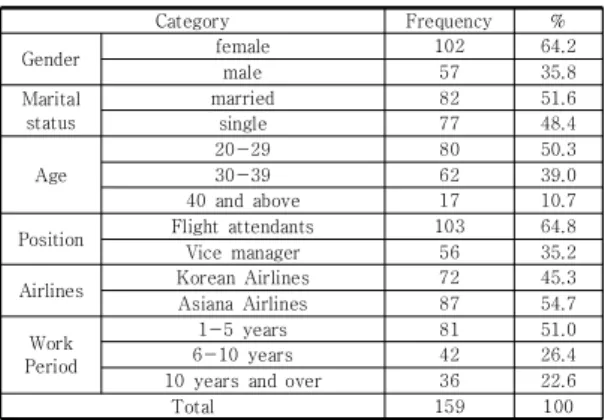
To find out demographic characteristics of respondents, frequency analysis was performed.
To test reliability and validity of the data, confirmatory factor analysis was done. To secure discriminant validity, correlation analysis was done. Finally, to figure out relations among variables, structural equation modeling was done.
3. Empirical Analysis 3.1 Demographic characteristics
Category Frequency %
Gender female 102 64.2
male 57 35.8
Marital status
married 82 51.6
single 77 48.4
Age
20-29 80 50.3
30-39 62 39.0
40 and above 17 10.7
Position Flight attendants 103 64.8
Vice manager 56 35.2
Airlines Korean Airlines 72 45.3
Asiana Airlines 87 54.7
Work Period
1-5 years 81 51.0
6-10 years 42 26.4
10 years and over 36 22.6
Total 159 100
Table 1. Demographic characteristics
3.2 Reliability
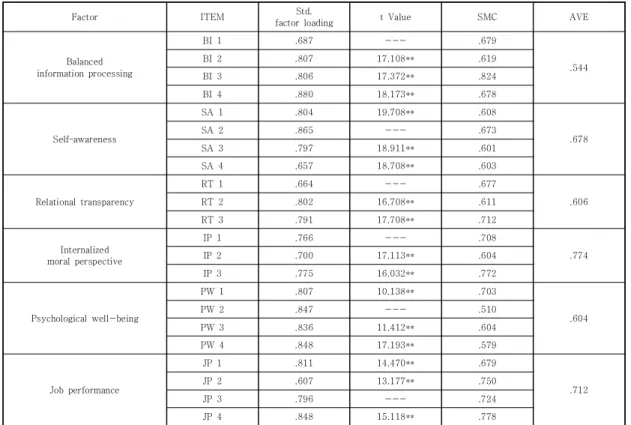
To confirm reliability and validity of construct concepts and question items, this study did confirmatory factor analysis. The findings are shown in Table 2, which contain estimates and standardized estimates of all questions.
Standardized estimates range from .607 to .880 and all the questions are significant at .001 level.
Goodness-of-fit which tests whether the model fits the data shows that the model is acceptable.
The statistics are as follows: χ²=415.001, df=181, p<.001, χ²/df=2.292, CFI=.951, and IFI=.907.
RMSEA is .043, lower than the critical value .08, satisfying the requirement of goodness-of-fit[17].
And, GFI=.900, and AGFI=.890, which are lower than recommended value .9. But, as all other values satisfy requirements, goodness-of-fit is acceptable.
Table 3 shows correlation matrix to test convergent validity and discriminant validity. Average Variance
A B C D E F
Balanced
information processing: A .737
Self–awareness: B .442 .823
Relational transparency: C .315 .521 .778
Internalized
moral perspective: D .337 .335 .441 .879
Psychological well-being: E .209 .302 .509 .540 .777
Job performance: F .348 .319 .445 .277 .341 .843
all correlations are significant at p<0.01(2-tailed), diagonal value: square root AVE Table 3. Correlation Matrix
Factor ITEM Std.
factor loading t Value SMC AVE
Balanced information processing
BI 1 .687 --- .679
.544
BI 2 .807 17.108** .619
BI 3 .806 17.372** .824
BI 4 .880 18.173** .678
Self–awareness
SA 1 .804 19.708** .608
.678
SA 2 .865 --- .673
SA 3 .797 18.911** .601
SA 4 .657 18.708** .603
Relational transparency
RT 1 .664 --- .677
.606
RT 2 .802 16.708** .611
RT 3 .791 17.708** .712
Internalized moral perspective
IP 1 .766 --- .708
.774
IP 2 .700 17.113** .604
IP 3 .775 16.032** .772
Psychological well-being
PW 1 .807 10.138** .703
.604
PW 2 .847 --- .510
PW 3 .836 11.412** .604
PW 4 .848 17.193** .579
Job performance
JP 1 .811 14.470** .679
.712
JP 2 .607 13.177** .750
JP 3 .796 --- .724
JP 4 .848 15.118** .778
Table 2. Confirmatory Factor Analysis for the measurement model
Extracted (AVE) values for all construct concepts exceed 0.5, securing convergent validity[17] and to test discriminant validity, the squared value of each correlation coefficient and its AVE value were compared, and whether the former is lower than the latter[18]. It was found that in all the potential variables, squared values of a pair of factors and AVE value of each factor satisfied the requirement. So, discriminant validity was secured.
3.3 Results
To identify reliability and inner consistency, construct reliability (CR) values of construct concepts were identified, and all the values were over 0.7, reliability was secured[14]. To identify causal relations among concepts in this research model, this study made a structural equation model.
Goodness-of-fit of the model was χ²=402.331, df=171, p<.001, χ²/df=2.352, GFI=.921, AGFI=.895, CFI=.942, IFI=.960, and TLI=.932; RMSEA was .050, lower than the critical value .08, satisfying the criteria of goodness-of-fit of the model[17].
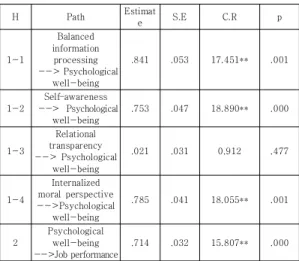
Table 4 shows the results of hypothesis tests.
Specifically, authentic leadership of boss as his members perceive is divided into sub-categories:
balanced information processing, self–awareness, relational transparency, internalized moral perspective.
Hypothesis 1-1: balanced information processing will have significant effect on psychological well-being was accepted because its path coefficient
= .841, t=17.451 satisfies the criteria. Hypothesis 1-2: self–awareness will have significant effect on psychological well-being was also accepted (path coefficient = .753, t=18.890).
Hypothesis 1-3: relational transparency will have significant effect on psychological well-being was rejected (path coefficient = .144. t=1.431).
Forth, internalized moral perspective was found to have significant effect on psychological well-being (path coefficient = =.785, t=18.055).
Finally, hypothesis 2: psychological well-being will have significant effect on job performance was accepted (path coefficient = .714, t=15.807).
H Path Estimat
e S.E C.R p
1-1
Balanced information processing --> Psychological
well-being
.841 .053 17.451** .001
1-2
Self–awareness --> Psychological
well-being
.753 .047 18.890** .000
1-3
Relational transparency --> Psychological
well-being
.021 .031 0.912 .477
1-4
Internalized moral perspective -->Psychological
well-being
.785 .041 18.055** .001
2
Psychological well-being -->Job performance
.714 .032 15.807** .000
**:=t-statistic (≧1.96) sig. level of p<0.05 Table 4. Structure model path analysis
4. Conclusion
Air service business gets increasingly competitive due to deregulation and continuous growth of low cost carriers. All the carriers try to acquire competitive edge in the global market. As cabin service is provided by flight attendants in closed space, role of flight attendants and leadership of manager are very important. Accordingly, this study set the research model that in the effect of authentic leadership on organizational performance of members, psychological well-being of members plays mediating role, and extracted construct factors, and did empirical analysis. The findings of empirical analysis are as follows.
First, among the types of authentic leadership as cabin crew perceive, balanced information processing was found to have positive effect on psychological well-being. Namely, the more boss tends to listen to opinions of his members before making decisions, and consider rational alternatives, the higher psychological well-being of flight attendants goes.
Second, among the types of authentic leadership as cabin crew perceive, self-awareness was found to have positive effect on psychological well-being.
It means that the more cabin crew perceive that their boss explains something clearly, and give feedback to improve relationship with his members, the more his members feel competent that they can do something well, feel capable, and the higher psychological well-being of flight attendants goes.
Third, among the types of authentic leadership as cabin crew perceive, relational transparency was found not to have significant effect on psychological well-being, rejecting hypothesis 1-3. That is, the fact that boss clearly expresses his ideas to others and honestly admits his mistakes does not improve psychological well-being of his members. Such a result seems to be caused by the fact that cabin crew do not consider relational transparency as important, unlike other factors in authentic leadership.
Forth, among the types of authentic leadership as cabin crew perceive, internalized moral perspective was found not to have significant positive effect on psychological well-being, which means that the more cabin crew perceive that their boss behaviors along with his beliefs, the more they feel happy, and they feel happier working in airplane than doing something else.
Authentic leaders suggests high moral standards to his members and guide his members to follow them, and plays a role model of them.
And, authentic leader discuss their weaknesses transparently and honestly, they grow together.
Finally, psychological well-being as cabin crew perceive was found to have significant effect on job performance. That is, the more one is confident that one can do something well, the more one performs the work. Accordingly, to improve job performance of crew members, authentic leadership is important. Unlike other leaderships suggested up to now such as transformational leadership, ethical leadership and servant leadership, authentic leadership plays a positive role by serving as role model to his members and promoting self-development of
the leader.
This study did survey to big carriers in Korea.
In the future, it seems necessary to expand this research to cabin crew of low cost carriers. And, there should be more deep research on psychological well-being.
REFERENCES
[1] J. B. Kim. (2018). Effects of Leadership, Organizational Justice and Psychological Empowerment on Job Performance. Journal of the Korea Convergence Society, 9(12), 265-272.
DOI: 10.15207/JKCS.2018.9.12.265
[2] J. Burns. (1978). Leadership. NY: Harper & Row.
[3] B. M. Bass. (1985). Leadership and Performance Beyond Expectations,New York, Free Press.
[4] B. J. Avolio & W. L. Gardner. (2005). Authentic Leadership Development: Getting to the Root of Positive Forms of Leadership. The Leadership Quarterly, 16(3), 315-338.
http://www.riss.kr/link?id=O42786077
[5] F. O. Walumbwa, B. J. Avolio, W. L. Gardner, T. S.
Wernisberg & S. J. Peterson. (2008) Authentic Leadership:
Development and Validation of a Theory-based Measure. Journal of Management, 34(1), 89-126.
http://dx.doi.org/10.1177/0149206307308913
[6] F. Luthans & B. J. Avolio. (2003). Authentic Leadership: A Positive Development Approach. In K.
S. Cameron, J. E. Dutton, & R. E. Quinn (Eds.). Positive Organizational Scholarship. San Francisco, CA:
Barrett-Koehler, 241-261.
[7] T. J. Leem, B. K. Kim & H. J. Choi. (2017). The Effect of Authentic Leadership on Relation Between Participative Budgeting and Budgetary Slack. Journal of the Korea Convergence Society, 8(11), 343-352.
DOI: 10.15207/JKCS.2017.8.11.343
[8] J. Menard & L. Brunet. (2011). Authenticity and Well-being in the Workplace: A Mediation Model.
Journal of Managerial Psychology, 26(4), 331-346.
DOI: 10.1108/02683941111124854
[9] R. M. Ryan & E. L. Deci. (2001). On Happiness and Human Potential: A Review of Research on Hedonic and Eudaemonic Well-being. Annual Review of Psychology, 52(1), 141-207.
DOI: 10.1146/annurev.psych.52.1.141
[10] M. E. P. Seligman. (2002). Authentic Happiness: Using the New Positive Psychology to Realize your Potential for Lasting Fulfillment,New York: Free Press.
[11] A. S. Waterman, S. J. Schwartz, B. L. Zamboanga, R.
D. Ravert, M. K. Williams, B. Agocha, S. Y. Kim & M.
B. Donnellan. (2010). The Questionnaire for Eudaimonic Well-Being: Psychometric Properties, Demographic Comparisons, and Evidence of Validity.
Journal of Positive Psychology, 5(1), 41-61.
DOI: 10.1080/17439760903435208
[12] C. D. Ryff & C. L. M. Keyes. (1995). The Structure of Psychological Well-Being Revisited. Journal of Personality and Social Psychology, 69(4), 719-746.
MEDLINE®/PubMed® British Library
[13] J. M. Kang & J. O. Kwon. (2017). A Convergence Effect of Positive Psychological Capital and Psychological Well-being on Work Engagement of Medium and Small Hospitals Nurses. Journal of the Korea Convergence Society, 8(4), 89-99.
DOI: 10.15207/JKCS.2017.8.4.089
[14] R. Ilies, F. P. Morgeson & J. D. Nahrgang. (2005).
Authentic Leadership and Eudaimonic Well-Being:
Understanding Leader-follower Outcomes. The Leadership Quarterly, 16(3), 373-394.
DOI: 10.1016/j.leaqua.2005.03.002
[15] T. A. Wright & D. G. Bonett. (1997). The Role of Pleasantness and Activation-Based Well-Being in Performance Prediction. Journal of Occupational Health Psychology, 2(3), 212-221.
DOI : 10.1037/1076-8998.2.3.212
[16] T. A. Wright, D. G. Bonett & D. A. Sweeney. (1993).
Mental Health and Work Performance: Results of a longitudinal field study. Occupational and Organizational Psychology, 66, 277-284.
DOI : 10.1111/j.2044-8325.1993.tb00539.x
[17] R. P. Bagozzi & Y. Yi. (1988). On the evaluation of structural equation models. Journal of the Academy of Marketing Science. 16(1), 74-94.
DOI : 10.1007/BF02723327
[18] C. Fornell & D. F. Larcker. (1981). Evaluating structural equation models with unobservable variables and measurement error. Journal of Marketing Research, 18(1), 39-50.
DOI: 10.2307/3151312
고 선 희(Seon-Hee Ko) [정회원]
․ 1994년 2월 : 국립경상대학교 독문학 과(문학사)
․ 2008년 8월 : 경기대학교 서비스경영 (경영학석사)
․ 2011년 8월 : 경기대학교 관광경영(관 광학박사)
․ 2013년 3월 ~ 현재 : 서원대 항공서비 스학과 교수
․ 관심분야 : 관광경영, 항공서비스, 서비스품질
․ E-Mail : [email protected]