Journal of Internet Computing and Services(JICS) 2018. Feb.: 19(1): 113-122 113
Roles of Authentic Leadership, Psychological Empowerment and Intrinsic Motivation on
Workers’ Creativity in e-business
함 상 우* Sang-Woo Hahm
ABSTRACT
In today’s rapidly changing environment, companies need to have proper strategies in place to meet the challenges that constant change presents. Being flexible, responding and adapting to changes can be valuable. However, they are essentially passive ways of dealing with situations. Creating new values and innovation are more active and effective strategies fora constantly changing environment. As such, most companies in e-business should focus on developing creativity across the board. Employees’ creativity has become a critical factor in e-business. This paper explains how to increase workers’ creativity through authentic leadership and psychological empowerment. As it is not machines or computers, but people, that are ultimately still responsible for creating novel outcomes, this study emphasizes the overriding importance of members’ ability and leader’s roles, which greatly influence followers’
levels of motivation. Authentic leadership encourages members to reach and display their potential, and enhances their intrinsic motivation. Moreover, members’ psychological empowerment is directly associated with both intrinsic motivation and autonomy, preconditions for creativity. Hence, these two dimensions- leadership and an individual’s psychological state- will increase workers’
creativity, which works to increase performance and create more opportunities not only at the individual level, but also at the team or organization level. The purpose of this paper is to explain the effects of authentic leadership on creativity and the moderating effects of psychological empowerment between authentic leadership and creativity in the e-business environment.
☞ Keyword : creativity, authentic leadership, psychological empowerment, e-business
1. Introduction
Electronic business (e-business) refers to the practice of using the internet to network and empower business processes, e-commerce, organizational communication, and associations within a firm and with its consumers, suppliers, and stakeholders. The internet has transformed the business environment, making it both stronger and more competitive, and these days leaders must understand its unique attributes to build effective and efficient models and exploit the myriad chances that its use presents. The development and usage of the internet for e-business
1 College of Business Administration, Soongsil University, Seoul, 06978, Korea.
* Corresponding author ([email protected])
[Received 2 June 2017, Reviewed 12 June 2017(R2 26 July 2017, R3 30 October 2017, R4 9 November 2017), Accepted 11 December 2017]
☆ A preliminary version of this paper was presented at ICONI 2016 and was selected as an outstanding paper.
purposes has presented some strategic challenges to leaders as they need to keep on top off a rapidly changing and highly competitive environment [1, 2].
To counter this, enterprises need to search for creative and valuable solutions [3]. Moreover, most companies began to realize their future as one of sustainable development when they first start creating shared values [4]. To improve a competitive advantage in a dynamic environment, leaders should develop specific strategies to exploit the opportunities that novel information technology can promote. Organizations need to have creativity and innovation at the center of their organizational culture and a climate that supports creating a consistent current of new information and knowledge. In this way they can create new and novel values [1-2, 5-6]. Rising costs, global competition, and the rapid changes in the e-business environment require the flexible and quick adaptation of creativity and innovation [7, 8]. Thus companies must use creative technology and novel information [9, 10], and ISSN 2287-1136 (Onine)
http://www.jksii.or.kr
to run a successful e-business, managers should focus on organizational creativity, which creates new values for the future. Moreover, for the success of an organization, there is a need to understand the importance of not only technology or information, but also particular psychological factors, such as expectancy and motivation [11]. Authentic leadership has specific characteristics in which inner elements such as thoughts and experiences coincide with external factors such as expressions and actions. This type of leadership instills strong confidence, and hope in a company’s members [12-15]. The characteristics of authentic leadership play a strong role in enhancing the creativity of the members. Owing to the potential impacts of specific leadership, we emphasize the importance of psychological empowerment.
Psychological empowerment involves meaning, impact, capacity and self-determination. Because creativity can occur when an individual has autonomy and an interest in his or her work, psychological empowerment may increase creativity along with authentic leadership. Hence, this article explains how to enhance workers’ creativity through authentic leadership, psychological empowerment and their interactive effects in the e-business environment.
2. Literature review
2.1 Authentic leadership
Authenticity, although a somewhat difficult concept to define precisely, essentially means owning ones’
individual’s personal experiences, whether thoughts, emotions, needs, preferences, or beliefs, and the processes captured by the injunction to know oneself [12]. Authentic leadership studies have been emerging over the last ten years or so from the intersection of cross-disciplinary studies of leadership, cognition, psychology, positive or negative organizational behavior and business ethics [13-15]. There are several conceptual definitions for an authentic leader or leadership. First, authentic leadership is “a process that draws from both positive psychological capacities
and a highly developed organizational context, which results in both greater self-awareness and self-regulated positive behaviors on the part of leaders and associates, fostering positive self-development”
[16; p.243]. In addition, the term authentic leader refers to“leaders who are deeply aware of how they think and behave and are perceived by others as being aware of their own and others’ values/moral perspectives, knowledge, and strengths; aware of the context in which they operate; and who are confident, hopeful, optimistic, resilient, and of high moral character” [14; p .4]. Moreover, authentic leaders can be defined as people who have particular attributes such as “the role of the leader is a central component of their self-concept”, “they have achieved a high level of self-resolution or self-concept clarity”, “their goals are self-concordant”, and “their behavior is self-expressive” [17; p.399].
In addition, most definitions of authentic leadership seem to acknowledge that it involves at least four distinct sub dimensions [14, 18]. The first of these is self-awareness, which means demonstrating an understanding of how a leader makes and derives meaning from the real world, and how the process of meaning-making influences the way a leader views him or herself over time. Further, self-awareness means showing an understanding of the leader’s strengths and weaknesses, and the multifaceted nature of the self. Relational transparency, which is the second factor, refers to presenting the leader’s authentic self (as opposed to a distorted or fake self) to members. This behavior promotes trust in a leader by acknowledgement, which involves expressions of the leaders’ truthful thoughts and feelings, instead of trying to display inadequate or negative emotions. The third factor is balanced processing, which is referring to a leader who objectively analyzes all related information and opposing viewpoints before decision making. The fourth and final quality is that of internalized moral perspective. This refers to the internal moral or ethical values and standards of a leader, and their ability to adhere to them in the face of group, organizational, and social pressures [14, 19].
2.2 Psychological empowerment
Empowerment refers to sharing power and the motivational concept of self-efficacy on subordinates [20]. Empowerment can facilitate increased intrinsic motivation of tasks [18]. The concept of empowerment is composed of several aspects, namely meaning, competence, self-determination, and impact [21]. The first of these aspects, meaning, refers to the alignment of a team goal or shared purpose with an individual's ideals or standards. Meaning includes a fit between a required work role and individual characteristics such as values, belief, and behaviors. Secondly, competence is similar to self-efficacy, and refers to a person’s belief in their capability or ability to achieve a task or tasks.
Thirdly, self-determination refers to an individuals’
sense of autonomy or control in regards to their decisions and actions. Fourth, impact refers to the degree to which a person can influence various work related outcomes. To sum up, psychological empowerment is a motivational construct, which involves meaning, competence, self-determination, and impact. Empowerment involves sharing in organizations, and information availability is directly related to empowering in organizations [18, 20-22].
2.3 Creativity
Creativity is defined as the capability or ability to produce novel thoughts, new and useful ideas, and constructive results to problems by a person or a team [23-24]. Individual workers’ creativity is different from creativity in an organizational context and organizational innovation. “Creativity is the generation of new and useful ideas by individual employees, whereas innovation involves the successful implementation of creative ideas by the organization.
Thus, employees’ creativity is often the starting point for innovation” [25; p.683], especially in organizations such as e-business companies. Creativity creates valuable outcomes, which organizations require to meet environmental challenges [26]. Some companies in e-business utilize a specific team form such as a virtual team to adapt to changes and create new values. Virtual
teams are well suited for creative activities such as new product development, and their use is one example of the ways in which firms in e-business make various efforts to improve creativity. Creativity is one of the most crucial factors involved in the success of an e-business [27].
2.4 Intrinsic motivation
Motivation is defined as forces within the person that account for the direction (an individual’s choice when presented with a number of possible alternatives), level (the amount of effort a person puts forth), and persistence (the length of time a person sticks with a given action) of a person’s effort expended at work [28; p.102]. Thus, motivation refers to the psychological willingness of an individual to take a specific action such as work and study.
There are two types of motivation-intrinsic and extrinsic. Extrinsic motivation is connected to external factors of work such as rewards, praise, and reputation. In contrast, intrinsic motivation is related to factors directly related to work such as levels of interest and enjoyment. Intrinsic motivation refers to
“the doing of an activity for its inherent satisfactions rather than for some separable consequence. When intrinsically motivated a person is moved to act for the fun or challenge entailed rather than because of external prods, pressures, or rewards” [29; p.56].
2.5 Authentic leadership, psychological empowerment and creativity
Authentic leadership is “a pattern of leader behavior that draws upon and promotes both positive psychological capacities and a positive ethical climate, to foster greater self-awareness, an internalized moral perspective, balanced processing of information, and relational transparency on the part of leaders working with followers, fostering positive self-development”
[15; p.94].
An authentic leader has a positive influence on followers’ psychological capabilities such as hope, self-esteem, trust, resilience, optimism, confidence and
self-efficacy. When employees are confident and optimistic, they will be more encouraged to better meet the challenge of new tasks more often, and will be less afraid of failure, frustration or rejection. These results will inspire and cultivate a state of mind that can meet challenges; and also influence them to pursue new things and to be more creative. Moreover, characteristics of authentic leadership motivate members intrinsically, and intrinsic motivation is the key factor for creativity. Hence, authentic leadership will increase creativity [13, 16, 28-30].
In addition, authentic leaders who have higher levels of self-regulation will be more open to new challenges and experiences, and also more tolerant of ambiguity, since these leaders are less likely to be thrown off by potentially dangerous or risky ideas [31]. Thus, the following hypothesis is offered to be tested.
Hypothesis 1. Authentic leadership will increase members’ creativity.
2.6 Moderating effect of psychological empowerment
When workers in organizations have higher levels of autonomy or opportunities to decide autonomously for tasks, their creativity will be facilitated [32]. Similarly, self-determination theory asserts that when employees have autonomy, their intrinsic motivation can be enhanced, which leads to creativity being fostered, because intrinsic motivation is a powerful source of creativity [29]. Psychological empowerment involves autonomy at work, which is directly associated with self-determination. Hence, a higher level of psychological empowerment guarantees autonomy and intrinsic motivation of workers; and it can enhance creativity or make opportunities to display creativity.
Moreover, psychological empowerment can increase employees’ intrinsic motivation, which is also related to the creativity level of workers [21, 30, 33].
When people have psychological empowerment, they usually expend more effort at work and achieve
better results [33]. These empowered employees are both more powerful and passionate, and have higher goal commitment and confidence, which helps them to demonstrate initiative and creativity. Furthermore, they have the freedom to generate new and novel ideas, and confidence in their ideas. This belief makes new ideas more valuable [34-35].
In addition, when authentic leadership influences members to take on a new challenge without fear, if they have higher psychological empowerment, they will be more autonomous, intrinsically motivated, and will display more creativity [29, 31]. Hence, both authentic leadership from a leader’s perspective and psychological empowerment from a members’
perspective will simultaneously increase workers’
creativity in an e-business. Thus, the following hypothesis is offered to be
Hypothesis 2. Psychological empowerment will enhance the relationship between authentic leadership and members’ creativity.
2.7 Mediating effect of intrinsic motivation between psychological empowerment and creativity
There exists a good deal of evidence that psychological empowerment facilitates or increases creativity [30]. According to self-determination theory, workers who can decide how they work or have a higher level of work related autonomy are usually intrinsically motivated [29]. Moreover, psychological empowerment, which involves autonomy and self-determination, is “presumed to be a proximal cause of intrinsic task motivation and satisfaction”
[18; p.668]. Further, intrinsic motivation is one of the most crucial factors for creativity, and this type of motivation powerfully influences employees’ work related creativity [32].
As such, psychological empowerment can increase or influence individual’s intrinsic motivation [21].
Also Intrinsic is the most important variable for work related creativity [32]. Thus, the following hypothesis
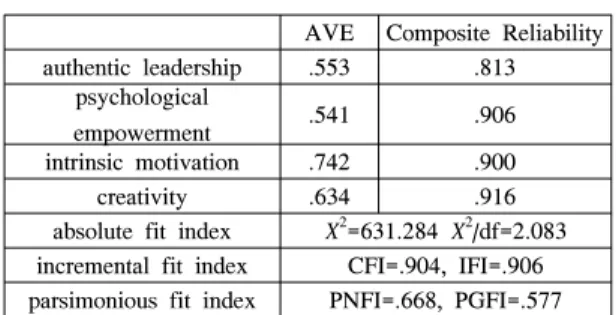
AVE Composite Reliability authentic leadership .553 .813
psychological
empowerment .541 .906
intrinsic motivation .742 .900
creativity .634 .916
absolute fit index X2=631.284 X2/df=2.083 incremental fit index CFI=.904, IFI=.906 parsimonious fit index PNFI=.668, PGFI=.577 is offered to be tested.
Hypothesis 3. Intrinsic motivation will mediate the relationship between psychological leadership and creativity.
3. Participants and Measurement
Data was collected from 135 workers who were members of e-business related companies, such as information technology companies. In terms of gender, there were 94 males (69.6%) and 41 females (30.4%).
In terms of age, 12 were in their twenties (8.9%), 89 in their thirties (65.9%), and 34 were older than 40 (25.2%). In terms of academic background, 8 had completed high school (5.9%), 85 had bachelor degrees (63%), and 42 had master degrees or doctorates (31.1%). In regards to their length of employment, 15 had worked for less than 1 year (11.1%), 43 had worked 1-5 years (31.9%), 54 had worked 5-10 years (40%), and 23 had worked longer than 10 years (17%).
All items were measured by a Likert 7 point scale.
First, authentic leadership was measured by 7 items, including, “My leader shows that he/she understands his/her strengths and weaknesses (Self-Awareness)”,
“My leader objectively analyzes relevant data before making a decision (Balanced Processing)”, “My leader openly shares information with others (Relational Transparency)”, “My leader shows consistency between his/her beliefs and actions (internalized Moral Perspective)” [35].
Second, psychological empowerment was measured by 9 items, including “The work I do is very important to me (meaning)”, “I am confident about my ability to do my job (competence)”, “I can decided on my own how to go about doing my work (self-determination)”, “I have significant influence over what happens in my department (impact)” [22].
Third, intrinsic motivation was measured by 9 items, including “I enjoy finding solutions to complex problems”, “I enjoy engaging in analytical thinking”
[36].
Finally, creativity was measured by 13 items, which included “Comes up with new and practical ideas to improve performance”, “Exhibits creativity on the job when given the opportunity to” and “Suggests new ways of performing work tasks” [25].
4. Analysis
For empirical analysis, this study used confirmatory factor analysis (CFA) for validity, Cronbach's α for reliability, correlation, and linear regression analysis.
Further, for moderating effect, the mean centering method was used. Table 1 suggests the results of the CFA, and measurements have significant validity, thus they are adopted.
(표 1) 확인적 요인분석 결과 (Table 1) Results of CFA
Table 2 shows reliability and descriptive statics such as mean and standard deviation. All factors’
Cronbach's α values are higher than 0.9, thus they have enough reliability.
(표 2) 신뢰도와 기술통계
(Table 2) Reliability and descriptive statistics Cronbach's α Mean Std. Deviation authentic
leadership .905 5.2148 1.13482
psychological
empowerment .918 5.6905 .77188
intrinsic
motivation .923 5.1704 1.12247
creativity .939 5.3605 1.19435
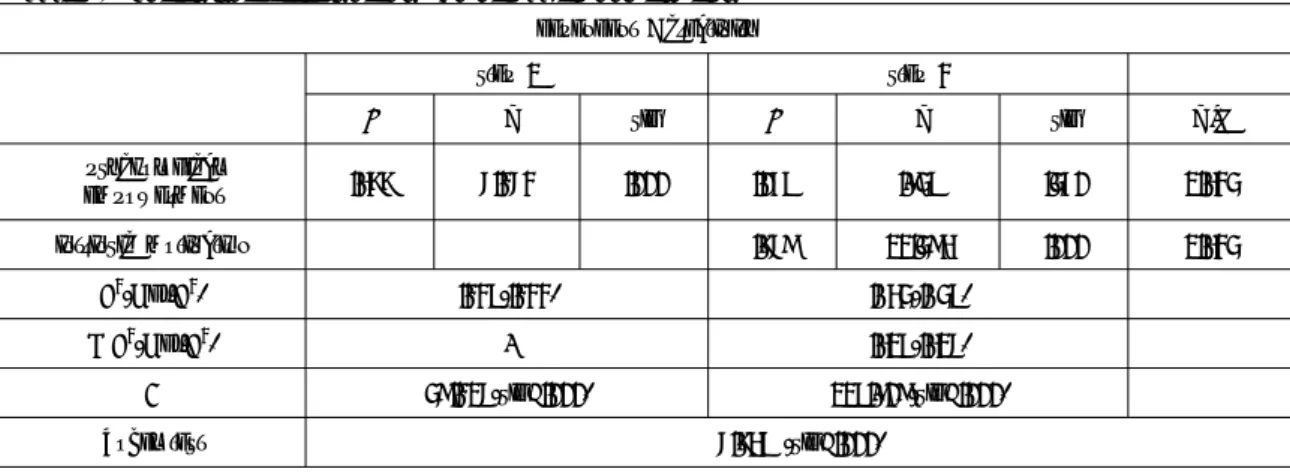
(표 4) 심리적 임파워먼트의 조절효과
(Table 4) Moderating effect of psychological empowerment dependent : creativity
step 1 step 2
β t sig β t sig VIF
psychological
empowerment .477 6.262 .000 .058 .938 .350 1.423
intrinsic motivation .769 12.394 .000 1.423
R2(Adj-R2) .228(.222) .643(.638)
⊿R2(Adj-R2) - .415(.416)
F 39.216(sig=.000) 118.909(sig=.000)
Sobel test 6.748 (sig=.000)
(그림 1) 단순기울기 (Figure 1) SIMPLE SLOPE Table 3 indicates the results of the correlation
analysis. All factors have significant and positive relationships. Since intrinsic motivation is the key factor for creativity, it has a higher level of positive correlation.
(표 3) 상관관계 분석
(Table 3) Correlation analysis
1 2 3 4
1 -
2 .491*** -
3 .642*** .545*** -
4 .534*** .477*** .800*** -
***:p<.001, **:p<.01, *:p<.05
1=authentic leadership, 2=psychological empowerment, 3=intrinsic motivation, 4=creativity
Table 4 displays the results of the linear regression analysis, and we can confirm the moderating effect of psychological empowerment between authentic leadership and creativity.
In the first step, authentic leadership and creativity demonstrate a significant relationship (β=.534, p<.001).
Hence, hypothesis 1 is supported. In the second step, authentic leadership and psychological empowerment are inserted. In the third step, a moderating factor, made by multiplying authentic leadership and psychological
empowerment are inserted. As a result, a moderating factor is significant (β=.142, p<.01), and R2 and Adjusted R2 values are increased. Hence, psychological empowerment has a significant moderating effect between authentic leadership and creativity. Thus, hypothesis 2 is supported.
Figure 1 shows a simple slope for the moderating effect of psychological empowerment. Each factor has high and low groups. The high group refers to higher than average, and the low group means lower than average. When a moves from low authentic leadership to high authentic leadership, the low level of psychological empowerment does not increase creativity much, but the higher level of psychological empowerment increases creativity more.
Table 5 indicates the mediating effect of intrinsic motivation between psychological empowerment and creativity. In step 1,
(표 5) 내재적 동기부여의 매개효과
(Table 5) Mediating effect of intrinsic motivation
dependent : creativity
step 1 step 2
β t sig β t sig VIF
psychological
empowerment .477 6.262 .000 .058 .938 .350 1.423
intrinsic motivation .769 12.394 .000 1.423
R2(Adj-R2) .228(.222) .643(.638)
⊿R2(Adj-R2) - .415(.416)
F 39.216(sig=.000) 118.909(sig=.000)
Sobel test 6.748 (sig=.000)
psychological empowerment has a significant influence on creativity (β=.477, sig=.000).
However, in step 2, although intrinsic motivation has a significant effect on creativity, psychological empowerment loses its effect on creativity. Moreover, R2 and Adjusted R2 values are increased (.643 and .638).
This result demonstrates perfectly the mediating effect of intrinsic motivation between psychological empowerment and creativity.
In addition, a Sobel test also supports the significant mediating effect of intrinsic motivation. Therefore, hypothesis 3 is supported.
5. Conclusion
5.1 Conclusion and Implications
Creativity is one of the most crucial factors in the e-business environment. Since, e-business has changed rapidly and continues to constantly evolve, workers need to create new values for the future.
A leader has a critical role in enhancing members’
creativity.
The results of this paper suggest that leaders in the e-business world should understand and demonstrate authentic leadership to enhance worker’s creativity and foster organizational success. Therefore, in e-business situations,
leaders should have authenticity. That way, followers will trust the leaders more. Trust in a leader can increase job satisfaction as well as satisfaction with the leader. In turn, higher levels of job satisfaction can positively affect the enthusiasm and intrinsic motivation of workers, which will increase their creativity. In addition, leaders in e-business should develop their self-confidence, and present hope and an optimistic future. These characteristic of authentic leadership will make members more open to challenges, and will affect creativity.
Hence, authentic leadership will enhance creativity and bring success to e-businesses.
Furthermore, members should be cognizant of psychological empowerment, which increases intrinsic motivation and creativity. Hence, we should seek to understand fully how to increase psychological empowerment in e-business situations.
Psychological empowerment is more effective when members perceive it as coming from themselves rather than their leaders [18, 21]. Hence, as a starting point, organizational policies, norms, and cultures should be set up so that members can have psychological empowerment. Furthermore, leaders and coworkers should support this. Moreover,
appropriate tasks or jobs should be given to individual members so that they can recognize psychological empowerment.
The purpose of this paper is to suggest the strategies of authentic leadership at the management level, and psychological empowerment at the individual level to enhance workers’ creativity, which will help to bring success to
organizations in e-business.
5.2 Limitations and Potential Areas of Future Study
Like authentic leadership and psychological empowerment, the effects of other leadership traits and individuals’
psychological states may increase workers’ creativity. Thus, we need to investigate the influence of new concepts of leadership such as differentiated leadership, psychological states such as engagement, and other factors such as task characteristics or organizational systems.
In this paper, we measured creativity with self-assessments.
However, self-reported measures of creativity have come in for some criticism, hence, in the future, peer or supervisor’s assessments should be used for better measurement [23-25], [34].
In addition, psychological empowerment has specific dimensions such as impact, meaning, self-determination and capacity [21], and authentic leadership has four dimensions, namely balanced processing, internalized moral perspective, relational transparency and self-awareness [37]. Hence, further studies should examine in detail these sub-dimensions’
different relationships and influences on creativity.
참 고 문 헌(Reference)
[1] C. Combe, “Introduction to E-business,” NY: Routledge, 2012.
[2] B. Stevenson, “The Impact of the Internet on Worker Flows,” Unpublished Manuscript, Wharton School of Business, University of Pennsylvania, Philadelphia, pp.
1-24, 2006.
[3] I. Ghani, and M. Bello, “Agile Adoption in IT Organizations,” KSII Transactions on Internet &
Information Systems, Vol. 9, no. 8, pp. 3231-3248, 2015.
http://dx.doi.org/10.3837/tiis.2015.08.029
[4] I. K. Song, and J. Chun, “Evolving Internet Information
& Technology as Enablers for Creating Shared Values,”
KSII Transactions on Internet & Information Systems, Vol. 9, no. 1, pp. 309-317, 2015.
http://dx.doi.org/10.3837/tiis.2015.01.018
[5] K. Y. Kim, “Business Intelligence and Marketing Insights in an Era of Big Data: The Q-sorting Approach,” KSII Transactions on Internet & Information Systems, Vol. 8, no. 2, pp. 567-582, 2014.
http://dx.doi.org/10.3837/tiis.2014.02.014
[6] N. Niknejad, I. Ghani, and S. R. Jeong, “Relationship between SOA Adoption and Performance of IT Organizations,” Journal of Internet Computing and Services, Vol. 17, no. 4, pp. 173-180, 2016.
http://dx.doi.org/10.7472/jksii.2016.17.4.173
[7] P. Gloor, “Making the E-business Transformation,”
Springer Science & Business Media, 2012.
[8] K. McElheran, “Do Market Leaders Lead in Business Process Innovation? The Case (s) of E-business Adoption,” Management Science, Vol. 61, no. 6, pp.
1197-1216, 2015.
http://dx.doi.org/10.1287/mnsc.2014.2020
[9] C. Ren, and S. Wang, “Managing Flow Transfers in Enterprise Datacenter Networks with Flow Chasing,”
KSII Transactions on Internet & Information Systems, Vol. 10, no. 4, pp. 1519-1534, 2016.
http://dx.doi.org/10.3837/tiis.2016.04.003
[10] M. Song, J. D. Cho, and J. Jeong, “Global Mobility Management Scheme for Seamless Mobile Multicasting Service Support in PMIPv6 Networks,” KSII Transactions on Internet & Information Systems, Vol. 9, no. 2, pp. 637-658, 2015.
http://dx.doi.org/10.3837/tiis.2015.02.009
[11] S. Liu, X. Wang, L. Zhang, P Li, Y Lin, and Y. Yang,
“A Social Motivation-aware Mobility Model for Mobile Opportunistic Networks,” KSII Transactions on Internet
& Information Systems, Vol. 10, no. 8, pp. 3568-3584, 2016.
http://dx.doi.org/10.3837/tiis.2016.08.008
[12] M. Morishima, “Information Sharing and Firm Performance in Japan,” Industrial Relations: A Journal of Economy and Society, Vol. 30, no. 1, pp. 37-61, 1991.
http://dx.doi.org/10.1111/j.1468-232X.1991.tb00774.x [13] B. J. Avolio, W. L. Gardner, F. O. Walumbwa, F.
Luthans, and D. R. May, “Unlocking the Mask: A Look at the Process by Which Authentic Leaders Impact Follower Attitudes and Behaviors,” The Leadership Quarterly, Vol. 15, no. 6, pp. 801-823, 2004.
http://dx.doi.org/10.1016/j.leaqua.2004.09.003
[14] S. Harter, S, “Authenticity”. In C. R. Snyder, & S.
Lopez (Eds.), Handbook of positive psychology, Oxford, UK7 Oxford University Press, pp. 382-394, 2002 [15] F. O. Walumbwa, B. J. Avolio, W. L. Gardner, T. S.
Wernsing, and S. J. Peterson, “Authentic Leadership:
Development and Validation of A Theory-based Measure,” Journal of Management, Vol. 34, no. 1, pp.
89-126, 2008.
http://dx.doi.org/10.1177/0149206307308913
[16] F. Luthans, and B. Avolio, “Authentic Leadership Development,” in Cameron, K S.Dutton, J E. and Quinn, R. E. Eds., “Positive organizational scholarship:
Foundations of a new discipline,” Berrett-Koehler Publishers, pp. 241-258, 2003.
[17] B. Shamir, and G. Eilam, “What's Your Story? A Life-stories Approach to Authentic Leadership Development,” The Leadership Quarterly, Vol. 16, no.
3, pp. 395-417, 2015.
http://dx.doi.org/10.1016/j.leaqua.2005.03.005
[18] K. W. Thomas, and B. A. Velthouse, “Cognitive Elements of Empowerment: An “Interpretive” Model of Intrinsic Task Motivation,” Academy of Management Review, Vol. 15, no. 4, pp. 666-681, 1990.
http://dx.doi.org/10.5465/AMR.1990.4310926
[19] B. J. Avolio, and W. L. Gardner, “Authentic Leadership Development: Getting to the Root of Positive Forms of Leadership,” The Leadership Quarterly, Vol. 16, no. 3, pp. 315-338, 2005.
http://dx.doi.org/10.1016/j.leaqua.2005.03.001
[20] C. A. Conger, and R. N. Kanungo, “The Empowerment Process: Integrating Theory and Practice,” Academy of Management Review, Vol. 13, no. 3, pp. 471-482, 1988.
http://dx.doi.org/10.5465/AMR.1988.4306983
[21] G. M. Spreitzer, “Psychological Empowerment in the Workplace: Dimensions, Measurement, and Validation,”
Academy of Management Journal, Vol. 38, no. 5, pp.
1442-1465, 1995.
http://dx.doi.org/10.2307/256865
[22] R. M. Kanter, “The New Managerial Work,” Harvard Business Review, Vol. 67, no. 6, pp. 85-92, 1989.
https://www.ncbi.nlm.nih.gov/pubmed/10303993 [23] T. M. Amabile, “A Model of Creativity and Innovation
in Organizations,” Research in Organizational Behavior, Vol. 10, no. 1, pp. 123-167, 1988.
[24] J. Zhou, and C. E. Shalley, “Research on Employee Creativity: A Critical Review and Directions for Future Research,” Research in Personnel and Human Resources Management, Vol. 22, pp. 165-218, 2003.
[25] J. Zhou, and J. M. George, “When Job Dissatisfaction Leads to Creativity: Encouraging the Expression of Voice,” Academy of Management Journal, Vol. 44, no.
4, pp. 682-696, 2001.
http://dx.doi.org/10.2307/3069410
[26] A. Bandura, “Social Foundations of Thought and Action:
A social Cognitive Theory,” NY: Prentice-Hall, 1986.
[27] R. T. A. Leenders, J. M. Van Engelen, and J. Kratzer,
“Virtuality, Communication, and New Product Team Creativity: A Social Network Perspective,” Journal of Engineering and Technology Management, Vol. 20, no.
1, pp. 69-92, 2003.
http://dx.doi.org/10.1016/S0923-4748(03)00005-5 [28] R. Ilies, F. P. Morgeson, and J. D. Nahrgang, “Authentic
Leadership and Eudaemonic Well-being: Understanding Leader–follower Outcomes,” The Leadership Quarterly, Vol. 16, no. 3, pp. 373-394, 2005.
http://dx.doi.org/10.1016/j.leaqua.2005.03.002
[29] X. Zhang, and K. M. Bartol, “Linking Empowering Leadership and Employee Creativity: The Influence of Psychological Empowerment, Intrinsic Motivation, and Creative Process Engagement,” Academy of Management Journal, Vol. 53, no. 1, pp. 107-128, 2010.
http://dx.doi.org/10.5465/AMJ.2010.48037118
[30] X. Zhang, and K. M. Bartl, “Linking Empowering Leadership and Employee Creativity: The Influence of Psychological Empowerment, Intrinsic Motivation, and Creative Process Engagement,” Academy of Management Journal, Vol. 53, no. 1, pp. 107-128, 2010.
http://dx.doi.org/10.5465/AMJ.2010.48037118
[31] M. Černe, M. Jaklič, and M. Škerlavaj, “Authentic Leadership, Creativity, and Innovation: A Multilevel Perspective,” Leadership, Vol. 9, no. 1, pp. 63-85, 2013.
http://dx.doi.org/10.1177/1742715012455130
[32] T. M. Amabile, R. Conti, H. Coon, J. Lazenby, and M.
Herron, “Assessing the Work Environment for Creativity,” Academy of Management Journal, Vol. 39,
◐ 저 자 소 개 ◑
함 상 우(Sang-Woo Hahm) 2004년 숭실대학교 경영학학사 2007년 숭실대학교 경영학석사 2014년 숭실대학교 경영학박사
2015년∼현재 숭실대학교 경영대학 경영학부 조교수 관심분야: 조직행동, 융합연구, e-business, information no. 5, pp. 1154-1184, 1996.
http://dx.doi.org/10.2307/256995
[33] R. M. Ryan, and E. L. Deci, “Intrinsic and Extrinsic Motivations: Classic Definitions and New Directions,” Contemporary Educational Psychology, Vol.
25, no. 1, pp. 54-67, 2000.
http://dx.doi.org/10.1006/ceps.1999.1020
[34] L. Y. Sun, Z. Zhang, J. Qi, and Z. X. Chen,
“Empowerment and Creativity: A Cross-level Investigation,” The Leadership Quarterly, Vol. 23, no. 1, pp. 55-65, 2012.
http://dx.doi.org/10.1016/j.leaqua.2011.11.005
[35] B. J. Alge, G. A. Ballinger, S Tangirala, and J. L.
Oakley, “Information Privacy in Organizations:
Empowering Creative and Extrarole Performance,” Journal of Applied Psychology, Vol. 91, no. 1, pp. 221-232, 2006.
http://dx.doi.org/10.1037/0021-9010.91.1.221
[36] L. L. Neider, and C. A. Schriesheim, “The Authentic Leadership Inventory (ALI): Development and Empirical Tests,” The Leadership Quarterly, Vol. 22, no. 6, pp.
1146-1164, 2011.
http://dx.doi.org/10.1016/j.leaqua.2011.09.008