ABSTRACT
This study sets out to verify the moderated mediation of followers’ identification with the leader on the indirect effect of authentic leadership on organizational cynicism via psychological contract breach.
A total of 279 responses from employees at companies with more than 500 employees and of diverse industries were used for analysis. Our findings showed that authentic leadership (X) had a negative indirect effect on organizational cynicism (Y) via psychological contract breach (M), and that this indirect effect was negatively moderated by identification with the leader, thereby identifying its role as a moderating mediator. Further verification revealed that the indirect effect (X→M→Y) was conditional upon the value of the moderating variable, where identification with the leader had a significant effect in the 25%, 50%, 75%, 90% levels, but not in the 10% level. The findings of this research empirically verified that greater exertion of authentic leadership lowers psychological contract breach among organization members and, consequently, organizational cynicism. In particular, this effect was stronger when the organization member identified him/herself more strongly with the leader. Our findings extend the body of knowledge on the relationship between authentic leadership and organizational cynicism and expands the possibilities for future research.
Keywords: Authentic leadership, Psychological contract breach, Organizational cynicism, Identification with the leader, Moderated mediation
The Effect of Authentic Leadership and Psychological Contract Breach on Organizational Cynicism:
Focusing on the Moderated Mediation of Followers’
Identification with the Leader
1Yesung Kim A Seoul School of Integrated Sciences & Technologies2 Je-Goo Shin A Seoul School of Integrated Sciences & Technologies3
1 논문접수일: 2017년 10월 12일; 2차 수정: 2017년 11월 11일; 게재 확정일: 2017년 12월 1일
This study was supported by a Seoul School of Integrated Sciences & Technology research fund.
2 First author: Ph.D. candidate, a Seoul School of Integrated Sciences & Technology ([email protected])
3 Corresponding author: Professor, a Seoul School of Integrated Sciences & Technology ([email protected])
1. Introduction
Speculand (2006) argued that when an organization attempts a strategic change, 20% of its members show resistance, 60% are indifferent, and only 20% accept the change. The cynical attitude of members toward change lead to low participation and support, causing the attempt for organizational change to fail (Reichers, Wanous and Austin 1997). To reduce the resistance to change and increase organizational commitment, organizations need to adopt strategies for reducing cynicism among organizational members. The causes of cynicism towards organizational change include degree of organizational change, ineffectiveness of the leadership, and lack of participation in decision-making, and transformational leadership (Wanous, Reichers and Austin 2000; Bommer and Rich 1999). This study sets out to analyze the specific mechanism of organizational cynicism experienced by members in the context of organizational change (Dean, Brandes and Dharwadkar 1998).
In the knowledge management era, knowledge is retained at the individual level, so organizations utilize various internal and external rewards to induce members to actively share their knowledge with other organization members. However, often, such organizational push for knowledge-sharing prove to be ineffective, and organization members resist sharing their knowledge. Knowledge- sharing is inhibited at multiple dimensions and levels: at the personal/individual level; relational dimensions (i.e., relationship with the supervisor,
colleagues, and job); and organizational dimensions (i.e., organizational culture, regulations) (Park and Chae 2017). Considering the detrimental effect of organizational cynicism at individual and organizational levels, managers of organizations need to understand and actively respond to organizational cynicism (Dean et al.
1998). Organizational cynicism causes emotional exhaustion and dehumanization among members to have a negative impact organizational performance and bring unwanted consequences such as lower quality of products and services and disruption in organizational commitment (Pfeffer 1998; Maslach, Schaufel and Leiter 2001;
Kim 2014). Because it can distort the efforts and meaning of the organization’s policies and intentions toward change, organizational cynicism must be managed to achieve the goals of the organization (Kim and Shim 2005). Despite such necessities, there still lacks sufficient theoretical and empirical research concerning organizational cynicism.
Through this study, we focus on analyzing the factors that affect the organizational cynicism among the members of the organization.
Recognizing the need for practical strategies for handling organizational cynicism from a management perspective, we highlight the role of the leadership shown by middle management as leadership is one of the most influential factors behind the attitudes and behaviors of organization members as well as organizational effectiveness. In particular, our study concentrates on what management strategies can reduce
the organizational cynicism among members to cultivate them into human resources that ultimately contribute to organizational performance.
Specifically, this study presents authentic leadership as a critical strategy to reduce organizational cynicism and examines the specific process through which psychological contract breach links authentic leadership to organizational cynicism. In addition, we verify the mechanism through which identification with the leader who exhibits authentic leadership moderates the effect of authentic leadership on organizational cynicism through psychological contract breach. Through this analysis, we anticipate that our study will contribute to the expanding the understanding of the mechanism behind authentic leadership and the organizational cynicism of members who show resistance to change.
In what follows, Sect ion 2 prov ides a literature review on the variables dealt in this study and presents the hypotheses set in this research. Section 3 and 4 illustrate the research methodology and the results of analysis and hypothesis verification. Section 5 summarizes the research f indings and discusses their theoretical and practical implications, followed by suggestions for future research in Section 6.
2. Literature Review
2.1 Authentic leadership
First, our study expects the leadership of
managers to have a significant impact on organizational cynicism. We specif ically concentrate on authentic leadership, among various leadership styles, as we anticipate authentic leadership to impact the organizational cynicism experienced by members during the process of organizational change in a meaningful way. Organization members feel more attracted to authentic leaders when facing risk, as authentic leaders exert their true vision and communicate with members (Williams, Pillai, Deptula and Lowe 2008).
Most of the existing research on the influence of leadership and organizational cynicism discuss transformational leadership. Transformational leaders charismatically present a vision and role model for their followers and provide intellectual stimulation for growth and learning as well as individual consideration and care towards members, thereby instilling in organization members the expectation that they and the organization will grow together to reduce the cynicism within the organization (Bakker, Demerauti and Verbeke 2004). The individual consideration shown by transformational leaders enhance the communication and trust between organization members and the management, and their charisma endows trust in the capacity for change, such that both can play a role in reducing organizational cynicism (Stanley, Meyer and Topolysky 2005).
Authentic leadership focuses on the process of self-reflection and self-understanding through which a leader finds his/her authentic self. An
authentic leader is a leader who is well aware of his/her strengths and weaknesses, makes decisions based on his moral values, and demonstrates transparent communication with members about his/her vision and its meaning (Avolio, Gardner, Walumbwa, Luthans and May 2004). Previous literature has identified four components or constructs of authentic leadership: self-awareness, balanced processing of information, relational transparency, and internalized moral perspective.
Aut hent ic leaders ga i n t he loya lt y of organization members not through control and coercion but by forming trusting relationships.
As authentic leaders recognize their limitations, they accept the incompleteness of others and help them to learn, grow, mature, and succeed as a result (Greenleaf 1977). A study on the mediation of the authenticity of organization members’ innovation behaviors between task conflict and relationship conflict showed that task and relationship conflicts have a significant effect on the authenticity of knowledge creation, and authenticity on innovation behavior. The authenticity of the leader plays an important role as a motivator for organization members (Heo and Cheon 2013). Authentic leadership behavior improves the image of the organization to strengthen organizational identification among members (Dutton, Dukoich and Hargual 1994). Furthermore, authentic leaders build transparent relationships with organization members by sharing not only their strengths but also weaknesses, thereby drawing trust, respect,
and voluntary imitation from members (Avolio and Gardner 2005). Authentic leaders recognize themselves as social beings and prioritize the values of the organization and community, performing necessary actions and regulating their own behavior so that those values can be realized.
In other words, authentic leaders behave as they speak (Yoon 2012).
On the individual level, the positive aspects of authenticity include better self-esteem, increased psychological well-being, and better performance (Kernis 2003). Luthans and Avolio (2008) also associated authentic leadership with positive psychological ability, hope, optimism, resilience, and self-belief or self-efficacy, where the latter is an indispensable factor for promoting the sense of ownership. Through organization members’
identification with the leader, authentic leadership can foster to higher levels of commitment, greater willingness to engage in extra-role behaviors, and higher satisfaction with the leader (Avolio and Gardner 2005).
We expect that the authentic attitude of the leader will play an important role. Authentic leaders show that they look beyond their personal gains, which prompts their subordinates to identify with the leaders as well as to hold an expectation for mutual growth that is spurred by the desire to achieve a common goal and vision.
Thus, when authentic leaders share a common goal with organization members and form mutual trust through open communication and transparent information-sharing, organizational cynicism among members will decrease.
Recent literature has also identified variables that mediate or moderate between authentic leadership and its outcome variables. According to Choi (2017) which studied the effect of authentic leadership on the speech behavior of administrative staffs at public education agencies and the mediating effect of organizational cynicism, authentic leadership had a positive influence on the member’s speech behavior with the person-job fit as a moderator. A reduction in members’ organizational cynicism is expected to increase their voluntary participation in bringing organizational change.
In this sense, authentic leadership may exert a greater influence on the attitudes and behaviors of members as an indirect effect via an unspecified mediator than as a direct effect. Previous research has found that identification with the leader indirectly impacted the mechanism through which authentic leadership affects the behavior and attitudes of organization members (Jeon, Suh, Bae and An 2010). Authentic leadership has also been found to have a positive effect on trust-in-supervisor, job satisfaction, psychological commitment, and organizational citizenship behavior, where trust-in-supervisor, in particular, completely mediated bet ween authentic leadership and its outcome variables (Moon 2015).
Authentic leadership influences organization members’ behavior and attitude through the natural transference of the leader’s value-based behavior based on self-awareness. While there are many studies on how authentic leadership can enhance organizational effectiveness by inducing
positive attitudes and behaviors, there are still few that conduct a multi-level investigation into the members’ negative attitudes and behaviors and the role of leaders. In this context, this study sets out to provide an empirical demonstration of how authentic leadership affects organizational cynicism, which hinders organizational change.
2.2 Organizational cynicism
The word “cynicism” is coined from the Cynics who lived in the Greek town of Cynosarges, near Athens, whose name originates from the ancient Greek word ‘Kyon,’ meaning ‘dog’ (Dean et al. 1998). As the origin of the term suggests, cynicism, or cynic, was used to slander people of lower morals and ethics in the eyes of Greek philosophers. Today, cynicism is understood as indifference and resignation, or alienation and despair (Kanter and Mirvis 1989) and refers to the expression of hostility toward persons or objects that do not meet personal ethical and moral standards (Park 2011). From a psychological point of view, cynicism refers to general personal characteristics such as distrust and ridicule, frustration and disillusionment felt toward the society or organizations (Kanter and Mirvis1989).
Dean et al. (1998), based on Ajzen’s(1985) behavioral theory, argued that cynicism is a multi-level attitude which can target organizations and established the concept of organizational cynicism. Organizational cynicism refers to the disdain, disbelief, disappointment, and frustration felt about organizations, departments, policies, and institutions and the negative attitudes toward
unreasonable and unfair practices or systems within organizations (Andersson 1996). Since organizational cynicism is a negative attitude held by organization members, it can negatively impact organizational commitment, job satisfaction, and organizational citizenship (Andersson and Bateman 1997), thereby distorting the efforts, purpose, and actions for realizing organizational change.
Modern cynicism, with its implicit association with alienation and despair, can hinder the leaders, institutions, and practices that support them (Stivers 1994). Cynicism can arise from a variety of causes at the workplace. When job demands exceed the number of job resources, the surplus demand can lead to emotional exhaustion and depersonalization and result in employee cynicism (Maslach, Schaufeli and Leiter 2001).
Excessive job demands are a cause of stress, and when there are not enough job resources, such as social and organizational support, it can lead to an increase in emotional exhaustion and cynicism among members (Cordes and Dougherty 1993;
Halbesleben and Buckley 2004).
Organizational cynicism can have a detrimental impact on the organization. When organization members hold a high level of cynicism, it is up to the organization to make strategic moves to manage the organizational cynicism among the members. Members can experience organizational cynicism when they face injustice in the organization’s system or customs, such as policies or events at the organizational level (e.g., excessively high compensation for upper
management, a rapid drop in organizational performance, or large-scale layoffs (Andersson and Bateman 1997). When organization members are continuously unable to express their personal opinions or thoughts, they can feel disappointed and disillusioned by the organization and their leaders to form a cynical attitude toward the organization (Morrison and Milliken 2000).
Also, there is a higher chance of organizational cy nicism in organization members who experience regular organizational change. This study focuses on how psychological contract breach experienced by members who face a high level of organizational change and the leadership to manage such changes adequately affect organizational cynicism. In this line of logic, we expect that the positive effect of authentic leadership on organization members’ self- development will reduce organizational cynicism.
2.3 The relationship between authentic leadership and organizational cynicism
To realize successful organizational change, the cynicism felt by organization members need to be transformed into positive energy. This transforma- tion requires the management executives to ac- knowledge the discomfort organization members feel about the change and to demonstrate initia- tive along with continued attention and support.
Through these efforts, the distrust, anxiety, and stress felt by employees may be converted into brighter future prospects and optimistic attitudes.
Previous literature on authentic leadership reflects the paradigm of positive organizational theory
(Luthans and Avolio 2003) in that the leader’s authentic behavior can be naturally transferred to members to affect their attitudes and behaviors.
Thus, authentic leadership is a fundamental lead- ership style that goes beyond transformational leadership skills or techniques (Jeong 2012; Yoon 2012; Avolio and Gardner 2005).
In spite of this, most of the empirical studies on the effectiveness of leadership in managing organizational cynicism have looked into that of transformational leadership. Cha (2004) verified the effectiveness of authentic leadership and or- ganizational cynicism and found that transforma- tional leadership reduced organizational cynicism among organization members. Also, cynicism was found to have a negative effect on organizational citizenship behavior, which is an extra-role behav- ior. According to a study analyzing the mediating effect of psychological contract breach on trans- formational leadership and job stress’ impact on organizational cynicism among public employees, transformational leadership was verified to have a negative effect on organizational cynicism and psychological contract breach (Kang and Kim 2017). In the process through which authentic leadership affects the speech behavior of orga- nization members, organizational cynicism was found to have a mediating effect (Choi 2017). The implication here is that when the leader exercises authentic leadership, it is possible to ease organi- zation members’ cynical attitude and affect their speech behavior. Furthermore, all of the lower components of authentic leadership (relational transparency, internalized moral perspective, bal-
anced processing, and self-awareness) have been found to have a significant effect on the trust in leaders (Choi and Lee 2014), while trust has been negatively associated with organizational silence and positively with anti-productive task behav- ior (Kwon 2017). Organizational silence has been known to hurt the organization, such as bringing financial loss or causing negligence (Joinson 1996).
Therefore, it is possible to infer that trust in lead- ers will alleviate organizational cynicism.
As such, authentic leadership can be effective in controlling organizational cynicism. Therefore, this study will empirically demonstrate the causal relationship involving mediating/moderating vari- ables with organizational cynicism as a dependent variable to expand the existing knowledge on the effectiveness of authentic leadership on organi- zational cynicism. Based on the literature on au- thentic leadership’s effectiveness on organizational cynicism, we set the following hypothesis:
H1: Authentic leadership has a negative effect on organizational cynicism.
2.4 Psychological contract breach
A conflict is a process that begins when one perceives an actual or potential negative impact on something that is precious to oneself (Thomas 1992). Conflicts arise when a psychological contract based on the principle of reciprocity is violated. According to social exchange theory, organizations and its members form an implicit psychological contract based on the principle of reciprocity and form mutual expectations (Levinson 1962; Rousseau 1989). When there is
a change in this contract, individuals experience a breach of t he psychologica l contract.
Psychological contract breach, or psychological contract violation, involves all perceptions made by organization members about their organization’
s performance of duties, and the organization’s failure to fulfill promises or the difference in the expectations of the organization and the members affect the individual-level trust and expectations of the employment relations to alter the members’
attitudes and behaviors (Robinson 1995).
Existing research on psychological contract breach has largely concentrated on how perceived contract violation affects the members of the organization. Employees’ affectivity has been found to influence the perceived degree of psychological contract breach (Isen and Baron 1991). Previous research conducted on employees who have been dispatched overseas showed that the degree of perceived psychological contract mediated the relationship between the antecedents associated with positive attitude and attitudinal variables. In this study, the length of overseas stay and the condition of the overseas workplace did not play the expected moderating roles (Guzzo, Noonan and Elron 1996). The insignificant role of the variables that were expected to perform as moderators highlight the strong impact the perceived degree of psychological contract influence has on the organization members’ attitudes.
In transactional and relational contracts, the role of emotions gains greater importance.
Individuals who feel less job satisfaction due to
their supervisors and thereby feel disappointment or distrust toward their organization were found to lower their level of organizational duties (Herriot and Pemberton 1996). Individuals with low self-esteem and high negative emotions and members of organizations that are Machiavellistic or have low ethical standards are more likely to maintain cynical attitudes as a result of contract violations (Andersson and Lynne 1996). Perceived psychological contract breach is also greater when there is a larger gap in the expectations of the employee and the employer (Robinson and Morrison 2000). The mediating effect of psychological contract breach between job instability and organizational citizenship behavior has been verified in a previous study (King 2000).
The experience of psychological contract breach cannot but affect organization members’
overall evaluation of the leader’s competence, the meaning of the remuneration provided by the organization, and the organization’s practice towards the members. As a result, such experience becomes directly associated with the positive or negative perceptions the members have about the organization. In other words, the higher the perceived psychological contract breach, the more negative and cynical organization members’ evaluation of the organization become.
In previous studies, psychological contract breach has been shown to mediate between the supervisor’s leadership and the members’
attitudes to the organization (Epitropaki, 2003;
2013; Tekleab, Takeuchi and Taylor 2005). As organization members depend largely upon the
leader in their performance of the duties outlined by the psychological contract, leaders are often viewed as an important representative of the organization in the setting up and maintenance of the psychological contract between the members and the organization (Shore and Tetrick 1994).
Authentic leadership has also been found to be positively related to procedural fairness, trust in leaders, and psychological contracts. It has been reported that procedural fairness partially mediates the effect of authentic leadership on perceived psychological contract. Meanwhile, trust in leaders has been said to play the role of complete mediator between authentic leadership and perceived psychological contract (Choi and Lee 2014). Rather than the vague entity of the organization, members look towards their supervisors, and the interaction with their supervisors can postpone their perception of psychological contract breach (Bae and Jung 2006). As such, the leader’s authentic authenticity can enhance the trust of organization members and postpone the perception of psychological contract breaches, thereby preventing the adverse effect on organizational effectiveness they cause. Psychological contract breaches have also been found to have positive correlations with organizational cynicism and static activities, organizational citizenship behavior have negative correlations, and organizational cynicism to have an insignificant effect on organizational citizenship behavior (Jung and Lee 2013).
This study predicts that psychological contract breach will mediate the relationship between
authentic leadership and organizational cynicism.
That is, the relationship between the leader and the members established within the organization may be expressed in the form of a positive or negative attitude toward the organization depending on the organization’s adherence to the psychological contract. These findings imply that the disappointment experienced by organization members in their exchange relationship with the organization can lead to feelings of betrayal and victim mentality, and consequently, to a cynical attitude toward the organization. Thus, we suggest the following hypotheses:
H2: Psychological contract breach has a positive effect on organizational cynicism.
H3: Psychological contract breach mediates the relationship between authentic leadership and organizational cynicism.
2.5 Identification with the leader
Identification refers to the process through which a person forms a psychological bond with an external entity, along with the perception that this entity is critical for defining oneself in relation to others. Individuals can identify themselves with multiple entities at the same time, and in an organization, identification can occur with one’s team, supervisor, colleague, and so on. Therefore, personal identification with the leader can be defined as the degree to which an individual includes his/her leader in the process of defining the relational self (Kark and Shamir 2002; Kark, Shamir and Chen 2003; VAN Knippenberg, van Knippenberg, Decremer and Hogg 2004). When
the leader is thoughtful and proficient, members tend to integrate their values more actively with the leader’s values(Weiss 1978).
In previous studies, it has been found that greater identification leads to higher organizational effectiveness (Tsui and O’Reilly 1989), especially when there is better person-supervisor fit (Kristof- Brown, Zimmerman and Johson 2005). The relationship between identification and organizational effectiveness has been explored by other scholars as well (Schaubroeck and Lam 2002; Strauss, Barrick and Connerley 2001).
When a leader becomes a role model by showing a high level of ethics, honesty, and sincerity, a process of identification occurs between the members and the leader. and refers to the process of defining oneself according to the belief one has in the leader (Avolio, Garder, Walumbwa, Luthans and May 2004).
Authentic leadership has been noted to promote a high level of job commitment, willingness to engage in extra-role behaviors and leader satisfaction through identification (Avolio and Gardner 2005).
In a previous study, trust has been identified as a partial mediator in the relationship between authentic leadership and identification with the leader (Jeon et al. 2010). Meanwhile, it has also been found that organization members perceive lower psychological contract breach when they have strong perceptions of relational factors such as high organizational support and high-quality supervisor-subordinate relationship (Suazo 2003).
It is also possible to anticipate that the alleviation of psychological contract breach will also affect organizational cynicism.
Leadership practices that involve members in the decision-making process and actively share information lead to higher trust in the leader among members, as do greater degrees of transparency and psychological capital exhibited by the leader (Walumbwa et al. 2004). Thus, the components of authentic leadership, balanced processing of information and transparent relationship, are strengthened, the values of the leader and the members become more congruent to create a mutual attraction that develops into psychological trust (Walumbwa, Luthans, Avey and Oke 2011).
Even if organization members perceive a psychological contract breach, those who trust and have corresponding values with their leaders will exhibit less negative attitudes and behaviors due to their identification with the leader. In other words, it will be able to reduce the negative attitude arising from organizational cynicism.
Therefore, we set the following hypothesis:
H4: The indirect effect of psychological contract breach between authentic and organizational cynicism is negatively moderated by identification with the leader.
3. Research Methodology
3.1 Research model
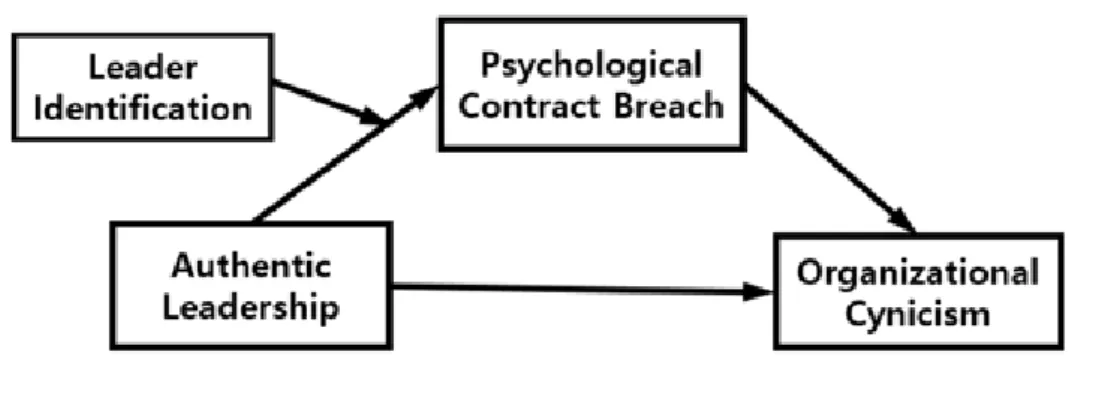
The research model of this study is shown in Figure 1. The moderating effect of identification with the leader in authentic leadership’s effect, negatively mediated by psychological contract
breach, on organizational cynicism, that is, the moderated mediation of identification was analyzed using model 7 of the moderated mediation models in PROCESS macros proposed by Hayes (2013) after integrating most of the existing macros (Lee 2016).
3.2 Data collection and respondent demographics
An empirical analysis was conducted based on a questionnaire survey to verify the research model. A two-step pilot survey was performed to ensure the validity of the questionnaire items, then a team consisting of one expert and five Ph.D. students from the field of human resource management to revised the contents of the pilot survey to prepare the final survey questionnaire.
The survey was conducted in two stages over a two-week period from July 17, 2017, on employees at companies with more than 500 employees. Of the 288 responses collected in total, 9 samples were excluded due to their incomplete or inappropriate responses and the remaining 279 samples were used for analysis. The demographic
characteristics of the respondents are as follows.
Concerning gender, there were more male respondents than female, with 180 male respondents (84.5%) were male and 99 (35.5%) female respondents. In terms of age, a little more than half of the respondents in their thirties (143, 51.3%), while 53 respondents were between ages 20 to 29 (19%), 77 were between 40 to 49 (27.6%), and 6 were above 50 (2.2%). Most of the respondents had an undergraduate degree (204, 73.1%), while 11 respondents had a high school diploma (3.9%), 19 had graduated from a professional college (6.8%), 39 had a master’s degree (14%), and 6 had doctoral degrees (2.2%).
105 respondents had worked at the company for under 5 years (37.6%), 91 for 5 to 9 years (32.6%), 39 for 10 to 14 years (14%), 23 for 15 to 19 years (8.2%), and 21 for more than 20 (7.5%). Meanwhile, the majority of the respondents had worked under their current supervisor for less than three years (163, 58.4), although 73 had done for 3 to 5 years (26.2%), 18 for 6 to 8 years (6.5%), 15 for 9 to 11 years (5.4%), and 10 for more than 12 years (3.6%).
Regarding profession, 200 respondents were
Figure 1. Research model
employed in office jobs (71.7%), 27 in production and technical jobs (9.7%), 14 in sales (5%), 31 in R&D (11.1%), 2 in medical services (0.7%), and 5 in others (1.8%). Assistant managers took up the largest portion of respondents (92, 33%), but the sample showed a good distribution in terms of job titles with 75 entry-level employees (26.9%), 63 managers (22.6%), 29 deputy directors (10.4%), and 20 above director-level (7.2%).
3.3 Measures for variables
Although there are slight differences in the definition of authentic leadership used by scholars, it is commonly defined as the leadership style in which leaders exhibit congruence in speech and action based on their own set of values, which is formed through self-awareness and self-regulation, to stimulate followers’ positive psychology.
Authentic leadership (AL) is often measured using the 16 items of the authentic leadership questionnaire (ALQ ) developed by Walumbwa et al. (2008). The ALQ measures the lower constructs of authentic leadership using four items for self- awareness, four items for internalized moral perspective, five items for relational transparency, and three items for balanced processing of information. In this study, we reconstructed the ALQ items verified (Cronbach’s α: .958) by Oh (2016) to measure authentic leadership.
Organizational cynicism (OC) is defined by Dean et al. (1998) as a negative attitude toward the organization to which one belongs. In this study, we defined the term as negative emotions such as despair, frustration, and resignation that
form the negative attitude held by organization members toward the organization, and used the 5 questionnaire items developed by Dean, Brandes and Dharwadkar (1998).
Psychological contract breach (PCB) refers to the full process through which members perceive the organization’s performance of its obligations, where the trust and expectations formed in the employment relationship is affected when the organization fails to fulfill its promises or when the expectations of organization and its members differ, to bring changes in the members’ attitudes and behaviors (Robinson 1995). To measure psychological contract breach, we used the 9 questionnaire items employed in Robinson and Morrison (2000).
Personal identification with the leader (LI) is defined as the degree to which an individual includes the leader in his/her definition of the relational self (Kark and Shamir 2002; Kark et al.
2003; VAN Knippenberg et al. 2004). Identification was measured using the 7 measures developed by Shamir et al. (1998) which includes items such as “I completely trust my supervisor.”
All variables used in the study were measured using a 5-point Likert scale (1 point: not at all, 5 points: very much).
3.4 Control variable
Previous research that empirically analyzed organizational cynicism, leadership, organizational justice and organizational effectiveness have found gender to be an insignificant control variable (Cha 2004). Meanwhile, organizational cynicism
was found to decrease with higher job positions (titles) and longer duration of employment at the company. The bulk of the studies conducted in Korea on organization cynicism have used job title, duration of employment, and gender as control variables. For this study, we consecutively controlled job title, duration of employment and gender as control, then used only the duration of employment(DE) as a control variable. Also, we set positive and negative affective states (PAS/
NAS) that indicate individual affectivity as control variables. Affectivity is a state that affects a person’
s perception, attitude, and behavior that maintains stability regardless of momentary feelings or specific environments to allow prediction of behavior or state (Watson, Clark and Tellegen 1988). Thus, affectivity may affect psychological contract breach and organizational cynicism which have negative connotations and may impact the covariance. By controlling these variables, we expected that the covariance arising from common method bias might be controlled to a great extent (Yoon and Kwon 2015).
3.5 Assessment of common method bias Common method bias can be caused not only by the respondent but also by the measurement methods used, such as questionnaire items and survey situations. The methods for overcoming common method bias can be employed during the pre-survey (research design/questionnaire preparation) stage and post-survey (statistical analysis) stage (Park, Joen, Kim and Hou 2007).
The following methods were applied in this study.
This study has the possibility of common method bias in that all variables are measured from the same respondent through a self-report survey. Therefore, in the research design stage, the survey was created in two parts to be conducted with a time interval so that the respondents can fill the survey in different situational contexts, as a way to reduce retrieval cues and the consistency motif. The first part of the survey presented items on the independent and moderating variables of authentic leadership and identification with the leader, as well as questions on their demographical characteristics, and the second part of the survey gave items on the mediating and dependent variables, psychological contract breach and organizational cynicism. Both parts of the survey were filled out by the same respondents. Positive and negative affective states were used as control variables to control covariance arising from common method bias.
In the questionnaire preparation stage, an online pilot survey was conducted on 165 respondents to improve the questionnaire’s specificity and objectivity. Crampton and Wagner (1994) meta- analyzed over 500 empirical studies and found that percept inflation from self-report surveys is an exceptional phenomenon that rarely occurs.
There is also a study that found self-report surveys to have hardly any effect in work-relatedness evaluations on employees’ work attitudes (Chan 2001). However, to strengthen the reliability of the empirical research, common method bias was given attention at the research design stage for its minimization.
4. Analysis Results
4.1 Validity and reliability assessment The data analysis was performed using IBM SPSS Statistics 24 and SPSS-based PROCESS macro (Hayes 2013). To verify the validity of
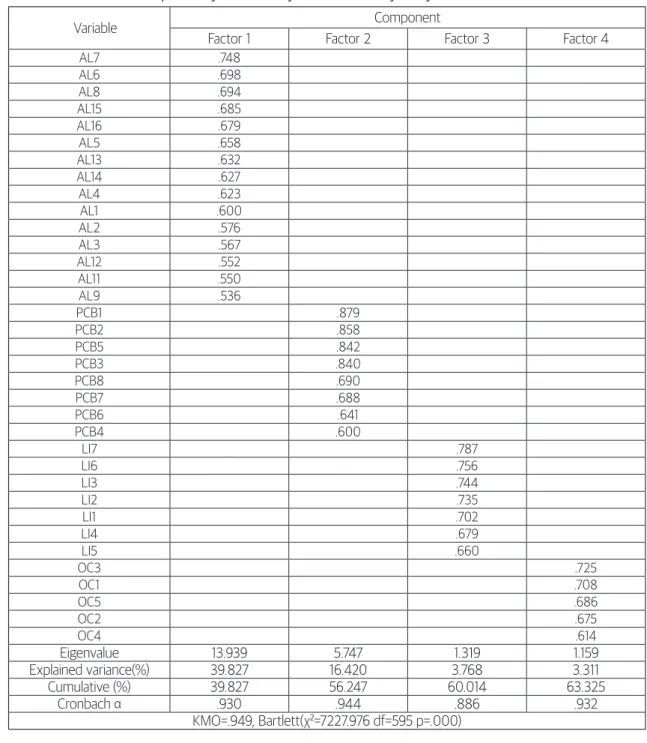
each variable used in the study, exploratory factor analysis was performed by extracting the principal components and rotating them using the Varimax method. The results of factor and reliability analysis are shown in Table 1 below.
Table 1. Results of the exploratory factor analysis and reliability analysis
Variable Component
Factor 1 Factor 2 Factor 3 Factor 4
AL7 .748
AL6 .698
AL8 .694
AL15 .685
AL16 .679
AL5 .658
AL13 .632
AL14 .627
AL4 .623
AL1 .600
AL2 .576
AL3 .567
AL12 .552
AL11 .550
AL9 .536
PCB1 .879
PCB2 .858
PCB5 .842
PCB3 .840
PCB8 .690
PCB7 .688
PCB6 .641
PCB4 .600
LI7 .787
LI6 .756
LI3 .744
LI2 .735
LI1 .702
LI4 .679
LI5 .660
OC3 .725
OC1 .708
OC5 .686
OC2 .675
OC4 .614
Eigenvalue 13.939 5.747 1.319 1.159
Explained variance(%) 39.827 16.420 3.768 3.311
Cumulative (%) 39.827 56.247 60.014 63.325
Cronbach α .930 .944 .886 .932
KMO=.949, Bartlett(χ²=7227.976 df=595 p=.000)
It was deemed statistically significant if the Ei- genvalue is 1 or above and the factor loading is 0.5 or above. Of the 37 items used to measure the four variables, 2 items (AL item 10, PCB item 9) were removed due to their low factor loading and 35 items were adopted. All items showed factor loadings above 0.6 (0.638-0.818) and therefore deemed appropriate for analysis. The KMO value, which measures the appropriateness of the sam- ple, was close to 1 at 0.949, and Bartlett’s sphere, which is used to verify whether the correlation between factors are 0, gave a value of 7227.976 (df = 595, p = 0.000) at the 0.01 significance level, thereby confirming the correlation matrix’s suit- ability for the present analysis.
The Cronbach α of all four latent variables gave values above 0.7 (0.886~0.944), showing high re- liability. In general, reliability is guaranteed when the Cronbach α value is greater than 0.6, and all items can be analyzed as a single measure (Nun- nally 1967). Therefore, all measurement tools used in this study were confirmed to have relatively high internal consistency.
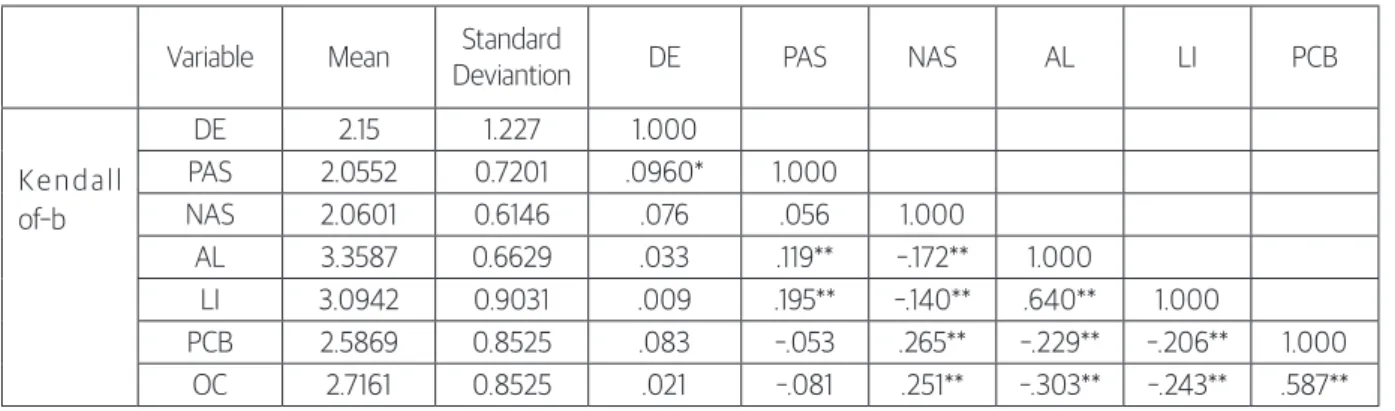
The results of the correlation analysis between the variables are shown in Table 2.
Significant positive and negative correlations were found between authentic leadership and psychological contract breach (r=-.229, p<.01), between authentic leadership and organizational cynicism (r =-.303, p<.01), between authentic leadership and identification (r=.640, p<.01), between psychological contract breach and cynicism (r=.587, p<.01), between psychological contract breach and identification (r=-.206, p<.01), and between organizational cynicism and identification (r= -.243, p<.01) .
Of the two control variables, positive affective state was correlated to authentic leadership (r=.195, p<.01), identification (r=292, p<.01), organizational cynicism (r=-.140, p<.1), psychological contract breach (r=.101, not significant), and duration of employment (r=.096 , p<.05); and negative affective state was correlated to authentic leadership (r=-.188, p<.01), identification (r=-1551, p<.01), organizational cynicism (r=.3281, p<.01),
Table 2. Correlation analysis of latent variables
Variable Mean Standard
Deviantion DE PAS NAS AL LI PCB
Ke n d a l l of-b
DE 2.15 1.227 1.000
PAS 2.0552 0.7201 .0960* 1.000
NAS 2.0601 0.6146 .076 .056 1.000
AL 3.3587 0.6629 .033 .119** -.172** 1.000
LI 3.0942 0.9031 .009 .195** -.140** .640** 1.000
PCB 2.5869 0.8525 .083 -.053 .265** -.229** -.206** 1.000
OC 2.7161 0.8525 .021 -.081 .251** -.303** -.243** .587**
Note 1) **Correlation is significant at the 0.01 level: *Correlation is significant at the 0.05level Note2) Positive/Negative affective states were measured using a 4-point scale
and psychological contract breach (r =.365, p<.01).
However, there was no significant correlation between positive affective state and psychological contract breach. Also, the duration of employment had no correlations with variables other than positive affective state.
4.2 Hypothesis verification
This study employed SPSS PROCESS macro which can quantify the indirect effect and analyze moderated mediation, which was not presented in Baron and Kenny (1986), and includes the bootstrapping technique that can be used to overcome the limitations of the Sobel test (Lee 2015). Considering that the concept, analysis, and interpretation of moderated mediation is inconsistently applied in studies conducted in Korea (Lee 2016), this study applied the concept of moderated mediation based on Hayes (2013) translated and presented by Lee (2015, 2016) to analyze and interpret the moderated mediation in the present analysis.
4.2.1 Verification of organizational cynicism Table 3 shows the results of the analysis on the effects of authentic leadership and psychological contract breach on organizational cynicism
proposed in hypothesis 1 and 2. If the bootstrap confidence interval does not include 0, the results were deemed statistically significant (Lee 2015). The coefficient for authentic leadership’
s impact on organizational cynicism was -.245, and bootstrapping technique was used to confirm whether this value is significant. 10,000 samples were re-extracted for bootstrapping, and the upper and lower limits of the coefficients for the mediating effect were -.378 and -.113, respectively, at the 95% confidence interval as shown in Table 3 (Lee 2015). Since the value does not include 0, hypothesis 1 that authentic leadership has a negative impact on organizational cynicism is supported.
The coefficient for psychological contract breach was .665, and the upper and lower limits of the coefficients for the mediating effect were .568 and .763, respectively, indicating statistical significance.
Therefore, hypothesis 2 on the positive effect of psychological contract breach on organizational cynicism is supported.
4.2.2 Verification of the mediating effect of psychological contract breach
Table 4 shows the results of the analysis on the mediating effect of psychological contract breach
Table 3. Verification of organizational cynicism Outcome: Organizational cynicism
Variable Effect SE 95% Confidence Interval
Boot LLCI Boot ULCI
AL -.245 .067 -.378 -.113
PCB .665 .050 .568 .763
Note 1) LLCI : Lower Level Confidence Interval, ULCI : Upper Level Confidence Interval
in the relationship between authentic leadership and organizational cynicism. The indirect (mediating) effect was tested by verifying the statistical inference for ab. In other words, if the values of the bootstrap confidence interval for the mediating effect’s coefficients do not include 0, it is considered statistically significant (Lee 2015).
The coefficient of psychological contract breach’
s mediating effect on the relationship between authentic leadership and organizational cynicism was -.223, and bootstrapping technique was applied to verify its statistical significance. 10,000 samples were extracted for bootstrapping, and the upper and lower limits of the coefficients obtained from the 95% confidence interval were -338 and -.119, respectively, as shown in Table 4. Since the values do not include 0, the mediating effect of psychological contract breach is statistically significant (Lee 2015), and therefore, hypothesis 3
is supported.
The results of the analysis performed in this study is visualized in Figure 2.
4.2.3 Verification of the moderated mediation of identification with the leader
The moderated mediating effect (moderated mediation) was analyzed to see whether the mediating effect of psychological contract breach (M) in the relationship between authentic leadership (X) and organizational cynicism (Y) is moderated by identification with the leader.
Moderated mediation is also called conditional indirect effect and refers to the moderating effect on the indirect (mediating) effect of ‘X→ M→Y’
depending on the condition of the moderating variable (Lee 2015). This study used the model 7 of the PROCESS macro for the analysis, which
Table 4. Bootstrapping results for the mediating effect of psychological contract breach
Variable Mediating Effect Boot SE 95% Confidence Interval
Boot LLCI Boot ULCI
PCB -.223 .055 -.338 -.119
Note 1) LLCI : Lower Level Confidence Interval, ULCI : Upper Level Confidence Interval
Figure 2. Research model analysis results (***p<0,001, **p<0.01)
provides the index for mediated moderation and the confidence interval for the conditional indirect effect (Lee 2015).
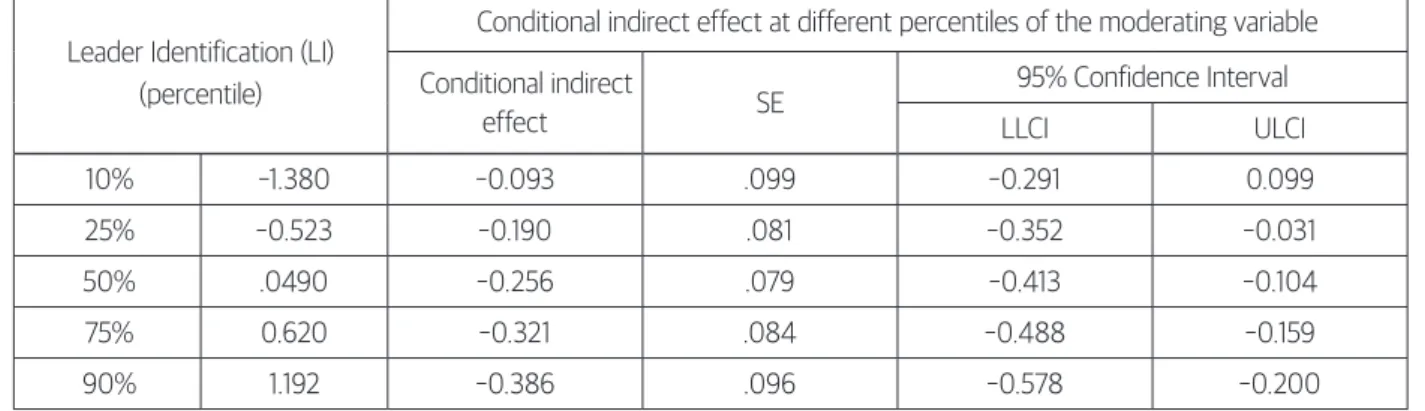
Next, the changes in the conditional indirect effect of identification were tested. As shown in Table 5, the coefficients of the conditional indirect effect and their statistical significance were calculated for the five percentile levels(10%, 25%, 50%, 75%, and 90%), and apart from the 10% percentile, the values were statistically significant. 10,000 samples were re-extracted for bootstrapping, and since the CI value at the 95%
confidence interval was non-zero at all percentile levels, the conditional effect is deemed statistically significant at all levels (Lee 2015).
Finally, to verify the moderated mediating effect, the moderated mediation index was determined using the bootstrapping method. The moderated mediation index was first introduced
in Hayes (2015) and added to the PROCESS macro as an analysis method (Lee 2016) as a formal test of moderated mediating effect to see whether the conditional indirect effect quantifying the relationship between the indirect effect and the control variable is non-zero (Lee 2015). Table 6 shows the results of the analysis.
The moderated mediation index, which shows the overall magnitude of identification’s conditional indirect effect on the indirect (mediating) effect of psychological contract breach between authentic leadership and organizational cynicism was -.114. Since the bootstrap confidence interval (-.203~-.024) did not include 0, the moderated mediating effect is deemed significant. Thus, hypothesis 4 that identification with the leader negatively moderates the indirect effect of psychological contract breach between authentic and organizational cynicism is supported.
Table 5. The conditional effect of identification with the leader
Leader Identification (LI) (percentile)
Conditional indirect effect at different percentiles of the moderating variable Conditional indirect
effect SE 95% Confidence Interval
LLCI ULCI
10% -1.380 -0.093 .099 -0.291 0.099
25% -0.523 -0.190 .081 -0.352 -0.031
50% .0490 -0.256 .079 -0.413 -0.104
75% 0.620 -0.321 .084 -0.488 -0.159
90% 1.192 -0.386 .096 -0.578 -0.200
Note 1) The values for personal identification with the leader were mean-centered.
Note 2) The percentile levels for personal identification with the leader are 10%, 25%, 50%, 75%, 90%.
Note 3) LLCI : Lower Level Confidence Interval, ULCI : Upper Level Confidence Interval