진성리더십이 조직시민행동 및 직무성과에 미치는 영향:
조직분위기 매개효과를 중심으로
How can Authentic Leadership Affect Organizational Citizenship Behavior and Job Performance?: The Role of Organizational Climate as a Mediator
탁진규*, 노태우**
서울과학종합대학원 경영학과*, 순천향대학교 국제통상학과**
Jin-Gyu Tak([email protected])*, Tae-Woo Roh([email protected])**
요약
본 연구에서는 상사의 진성리더십이 조직분위기, 조직시민행동 및 직무성과에 미치는 영향을 분석함으로 써 진성리더십의 중요성에 대한 시사점을 제시하는데 그 목적이 있다. 특히, 조직분위기가 조직 내에서 리 더의 역할과 구성원들 간의 긴장 관계를 완화해준다는 기존 연구에 따라 진성리더십과 직무성과 간의 관계 에서 조직분위기의 매개역할을 실증적으로 살펴보고자 하였다. 국내에서 다양한 업종에 종사하는 구성원을 대상으로 설문을 실시하였으며, 회수된 설문지 총 444부가 분석에 사용되었고, 통계분석은 SPSS/WIN 24.0 과 STATA 14.0 통계패키지를 사용하여 구조방정식으로 검증하였다.
연구결과를 요약하면, 첫째, 상사의 진성리더십은 조직분위기, 조직시민행동 및 직무성과에 정(+)의 영향 을 미쳤다. 둘째, 조직분위기는 조직시민행동과 직무성과에 정(+)의 영향을 미쳤다. 셋째, 조직시민행동은 직무성과에 정(+)의 영향을 미쳤다. 넷째, 진성리더십과 조직시민행동, 직무성과 간의 관계에 있어서 조직분 위기는 매개역할을 하였다.
본 연구결과가 함의하는 바는, 기존의 진성리더십 연구에서 고려하지 않았던 조직분위기의 효과성을 검증 함으로써 향후 진성리더십 연구에 새로운 관점을 제시하였다는 점에서 의미를 둘 수가 있다.
■ 중심어 :∣진성리더십∣조직분위기∣조직시민행동∣직무성과∣
Abstract
This study analyzes the effect of authentic leadership on organizational climate, organizational citizenship behavior, and job performance to suggest the implications behind the growing importance of authentic leadership. In particular, this study substantiates existing arguments that organizational climate moderates the tension between leaders and employees by investigating the mediating effects of organizational climate on the relationship between authentic leadership and job performance. A survey was conducted on employees of various business areas in Korea, and 444 responses were used in statistical analysis which was performed using SPSS/WIN 24.0 and STATA 14.0 statistics package and verified using structural equations. The analysis results showed that 1) authentic leadership has positive effects on organizational climate, organizational citizenship behavior, job performance; 2) organizational climate has positive effects on organizational citizenship behavior and job performance; 3) organizational citizenship behavior has a positive effect on job performance; and 4) organizational climate performs a mediating role in the relationships among authentic leadership, organizational citizenship behavior, and job performance. By including organization climate’s mediating effect as a factor in the research on authentic leadership, this study presents a new perspective for future studies on leadership.
■ keyword :∣Authentic Leadership∣Organizational Climate∣Organizational Citizenship Behavior∣Job Performance∣
* 본 연구는 순천향대학교 학술연구비 지원으로 수행하였음.
* 본 연구는 서울과학종합대학원대학교 학술연구비 지원으로 수행하였음.
접수일자 : 2016년 08월 26일 수정일자 : 2016년 09월 11일
심사완료일 : 2016년 09월 12일
교신저자 : 노태우, e-mail : [email protected]
I. INTRODUCTION
To overcome the uncertainties in management environment and to gain competitive advantage among domestic and international businesses, companies have been slowly flatting their previously-hierarchical organizational structure as a means to strengthen interaction among employees[1].
Such efforts have not only been made on the organization as a whole but also in each organizational unit within the company, where shared values and cooperative interaction have been stressed by promoting autonomous and flat relationships among its members[2]. In global companies such as IBM, Google, and Apple, autonomous and flat organizational culture has been the key in developing innovative business items that has enabled them to lead the market. In Korea also, companies such as Samsung, LG, CJ, POSCO, and Amore Pacific have been flattening their organizational structure, and revamping the title and rank system has been one of the main methods adopted by these companies as a way to dilute the authoritative organizational climate.
In many Korean companies, ridding of titles within the organization has been thought of as an effective way to strengthen interaction and communication among all levels of employees as well as to cultivate innovation and creativity from the bottom for improved responsiveness to the fast-changing management environment. However, there remains doubt on whether the nature of Korean companies facilitates its immediate and practical implementation as the Korean culture can make it daunting for lower-level employees to call their supervisors by their names or to eliminate ‘titles and ranks’ which had the role of supporting the authority of supervisors over their staff.
With the greater weight on modifying the
organizational structure as a solution for improving responsiveness to external environments[3], the role of leadership is also being highlighted more than ever as a key factor in enhancing employees’ commitment and motivation[4]. At the same time, there is continued debate on whether traditional leadership models actually work as intended in actual business practice. The “Organizational Health and Company Culture” among Korean Companies report published by the Korea Chamber of Commerce and Industry in collaboration with McKinsey & Company shows how Korean companies are falling short against global benchmarks. Based on a survey conducted on approximately 40,000 employees in 100 Korean companies, this report found that the organizational health of Korean companies was lower than that of global companies in areas such as leadership, coordination and control, capabilities, and external orientation[5]. In particular, Korean companies scored extremely lower compared to the global benchmark on the leadership indicator for support and encouragement for cooperation among employees.
There is also increasing criticism that traditional leadership theories have developed in a way that puts too much focus on the leader’s speech, actions, and skills from the leader’s perspective, thus reducing the idea of leadership into a mere tool for leaders to use toward their own interests[6].
It is from this background that the concept of authentic leadership came to the fore as a new leadership model that differs from existing leadership theories to enable companies to better respond to the fast-changing management environment and its uncertainties[7]. For instance, an authentic leader possesses the moral character that enables him/her to form amicable relationships with employees, which promotes greater communication within the organization to render better performance[8]. Leaders
are thought as authentic when they are able to be honest about not only their strengths but also their weaknesses and mistakes, and this quality is also reported to increase interaction between the leader and the employees to improve organizational climate[9]. In other words, authentic leadership is believed to wield greater influence over its employees than traditional leadership models, and for this reason, research on authentic leadership has gained great interest from scholars and practitioners as a way to unite employees[6].
This study defines an authentic leader as a leader that understands him/herself well with keen awareness of his/her surroundings, who communicates openly with his/her employees and bases his/her speech and actions on his/her own values and beliefs. This study differentiates itself from existing research on leadership in the following ways. First, despite the increasing need for authentic leadership, research on authentic leadership is still in its early stage with only a few available empirical studies compared to that on existing leadership theories[10]. The investigation conducted in this study contributes in mending this gap by looking into the relationships between the supervisors’ authentic leadership and the employees’ organizational citizenship behavior and job performance. Second, this study provides insight on the mediating effects of organizational climate that is lacking from previous research on authentic leadership. Third, to address the fact that previous studies on authentic leadership have been limited to specific locations, subjects, or business areas[6][10], the respondents of the 444 survey responses analyzed in this research were composed of 202 from private companies and 242 from public institutions and firms, to present a more extended understanding of the relationships between variables. That is, while authentic leadership is an
important phenomenon for any organization, many recent studies have focused on demonstrating its effect in private firms, and therefore, this study expanded the scope of its subject to include not only private firms but also public institutions and public firms. Fourth, this study expands the usual subjects in authentic leadership research, namely CEOs, to supervisors (e.g. team leaders) within the organization to confirm that authentic leadership can indeed be applied to all leaders within the company [11].
The purpose of this research is to demonstrate the effect of authentic leadership on organizational climate, organizational citizenship behavior, and job performance. In doing so, this study develops a theoretical model for authentic leadership that is applicable to all levels of supervisors within the company organization, and explores a structural model on the mediating effects of organization climate on the relationships among authentic leadership, organizational citizenship behavior, and job performance. Based on the analysis results, this study suggests the practical implications for authentic leadership required by the ‘new normals’ of this age, namely, low growth, low consumption, high unemployment, and high uncertainty.
II. THEORETICAL BACKGROUND
1. Authenticity and Authentic leadership
The corrupt and unethical behaviors of domestic and global conglomerates and their social impacts have spurred greater discussion on the concept of authenticity in the academic and the business sphere.The concept of authenticity originates from Socrates’
renown phrase, “know thyself” [11][12]. Socrates’
way of thinking – his emphasis on the recognition of one’s ultimate ignorance and the formation of honest
relationships with others through continued questioning of one’s true self – has long been dealt in the fields of philosophy[13][14] and psychology [15-18].
In the modern age, existential philosophers such as Nietzsche have revisited the concept of authenticity as an existential concept to define it as a
“characteristic held by those who do not feel fear in the face of fundamental existential anxiety”[19]. To Heideger, authenticity was not a thing of human nature but something that is revealed through the conscientious action taken upon necessity[19]. On the other hand, Sartre defined authenticity as “the pursuit of meaning by the individual guided by one’s conscience in the context of society”[20] while Trilling(1972) argued that authenticity is “ego-centric and exists solely based on the rule of self-existence”
and emphasized the importance of building character in the given environment. The philosophical discourse on authenticity gained more specificity in the field of psychology. The humanistic psychologist, Carl Rogers(1961), based on the concept of a fully functioning individual, argued for the need to lead an authentic life in which one is able to make choices for his/herself free from others’ expectations[23].
Similarly, Maslow(1968) understood authenticity as self-actualization, which is possible by judging and acting based on one’s ego to live in accordance one’s true nature.
The research on authentic leadership started in full-fledge by the U.S. Gallup Leadership Institute at the University of Nebraska-Lincoln in 2004, and authentic leadership was dealt as a major topic by the Leadership Quarterly in 2005[7]. Later, the development of the Authentic Leadership Questionnaire (ALQ), a measurement method for authentic leadership, gave momentum to the study on authentic leadership[24]. Meanwhile, authentic
leadership gained explosive attention beyond the academic sphere when the Enron/Arthur Anderson scandal exposed the U.S. energy company’s account irregularities and corruption. The unethical and corrupt leadership leading to Enron’s bankruptcy became a prime example of how a global conglomerate can go to ruins almost instantly due to the avarice, arrogance, and moral hazard among its leaders[25]. In Korea also, Daewoo Group’s account manipulation and the recent cases surrounding toxic humidifier disinfectants and rigged automobile exhaust fume documentation demonstrated the pressing need for authentic leaders with morality and authenticity.
Shamir and Eilam(2005) defined authentic leaders as “those who have a clear concept of the self to properly understand their surrounding environment, whose egos and goals match, and who appropriately express themselves.” An authentic leader does not concentrate on his/her style or skill as a leader but rather on his/her values and character[27]. Therefore, an authentic leader is a leader who understands his/herself the best and is always aware of his/her surroundings, conducts open communication with his/her employees, and speaks and acts upon his/her values and beliefs[7][28]. The elements of authentic leadership differ slightly by scholar, but generally consists of the four concepts: self-awareness, internalized moral perspective, relational transparency, balanced processing of information.
Specifically, self-awareness refers to the recognition of and trust in one’s values, character, characteristics, motivations, and desires[8].
internalized moral perspective to the unity between one’s behavior and internal moral standards to enable strength in face of external social pressures[25].
relational transparency to the ability to show onself in an authentic way by expressing not only one’s
strengths but also weaknesses[28]. and balanced processing of information to the ability to review and analyze objectively the various information and data available in making decisions[28].
2. Organizational Climate
Organizational climate is a concept that has been of great interest to organizational psychologists and behaviorists as a vital factor for employees’ behavior, attitude and motivation[30]. According to Moran and Volkswein(1992), an organization has its own climate in some form or another, and this organizational climate influences not only the employees’ behavior and motivation but also performance. Glick (1985) saw organizational climate as a reflection of the interaction between the individual and the organization and as such, an ecological factor affecting the employees’ behavior and attitude.
Therefore, organizational climate surfaces through individual recognition of the organization’s characteristics[33] and refers to the sum of the descriptions provided by the employees of their interpretations of the organizational environment, structure, policy, and procedures for realizing the organization’s goals[34].
As such, organizational climate is the unique characteristic that differentiates one organization from another[35], arising from within the organization’s environment to affect the employees’ behaviors and attitudes[36]. Unlike organizational culture comprised of values and beliefs delivered top-down to be shared by the employees, organizational climate is formed through each employee’s personal and relative understanding of the organization to improve job performance, employee relationships and job satisfaction[35]. Likert (1967) lists leadership, motivation, communication, interaction, decision making, goal setting, and management control as the
seven factors comprising organizational climate while Jones and James (1979) saw the components of organizational climate as characteristics of leadership, workgroup characteristics, subsystem and organizational characteristics, and job and role characteristics. On the other hand, Srivastav (2006) understood organization climate as consisting of two factors: functional factors which includes achievement, professionalism, interest in collegues, and dysfunctional factors which includes dependency, control, and personal relationships.
Organizational climate can be a predictor variable, dependent variable, or mediating variable depending on how it is understood in an organizational perspective. It performs as a predictor variable if the focus is on the organizational climate’s influence on employees’ job satisfaction and job performance [38][39], but as a dependent variable when considering how it is affected by changes in organizational structure, decision making, and leadership style[40][41]. More recently, organizational climate is argued to form under the influence organizational structure, role, decision making, and leadership style while simultaneously influencing employees’ job satisfaction and job performance, and from this viewpoint, organization climate can be seen as a mediating variable[42][43].
3. Organizational Citizenship Behavior
Organizational citizenship behavior refers to the employees’ discretionary behavior that is not directly and officially mentioned in the employees’ job descriptions but which improves organizational performance[44]. Employees are not criticized or penalized for not performing organizational citizenship behavior nor is it demanded from them – organizational citizenship behaviors are voluntary actions by individual employees[45]. Katz and Kahn(1966) underlined the importance of such extra-role behavior as a behavioral factor for the smooth operation and growth of an organization, and argued that any organization in which employees only perform officially-demanded role behaviors will easily collapse. In other words, although organizational citizenship behavior is not a requirement for employees in fulfilling their roles, it is gaining importance for its positive influence on organizational effectiveness and employees’ performance[47].
The components of organizational citizenship behavior have been studied quite thoroughly since Bateman and Organ (1983)’s pioneering research. The five components suggested by Organ (1988) are most generally accepted, which are altruism, conscientiousness, courtesy, civic virtue, and sportsmanship. Altruism is the voluntary action of employees to help each other within the organization, and conscientiousness is the employees’ performance beyond the role given by their organization. Courtesy refers to appropriate actions necessary in maintaining relationships with other employees while civic virtue means the active participation in changing the organization for the better with a sense of responsibility. Finally, sportsmanship refers to being patient towards small inconveniences and avoiding the voicing of harsh criticism against one’s organization.
4. Job Performance
Job performance can be defined as the ideal status achieved in the work of the employees or the degree in which the employees have realized their work goals (Kim, 2012) and refers to the effectiveness in work[48]. Koo and Lee (2014) defined job performance as the degree of awareness required for substantial work achievement, either in quantity or quality. Job performance is the combined result of the employees’ attributes, work efforts, and organizational
support[50]. Due to its large effect on the performance of the whole organization, job performance is considered an important factor in organizational management and studied closely by many scholars[48][51].
Job performance reflects the level of the results achieved by the employees in their respective organization, and as individual employees’ job performances come together to result in the performance of the overall organization, job performance is a major factor in enabling the company’s sustainable growth[52]. Job performance is generally measured using two methods: the first based on financial indexes such as individual productivity, degree of goal achievement, and work evaluations; and the second based on psychological and behavioral indexes such as employee morale, organizational commitment, and job satisfaction[53].
III. RESEARCH HYPOTHESIS AND MODEL
1. Authentic Leadership, Organizational Climate, Organizational Citizenship Behavior, and Job Performance
Avolio et al. (2004) and Nelson et al. (2014) both saw authentic leadership to have a significant effect in creating a positive climate within an organization [9][42], and Walumbwa et al. (2008) argued that authentic leadership has a positive effect on organizational effectiveness such as organizational citizenship behavior and organizational commitment [28]. According to Tak & Roh (2016), an authentic leader understands his/herself well, is aware of his/her surroundings, and conducts open communication with those around him/her. As an authentic leader speaks and behaves according to his/her values and beliefs, he/she is able to positively
impact the organizational citizenship behavior and work performance of the organization’s members[75].
Kim et al. (2014) found that the frank speech and behavior of leaders based on their ethical standards and personal character promotes the organization’s members to behave conscientiously and cooperate with others, thereby improving the organization’s performance. Based on these findings, it was argued that the perceived authentic leadership positively affected organizational citizenship behavior among the members of the organization[55]. Furthermore, it has been reported that authentic leadership positively affects employees’ job performance[56] by strengthening employees’ commitment and work behavior[9]. Therefore, this study hypothesizes that:
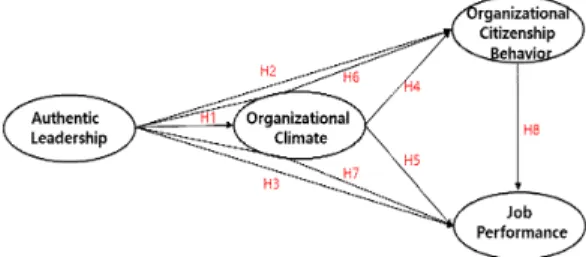
H1 Authentic leadership has a significant impact on organizational climate.
H2 Authentic leadership has a significant impact on organizational citizenship behavior.
H3 Authentic leadership has a significant impact on job performance.
2. Organizational Climate, Organizational Citizenship Behavior, and Job Performance
According to Glick (1985) and Long & Fahey (2000), organizational climate reflects the interaction between individuals and the organization and is an ecological factor that affects the behavior and attitude of the organization’s members[32], therefore, it can significantly affect the behavior and attitude of individuals in the work environment[57]. Paulin et al.(2006) studied small to medium-sized private hospitals in the U.S. region and found that the organization’s service climate had a positive influence on job satisfaction, organizational commitment, and organizational citizenship behavior, and Litwin and Stringer Jr. (1968) concluded from their study that
organizational climate positively affected job performance and job satisfaction. Therefore, it can be said that the organizational climate perceived by the employees has a significant effect on job satisfaction and job performance[59]. Therefore, this study hypothesizes that:
H4 Organizational climate has a significant impact on organizational citizenship behavior.
H5 Organizational climate has a significant impact on job performance.
3. The Mediating Effects of Organizational Climate
Previous literature on authentic leadership mostly discusses its effect on the capabilities of the organization’s members, however, in actuality, the positive speech and behavior of leaders more often work in terms of providing motivation[27]. If transformational leadership and charismatic leadership had been about improving organizational performance by making members work harder, authentic leadership enhances performance by creating a positive organizational climate with the members of the organization[27][75]. That is, the positive mechanism in place between the leader and the employees affect organizational performance through the climate that is formed within their common community as a team. Avolio et al. (2004) and Nelson et al. (2014) state that authentic leadership has a significant effect in forming a positive climate in the organization[9][42], Walumbwa et al. (2008) and Gardner et al. (2011) found that authentic leadership positively impacts organizational citizenship behavior and work performance[28][56]. According to Paulin et al. (2006) and Litwin & Stringer Jr (1968), organizational climate has a meaningful relationship to organizational citizenship behavior and work
performance[35][58]. In addition, Lee et al. (2009) found that the organizational climate perceived by the organization’s members had a positive effect on work performance[39]. Thus, organizational climate promotes the employees to form a positive perception about the authenticity of their leader[60] and improves organizational citizenship behavior such as greater communication and cooperation among employees[58]
as well as employees’ job performance[35]. Therefore, this study hypothesizes that:
H6 Organizational climate has a mediating role in the relationship between authentic leadership and organizational citizenship behavior.
H7 Organizational climate has a mediating role in the relationship between authentic leadership and job performance.
4. Relationship between Organizational Citizenship Behavior and Job Performance
Organ (1988) stated that organizational citizenship behavior has a positive relationship to job performance and organizational performance while Meyer and Allen (1991) argued that organizational citizenship behavior has a positive correlation to job performance. It has also been reported that organizational citizenship behavior has a significant influence on job performance[45][62] showed that organizational citizenship behavior such as the employees’ voluntary cooperation in corporate social responsibility (CSR) activities has a significant effect on job performance. Therefore, this study hypothesizes that:H8 Organizational citizenship behavior has a significant effect on job performance.
This study investigates the relationships among
authentic leadership, organizational climate, organizational citizenship behavior, and job performance by testing the hypotheses above through the original research model illustrated in [Figure 1].
Figure 1. Research model
Ⅳ. RESEARCH METHODOLOGY
1. Variables and Measurement Method
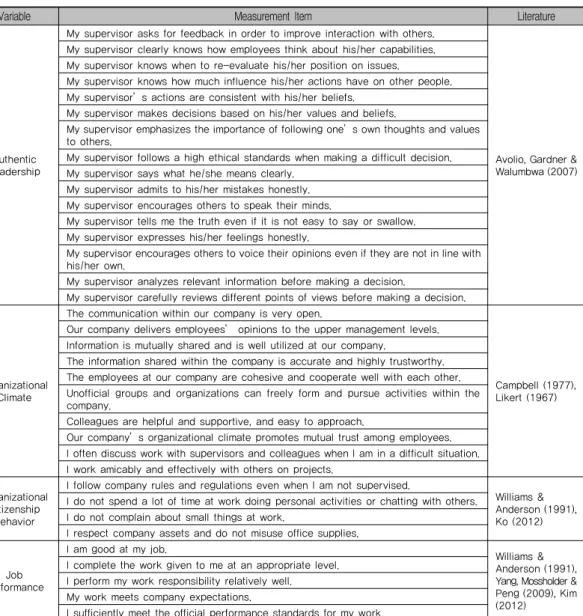
To see the effect of authentic leadership on organizational climate, organizational citizenship behavior, and job performance as well as to demonstrate the mediating effects of organizational climate, a structured survey was conducted. The survey questionnaire was constructed by modifying those used in previous literature and consulting with experts on leadership research. The measurement was made in a 5-point Likert scale. The definitions of each variable is listed in [Table 1].2. Authentic Leadership
Authentic leadership is defined as balanced interactions with employees based on good self-understanding, high ethical standards, and personal values and beliefs, and was measured using the Authentic Leadership Questionnaire (ALQ) developed by Avolio et al. (2007). The 16 questions in the questionnaire were translated into Korean. ALQ has been proven as an appropriate measurement method through studies on companies in the U.S.,
Variable Measurement Item Literature
Authentic Leadership
My supervisor asks for feedback in order to improve interaction with others.
Avolio, Gardner &
Walumbwa (2007) My supervisor clearly knows how employees think about his/her capabilities.
My supervisor knows when to re-evaluate his/her position on issues.
My supervisor knows how much influence his/her actions have on other people.
My supervisor’s actions are consistent with his/her beliefs.
My supervisor makes decisions based on his/her values and beliefs.
My supervisor emphasizes the importance of following one’s own thoughts and values to others.
My supervisor follows a high ethical standards when making a difficult decision.
My supervisor says what he/she means clearly.
My supervisor admits to his/her mistakes honestly.
My supervisor encourages others to speak their minds.
My supervisor tells me the truth even if it is not easy to say or swallow.
My supervisor expresses his/her feelings honestly.
My supervisor encourages others to voice their opinions even if they are not in line with his/her own.
My supervisor analyzes relevant information before making a decision.
My supervisor carefully reviews different points of views before making a decision.
Organizational Climate
The communication within our company is very open.
Campbell (1977), Likert (1967) Our company delivers employees’ opinions to the upper management levels.
Information is mutually shared and is well utilized at our company.
The information shared within the company is accurate and highly trustworthy.
The employees at our company are cohesive and cooperate well with each other.
Unofficial groups and organizations can freely form and pursue activities within the company.
Colleagues are helpful and supportive, and easy to approach.
Our company’s organizational climate promotes mutual trust among employees.
I often discuss work with supervisors and colleagues when I am in a difficult situation.
I work amicably and effectively with others on projects.
Organizational Citizenship
Behavior
I follow company rules and regulations even when I am not supervised.
Williams &
Anderson (1991), Ko (2012) I do not spend a lot of time at work doing personal activities or chatting with others.
I do not complain about small things at work.
I respect company assets and do not misuse office supplies.
Job Performance
I am good at my job.
Williams &
Anderson (1991), Yang, Mossholder &
Peng (2009), Kim (2012)
I complete the work given to me at an appropriate level.
I perform my work responsibility relatively well.
My work meets company expectations.
I sufficiently meet the official performance standards for my work.
Table 1. Survey questionnaire by variable
Africa, China, and Europe regions [28] as well as for Korea in Lee(2010). The scale reliability for ALQ on measuring authentic leadership using Chronbach’s α was .960.
3. Organizational Climate
Organizational Climate is defined as the organization’s unique characteristics in the
communication and interaction among employees, formed from the employees’ personal perceptions.
Organization climate was measured using 10 questions that were modified from Likert(1967) and Campbell(1977). The scale reliability for organizational climate using Chronbach’s α was .943.
Category Number (N) Percentage (%)
Gender Male 350 78.8
Female 94 21.2
Age
Under 30 47 10.6
30-39 137 30.9
40-49 162 36.5
50-59 98 0.9
Education
High School Diploma or Under 64 14.5
Undergraduate Degree 279 63.4
Master’s Degree 79 18.0
Doctoral Degree 18 22.1
Business Area
Service 112 25.5
Construction/Manufacturing 20 4.5
Finance/Insurance 44 10.0
IT 8 1.8
Public Corporation/Government Employee 242 55.0
Research Institute/Research Center 14 3.2
Length of Employment under Current Supervisor
Under 1 Year 136 30.6
1-2 Years 135 30.4
3-4 Years 47 10.6
5-9 Years 53 12.0
More than 10 Years 73 16.4
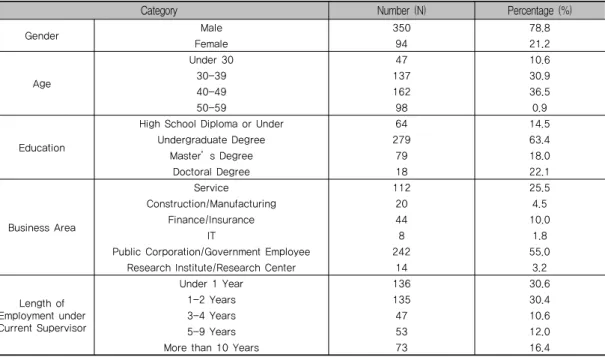
Table 2. Demographical characteristics of sample
4. Organizational Citizenship Behavior
Organizational citizenship behavior is defined as actions outside official job descriptions that are left to individual employee’s own discretion, which help improve organizational effectiveness. Organizational citizenship behavior was measured using 4 questions modified from Ko(2012) which were originally based on Williams and Anderson(1991). The scale reliability for organizational citizenship behavior using Chronbach’s α was .760.5. Job Performance
Job performance is defined as the degree in which the employees’ work meet its ideal state or goal, and was measured using 5 questions modified from Kim (2012) which refers to Williams and Anderson(1991) and Yang et, al.(2009). The scale reliability for job performance using Chronbach’s α was .932.
V. ANALYSIS AND RESULTS
1. Respondent’s Profiles
To analyze the research model proposed in this study, a survey was conducted on employees working in various business areas (service, construction/
manufacturing, finance/insurance, IT, public corporations /government employees, research institutions/research centers) in Korea over a three week period from April 5 to 24, 2016. 560 questionnaires were distributed and 460 (82%) responses were collected. From the responses, 16 were eliminated for incompleteness to render a final number of 444 responses for analysis.
The respondents’ demographical characteristics are listed in [Table 2].
2. Reliability and Validity Verification
A reliability and confirmatory factor analysis (CFA) was first conducted to assess the measurement model to test reliability, uni-dimensionality, and convergentFactor Measured
Variable Factor Loading t-value s.e. p AVE C.R. Cronbach's α
Authentic Leadership
AL1 0.750 0.022 34.470 0.000
0.776 0.960 0.960
AL2 0.800 0.018 44.380 0.000
AL3 0.771 0.020 38.160 0.000
AL4 0.729 0.023 31.480 0.000
AL5 0.743 0.022 33.450 0.000
AL6 0.743 0.022 33.410 0.000
AL7 0.824 0.016 50.970 0.000
AL8 0.815 0.017 48.280 0.000
AL9 0.675 0.027 25.170 0.000
AL10 0.781 0.019 40.230 0.000
AL11 0.801 0.018 44.480 0.000
AL12 0.803 0.018 45.080 0.000
AL13 0.650 0.028 22.910 0.000
AL14 0.837 0.015 54.940 0.000
AL15 0.798 0.018 43.690 0.000
AL16 0.872 0.012 70.000 0.000
Organizational Climate
OC1 0.802 0.018 43.360 0.000
0.791 0.944 0.943
OC2 0.817 0.018 46.570 0.000
OC3 0.795 0.019 41.390 0.000
OC4 0.769 0.021 36.550 0.000
OC5 0.837 0.016 53.170 0.000
OC6 0.707 0.025 28.140 0.000
OC7 0.784 0.020 39.220 0.000
OC8 0.855 0.014 59.120 0.000
OC9 0.780 0.020 38.870 0.000
OC10 0.757 0.022 34.610 0.000
Organizational Citizenship
Behavior
OCB1 0.738 0.030 24.620 0.000
0.674 0.768 0.760
OCB2 0.606 0.037 16.570 0.000
OCB3 0.647 0.035 18.590 0.000
OCB4 0.697 0.032 21.890 0.000
Job Performance
JP1 0.842 0.016 52.630 0.000
0.857 0.933 0.932
JP2 0.884 0.013 68.820 0.000
JP3 0.865 0.014 61.080 0.000
JP4 0.867 0.014 61.320 0.000
JP5 0.827 0.017 48.170 0.000
= 1893.268, p=0.00>0.05, RMSEA=0.074, CFI=0.893, TLI=0.885, SRMR=0.046 Table 3. Reliability and confirmatory factor analysis results
validity, the results of which are listed in [Table 3].
Internal consistency was tested using SPSS 24.0 and the Cronbach’s α values were .960 for authentic leadership, .943 for organizational climate, .760 for organizational citizenship behavior, and .932 for job performance. As all Cronbach’s α values are higher than .70, the measurement has reliability[70].
The CFA was conducted using STATA 14.0 to verify each variable’s uni-dimensionality. The variables showed goodness-of-fit indices (=1893.268, p=0.00>0.05, RMSEA=0.074, CFI=0.893, TLI=0.885, SRMR=0.046) meeting the recommended levels for fit
verification[71]. The standardized factor loading of most of the measurement items were above 0.7, ensuring statistical significance. The average variance extracted (AVE) and construct reliability (CR) was calculated to check the convergent validity of the measurement items, and it was found that all AVE, CR values were above the cut-off criterion (AVE>0.5, CR>0.7)[71], ensuring the convergent validity of all measurement items.
Furthermore, the variables were checked for discriminant validity, whose results are tabulated in [Table 4]. Discriminant validity can be explained by the
Factor Mean S.D. 1 2 3 4
1. Authentic Leadership (AL) 3.526 1.121 0.776*
2. Organizational Climate (OC) 3.918 0.860 0.742* 0.791*
3. Organizational Citizenship Behavior (OCB) 3.997 0.689 0.508* 0.621* 0.674*
4. Job Performance (JP) 3.431 1.034 0.243* 0.395* 0.537* 0.857*
* p<0.001
Table 4. Discriminant validity verification results
Path Coefficients T p RMSEA CFI TLI SRMR
H1 AL→OC 0.747 32.040 0.000 1960.412 0.075 0.887 0.879 0.067
H2 AL→OCB 0.521 12.140 0.000 1998.622 0.076 0.884 0.876 0.069
H3 AL→JP 0.257 5.470 0.000 1986.200 0.076 0.885 0.877 0.072
H4 OC→OCB 0.633 17.010 0.000 1943.606 0.075 0.889 0.881 0.055
H5 OC→JP 0.401 9.350 0.000 1945.294 0.075 0.888 0.881 0.055
H6
AL→OC→OCB
AL→OC 0.746 31.930 0.000 1988.445 0.076 0.885 0.877 0.074
OC→OCB 0.625 16.570 0.000
H7
AL→OC→JP
AL→OC 0.746 31.900 0.000 2000.388 0.076 0.884 0.876 0.068
OC→JP 0.391 9.060 0.000
H8 OCB→JP 0.548 13.370 0.000 1900.667 0.074 0.892 0.885 0.048
Variable Definitions: AL (Authentic Leadership), OC (Organizational Climate), OCB (Organizational Citizenship Behavior), JP (Job Performance) Note: Coefficients have been standardized (standardized coefficient)
Table 5. Path analysis results
relationship between the correlation and AVE, where discriminant validity is ensured when the AVE of the two latent factors being evaluated for discriminant validity is larger than the squared correlation between the two latent factors[72]. As all variables had larger AVE than the squared correlation between the two latent factors, discriminant validity is ensured.
3. Common Method Bias
To reduce the problems occurring from common method bias, first, the survey emphasized the anonymity of the responses and that the responses will be only used for statistical analysis purposes to encourage honest answers. second, the measurement items of the variables were randomly placed to minimize possible prediction of the relationship between variables[73]. and third, Harman's single factor test was conducted. Unrotated factor analysis on the four variables’ measurement items resulted in four factors with explanatory power with eigenvalues
above 1.0, and of the four, the factor with the highest eigenvalue accounted for 44.901%, which is more than half of the explanatory power. Therefore, additional analysis was performed to check the severity of the common method bias. Common method bias is said to exist when the correlation coefficient among the latent variables is high (>0.9)[74]. As can be seen in [Table 4], the highest correlation coefficient value was found to be 0.742, ensuring a low level of common method bias.
4. Hypothesis Test
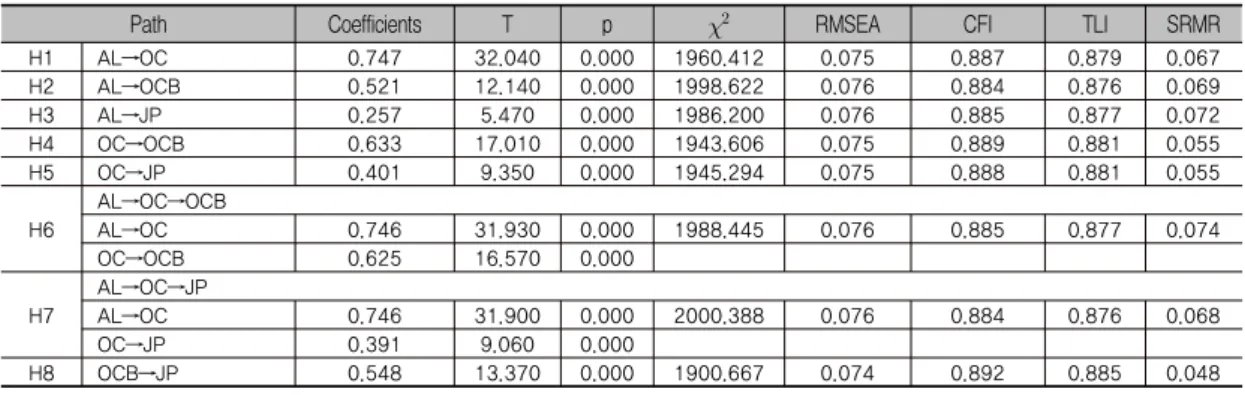
The test results for the hypotheses on authentic leadership, organizational climate, organizational citizenship behavior, and job performance are summarized in [Table 5].
4.1 Verification of the Relationships among Authentic Leadership, Organizational Climate, Organizational Citizenship Behavior, and Job Performance For H1, the path coefficient between authentic
leadership and organizational climate was .747 (T=32.040, p<0.001), and for H2, the path coefficient between authentic leadership and organizational citizenship behavior was .521 (T=12.140, p<0.001).
Thus, higher perception of authentic leadership leads to better organizational climate and better organizational citizenship behavior. Also, for H3, the path coefficient between authentic leadership and job performance was .257 (T=5.470, p<0.001), proving that higher perception of authentic leadership leads to higher job performance. Therefore, it can be said that authentic leadership is an antecedent that improves organizational climate, organizational citizenship behavior, and job performance.
4.2 Verification of the Relationships among Organizational Climate, Organizational Citizenship Behavior, and Job Performance For H4, the path coefficient between organizational climate and organizational citizenship behavior was .633 (T=17.010, p<0.001), showing that higher perception of organizational climate leads to better organizational citizenship behavior. For H5, the path coefficient between organizational climate and job performance was .401 (T=9.350, p<0.001), implying that higher perception of organizational climate leads to higher job performance. Thus, it can be said that organizational climate is a predisposing factor for improving organizational citizenship behavior and job performance.
4.3 Verification of Organizational Climate’s Mediating Effects
For H6 on the mediating effects of organizational climate on the relationship between authentic leadership and organizational citizenship behavior, authentic leadership showed a significant relationship with organizational climate (coefficient value .746, T=31.930, p<0.001) and organizational climate with
organizational citizenship behavior (coefficient value .625, T=16.570, p<0.001). Therefore, it can be said that organizational climate has a mediating effect on the relationship between authentic leadership and organizational citizenship behavior. For H7 on the mediating effects of organizational climate on the relationship between authentic leadership and job performance, a significant relationship was found between authentic leadership and organizational climate (coefficient value .746, T=31.900, p<0.001), and organizational climate and job performance (coefficient value .391, T=9.060, p<0.001). Thus, it can be said that organizational climate has a mediating effect on the relationship between authentic leadership and job performance.
4.4 Verification of the Relationship between Organizational Citizenship Behavior and Job Performance
For H8, the path coefficient between organizational citizenship behavior and job performance was .548(T=13.370, p<0.001), implying that more organizational citizenship behavior leads to higher job performance.
Ⅵ. CONCLUSION AND DISCUSSION
This study looked at how authentic leadership affects organizational climate, organizational citizenship behavior, and job performance, and how organizational climate mediates the relationships among authentic leadership, organizational citizenship behavior, and job performance. In addition, the study further investigated the relationship between organizational citizenship behavior and job performance. The results gained from the constructs of the structural equation model can be summarized as follows.
First, it was found that authentic leadership had a significant impact on organizational climate. This result corroborates with previous researches that suggested the positive effect of authentic leaders on forming a positive organizational climate[9][42].
Second, authentic leadership was found to have a significant impact on organizational citizenship behavior and job performance, which is in line with Walumbwa et al. (2008)’s claim that the authenticity of a supervisor can improve the employees’
organizational citizenship behavior as well as that of Avolio et al. (2004) that authentic leadership leads to higher commitment and better attitude in employees to improve job performance[28][75].
Third, organizational climate was found to have a significant impact on organizational citizenship behavior. This is in agreement with Paulin et al.
(2006) who concluded that organizational climate has a positive relationship with organizational citizenship behavior. Organizational climate was also found to have a significant impact on job performance, which was previously suggested by [35][58]. Fourth, organizational climate was found to have a mediating effect on authentic leadership, organizational citizenship behavior, and job performance. Fifth, organizational citizenship behavior showed to have a significant impact on job performance, which is in accordance to [45].
Based on these results, the theoretical implications of this study can be given as follows. First, amid the little progress and lack of empirical studies in the research on authentic leadership despite their growing need, this research contributed to the theoretical understanding of authentic leadership by closely examining the effect of authentic leadership on employees’ organizational citizenship behavior and job performance. Second, this study uniquely looked at the mediating effects of organizational climate which
has so far been neglected in previous research. Third, while studies on authentic leadership have been conducted based on specific locality or business area, this research expanded its survey sample to include employees working in diverse business areas. Thus, the results of this research has greater universality in its demonstration of the relationships among antecedents. Fourth, most studies on authentic leadership have targeted CEOs as the basis of their research, however, this study targeted all levels of supervisors within the organization (e.g. team manager) to expand the scope of leadership, and confirmed that authentic leadership can be applied to all leaders within an organization[11].
The practical implications of this research can be listed as the following. First, although many major corporations in Korea have been attempting to flatten their organizational culture, revamping the title and rank system is not enough to bring change in organizational culture. For many Korean corporate leaders who are used to the hierarchical organizational structure, eliminating or reducing titles and ranks can be awkward and overwhelming.
However, if the leaders within the company take initiative with authenticity and try to form honest and frank communication with others, there will be greater possibility of success. What is needed then, is the immediate and specific training for leaders at various levels of the company on the concept of authentic leadership, its components, and ways for its practical implementation.
Second, the new normals of this age such as low growth, low consumption, high unemployment, and high uncertainty have been triggering M&A among companies and higher job turnover, and the resulting increase organizational flexibility has promoted a nomad effect among employees. Since organizational culture is not only difficult to establish but also very
difficult to change once it has been established, it is recommended for companies to focus on managing organizational climate as a way to better respond to the changing business environment. This way, companies may be able to construct a detection and response system against the uncertainties produced by the fast-changing business environment.
Third, there exists vacuums and/or blind spots in work roles and responsibilities that no one in the organization is officially responsible for but that must be performed when the situation arises[76]. These vacuums and/or blind spots may be insignificant roles when seen from the organization as a whole, but continued neglect and accumulation of these vacuums can become serious risks in the organization’s growth.
Improving communication and cooperation between leaders and employees will enable the reduction of these blind spots.
Despite the theoretical and practical implications of this study, the following limitations exist. First, the relationships among the variables may have common method bias due to the fact that their measurement was conducted based on self-report. Therefore, future research should conduct separate surveys on leaders and employees to resolve the issue of common method bias. In other words, the survey on authentic leadership should be conducted on employees, and that on the employee’s organizational citizenship behavior and work performance conducted on leaders (CEOs and team managers). Second, the effect of authentic leadership may depend on the characteristics of the organization. For instance, depending on whether the organization pursues profit or not, the effect of authentic leadership can be different, where its effect may be greater at a profit-seeking organization. The mediating effect of organizational climate in the process of authentic leadership’s activation need to be examined in more
details. The organizational climate and its effect discussed in this study can be understood as universal, however, future studies will benefit from studying organizational climate based on the characteristics of the organization. Third, in measuring organizational climate, the indicators used were communication and interaction, but additional indicators such as goal setting, management control may be helpful in providing more insight.
참 고 문 헌
[1] T. G. Cummings and C. G. Worley, Organization Development and Change, 9th Ed. DH:
Sourth-Western, a part of Cengage Learning, 2014.
[2] P. Kanawattanachai and Y. Yoo, “Dynamic nature of trust in virtual teams,” Journal of Strategic Information Systems, Vol.11, No.3-4, pp.187-213, 2002.
[3] Y. H. Ryu, K. S. Song, and J. H. Koo, “The Influence of Transformational Leadership Exhibited by Organizational Leaders on Organizational Commitment: Focusing on the Mediating Effect of Knowledge Management Activities,” Management and Information Systems Review, Vol.34, No.3, pp.273-302, 2015.
[4] B. J. Kim and M. H. Chung, “Harmonizing dependency and independence: The ambidextrous effects of transformational leadership and mediating role of trust and perceived control,” Korean Journal of Industrial and Organizational Psychology, Vol.25, No.2, pp.453-476, 2012.
[5] The Korea Chamber of Commerce and Industry, The Report of Organizational Health and Company Culture among Korean Companies,
2016.
[6] J. I. Jung, A Study on the Effect of Authentic Leadership on the Member’ Organizational Citizenship Behavior, The Graduate School of Business Administration Dongshin University:
Naju, 2015.
[7] B. J. Avolio and W. L. Gardner, “Authentic leadership development: Getting to the root of positive forms of leadership,” Leadership Quarterly, Vol.16, No.3, pp.315-338, 2005.
[8] R. Ilies, F. P. Morgeson, and J. D. Nahrgang,
“Authentic leadership and eudaemonic well-being: Understanding leader-follower outcomes,” Leadership Quarterly, Vol.16, No.3, pp.373-394, 2005.
[9] B. J. Avolio, W. L. Gardner, F. O. Walumbwa, F. Luthans, and D. R. May, “Unlocking the mask: A look at the process by which authentic leaders impact follower attitudes and behaviors,”
Leadership Quarterly, Vol.15, No.6, pp.801-823, 2004.
[10] W. J. Choi and Y. H. Cho, “The Effects of Authentic Leadership on Psychological Well-being and Adaptive Performance: The Mediating Role of Self-Efficacy,” Korean Journal of Management, Vol.21, No.1, pp.185-228, 2013.
[11] F. Luthans and B. J. Avolio, Authentic Leadership: A Positive Developmental Approach, K. S. Cameron, J. E. Dutton, R. E.
Quinn, Positive organizational scholarship, 2003.
[12] S. Harter, Authenticity, Snyder, C. R. (Ed) &
Lopez, S. J. (Ed), Handbook of positive psychology, London: Oxford University Press, 2002.
[13] M. Heidegger, Being and Time, trans. J.
Macquarrie and E. Robinson, New York: Harper and Row, 1962.
[14] J. P. Sartre, Being and Nothingness, 1943.
[15] C. R. Rogers, “A Theory of Therapy, Personality, and Interpersonal Relationships: As Developed in the Client-Centered Framework,”
in Psychology: A Study of a Science, Vol.3, No.1, S. Koch, Ed. Toronto: McGraw-Hill, 1959.
[16] C. R. Rogers, “Actualizing tendency in relation to ‘Motives’ and to consciousness,” in Nebraska symposium on motivation, 11, M. R. Jones, Ed.
Lincoln, NE: University of Nebraska Press, pp.1-24, 1963.
[17] A. Maslow, Motivation and Personality, New York: Harper & Row, 1968.
[18] A. Maslow, The Father Reaches of Human Nature, New York: Harper & Row, 1971.
[19] M. G. Thompson, “The way of authenticity and the quest of personal integrity,” European Journal of Psychology: Counselling and Health, Vol.7, No.3, pp.143-157, 2005.
[20] A. Chan, S. T. Hannah, and W. L. Gardner, Veritable authentic leadership: Emergence, functioning, and impacts, in Authentic leadership theory and practice: Origins, effects and development 3, W. L. Gardner, B. J. Avolio, and F. O. Walumbwa, Eds. Monograph in leadership and management, San Diego: Elsevier Inc., pp.3-41, 2005.
[21] L. Trilling, Sincerity and Authenticity, Cambridge: MA7. Harvard University Press, 1972.
[22] C. Rogers, On Becoming a Person: A Therapist’s View of Psychotherapy. Boston:
Houghton Mifflin, 1961.
[23] J. Y. Yun, The Effect of Authentic Leadership on Organizational Effectiveness: The Mediating Role of Organization-Based Self-Esteem and Resilience, The Graduate School of Business Administration SungKyunKwan University:
Seoul, 2014.
[24] B. J. Avolio, W. L. Gardner, and F. O.
Walumbwa, Authentic Leadership Scale (ALQ Version 1.0 Self), Mind Garden: Redwood City, CA, 2007.
[25] W. L. Gardner, B. J. Avolio, F. Luthans, D. R.
May, and F. Walumbwa, “Can you see the real me?’ A self-based model of authentic leader and follower development,” Leadership Quarterly, Vol.16, No.3, pp.343-372, 2005.
[26] B. Shamir and G. Eilam, “‘What’s your story?’
A life-stories approach to authentic leadership development,” Leadership Quarterly, Vol.16, No.3, pp.395-417, 2005.
[27] J. G. Yoon, What Is Authenticity?, Haneon:
Seoul, 2012.
[28] F. O. Walumbwa, B. J. Avolio, W. L. Gardner, T. S. Wernsing, and S. J. Peterson, “Authentic Leadership: Development and Validation of a Theory-Based Measure,” Journal of Management, Vol.34, No.1, pp.89-126, 2008.
[29] S. H. Hong, An Analysis of the Structural Relationships Between Authentic Leadership of the CEO of Small and Medium Business, Learning Organization, Positive Psychological Capital of the Employees and Organizational Effectiveness. Department of Lifelong Education Graduate School Soongsil University: Seoul, 2011.
[30] R. Stringer, Leadership and Organizational Climate, Upper Saddle River, NJ: Prentice-Hall, 2002.
[31] E. T. Moran and J. F. Volkswein, “The Cultural Approach to the Formation of Organizational Climate,” Human Relations, Vol.45, No.1, pp.19-48, 1992.
[32] W. H. Glick, “Conceptualizing and measuring organizational and psychological climate,”
Academy of management review, Vol.10, No.3, pp.601-616, 1985.
[33] A. P. Jones and L. R. James, “Psychological climate: Dimensions and relationships of individual and aggregated work environment perceptions,” Organizational Behavior and Human Performance, Vol.23, No.2, pp.201-250, 1979.
[34] L. R. James and A. P. Jones, “Organizational Climate: A review of theory and research,”
Psychological Bulletin, Vol.81, No.12, pp.1096-1112, 1974.
[35] G. H. Litwin and R. A. Stringer Jr, Motivation and Organizational Climate, Harvard University Press, 1968.
[36] H. S. Kim, “A Study on the Controversies and Current Research Trends about Organizational Climate,” Journal of Graduate School Research Paper, Vol.7, pp.227-248, 1999.
[37] A. K. Srivastav, “Organizational climate as a dependent variable: Relationship with role stress, coping strategy and personal variables,”
Journal of Management Research, Vol.6, No.3, pp.125-136, 2006.
[38] R. D. Pritchard and B. W. Karasick, “The effects of organizational climate on managerial job performance and job satisfaction,”
Organizational Behavior and Human Performance, Vol.9, No.1, pp.126-146, 1973.
[39] S. K. Lee, Y. H. Kim, and U. H. Lee, “A study on the Effect of the Organizational Climate on the Job Satisfaction and Job performance,”
Journal of the Society of Korea Industrial and Systems Engineering, Vol.32, No.3, pp.20-28, 2009.
[40] C. Novac and C. I. Bratanov, “The Impact of the Leadership Style on the Organizational Climate in a Public Entity,” Management
Dynamics in the Knowledge Economy, Vol.2, No.1, pp.155-179, 2014.
[41] W. B. Yang, H. W. Kim, and C. G. Kim, “The Effect of ROTC Students’ Through Value of Sports Activity Recogniz to Organizational Climate and Organizational Commitment,”
Korean Society For The Study of Physical Education, Vol.19, No.1, pp.113-127, 2014.
[42] K. Nelson, J. S. Boudrias, L. Brunet, D. Morin, M. De Civita, A. Savoie, and M. Alderson,
“Authentic leadership and psychological well-being at work of nurses: The mediating role of work climate at the individual level of analysis,” Burnout Research, Vol.1, No.2, pp.90-101, 2014.
[43] B. Y. Cheon, Newcomer’s Socialization Process and Adjustment to Organization: The Mediating Effect of Acceptance of Organizational Value and Psychological Climate. The Graduate School Chung-Ang University: Seoul, 2013.
[44] D. W. Organ, Organizational Citizenship Behavior: The Good Soldier Syndrome, Lexington, 1988.
[45] D. W. Bateman and T. S. Organ, “Job satisfaction and good soldier: The relationship between affect and employee citizenship,”
Academy of Management journal, Vol.26, No.4, pp.587-595, 1983.
[46] D. Katz and R. L. Kahn, The Social Psychology of Organizations, New York: Wiley, 1966.
[47] H. S. Ko and J. Y. Lee, “Effect of Leadership Type on the Organizational Commitment and Organization Citizenship Behavior of Hotel Employees,” Journal of the Korea Contents Association, Vol.9, No.9, pp.346-358, 2009.
[48] R. P. Tett and J. P. Meyer, “Job satisfaction, organizational commitment, turnover intention,
and turnover: path analyses based on meta analytic findings,” Personnel psychology, Vol.46, No.2, pp.259-293, 1993.
[49] D. W. Koo and S. M. Lee, “The Effect of General Manager’s Authentic Leadership in Hotel on Employee’s Job Satisfaction, Commitment, and Job Performance,” Korean Journal of Hotel Administration, Vol.23, No.5, pp.197-219, 2014.
[50] M. Blumberg and C. D. Pringle, “The missing, opportunity in organizational research: Some implications for a theory of work performance,”
Academy of Management Review, Vol.7, No.4, pp.560-569, 1982.
[51] S. P. Brown and R. A. Peterson, “Antecedents and Consequences of Salesperson Job Satisfaction A Meta-analysis and Assessment of Causal Effects,” Journal of Marketing, Vol.30, No.2, pp.66-70, 1993.
[52] J. W. Lee and J. W. Park, “Effects Hotel Leader’s Transformational Leadership on Job Performance: Focused on Intermediating Effect of Organizational Commitment and Job Commitment,” Journal of Tourism and Leisure Research, Vol.27, No.12, pp.393-409, 2015.
[53] T. H. Kim, The Relationship Between Communication and Organizational Effectiveness of Professional Dancers, The Graduate School of Chung-Ang University:
Seoul, 2006.
[54] M. H. Kim, A. H. Kim, and E. J. Song, “The Relationship between Authentic Leadership, Trust in Leader and OCB of Hotel Restaurant,”
Journal of Food service Management Society of Korea, Vol.17, No.2, pp.117-134, 2014.
[55] M. H. Kim and C. H. Nam, “The Effect of Managers’ Authentic Leadership on Organizational Citizenship Behavior: Focused on