1. 서론1)
1.1. 연구의 배경 및 목적
경찰청 범죄통계 자료에 따르면 2011년부터 2013년까지 서울에 서 발생된 5대 범죄(살인, 강도, 절도, 강간 및 추행, 폭행)의 32%가 건축물 내에서 발생하였고 매년 주거침입 발생 건수도 늘어나고 있 다.1) 장소별 전국 범죄발생 현황을 살펴보면, 범죄 발생률이 가장 높 은 곳은 노상(827,395건)으로 조사되었다. 다음으로는 사무실 (142,511건), 유흥업소(123,372건), 단독주택(106,024건), 공동주 택(77,667건) 순으로 범죄율이 높은 것으로 조사되었는데 지능형 범 죄가 대다수인 사무실, 유흥업소를 제외하면 단독주택에서의 범죄 발생률이 노상을 제외하고 가장 높다는 것을 알 수 있다.2) 이처럼 주 거지에서의 범죄 예방은 매우 시급한 실정이며 범죄 발생으로 인한
pISSN 2288-968X, eISSN 2288-9698 http://dx.doi.org/10.12813/kieae.2016.16.6.039
1) 경찰청, http://www.police.go.kr/main.html, 범죄통계
2) 공동주택 단지에서 1인가구의 프라이버시 확보를 통한 범죄예방 방안 연구: 방어공간 이론을 중심으로. 이선영, 중앙대학교 건설대학원, 건축공간환경디자인학과, 석사학 위논문, 2016, p33.
범죄 안전성 결여는 거주자로부터 범죄 불안감을 유발시키고 주거 만족도에도 영향을 미칠 것으로 예상된다. 최근 서울시 가구변화를 살펴보면, 1인 가구가 지속적으로 증가하고 있고 통계청이 자료에 따 르면 2035년 1인 가구의 비중이 30.76%까지 증가할 것으로 예상하 고 있다.3) 이처럼 1인 가구의 증가는 다양한 사회적 구조 변화를 가 져오며 특히, 1인가구를 수용할 수 있는 도시형생활주택, 준주택 등 의 등장이 주요 변화 중 하나이다. 2012년 국민생활안전실태조사‘주 거침입관련 범죄 피해가구 특성’에 관한 연구 결과에 따르면 1인 가 구를 대상으로 한 범죄가 전체 범죄 건수의 30% 이상을 차지한다고 보고되었다.4) 연구결과에서도 알 수 있듯이 1인가구가 범죄로부터 취약한 환경에 노출되어 있어 변화하는 가구유형에 맞는 범죄예방환 경 설계가 필요하다는 것을 시사한다. 하지만 현재까지 진행된 선행 연구를 살펴보면 1인가구의 범죄 안전에 관한 연구가 매우 미흡하고 대부분 공동주택에서의 범죄예방, 범죄불안감, 범죄예방을 위한 설 계기준 등을 제시하는 연구들이 진행되었다. 따라서 본 연구는 1인가
3) 통계청, http://kosis.kr/, 국가통계포털
4) 도시형생활주택의 평가 및 발전방향 연구, 최상희 외3, 한국토지주택공사 토지주택연 구원, 2013. p53.
KIEAE Journal
Korea Institute of Ecological Architecture and Environment
82
도시형생활주택의 범죄예방환경설계 측면에서 본 주거환경 실태조사에 관한 연구
- 서울시 관악구 원룸형 주택 1인가구 5개를 중심으로-
The Actual Condition investigation of Residental Environment of Urban Life-Type Housing Regarding Crime Prevention Through Environmental Design
-Focused on Five Single Households in studio-type housings in Gwanak-gu, Seoul Urban Life-Type Housing- 정윤혜*⋅이유미**⋅이윤재***
Jung, Yoon-Hye*⋅Lee, You-Mi**⋅Lee, Youn-Jae***
* Main author; Dept. of Global Human Environmental Sciences(residence circumstances), Sangmyung Univ., South Korea([email protected]) **Corresponding author; Dept. of Consumer & Housing Studies, Sangmyung Univ., South Korea([email protected])
***Coauthor; Dept. of Consumer & Housing Studies, Sangmyung Univ., South Korea([email protected])
A B S T R A C T K E Y W O R D
Purpose: The purpose of this study is to be performed with studio-type housings among urban life-type housings to investigate the physical characteristic and crime-related factors of studios from the viewpoint of the basic principles of crime prevention through environmental design (CPTED). Method: Eight CPTED guidelines available in Korea were reviewed to select 20 planing factors for actual condition investigation. Five single households in studio-type housings in Gwanak-gu, Seoul, were chosen according to the subject screening criteria to perform the actual condition investigation. Results: First, a lighting plan around a building for natural surveillance should consider the building location, relation with the front road, and surrounding facilities. In a building of a piloti structure, the parking lot and the building gate should be arranged in a manner that enables natural surveillance. Second, the shape of the corridors in studio-type housings should be considered to plan the installation of a lighting at the door of each household, the installation of a viewer window at the door of each household, and the arrangement of the elevator. Third, to support access control, an access control system having the function of video and voice communication is recommended to be installed at the building gate. Criteria for the type of security windows and the floors on which security windows should be installed, and the regulations about the CCTV installation inside and outside the building should be prepared. Fourth, to enhance territoriality in parking lots, ground patterns, parking lot gate, and signs may be installed. Fifth, in view of effective utilization and maintenance, lighting facilities should be installed to increase the usability of ground parking lots, and relevant installation criteria should be prepared regarding the type, number, and brightness of the lightings.
ⓒ 2016 KIEAE Journal
도시형생활주택 1인가구 범죄예방환경설계 주거환경
Urban Life's Housing Single Household CPTED
Housing Environment A C C E P TA N C E I N F O Received Sep 13, 2016
Final revision received Nov 1, 2016 Accepted Nov 6, 2016
구를 수용하는 대표적인 주거유형인 도시형생활주택 중 원룸형 주택 을 대상으로 CPTED의 기본 원리의 관점에서 원룸형 주택의 물리적 현황 및 범죄 취약요소의 실태를 파악하고자 한다.
1.2. 연구의 방법 및 범위
본 연구는 도시형생활주택의 범죄안전을 위한 주거환경 개선에 관한 연구로 구체적인 연구방법 및 내용은 다음과 같다.
연구의 주요 내용으로 첫째, 이론적 고찰을 통해 도시형생활주택 의 개념과 특성, 1인 가구 주택의 범죄 안전 연구동향, 국내 CPTED 가이드라인을 분석하였다. 둘째, 실태조사계획요소 도출을 위해 국 내 CPTED 가이드라인 중 원룸형 주택에 적용 가능한 계획요소를 도 출하여 CPTED 주요 원리와의 관계를 분석하였다. 이를 바탕으로 실 태조사에 활용 가능한 항목을 CPTED 기본 원리에 따라 실태 조사서 를 작성하였다. 셋째, 실태조사를 통해 원룸형 주택의 일반적인 물리 적 현황 및 CPTED 기본 원리별 범죄 현황 및 범죄 취약요소를 분석 하였다. 연구범위는 대상지 건물과 건물이 면하는 주변골목으로 한 정하여 조사하였다.
2. 이론적 고찰
2.1. 도시형생활주택의 개념 및 특성
도시형생활주택은 2009년 정부가 1-2인 가구의 주거 안정을 위 해 새롭게 도입한 주거 정책이다. 건축법 제2조에 따르면 300세대 미 만의 국민주택규모에 해당하는 주택으로서 ‘국토의 계획 및 이용에 관한 법률’에 따른 도시지역에 건설하는 주택을 도시형생활주택이라 한다. 도시형생활주택은 크게 2가지 유형으로 분류되며 1)단지형 연 립주택/다세대 주택, 2)원룸형 주택이 있다.5) 본 연구에서는 전국 도 시형생활주택 중 공급유형이 가장 높은 비중을 차지하고 있는6) 원룸 형 주택을 대상지로 선정하고자 하였다.
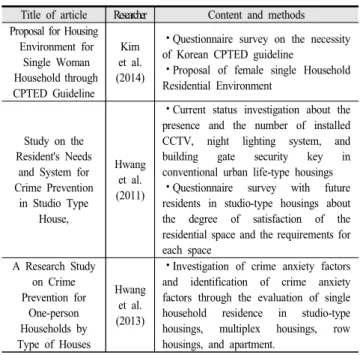
2.2. 1인 가구 주택의 범죄 안전에 관한 연구 동향 1인 가구에 대한 선행연구는 다양한 시각에서 연구되었다. 특히 1 인가구의 주거실태, 거주분포, 소득수준 등의 요인은 1인가구가 주 거지를 선택하는데 중요한 요인인 것으로 분석되었다. 심은진(2010) 의 연구에 따르면 직장인 1인가구의 소득 수준은 주거를 선택하는 중 요한 요인이지만 직장과의 통근거리와 범죄율 또한 소득수준과 상관 없이 주거지를 선택하는데 중요한 요인이라 밝히고 있다. 김상훈 (2014) 연구에서는 설문조사를 통해 국내의 CPTED 가이드라인의 필요성을 조사하였고 이를 통해 1인 가구 중 여성을 위한 주거환경 계획을 제안하였다.
황성은(2013) 연구에서는 설문조사를 통해 1인가구를 대상으로 원룸, 다가구·다세대·연립, 공동주택에서의 거주 후 평가를 실시하였 고 이를 통해 주택의 내·외부에서의 범죄 불안감 및 범죄 불안감 요소 를 도출하였다. 또 다른 황성은(2011) 연구에서는 기존 도시형생활 주택의 실태조사를 위해 기존 선행연구에서 제시한 CPTED 계획요 소 중 일부 항목(CCTV설치 유무/개수, 야간 조명, 현관 보안키 유무 등)에 대하여 실태 조사 하였다. 또한 도시형생활주택 모델하우스 방 문자를 대상으로 도시형생활주택의 현재 거주 공간 만족도와 각 공
5) 주택법 시행령 제3조(도시형 생활주택)에서 도시형 생활주택 유형 분류체계 명시 6) 도시형생활주택의 평가 및 발전방향 연구, 최상희 외3, 한국토지주택공사 토지주택연
구원, 2013. p53.
간별 요구사항에 대하여 설문조사하였다. 이처럼 선행연구에서도 알 수 있듯이 1인가구의 범죄로부터 안전성 및 범죄 불안감 요인은 반듯 이 고려되어야 할 요소이다. 그러나 범죄 안전성 및 불안감에 대한 연 구는 대부분 공동주택에 집중되어 있고 앞에서 언급한 일부 선행연 구에서만 1인 가구에 대한 연구가 이루어지고 있다. 또한, 앞서 고찰 한 선행연구에서도 대부분 설문조사를 통해 결과를 도출하고 있고, 실태조사에 대한 분석이 일부 항목으로 국한되어 있어 1인 가구 주택 에 대한 범죄 안전성에 대한 물리적 현황을 파악하는데 한계가 있었 다. 따라서 본 연구는 1인 가구를 수용할 수 있는 대표적인 주택 유형 인 도시형생활주택 중 원룸형 주택을 대상으로 실태조사를 실시하였 다. 기존 선행연구와의 차별성은 국내 CPTED 가이드라인을 통해 실 태조사 항목을 도출하였고 CPTED 기본 원리에 따라 원룸형 주택의 물리적인 주택 현황 및 범죄 취약요소를 분석한 점이다.
Title of article Researcher Content and methods Proposal for Housing
Environment for Single Woman Household through
CPTED Guideline Kim et al.
(2014)
⦁Questionnaire survey on the necessity of Korean CPTED guideline
⦁Proposal of female single Household Residential Environment
Study on the Resident's Needs
and System for Crime Prevention
in Studio Type House,
Hwang et al.
(2011)
⦁Current status investigation about the presence and the number of installed CCTV, night lighting system, and building gate security key in conventional urban life-type housings
⦁Questionnaire survey with future residents in studio-type housings about the degree of satisfaction of the residential space and the requirements for each space
A Research Study on Crime Prevention for
One-person Households by Type of Houses
Hwang et al.
(2013)
⦁Investigation of crime anxiety factors and identification of crime anxiety factors through the evaluation of single household residence in studio-type housings, multiplex housings, row housings, and apartment.
Table 1. Previous studies on crime at single household housings
2.3. 국내 범죄예방환경설계(CPTED)가이드라인 고찰 국내 8개의 범죄예방환경설계(CPTED) 가이드라인을 중심으 로 계획요소를 분석한 결과 대부분 공동주택을 중심으로 CPTED 세부 지침이 마련되었다. 양산시 및 부천시의 경우, 단독주택에 대한 CPTED 지침사항이 마련되지 않았다. 이처럼 단독, 다가구, 다세대 주택(이하 단독주택)의 CPTED 가이드라인은 공동주택 에 비해 상대적으로 매우 미비한 것을 알 수 있다.
Year CPTED Guideline A DH
2009 Crime Prevention Design Guidelines on Regeneration
Promotion District in Bucheon ● x
2012 Crime Prevention Through Environmental Design for Women ● ●
2013 Yangsan CPTED Planning Guideline ● x
2013 Busan CPTED Planning Guideline ● ●
2013 Public Service Design Manual For The Crime
Prevention in Vulnerable Area ● ●
2013 Crime Prevention Design Guidelines for Buildings ● ● 2013 Seoul Design Guideline for Crime Prevention Through
Environmental Design ● ●
2014 Cheongju CPTED Planning Guideline ● ●
*A: Apartment, DH: Detached House Table 2. Korean CPTED Guidelines
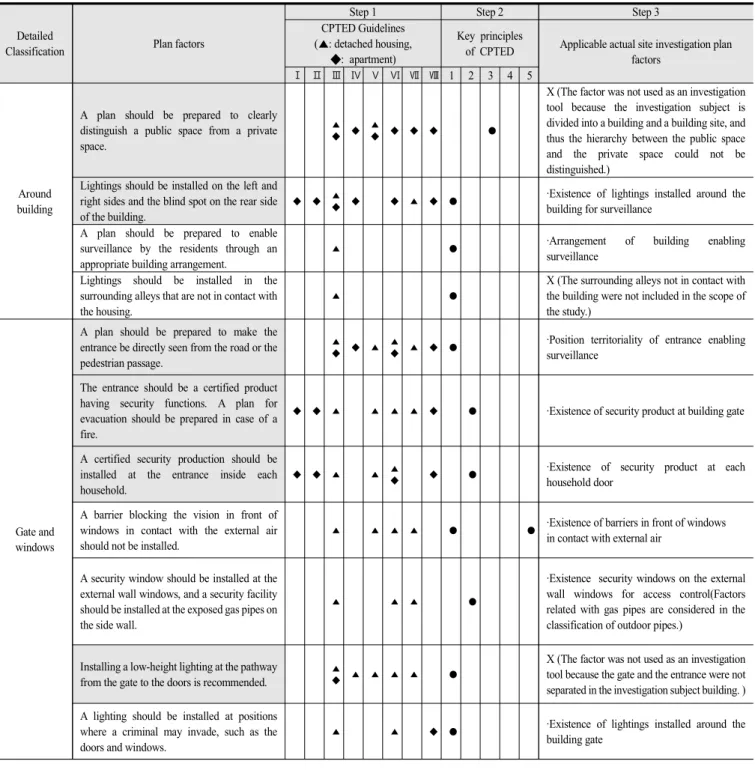
본 연구는 원룸형 주택 실태조사를 위해 국내 8개의 CPTED 가이 드라인을 활용하였고 3단계 연구방법을 통해 조사 내용을 도출하였 다. 특히, 원룸형 주택의 경우, 공동주택과 단독주택의 일부 특성을 모두 갖고 있어 두 가지 유형의 가이드라인을 모두 고찰하여 원룸형 주택에 적용 가능한 계획요소를 찾고자 하였다.
1단계로 8개(표3 참조)의 가이드라인의 세부 계획요소를 나 열하고 각 계획요소에 대하여 3개 이상의 가이드라인에서 언급하 고 있는 계획요소와 원룸형 주택에 적용 가능한 계획요소를 중심 으로 정리하였다. 그 결과, 공동주택 가이드라인에서 97개의 세 부 계획요소 중 18개를 도출하였고 단독주택 가이드라인에서 34 개 세부 계획요소 중 19개 계획요소를 도출하였다.
2단계로 주택 유형별 도출된 37개(공동주택:18개, 단독주 택:19개)의 세부 계획요소 중 서로 중복되는 10개의 계획요소7) 를 제외한 27개의 계획요소를 원룸형 주택의 범죄예방환경설계 를 위한 계획요소로 도출하였다. 또한, 도출된 세부계획은 CPTED 기본 원리와 연계시켜 분류하였다.
3단계로 앞서 도출된 27개 계획요소 중 현장 실태 조사 시 활용 할 수 있는 계획요소를 선별하였으며 그 결과 <표4>와 같다. 반 면 총 7개의 계획요소는 연구범위에 벗어나거나 원룸형 주택의 구조 및 조사의 용이성 등에 관한 어려움이 있어 활용하지 못했 다.
7) 중복되는 계획요소 중 단독주택과 공동주택 가이드라인이 내용상 중복되는 계획요소 는 음영처리 함
Detailed
Classification Plan factors
Step 1 Step 2 Step 3
CPTED Guidelines (▲: detached housing,
◆: apartment)
Key principles
of CPTED Applicable actual site investigation plan factors
Ⅰ Ⅱ Ⅲ Ⅳ Ⅴ Ⅵ Ⅶ Ⅷ 1 2 3 4 5
Around building
A plan should be prepared to clearly distinguish a public space from a private space.
▲
◆ ◆ ▲
◆ ◆ ◆ ◆ ●
X (The factor was not used as an investigation tool because the investigation subject is divided into a building and a building site, and thus the hierarchy between the public space and the private space could not be distinguished.)
Lightings should be installed on the left and right sides and the blind spot on the rear side of the building.
◆ ◆ ▲
◆ ◆ ◆ ▲ ◆ ● ·Existence of lightings installed around the building for surveillance
A plan should be prepared to enable surveillance by the residents through an appropriate building arrangement.
▲ ● ·Arrangement of building enabling
surveillance Lightings should be installed in the
surrounding alleys that are not in contact with the housing.
▲ ●
X (The surrounding alleys not in contact with the building were not included in the scope of the study.)
Gate and windows
A plan should be prepared to make the entrance be directly seen from the road or the pedestrian passage.
▲
◆ ◆ ▲ ▲
◆ ▲ ◆ ● ·Position territoriality of entrance enabling surveillance
The entrance should be a certified product having security functions. A plan for evacuation should be prepared in case of a fire.
◆ ◆ ▲ ▲ ▲ ▲ ◆ ● ·Existence of security product at building gate
A certified security production should be installed at the entrance inside each household.
◆ ◆ ▲ ▲ ▲
◆ ◆ ● ·Existence of security product at each
household door
A barrier blocking the vision in front of windows in contact with the external air should not be installed.
▲ ▲ ▲ ▲ ● ● ·Existence of barriers in front of windows
in contact with external air
A security window should be installed at the external wall windows, and a security facility should be installed at the exposed gas pipes on the side wall.
▲ ▲ ▲ ●
·Existence security windows on the external wall windows for access control(Factors related with gas pipes are considered in the classification of outdoor pipes.)
Installing a low-height lighting at the pathway from the gate to the doors is recommended.
▲
◆ ▲ ▲ ▲ ▲ ●
X (The factor was not used as an investigation tool because the gate and the entrance were not separated in the investigation subject building. ) A lighting should be installed at positions
where a criminal may invade, such as the doors and windows.
▲ ▲ ◆ ● ·Existence of lightings installed around the
building gate
Table 3. Process of deriving actual condition investigation plan factors for CPTED of studio-type housings and key principles of CPTED
Detailed
Classification Plan factors
Step 1 Step 2 Step 3
CPTED Guidelines (▲: detached housing,
◆: apartment)
Key principles
of CPTED Applicable actual site investigation plan factors
Ⅰ Ⅱ Ⅲ Ⅳ Ⅴ Ⅵ Ⅶ Ⅷ 1 2 3 4 5
Outdoor pipes
The electricity, gas, and tap water meters should be installed outside so that a meter man should not come inside a household.
◆ ◆ ▲
◆
▲
◆ ▲ ● ·Position of utility meters
A storehouse or a garage should be separated from a balcony or windows to prevent invasion from the outside.
◆ ◆ ▲ ▲ ◆ ▲ ●
X (The factor was not used as an investigation tool because the structure of the investigation subject building had a storehouse inside the building but did not have a balcony.) A pipe covering or a thorn covering for
security should be installed at a height that may not be touched by a person or should be buried in an internal wall.
▲ ▲ ●
X (The investigation subject building did not have a pipe covering or a thorn covering for security.)
A gas pipe, a rainwater pipe, a terrace, or a embossed wall should not be installed on the external wall of a building.
◆ ◆ ◆ ●
· Position of gas pipes and rainwater pipe.
(The factor was not used as an investigation tool because the investigation subject building did not have a terrace or an embossed wall surface exposed externally.)
Parking lot
surveillance should be possible and a blind point should be prevented in a parking lot near residential housings.
▲ ◆ ◆ ◆ ● ·Parking lot arrangement enabling
surveillance The territoriality of a parking lot should be
definitely secured. ▲ ● ·Status of parking lot territoriality plan
A parking lot lighting plan should be prepared
so that it may be safely used even at night. ▲ ◆ ●
·Enhanced spatial usability by lightings installed at parking lot
A blind spot that may be formed at a pilotis parking lot should be considered in planning.
A CCTV may be installed.
▲ ● ● ·Existence of CCTV installed at parking lot for access control
Rooftop
A CCTV should be installed at the exit leading to the rooftop of the main building.
A locking system should be installed in connection with a fire alarm. A plan should be made to use the rooftop.
◆ ◆ ◆ ◆ ● ● ·Status of rooftop utilization and existence of
locking system interlinked with fire alarm
Corridor A lighting should be installed in front of the
door of each household. ◆ ▲ ◆ ●
·Lightings installed in front of each household door and corridor environment
Elevator
The illumination inside the elevator should be
50 lux or higher at the bottom. ◆ ◆ ●
X (The factor was not used as an investigation tool because use of an illuminometer makes the investigation difficult.)
The elevator entrance should be seen from the
gate. ◆ ◆ ◆ ◆ ◆ ●
·Position of elevator entrance enabling surveillance
A CCTV should be installed inside the elevator and at the elevator hall on the ground floor.
◆ ◆ ◆ ◆ ◆ ◆ ◆ ● ·Existence of CCTV installed inside and
outside of elevators
Inside household
A certified security production should be installed at the door inside each household.
Slots for newspaper or milk should not be installed.
◆ ◆ ◆ ● ·Existence of newspaper and milk bottle slots installed at each household for access control
Certified windows with a defensive function should be installed inside each household. The windows should allow evacuation in case of a fire.
◆ ◆ ◆ ● · Existence of security product installed at windows in each household
Factors enabling invasion through the external
wall on the lower floors should be eliminated. ◆ ◆ ●
X (A studio-type housing is different from apartments because no space is exposed to the outside and thus invasion into the housing is difficult.)
[CPTED Guideline]
Ⅰ. Yangsan CPTED Planning Guideline, 2013. Ⅱ. Crime Prevention Design Guidelines on Regeneration Promotion District in Bucheon, 2009.
Ⅲ. Busan CPTED Planning Guideline, 2013.Ⅳ. Public Service Design Manual For The Crime Prevention in Vulnerable Area, 2013.
Ⅴ. Crime Prevention Design Guidelines for Buildings, 2013. Ⅵ. Cheongju CPTED Planning Guideline, 2014.
Ⅶ. Seoul Design Guideline for Crime Prevention Through Environmental Design, 2013.
Ⅷ Crime Prevention Through Environmental Design for Women, 2012, p53-58.
[Key principles of CPTED]
1: Surveillance, 2: Access control, 3: Territoriality, 4: Activity support, 5: Maintenance and management
3. 현장조사
3.1. 조사대상지 선정
본 연구의 조사 대상지는 서울시 관악구에 위치한 5개의 원룸 형 주택이며 구체적인 선정기준은 다음과 같다.
첫째, 서울시 25개 구 중 1인 가구 비율이 가장 높은 관악구를 대상지로 선정하였다. 국가통계포털 자료에 따르면 2010년 기준 (가장최근) 관악구 1인가구의 수가 84,423명으로 가장 높았다.
둘째, 선정된 관악구에서 녹지 및 수변 공간, 전면도로, 교통시 설 등의 주변입지 조건이 유사한 동단위의 신림동을 대상지 세부 지역으로 선정하였다. 이는 건물의 물리적인 조건만을 CPTED 관점에서 실태조사하기 위해 범죄 안전 및 불안감에 영향을 미칠 수 있는 주변의 입지조건을 통제하고자 신림동으로 한정한 것이 다.
셋째, 원룸형 주택의 준공시기 및 관리형태가 다른 건물을 선 정하였다. 즉, 준공시기 따라 물리적 계획요소의 실태를 파악하 고, 관리형태로 주인관리와 위탁관리 시 CPTED 관점에서 물리 적인 현황에 어떤 영향을 주는지 살펴보기 위해 위와 같은 기준으 로 선정하였다.
넷째, 복도의 유형 및 규모가 다른 원룸을 선정하였다. 즉, 원룸 의 특성상 복도 형태 및 규모가 실내·외에서의 자연감시 측면에 영향을 줄 것으로 판단되기 때문이다.
3.2. 대상지 실태조사 분석
선정된 5개의 원룸형 주택8)의 실태조사를 위해 앞서 도출한 원룸형 주택에 적용 가능한 범죄예방환경설계를 위한 계획요소 를 활용하여 CPTED 관점에서의 현장 조사 내용을 작성하였다.
8) 지면상 아래 본문부터 원룸형 주택을 건물이라고 지칭하여 표기함.
1) 건축물의 일반적인 물리적 현황
조사 대상 건물의 물리적 현황을 살펴보면 A,C,E 건물의 준공 시기는 2000년대 후반이고 B, D건물은 2000년대 초반에 준공되 었다. 건축물의 건축심의 시기에 따라 피난계단 설치(건축법 시 행령 제35조, 2008.10.28.)법규 적용이 달랐으며 이에 따라 B,C,D 건물은 피난계단이 설치되지 않았다. 조사 대상 건물의 복 도형태는 기본적으로 중복도 형태이며 그 중 B건물은 이중 중복 도, C건물은 ‘ㄱ’형 중복도 형태였다. 세대수는 건물의 규모에 따 라 차이를 보이며 이중 중복도 형태인 B건물이 76세대로 세대수 가 가장 많았다. 건물의 관리 형태를 살펴보면 C건물만 위탁관 리 이며 나머지 건물은 주인세대가 상주하여 관리하는 것으로 조 사되었다. 주차장의 경우, 건물에 계획되어 있었고 엘리베이터의 경우 E건물(4층)을 제외한 모든 건물에 설치되어 있었다. 주변 입지조건 인 녹지, 수변, 자동차 도로, 버스정류장은 모든 조사 대 상 건물에서 도보로 5분 이내에 위치하고 있었다.
2) CPTED 주요원리에 따른 원룸형 주택 현황분석
조사 대상 건물의 물리적 현황 및 범죄 취약요소를 CPTED 관 점에서 살펴보기 위하여 CPTED 기본 원리인 자연감시, 접근통 제, 영역성, 활동성강화, 유지관리 별 조사한 결과 다음과 같다.
(1) 자연감시
➀ 자연감시를 위한 건물주변 조명 설치 유무
자연감시를 위해 출입구가 있는 건물 주변의 조명 설치 유무와 더불어 조명의 종류, 높이, 색상9), 상업시설 현황을 중심으로 분 석한 결과 다음과 같다.
조사 대상 건물 주변의 조명 종류는 크게 전봇대에 매입되어 있 는 조명과 가로등으로 구분되었다. 조명의 높이의 경우, 전봇대 매입 조명은 2.5m, 가로등은 8m 였다. 가로등의 경우, 보행자 중 심이 아닌 차량 통행을 위한 조명 계획으로 설치되어 조명의 높이 가 전봇대에 매입된 조명 높이보다 높은 것을 알 수 있다. 조명 색 상의 경우 전봇대 매입 조명은 주백색(840)으로 자연광에 가까 우며 가로등은 주광색(865)으로 밝은 흰 색을 띠고 있었다. 조명 색상에서 주광색이 주백색 보다 주변을 인식하는데 가시성이 더 좋으며 실제 주광색등을 설치한 D건물 주변이 다른 건물보다 상 대적으로 밝은 것을 알 수 있다. 앞서 조사한 결과를 종합해 보면 건물 주변에 설치된 조명의 색상은 주백색의 노란색 계열인 것을 알 수 있었다. 이를 조명 계획 분야 관점에서 살펴보면 주백색은 주광색보다 안개나 스모그 등의 조건에서 빛을 잘 전달하기 때문 에 대부분 주백색 조명을 사용하고 있었다. 하지만 CPTED 관점 에서 보면 주백색 보다 주광색에서 사람의 얼굴을 더 잘 인식할 수 있기 때문에 주광색을 권장하고 있다.
9) 실내외 LED조명 디자인과 응용, 황명근,이장원, 노재엽, 도서출판 아진, 2011.09.09.
제3장 조명의 색.
Key principles
of CPTED Content of investigation
Surveillance
⦁Existence of lightings installed around the building for surveillance
⦁Arrangement of building enabling surveillance
⦁Position territoriality of entrance enabling surveillance
⦁Existence of barriers in front of windows in contact with external air
⦁Existence of lightings installed around the building gate
⦁Parking lot arrangement enabling surveillance
⦁Lightings installed in front of each household door and corridor environment
⦁Position of elevator entrance enabling surveillance
Access control
⦁Existence of security product at building gate
⦁Existence of security product at each household door
⦁Existence security windows on the external wall windows for access control
⦁Position of utility meters, gas pipe, and rainwater pipe
⦁Existence of CCTV installed at parking lots, inside and outside of elevators, and rooftop for access control
⦁Existence of newspaper and milk bottle slots installed at each household for access control
⦁Existence of security product installed at windows in each household
Table 4. Contents of status investigation
Territoriality ⦁Status of parking lot territoriality plan
⦁Status of building gate territoriality plan Activity support
&
maintenance and management
⦁Enhancement of spatial usability by installation of lightings at parking lots
⦁Status of rooftop utilization and existence of locking system interlinked with fire alarm
10) A: 대상건물, B: 버스정류장, G: 녹지공간, W: 수변공간
11) 거리 측정은 네이버 지도 거리재기 프로그램을 이용하여 직선 거리를 산출함.
Item Studio-Type Housing A Studio-Type Housing B Studio-Type Housing C Studio-Type Housing D Studio-Type Housing E
Location10)
Completion 2010년 2002년 2009년 2002년 2009년
site area 240㎡ 553.88㎡ 274㎡ 163.1㎡ 162.40㎡
Building area 126.13㎡ 312.12㎡ 122.95㎡ 95.55㎡ 80.98㎡
Total floor area 477.66㎡ 1,975.69㎡ 599.12㎡ 571.5㎡ 356.68㎡
Building-to-land ratio 52.55% 56.35% 44.87% 58.58% 49.88%
Floor area ratio 199.03% 294.82% 218.66% 299.1% 169.77%
Region type Type 2 general residential region
Type 2 general residential region
Type 2 Neighbourhood living facility
Type 2 general residential region
Type 3 general residential region No. of floors Five floors on ground Six floors on ground Five floors on ground Six floors on ground Four floors on ground Corridor type Middle corridor Dual middle corridors ‘ㄱ’ type middle corridor Middle corridor Middle corridor
No. of households 27 76 28 17 17
Household area 13.23㎡, 12.60㎡ 19.8㎡ 18.15㎡ 15.4㎡ 12.95㎡
Management type Managed by building owner Managed by building owner Entrusted Managed by building owner Managed by building owner No . of parking lot
(ground/underground) (5/1) (4/No used) (6/None) (6/None) (4/None)
Existence of elevator O O O O X
Existence of shelter stairs O X X X O
Distance
11)
Public Transportation
(Bus)
Path1: 329m(5 min walk) Path2: 322m(5 min
walk)
Path1: 211m(3 min walk) Path2: 217m(4 min
walk)
Path : 93m(2 min walk) Path : 26m(1 min walk) Path1: 76m(2 min walk) Path2: 74m(2 min walk)
Car road 91m(2 min walk) 150m (3 min walk) 86m(2 min walk) 2m (10 sec walk) 46m (1 min walk) Front road width
(for both pedestrians and cars)
5m (for both pedestrians and cars)
5m (for both pedestrians and cars)
6m (for both pedestrians and cars)
20m (cars only)
3m (for both pedestrians and cars) Distance from
waterfront space 149m(3 min walk) 136m(3 min walk) 118m(2 min walk) 246m(4 min walk) 93m(2 min walk) Distance from green space 61m(1 min walk) 8m(20 sec walk) 118m(2 min walk) 246m(4 min walk) 93m(2 min walk)
C C T V
Existence O
X
O
X
O
Number 7 3 3
Installed position
- Parking lot (3) - In front of gate (1) - Outside elevator on ground floor(1) - Inside elevator (1) - Inside of building owner’s household (1)
-Parking lot (1) -In front of gate (1) -Outside elevator on ground floor (1)
- Parking lot (1) - In front of gate (1) - Staircase on 3rd floor (1)
Existence of lightings installed at buildling
gate
O O O O O
Lightings installed at
the corridor O O O O O
Opening of rooftop O O O X(Only for the building
owner's household)
X(Only for the building owner's household)
Buildi ng access system
Card Key O x O x O
Password O(Only for the building
owner's household) O O(Only for the building
owner's household) O O(Only for the building
owner's household) Video and
voice communication
O x O x O
Access system for each household door
O (Password locking)
O (Password locking)
O (Password locking)
O (Password locking)
O (Password locking) Table 5. General physical characteristic of buildings
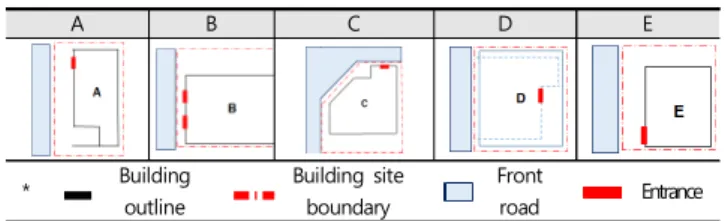
➁ 자연감시가 가능한 건물의 배치
자연감시가 가능한 건물 배치를 살펴보기 위해 건물과 전면도
로와의 관계를 중심으로 살펴본 결과 <표7>과 같다. 모든 조사 대상 건물 A,B,C,D,E는 건물 앞 전면도로와 면하게 배치되어있고 도로와 건물간의 거리가 2~3m 내로 가까워 도로 내 보행자 및 차 량으로부터 자연적 감시가 가능한 것으로 조사되었다.
A B C D E
* Building outline
Building site boundary
Front
road Entrance Table 7. Arrangement of buildings
➂ 자연감시가 가능한 건물의 출입문 개수 및 위치
자연감시가 가능한 건물의 출입문 개수 및 위치를 조사한 결과 다음과 같다. 출입문 개수의 경우, A,C,D,E 건물은 출입구가 1개 씩 있었고 B건물은 2개의 출입구가 있었다. 건물 출입문의 위치 로는 A,C,D,E 건물의 경우, 건물 앞 전면도로와 면하도록 출입구 가 있어 보행자 및 차량으로부터 자연적 감시가 가능했다. 반면, D건물의 경우, 자동차도로와 건물 출입문이 서로 면하도록 위치 하고 있으나 1층이 필로티 형태의 구조로 되어 있어 건물 앞면에 주차공간이 있고 뒤편으로 출입문이 있었다. 따라서 보행자나 차 량으로부터 건물 출입문의 자연적 감시가 어려웠다.
➃ 외기에 면한 창문 앞 장애물 설치 유무
외기 창문 앞에 설치된 나무나 간판 등과 같은 장애물이 설치되 었는지 조사한 결과, 대상지 건물의 외기에 면한 창문 앞에는 시 야를 가리는 장애물은 없었다.
➄ 건물 출입문 주변 조명 설치 유무
건물 출입문 주변 조명의 설치 유무를 조사한 결과, 모든 건물 출입문 중앙에 조명이 설치되어 있었다. 건물 출입문 중앙에 설 치된 조명은 동작 감지형 조명으로 일정 시간동안 움직임이 없는 경우 조명이 작동하지 않아 야간 시 멀리서 출입문을 인식하기 어 려웠다. D건물은 다른 조사대상 건물과 달리 출입문의 위치가 주 차장 안쪽에 있어 야간에 어두운 필로티 주차장을 지나야 조명이 작동되었다.
➅ 자연감시가 가능한 주차장 배치
자연감시가 가능한 주차장 배치를 살펴본 결과 다음과 같다.
주차장의 경우, C,D,E 건물은 지상주차장만 있었고 A,B건물은 지 상·지하주차장이 있었다.
A건물의 지상 주차장은 건물의 좌측과 전면에 배치되어 있었 다. 야간 시 건물 좌측 주차장에서 차량이 연속적으로 주차되어 있을 때 주차장 후면은 외부로부터 감시가 어렵고 은닉장소가 될 수 있었다. 지하 주차장의 경우, 반 지하 형태의 주차장으로 주차 장 출입문이 없어 지상주차장과 유사한 환경을 갖고 있었다.
B건물은 지상주차장과 지하주차장이 모두 있었다. 지하 주차 장의 경우, 기계식 주차를 하고 있었으나 세입자 특성상 자차 보 유자가 거의 없어 사용되지 않고 있었다. 지상주차장은 전면도로 와 면하는 형태로 건물 우측과 전면에 배치되어 건물 내·외부로부 터 자연적 감시가 쉬웠다.
C건물의 주차장은 건물 좌측에 지상주차장이 있고 주차장 주 변에 공영 버스 차고지와 24시간 운영되는 음식점이 있다. 따라 서 야간시 다른 건물에 비해 상대적으로 주차장이 밝고 야간에도
Image Analysis
A
⦁Lightings mounted on utility poles around the building.
⦁Height of lighting:2.5m, Color: daylight white
⦁Easy to recognize the person in the front while walking at night.
B
⦁Lightings mounted on utility poles around the building.
⦁Height of lighting:2.5m, Color: daylight white
⦁Desolate at night due to the green space in front of the building. Difficult to recognize the person in the front while walking at night.
C
⦁Lightings mounted on utility poles around the building.
⦁Height of lighting:2.5m, Color: daylight white
⦁Shops around the building
⦁Easy to recognize the person in the front while walking at night.
D
⦁Car road around the building. Street lamps installed in the interval of street trees
⦁Height of lighting:8m, Color: daylight blue
⦁Shops around the building
⦁Easy to recognize the person in the front while walking at night.
E
⦁Lightings mounted on utility poles around the building.
⦁Height of lighting:2.5m, Color: daylight white
⦁Many passersby due to the detached housings, studio-type housings, and apartments around the building.
따라서 조명 설치시 각 분야의 장점을 고려하여 공간에 따라 적 절한 조명이 설치될 수 있도록 계획되어야 한다.
A건물 주변에는 전봇대 매입형 조명이 설치되어 있었고 야간 시 마주 오는 사람의 얼굴을 인식하는데 어려움이 없었다. B건 물 주변에는 전봇대 매입형 조명이 설치되어 있었으며 건물 자체 에 매입되어 있는 조명은 없었다. 또한, B건물 주변에 자연녹지 가 조성되어 있어 야간 시 인적이 드물고 가로등만으로 사람의 얼굴을 인식하기 어려웠다.
C건물 주변에는 전봇대 매입형 조명과 건물주변에 위치한 상 업시설, 주거편의시설 등의 조명시설이 조명 역할을 하고 있었 다. 주변의 상업시설로 인해 상대적으로 다른 조사 대상 건물에 비해 그 주변이 밝았으며 야간 시 마주 오는 사람의 얼굴을 인식 하기 쉬웠다.
D건물 주변은 다른 조사대상 건물과 달리 자동차도로가 있어 가로수 간격으로 설치된 가로등이 조명 역할을 하고 있었고 필로 티 구조에 의한 1층 천장에 동작 감지형 조명이 매입되어 있었 다. 또한, 자동차 라이트 및 24시간 운영하는 음식점 조명으로 마주 오는 사람의 얼굴을 인식하는데 어려움이 없었다. E건물은 A건물과 유사하게 건물주변에 단독주택 및 원룸형 주택이 많았 고 60m안에 88세대 규모의 공동주택이 위치하고 있어 주택으로 부터 나오는 조명을 간접적으로 이용하고 있었다. 전봇대 매입 된 조명을 통해 야간 보행 및 마주 오는 사람의 얼굴을 인식하는 데 어려움이 없었다.
Table 6. Existence of lightings installed around the building for surveillance
자연적 감시가 쉬웠다.
D건물은 1층 필로티 공간을 주차장으로 사용하고 있었다. 주 차장은 전면도로와 마주 닿아 있어 외부로부터 자연적 감시가 좋 으나 주차장에 모든 차량이 주차된 경우, 안쪽 주차공간은 외부로 부터 감시가 어려운 것을 알 수 있었다. 필로티 주차장은 공간 활 용에는 좋으나 건물 4면이 오픈되어 있지 않은 경우, 주차장 안쪽 으로 은닉장소가 될 수 있다.
E건물 주차장은 건물 우측과 전면에 지상주차장이 있었다. E 건물 주차장은 전면이 외부로부터 오픈되어 있어 자연적 감시가 좋았다.
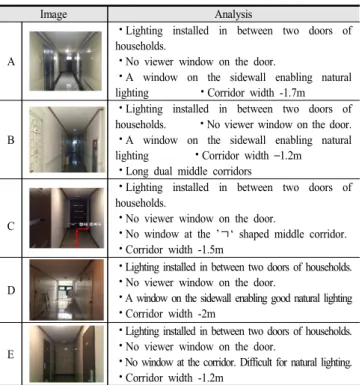
⑦ 자연감시가 가능한 세대 현관문 앞 조명 설치 및 복도환경 자연감시가 가능한 세대 현관문 앞 조명 설치 및 복도환경을 조 사한 결과 다음과 같다. 모든 조사 대상 건물 복도에서 두 세대 현 관문 중앙에 조명이 설치되어 있었고 동작감지형 조명 특성상 움 직임이 없는 경우, 조명이 작동하지 않아 복도 끝 구석공간의 상 황을 인지하기 어려웠다. 이와 더불어 현관문에 뷰어창이 없어 세 대 내 복도 상황을 인지하기 어려웠다.
B건물은 다른 건물과 달리 이중 중복도라는 특성상 복도로 유 입되는 자연채광이 적어 주간에 조명을 켜지 않으면 사람을 인식 하기 어려웠다.
C건물은 다른 건물과 달리 건물의 형태가 다각형 형태로써 ‘ㄱ’
형태의 중복도로 계획되어 있었으며(표 12. 평면도 참조) 복도에 창문이 없어 자연채광이 어려웠다. 또한 ‘ㄱ’ 형태의 중복도 특성 상 꺾이는 부분에 의해 복도가 분리되어 같은 층에 있는 복도라 해도 자연적 감시가 어려운 것을 알 수 있었다.
D건물은 복도의 폭이 다른 건물에 비해 넓이가 1.5배에서 2배
정도 넓고 주간에는 창을 통해 유입되는 자연채광으로 조명 없이 도 자연감시가 가능하였다. 이는 다른 건물과 달리 복도 양쪽 측 벽에 창문이 있기 때문에 나타난 결과이다.
E건물은 상대적으로 건물의 규모가 작아 다른 건물에 비해 세 대수도 적도 복도의 길이도 짧았다. 복도 끝에는 창문이 없어 자 연채광이 불가능하지만 A,B,C 건물과 달리 복도의 길이가 짧아 주간에 건물 복도에 설치된 조명에 의해 내부 복도의 자연감시가 가능하였다.
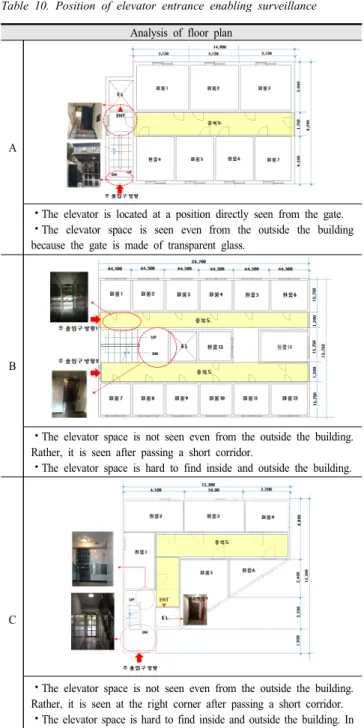
⑧ 자연감시가 가능한 엘리베이터 출입구 위치
자연감시가 가능한 엘리베이터 출입구 위치를 조사한 결과 다 음과 같다. 건물 출입구 내·외부에서 엘리베이터 출입구 공간에 대하여 자연감시가 가능한지에 대한 측면에서 살펴보았다.
A건물은 출입문에서 마주보는 곳에 엘리베이터가 위치하고 출입문의 소재가 유리로 되어 있어 건물 외부에서도 엘리베이터 공간이 잘 보였다. 반면, B건물은 엘리베이터 공간이 건물 중앙 에 위치하여 출입구로부터 짧은 복도를 지나 좌측으로 돌아야 엘 리베이터 출입구로 갈 수 있었다. 이러한 구조는 건물의 내·외부 에서 엘리베이터 출입구를 인지하기 어렵다.
C건물은 B건물과 유사하게 출입구에 엘리베이터 공간이 바로 보이지 않고 짧은 복도를 지나 오른쪽 모서리를 돌아야 엘리베이 터 공간 있었다. 특히 ‘ㄱ’형태의 중복도로 한번 꺾어지는 공간이 있어 측벽에 가까운 세대는 엘리베이터 공간을 전혀 인지 할 수 없었다.
D건물은 건물 출입문이 투명한 유리 소재로 되어 있어 출입문 에서 엘리베이터 공간을 바로 확인할 수 있었다. 또한 다른 건물 에 비해 로비공간이 넓고 로비공간에서 주차장의 자연 감시가 가 능하였다. 반면, 야간시 로비공간의 벽과 출입문이 투명한 유리 소재로 되어 있어 로비공간의 2면과 닿아있는 주차장 내 자동차 라이트로 인한 눈부심 현상과 프라이버시 침해 등의 문제를 갖고
Image Analysis
A
⦁Ground parking lot on the left side and in front of the building
⦁The parking open to the public during daytime is good for external surveillance.
⦁When two cars are placed in a row, the inner side of the parking lot may be a concealment place.
B
⦁Ground and underground parking lots are placed on the right side of the building.
⦁The mechanical type of underground parking lot is not currently used.
⦁The parking lot facing the road is good for external surveillance day and night.
C
⦁A ground parking lot is placed on the left side of the building.
⦁The parking lot is faced with a public bus garage and a 24-hour restaurant.
⦁A motorcycle parking lot is located on one side of the gate.
D
⦁The ground floor pilotis is used as a parking lot.
⦁The parking lot facing the front road is good for external surveillance.
E
⦁A parking lot is placed on the right side and in front of the building.
⦁The front side of the parking lot open to the outside is good for surveillance.
* -Building -Ground parking lot -Front road -Parking lot boundary -Undergraound parking lot
Table 8. Parking lot arrangement enabling surveillance Image Analysis
A
⦁Lighting installed in between two doors of households.
⦁No viewer window on the door.
⦁A window on the sidewall enabling natural lighting ⦁Corridor width -1.7m
B
⦁Lighting installed in between two doors of households. ⦁No viewer window on the door.
⦁A window on the sidewall enabling natural lighting ⦁Corridor width –1.2m
⦁Long dual middle corridors
C
⦁Lighting installed in between two doors of households.
⦁No viewer window on the door.
⦁No window at the ’ㄱ‘ shaped middle corridor.
⦁Corridor width -1.5m
D
⦁Lighting installed in between two doors of households.
⦁No viewer window on the door.
⦁A window on the sidewall enabling good natural lighting
⦁Corridor width -2m
E
⦁Lighting installed in between two doors of households.
⦁No viewer window on the door.
⦁No window at the corridor. Difficult for natural lighting.
⦁Corridor width -1.2m
Table 9. Lightings installed in front of each household door enabling surveillance and corridor environment
있다. E건물은 4층 건물로 엘리베이터 공간이 없고 출입문에서 바로 계단실로 연결되었다.
(2) 접근통제
① 건물 출입문에 방범성능을 갖춘 제품 설치 유무
건물 출입문에 방범 성능을 갖춘 제품 설치 유무를 분석하기 위 해 건물 출입 시스템 설치 현황을 살펴보았다. 건물 출입시스템은 세 가지 기능으로 구분되고 구체적으로 카드키 출입, 비밀번호 출 입, 세내와 연결 가능한 화성/음성 지원이 있다. A,C,E건물의 경 우, 세 가지 기능을 모두 갖춘 출입시스템을 설치하고 있었으며 그 중 비밀번호 기능은 주인세대만 사용하고 있었다. 반면, B,D 건물의 출입문은 비밀번호 출입 기능만 갖은 출입시스템을 설치 하고 있어 비밀번호가 노출되었을 때 외부인의 출입을 통제하기 어려울 것으로 유추된다.
② 세대 현관문 방범 성능 제품 사용 현황
세대 현관문에 방범 성능 제품 사용여부를 조사하기 위해 세대 현관문 출입시스템 설치, 안전 고리 설치 현황을 중심으로 살펴보 았다. 그 결과, 모든 조사 대상 건물의 세대 현관문은 비밀번호 출 입시스템을 설치하고 있었고 안전고리 및 현관문 뷰어시스템은 설치되지 않았다. 현관문 뷰어시스템 현황의 경우, 세대 현관문 앞 조명 설치 및 복도환경 조사결과에서도 알 수 있었듯이 세대 현관에 뷰어 창 기능이 없어 세대 내부에서 외부의 상황을 인지 할 수 없었다.
③ 접근통제를 위한 외벽창문에 방범창 설치 유무
접근통제를 위한 외벽 창문에 방범창 설치유무를 살펴본 결과, A건물은 1층 세대, B건물은 2층~6층 세대, C건물은 4층~6층 세 대, D건물은 5층~6층 세대, E건물은 1층~2층 세대 외벽 창문에 방범창을 설치하고 있었다. 이처럼 각 건물마다 방범창 설치 위치 가 다르고 종류도 다양한 것을 알 수 있었다.
Analysis of floor plan
A
⦁The elevator is located at a position directly seen from the gate.
⦁The elevator space is seen even from the outside the building because the gate is made of transparent glass.
B
⦁The elevator space is not seen even from the outside the building.
Rather, it is seen after passing a short corridor.
⦁The elevator space is hard to find inside and outside the building.
C
⦁The elevator space is not seen even from the outside the building.
Rather, it is seen at the right corner after passing a short corridor.
⦁The elevator space is hard to find inside and outside the building. In particular, the ’ㄱ‘ shaped middle corridor makes surveillance difficult.
D
⦁The elevator space is seen even from the outside the building because the gate is made of transparent glass.
⦁The elevator lobby space is wider than that of other buildings, which enables surveillance of the parking lot from the lobby space.
⦁On the other hand, due to the transparent glass gate, the lightings of a car may cause dazzling and violation of privacy.
Table 10. Position of elevator entrance enabling surveillance
E
⦁There is no elevator space. The elevator is immediately connected with the entrance.
Image Analysis
A
⦁Opaque security windows are installed at the windows facing the outside on the ground floor.
⦁No security windows are installed at the windows facing the outside on the second floor or higher
B
⦁No security windows are installed at the windows facing the outside on the ground floor.
⦁Opaque security windows are installed at the windows facing the outside from the second floor to the sixth floor.
C
⦁Opaque security windows are installed at the windows facing the outside from the fourth(4) floor to the sixth(6) floor.
Table 11. Existence security windows on the external wall windows for access control
④ 검침용 기기, 가스배관, 물받이 위치
검침용 기기의 위치를 분석한 결과, A,C,D,E건물은 1층 계단 측벽 쪽으로 검침용 기기가 매입되어 있었고 B건물은 주인세대 내 설치되어 있었다. 검침용 기기가 세대 내부가 아닌 외부에 설 치된 경우, 검침원이 세대 내로 출입할 필요가 없어 외부인의 출 입을 막을 순 있지만 세대별로 사용하고 있는 전기, 가스 등의 사 용량이 건물 방문자 또는 다른 세대에게 노출 될 수 있다. 가스배관 과 물받이의 경우, 모든 조사 대상 건물에서 범죄자가 타고 올라가 기 어렵게 설치되어 있었다.
Building A (Encased on the first floor sidewall)
Building B
(Installed in the building owner’s household) Table 12. Position of utility meters
⑤ 접근통제를 위한 주차장, 엘리베이터 내·외부, 옥상 CCTV 설 치유무
주차장 CCTV 설치 현황을 조사한 결과, A,C,E 건물에서만 CCTV 가 설치되어 있었고 지상주차장에 설치된 CCTV는 자연 감시가 어려운 공간까지 확인 할 수 있도록 계획하여 설치되었다.
Parking lot of Building A Parking lot of Building C Parking lot of Building E Table 13. Existence of CCTV installed at the ground parking lot for access control
엘리베이터 내·외부의 CCTV 설치 현황을 조사한 결과, A,C 건 물의 엘리베이터에서만 CCTV가 설치되어 있었다. A건물은 엘리 베이터 내·외부 모두 CCTV가 설치되어 있어 탑승자 확인 뿐만 아 니라 엘리베이터 내부도 감시 할 수 있었다. 반면 C건물의 경우, 엘리베이터 외부에만 CCTV가 설치되어 탑승자 현황을 알 수 있 으나 엘리베이터 내부에서 일어나는 행위는 알 수 없었다. 옥상의 경우, 모든 대상 건물에서 CCTV를 설치하고 있지 않았다.
Inside of the elevator of Building A Outside of the elevator of Building C 표 14. Existence of CCTV inside and outside elevator for access control
⑥ 접근통제를 위한 세대 내 신문, 우유, 투입구 설치 여부 세대 내 신문, 우유 투입구 설치 현황을 조사한 결과, 모든 대상 건물에서 설치되지 않은 것으로 조사되어 투입구를 통한 세대 내
로의 침입 가능성은 적은 것으로 분석되었다.
⑦ 세대 내 창문에 방범 성능을 갖춘 제품 설치 여부
세대 내 창에 방범 성능 제품 사용 현황을 살펴본 결과, A,C,E 건물 전 세대에서 창살 형태의 방범창이 설치되어 있었다. 반면 B,D건물은 세대 내 창문에는 창살 형태의 방범창이 설치되지 않았다.
(3) 영역성 강화
①주차장의 영역성 계획 현황
주차장 영역성 계획 현황을 분석한 결과, A건물은 주차장과 차량 도로와의 구분을 위해 바닥 재료 및 패턴을 차별화하여 사적 공간과 공적공간의 영역을 구분하였고 외부차량의 접근을 제한 시키고 있었다. B건물은 지상 주차장과 지하주차장이 구분되어 있지만 지상 주차장이 지하주차장 입구 전면부에 위치하여 지하 주차장을 이용하기 위해서는 지상주차장을 통과해야 사용이 가 능하였다. 지하 및 지상 주차장이 계획되어 있지만 지상 주차장을 통해 지하주차장으로 진입하도록 배치되어 각 공간의 영역성이 확보되지 않은 것을 알 수 있었다.
C건물은 지상주차장의 출입을 제한시키고 영역성을 확보하기 위해 출입문을 설치하였다. 그러나 상주하는 관리자가 없어 주차 장 출입문 주변에 쓰레기를 투기하는 사례를 볼 수 있었다. D건물 은 건물 외벽에 주차장이라는 이름을 새겨 영역성을 부여하고 있 었다. 또한, 이중 주차를 방지하기 위해 칼바콘(고깔 모양의 설치 물)을 설치하여 외부인의 차량을 통제하고 있었다. E건물은 주차 장에 지붕을 설치하여 영역성을 부여하였고 눈이나 비가 올 때 잠 시 피할 수 있는 공간으로도 활용하고 있었다.
② 건물 출입문의 영역성 계획 현황
건물 출입문의 영역성 계획 현황을 분석한 결과, A와 C건물 출 입문의 경우, 건물 외벽 외장재와 출입구 외장재의 재료가 달라 출입구의 영역성이 강조되었으며 야간 시 출입문를 인식하기 좋 았다. 특히, C건물의 경우, 출입문 앞 공간에 영역성을 강조하기 위해 유리로 된 가벽을 설치하여 외부공간과 분리하고 있었다.
B건물의 출입문은 건물 명패와 건물 주소가 출입문 쪽 외벽에 부착되어 있어 다른 건물과의 차별성을 갖고 있으며 야간 시 식별 이 가능하였다. D건물은 건물 출입문이 주차장 안쪽에 있고 출입 및 문 출입공간이 유리벽으로 설치되어 있어 다른 건물에 비해 상 대적으로 영역성이 떨어진다. E건물 출입문의 명패는 A,C 건물 출입문와 달리 명패에 다른 소재를 사용하지 않고 재료에 이름을 새기는 방식을 사용하여 야간시 건물명을 확인하기 어려웠다.
D
⦁Security windows are installed at the windows facing the outside except the ground floor, and the fifth and sixth floors.
E
⦁Opaque security windows are installed at the windows facing the outside on the first floor and the second floor.
Parking lot of Building C Parking lot of Building D Parking lot of Building E Table 15. Status of plan for securing parking lot territoriality
Image Analysis
A
⦁The gate cladding material is different from the main cladding materials of the building to highlight the territoriality.
⦁The building and the gat may be recognized at hight.
Table 16. Status of building gate territoriality plan