• 검색 결과가 없습니다.

MicroRNA Expression Profiles in Korean Non-Small Cell Lung Cancer

N/A
N/A
Protected

Academic year: 2021

Share "MicroRNA Expression Profiles in Korean Non-Small Cell Lung Cancer"

Copied!
9
0
0

로드 중.... (전체 텍스트 보기)

전체 글

(1)

Tuberc Respir Dis 2009;67:413-421

CopyrightⒸ2009. The Korean Academy of Tuberculosis and Respiratory Diseases. All rights reserved.

MicroRNA Expression Profiles in Korean Non-Small Cell Lung Cancer

Departments of

1

Internal Medicine,

2

Thoracic Surgery, Konyang University Hospital, Daejeon,

3

Myunggok Research Institute for Medical Science, Konyang University, Daejeon,

4

Department of Biochemistry, Kyungpook National University School of Medicine, Daegu,

5

Department of Hospital Pathology, Daejeon St. Mary's Hospital, Daejeon,

6

Department of Internal Medicine, Kyungpook National University Hospital, Daegu, Korea

Ji Woong Son, M.D.

1

, Young Jin Kim, M.D.

2

, Hyun Min Cho, M.D.

2

, Soo Young Lee, M.S.

3

, Jin Sung Jang, Ph.D.

4

, Jin Eun Choi, M.S.

4

, Jung Uee Lee, M.D.

5

, Min Gyu Kang, M.D.

1

, Yu Mi Lee, M.D.

1

, Sun Jung Kwon, M.D.

1

, Eugene Choi, M.D.

1

, Moon Jun Na, M.D.

1

, Jae Yong Park, M.D.

4,6

Background: MicroRNAs (miRNAs) play an important role in the regulation of cell proliferation, apoptosis, devel- opment and differentiation. Several studies have shown that aberrant expression of miRNAs is involved in cancer development and progression by regulating the expression of proto-oncogenes or tumor suppressor genes. In this study, we investigated miRNA expression profiles in Korean patients with non-small cell lung cancer (NSCLC).

Methods: We performed miRNA microarray analysis containing 60∼65 bp oligonucleotide probes representing human 318 miRNAs and validated the results of the microarray with Northern blot analysis or quantitative RT-PCR.

Next, we examined the correlation between miRNA expression and the target gene transcriptional profile using a human whole-genome-expression microarray.

Results: We showed that 35 miRNAs were expressed differentially in the NSCLCs and corresponding non-malignant lung tissues. We showed that 35 miRNAs were expressed differentially in the NSCLCs and corresponding non- malignant lung tissues. Thirteen of the 35 differentially expressed miRNAs were newly identified in the present study. Of the 35 miRNAs, 2 ( miR-371 and miR-210 ) were over-expressed in lung cancers, and 33 miRNAs, including miR-145 , were under-expressed in lung cancers. miR-99b expression consistently showed a negative correlation with FGFR3 expression.

Conclusion: Albeit a small number of patients were examined, these results suggest that miRNA expression profiles in Korean lung cancers may be somewhat different from the expression profiles reported on lung cancers in Western populations. The findings suggest that miR-99b might be a tumor suppressor through its up-regulation of FGFR3 .

Key Words: MicroRNAs; Carcinoma, Non-Small-Cell Lung; Korea

This work was supported by the Korea Research Foundation Grant funded by the Korean Government (MOEHRD, Basic Research Promotion Fund) (KRF-2007-331-E00078).

Address for correspondence: Jae Yong Park, M.D.

Department of Internal Medicine, Kyungpook National University Hospital, 50, Samduk 2-ga, Daegu 700-412, Korea Phone: 82-53-420-5536, Fax: 82-53-426-2046

E-mail: [email protected] Received: Aug. 14, 2009 Accepted: Sep. 18, 2009

Introduction

MicroRNAs (miRNAs) are noncoding, single-stranded RNAs of ∼22 nucleotides that repress gene expression

by interacting with messenger RNA (mRNA), either by inhibiting mRNA translation or by inducing mRNA cleav- age

1-3

. To date, more than 400 human miRNAs have been identified and up to 30% of all protein-coding genes are estimated to be regulated by miRNAs

2,4,5

. Although the precise functions of individual miRNAs have not been characterized, biochemical and genetic studies have revealed that miRNAs regulate a variety of biological processes, such as cell proliferation, apopto- sis, development and differentiation

6-9

.

miRNA genes are frequently located at chromosomal

regions, such as fragile sites, and regions of deletion or

(2)

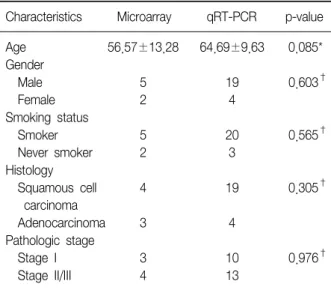
Table 1. Characteristics of study populations

Characteristics Microarray qRT-PCR p-value

Age 56.57±13.28 64.69±9.63 0.085*

Gender

Male 5 19 0.603

Female 2 4

Smoking status

Smoker 5 20 0.565

Never smoker 2 3

Histology

Squamous cell 4 19 0.305

carcinoma

Adenocarcinoma 3 4

Pathologic stage

Stage I 3 10 0.976

Stage II/III 4 13

*Student t-test,

Fisher's exact test.

amplification that are genetically altered in human can- cer

10,11

. In addition, it has been reported that some miRNAs are aberrantly expressed or mutated in human cancers, suggesting that they may function as either on- cogenes or tumor suppressor genes; depending on the targets they regulate

12-14

. The first evidence of the in- volvement of miRNAs in cancer came from a study char- acterizing the 13q14 deletion in chronic lymphocyte leu- kemia, which revealed that two clustered miRNA genes, miR-15a and miR-16-1 , are the target genes of the 13q14 deletion

15

. Subsequently, deregulation of miRNA has been found in various human cancers including lung cancer, such as the down-regulation of let-7 in lung can- cer

16,17

, up-regulation of the miR-17-92 cluster in B-cell lymphoma and lung cancer

18,19

, and down-regulation of miR-143 and miR-145 in colorectal cancer

20

.

Using miRNA microarray technology, several groups have revealed miRNA expression profiles in many hu- man cancers

21-25

, and also identified miRNA expression signatures associated with clinical and pathological fea- tures as well as disease outcome

21-23

. Although miRNA expression profiles have been studied in lung cancer, the majority of the previous studies were performed on Western populations

21,22,26

. The epidemiological charac- teristics of lung cancer in East Asian countries are differ- ent from those reported from Western countries. For ex- ample, lung adenocarcinoma in women, in East Asian countries, frequently develops in never-smokers

27,28

. In addition, several recent studies have shown that muta- tions in the kinase domain of the epidermal growth fac- tor receptor gene are more frequent in never-smokers, females and East Asian populations, whereas KRAS mu- tations are more frequent in smokers, males and Wes- tern populations

29,30

. These observations, coupled with the differences in the epidemiological characteristics of lung cancer, suggest that the genetic and environmental factors leading to lung cancer in East Asian populations may be different from those of Western populations

29,30

. Therefore, it is possible that miRNA expression profiles in lung cancer among East Asian populations may be different from Western countries. In this study, we in- vestigated the miRNA expression profiles in Korean pa-

tients with non-small cell lung cancers (NSCLCs).

Materials and Methods 1. Tissue samples

Tumor and corresponding non-malignant lung tissue specimens were obtained from Korean patients with NSCLC that underwent curative resection at the Konyang University Hospital (Daejeon, Korea). Seven NSCLC cases (4 squamous cell carcinomas [SCCs] and 3 adenocar- cinomas [ACs]) were included for miRNA microarray analysis. Four NSCLC cases (3 SCCs and 1 AC) among seven NSCLC case were randomly selected and included for Northern blotting and human whole genome ex- pression microarray analysis. Twenty-three NSCLC cases (19 SCCs and 4 ACs) were included for quantitative RT-PCR (qRT-PCR) (Table 1). None of the patients had received chemotherapy or radiotherapy before surgery.

Informed consent was obtained from each patient be-

fore surgery. This study was approved by the Bioethics

Committee of Konyang University Hospital. All of the

tumor and macroscopically normal lung tissue samples

were obtained at the time of surgery, and were rapidly

frozen in liquid nitrogen and stored at -80

o

C until

analysis. Tissue samples were histologically confirmed

by hematoxylin-eosin staining.

(3)

2. miRNA extraction

The total RNA of each sample was extracted using the Trizol reagent (Life Technologies, Carlsbad, CA, USA) according to the instructions of the manufacturer.

Low molecular weight (LMW) enriched RNA was iso- lated from 50 μg of total RNA using the mirVana miRNA extraction kit (Ambion Inc., Austin, TX, USA), and quantified using a ND-1000 spectrophotometer (Nano- Drop Technologies, Wilmington, DE, USA). RNA quality was evaluated using the Agilent 2100 Bioanalyzer (Agilent Technologies, Palo Alto, CA, USA).

3. miRNA microarray hybridization

The expression of miRNAs was profiled using a miRNA microarray chip (Genomic Tree Inc., Seoul, Korea) containing 60∼65 bp oligonucleotide probes representing human 318 miRNAs. Briefly, 1 μg of LMW RNA was labeled using a ULS

TM

small RNA labeling kit (Kreatech, Amsterdam, The Netherlands), LMW RNA of an adjacent normal tissue sample was labeled with fluo- rescent Cy3 and LMW RNA of tumors was labeled with fluorescent Cy5. The fluorescent-labeled LMW RNA was purified using KREA pure columns (Kreatech) as per the manufacturer’s instructions. The purified target RNA was resuspended in 100 μL of hybridization solution containing 3.5×SSC, 0.3% SDS, and 10 μg of ssDNA (Invitrogen). The hybridization mixture was heated at 100

o

C for 2∼3 min and hybridized onto a miRNA mi- croarray. The array was hybridized at 42

o

C for 16 h in a humidified hybridization chamber (Genomic Tree Inc.). The hybridized microarray was washed twice with 2×SSC/0.1% SDS for 5 min, 0.1×SSC/0.1% SDS for 5 min and 0.1×SSC for 2 min. The washed micro- array was immediately dried using a microarray cen- trifuge (Genomic Tree, Inc.).

The hybridization signals were analyzed using a Gen- ePix Pro 6.0 program (Axon Instruments, Foster City, CA, USA). The average fluorescence intensity for each spot was calculated and then the local background was subtracted. All data mining and selection of fold-chang- ed genes were performed using GeneSpringGX 7.3

(Agilent Technologies). Genes were filtered with cut-off values based on the sum of the median of ≥1,000 in each experiment. The averages of the ratios were calcu- lated by dividing the average of the signal channel in- tensity by the average of the control channel intensity.

We considered the results from the Significance Analysis of Microarray 3.0 (SAM) with genes of ratios (Cy5/Cy3) either ≥2.0 or ≤0.5 from ≥5 of 7 tumor samples as significantly different in expression.

4. Northern blotting and qRT-PCR

To validate the microarray analysis results, we carried out Northern blot analysis on two ( miR-145 and miR- 210 ) of the 35 differentially expressed miRNAs using a mirVana miRNA detection kit (Ambion Inc.). Briefly, 3 μg of total RNA was hybridized with 1 pM RNA probe ( miR-145 , biotin-5’-AAAAGGGAUUCCUGGGAAAACUG GAC-3’; and miR-210 , biotin-5’-AAAAUCAGCCGCUGUC ACACGCACAG-3’). The 5S RNA probe (biotin-5’-AAAA UGAUCUCGGAAGCUAA-3’) was used to normalize the level of expression. To remove unhybridized RNA, the RNAase A/T1 solution was added, followed by alcohol precipitation. Hybridized RNA was separated on a 15%

denaturing polyacrylamide gel and then electroblotted on a Hybond-Nylon membrane (Amersham Biosciences, Buckinghamshire UK). Detection of hybridized RNA was performed using a non-radioactive LightShift Chem- iluminescent kit (Pierce Biotechnol Inc., Rockford, IL, USA). The membrane was UV cross-linked, and the bio- tin end-labeled hybridized RNA was detected with strep- tavidin-HRP using a luminal enhancer solution. qRT- PCR analysis for miRNAs was performed in duplicate with a TaqMan MicroRNA assay kit (Applied Biosys- tems, Foster City, CA, USA) according to the instructions of the manufacturer, and 18S RNA was used for nor- malization.

5. Human whole genome expression microarray

For hybridization onto an Agilent Whole Human Genome 4×44 K 60 mer oligonucleotide array (G4112F;

Agilent Technologies), 1 μg of total RNA was used in

the Agilent LIRAK PLUS with the two-color Low RNA

(4)

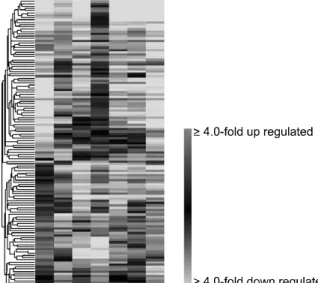
Figure 1. Unsupervised hierarchical clustering of 315 miRNA expression patterns in non-small cell carcinomas and corresponding non-malignant lung tissues. Ratios of miRNA expression are displayed colorimeterically in lung cancers relative to non-malignant lung tissues. The scale bar at the right side represents the relative level of ex- pression of each miRNA. Columns represent array and miRNAs are represented in rows.

input Linear Amplification method, according to the manufacturer's instructions. Briefly, the total RNA was reverse transcribed into complimentary DNA (cDNA) us- ing a T7-promotor primer and MMLV reverse trans- criptase. The cDNA was transcribed into complimentary RNA (cRNA), during which the cDNA was fluorescently labeled by incorporation of cyanine Cy5-CTP (lung can- cer tissue) or Cy3-CTP (normal lung tissue). After purifi- cation, using the RNeasy mini kit (Qiagen), the cRNA yield and Cy incorporation efficiency (specific activity) into the cRNA were determined using a NanoDrop Spectrophotometer (NanoDrop Technologies). cRNAs showing a yield >825 ng and a specific activity of 8∼

20 pmol/μg cRNA were selected for further processing.

Equal amounts of the exposed and negative control sample were competitively hybridized onto Agilent Wh- ole 4×44 K human oligonucleotide arrays in a hybrid- ization oven at 60

o

C for 17 h. Slides were washed ac- cording to the manufacturer's instructions with washing buffers and finally dipped in Stabilization and Drying

Solution (Agilent Technologies) for protection from en- vironmental ozone. The arrays were scanned on an Agilent scanner (G2565BA) and further processed using Agilent Feature Extraction Software (version 9.5.1).

Results

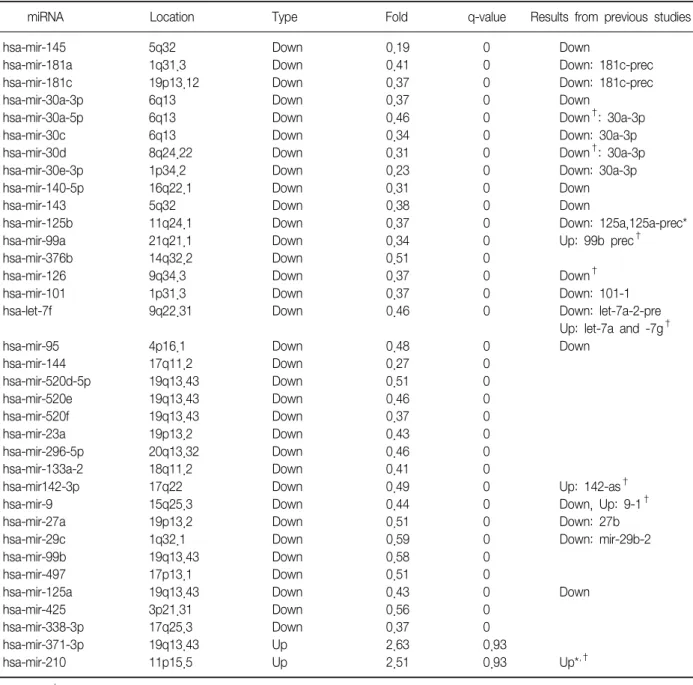
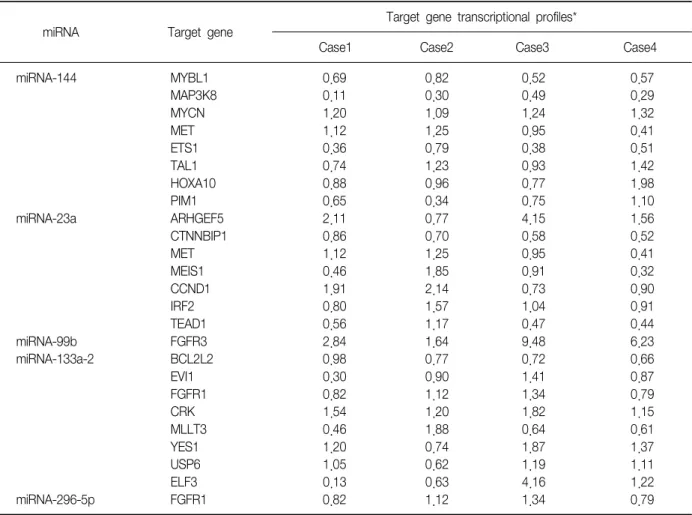
To generate miRNA expression profiles for NSCLC, we analyzed the expression of 315 human miRNAs using oli- gonucleotide microarray hybridization chips in 7 pairs of primary lung cancers and corresponding non-malignant lung tissues (Figure 1). We identified 35 miRNA genes that were differentially expressed in the NSCLCs and corresponding non-malignant lung tissues with ratios (Cy5/Cy3) either ≥2 fold or ≤0.5 fold from at least 5 of 7 tumor samples (Table 2). Among the 35 differ- entially expressed miRNAs, two ( miR-371 and miR-210 ) were over-expressed in lung cancers, and 33 miRNAs, including miR-145 , were under-expressed in lung can- cers. Among the 35 differentially expressed miRNAs, 13 of the miRNAs have not been previously reported to be altered in lung cancer; miR-376b , miR-144 , miR-520d-5p , miR-520e , miR-520f , miR-23a , miR-296-5p , miR-133a-2 , miR-99b , miR-497 , miR-425 , and miR-338-3p were down- regulated, and miR-371-3p was up-regulated.

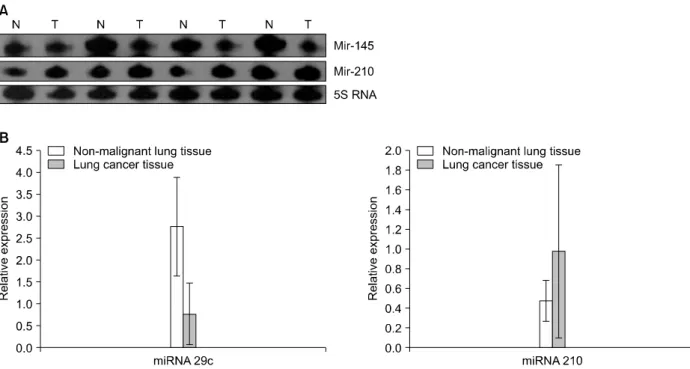
To validate the microarray results, the expression of representative miRNAs were determined using Northern blot analysis ( miR-210 and miR-145 ) and qRT-PCR ( miR-210 and miR-29c ). Consistent with the results of the microarray analysis, miR-210 was up-regulated in the lung cancers, and miR-145 and miR-29c were down-regulated in the lung cancers (Figure 2).

We predicted tumor-associated target genes of the

new 13 miRNAs using 3 public algorithms (MIRAND

31

,

TARGETSCAN

32

, and PICTAR

33

). The list of putative tar-

get genes of 5 miRNAs ( miR-144 , miR-23a , miR-99b ,

miR-133a-2 , and miR-296-5p ), which were predicted by

at least 2 of the 3 programs, are shown in Table 3. We

next examined the correlation between miRNA expres-

sion and target gene transcriptional profiles. Of the 5

miRNAs, miR-99b expression consistently showed a

negative correlation with fibroblast growth factor re-

(5)

Table 2. MiRNAs differentially expressed between lung cancers and their corresponding normal lung tissues

miRNA Location Type Fold q-value Results from previous studies

hsa-mir-145 5q32 Down 0.19 0 Down

hsa-mir-181a 1q31.3 Down 0.41 0 Down: 181c-prec

hsa-mir-181c 19p13.12 Down 0.37 0 Down: 181c-prec

hsa-mir-30a-3p 6q13 Down 0.37 0 Down

hsa-mir-30a-5p 6q13 Down 0.46 0 Down

: 30a-3p

hsa-mir-30c 6q13 Down 0.34 0 Down: 30a-3p

hsa-mir-30d 8q24.22 Down 0.31 0 Down

: 30a-3p

hsa-mir-30e-3p 1p34.2 Down 0.23 0 Down: 30a-3p

hsa-mir-140-5p 16q22.1 Down 0.31 0 Down

hsa-mir-143 5q32 Down 0.38 0 Down

hsa-mir-125b 11q24.1 Down 0.37 0 Down: 125a,125a-prec*

hsa-mir-99a 21q21.1 Down 0.34 0 Up: 99b prec

hsa-mir-376b 14q32.2 Down 0.51 0

hsa-mir-126 9q34.3 Down 0.37 0 Down

hsa-mir-101 1p31.3 Down 0.37 0 Down: 101-1

hsa-let-7f 9q22.31 Down 0.46 0 Down: let-7a-2-pre

Up: let-7a and -7g

hsa-mir-95 4p16.1 Down 0.48 0 Down

hsa-mir-144 17q11.2 Down 0.27 0

hsa-mir-520d-5p 19q13.43 Down 0.51 0

hsa-mir-520e 19q13.43 Down 0.46 0

hsa-mir-520f 19q13.43 Down 0.37 0

hsa-mir-23a 19p13.2 Down 0.43 0

hsa-mir-296-5p 20q13.32 Down 0.46 0

hsa-mir-133a-2 18q11.2 Down 0.41 0

hsa-mir142-3p 17q22 Down 0.49 0 Up: 142-as

hsa-mir-9 15q25.3 Down 0.44 0 Down, Up: 9-1

hsa-mir-27a 19p13.2 Down 0.51 0 Down: 27b

hsa-mir-29c 1q32.1 Down 0.59 0 Down: mir-29b-2

hsa-mir-99b 19q13.43 Down 0.58 0

hsa-mir-497 17p13.1 Down 0.51 0

hsa-mir-125a 19q13.43 Down 0.43 0 Down

hsa-mir-425 3p21.31 Down 0.56 0

hsa-mir-338-3p 17q25.3 Down 0.37 0

hsa-mir-371-3p 19q13.43 Up 2.63 0.93

hsa-mir-210 11p15.5 Up 2.51 0.93 Up*

,†

*Ref. 22,

Ref. 26.

ceptor 3 ( FGFR3 ) expression (Table 3).

Discussion

We performed miRNA expression profiling using mi- croarray analysis in Korean patients with NSCLC and identified a number of miRNAs that were differentially expressed in NSCLCs. To date, two large studies on miRNA expression profiles in lung cancer have been re-

ported

22,26

. In a study of 104 matched pairs of lung can- cers and non-cancerous lung tissues, Yanaihara et al

22

identified a set of 43 differentially expressed miRNAs;

28 were down-regulated and 15 were up-regulated. The

majority of the miRNAs detected in the present study

were the same miRNAs that were identified by Yanai-

hara et al

22

. For example, miR-145 , miR-181c , miR-30

family , miR-140 , miR-143 , miR-125 , miR-126 , miR-101 ,

miR-95 , miR-9 , and miR-125a were down-regulated and

(6)

Figure 2. (A) Northern blot analysis for has-miR-145 and has-miR-210 in four paired lung cancers and corresponding non-malignant lung tissues. Has-miR-210 was up-regulated in lung cancers, and has-miR-145 was down-regulated in lung cancers. (B) Quantitative RT-PCR (qRT-PCR) of miRNA expression utilized total RNA isolated from cancer tissues and non-malignant lung tissues. The expression of miRNA was normalized to 18S rRNA expression and was performed in duplicate. Has-miR-29c was down-regulated in lung cancers (p=0.0001, Mann-Whitney's U test), whereas has-miR- 210 was up-regulated in lung cancer (p=0.1295), although statistically not significant.

miR-210 was up-regulated in both studies (Table 2). In addition, we found that let-7f was down-regulated in lung cancer tissues, which was also consistent with the results of Yanaihara et al

22

, where let-7a-2 was down- regulated in lung cancer. Volinia et al

26

also found that lung cancer cells showed distinct miRNA profiles com- pared to normal cells in a study of 80 lung cancers and 40 normal lung tissues. They reported that 3 miRNAs were down-regulated and 35 miRNAs were over-ex- pressed in lung cancers. When our data were compared with the results of the study reported by Volinia et al

26

, several miRNAs showed the opposite results of up-regu- lation or down-regulation. For example, they reported that let-7a , let-7g , miR-142 and miR-9-1 were up-regu- lated in lung cancers. However, these miRNAs were down-regulated in lung cancers in the present study, as well as in the study reported by Yanaihara et al

22

. This discrepancy may be due to differences in the methods used in the studies. Volinia et al

26

measured the ex-

pression of both the pri-miRNAs and the active mature miRNAs simultaneously. Considering that the pri-miRNAs are transient products in miRNA biogenesis, and pre- sumably are rapidly further processed after synthesis

34

, the expression status of the pri-miRNA and the mature miRNA is not necessarily the same. Therefore, the pro- files of the combined expression of the pri-miRNAs and the mature miRNAs may be different from the ex- pression of the mature miRNAs

24

.

Racial differences in miRNA expression were reported

in uterine leiomyomas. Wang et al

35

found that sub-

stantial number of miRNAs that are significantly differ-

ently regulated between black and white women. Black

women had a greater than 2-fold overexpression in

miR-23a/b , let-7s , miR-145 , miR-197 , miR-411 , and miR-

412 . In the present study, we found that miR-376b ,

miR-144 , miR-520d-5p , miR-520e , miR-520f , miR-23a ,

miR-296-5p , miR-133a-2 , miR-99b , miR-497 , miR-425 ,

and miR-338-3p were down-regulated and miR-371-3p

(7)

Table 3. Correlation between microRNA expression profiles and target gene transcriptional profiles in NSCLC

miRNA Target gene

Target gene transcriptional profiles*

Case1 Case2 Case3 Case4

miRNA-144 MYBL1 0.69 0.82 0.52 0.57

MAP3K8 0.11 0.30 0.49 0.29

MYCN 1.20 1.09 1.24 1.32

MET 1.12 1.25 0.95 0.41

ETS1 0.36 0.79 0.38 0.51

TAL1 0.74 1.23 0.93 1.42

HOXA10 0.88 0.96 0.77 1.98

PIM1 0.65 0.34 0.75 1.10

miRNA-23a ARHGEF5 2.11 0.77 4.15 1.56

CTNNBIP1 0.86 0.70 0.58 0.52

MET 1.12 1.25 0.95 0.41

MEIS1 0.46 1.85 0.91 0.32

CCND1 1.91 2.14 0.73 0.90

IRF2 0.80 1.57 1.04 0.91

TEAD1 0.56 1.17 0.47 0.44

miRNA-99b FGFR3 2.84 1.64 9.48 6.23

miRNA-133a-2 BCL2L2 0.98 0.77 0.72 0.66

EVI1 0.30 0.90 1.41 0.87

FGFR1 0.82 1.12 1.34 0.79

CRK 1.54 1.20 1.82 1.15

MLLT3 0.46 1.88 0.64 0.61

YES1 1.20 0.74 1.87 1.37

USP6 1.05 0.62 1.19 1.11

ELF3 0.13 0.63 4.16 1.22

miRNA-296-5p FGFR1 0.82 1.12 1.34 0.79

*Ratios of transcription was cy5 (lung cancer tissue)/Cy3 (normal lung tissue) in human whole genome expression microarray.

was up-regulated. To characterize these miRNA, we an- alyzed their chromosomal location. miR-520d-5p , miR- 520e , miR-520f , miR-99b , miR-371-3p were located in 19q13.43.

The results of this study showed that miR-99b was down-regulated in NSCLCs and the expression was neg- atively correlated with FGFR3 expression. FGFR3 be- longs to a family of structurally-related tyrosine kinase receptors (FGFR1∼4) involved in many aspects of em- bryogenesis and tissue homeostasis. These receptors regulate various biological processes, including prolifer- ation, differentiation, angiogenesis, migration, and ap- optosis

36

. FGFR3 has been demonstrated to be involved in the RAS/RAF/MEK/MAPK pathway through activation of p90 ribosomal S6 kinase

37

. In addition, it has been reported that FGFRs are frequently overexpressed in

NSCLC cell lines, suggesting that an FGFR -dependent autocrine signaling pathway may operate in a subset of NSCLCs

38

. Based on these observations, it is possible that miR-99b may be involved in lung tumorigenesis through up-regulation of FGFR3 .

Albeit a small number of patients were examined, these results suggest that miRNA expression profiles in Korean lung cancers may be somewhat different from the expression profiles reported on lung cancers in Western populations. The findings suggest that miR-99b might be a tumor suppressor through its up-regulation of FGFR3 .

References

1. Ambros V. The functions of animal microRNAs. Nature

(8)

2004;431:350-5.

2. Bartel DP. MicroRNAs: genomics, biogenesis, mecha- nism, and function. Cell 2004;116:281-97.

3. Lim LP, Lau NC, Garrett-Engele P, Grimson A, Schelter JM, Castle J, et al. Microarray analysis shows that some microRNAs downregulate large numbers of target mRNAs. Nature 2005;433:769-73.

4. Bentwich I, Avniel A, Karov Y, Aharonov R, Gilad S, Barad O, et al. Identification of hundreds of conserved and nonconserved human microRNAs. Nat Genet 2005;

37:766-70.

5. Berezikov E, Guryev V, van de Belt J, Wienholds E, Plasterk RH, Cuppen E. Phylogenetic shadowing and computational identification of human microRNA gen- es. Cell 2005;120:21-4.

6. Cheng AM, Byrom MW, Shelton J, Ford LP. Antisense inhibition of human miRNAs and indications for an in- volvement of miRNA in cell growth and apoptosis.

Nucleic Acids Res 2005;33:1290-7.

7. Xu P, Guo M, Hay BA. MicroRNAs and the regulation of cell death. Trends Genet 2004;20:617-24.

8. Karp X, Ambros V. Developmental biology. Encounter- ing microRNAs in cell fate signaling. Science 2005;310:

1288-9.

9. Chen CZ, Li L, Lodish HF, Bartel DP. MicroRNAs modu- late hematopoietic lineage differentiation. Science 2004;

303:83-6.

10. Calin GA, Sevignani C, Dumitru CD, Hyslop T, Noch E, Yendamuri S, et al. Human microRNA genes are fre- quently located at fragile sites and genomic regions in- volved in cancers. Proc Natl Acad Sci U S A 2004;101:

2999-3004.

11. Zhang L, Huang J, Yang N, Greshock J, Megraw MS, Giannakakis A, et al. microRNAs exhibit high frequency genomic alterations in human cancer. Proc Natl Acad Sci U S A 2006;103:9136-41.

12. Esquela-Kerscher A, Slack FJ. Oncomirs - microRNAs with a role in cancer. Nat Rev Cancer 2006;6:259-69.

13. Calin GA, Croce CM. MicroRNA signatures in human cancers. Nat Rev Cancer 2006;6:857-66.

14. Gartel AL, Kandel ES. miRNAs: little known mediators of oncogenesis. Semin Cancer Biol 2008;18:103-10.

15. Calin GA, Dumitru CD, Shimizu M, Bichi R, Zupo S, Noch E, et al. Frequent deletions and down-regulation of micro- RNA genes miR15 and miR16 at 13q14 in chronic lymphocytic leukemia. Proc Natl Acad Sci U S A 2002;99:15524-9.

16. Takamizawa J, Konishi H, Yanagisawa K, Tomida S, Osada H, Endoh H, et al. Reduced expression of the

let-7 microRNAs in human lung cancers in association with shortened postoperative survival. Cancer Res 2004;

64:3753-6.

17. Johnson SM, Grosshans H, Shingara J, Byrom M, Jarvis R, Cheng A, et al. RAS is regulated by the let-7 mic- roRNA family. Cell 2005;120:635-47.

18. He L, Thomson JM, Hemann MT, Hernando-Monge E, Mu D, Goodson S, et al. A microRNA polycistron as a potential human oncogene. Nature 2005;435:828-33.

19. Hayashita Y, Osada H, Tatematsu Y, Yamada H, Yanagi- sawa K, Tomida S, et al. A polycistronic microRNA clus- ter, miR-17-92, is overexpressed in human lung cancers and enhances cell proliferation. Cancer Res 2005;65:

9628-32.

20. Michael MZ, SM OC, van Holst Pellekaan NG, Young GP, James RJ. Reduced accumulation of specific mic- roRNAs in colorectal neoplasia. Mol Cancer Res 2003;1:

882-91.

21. Lu J, Getz G, Miska EA, Alvarez-Saavedra E, Lamb J, Peck D, et al. MicroRNA expression profiles classify hu- man cancers. Nature 2005;435:834-8.

22. Yanaihara N, Caplen N, Bowman E, Seike M, Kumamo- to K, Yi M, et al. Unique microRNA molecular profiles in lung cancer diagnosis and prognosis. Cancer Cell 2006;9:189-98.

23. Yu SL, Chen HY, Chang GC, Chen CY, Chen HW, Singh S, et al. MicroRNA signature predicts survival and relapse in lung cancer. Cancer Cell 2008;13:48-57.

24. Porkka KP, Pfeiffer MJ, Waltering KK, Vessella RL, Tammela TL, Visakorpi T. MicroRNA expression profil- ing in prostate cancer. Cancer Res 2007;67:6130-5.

25. Iorio MV, Visone R, Di Leva G, Donati V, Petrocca F, Casalini P, et al. MicroRNA signatures in human ovarian cancer. Cancer Res 2007;67:8699-707.

26. Volinia S, Calin GA, Liu CG, Ambs S, Cimmino A, Petrocca F, et al. A microRNA expression signature of human solid tumors defines cancer gene targets. Proc Natl Acad Sci U S A 2006;103:2257-61.

27. Du YX, Cha Q, Chen XW, Chen YZ, Huang LF, Feng ZZ, et al. An epidemiological study of risk factors for lung cancer in Guangzhou, China. Lung Cancer 1996;

14 Suppl 1:S9-37.

28. Lee C, Kang KH, Koh Y, Chang J, Chung HS, Park SK, et al. Characteristics of lung cancer in Korea, 1997.

Lung Cancer 2000;30:15-22.

29. Gazdar AF, Shigematsu H, Herz J, Minna JD. Mutations and addiction to EGFR: the Achilles ‘heal’ of lung can- cers? Trends Mol Med 2004;10:481-6.

30. Marchetti A, Martella C, Felicioni L, Barassi F, Salvatore

(9)

S, Chella A, et al. EGFR mutations in non-small-cell lung cancer: analysis of a large series of cases and de- velopment of a rapid and sensitive method for diag- nostic screening with potential implications on pharma- cologic treatment. J Clin Oncol 2005;23:857-65.

31. John B, Enright AJ, Aravin A, Tuschl T, Sander C, Marks DS. Human MicroRNA targets. PLoS Biol 2004;2:e363.

32. Lewis BP, Shih IH, Jones-Rhoades MW, Bartel DP, Burge CB. Prediction of mammalian microRNA targets.

Cell 2003;115:787-98.

33. Krek A, Grun D, Poy MN, Wolf R, Rosenberg L, Epstein EJ, et al. Combinatorial microRNA target predictions.

Nat Genet 2005;37:495-500.

34. Lee Y, Jeon K, Lee JT, Kim S, Kim VN. MicroRNA matu- ration: stepwise processing and subcellular localization.

EMBO J 2002;21:4663-70.

35. Wang T, Zhang X, Obijuru L, Laser J, Aris V, Lee P,

et al. A micro-RNA signature associated with race, tu- mor size, and target gene activity in human uterine leiomyomas. Genes Chromosomes Cancer 2007;46:336- 47.

36. Bernard-Pierrot I, Brams A, Dunois-Larde C, Caillault A, Diez de Medina SG, Cappellen D, et al. Oncogenic properties of the mutated forms of fibroblast growth factor receptor 3b. Carcinogenesis 2006;27:740-7.

37. Kang S, Dong S, Gu TL, Guo A, Cohen MS, Lonial S, et al. FGFR3 activates RSK2 to mediate hematopoietic transformation through tyrosine phosphorylation of RSK2 and activation of the MEK/ERK pathway. Cancer Cell 2007;12:201-14.

38. Marek L, Ware KE, Fritzsche A, Hercule P, Helton WR,

Smith JE, et al. Fibroblast growth factor (FGF) and FGF

receptor-mediated autocrine signaling in non-small-cell

lung cancer cells. Mol Pharmacol 2009;75:196-207.

수치

Table  1.  Characteristics  of  study  populations
Figure  1.  Unsupervised  hierarchical  clustering  of  315  miRNA  expression  patterns  in non-small  cell  carcinomas and corresponding non-malignant lung tissues
Table  2.  MiRNAs  differentially  expressed  between  lung  cancers  and  their  corresponding  normal  lung  tissues
Figure  2.  (A)  Northern  blot  analysis  for  has-miR-145  and  has-miR-210  in  four  paired  lung  cancers  and  corresponding  non-malignant  lung  tissues
+2

참조

관련 문서

In this way, it is possible to shorten the time of accident restoration and maintenance by minimizing the expression error of the high-strength facial

1) Effects of methanol extracts of Capsella bursa-pastoris on cyclooxygenase-2 (COX-2) and Inducible Nitric oxide synthase (iNOS) expression in human prostate cancer cell

Inhibitory effects of classified methanol extracts of Smilax china L on the COX-2 and iNOS expression of human colorectal cancer cell lines... Inhibitory

This study suggested diversity in the configuration of expression through expression of abstract images, the style of modern painting, which are expressed

Results : The expression of p21 was increased in boderline serous tumor and serous cystadenocarcinoma in contrast to benign serous tumors. The expression of

Activated H-Ras expression in human fibroblast cell lines increases the activity of Ku80 to bind injuried DNA, reduces γ-H2AX expression by UV irradiation,

4 > Effects of Taro on COX-2 expression and iNOS expression(hot water) in human thyroid cancer cells. The cells were pretreated for 48hours with either

In the present study we investigated the proliferation effect of human oral cancer KB cell treated with pulsatilla koreana extract.. We analyzed the effects of this