• 검색 결과가 없습니다.

Determination of Chloramphenicol in Milk by High Performance Liquid Chromatography

N/A
N/A
Protected

Academic year: 2021

Share "Determination of Chloramphenicol in Milk by High Performance Liquid Chromatography"

Copied!
5
0
0

로드 중.... (전체 텍스트 보기)

전체 글

(1)

HPLC를 이용한 우유중의 클로람페니콜의 정량 분석

김 경 례

김정 한

* •

최 경숙

*

성 균관대 학교 약학대 학 • * 연세 대 학교 식 품공학과 (Received January 5, 1985)

Determination of Chloramphenicol in M ilk by High Performance Liquid Chromatography

Kyoung Rae Kim, Jung Han Kim * and Kyoung Sook Choi*

College o f Pharmacy, Sung Kyun Kwan University, Suwon 170 and * Department o f Food Engineering, Yon Sei University, Seoul 122,Korea

A bstract—Seven different sorbents were evaluated for their adsorptivity and desorptivity of antibiotic, chloramphenicol. Among the sorbents studied, Carbopak B was found to be the most efficient in enriching the chloramphenicol from dilute aqueous solution. Interfering components in the milk matrix could be wa­

shed off by water and petroleum ether from Carbopak B column, while the chloramphenicol was retained on the surface of Carbopak B. The method of simple and efficient purification and enrichment of chloram­

phenicol using Carbopak B, followed by quantitative analysis employing Cis reversed phase high perform­

ance liquid chromatography has been applied to the determination of chloramphenicol in milk.

클로람페 니 콜 (CP) (D-threo-2-dichloroacetamide-l-nitrophenyl 1,3-propanediol) 은 Streptomyces venezuelaey} 생 산하는 항생 제 ” 로서,가축의 질 병 치 료에 널리 사용되 고 있는데, 젖소의 유선 염 및 유방염의 치료시 혈액을 통해 CP 가 우유로 혼입되고 있어 식품위생에 문제가 되고 있다 . 2, 3) 대 는 적혈구의 기능을 약화시켜 hemoglobin의 생산을 억제하여 재생불능의 빈혈을 유발하므로5) 유제품의 CP 잔유량을 측정하는 것은 국민보건상 매우 큰 의미가 있다 . CP 의 정 량법으로는 biol­

ogical assay,4) electrophoretic assay,6) gas-liguid chromatography (GLC)7, 8) 와 high performance liguid chromatography (HPLC) 가9~1<5> 있 는데,biological assay와 electrophoretic assay는 감도가 낮 고 (0.5 〜 lppm) 선택성이 적으며, GLC 는 휘발성의 유도체를 만들어 야 하므로 최근에는 HPLC 를 이용한 분석이 활발해지고 있다 .

생체내의 미량 성분을 분석할 때는 첫째,미량 성분을 순수분리하여야 하고,둘째 기존의 기기 로 감지할 수 있도록 농죽해 주어야한다. Wal9K둥은 에틸 아세테이트 抽出과 2회의 液-液分配 3 회의 농축 과정으로 우유로부터 CP룰 분리, 농축하였으며 Crechiolo^ 둥은 에틸 아세테이트 抽出과 2회의 液-液分配가 포함된 방법으로 혈액에서 CP를 분리, 농축하였다. 따라서,본 연구 에서는 CP롤 잘 흡착시키는 흡착제를 선정하여 液-液分配 조작없이 CP를 우유로부터 분리, 농 축할 수 있는 방법을 개발하여 본 방법으로 우유 중의 CP잔유량을 측정하였다.

실 험 방 법

기기 및 시약 ᅳ 시판중(1984년 10월 〜 12월 사이)인 우유와 분유를 시료로 선택하여 품질보증한 날짜내에 사용하였으며,시약으로는 CP(국제약품, Korea), thiamphenicol(TP) (Sigma Chem.

50

(2)

Co., USA), methanol, 물과 석 유 에텔 (Rots Chem. N.V., Belgium) 을 사용하였고,흡착제 는 Boron nitride (BN) (80/100mesh, Union Carbide, USA), Carbopak B (CB) (80/100mesh,Supelco Inc., USA), XAD-2(60/80mesh, Supelco Inc., USA), XAD-7(60/80mesh, Supelco Inc., USA), Sep-pak C18(200/400mesh, Waters Assoc. Inc., USA),

Alumina(60/80mesh, Su-pelco Inc., USA) 와 Porapak Q(50/80mesh, Alltech Assoc. Inc., USA) 를 이용하였다.

정 량곡선의 작성을 위한 C P 용액은 내부표준 물질 TP가 첨 가된 methanol(2. 5Xl(T8g//났) 에 CP룰 녹여 사용하였으며,그 외의 CP표준 용 액 은 탈이 온수에 CP를 녹여 l(T8g / ^ 용액 을 조제하여 사용하였다. 분석에 사용한 HPLC는 Waters Model 244이 며,분석 조건은 Table I 과 같다.

Table I-HPLC conditions of chloramphenicol.

Column 10//m f! Bondapak Cis (300 x 3. 9mm I. D .) Mobile 40% methanol in water, lm l/m in.

phase

Detector UV at 280nm Sample 10 fd

size

흡착제의 CP 흡착능 시 험

희 석 된 수용액 중의 CP를 가장 잘 흡착시 키 는 흡착제 를 선정 하기 위 해 Sep-pak C18을 제외한 흡착제를 0. 2g씩 Polypropylene Econo Column™(0. 7X4. 0cm, Bio-rad Lab., USA) 에 넣어 사용하였고(Fig. 1),Sep-pak C18은 0. 35g의 시 판되 는 것을 그대 로 사용하였 다 . BN, CB, Sep-pak C 18과 A lum ina는 methanol 로, XAD-2, XAD-7 과 Porapak Q 는 acetone, methanol, methylene dichloride 와 m ethanol 의 순으로 씻어주고, 물로 평형시 킨후 사용하였다.

CP표준용액 lm l를 column에 넣어 filtrate(A) 와 물로 용출시킨액 (피을 모아, (A + B) 가 2ml가 되 도록한 다음, column 내의 수용액을 없앤 다음, methanol 로 용출하여 methanol 용출액 2ml(C ) 를 모은 후, (A+B) 와 (C) 용출액내의 CP량을 측정하였다.

CB의 적정용출량 시험一CB에 흡착된 10j«g CP를 회수하기 위한 methanol의 최소량을 정하기 위해, methanol 용출액 5ml를 lml씩 모아서 lm l내의 CP량을 측정하였다.

CB의 적정량 시험 ᅳ CB의 적정 량을 선정 하기 위해 CP 10_5g을 50m l 물에녹여 0. 2g과 0.5g CB 로 충진된 각각의 column에 넣은 후,물과 석유 에텔로 씻어주었다. 석유 에텔을 완전히 제거한 후 methanol용출액중의 CP함량을 즉정하여 희석에 의한 CB의 흡착능을 조사하여 CB의 최소적 정 량을 선정하였다.

CB를 이용한 sampling 방법의 효능시험ᅳ본 방법의 재현성과 회수율 및 정제된 정도를 측정 하기 위하여 대 가 첨가된 우유 50m l(10ppb) 롤 시료로 하여 본 방법으로 실험하였다.

우유와 유분중의 CP 정량분석_ 시유와 분유 50m l 를 CB에 통과시킨 후 물과 석유 에텔로 씻어

(3)

내 고 , TP 가 첨 가된 methan 이로 용출하여 TP 의 peak 높이 에 대 한 CP 의 peak 높이비 로서 CP 의 잔유량을 측정하였다 .

실 험 결 과 및 고 찰

흡착제의 선정*ᅳ흡착제의 CP 흡착능을 시험한 결과 (Table II ) , 비극성인 CB 와 Sep-pak C 18은 CP 를 모두 흡착하였고, XAD-2 와 Alumina 는 그대로 통과시 켰으며 BN , XAD-7 과 Porapak Q 는 CB 와 Sep-pak C 18보다 흡착능이 적었다 . 무기흡착제 CB 는 산 또는 알카리로 재생할 수 있으나,

반면에 Sep-pak C 18은 알카리 용액으로 씻어내면 siloxane bond 가 깨어진다 . 예비실험결과 Sep-

Table II-Adsorptivity and desorptivity of adsorbents with chloramphenicol solution(10_5g/m l).

Adsorbent Recovery of CP(% ) Water eluate Methanol eluate

Boron nitride 68.1 31.9

Carbopak B 0.0 100.0

XAD-2 100.0 0.0

XAD-7 53.8 46.2

Sep-pak Ci8* 0.0 100.0

Alumina 100. 0 0.0

Porapak Q 3.1 96.9

*0. 35g

E l ution range ( ml )
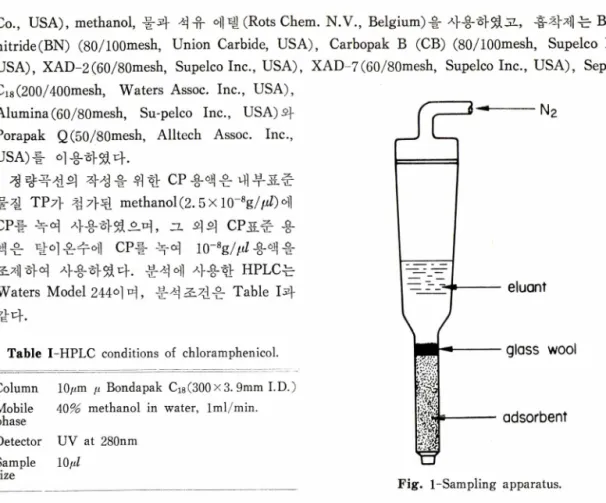
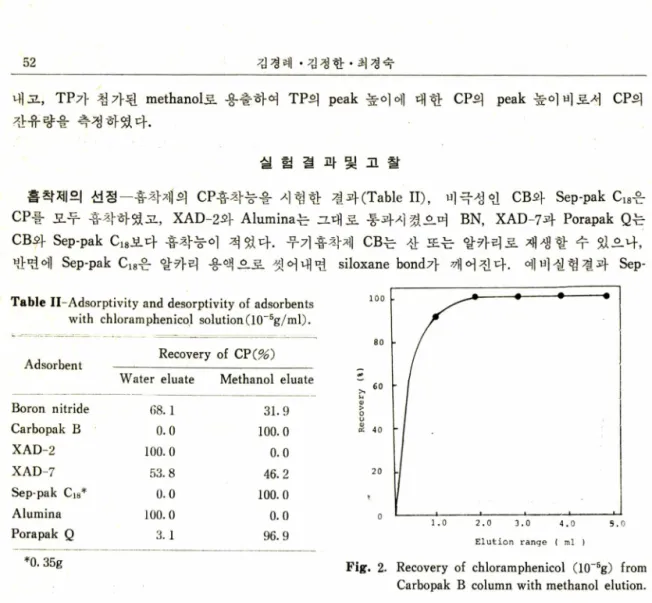
Fig. 2. Recovery of chloramphenicol (10_5g) from Carbopak B column with methanol elution.

pak C18이 물로 완전히 포화되지 않았을 경우 CB에 대한 흡착능이 현저하게 감소됨이 확인되었 고 , CB보다 입자의 . 크기가 적어 우유를 시료로 사용할 경우 plugging현상으로 인해 sampling에 어려움을 겪었다 . 이상의 실험결과로 CB룰 선정하였다 .

CB 의 적정 methanol 용 출 량 선 정 一 CB(0.2g)에 10_5g CP를 흡착시킨 후 , CP롤 100% 회수 하기 위 한 methanol의 최소량을 측정 한 결과 2ml의 methan이이 필요하였다(Fig. 2). CB 0. lg 당 methanol 적정용출량을 1ml로 선정하였다 .

CB 의 적 정 량 선 정 一 CP의 희석된 수용액 (1(r 5g CP/50ml)을 사용하여 0.2g과 0. 5g CB로 충진 된 column으로 CP의 흡착 회 수실 험 을 한 결 과,각각 85. 5±2. 4%와 90. 5±2. 5%의 CP를 회 수 Table III-Effect of dilution of chloramphenicol (10"5g) with aqueous solution on Carbopak B adsorptivity*.

Amount of Carbopak B(g) Recovery from dilute sample (% )

10ml 50ml 100ml

0.2 0.5

91.7 士 2. 2 85.5 士 2.4

90.5 士 2.5

82.0± 2.5

* After loading each chloramphenicol solution, wash with water and petroleum ether.

(4)

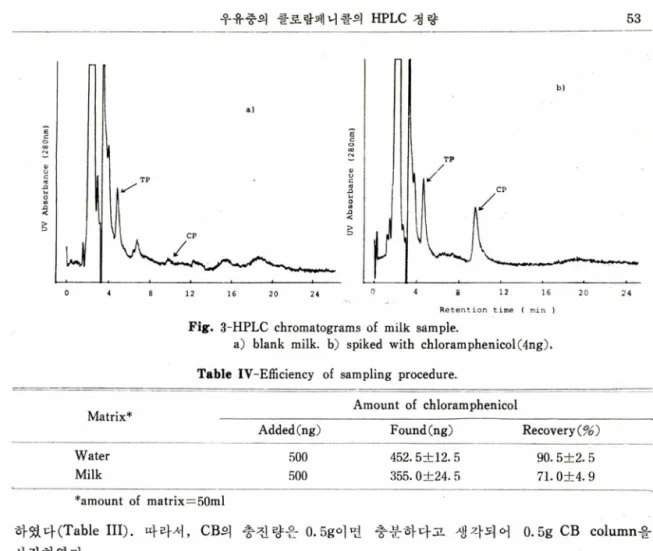
Figf. 3-HPLC chromatograms of milk sample.

a) blank milk, b) spiked with chloramphenicol(4ng).

Table IV-Efficiency of sampling procedure.

Matrix* Amount of chloramphenicol

Added (ng) Found(ng) Recovery (%)

Water 500 452.5±12.5 90.5土2. 5

Milk 500 355.0土24. 5 71.0 士 4. 9

*amount of matrix=50ml

하였다(Table III). 따라서, CB의 충진 량은 0. 5g이 면 충분하다고 생각되어 0. 5g CB column을 선정하였다.

CB률 이용한 sampling의 효능 측정一CP가 첨가된 우유를 시료로 하여 CP의 회수율을 측정 한 결과,71.0±4.9%로 나타났으며 (Table IV), Wal« 등보다 정제된 시료를 얻을 수 있었다.

시유 및 분유의 CP정량--본 방법으로 시유 및 분유를 분석한 결과, 제품에1 따른 CP의 농도차 이는 다소 있었지만, 모든 시료가 0.5ppb이상의 CP를 함유하고 있었다.

Table V-Levels of chloramphenicol in milks.

Milk sample(50ml) Found(ppb) Milk sample (50ml) Found(ppb)

A 0.9 E 0.6

B 0.6 F 1.0

C 0.7 G 0.5

D 0.8

결 론

Carbopak B룰 이용하여 液-液 分配조작 없이 우유중의 클로람메니콜(CP) 를 분리, 농축할 수

있었으며,Wal 등의 방법보다 처리조작이 간단하면서도 더 정제된 시료를 얻을 수 있었다. 본

연구의 방법을 이용하여 우유와 분유의 CP함량을 측정 한 결과,검토한 7종의 시료중에는 제 품간

(5)

의 농도차이는 다소 있지만, 0.5ppb이상의 CP를 함유하고 있었다.

본 연구는 1984학년도 문교부 학술연구조성비의 지원으로 이루어졌으며 본 연구의 수행에 도움 을 주신 GINSCO 회사에 감사드립니다 .

문 헌

1. R.Y. Stainer, E.A. Adelberg and J.L. Ingraham, Microbial World. Prentice-Hall Inc., New Jersey, 844 (1976).

2. P. Michael, High-pressure liquid chromatographic method for the determination of residual chloramph­

enicol, furazolidone and five sulfonamides in eggs, meat and milk, Z. Lebensm-Unters Forsch. 176,

289 (1983). [C.A., 98 196502f〕 .

3. J.H. Van der Stroom-Kruyswijk, H .W . Van Gend and R. Kommerij, Testing chlorampheniol for its excretion in milk using FAST liquid chromatography, Tijdschr. Diergeneeskd. 108, 145 (1983)〔 C. A .,

98, 196461s〕.

4. R,M. Hans, M. Galbraith and W.C. Alegnam in F. Kavanagh (Ed), Analytical Microbiology, Ac­

ademic Press, New York, 271 (1963).

5. B.J. Gross, R.V. Branchflower, T.R. Burke, D.E. Lees and L.R. Pahl, Bone marrow toxicity in vitro of chloramphenicol and its metabolites, Toxicol. Appl. Pharmacol. 64,557 (1982)

6. J. Stadhouders, F. Hassing and T.E. Galesloot, A n electrophoretic method for the identification of antibiotic residues in small volumes of milk, Neth. M ilk Dairy J. 35, 23 (1981).

7. J.J. Van der Lee, H.B.J. Van der Lee-Rijsbergen, U.R. Tjaden and W .P. Van Bennekom, A liquid chromatographic method for chloramphenicol and its nitro degradation products with reductive ampero- metric detection at a mercury electrode, Anal. Chim. Acta. 149,29 (1983).

8. J.M. W al,J.C. Peleran and G.F. Bories, Electroncapture detection of chloramphenicol using a heptafl- uorobutyrate derivative, J. Chromatogr. 168,179 (1979).

9. J.M. W al, J.C. Peleran and G.F. Bories, High performance liquid chromatographic determination of chloramphenicol in milk, J. Assoc. Off. Anal. Chem. 63(5), 1044 (1980).

10. R. Kutter, D. Jahr and H. Stritzinger, Detection and determination of chloramphenicol by HPLC and GC/M S, Fleischwirtschart 62,515 (1982).

11. J. Crechiolo and R.E. Hill, Determination of serum chloramphenicol by HPLC, J. Chromatogr. 162, 480 (1979).

12. J.T. Burke, W .A . Wargin and M.R. Blum, HPLC assay for chloramphenicol, chloramphenicol-3-mon- osuccinate and chloramphenicol-1 -monosuccinate, J. Pharm. Sci. 69,909 (1980).

13. M.C. Nahata and D. A. Powell, Simultaneous determination of chloramphenicol and its succinate esters by HPLC, J. Chromatogr. 223,247 (1981).

14. M.K. Aravind, J.N. Miceli, R.E. Kauffman, L.E. Strebel and A.K. Done, Simultaneous measurement of chloramphenicol and chloramphenicol succinate by HPLC, J. Chromatgr. 221, 176 (1980).

15. R. Velagapudi, R.V. Smith, T.M. Ludden and R.S. Sagraves, Simultaneous determination of chloram­

phenicol and chloramphenicol succinate in plasma using HPLC, J. Chromatogr. 228, 423 (1982).

수치

Table  I-HPLC  conditions  of  chloramphenicol.
Table  II-Adsorptivity and desorptivity of adsorbents  with  chloramphenicol  solution(10_5g/m l).
Table  IV-Efficiency  of  sampling  procedure.

참조

관련 문서

Analysis of antibiotic residues in milk from healthy dairy cows treated with bovine mastitis ointment using ultra-performance liquid chromatography.. coupled with

Abstract − High-performance countercurrent chromatography (HPCCC) coupled with reversed-phase high- performance liquid chromatography (RP-HPLC) method was developed to

A Fluorescence immunochromatography assay system has the unique advantages of short detection time and low detection limit, and high performance liquid chromatography

Abstract : A simple analytical method to quantify formaldehyde in water at lower levels (µg/L) was developed using a high performance liquid chromatography (HPLC) and acetylacetone

Zwaan and Abram Hulshoff: Micro-determination of Tobramycin in serum by high-performance liquid chromatography with ultraviolet detection.. L: Determination

Determination of 8-iso-PGF 2α as Oxidative Stress Marker in Human Urine by High Performance Liquid Chromatography.. with Tandem

Analysis of Zearalenone Contamination in Cereal-Based Products Using High Performance Liquid Chromatography-Fluorescence Detector and Ultra Performance Liquid Chromatography-Tandem

Zearalenone was quantified by the immunoaffinity column clean-up method with high performance liquid chromatography-fluorescence detection (HPLC-FLD), and was confirmed by