Changed Relationship between Snowfall over the Yeongdong region of the Korean Peninsula and Large-scale Factors
Keon-Hee Cho and Eun-Chul Chang*
Department of Atmospheric Science, Kongju National University, Gongju 32588, Korea
Abstract: A typical snowfall pattern occurs over the east coastal region of the Korean Peninsula, known as the Yeongdong region. The precipitation over the Yeongdong region is influenced by the cold and dry northeasterly wind which advects over warm and moist sea surface of the East Sea of Korea. This study reveals the influence of large-scale factors, affecting local to remote areas, on the mesoscale snowfall system over the Yeongdong region. The National Centers for Environmental Prediction-Department of Energy reanalysis dataset, Extended Reconstructed sea surface temperature, and observed snowfall data are analyzed to reveal the relationship between February snowfall and large-scale factors from 1981 to 2014. The Yeongdong snowfall is associated with the sea level pressure patterns over the Gaema Plateau and North Pacific near the Bering Sea, which is remotely associated to the sea surface temperature (SST) variability over the North Pacific. It is presented that the relationship between the Yeongdong snowfall and large-scale factors is strengthened after 1999 when the central north Pacific has warm anomalous SST. These enhanced relationships explain the atmospheric patterns of recent strong snowfall years (2010, 2011, and 2014). It is suggested that the newly defined index in this study based on related SST variability can be used for a seasonal predictor of the Yeongdong snowfall with 2-month leading.
Keywords: Yeongdong snowfall, Northeasterly wind, North Pacific, sea level pressure, sea surface temperature
Introduction
A typical snowfall pattern occurs over the east coastal region of the Korean Peninsula, known as the Yeongdong (YD) region. This snowfall usually occurs in response to the extension of the Siberian High (SH) to the northeastern region of the Korean Peninsula, which generates the northeasterly winds in the YD region (Lee and Kim, 2008, 2009; Jung et al., 2014).
This event has a narrow precipitation area and a strong intensity (Kim et al., 2005), which can cause severe damage. Snowfall occurred on 6-14 February 2014 over the YD region, resulting in tremendous damage to traffic flow, agriculture, and fisheries. The 24-hour accumulated snowfall amount on 11 February
2014 over Gangneung, a major city in the YD region, was 110 cm, which is the highest recorded amount since observations began in 1911. According to the National Disaster Information Center of Korea, the reported damage was approximately 156 billion won and there were two deaths due to the record-breaking snowfall. Therefore, understanding the mechanisms influencing the heavy snowfall over the YD region is important to reduce social and economical losses.
There are three processes that can influence the snowfall over the YD region (Jhun et al., 1994; Jung et al., 2012; Lee and Kim, 2008, 2009). First, the eastward expansion of the SH to the northeastern region of the Korean Peninsula generates the northeasterly winds over the East Sea and the YD region. Subsequently, the cold air advection over the East Sea surface, which is relatively warmer than the atmosphere, induces a thermal inversion that develops convective clouds in response to the sensible heat, latent heat, and moisture fluxes over the ocean surface. Finally, the northeasterly wind transports the developed convective clouds over the ocean into the coastal region. The formation of the northeasterly
*Corresponding author: [email protected]
*Tel: +82-41-850-8527
*Fax: +82-41-856-8527
This is an Open-Access article distributed under the terms of the Creative Commons Attribution Non-Commercial License (http://
creativecommons.org/licenses/by-nc/3.0) which permits unrestricted non-commercial use, distribution, and reproduction in any medium, provided the original work is properly cited.
Changed Relationship between Snowfall over the Yeongdong region of the Korean Peninsula and Large-scale Factors
183
winds determines the duration of the snowfall over the YD region (Lee and Kim, 2008, 2009). When the northeasterly winds dissipate, the snowfall disappears simultaneously over the region.
Lake-effect snowfall occurs via a mechanism similar to that of the snowfall over the YD region (Andersson and Nilsson, 1990; Eichenlaub, 1970; Niziol, 1987;
Waldstreicher, 2002). Andersson and Nilsson (1990) reported that the heavy snowfall on the Swedish eastern coast occurred as a result of the consistent cold advection that crosses the relatively warm Baltic Sea surface. In the case of eastern Massachusetts, when the sea–air temperature difference (SATD) between the cold air mass at 850 hPa and the sea surface temperature (SST) over the New England coast is 15-17oC, heavy snowfall occurs over eastern Massachusetts (Waldstreicher, 2002). Studies have considered similar effects of the East Sea. The SATD between the cold air mass at 850 hPa and the SST over the East Sea is one of the primary factors generating snowfall over the YD region. The intensity of the snowfall is strengthened when the SATD over the East Sea is increased (Cho and Kwon, 2012; Jung et al., 2012). Jung et al. (2012) showed that an increased SST tends to enhance the precipitation amount because the higher SST can provide more sensible and latent heat fluxes, which act as the source of energy for the formation of the heavy snowfall.
In the case of the YD region, the topography is also considered an important factor in forming snowfall (Jhun et al., 1994; Lee and Kim, 2008, 2009; Lee et al., 2010; Cho and Kwon, 2012; Jung et al., 2012;
Cho et al., 2015). The YD region is located in the eastern part of the Taebaek Mountains, upstream of the northeasterly wind. Lee and Kim (2008) showed that the Taebaek Mountains play an important role in causing a convergence by blocking atmospheric inflows. Such blocking due to the topography can induce horizontal convergences and upward airflow, which are essential for the development of snowfall systems. The Gaema Plateau, which is located in the northern region of the Korean Peninsula, is another important factor affecting the snowfall system. Lee
and Kim (2009) determined that the Gaema Plateau is important in forming northeasterly winds by inducing a high-pressure system over the plateau.
As previously noted, the SH is an important factor in the formation of snowfall over the YD region (Jhun et al., 1994; Jung et al., 2012; Lee and Kim, 2008, 2009). The SH plays an important role in determining the intensity of the East Asian Winter Monsoon (EAWM), which directly influences the climate variations over East Asia (Wu and Wang, 2002). The Aleutian Low is another factor that can affect the EAWM system. The EAWM is controlled by the interannual variation of the SH and the Aleutian Low (Jhun and Lee, 2004). In particular, the weakening of the SH and the Aleutian Low decreases the northeasterly wind over East Asia (Chen et al., 2005).
The EAWM is closely related to other atmospheric systems, such as the East Asian trough and the East Asian Jet Stream (EAJS), which influences the climate in both local and remote regions, including North America (Cohen et al., 2001; Yang et al., 2002). A strong EAJS can strengthen the EAWM, which leads to the cold and dry conditions that prevail in East Asia and decrease the North Pacific SST. The EAJS is influential from the Asia-Pacific region to the North Pacific-American region (Yang et al., 2002). The EAJS is affected by the Arctic Oscillation (AO), which directly influences the air temperature and pressure from the surface to the mid-troposphere north of 35N in East Asia (Wu and Wang, 2002). The positive phase of the AO corresponds to a strengthening of the polar and subtropical jets over the Euro-Atlantic region and to a weakening of the EAJS (Ambaum et al., 2001). These climate systems suggest that the mesoscale snowfall system in the YD region is influenced by large-scale features that affect local to remote areas.
In this study, we investigated relationship between large-scale factors and the YD snowfall for recent 34- years. Also, changes of the relationship are examined by analyzing changes of the large-scale factors related to the YD snowfall mechanism.
Datasets
Two gridded data sets are used in this study. The SLP and wind data are obtained from the National Centers for Environmental Prediction (NCEP)-Department of Energy (DOE) Reanalysis (Kanamitsu et al., 2002;
hereafter RA2), which has a horizontal resolution of 2.5o (latitude)×2.5o (longitude). The SST is acquired from the Extended Reconstructed Sea Surface Temperature Dataset Version 3b (ERSST.v3b) from the National Climatic Data Center (NCDC) of the National Oceanic and Atmospheric Administration (NOAA) (Smith et al., 2008; Xue et al., 2003). This ERSST data has a resolution of 2o (latitude)×2o (longitude). The observed precipitation is obtained from 8 stations through the National Climate Data Service System (NCDSS) of the Korea Meteorological Administration (KMA). All datasets cover 34 years (1981-2014), the period selected to investigate the snowfall changes in this study.
Results
Synoptic structure related to the YD snowfall Figure 1 depicts the time-series of the February snowfall anomaly over the YD region, which is defined as 128.5oE-129.0oE and 37.6oN-38.3oN, from 1981 to 2014. Precisely, the YD region indicates eastern part of the Taebaek Mountains. When the snowfall forms over the East sea with northeasterly, it initiates from coastal region and penetrates western part of the Taebaek Mountains (Yeongseo region) in strong snowfall years. Thus, in this study, we defined the YD region including part of Yeongseo region as well as the eastern part of the Mountains (i.e., original YD region) to represent the snowfall pattern.
The snowfall observation data are obtained from 8 stations (Chuncheon, Daegwallyeong, Donghae, Gangneung, Inje, Sokcho, Wonju, and Yeongwol) over the YD region from the NCDSS in the KMA. No significant trends are observed; however, there are some distinct strong snowfall years (1987, 1996, 2010, 2011, and 2014). One interesting thing is that strong snowfall
years are more frequent in recent years (after 2010).
Figure 2 shows the regressed field of the February SLP on the monthly averaged snowfall for February from 1981 to 2014 over the YD region. The February snowfall in the YD region exhibit a significant relationship with two regions, the Gaema Plateau (GP) and the North Pacific near the Bering Sea (NB). The GP is located in the northern region of the Korean Peninsula (125oE-135oE, 40oN-50oN), and the NB is defined as 160oE-180oE and 45oN-55oN. The signs of the regressed SLP over the GP and NP are positive, which indicates that the snowfall over the YD region is above normal when the SLP over the GP and NB is higher than normal. For the NB region, there is a persistent low-pressure system, called the Aleutian Low. The SLP over the GP is influenced by the expansion of the SH. Therefore, the increased snowfall amount over the YD region is related to the strengthened (or expanded) SH and the weakened Aleutian Low.
Figure 3 shows the regressed SLP field on the areal averaged SLP over the GP region for February from 1981 to 2014. A significant positive relationship exists between the SLPs over the GP and NB regions.
Therefore, the strengthened SH, which expanded to the GP, is significantly related to the weakened Aleutian Low. When the SH expands to the northeastern Korean Peninsula, it weakens the low-pressure system Fig. 1. The time-series of the snowfall (cm mon-1) anomaly for February over the Yeongdong region, which is defined as 128.5oE-129.0oE and 37.6oN-38.3oN, from 1981 to 2014.
Changed Relationship between Snowfall over the Yeongdong region of the Korean Peninsula and Large-scale Factors
185
over the NB. Therefore, the snowfall over the YD region is related to this large-scale system, which extends from the GP region to the NB region.
Figure 4 presents that the regressed field of winds at 850 hPa level on YD precipitation for February from 1981 to 2014. It is shown that the YD snowfall has significant relationship with not only easterly winds over East Asia but large-scale winds that expanded over the North Pacific region. The northeasterly winds
on the eastern coast of the Korean Peninsula determines the duration of the snowfall over the YD region (Lee and Kim, 2008, 2009). The wind direction in the lower level is a key factor influencing the snowfall over the YD region. Therefore, we emphasize that the wind direction in the lower level, which can form the local snowfall over the YD region, is significantly associated with the large-scale circulation over the North Pacific as well as the East Asian region. In Fig. 2. The regressed field of the sea level pressure (hPa) for February from the RA2 on the monthly averaged snowfall (cm mon−1) for February from 1981 to 2014 over the YD region. The shaded areas indicate the values that exceed the 95% confi- dence level.
Fig. 3. The regressed field of the SLP (hPa) on the SLP (hPa) averaged over the GP region for February from 1981 to 2014.
The shaded areas indicate the values that exceed the 95% confidence level.
strong snowfall winters, the SLP over the GP and NB area increases and the easterly winds are generated over the East Sea in the lower troposphere. The positive anomalies of the SLP over the GP and NB area are related to snowfall over the YD region (Fig.
2). The positive SLP anomaly over the NB region (Fig. 2) generates anomalous anti-cyclonic circulation on the Aleutian Low, which is correlated with the snowfall over the YD region by inducing easterly flows over the East Asian region (Fig. 4). Strong snowfalls occurred in 2010, 2011, and 2014 in response to the SLP over the GP and NB region, winds at 850 hPa over the East Sea, and the weakened Aleutian Low.
Changed relationship between YD snowfall and large-scale factors
In the previous chapter, it is revealed that the YD snowfall is significantly related to the SLP patterns over the Northeast Asia and northern Pacific region.
Because that the SST patterns can induce anomalous SLP fields by surface heat fluxes, the SST field
regressed on the YD snowfall for February from 1981 to 2014 is presented in Fig. 5. This figure shows that the SSTs over the Eastern North Pacific (ENP), the Central Tropical Pacific, and the Bering Sea exhibit a significantly positive relationship with the YD snowfall.
However, a negative relationship is observed between the YD snowfall and the SST variability over the CNP region, although it does not exceed the 95%
confidence level. Jung et al. (2012) presented SST over the East Sea is important to formation of the YD snowfall with same atmospheric condition. However, there are no significant SST signals related to the YD snowfall over the East Sea in Fig. 5. It indicates that the atmospheric condition has higher impact on the YD snowfall than the local sea surface condition.
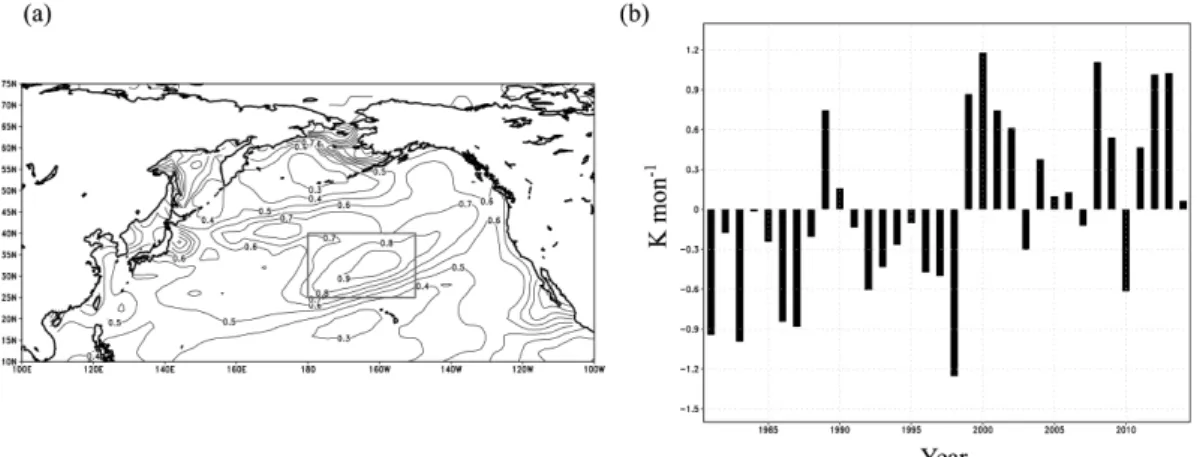
The CNP region has strong interannual variability of SST (Fig. 6a). The time-series of February SST over the CNP region (Fig. 6b) shows that there exists a distinct shift occurs in 1998/1999, which is below normal from 1981 to 1998 (the cold SST period;
Period C) and above normal from 1999 to 2014 (the warm SST period; Period W). We further investigate Fig. 4. The regressed field of winds (vector, m s−1) at the 850 hPa level on the snowfall (cm) averaged over the YD region for February from 1981 to 2014. The shaded areas indicate the values that exceed the 95% confidence level.
Changed Relationship between Snowfall over the Yeongdong region of the Korean Peninsula and Large-scale Factors
187
impact of this SST shift on the changes of the YD snowfall, which does not show clear shift of snowfall amount itself (Fig. 1).
We separately verify the relationship between the snowfall and the SST for Period C and Period W.
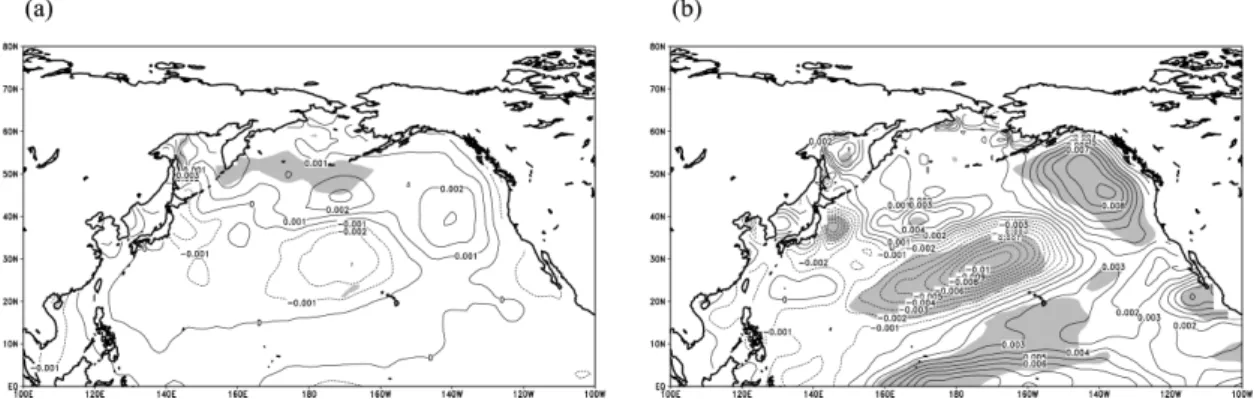
Figure 7 shows the regressed field of the February SST on the YD snowfall for February in Period C (Fig. 7a) and Period W (Fig. 7b). In Period C, no significant relationship is observed between the SSTs over the Northern Pacific and the YD snowfall
variability. After 1999 (i.e., Period W), however, the SSTs over the ENP, CNP region, Central Tropical Pacific, and the Bering Sea exhibit a significant relationship with the snowfall over the YD region.
The precipitation is related to the positive SST anomalies over the ENP and Central Tropical Pacific, whereas the SST over the CNP region is negatively related to the snowfall. Figure 8 presents the regressed field of the February SLP on the YD snowfall in Period C and Period W. The pressure fields exhibit a Fig. 5. The regressed field of the SST (K) on the snowfall (cm) averaged over the YD region for February from 1981 to 2014.
The shaded areas indicate the values that exceed the 95% confidence level.
Fig. 6. (a) The spatial distribution of the standard deviation of the February SST (K) from 1981 to 2014 and (b) the time-series of the monthly averaged SST (K) anomaly for February from 1981 to 2014 over the CNP region.
significant relationship with the snowfall variability over the YD region in Period W but not in Period C.
A distinct change occurs after 1999, in which the positive SLP anomalies over the GP and NB region are associated with the above-normal snowfall in Period W (Fig. 8b). As shown in Fig. 2, the YD snowfall exhibit a significant relationship with the SLP over the GP and NB from 1981 to 2014. The results in Fig. 8 show that these strong teleconnections are mostly formed in Period W. Therefore, the change in the snowfall variability over the YD region after 1999 is related to the change in the SST variability over the CNP region, the ENP, and Central Tropical Pacific. Additionally, these changes are significantly related to the SLP changes over the GP and NB regions. These strengthened relationships can be explained by SST pattern changes. Correlation coefficients between the SST over the CNP region and the SST over the Aleutian region are −0.12 and −0.57 in periods C and
W, respectively. It indicates that the CNP SST variability can significantly affect SST pattern over the NB region in Period W with opposite sign. After 1999, warmer CNP SST is related to the colder NB SST which can form higher SLP over the NB and GP regions.
Figures 9a and c present the eigenvectors of the first two EOF modes for the monthly averaged SLP for February in Period W. The first and second modes explain 40.3% and 18.4% of the total variance, respectively. The first mode can be characterized by the Aleutian Low and the second mode is related to the SLP anomalies over the GP and NB regions.
From previous analyses, we found that the second mode is associated with the YD snowfall variability (Fig. 8b). Figure 9b shows the principal component (PC) of the first EOF mode, which shows the biennial variation after 2008. As shown in Fig. 1, recent heavy snowfall events occurred in 2010, 2011, and 2014.
Fig. 7. The regressed field of the SST (K) on the snowfall (cm) averaged over the YD region for February from (a) 1981 to 1998 and (b) 1999 to 2014. The shaded areas indicate the values that exceed the 95% confidence level.
Fig. 8. The regressed field of the SLP (hPa) on the snowfall (cm) averaged over the YD region for February from (a) 1981 to 1998 and (b) 1999 to 2014. The shaded areas indicate the values that exceed the 95% confidence level.
Changed Relationship between Snowfall over the Yeongdong region of the Korean Peninsula and Large-scale Factors
189
The first mode PC indicates a positive SLP anomaly over the Aleutian region in 2011 and 2014. The second mode PC reveal the positive SLP anomalies in 2010 and 2014 (Fig. 9d). As shown in Figs. 2 and 3, the positive SLP anomalies over the Aleutian, GP and NB regions are related more strongly to the snowfall anomaly than in normal years. The strong precipitation that occurred after 2010 is related to these two EOF modes. The February snowfall events in 2010 and 2011 are associated with the SLP patterns, which are characterized by the SLP EOF second and first modes, respectively. In 2014, the first and second modes affect the above-normal snowfall.
Anomalies of the SLP and winds at 850 hPa level in 2010, 2011, and 2014 are analyzed in Fig. 10 to clarify how each SLP EOF mode affects the strong precipitation in the YD region. As shown in Fig. 10a, anomalous easterly winds at 850 hPa over the East Sea of Korea in 2010 are generated by the positive anomaly of the SLP over the GP and NB regions. The spatial correlations of the SLP in 2010, with respect to
the first and second EOF modes, are -0.33 and 0.72, respectively. The SLP patterns in 2010 can be explained by the second EOF mode (Fig. 9c). Figure 10b shows the weakened Aleutian Low in 2011, which is the pattern presented in the first EOF mode (Fig. 9a). The SLP pattern in 2011 is related to the first and second EOF modes with spatial correlations of 0.93 and -0.18, respectively. The SLP pattern of 2011 is described by the first EOF mode. Positive anomalies of the SLP exist over the GP and NB regions in 2014 (Fig. 10c). The pressure patterns in 2014 are closer to those in 2010 (second EOF mode) than in 2011 (first EOF mode). The anomalous SLP has spatial correlations of 0.40 and 0.81 with the first and second EOF modes, respectively. The snowfall that occurred in 2014 over the YD region is more strongly affected by the second EOF mode, although both EOF modes influence the snowfall.
The regressed fields of the SST in February on the PC time-series of the first and second EOF modes are presented in Fig. 11 to explain how EOF modes are Fig. 9. The (a) first and (c) second empirical orthogonal function (EOF) modes of the monthly averaged SLP (hPa) for Febru- ary in Period W and the principal component (PC) associated with the eigenvectors of the (b) first and (d) second EOF modes.
associated with the SST variability. A significant positive relationship is observed between the first EOF mode and the SST over the Bering Sea. In Fig. 11b, the second EOF mode is negatively related to the SST variability over the CNP, whereas a positive relationship is observed between the second mode PC and the SST over eastern North Pacific. Additionally, a negative relationship exists over the western North Pacific (east of Japan). Figure 7b shows the SST variability patterns, which exhibit a strong relationship with the snowfall variability over the YD region in Period W. These patterns are similar to the SST
patterns in Figs. 11a and b, which are acquired from the EOF modes of the SLP. Those SST structures are associated with the two leading EOF modes of the SLP. The SLP patterns explain the easterly winds, which are the key parameter affecting snowfall in the YD region. The SST patterns in Fig. 7b are the combined patterns in Figs 11 a and b. Therefore, the first EOF mode, which is related to the Aleutian Low SLP, is affected by the local SST variability. However, the second EOF mode, which is related to the GP and NB SLP, is affected by the remote SST variability.
Fig. 10. The anomalous field of the SLP (contour, hPa) and winds (vector, m s−1) at 850 hPa level for February from (a) 2010, (b) 2011, and (c) 2014.
Fig. 11. The regressed field of the SST (K) for February on a) the first EOF PC and b) the second EOF PC. The shaded areas indicate the values that exceed the 95% confidence level.
Changed Relationship between Snowfall over the Yeongdong region of the Korean Peninsula and Large-scale Factors
191
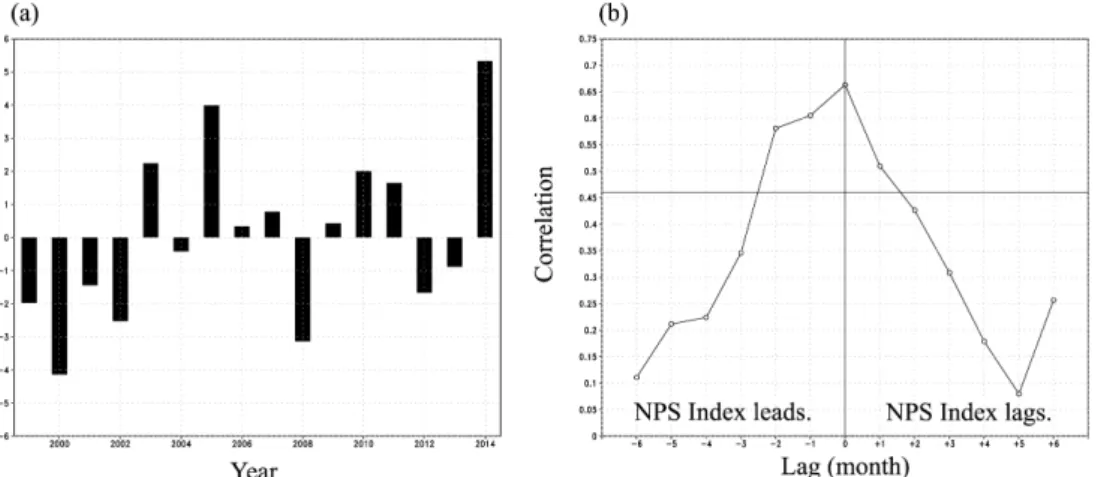
Possible YD snowfall seasonal predictor The precipitation over the YD region is related to the SLPs over the GP and NB, which are associated with the SSTs over the Bering Sea, ENP and CNP in Period W. Figure 12a presents the newly defined index in this study (Northern Pacific SST variance;
hereafter NPS index) for the YD snowfall. This index is defined as the sum of the normalized SST anomalies for February over the Bering Sea, ENP and the CNP regions (sign of CNP SST is reversed). The regions in this index are defined as 180oE-160oW and 45oN-55oN for the Bering Sea and 130oW-150oW and 45oN-55oN for ENP. The CNP region is redefined as 160oW- 180oW and 20oN-35oN in the NPS index, whereas defined as 150oW-180oW and 25oN-40oN in Fig. 6.
The NPS index is designed to have positive value when the YD snowfall is above normal. Because the index is based on SST patterns which have large inertia, we assumed that the NPS index can have leading signal to the atmospheric patterns linked to the YD snowfall. The NPS index shows positive values in 2010, 2011, and 2014, when the snowfall amounts are larger than in normal years (Fig. 12a). Generally, the index well describes the YD snowfall variability in Period W. The validity of the index is supported by the correlation coefficient (0.66) between the NPS index and the YD region snowfall variability in Period
W. Figure 12b shows the lagged correlation between the February YD precipitation and the NPS index from August in the previous year to August in the same year for 1999-2014. The February NPS index exhibit the highest correlation with the YD snowfall.
Figure 12b indicates that the February YD regional snowfall is strongly related to the 2-month leading NPS index with a correlation coefficient higher than 0.46 which indicate the values that exceed the 95%
confidence level. These results show that the NPS index in December (or January) can be used as a seasonal predictor for the February YD snowfall.
Summary
The snowfall for February over the YD region is influenced by large-scale systems involving the SLP and the winds at 850 hPa. The northeasterly wind over the East Sea is important factor affecting precipitation. The northeasterly wind transports the developed convective clouds over the East Sea into the YD region. In addition, this wind is generated by the synoptic pattern for the SLP over the GP and NB region.
By 1999, the relationship between the snowfall and large-scale patterns are changed, whereas no significant trends are observed in snowfall amount. The change is Fig. 12. (a) The NPS index for February which is defined in this study. (b) The monthly lead-lag correlation of the NPS index on the February YD snowfall from 1999 to 2014. Lag 0 indicates the correlation between the February NPS index on the Feb- ruary YD snowfall. The straight line indicates the values that exceed the 95% confidence level.
related to a shift of the SST over the CNP region by 1999. During Period W (after 1999), the relationship between the precipitation and the SLP over the GP and NB region is strengthened. Furthermore, the snowfall is related to the SST variability over the Bering Sea, ENP, and CNP that can affect large-scale atmospheric patterns.
The EOF analysis in Period W shows characteristics of large-scale features in recent strong snowfall years.
The first EOF mode of the monthly averaged SLP for February can be characterized by the Aleutian Low in Period W. The first EOF mode can explain the snowfall occurred in 2011. The second EOF mode is associated with the anomalies of the SLP over the GP and NB regions. The second EOF mode is the major pattern of the 2010 and 2014 snowfalls. Both EOF modes are important to explain the YD precipitation.
The first and second EOF modes are related to the SST variability over the ENP, CNP, and Bering Sea.
The first mode is related to the variability over the Bering Sea, and the second mode is associated with the anomaly of the SST over the ENP and the CNP region in Period W. Therefore, the SST variability is related to the SLP patterns exhibited by the GP and NB regions and the precipitation over the YD region.
The SLP pattern is related to the snowfall and the easterly winds over the East Sea, which are generated by the SLP pattern. The winds are a key factor influencing precipitation.
We suggest the NPS index for the seasonal forecast of February YD snowfall. The index comprises the sum of the variability of the normalized SST over the Bering Sea, ENP, and CNP. The YD precipitation can be predicted by the 2-month leading NPS index, which can be utilized as a predictor for the seasonal forecast.
Acknowledgments
This work was supported by the research grant of the Kongju National University in 2014.
References
Ambaum, M.H.P., Hoskins, B.J., and Stephenson, D.B., 2001, Arctic Oscillation or North Atlantic Oscillation?
Journal of Climate, 14, 3495-3507.
Andersson, T. and Nilsson, S., 1990, Topographically induced Convective Snowbands over the Baltic Sea and Their Precipitation Distribution. Weather and Forecasting, 5, 299-312.
Chen, W., Yang, S., and Huang, R.H., 2005, Topographically induced Convective Snowbands over the Baltic Sea and Their Precipitation Distribution. Journal of Geophysical Research, 110, D14110, doi:10.1029/2004JD005669.
Cho, K.H. and Kwon, T.Y., 2012, Orographic and Ocean Effects Associated with a Heavy Snowfall Event over YD Region. Atmosphere, 22, 57-71. (In Korean with English abstract)
Cho, Y.J., Kwon, T.Y., and Choi, B.C., 2015, Characteristics of Meteorological Variables in the Leeward Side associated with the Downslope Windstorm over the Yeongdong Region. Journal of the Korean Earth Science Society, 36(4), 315-329.
Cohen, J., Saito, K., and Entekhabi, D., 2001, The role of the Siberian high in Northern Hemisphere climate variability. Geophysical Research Letters, 28, 299-302.
Eichenlaub, V.L., 1970, Lake effect snowfall to the lee of the Great Lakes: its role in Michigan. Bulletin of the American Meteorological Society, 51, 403-412.
Jhun, J.G., Lee, D.K., and Lee, H.A., 1994, A Study on the Heavy Snowfalls Occurred in South Korea. Asia- Pacific Journal of Atmospheric Sciences, 30, 97-115.
(In Korean with English abstract)
Jhun, J.G. and Lee, E.J., 2004, A New East Asian Winter Monsoon Index and Associated Characteristics of the Winter Monsoon. Journal of Climate, 17, 711-726.
Jung, S.H., Im, E.S., and Han, S.O., 2012, The Effect of Topography and Sea Surface Temperature on Heavy Snowfall in the YD Region: A Case Study with High Resolution WRF Simulation. Asia-Pacific Journal of Atmospheric Sciences, 48, 259-273.
Jung, S.P., Lim, Y.K, Kim, K.H., Han, S.O., and Kwon, T.Y., 2014, Characteristics of Precipitation over the East Coast of Korea Based on the Special Observation during the Winter Season of 2012. Journal of the Korean Earth Science Society, 35(1), 41-53.
Kanamitsu, M., Ebisuzaki, W., Woollen, J., Yang, S.K., Hnilo, J.J., Fiorino, M., and Potter, G.L., 2002, NCEP- DOE AMIP-II Reanalysis (R-2). Bulletin of the American Meteorological Society, 83, 1631-1643.
Kim, J.E., Kwon, T.Y., and Lee, B.Y., 2005, Characteristics
Changed Relationship between Snowfall over the Yeongdong region of the Korean Peninsula and Large-scale Factors
193
of Sensible Heat and Latent Heat Fluxes over the East Sea Related with YD Heavy Snowfall Events. Ocean and Polar Research, 27, 237-250. (In Korean with English abstract)
Lee, H.Y., Ko, H.Y, Kim, K.E., and Yoon, I.H., 2010, An analysis of Characteristics of Heavy Rainfall Events over Yeongdong Region Associated with Tropopause Folding. Journal of the Korean Earth Science Society, 31(4), 354-369.
Lee, J.G. and Kim, Y.J., 2008, A Numerical Case Study Examining the Orographic Effect of the Taebaek Mountains on Snowfall Distribution over the YD Area.
Atmosphere, 18, 367-386. (In Korean with English abstract)
Lee, J.G. and Kim, Y.J., 2009, A Numerical Case Study Examining the Orographic Effect of the Northern Mountain Complex on Snowfall Distribution over the YD Region. Atmosphere, 19, 345-370. (In Korean with English abstract)
Niziol, T.A., 1987, Operational Forecasting of Lake Effect Snowfall in Western and Central New York. Weather
and Forecasting, 2, 310-321.
Smith, T.M., Reynolds, R.W., Peterson, T.C., and Lawrimore, J., 2008, Improvements to NOAA's Historical Merged Land-Ocean Surface Temperature Analysis (1880-2006).
Journal of Climate, 21, 2283-2296.
Waldstreicher, J.S., 2002, A foot of snow from a 3000-foot cloud: The Ocean-Effect Snowstorm of 14 January 1999. Bulletin of the American Meteorological Society, 83, 19-22.
Wu, B. and Wang, J., 2002, Winter Arctic Oscillation, Siberian High and East Asian Winter Monsoon.
Geophysical Research Letters, 28, doi:10.1029/2002 GL015373.
Xue, Y., Smith, T.M., and Reynolds, R.W., 2003, Interdecadal changes of 30-yr SST normals during 1871-2000. Journal of Climate, 16, 1601-1612.
Yang, S., Lau, K.M., and Kim, K.M., 2002, Variations of the East Asian Jet Stream and Asian-Pacific-American Winter Climate Anomalies. Journal of Climate, 15, 306- 324.
Manuscript received: March 21, 2017 Revised manuscript received: April 20, 2017 Manuscript accepted: May 10, 2017