Printed in the Republic of Korea
http://dx.doi.org/10.5012/jkcs.2011.55.5.745
Alkyl Group Dissociation During Corona Excitation of Alkylbenzenes
Young Wook Yoon and Sang Kuk Lee*
Department of Chemistry, Pusan National University, Busan 609-735, Korea. *E-mail: [email protected] (Received August 10, 2011; Accepted August 23, 2011)
ABSTRACT. Well-resolved vibronic emission spectra were recorded in the visible region from the corona discharge of pre- cursor alkylbenzenes in a technique of corona excited supersonic expansion using a pinhole-type glass nozzle. From the observed spectra, we found the evidence of the presence of benzyl-type radicals generated by dissociation of C-C or C-H bonds of alkyl group. After identification of benzyl-type radicals formed in the corona discharge, we suggest that energy den- sities in alkyl chain play a crucial role in determining the bond dissociation during corona excitation.
Key words: Spectroscopy, Reaction mechanism, Benzyl-type Radical
INTRODUCTION
Transient species such as molecular ions and radicals have long been believed to play important roles as reac- tion intermediates in chemical process.1 Thus, the char- acteristics and structures of transient species could at least describe chemical reactivities and aid our understanding of reaction dynamics at the transition state. Many reaction intermediates can be formed by eliminating atoms or groups of atoms (radicals) from stable molecules to pro- duce free radicals, and thus, comparisons of the structures of starting molecules and resulting free radicals allow us to explore the effects of bond cleavage on molecular struc- ture. Furthermore, these effects of bond cleavage are often large, and cause drastic changes in bond lengths and bond angles, even when only a single hydrogen atom is removed.2 The benzyl radical, the prototypical aromatic free rad- ical, is regarded to be one a fundamental reaction inter- mediate during aromatic chain reactions and has been the subject of a large number of spectroscopic studies.3 Fur- thermore, the delocalized π systems of aromatic mole- cules have been extensively investigated to explain substitution effects. Schüler et al.4 first observed an emis- sion line near 450 nm in the electronic spectrum of the benzyl radical. A few years later, Porter and coworkers5 also identified the 450 nm band and a 305 nm band in an absorption spectrum using the flash photolysis technique.
In fact, vibronic transition bands in the visible region of the benzyl radical have been most widely studied.
Laser spectroscopic techniques have been employed to investigate the vibronic coupling of two quasi-degenerate excited electronic states of the benzyl radical in the vis- ible region. Miller and coworkers6 obtained using a super-
sonic jet expansion technique, changes in rotational constants upon electronic excitation by simulating high resolution laser excitation spectra. A similar study was performed by Fukushima and Obi,7,8 who examined vibronic coupling between the two lowest excited elec- tronic states of the benzyl radical.
Cossart-Magos and Leach9 determined the symmetry of the excited electronic state by analyzing the rotational contour of the 450 nm band, and Carrick and Selco10 attempted to determine the rotational constant of the ben- zyl radical in the visible region using high resolution emission spectra.
The emission spectroscopy coupled with corona dis- charge using a pinhole-type glass nozzle has proved to be a useful tool for observing the vibronic spectra of tran- sient species, especially those of benzyl-type radicals.
Recently, Lee11 significantly upgraded the nozzle system and improved efficiency of radical generation and stabil- ity of corona discharge, which allowed observations to be extended to multi-substituted benzyl-type radical systems.
The technique of corona excited supersonic expansion (CESE), a combination of corona discharge and super- sonic jet expansion, was originally invented by Engelk- ing,12 and has been used to obtain the vibronic emission spectra of jet-cooled benzyl-type radicals because this technique easily produces electronically hot but jet- cooled transient species for spectroscopic identification of reaction intermediates. More specifically, the CESE sys- tem has allowed much work to be conducted on benzyl- type radicals.
In this study, we obtained visible vibronic emission spectra from the corona discharges of alkylbenzenes seeded in a large amount of carrier gas helium and ana-
lyzed the effects of the alkyl group on corona excitation and bond dissociation during the productions of benzyl- type radicals.
EXPERIMENTAL SECTION
The experimental setup employed in this work is sim- ilar to those described elsewhere.13 CESE was performed using a pinhole-type glass nozzle to produce and excite benzyl-type radicals from alkylbenzenes. The vibronic emission spectra of the benzyl-type radicals were recorded using a long path monochromator and used to identify the species generated during corona discharge.
Precursor alkylbenzene (Aldrich, reagent grade) vapor was mixed with 2.0 atm of helium gas inside a vaporizing vessel at room temperature. The concentration of precur- sor vapor in the gas mixture was adjusted by controlling the openness of a bypass valve to achieve maximum emis- sion intensity, which was monitored using the strongest band in the spectrum, and is believed to be less than 1%.
Since the heavy aromatic compounds produce a soot deposit during corona discharge that blocks the glass noz- zle orifice, we adopted a modified pinhole-type glass noz- zle with an orifice diameter of 0.3 mm made in our laboratory, which substantially improved the stability of the discharge. A DC discharge of 1.5 kV and 3 mA was applied to achieve maximum emission intensities at low- est small fragment production levels. These small frag- ments are predominantly C2 and CH radicals which emit strong fluorescence in the same spectral region.14 Although we tried to maintain uniform discharge condi- tions during the experiments, a little and S/N ratio fluc- tuation in spectra could not be avoided when precursors were changed.
The 6-way cross-type Pyrex expansion chamber was evacuated using a mechanical vacuum pump, and main- tained at a chamber pressure of about 2 mbar during con- tinuous expansion using a backing pressure of 2.0 bar. The DC discharge in the presence of precursor produced a blue-green jet, indicating the benzyl-type radical forma- tion in the jet. Emission from the jet area at 5mm below the nozzle throat was collected through a quartz lens (f=50 mm, d=38 mm) placed inside the chamber arm, and was focused onto the slit of a monochromator (Jobin Yvon U1000) containing a cooled PMT (Hamamatsu R649) detector. Emission spectra were recorded by scanning from 18500 to 22500 cm-1 in steps of 2.0 cm-1 using a slit width of 100 µm for 1 hr. Spectral frequencies were cal- ibrated using He atomic lines,15 which were recorded at
the same time, and wavelengths are believed to be accu- rate to within ±1.0 cm-1.
RESULTS AND DISCUSSION
It has been demonstrated that a well-controlled corona discharge of toluene3 in a large amount of inert carrier gas helium produces the benzyl radical in a vibronically excited state. Although the mechanism responsible for the generation and excitation of the benzyl radical from tol- uene has not been established for the CESE system using a pinhole-type nozzle, it has been suggested that the meta- stable He in the 1s2s 3S1 state,16 above 19.82 eV initially excited by the corona discharge, transfers its excess energy to precursors via a collisional process. Subsequently, a C-H bond of a methyl group on the benzene ring, already weakened in the excited electronic state, dissociates to produce benzyl radical and a hydrogen atom.
The benzyl radical that is generated then undergoes col- lisional relaxation in the jet with helium atoms and in the process loses its rotational and vibrational energy while in an excited electronic state, which produces an electroni- cally ‘hot’, but rovibrationally ‘cold’ species. A simulation17 of the rotational contour of vibronic band resulted in a rotational temperature of about 40 K, which is relatively high for supersonic jet expansion presumably because of the combination of continuous jet expansion, high volt- age DC discharge, and a low backing pressure, the latter of which is limited by maximum tolerance used for the noz- zle glassware.
The benzyl radical has a planar structure with 7 delo- calized π electrons, to which the methylene group con- tributes a π electron. Thus, the interaction between the benzene ring and the methylene group is substantial. The two lowest excited electronic states created are the 22B2 (D2) and 12A2 (D1)states, and the ground state is 12B2 (D0).18 Similarly, in benzyl-type radicals with substituents connected to benzene ring by a single ó bond, the inter- action between the substituents and the benzene ring should be of second-order as compared with that between the methylene group and the benzene ring. Thus, the elec- tronic structure of benzyl-type radicals should be similar to that of the parent benzyl radical.
Visible emission by benzyl-type radicals is believed to arise from transitions to the D0 ground state from the close-lying D2 and D1 excited electronic states, which could be mixed through vibronic coupling. Ring substi- tution is also likely to affect the energies of the two excited electronic states differently.However, it is extremely dif-
ficult to observe the D2→D0 transition because of effi- cient relaxation of the population from D2 to D1 states due to vibronic coupling. In addition to the electronic relax- ation, rapid vibrational relaxation in the D1 state transfers the population to the vibrationless state (v=0) with colli- sion of helium atoms for the pinhole-type glass nozzle employed in a CESE. Thus, the vibronic emission spectra produced using a CESE and a pinhole-type glass nozzle should be similar to the dispersed fluorescence spectra observed while pumping the origin band of the D1→D0
electronic transition, which exhibits an origin band with strongest intensity at highest wavenumber.19 Further- more, transition from the vibrationless (v=0) D1 state to the D0 state provides spectroscopic information on elec- tronic transition energy and on vibrational mode frequen- cies in the D0 state.
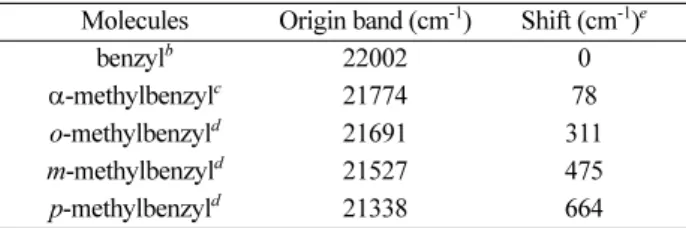
The origin band of the benzyl radical was observed with weak intensity at 22002 cm-1. The strong bands at 21476 and 21384 cm-1 belong to the 6a10and 6b10bands of the benzyl radical, respectively.3 The intensity of the origin band is lower than those of the 6a10and 6b10 bands due to the selection rule. For benzyl-type radicals with substituents, the origin band always shifts to red region because of the larger space available for delocalized π electrons. Table 1 lists the positions of the origin bands of benzyl and mono-methyl substituted benzyl-type rad- icals. The sizes of the shifts caused by substitution posi- tions are qualitatively predictable from the substitution effect of aromatic compounds.20 Furthermore, it is inter- esting that the shift trends depend on the natures of sub- stituents.
Fig. 1 shows the possible formation of benzyl-type rad- icals due to bond cleavage in a corona discharge of tol- uene (Fig. 1(a)), which has only one type of alkyl C-H bond. The cleavage of the C-CH3 bond of toluene pro- duces the phenyl radical, which has an electronic config-
uration quite different from that of the benzyl radical. The spectrum in Fig. 2(a) clearly confirms the formation of the benzyl radical, and shows strong vibronic bands at 21476 and 21384 cm-1, which were assigned to the 6a10and 6b10 bands, respectively, of the benzyl radical.
Fig. 1(b) shows the possible products formed from the corona discharge of precursor ethylbenzene. The cleav- age of C-CH3 and C-H bonds of the ethyl group generates the benzyl and α-methylbenzyl radicals, respectively. Since the C-CH3 bond (D0=345 kJ/mol) is weaker than the C-H bond (D0=411 kJ/mol),21 it was expected that the benzyl radical would be produced in greater amounts than the α-methylbenzyl radical, as confirmed in Fig. 2(b). The vibronic emission spectrum observed from the corona dis- charge of ethylbenzene shows the 6a10and 6b10 bands with strong intensity indicating the benzyl radical resulting from C-CH3 bond cleavage and the band with moderate intensity at 21774 cm-1 of the origin band of the á-meth- ylbenzyl radical.22
To form the α-methylbenzyl radical as a major product, we employed isopropylbenzene as a precursor, which has two C-CH3 bonds and one C-H bond located on the cen- tral α isopropyl carbon atom. The cleavage of the weak C- Fig. 1. Possible formation of benzyl-type radicals from precur- sors. (a) benzyl radical from methylbenzene, (b) benzyl radical and α-methylbenzyl radical from ethylbenzene, (c) α-methyl- benzyl radical and α,α-dimethylbenzyl radical from isopropyl benzene, (d) benzyl radical and α-ethylbenzyl radical from pro- pylbenzene, and (e) benzyl radical and α-propylbenzyl radical from butylbenzene.
Table 1. Origin Bands of Benzyl-type Radicals for the D1→D0
Transitiona
Molecules Origin band (cm-1) Shift (cm-1)e
benzylb 22002 0
α-methylbenzylc 21774 78
o-methylbenzyld 21691 311
m-methylbenzyld 21527 475
p-methylbenzyld 21338 664
aMeasured in vacuum.
bReference 4.
cReference 22.
dReference 23.
eWith respect to the origin band of the benzyl radical (22002 cm-1).
CH3 bond produced an α-methylbenzyl radical as a major product, whereas the dissociation of the strong C-H bond at the α-position formed α,α-dimethylbenzyl radicals as a minor product, as shown in Fig. 1(c). Dissociation at the β-position of the isopropyl group did not produce a ben- zyl-type radical. Fig. 2(c) shows the corona discharge spectrum of isopropylbenzene, in which the intense vibronic structure of the α-methylbenzyl radical is present as well as other vibronic bands of increased intensity. Evidence of the benzyl radical completely disappeared because iso- propylbenzene cannot produce a benzyl radical by bond cleavage. The α,α-dimethylbenzyl radical could not be identified due to the absence of spectroscopic data. How- ever, we would expect its origin band at around 21500 cm-1 based on expected origin band shifts produced by substitution effects.
Next, we used propylbenzene as a precursor which pos- sesses C-C2H5 and C-H bonds at the α-position, the cleav- ages of which produce benzyl and α-ethylbenzyl radicals, as shown in Fig. 1(d), respectively. In terms of bond dis- sociation energies, the benzyl radical is expected to be the major product, and the spectrum in Fig. 2(d) shows the formation of benzyl radical only from the corona dis-
charge of propylbenzene. However, we could detect the evidence of the α-ethylbenzyl radical because of an absence of spectroscopic data.
Finally, we expected that the benzyl and α-propylben- zyl radicals are formed from the cleavage of C-C3H7 and C-H bonds, respectively, of butyl group of precursor butylbenzene as shown in Fig. 1(e). Similarly to the pro- pylbenzene, we expect that the benzyl radical is produced in greater abundance. Fig. 2(e) shows the spectrum the presence of the vibronic bands of the benzyl radical. Fur- thermore, no evidence of the α-propylbenzyl radical was found, which suggests that bond dissociation energy plays a crucial role in the selection of bond cleavage. The origin band of the α-propylbenzyl radical is expected to be located near 21500 cm-1.
In the molecular radical production1 by bond cleavage using photolysis, the absorption characteristics of the pre- cursor and its relevant bond strengths are important con- siderations. However, bond dissociation induced by kinetic or thermal energy mainly depends on the amount of energy supplied and bond strengths. During the dissoci- ation of alkyl group caused by collision with excited helium atoms, the weakest bond is preferentially disso- ciated by thermal energy, which suggests the energy den- sity over the alkyl group is a key determinator of the bond dissociated. Furthermore, the energy density would be inversely related to the length of the alkyl chain. Thus, C- H and C-C bonds would tend to be broken simultaneously in ethylbenzene that has high energy density over alkyl group, whereas weakest alkyl bonds would be selectively broken in propyl- and butylbenzenes, resulting in the cleavage of C-C bond only.
CONCLUSION
We observed the visible vibronic emission spectra, pro- duced by a corona discharge, of alkylbenzenes in a large excess of carrier gas helium using a CESE system with a pinhole-type glass nozzle. Based on our analyses of the spectra obtained, we suggest that the energy density over alkyl group plays a key role in the determination of bond cleavage. Furthermore, with this concept of energy den- sity, we are able to predict what types of radicals would be formed from given alkylbenzene precursors exposed to a corona discharge.
Acknowledgment. This work was supported for two years by a Pusan National University Research Grant.
Fig. 2. The vibronic emission spectra of different alkylbenzene precursors. The spectra (a), (b), (c), (d), and (e) were observed from the corona discharges of methylbenzene, ethylbenzene, iso- propylbenzene, propylbenzene, and butylbenzene, which were seeded in a large amount of carrier gas helium.
REFERENCES
1. Tan, X. Q.; Wright, T. G.; Miller, T. A. Electronic Spec- troscopy of Free Radicals in Supersonic Jets: Jet Spec- troscopy and Molecular Dynamics; Hollas, J. M.; Phillip, D., Eds.; Blackie Academic & Professional: London, 1994.
2. Hirota, E. J. Phys. Chem. 1983, 87, 3375.
3. Selco, S. I.; Carrick, P. G. J. Mol. Spectrosc. 1989, 137, 13.
4. Schüler, H.; Reinbeck, L.; Kaberle, A. R. Z. Naturforsh 1952, 7A, 421.
5. Porter, G.; Strachan, E. Spectrochim. Acta 1958, 12, 299.
6. Lin, T.-Y. D.; Tan, X.-Q.; Cerny, T. M.; Williamson, J.
M.; Cullin, D. W.; Miller, T. A. Chem. Phys. 1992, 167, 203.
7. Fukushima, M.; Obi, K. J. Chem. Phys. 1990, 93, 8488.
8. Fukushima, M.; Obi, K. J. Chem. Phys. 1992, 96, 4224.
9. Cossart-Magos, C.; Leach, S. J. Chem. Phys. 1976, 64, 4006.
10. Carrick, P. G.; Selco, J. I. J. Mol. Spectrosc. 1990, 139, 449.
11. Lee, S. K. Chem. Phys. Lett. 2002, 358, 110.
12. Engelking, P. C. Rev. Sci. Instrum. 1986, 57, 2274.
13. Han, M. S.; Choi, I. S.; Lee, S. K. Bull. Korean Chem.
Soc. 1996, 17, 991.
14. Pearse, R. W. B.; Gaydon, A. G. The Identification of Molec- ular Spectra, 4th ed.; Chapman and Hall: London, UK 1976.
15. Weise, M. L.; Smith, M. W.; Glennon, B. M. Atomic tran- sition Probabilities: NSRD- NBS4, 1966.
16. Banwell, C. N.; McCash, E. M. Fundamentals of Molec- ular Spectroscopy, 4th ed.; McGraw-Hill: New York, NY, 1994.
17. Suh, M. H.; Lee, S. K.; Miller, T. A. J. Mol. Spectrosc.
1999, 194, 211.
18. Hiratsu, H.; Mori, K.; Shizuka, H.; Fukushima, M.; Oki, K. Chem. Phys. Lett. 1989, 157, 35.
19. Lee, S. K.; Baek, D. Y. Chem. Phys. Lett. 1999, 301, 407.
20. Petruska, J. J. Chem. Phys. 1961, 34, 1111.
21. Atkins, P. W. Physical Chemistry, 6th ed.; Oxford: Oxford, UK, 1998.
22. Lee, G. W.; Ahn, H. G.; Kim, T. K.; Lee, S. K. Chem. Phys.
Lett. 2008, 465, 193.
23. Selco, J. I.; Carrick, P. G. J. Mol. Spectrosc. 1995, 173, 277.