Printed in the Republic of Korea https://doi.org/10.5012/jkcs.2017.61.4.157
One Pot Four-Component Synthesis of Novel Substituted 2-Phenyl-4(3 H) Quinazolinones Using Recyclable Nanocrystalline CuMnO
3Catalyst
A. V. Borhade*, D. R. Tope, G. D. Gare, and G. B. Dabhade
Department of Chemistry, Research Centre, HPT Arts and RYK Science College, Nasik (MS), INDIA (Affiliated to S. P. Pune University). *E-mail: [email protected]
(Received April 29, 2017; Accepted June 19, 2017)
ABSTRACT. In the present study, nanocrystalline mixed metal oxide, CuMnO3 catalyst have been synthesized by mechano- chemical method with green chemistry approach. The synthesized catalyst was characterized by analytical techniques including FTIR, XRD, SEM, TEM and BET surface area. The synthesized catalyst shows high surface area is 121.06 m2/g with particle size 18 nm. The one pot four component synthesis of substituted 2-phenyl-4(3H) quinazolinone from the reaction of anthra- nilic acid, benzoyl chloride, hydrazine hydrate and substituted benzaldehyde in presence of CuMnO3 nanocatalyst has been carried out. It affords the corresponding products with high yield (76-95%) in very short reaction time. All the obtained prod- ucts were characterized with 1HNMR, 13CNMR, FTIR and EIMS.
Key words: Green synthesis, Mixed metal oxide, Multicomponent reaction, 2-Phenyl-4(3H) quinazolinone, Recyclable catalyst
INTRODUCTION
The design and application of new catalysts are always in favour of improving clean and green environment. The large surface to volume which ends up with high catalytic efficiency per gram than bulk catalytic materials1 similarly at present homogeneous catalytic process are extensively used in the industrial application for the production of large number of compound used as an important intermediates in pharmaceutical industries.2 However the recyclability and laborious steps involved in the separation of major prod- uct are the main hurdles, such as toxicity, potential danger in the handling in homogeneous catalyst.3,4 In recent, our group has been interested on searching the efficiency and recyclability of metal oxides, composite metal oxides and modified metal oxides.5−7 The reports in the literature reveals that less attention is given on perovskite type of metal oxide catalyst for organic conversions. Hence herein we report synthesis of CuMnO3 catalyst and its efficient catalytic activity for synthesis of substituted 2-phenyl-4(3H) quinazoli- none derivatives. Moreover at the most, mixed metal oxide and their catalytic properties have been studied in organic chemistry8 and as a photocatalyst.9 Cobalt and manganese based mixed metal oxide acts as an efficient oxidation cat- alyst.10 It also shows photocatalytic and adsorption prop- erties, as proton conductor, insulating, semiconducting and superconducting, ionic conducting behavior being useful for technological application in sensor device, electronic component, fuel cell, catalytic membrane reactor for hydro-
gen production material.11−13
Literature survey revealed that quinazolinone has received much attention due to their use as an intermediates for the synthesis of heterocyclic system having enhanced phar- macological and biological activity such as anti-inflametry, anticancer, anticonvulsants, anti-ulcer, hypolipidemic, antifun- gal, anti-helminthic, CNS-depressant, anti-neoplastic, hypo- tensive anti-tuberculosis, anti-parkinism. Recently substituted quinazolin-4(3H) one has got new direction due to some resemblance with folic acid. Some bioactive natural prod- ucts having quinazolin-4-ones show antimalarial activity.
The derivatives of substituted quinazolinone are also use- ful in treatment of tuberculosis.14−18
Recently one pot synthesis of the multisubstituted quinazoli- none derivatives were reported by using silica sulphuric acids, Zn/HCOONH4 under microwave irradiation, lan- thanum (III), Nitrate or p-toluene sulphonic acids, Tf2O- 2ClPy, CuCl2, CuI catalyzed coupling, Pd-catalyzed, pen- tamethylcyclopentadienylridium (III) chloride dimer, montmo- rillonite k10, hydrated ferric sulphate, ZnCl2, TiO2-magnetite composite.19−26
In view of antimicrobial activity shown by substituted 2-phenyl-4(3H) quinazolinone, it was of interest to incor- porate this moieties into various heterocyclic molecules anticipating that the resulting compounds might exhibit enhanced activity. Keeping this objective in mind herein, we wish to describe a novel and straight forward approach for the synthesis of 2-phenyl-4(3H) quinazolinone using nanocrystalline CuMnO3.
EXPERIMENTAL Ecofriendly Synthesis of CuMnO3 Catalyst
In the current method, A.R. grade equimolar (1:1) amount of CuO (Lancaster) and MnO2 (Merck) was mixed thor- oughly and removal of some water soluble impurities was conducted by washing the powder with distilled water and drying at 110oC. The dried precursors were subjected to stepwise calcination (after every 3 h the sample was removed from furnace and grinded) by heating till terminal tem- perature. The increase in temperature of muffle furnace was programmed at the rate 10oC/min. After heating at 180oC for 3 h, the material was cooled and grinded with agate mortar and pestle to acquire fine powder. The obtained product was further subjected to calcination at 900oC for next 20 h followed by grinding and milling in hot condition, polycrystalline black colored powder of CuMnO3 (98% yield) was characterized by FTIR, XRD, SEM-EDAX, BET and TEM-SAED and further used as catalyst for the synthesis of substituted 2-phenyl-4(3H) quinazolinone derivatives.
Characterization of CuMnO3 Catalyst
The vibrational frequencies of the synthesized catalyst was studied by Shimadzu IR -Affinity in the range of 4000- 500 cm−1. The structural property of the material was stud- ied using by X-ray diffractometer-DMAX-2500 (Rigaku) with Cu-Kα radiation, having λ = 1.5406Å. The surface morphology and chemical compositions of synthesized catalyst was analyzed using a Scanning Electron Micro- scope-JSM-6300 (JEOL). TEM images were recorded on CM-200 (Philips). BET surface area was calculated by using Tri Star II 3020 (Micrometrics, ASAP 2010, US) through nitrogen adsorption.
General Procedure for Synthesis of Substituted 2-Phe- nyl-4(3H) Quinazolinones (5)
Melting points of pure products were taken on Bio- Technic India (BTI) instrument and are uncorrected. 1H and 13C NMR spectra were recorded Bruker (Germany) Advance III 400 Instrument using TMS as an internal stan- dard. All reagents were purchased from Merck and Sigma Aldrich and used without purification. Mass analysis were recorded on EIMS instrument.
In the dissolved solution of 1 mmol anthranilic acid in 25 ml methanol, dropwise 1 mmol benzoyl chloride and 0.5 mol CuMnO3 catalyst was added through side neck of round bottom flask (50 ml capacity). In the above reaction mixture 1 mmol of hydrazine hydrate and 1 mmol of liquid substituted aromatic benzaldehyde was added by using
graduated pipette and solid substituted benzaldehyde directly.
The temperature of reaction mixture was maintained less than 10oC by keeping it in ice bath and the resulting mix- ture was stirred for 5 min. This reaction mixture (Scheme 1) was refluxed for 40 min on heating mantle with digital temperature controller, the progress of reaction was moni- tored on TLC. After completion of reaction, the reaction mix- ture was filtered at hot condition to separate solid catalyst and washed with 2-5 ml hot methanol. The methanol was distilled out, crude product was obtained. These crude prod- uct were washed with approximately 5 ml of aq. 10% NaH- CO3 to remove the unreacted anthranilic acid and also washed with excess water to remove the water soluble impurities. After washing, the solid product obtained was dried at 100oC in a hot air oven. The dried product was recrystallized by methanol and characterized by FTIR, 1H NMR, 13C NMR and Mass techniques.
Spectral Data of Prepared Compounds
3-(3-Nitrobenzylideneamino)-2-phenylquinazolin- 4(3H)-one (5a): IR, ῡ/cm−1: 1685 (C=O); 1589 (C=N); 3215, 3065 (Ar-H), 1492, 1369 (NO2), 1H NMR (CDCl3), δ 8.35 (s,1H, imine ), 8.31 (m, 1H,Ar), 8.2(m, 2H, Ar), 8.05 (m, 1H, Ar), 8.08 (d, J = 8 Hz, 1H, Ar), 7.85 (d, J = 8 Hz, 1H, Ar),7.64 (d, J = 8 Hz, 1H, Ar), 7.60 (d, J = 8 Hz, 1H, Ar), 7.45 (m, 5H, Ar), 13C NMR (CDCl3), δ 119.82, 122.02, 124.34, 123.62, 126.12, 126.12, 127.42, 128.55, 129.22, 129.26, 129.26, 129.90, 130.22, 134.23, 135.20, 136.21, 143.20, 149.00, 151.23, 160.40, 164.22. MS (m/z): (M+1) 356.
3-(4-Chlorobenzylideneamino)-2-phenylquinazolin- 4(3H)-one (5b): IR, ῡ/cm−1: 1654 (C=O); 1602 (C=N);
3215, 3065 (Ar-H), 748 (C-Cl), 1H NMR (CDCl3), δ 8.29 (s, 1H, imine), 8.20 (m, 1H, Ar), 8.05 (m, 2H, Ar), 7.8 (m, 1H, Ar), 7.55 (d, J = 8 Hz, 2H, Ar), 7.42 (d, J = 8 Hz, 2H, Ar), 7.35 (m, 5H, Ar), 13C NMR (CDCl3), δ 115.34, 115.34, 119.43, 122.59, 127.50, 127.50, 128.42, 128.63, 128.73, 128.96, 128.96, 129.24, 129.50, 129.50, 132.28, 134.08, 136.82, 141.43, 152.16, 159.42, 164.89. MS (m/z): (M+1) 370.
3-(4-Hydroxybenzylideneamino)-2-phenylquinazolin- 4(3H)-one (5c): IR, ῡ/cm−1: 3201 (OH), 1672 (C=O), 1601 (C=N), 1H NMR (CDCl3), δ 8.9 (s, 1H, imine), 8.4 Scheme 1. Synthesis of (E) substituted 2-phenyl-4(3H)-quinazoli- none (E-Configuration27 of R1).
(m, 1H, Ar), 54,7.8 (m, 2H, Ar), 7.75 (m, 2H, Ar), 7.55 (m, 4H, Ar), 7.42 (m, 2H, Ar), 6.8 (m, 2H, Ar), 5.8 (bs, 1H, OH), 13C NMR (CDCl3), δ 115.04, 115.04, 119.43, 122.59, 126. 22, 127.50, 127.50, 128.42, 128.63, 128.73, 128.96, 128.96, 129.24, 129.50, 129.50, 134.08, 141.43, 152.16, 159.42, 161.22, 164.89. MS (m/z): (M+1) 342.
3-(4-Methoxybenzylideneamino)-2-phenylquinazolin- 4(3H)-one (5d): IR, ῡ/cm−1: 1658 (C=O), 1600 (C=N), 1168 (C-O-C), 1H NMR (CDCl3), δ 8.1 (s, 1H, imine), 7.95 (s,1H, Ar), 7.3-7.25 (m, 8H, Ar), 7.15 (d, J = 8.1Hz, 2H), 6.97 (d, J = 8.1 Hz, 2H), 3.85 (s, 3H, OMe), 13C NMR (CDCl3), δ 55.57, 113.86, 113.86, 119.09, 122.59, 126.12, 126.12, 126.15, 127.52, 128.72, 128.83, 128.96, 128.96, 130.05, 130.25, 130.25, 133.63, 141.43, 152.16, 159.42, 163.20, 164.90. MS (m/z): (M+1) 356.
3-(3,4-Dimethoxybenzylideneamino)-2-phenylquina- zolin-4(3H)-one (5e): IR, ῡ/cm−1: 1674 (C=O); 1512 (C=N);
3215, 3065 (Ar-H), 1138 (C-O-C), 1H NMR (CDCl3), δ 8.4 (m, 2H, imine and Ar), 8.05 (m, 2H, Ar), 7.6-7.5 (m, 5H, Ar), 7.35 (m, 1H, Ar), 7.2 (m, 1H, Ar), 6.95 (m, 2H, Ar), 3.85 (s, 3H, OMe), 3.95 (s, 3H, OMe), 13C NMR (CDCl3), δ 55.57, 55.84, 114.86, 115.04, 119.43, 122.59, 122.59, 127.5, 127.5, 128.63, 128.73, 128.96, 129.24, 129.5 12, 131.63, 134.08, 141.43, 121.95, 151.95, 152.16, 159.42, 160.82, 164.89. MS (m/z): (M+1) 386.
3-(4-Nitrobenzylideneamino)-2-phenylquinazolin- 4(3H)-one (5f): IR, ῡ/cm−1: 1654 (C=O); 1604 (C=N);
3215, 3065 (Ar-H), 1531, 1346 (NO2), 1H NMR (CDCl3), δ 8.49 (s, 1H, imine ),8.40 (m, 1H,Ar), 8.25 (m, 2H, Ar), 8.0 (m, 1H, Ar), 7.85 (d, J = 8 Hz, 2H, Ar), 7.64 (d, J = 8 Hz, 2H, Ar), 7.45 (m, 5H, Ar), 13C NMR (CDCl3), δ 119.44, 121.42, 121.42, 122.44, 127.22, 127.22, 128.63, 128.73, 128.90, 128.90, 129.24, 130.25, 130.25, 131.63, 134.08, 138.24, 141.43, 150.85, 152.16, 159.42, 164.90. MS (m/z):
(M+1) 356.
3-(3-Methoxybenzylideneamino)-2-phenylquinazolin- 4(3H)-one (5g): IR, ῡ/cm−1: 1659 (C=O), 1601 (C=N), 1169 (C-O-C), 1H NMR (CDCl3), δ 8.45 (s, 1H, imine), 8.4 (s, 1H, Ar), 8.06 (m, 2H, Ar), 7.7 (m, 2H, Ar), 7.5 (m, 4H, Ar- H), 7.43 (m, 1H, Ar), 6.9 (m, 2H, Ar), 6.75 (m, 1H, Ar), 3.85 (s, 3H, OMe), 13C NMR (CDCl3), δ 55.82, 114.86, 115.04, 119.43, 121.49, 122.59, 126.5, 126.5, 127.63, 128.73, 128.10, 128.24, 128.24, 129.5, 130.2, 133.63, 134.08, 141.43, 152.16, 159.42, 161.82, 164.89 MS (m/z): (M+1) 356.
3-((3-(4-Nitrophenyl)-1-phenyl-1H-pyrazol-4-4yl)methy- leneamino)-2-phenylquinazolin-4(3H)-one (5h): IR, ῡ/
cm−1: 1674 (C=O), 1593 (C=N), 1527 and 1338 (NO2), 1H NMR (CDCl3), δ 8.75 (s, 1H, pyrazoline), 8.55 (m, 2H, Ar), 8.35 (d, J = 8 Hz, 2H, Ar), 8.0 (d, J = 8.1Hz, 2H, Ar), 8.95
(d, J = 8 Hz, 2H, Ar), 7.8 (d, J = 8 Hz, 2H, Ar), 7.5 (m, 8H, Ar), 7.25 (s, 1H, imine), 13C NMR (CDCl3), δ 106, 120.2, 120.2, 120.9, 121.6, 121.6, 122.4, 126.1, 126.1, 126.3, 127.4, 128.4, 128.4, 128.7, 128.8, 128.9, 128.9, 129.4, 129.4, 130, 130.2, 133.5, 139.2, 139.7, 143,148.4, 150.3, 151.3, 160, 164. MS (m/z): (M+1) 513.
3-((3-(3-Nitrophenyl)-1-phenyl-1H-pyrazol-4-4yl)methy- leneamino)-2-phenylquinazolin-4(3H)-one (5i): IR, ῡ/
cm−1: 1654 (C=O), 1604 (C=N), 1532 and 1346 (NO2), 1H NMR (CDCl3), δ 8.7 (s, 1H, pyrazoline), 8.5 (s, 1H, Ar), 8.3 (m, 2H, Ar), 8.1 (m, 2H, Ar), 8.9 (d, J = 8 Hz, 2H, Ar), 7.7 (d, J = 8 Hz, 2H, Ar), 7.5 (m, 9H, Ar), 7.35 (s, 1H, imine),
13C NMR (CDCl3), δ 106.05, 120.24, 120.24, 120.92, 121.12, 121.12, 122.42, 126.13, 126.13, 126.34, 127.42, 128.73, 128.82, 128.92, 128.92, 129.42, 129.42, 130.00, 130.22, 130.34, 133.52,133.62, 134.02, 139.73, 143.02, 148.93, 150.34, 151.36, 160.23, 164.22. MS (m/z): (M+1) 513.
RESULTS AND DISCUSSION
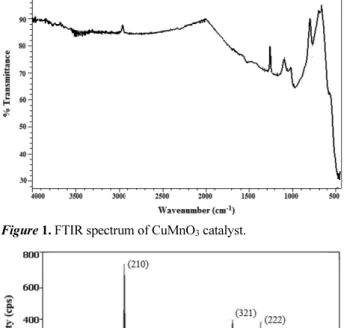
The typical infrared spectrum is depicted in Fig. 1 confirm the formation of oxide. The vibrational frequency below 700 cm−1 confirm the presence of new Cu-O-Mn bond. The peaks between 750 cm−1 to 1100 cm−1 assigned
Figure 1. FTIR spectrum of CuMnO3 catalyst.
Figure 2. XRD pattern for CuMnO3 catalyst.
to the stretching vibration of new Mn-O-Mn.
The XRD pattern of CuMnO3 powder is depicted in Fig.
2. The structure of CuMnO3 was found to be cubic with d- line pattern of CuMnO3 shows plane (111), (210), (211), (321), (221) and (222). The surface morphology and asso- ciated chemical composition of the synthesized CuMnO3 catalyst was analysed by SEM is depicted in Fig. 3. Fig. 3 shows that particles are uniformly distributed showing cubic face. Fig. 4 represents the TEM image along with SAED pattern of synthesized CuMnO3. The TEM image reveals that the CuMnO3 particles belong to the nano regime with average particle size 18 nm. The SAED pattern associated with dark spot confirms the occurence of CuMnO3 cubic structure which is in good agreement with XRD pattern.
The dark spot at the distances of 5.261, 8.781, 9. 291 and 12.871 nm−1 indicate (111), (221), and (222) planes respec- tively which exactly matches with d-line of XRD pattern at 25.60, 45.62 and 62.28 degree respectively.
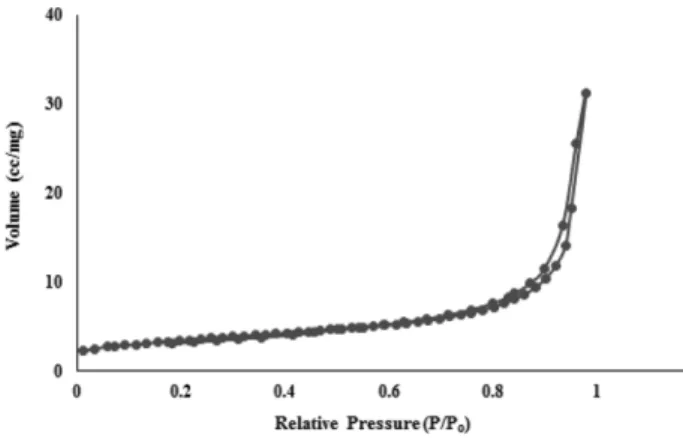
The BET surface area of ZnMnO3, CuMnO3 and CdM- nO3 catalysts was calculated by N2 adsorption /desorption method and was found to be 8.695 m2/g, 121.06 m2/g and 1.116 m2/g respectively. Among three synthesized catalyst CuMnO3 shows higher surface area (Fig. 5), and hence we have selected it as catalyst for synthesis of substituted 2 - phenyl-4(3) quinazolinone derivatives.
Our initial efforts were directed towards the catalytic evaluation of CuMnO3 for the synthesis of substituted 2- phenyl-4(3) quinazolinone derivatives. Initially, a blank reaction was carried out using anthranilic acid (1 mmol) and benzoyl chloride (1 mmol) at less than 10oC and then at 65oC, hydrazine hydrate followed by 3-nitro benzal- dehyde (1 mmol) was added in presence of methanol as a solvent, which resulted in 3-nitro-2-phenyl-4(3H) quinazoli- Figure 5. BET Surface area of CuMnO3 catalyst.
Figure 3. SEM image of CuMnO3 catalyst.
Figure 4. TEM and SAED pattern of CuMnO3 catalyst.
none derivative after 3 h. The same reaction was carried out using a catalytic amount of CuMnO3 in methanol afforded the desired 3-nitro-2-phenyl-4(3H) quinazolinone deriva- tives in 92% yield within 30 min at room temperature.
To check the effectiveness of different catalysts, we have synthesized and tried ZnMnO3, CuMnO3 and CdMnO3 for the synthesis of 2-phenyl-4(3H) quinazolinone derivatives.
The ZnMnO3 and CdMnO3 gave poor yield with long reaction time whereas the CuMnO3 gave excellent yield in short (Table 1). To optimize the amount of catalyst required for the cyclization, we tried various mol equivalents of the catalyst compared to the quantity of the anthranilic acid (Table 2).
It was found that, when the reaction was carried out with 0.5 mol, cyclization was 92%. The cyclization reaction was carried out in different solvents such as DMF, MeOH, EtOH, CH3CN, and CH2Cl2, and the results clearly showed that methanol was found to be the best choice (Table 3).
Treatment of substituted benzaldehydes (1 mmol) with anthranilic acid (1 mmol), benzoyl chloride (1 mmol), hydra- zine hydrate (1 mmol) in methanol with CuMnO3 (0.5 mol) at 65oC afforded substituted 2-phenyl-4(3H) quinazolinone with excellent yield, while the absence of the catalyst under similar conditions the reaction becomes incomplete for
longer period. The generality of the cyclization reaction of benzaldehyde with anthranilic acid, benzoyl chloride and Table 1. Effect of different catalyst on the synthesis of substituted 2-phenyl-4(3H) – quinazolinone
Entry Catalyst Amount of catalyst (mol)
Amount of each reactant
(mmol) Solvent Temp (oC) Time
(min)
Yield
% 1
2 3
ZnMnO3
CuMnO3
CdMnO3
0.1 0.1 0.1
1.0 1.0 1.0
MeOH MeOH MeOH
65 65 65
65 40 85
54 86 45
Table 2. Effect of mole percentage of CuMnO3 catalyst
Entry mol of CuMnO3 Amount of each reactant (mmol) Solvent Temperature (oC) Time (min) Yield (%) 1.
2.
3.
4.
5.
0.0 0.1 0.3 0.5 1.0
1.0 1.0 1.0 1.0 1.0
MeOH MeOH MeOH MeOH MeOH
65 65 65 65 65
180 60 40 30 20
10 68 79 92 89
Table 3. Effect of Temperature and solvent on the optimized reaction with 0.5 mol CuMnO3
Entry Solvent Temperature oC Time (min) Yield (%) 1.
2.
3.
4.
5.
6.
7.
8.
without solvent MeOH MeOH MeOH EtOH DMF MeCN CH2Cl2
R.T.
R. T.
65 70 60 60 60 40
50 45 30 25 20 45 40 50
75 83 92 85 84 76 74 60
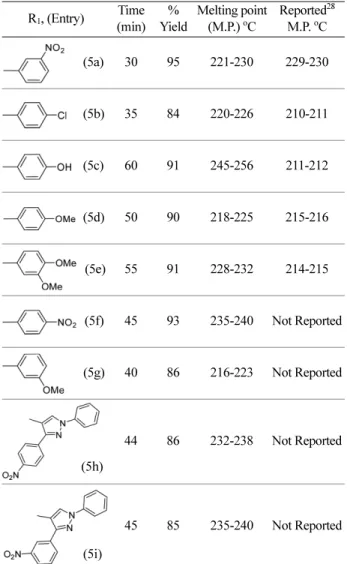
Table 4. Synthesis of substituted 2-phenylquinazolin-4(3H)-one in the presence of CuMnO3
R1, (Entry) Time (min)
% Yield
Melting point (M.P.) oC
Reported28 M.P. oC
(5a) 30 95 221-230 229-230
(5b) 35 84 220-226 210-211
(5c) 60 91 245-256 211-212
(5d) 50 90 218-225 215-216
(5e) 55 91 228-232 214-215
(5f) 45 93 235-240 Not Reported
(5g) 40 86 216-223 Not Reported
44 86 232-238 Not Reported
45 85 235-240 Not Reported (5h)
(5i)
hydrazine hydrate in methanol in presence of CuMnO3 (0.5 mol) at 65oC, and the results obtained are shown in Table 4.
Finally, we have examined the reusability of the cata- lyst as it is an important from industrial point of view. Cat- alyst was recovered by filtration and washed it with ethanol, dried and activated at 120oC for 1h before catalytic run.
The catalyst was successfully recycled (5a, Table 4) at least five times without significant loss of activity in terms of time and yield of product which is shown in Fig. 6.
CONCLUSIONS
In conclusion, we have developed a simple and one pot efficient four component reaction of anthranilic acid, ben- zoyl chloride, hydrazine hydrate and substituted aldehyde using ecofriendly synthesized nanocrystalline CuMnO3 for the preparation of 2-phenyl-4(3H) quinazolinone. Catalytic activity results revealed that, the CuMnO3 catalyst exhib- its excellent catalytic activity for the condensation of various aromatic aldehydes, anthranilic acid, hydrazine hydrate and benzoyl chloride. Most importantly this catalyst facil- itates the reaction at 65oC providing solid supports, with enhancing reaction rate and thereby the excellent yields of the products.
Acknowledgments. Authors are thankful to Korean Chemical Society and BCUD, Savitribai Phule Pune Uni- versity, for providing literature support. Publication cost of this article was supported by the Korean Chemical Society.
REFERENCES
1. Gude, V.; Narayanan, R. J. Phys. Chem. 2010, 114, 6356.
2. Khadlikar, B. M.; Borkar, S. D. J. Chem. Technol. Bio-
technol. 1998, 71, 209.
3. Gladysz, J. A.; Chem. Rev. 2002, 102, 3215.
4. Beach, E. S.; Cui, Z.; Anastas, P. T. Energy Environ Sci.
2009, 2, 1038.
5. Voorhoeve, R. J. H.; Johnson, D. W.; Remeika, J. P. Gal- lagher, P. K. Science 1977, 195, 827.
6. Borhade, A. V.; Kanade, K. G.; Tope, D. R.; Patil, M. D.
Res. Chem. Int. 2012, 38, 1931.
7. Borhade, A. V.; Patil, D. R.; Tope, D. R. Res. Chem. Int.
2012, 39, 1373.
8. Gawande, M. B.; Pandey, R. K.; Jayaram, R. V. Catal. Sci.
Tech. 2012, 2, 1113.
9. Shi, J.; Guo, L. Prog. Nat. Sci. 2012, 22, 592.
10. Voorhoeve, R. J. H.; Johnson, D. W. J.; Freeland, P. E.;
Mathaias, B. T. Science 1972, 177, 353.
11. Pena, M. A.; Fierro, J. L. G. Chem. Rev. 2001, 101, 1981.
12. Zhu, J.; Thomos, A. Catal. B. 2009, 92, 225.
13. Cristiani, C.; Dotelli, G.; Mariani, M.; Pelosato, R.; Zampori, L. Chem. Pap. 2013, 67, 526.
14. Cao, S. L.; Feng, Y. P.; Jiang, Y. Y.; Liu, S. Y.; Ding, G.
Y.; Li, R. T. Bioorg. Med. Chem. Lett. 2005, 15, 1915.
15. Kenichi, O.; Yoshihisa, Y.; Toyonari, O.; Toru, I.; Yoshio, I. J. Med. Chem. 1985, 28, 568.
16. Wolfe, J. F.; Rathman, T. L.; Sleevi, M. C.; Campbell, J.
A.; Greenwood, T. D. J. Med. Chem. 1990, 33, 161.
17. Kurogi, Y.; Inoue, Y.; Tsutsumi, K.; Nakamura, S.; Nagao, K.; Yohsitsugu, H.; Tsuda, Y. J. Med. Chem. 1996, 39, 1433.
18. Kunes, J.; Bazant, J.; Pour, M.; Waisser, K.; Slosarek, M.;
Janota, J. Farmaco 2000, 55, 725.
19. Connolly, B. J.; Guiry, P. J. Synlett. 2001, 11, 1707.
20. Abdel-Jalil, R. J.; Voelter, W.; Saeed, M. Tetrahedron Lett.
2004, 45, 3475.
21. Liu, J. F.; Lee, J.; Dalton, A. M.; Bi, G.; Yu, L.; Baldino, C. M.; McElory, E.; Brown, M. Tetrahedron Lett. 2005, 46, 1241.
22. Salehi, P.; Dabiri, M.; Zolfigol, M. A.; Baghbanzadeh,M.
Tetrahedron Lett. 2005, 46, 7051.
23. Zhou J., Fu, L.; Lv, M.; Liu, J.; Pei, D.; Ding, K. Synth.
2008, 24, 3974.
24. Giri, R.; Lam, J. K.; Yu, J. Q. J. Am. Chem. Soc. 2010, 132, 686.
25. Snider Band, P.; Zeng, H. Heterocycles 2003, 61, 173.
26. Choudhury, A.; Ali, S.; Khan A. T. J. Korean Chem. Soc.
2015, 15, 280.
27. Ganguli, S.; Panigrahi, M. K.; Singh, P.; Shukla, P. K. Int J. Pharm. Pharm. Sci. 2012, 4, 434.
28. Dhingra, A.; Chopra, B.; Dass, R.; Mittal, S. K. Der Pharma Chem. 2012, 7, 10.
Figure 6. Reusability of CuMnO3 catalyst during the synthesis of 2-phenyl – 4(3H) quinazolinone (5a, Table 4).