82 www.e-arms.org Since Komatsu and Tamai1 reported the first successful
replantation of a completely severed finger of a human by using the microvascular anastomosis in 1968, the replantation of amputated fingers using microscopes has been advanced consistently. But in case that irreversible damage is accompanied, an amputated part may not be reattached to their anatomically original position.1,2 If the replantation on the original position is not possible, the amputated tissue of a hand may be used as a donor for recovering hand functions at other positions. This procedure is termed
‘heterodigital replantation’. The biggest purpose of this surgery is to minimize the functional loss of the amputated finger while to maximize the recovery of functions of the entire hand.2 Heterodigital free flaps have an advantage that the reconstruction can be made without additional donor site morbidity by using tissues damaged by trauma such
as amputated, discarded or non functioning limbs.3-6 For successful heterodigital free flaps, it is necessary to preserve as much useful tissue as possible in the initial surgery and perform the reconstruction using the preserved tissue by deciding the priority of fingers to be replanted according to the degree of trauma and the demand of the patient.3
Herein, authors report a case of reconstruction which was performed on a patient using his amputated finger as a heterodigital free flap to preserve functions of other fingers since the amputated finger could not be replanted due to the severity of crushing injury.
CASE REPORT
A 63-year-old male patient who had a press machine accident came to the our hospital. Mutilated index finger was
Heterodigital Free Flap of Index Finger Amputee for Coverage of the Long Finger Soft Tissue Defect
So-Min Hwang, Jang Hyuk Kim, Hong-Il Kim, Yong-Hui Jung, Hyung-Do Kim
Aesthetic, Plastic and Reconstructive Surgery Center, Good Moonhwa Hospital, Busan, Korea pISSN 1226-2706 eISSN 2288-6184 Arch Reconstr Microsurg 2013;22:82-85
CC This is an open-access article distributed under the terms of the Creative Commons Attribution Non-Commercial License (http://creativecommons.org/licenses/by-nc/3.0) which permits unrestricted noncommercial use, distribution, and reproduction in any medium, provided the original work is properly cited.
Copyright © 2013 by the Korean Society for Microsurgery. All Rights Reserved.
If the replantation on the original position is not possible, the amputated tissue of a hand may be used as a donor for recovering hand functions at other positions. This procedure is termed ‘heterodigital replantation’. An 63-year-old male patient who was in press machine accident came to our hospital. He had large dorsal soft-tissue defects (5×3 cm) on his left long finger and complete amputation on his left index finger through the proximal interpharyngeal joint. Replantation was not indicated because crushing injury of index finger was severe. So we decided to use index finger soft tissue as heterodigital free flap for the coverage of the long finger defect. The ulnar digital artery and dorsal subcutaneous vein of the free flap were anastomosed with the radial digital artery and dorsal subcutaneous vein of the long finger. The heterodigital free flap provided satisfactory apperance and functional capability of the long finger. The best way to treat amputation is replantation. But sometimes surgeon confront severely crushed or multi-segmental injured amputee which is not possible to replant. In this situation, reconstructive surgeons should consider heterodigital free flap from amputee as an option.
Key Words: Free tissue flaps, Amputation, Replantation Received October 4, 2013
Revised October 24, 2013 Accepted October 29, 2013
Correspondence to: Jang Hyuk Kim Aesthetic, Plastic and Reconstructive Surgery Center, Good Moonhwa Hospital, 119 Beomil-ro, Dong-gu, Busan 601-803, Korea
Tel: +82-51-630-0199 Fax: +82-51-630-0145 E-mail: [email protected]
ARMS
Case ReportArchives of Reconstructive Microsurgery
So-Min Hwang, et al. Heterodigital Free Flap for Digital Defect
83
www.e-arms.org completely amputated distally at the proximal interpharyngeal
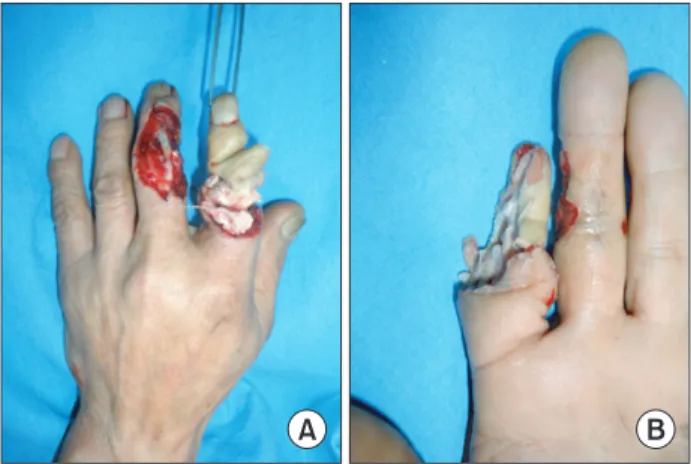
joint by severe crushing injury, where the avulsion of all arteries, veins, tendons and nerves was observed. Index finger showed open comminuted fracture, and the fracture site was exposed since the amputated part had full thickness soft tissue defect at the dimension of 5×3 cm and bone defect on the radial side (Fig. 1, 2). Since crushing and avulsion injuries in the amputated part of the index finger were too severe, the reconstruction of bony structure was difficult, which corresponds to the contraindication to replantation. Even if the replantation was successful, the finger would have no function at all and therefore, the fillet flap of index finger was performed at the proximal phalanx level. After bone was removed from the amputated part of the index finger, a heterodigital free flap of the size 5×3 cm including a digital artery and a dorsal subcutaneous vein was dissected from intact ulnar aspect under a microscope. Pedicle length of amputated part was 1.5 cm. Since dorsal skin and soft tissue defects on the long finger were measured as a radial aspect of 5×3 cm distally at the proximal interpharyngeal joint, and the extensor digitorum tendon was exposed, flap coverage was necessary. Radial digital artery and dorsal subcutaneous vein were isolated at the proximal phalanx level of the long finger, and the free flap was placed on the defect site and partially sutured. Under a microscope, the end-to-end anastomosis of digital artery and dorsal subcutaneous vein of the free flap with those of the long finger, respectively, were performed using 10-0 ethilon. When the clamp was removed,
excellent flow was observed in all anastomosed vessels and the flap displayed good capillary filling (Fig. 3). The remaining part of the flap was sutured using 5-0 prolene and 6-0 ethilon. Postoperative course showed complete survival of the reconstructed tissue without abnormal findings.
The patient started the active and passive range of motion exercise 10 days after surgery for the rapid recovery of the joint movement and was discharged after 4 weeks. During the 6 month post-operative follow-up examination period, the patient showed the satisfactory outcomes in the recovery of functions of the long finger such as flexion, extension, and pinch, and also in the aesthetic aspect (Fig. 4, 5). The
Fig. 1. Preoperative view. (A) A 63-year-old male patient who was in press machine accident came to our hospital. Large dorsal soft-tissue defects (5×3 cm) of the long fi nger. (B) Crushing amputation of the index fi nger through the proximal interpharyngeal joint.
Fig. 2. Preoperative view. A plain radiograph showing crushing amputation of the index fi nger through the proximal interpharyngeal joint. (A) Anterior-posterior view. (B) Oblique view.
Fig. 3. Intraoperative view. Index finger soft tissue as heterodigital free fl ap for the coverage of long fi nger defect.
Arch Reconstr Microsurg Vol. 22. No. 2. November 2013
84 www.e-arms.org
reconstructed proximal interphalangeal joint of the left long finger was stable and the patient did not complain of any pain.
DISCUSSION
One hundred thousand digital amputations occur each year in the United States. Among these, cases corresponding to replantation indication are fewer than 30%, the survival rate in the cases that digital replantations are performed is 80% to 94%, and the satisfactory functional outcomes after surgery are obtained in 60% to 78% of the cases.2 Although replantation and revascularization are the best option when hands are completely amputated or have crushing injuries, amputated parts that are in good condition should
be reconstructed on functionally important sites in case that replantation is impossible at the original site due to the mutilated injury of several parts of hands.2
Thorne et al.7 mentioned the topical and systemic factors contraindicant to the replantation of amputated fingers. The topical factors include severe crushing and avulsion injuries, extensive soft tissue or muscle loss, multiple segmental nerve defects, and a long ischemic time while the systemic factors include vascular shock, and pre-existing abdominal, thoracic and intracranial lesions that are life-threatening. In the case of the authors, the patient’s index finger amputation corresponds to the contraindication to the replantation due to the severe crushing and avulsion that precluded the reconstruction of bony structure. Even if the replantation was successful, the fingers would look abnormal and would not have any function or sensation. So we decided not to replant index finger, but to use as a heterodigital free flap for another defect.
Since a heterodigital free flap provides reliable and excellent tissue quality as well as enables early primary healing, minimizes scars, and reduces swelling, it is ideal for the resurfacing of defects of hands. In addition, it enables the reconstruction without additional donors so that there is the advantage of no donor site morbidity. Since the heterodigital free flap can reconstruct skin, fat, fascia, bone, muscle, tendon and nerve as necessary,3-6 it should not be overlooked that it can be used as the source of vascularized free flaps to preserve the function of other fingers in case that the damage of a finger is so severe that it is non-replantable.
Fig. 4. Postoperative 6 months view. Functional results 6 months after replantation. Th e heterodigital fl ap enables recovery of ranges of motions. (A) Extension and abduction. (B) Adduction. (C) Flexion.
Fig. 5. Postoperative view. A plain radiograph after heterodigital flap transplantation of the digit. (A) Anterior-posterior view. (B) Lateral view.
So-Min Hwang, et al. Heterodigital Free Flap for Digital Defect
85
www.e-arms.org However, when planning heterodigital flaps, care should be
taken to desquamation during surgery since blood vessels pass through the area of trauma, and therefore the damage might have been accompanied into the blood vessels. To perform proper debridement of devitalized tissue and find the useful tissue can be a key for successful heterodigital replantation.4-6
The heterodigital flap is in the same surgical field, and it provides the suitable caliber of arterial vessel and the reduced surgery time due to a single microvascular anastomosis.
In addition, it does not need additional donors, and can reconstruct the tissue with similar textures. Eventually it can provide the better functional outcome to reconstructed hands by allowing early mobilization and rehabilitation.
The authors used hand tissue, that could not be replanted, as a heterodigital free flap in order to reconstruct other fingers suffering accompanied damages, and were able to get good functional recovery.
Nonreplantable fingers may be used as a source of vascularized free flaps for reconstruction of complex wounds on the injured hand, and this opportunity should not be overlooked.2 In light of the results from this report, reconstructive surgeons should
consider heterodigital free flaps as a viable option.
REFERENCES
1. Komatsu S, Tamai S. Successful replantation of a completely cut- off thumb. Plast Reconstr Surg 1968;42:374-7.
2. Datiashvili RO, Knox KR, Kaplan GM. Solutions to challenging digital replantations. Clin Plast Surg 2007;34:167-75.
3. Küntscher MV, Erdmann D, Homann HH, Steinau HU, Levin SL, Germann G. The concept of fillet flaps: classification, indications, and analysis of their clinical value. Plast Reconstr Surg 2001;
108:885-96.
4. Alpert BS, Buncke HJ. Multilating multidigital injuries: use of a free microvascular flap from a nonreplantable part. J Hand Surg Am 1978;3:196-8.
5. An PC, Kuo YR, Lin TS, Yeh MC, Jeng SF. Heterotopic replantation in mutilating hand injury. Ann Plast Surg 2003;50:113-8.
6. Jeng SF, Wei FC, Noordhoff MS. Salvage replantation of two fingers from a nonreplantable midpalm. Plast Reconstr Surg 1993;91:1147-50.
7. Thorne C, Grabb WC, Smith JW. Grabb and Smith’s plastic surgery. 6th ed. Philadelphia: Wolters Kluwer Health/Lippincott Williams & Wilkins; 2007. p. 868-83.