• 검색 결과가 없습니다.

Successful Management of Atrio-Esophageal Fistula after Cardiac Radiofrequency Catheter Ablation

N/A
N/A
Protected

Academic year: 2021

Share "Successful Management of Atrio-Esophageal Fistula after Cardiac Radiofrequency Catheter Ablation"

Copied!
4
0
0

로드 중.... (전체 텍스트 보기)

전체 글

(1)

Korean J Thorac Cardiovasc Surg 2013;46:142-145 □ Case Report □ http://dx.doi.org/10.5090/kjtcs.2013.46.2.142 ISSN: 2233-601X (Print) ISSN: 2093-6516 (Online)

− 142 −

Department of Thoracic and Cardiovascular Surgery, Samsung Medical Center, Sungkyunkwan University School of Medicine Received: August 20, 2012, Revised: October 13, 2012, Accepted: October 17, 2012

Corresponding author: Kiick Sung, Department of Thoracic and Cardiovascular Surgery, Samsung Medical Center, Sungkyunkwan University School of Medicine, 81 Irwon-ro, Gangnam-gu, Seoul 135-710, Korea

(Tel) 82-2-3410-6541 (Fax) 82-2-3410-0089 (E-mail) [email protected]

C

The Korean Society for Thoracic and Cardiovascular Surgery. 2013. All right reserved.

CC
This is an open access article distributed under the terms of the Creative Commons Attribution Non-Commercial License (http://creative- commons.org/licenses/by-nc/3.0) which permits unrestricted non-commercial use, distribution, and reproduction in any medium, provided the original work is properly cited.

Successful Management of Atrio-Esophageal Fistula after Cardiac Radiofrequency Catheter Ablation

Hun Bo Shim, M.D., Chilsung Kim, M.D., Hong-Kwan Kim, M.D., Ph.D., Kiick Sung, M.D., Ph.D.

An increase in cardiac radiofrequency catheter ablation for treating refractory atrial fibrillation has resulted in an in- creased prevalence of complications. Among numerous complications of radiofrequency catheter ablation, atrio-esoph- ageal fistula, although rare, is known to have fatal results. We report a case of successful management of an at- rio-esophageal fistula as a complication of cardiac radiofrequency catheter ablation.

Key words: 1. Atrium

2. Esophageal surgery 3. Fistula

4. Radiofrequency 5. Complication

CASE REPORT

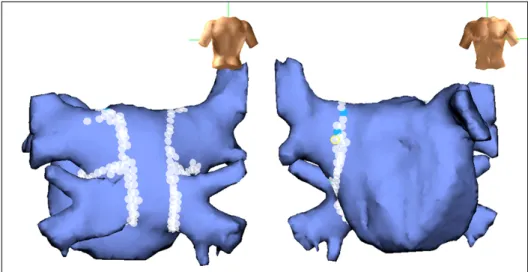
A previously healthy, 46-year-old man with a 2-year his- tory of atrial fibrillation presented with fever, headache, and dizziness. Three weeks earlier, he had undergone cardiac ra- diofrequency catheter ablation for symptomatic atrial fi- brillation refractory to medical management by a cardio- logist. Circumferential ablation of a wide area encircling the four pulmonary vein antra was performed point by point (Fig. 1). The energy was delivered under power control with a maximum pre-set power of average 30 to 35 watts using a Lasso catheter (Lasso; Biosense Webster, Diamond Bar, CA, USA). Three days after the ablation, the patient had a single episode of headache and all other symptoms were resolved.

Two weeks later, he developed fever, chills, cough, and headache. Two days after the symptoms started, he visited the emergency room. He was febrile (temperature, 39°C) and

hypotensive (blood pressure, 70/55 mmHg) with an irregular heart rate of 120 beats/min. Atrial fibrillation was confirmed by electrocardiography and then he underwent synchronized direct current cardioversion. Although the rhythm was re- stored by cardioversion, he was noted to be confused, with generalized tonic-clonic seizures. His blood leukocyte count was 16,500 cells/mL, with 87% neutrophilic predominance.

Findings of a chest radiograph were unremarkable, and a transthoracic and transesophageal echocardiogram showed no thrombus or vegetation. Empiric treatment with ceftriaxone was initiated, which resulted in resolution of the fever.

Magnetic resonance imaging of the brain revealed multifocal

infarcts (Fig. 2). Computed tomography of the chest showed

a minute air pocket around the left atrium near the level of

the esophagus, suggesting an atrio-esophageal fistula (AEF)

(Fig. 3). The patient was taken to the operating room to re-

pair the presumed fistula. Through a left posterolateral thor-

(2)

Atrio-Esophageal Fistula after Catheter Ablation

− 143 −

Fig. 1. The circumferential ablation line around the pulmonary veins.

Fig. 2. Axial brain magnetic resonance image shows multiple in- farcts (arrows).

Fig. 3. Axial computed tomography images demonstrating pneumo- mediastinum (arrow).

acotomy, adhesion between the esophagus and pericardium was observed, and a fistula between the left atrium and esophagus was found. The atrial lesion (2 cm) was closed with a bovine pericardial patch under cardiopulmonary by- pass using a femoral artery and vein. The esophageal lesion (3 cm) was closed with simple interrupted sutures using 3-0 vicryl. Sutures were performed separately in two layers. The mucosal layer was sutured first and the muscle layer was reinforced. No buttressed suture was used because of acute inflammatory tissue around the lesion. Two sets of blood

cultures revealed growth of Streptococcus mitis and Strepto-

coccus viridians. He completed a 4-week course of ampi-

cillin/sulbactam and 2-week course of amoxicillin/clavulanate

treatment. Seven days after surgery, he underwent a leak test

with grape juice and showed no leakage and started to drink

water. On the tenth day after surgery, esophagography

showed no leakage. He was discharged without any other

complications except for mild left arm motor weakness. In

follow-up computed tomography (CT) scans after 3 months,

ostium of right inferior pulmonary vein stenosis was

revealed. In addition, esophagogastroscopy after seven

months showed the esophageal defect site to be fully recov-

(3)

Hun Bo Shim, et al

− 144 − Fig. 4. Esophagogastroscopy showed fully recovered esophageal defect site.

ered (Fig. 4).

DISCUSSION

With an increase in cardiac radiofrequency catheter abla- tion for the treatment of refractory atrial fibrillation, there has also been a rise in complications. AEF due to thermal injury during cardiac radiofrequency catheter ablation is a rare complication with an incidence rate of 0.2% [1].

Although our patient survived with just minimal residual neurologic deficits, the mortality rate associated with AEF is very high. Cummings et al. [2] reported a mortality rate of 100% in a study with 9 patients. The overall mortality rate from all reported cases is 67% [3]. However, varying clin- ical presentations make diagnosis of such complications difficult.

Patients present from 3 to 41 days after the procedure with nonspecific symptoms, including fever, leukocytosis, neurologic symptoms, and chest pain [4]. Fever is one of the most common symptoms that occur in patients with AEF. Among those patients with reported symptoms, fever was noted in 75% of the patients with AEF [3]. However, fever is a nonspecific symptom, which can arise from in- flammation after the procedure. Ruby et al. [5] reported that 8% of patients who underwent ablation developed fever

within 24 hours after the procedure. Neurological deficits were presented in 69% of patients with clinical signs reported. Additional symptoms were mental status changes, transient ischemic attacks, stroke syndromes with hemi- paresis, and seizures. Chest pain was also found in 24% of patients [3]. Leukocytosis was revealed in patients with AEF, presumably secondary to severe bacterial sepsis [6].

Bacterial spread to the systemic circulation from the esoph- agus through the AEF can produce bacteremia. Although Streptococcus mitis and Streptococcus viridians were detected in our patient’s blood, the incidence of bacteremia is very low [3]. Endocarditis is rare as well, at only 0.2% at one high-volume center [1]. Transthoracic echocardiography did not provide useful information for the diagnosis of AEF.

Furthermore, a transesophageal echocardiogram has the pos-

sibility of producing air embolism. A chest CT showing

pneumomediastinum or air in the atrium is the most reliable

method for AEF diagnosis. Approximately 90% of the pa-

tients studied with this modality were diagnosed with AEF

[6]. Invasive esophageal procedures, including esophagogas-

troscopy, should be avoided for patients who may have an

AEF due to the risk of air embolization. Among 9 patients

with AEF for whom esophagogastroscopy was performed, 8

experienced immediate deterioration in their clinical status

and eventually died [3]. Electrophysiologists have implemen-

ted strategies to minimize esophageal injuries. Avoidance of

ablation near the esophagus, the titration of radiofrequency

energy delivery at the posterior left atrial endocardium, and

the use of alternative ablation methods are some of the most

well established methods [7]. These methods may be effec-

tive for reducing the occurrence of AEF. However, in this

case, a complication occurred. More indications at more

clinics will increase the possibility that this complication can

occur. Although 40% of patients who underwent surgery

died, spontaneous resolution of a left atrio-esophageal fistula

has not been reported yet. Also, all patients who did not un-

dergo surgery died except for one patient who was success-

fully treated with an esophageal stent [3,8]. Although our

patient had a minor neurologic deficit, early surgical man-

agement saved his life. Therefore, early diagnosis, prompt

surgical treatment, and appropriate antibiotic therapy are

thought to be crucial with regard to the survival rate of

(4)

Atrio-Esophageal Fistula after Catheter Ablation

− 145 − patients.

CONFLICT OF INTEREST

No potential conflict of interest relevant to this article was reported.

REFERENCES

1. Dagres N, Hindricks G, Kottkamp H, et al. Complications of atrial fibrillation ablation in a high-volume center in 1,000 procedures: still cause for concern? J Cardiovasc Electro- physiol 2009;20:1014-9.

2. Cummings JE, Schweikert RA, Saliba WI, et al. Brief com- munication: atrial-esophageal fistulas after radiofrequency ablation. Ann Intern Med 2006;144:572-4.

3. Siegel MO, Parenti DM, Simon GL. Atrial-esophageal fistula after atrial radiofrequency catheter ablation. Clin Infect Dis

2010;51:73-6.

4. Takahashi A, Kuwahara T, Takahashi Y. Complications in the catheter ablation of atrial fibrillation: incidence and management. Circ J 2009;73:221-6.

5. Ruby RS, Wells D, Sankaran S, et al. Prevalence of fever in patients undergoing left atrial ablation of atrial fibrillation guided by barium esophagraphy. J Cardiovasc Electrophysiol 2009;20:883-7.

6. Dagres N, Kottkamp H, Piorkowski C, et al. Rapid detection and successful treatment of esophageal perforation after ra- diofrequency ablation of atrial fibrillation: lessons from five cases. J Cardiovasc Electrophysiol 2006;17:1213-5.

7. Bahnson TD. Strategies to minimize the risk of esophageal injury during catheter ablation for atrial fibrillation. Pacing Clin Electrophysiol 2009;32:248-60.

8. Bunch TJ, Nelson J, Foley T, et al. Temporary esophageal

stenting allows healing of esophageal perforations following

atrial fibrillation ablation procedures. J Cardiovasc Electro-

physiol 2006;17:435-9.

수치

Fig. 2. Axial brain magnetic resonance image shows multiple in- in-farcts (arrows).

참조

관련 문서

Natural history of OA: Progressive cartilage loss, subchondral

Thermal balloon ablation versus endometrial resection for the treatment of abnormal uterine bleeding. Thermal balloon ablation in myoma-induced menorrhagia

The meeting resulted in the training of twenty seven national officials, experts in comprehensive disaster risk management, building resilience, climate

The purpose of this study was to identify the frequency and related factors of advanced airway management for patients with cardiac arrest by the

Result: During the study period, 482 patients had elevated cardiac troponin-T levels. The positive predictive value for the.. The diagnostic importance of

The struggle was successful, and in January 1926 the first of four papers on “Quantization as an Eigenvalue

Garden waste Clear glass Colour glass Metal Tin Non-metal Aluminum cans Other aluminum Hazardous waste Dust/sand Other organic Non-organic

The global rate in non-cigarette smoking shows an increase in recent years, and the smoking inequality phenomenon among non-cigarette smokers can be