• 검색 결과가 없습니다.

Organoleptic Characteristics of Dairy Products Supplemented with Raphanus raphanistrum subsp. sativus (radish) Powder: A Preliminary Study on Efficacy against Diabetes

N/A
N/A
Protected

Academic year: 2021

Share "Organoleptic Characteristics of Dairy Products Supplemented with Raphanus raphanistrum subsp. sativus (radish) Powder: A Preliminary Study on Efficacy against Diabetes"

Copied!
10
0
0

로드 중.... (전체 텍스트 보기)

전체 글

(1)

ARTICLE

Received: September 22, 2019 Revised: September 30, 2019 Accepted: September 30, 2019

These authors contributed equally to this study.

*Corresponding author : Kwang-Young Song

KU Center for Food Safety and Dept. of Public Health, College of Veterinary Medicine, Konkuk University, Seoul, Korea, and Dept. of Biological Engineering, Yanbian University of Science and Technology, Yanji, JL, China.

Tel : +82-2-450-4121 Fax : +82-2-3436-4128 E-mail : [email protected] Copyright © 2019 Korean Society of Milk Science and Biotechnology.

This is an Open Access article distributed under the terms of the Creative Commons Attribution Non-Commercial License (http://

creativecommons.org/licenses/by-nc/3.0) which permits unrestricted non-commercial use, distribution, and reproduction in any medium, provided the original work is properly cited.

ORCID Hyun-Woo Lim

https://orcid.org/0000-0001-6013-8106 Kwang-Young Song

https://orcid.org/0000-0002-5619-8381 Jung-Whan Chon

https://orcid.org/0000-0003-0758-6115 Dongkwan Jeong

https://orcid.org/0000-0002-6305-794X Kun-Ho Seo

https://orcid.org/0000-0001-5720-0538

Organoleptic Characteristics of Dairy Products Supplemented with Raphanus raphanistrum subsp.

sativus (radish) Powder: A Preliminary Study on Efficacy against Diabetes

Hyun-Woo Lim

1†

, Kwang-Young Song

1,2*

, Jung-Whan Chon

1,3

, Dongkwan Jeong

4

, and Kun-Ho Seo

1†

1KU Center for Food Safety and Dept. of Public Health, College of Veterinary Medicine, Konkuk University, Seoul, Korea

2Dept. of Biological Engineering, Yanbian University of Science and Technology, Yanji, JL, China

3College of Veterinary Medicine, Oklahoma State University, Stillwater, OK, USA

4Dept. of Food and Nutrition, Kosin University, Busan, Korea

Abstract

Raphanus raphanistrum

subsp

. sativus

(radish) powder contains several bioactive com- pounds and is widely used in the food industry. In this study, we examined the sensory attributes (taste, color, flavor, texture, and overall acceptability) of commercially available milk, yoghurt, and kefir containing different concentrations of

R. raphanistrum

subsp

. sativus

powder. The organoleptic characteristics of commercially available milk, yoghurt, and kefir was significantly different with respect to taste, flavor, color, texture, and overall acceptability in the treated group (1%, 2%. 3%. and 4%) compared to the control (0%;

p<0.05). In addition, the scores of taste, flavor, color, texture, and overall acceptability decreased in proportion to the increase in amount of radish-powder in commercially available milk, yoghurt, and kefir. When 1%
R. raphanistrum

subsp

. sativus

powder was added to commercially available milk, yoghurt, and kefir, they showed good results in organoleptic characteristics compared to the control group. Therefore, our results could be used as the basis for estimating changes in organoleptic characteristics on supple- mentation of various dairy products with

R. raphanistrum

subsp

. sativus

.

Keywords

Raphanus raphanistrum

subsp.

sativus

(radish), organoleptic characteristics, dairy products, diabetes

Introduction

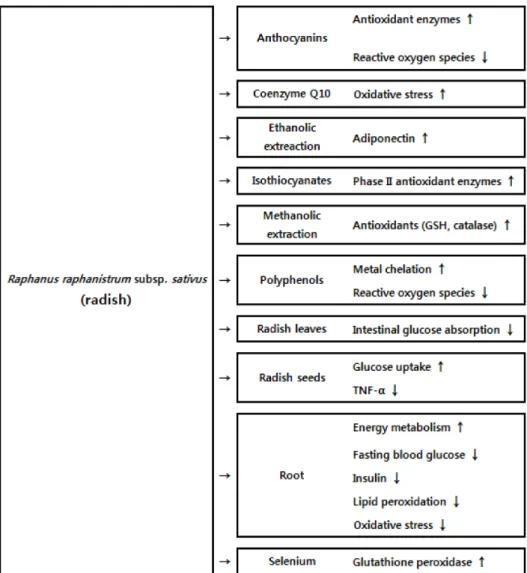
In general, Raphanus raphanistrum subsp. sativus (radish) recognized as the root vegetable was used for the human diet all over the world [1]. Many people would like to eat untreated raw radishes as a crunchy vegetable, and some people of the Middle East tried to drink the juice of Raphanus raphanistrum subsp. sativus (radish) so as to take various health benefits [1] (Fig. 1). The skin color of Raphanus raphanistrum subsp.

sativus (radish) were known to vary widely such as red, purple, black, yellow, and white

through pink, and so on, but the inside color of Raphanus raphanistrum subsp. sativus

(radish) was generally white [1]. Furthermore, the flavor, length and size of Raphanus

raphanistrum subsp. sativus (radish) that could be eaten in each country were reported

to be very diverse [1,2]. As it had been know, Raphanus raphanistrum subsp. sativus

(radish) was typically composed of carbohydrates, dietary fibers, fat, fluoride, minerals

(2)

Fig. 1. Various effects of Raphanus raphanistrum subsp. sativus’s (radish) and its bioactive substances on type 2 diabteic conditions. Adapted from Banihani [1].

(calcium, iron, magnesium, manganese zinc, potassium, phosphorous, etc), protein, sugar, water-soluble vitamins (B

1

, B

2

, B

3

, B

5

, B

6

, B

9

, and C) [3].

Recently, a variety of studies have revealed the efficacy of Raphanus raphanistrum

subsp. sativus (radish) in improving human health. Until now, the major bioactive

substances found in Raphanus raphanistrum subsp. sativus (radish) were (1) glucosinolates

such as glucoerucin, glucoraphanin, glucoraphasatin, glucobrassicin, 4-hydroxygluco-

brassicin, 4-methioxyglucobrassicin and neoglucobrassicin, and (2) isothiocyanates such

as indole-3-carbinol, sulforaphane and sulforaphene [4–6]. Among the various bioactive

substances, isothiocyanates was a particularly important bioactive substance of Raphanus

raphanistrum subsp. sativus (radish) [6]. The isothiocyanates were breakdown products

resulting from the enzymatic hydrolysis of glucosinolates by myrosinase. Since Raphanus

raphanistrum subsp. sativus (radish) had myrosinase, and also the enzymatic activity of

myrosinase was present in the intestinal microflora of the human colon [1,6,7].

(3)

Now, the number of diabetic people was dramatically uprising every year. Hence, the diabetes was recognized as a very difficult problem to solve medically, since it was a serious illness characterized by uncontrolled glucose hemostasis [8]. Furthermore, the diabetes was one of the top leading causes of death in humans [9]. Therefore, lots of researches were concentrated to find out the effective oral remedy and (or) home treatment to handle the diabetes were still direly needed [1]. The WHO-affiliated committee of diabetic experts strongly suggested the need to investigating the antidiabetic substance derived from the origin of plants, although there were unwanted side effects of it which were not fully known scientifically [1,10,11]. Until now, gastrointestinal irritation, nausea, and thyrotropin suppression were known as the adverse effect of synthetic hypoglycemic drugs [10,11].

Consequently, the final goal of this study was to produce market milk, yoghurt and Kefir added with Raphanus raphanistrum subsp. sativus‘s (radish) powder for helping the preventive diabetes and also improving organoleptic characteristics. In this experiment, among various physicochemical characteristics of dairy products, organoleptic characteristics of market milk, yoghurt and Kefir added with Raphanus raphanistrum subsp. sativus‘s (radish) powder were analyzed.

Materials and Methods

1. Raphanus raphanistrum subsp. sativus’ s (radish) powder

The power type of Raphanus raphanistrum subsp. sativus‘s (radish) was produced in Korean and bought form Heungyildang Food of Korea, and also was the food additive grade used in this study.

2. Manufacture of market milk added with Raphanus raphanistrum subsp. sativus’ s (radish) powder

The powder of Raphanus raphanistrum subsp. sativus’s (radish) was added to market milk (Seoul Dairy Co-op, Korea) at concentrations of 0% (control), 1.0%, 2.0%, 3.0%, and 4.0%, respectively, and then mixed thoroughly). Then, the market milk with Raphanus raphanistrum subsp. sativus’s (radish) powder was kept at 4℃.

3. Manufacture of yoghurt added with Raphanus raphanistrum subsp. sativus’ s (radish) powder

According to the instruction given by Kim et al. [12], Raphanus raphanistrum subsp.

sativus‘s (radish) powder was added to yoghurt premix at concentrations of 0% (control),

0.5%, 2.0%, 3.0%, and 4.0%, and then mixed thoroughly. In this study, a ready-mixed

starter culture (Lyofast YAB 450AB, Sacco srl., Codaragok, Italy) consisted of Strepto-

coccus thermophiles, Lactobacillus delbrueckii ssp. bulgaricus, Lactobacillus acidophilus,

and Bifidobacterium animalis ssp. lactis was artificially inoculated and then fermented

at 42℃ for at least 5 hours. The yoghurt was kept at around 4℃ for one day (over 18

hours).

(4)

4. Manufacture of Kefir added with Raphanus raphanistrum subsp. sativus’ s (radish) powder

According to the instruction given by Kim et al. [13], Kefir was manufacture by Kefir grains obtained from KU Center for Food Safety, College of Veterinary Medicine, Konkuk University in Seoul, Korea. Then Kefir samples were added with different concentration of Raphanus raphanistrum subsp. sativus‘s (radish) powder (control as 0%, 1.0%, 2.0%, 3.0%, and 4.0%). The final Kefir products were cooled at 4℃ and then stored in a refrigerator (Fig. 2).

5. Organoleptic characteristics of market milk, yoghurt, and Kefir added with Raphanus raphanistrum subsp. sativus’ s (radish) powder

The organoleptic characteristics were analyzed by 12 trained panelists between 20 and 50 years of age who gave written informed consent after explanation of risk-benefits of participation prior to the study. The samples was randomly served in single-use plastic cups (10 mL) about 10℃, and all evaluators completed a test assessment form to compare five different organoleptic characteristics such as taste, flavor, color, texture and overall acceptability with the five-point hedonic scale (5 as excellent; 4 as good;

3 as fair; 2 as poor; and 1 as extremely poor).

6. Analysis of statistics

All data were showed as means±SD which were performed by two separate experiments with duplicate assays in this study, and statistical significance was considered at p<0.05 using GraphPad Prism 5.0 (GraphPad Softward Inc., San Diegeo, CA, USA).

Results and Discussion

1. Oganoleptic characteristics of market milk added with Raphanus raphanistrum subsp. sativus’ s (radish) powder

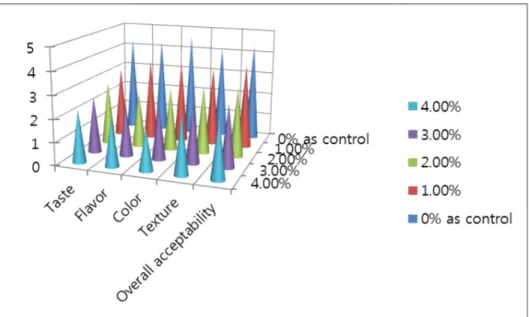
The market milk was prepared with addition of Raphanus raphanistrum subsp. sativus’s (radish) powder at concentrations of 0% (as control), 1.0%, 2.0%, 3.0%, and 4.0%, respectively, and the results were summarized in Fig. 3.

The scores of taste in market milk with Raphanus raphanistrum subsp. sativus’s (radish)

powder (control as 0%, 1.0%, 2.0%, 3.0%, and 4.0%) showed 4.33, 3.33, 2.5, 2.33, and

2.16, respectively. The scores of color in market milk with Raphanus raphanistrum

subsp. sativus’s (radish) powder (control as 0%, 1.0%, 2.0%, 3.0%, and 4.0%) showed 4.33,

3.0, 2.83, 2.33, and 2.0, respectively. The scores of flavor in market milk with Raphanus

raphanistrum subsp. sativus’s (radish) powder (control as 0%, 1.0%, 2.0%, 3.0%, and

4.0%) showed 4.33, 3.83, 3.0, 2.5, and 1.83, respectively. The scores of texture in market

milk with Raphanus raphanistrum subsp. sativus’s (radish) powder (control as 0%, 1.0%,

2.0%, 3.0%, and 4.0%) showed 4.33, 4.33, 4.0, 3.66, and 3.33, respectively. And the

scores of overall acceptability in market milk with Raphanus raphanistrum subsp.

(5)

Fig. 2. Manufacture of Kefir added with Raphanus raphanistrum subsp. sativus’s (radish) powder (control as 0%, 1.0%, 2.0%, 3.0%, and 4.0%).

Fig. 3. Comparison of organoleptic characteristics of market milk added with Raphanus raphanistrum subsp. sativus’s (radish) powder (control as 0%, 1.0%, 2.0%, 3.0%, and 4.0%).

sativus’s (radish) powder (control as 0%, 1.0%, 2.0%, 3.0%, and 4.0%) showed 4.33, 3.5, 3.25, 2.54, and 2.37, respectively.

According to statistical analysis of the organoleptic characteristics in market milk, there

was statistical difference in taste, flavor, color, texture and overall acceptability between

treated group and control group (p<0.05). Consequently, the scores of taste, flavor,

texture and overall acceptability were lower in Raphanus raphanistrum subsp. sativus’s

(radish) powder-containing market milk with 1.0%, 2.0%, 3.0%, and 4.0% than with the

control group (0%).

(6)

2. Organoleptic characteristics of yoghurt added with Raphanus raphanistrum subsp.

sativus’ s (radish) powder

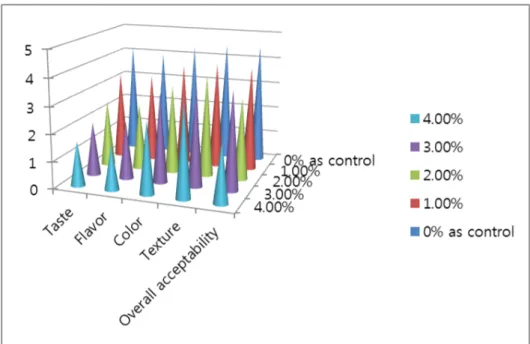
The yoghurt was prepared with Raphanus raphanistrum subsp. sativus‘s (radish) powder at concentrations of 0% (as control), 1.0%, 2.0%, 3.0%, and 4.0%, respectively, and the results were summarized in Fig. 4.

The scores of taste in yoghurt with Raphanus raphanistrum subsp. sativus’s (radish) powder (control as 0%, 1.0%, 2.0%, 3.0%, and 4.0%) showed 4.33, 3.16, 2.83, 2.5, and 2.33, respectively. The scores of color in yoghurt with Raphanus raphanistrum subsp.

sativus’s (radish) powder (control as 0%, 1.0%, 2.0%, 3.0%, and 4.0%) showed 4.66, 3.66, 2.83, 2.5, and 1.83, respectively. The scores of flavor in yoghurt with Raphanus raphanistrum subsp. sativus’s (radish) powder (control as 0%, 1.0%, 2.0%, 3.0%, and 4.0%) showed 4.33, 3.66 2.5, 2.33, and 2.16, respectively. The scores of texture in yoghurt with Raphanus raphanistrum subsp. sativus’s (radish) powder (control as 0%, 1.0%, 2.0%, 3.0%, and 4.0%) showed 4.16, 3.5, 3.0, 2.66, and 2.5, respectively. And the scores of overall acceptability scores in yoghurt with Raphanus raphanistrum subsp.

sativus’s (radish) powder (control as 0%, 1.0%, 2.0%, 3.0%, and 4.0%) showed 4.41, 3.75, 3.08, 2.75, and 2.62, respectively. Consequently, among the treated group compared with the control group (0%), the scores of taste, flavor, texture and overall acceptability were the same or lower in Raphanus raphanistrum subsp. sativus’s (radish) powder- containing yoghurt with 1.0%, 2.0%, 3.0%, and 4.0%.

According to statistical analysis of the organoleptic characteristics in yoghurt, there was statistical difference in taste, flavor, color, texture and overall acceptability between treated group and control group (p<0.05). To summarize the results of this study, the scores of taste, flavor, color, texture and overall acceptability decreased in proportion to the added amount of Raphanus raphanistrum subsp. sativus’s (radish) powder.

Fig. 4. Comparison of the organoleptic characteristics of yoghurt added with Raphanus raphanistrum

subsp. sativus’s (radish) powder (control as 0%, 1.0%, 2.0%, 3.0%, and 4.0%).

(7)

3. Organoleptic characteristics of Kefir added with Raphanus raphanistrum subsp.

sativus’ s (radish) powder

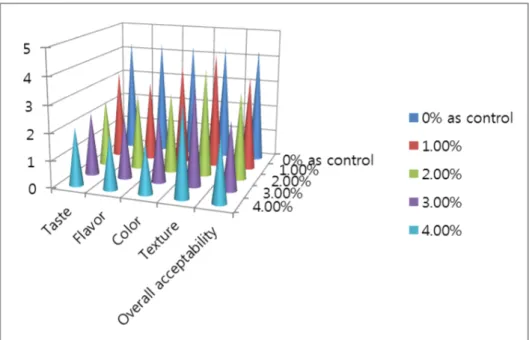
Kefir was prepared with Raphanus raphanistrum subsp. sativus’s (radish) powder at concentrations of 0% (as control), 1.0%, 2.0%, 3.0%, and 4.0%, respectively, and the results were summarized in Fig. 5.

The scores of taste in Kefir with Raphanus raphanistrum subsp. sativus’s (radish) powder (control as 0%, 1.0%, 2.0%, 3.0%, and 4.0%) showed 4.16, 3.33, 2.5, 2.0, and 1.66, respectively. The scores of color in Kefir with Raphanus raphanistrum subsp. sativus’s (radish) powder (control as 0%, 1.0%, 2.0%, 3.0%, and 4.0%) showed 4.33, 3.83, 3.33, 3.33, and 2.66, respectively. The scores of flavor in Kefir with Raphanus raphanistrum subsp. sativus’s (radish) powder (control as 0%, 1.0%, 2.0%, 3.0%, and 4.0%) showed 4.0, 3.33 2.5, 2.16, and 1.66, respectively. The scores of texture in Kefir with Raphanus raphanistrum subsp. sativus’s (radish) powder (control as 0%, 1.0%, 2.0%, 3.0%, and 4.0%) showed 4.5, 4.0, 3.83, 3.66, and 3.5, respectively. And the scores of overall acceptability scores in Kefir with Raphanus raphanistrum subsp. sativus’s (radish) powder (control as 0%, 1.0%, 2.0%, 3.0%, and 4.0%) showed 4.5, 3.91, 3.66, 3.08, and 2.2, respectively.

According to statistical analysis of the organoleptic characteristics in Kefir, there was not any statistical difference in color and flavor, but in taste, texture and overall acceptability between control group and treated group (p<0.05). Subsequently, among the treated group compared with the control group (0%), the scores of taste, flavor, color texture and overall acceptability were lower in Raphanus raphanistrum subsp. sativus’s (radish) powder-containing Kefir with 1.0%, 2.0%, 3.0%, and 4.0%.

Furthermore, Fig. 6 showed the color changes of market milk-, yoghurt-, and Kefir-

Fig. 5. Comparison of the organoleptic characteristics of Kefir added with Raphanus raphanistrum

subsp. sativus’s (radish) powder (control as 0%, 1.0%, 2.0%, 3.0%, and 4.0%).

(8)

Fig. 6. The change in the color of market milk, yoghurt and Kefir by the addition of Raphanus

raphanistrum subsp. sativus’s (radish) powder as 0% (control), 1.0%, 2.0%, 3.0%, and 4.0%.

added with Raphanus raphanistrum subsp. sativus’s (radish) powder with 0% (control), 1.0%, 2.0%, 3.0%, and 4.0%. Although Raphanus raphanistrum subsp. sativus (radish) may be effective in diabetes from previous studies, many future studies will have to be conducted to improve human health and also visual improvements in dairy products when it becomes food additives.

Up to now, almost all researches published with direct links between Raphanus

raphanistrum subsp. sativus (radish) and diabetes have been conducted in a nonclinical

state through in vivo and in vitro [1]. According to Banihani [1], the main studies were

done on Raphanus raphanistrum subsp. sativus (radish) and its extracts to have the

effect on various diabetic parameters. Also all the studies were able to confirm the

presence of the hypoglycemic effect of Raphanus raphanistrum subsp. sativus (radish)

[1]. The water-soluble Raphanus raphanistrum subsp. sativus (radish) extract showed an

advantage in the hypoglycemic response over the fat-soluble extract, but the fat-soluble

extract was found to play a role in lipid metabolism [14]. It was suggested that the

water-soluble extract contains insulin-like components such as polyphenolic substances

or glucosidase-inhibiting components [1,14,15]. Aly et al. reported that the histo-

pathological examination of the pancreas had significant changes in the streptozotocin-

induced diabetic rats fed with Raphanus raphanistrum subsp. sativus (radish) of

Egyptian at 10% for 6 weeks [16]. Tiwari et al. suggested that Raphanus raphanistrum

subsp. sativus (radish) would have a potent antidiabetic activity, since Raphanus

raphanistrum subsp. sativus (radish) could significantly reduce the starch induced-

postprandial glycemic load [17]. In other words, these proofs could prove that Raphanus

raphanistrum subsp. sativus (radish) and its extracts were very effective for diabetes and

diabetic conditions. Also according to Baenas et al. [6], the level of blood glucose could

be lower by about 33.4% after the diabetic rats fed with lyophilized Raphanus

(9)

raphanistrum subsp. sativus (radish) root-juice at 300 mg/kg of body weight and then fasted for 6 hours. Namely, the dose like this had therapeutic effect was equivalent to about 48.39 mg/kg of body weight in human [18]. Therefore, the effective therapeutic dosage was about 2903 mg of lyophilized Raphanus raphanistrum subsp. sativus (radish) root-juice in human (a man or woman) weighing 60 kg, and this amount was equal to about 0.726 kg extracted from Raphanus raphanistrum subsp. sativus (radish) [1,2].

In conclusion, Raphanus raphanistrum subsp. sativus (radish) could have the anti- diabetic activity due to various factors such as (1) the enhancement of the antioxidant defense mechanism, (2) the decrease of oxidative stress and lipid peroxidation, (3) improvement of hormonal-induced glucose hemostasis, (4) the promotion of glucose uptake and energy metabolism, (5) the reduction of glucose absorption in the intestine, and so on [1,2,6,14–16].

Therefore, future studies will need to keep the high quality of organoleptic charac- teristics of food including dairy products added with Raphanus raphanistrum subsp.

Sativus’s (radish) powder and its extracts and to prevent diabetes.

Conflict of Interest

The authors declare no potential conflict of interest.

Acknowledgement

This research was supported by Basic Science Research Program through the National Research Foundation of Korea (NRF) funded by the Ministry of Education (NRF- 2017R1D1A1B03035427).

References

1. Banihani SA. Radish (Raphanus sativus) and diabetes. Nutrients 2017;9:E1014.

2. Shukla S, Chatterji S, Mehta S, Rai PK, Singh RK, Yadav DK, et al. Antidiabetic effect of Raphanus sativus root juice. Pharm Biol. 2011;49:32-37.

3. Khattak KF. Nutrient composition, phenolic content and free radical scavenging activity of some uncommon vegetables of Pakistan. Pak J Pharm Sci. 2011;24:

277-283.

4. Malik MS, Riley MB, Norsworthy JK, Bridges W Jr. Variation of glucosinolates in wild radish (Raphanus raphanistrum) accessions. J Agric Food Chem. 2010;58:11626- 11632.

5. Ishida M, Kakizaki T, Morimitsu Y, Ohara T, Hatakeyama K, Yoshiaki H, et al. Novel glucosinolate composition lacking 4-methylthio-3-butenyl glucosinolate in Japanese white radish (Raphanus sativus L.). Theor Appl Genet. 2015;128:2037-2046.

6. Baenas N, Piegholdt S, Schloesser A, Moreno DA, Garcia-Viguera C, Rimbach G, et

al. Metabolic activity of radish sprouts derived isothiocyanates in Drosophila

melanogaster. Int J Mol Sci. 2016;17:251.

(10)

7. Kim JW, Kim MB, Lim SB. Formation and stabilization of raphasatin and sulforaphene from radish roots by endogenous enzymolysis. Prev Nutr Food Sci. 2015;20:119-125.

8. Banihani SA, Makahleh SM, El-Akawi Z, Al-Fashtaki RA, Khabour OF, Gharibeh MY, et al. Fresh pomegranate juice ameliorates insulin resistance, enhances β-cell function, and decreases fasting serum glucose in type 2 diabetic patients. Nutr Res.

2014;34:862-867.

9. Dal-Re R. Worldwide clinical interventional studies on leading causes of death: a descriptive analysis. Ann Epidemiol. 2011;21:727-731.

10. Vidon N, Chaussade S, Noel M, Franchisseur C, Huchet B, Bernier JJ. Metformin in the digestive tract. Diabetes Res Clin Pract. 1988;4:223-229.

11. Vigersky RA, Filmore-Nassar A, Glass AR. Thyrotropin suppression by metformin. J Clin Endocrinol Metab. 2006;91:225-227.

12. Kim HS, Kim YJ, Chon JW, Kim DH, Song KY, Kim H, et al. Organoleptic evaluation of the high-potein yoghurt containing the edible insect Oxya chinensis sinuosa (Grasshopper): a preliminary study. J Milk Sci Biotechnol. 2017;35:266-269.

13. Kim YJ, Chon JW, Song KY, Kim DH, Kim H, Seo KH. 2017. Sensory profiles of protein-fortified Kefir prepared using edible insects (silkworm pupae, Bombyx mori): a preliminary study. J Milk Sci Biotechnol. 2017;35:262-265.

14. Taniguchi H, Muroi R, Kobayashi-Hattori K, Uda Y, Oishi Y, Takita T. 2007.

Differing effects of water-soluble and fat-soluble extracts from Japanese radish (Raphanus sativus) sprouts on carbohydrate and lipid metabolism in normal and streptozotocin-induced diabetic rats. J Nutr Sci Vitaminol. 2007;53:261-266.

15. Broadhurst CL, Polansky MM, Anderson RA. 2000. Insulin-like biological activity of culinary and medicinal plant aqueous extracts in vitro. J Agric Food Chem.

2000;48:849-852.

16. Aly TAA, Fayed SA, Ahmed AM, Rahim EAE. 2015. Effect of Egyptian radish and clover sprouts on blood sugar and lipid metabolisms in diabetic rats. Glob J Biotechnol Biochem. 2015;10:16-21.

17. Tiwari AK. Revisiting “vegetables” to combat modern epidemic of imbalanced glucose homeostasis. Pharmacogn Mag. 2014;10:S207-S213.

18. Reagan-Shaw S, Nihal M, Ahmad N. Dose translation from animal to human studies

revisited. FASEB J. 2008;22:659-661.

수치

Fig.  1.  Various  effects  of  Raphanus  raphanistrum  subsp.  sativus’s  (radish)  and  its  bioactive  substances  on  type  2  diabteic  conditions
Fig.  3.  Comparison  of  organoleptic  characteristics  of  market  milk  added  with  Raphanus  raphanistrum  subsp
Fig.  4.  Comparison  of  the  organoleptic  characteristics  of  yoghurt  added  with  Raphanus  raphanistrum  subsp
Fig.  5.  Comparison  of  the  organoleptic  characteristics  of  Kefir  added  with  Raphanus  raphanistrum  subsp
+2

참조

관련 문서