ARTICLE
Received: June 10, 2019 Revised: June 18, 2019 Accepted: June 19, 2019
†These authors contributed equally to this study.
*Corresponding author : Kwang-Young Song
Center for KU Food Safety, College of Veterinary Medicine, Konkuk University, Seoul, Korea, and Dept. of Biological Engineering, Yanbian University of Science & Technology, Yanji, China.
Tel : +82-2-450-4121 Fax : +82-2-3436-4128 E-mail : [email protected] Copyright © 2019 Korean Society of Milk Science and Biotechnology.
This is an Open Access article distributed under the terms of the Creative Commons Attribution Non-Commercial License (http://
creativecommons.org/licenses/by-nc/3.0) which permits unrestricted non-commercial use, distribution, and reproduction in any medium, provided the original work is properly cited.
ORCID Se-Hyung Kim
https://orcid.org/0000-0003-4747-7394 Jung-Whan Chon
https://orcid.org/0000-0003-0758-6115 Kwang-Young Song
https://orcid.org/0000-0002-5619-8381 Dongkwan Jeong
https://orcid.org/0000-0002-6305-794X Kun-Ho Seo
https://orcid.org/0000-0001-5720-0538
Sensory Attributes of Market Milk, Yogurt, and Kefir Supplemented with Various Concentrations of Aronia melanocarpa (black chokeberry) Powder: A Preliminary Study
Se-Hyung Kim
1†, Jung-Whan Chon
1,2, Kwang-Young Song
1,3*, Dongkwan Jeong
4, and Kun-Ho Seo
1†1Center for KU Food Safety and Department of Public Health, College of Veterinary Medicine, Konkuk University, Seoul, Korea
2College of Veterinary Medicine, Oklahoma State University, Stillwater, OK, USA
3Dept. of Biological Engineering, Yanbian University of Science and Technology, Yanji, China
4Dept. of Food and Nutrition, Kosin University, Busan, Korea
Abstract
Aronia melanocarpa (black chokeberry) powder containing various bioactive compounds is widely used in the food industry. We examined the sensory attributes (taste, color, flavor, texture, and overall acceptability) of market milk, yogurt, and Kefir containing different concentrations of Aronia melanocarpa powder. In market milk, the scores of all categories except color were the same or lower in market milk containing 0.5%, 1.0%, 1.5%, or 2%
Aronia melanocarpa powder than the control group (0%). No statistical difference in color and flavor was observed between Kefir and yogurt. However, there was a statistical difference between the control and treated groups in taste, texture and, overall accep- tability (p<0.05). As the content of Aronia melanocarpa powder increased, color, flavor, taste, and overall acceptability scores generally decreased. Yogurt and Kefir, with the addition of 1% Aronia melanocarpa powder, displayed the highest scores.
Keywords
Aronia melanocarpa (black chokeberry), sensory attributes, market milk, Yogurt, Kefir
Introduction
In general, the category of Aronia was divided by 3 different color such as Aronia arbutifolia (red chokeberry), Aronia prunifolia (purple chokeberry), and Aronia melanocarpa (black chokeberry (Kokotkiewicz et al., 2010; Borowska and Brzoska, 2016; Kim et al., 2018).
Especially Aronia melanocarpa (black chokeberry) was cultivated for medicine use in the former Soviet Union from the middle of the 20th century, hence researchers had a focus on Aronia melanocarpa (black chokeberry) (Borowska et al., 2017; Sic Zlabur et al., 2017;
Kim et al., 2018).
Aronia melanocarpa (black chokeberry) had much amounts of phenolic components than those of the other berries (Chrubasik, et al., 2010; Kim et al., 2018). And the products of Aronia melanocarpa (black chokeberry) were sold the form of powder (Chrubasik, et al., 2010; Kim et al., 2018). Hence, it could be directly applied for adding Aronia melanocarpa (black chokeberry) to dairy products for upgrading nutritional quality and sensory attributes (Nguyen and Hwang, 2016; Jurikova et al., 2017; Kim et al., 2018).
Then, the ultimate goal of this study was to manufacture market milk, Yogurt and Kefir the
bioactive Yogurt added with Aronia melanocarpa (black chokeberry) powder for improving sensory attributes. In this experiment, among various physicochemical characteristics of dairy products, sensory attributes of market milk, Yogurt and Kefir added with Aronia melanocarpa (black chokeberry) powder were analyzed.
Materials and Methods
1. Aronia melanocarpa (black chokeberry) powder
The power type of Aronia melanocarpa (black chokeberry) was produced in Kiantama OY (Finland), and also was the food additive grade used in this study.
2. The preparation of market milk added with Aronia melanocarpa (black chokeberry) powder
The powder of Aronia melanocarpa (black chokeberry) was added to market milk (Seoul Dairy Co-op, Korea) at concentrations of 0% (control), 0.5%, 1.0%, 1.5%, and 2.0%, respectively, and then mixed thoroughly (T 25 digital ULTRA-TURRAX®, IKA-Labortechnik, Germany). Then, the market milk with Aronia melanocarpa (black chokeberry) powder was kept at 4±0.5℃.
3. The preparation of Yogurt added with Aronia melanocarpa (black chokeberry) powder
According to the instruction given by Kim et al. (2017), Aronia melanocarpa (black choke- berry) powder was added to Yogurt premix at concentrations of 0% (control), 0.5%, 1.0%, 1.5%, and 2.0%, and then mixed thoroughly. In this study, a ready-mixed starter culture (Lyofast YAB 450AB, Sacco srl., Codaragok, Italy) consisted of Streptococcus thermophiles, Lactobacillus delbrueckii ssp. bulgaricus, Lactobacillus acidophilus, and Bifidobacterium animalis ssp. lactis was artificially inoculated and then fermented at 42±1℃ for 5 h. The Yogurt was kept at around 4±0.5℃ for 24 h (Fig. 1).
4. The preparation of Kefir added with Aronia melanocarpa (black chokeberry) powder
According to the instruction given by Kim et al. (2017), Kefir was manufacture by Kefir grains obtained from Center for KU Food Safety, College of Veterinary Medicine, Konkuk University in Seoul, Korea. Then Kefir samples were added with different concentration of Aronia melanocarpa (black chokeberry) powder (control as 0%, 0.5%, 1.0%, 1.5%, and 2.0%).
The final Kefir products were cooled at 4℃ and then stored in a refrigerator.
5. The sensory attributes of market milk, Yogurt, and Kefir added with Aronia melanocarpa (black chokeberry) powder
The sensory attributes was analyzed by 15 trained panelists between 20 and 50 years of age who gave written informed consent after explanation of risk-benefits of participation prior to the study. The samples was randomly served in single-use plastic cups (10±1 mL) about
Yogurt premix
Market milk + Skim milk powder (4%) + Pectin (0.2%) + Sugar (1.5%)
↓
Aronia melanocarpa (black chokeberry) powder 0% (as control), 0.5%, 1.0%, 1.5%, and 2.0%,
↓ Homogenization 25℃ for 10 min
↓ Pasteurization 85℃ for 30 min
↓ Cooling
42℃
↓ Lactic acid bacteria
0.002%
↓ Incubation 42℃ for 5 hours
↓ Storage
4℃
Fig. 1. Procedure for the manufacture of Yogurt added with Aronia melanocarpa (black chokeberry) powder (control as 0%, 0.5%, 1.0%, 1.5%, and 2.0%).
8±1℃. All assessors completed a test assessment form to compare the 5 different sensory attributes - (1) taste, (2) color, (3) flavor, (4) texture and (5) overall acceptability - by a 5-point hedonic scale (1 as extremely poor; 2 as poor; 3 as fair; 4 as good; and 5 as excellent).
6. Statistical analysis
Statistical analysis was performed by GraphPad Prism 5.0 (GraphPad Softward Inc., San Diegeo, CA, USA), and statistical significance was considered at p<0.05. In this study, all data were showed as means±standard deviation which were performed by two separate experiments with triplicate assays.
Results and Discussion
1. The sensory attributes of market milk added with Aronia melanocarpa (black chokeberry) powder
The market milk was prepared with addition of Aronia melanocarpa (black chokeberry) powder at concentrations of 0% (as control), 0.5%, 1.0%, 1.5%, and 2.0%, respectively, and
the results were summarized in Fig. 2.
According to statistical analysis of the sensory attributes, there was statistical difference in taste, color, flavor, texture and overall acceptability between treated group and control group (p<0.05).
The scores of taste in market milk with Aronia melanocarpa (black chokeberry) powder (control as 0%, 0.5%, 1.0%, 1.5%, and 2.0%) showed 4.2, 3.3, 2.8, 2.77, and 2.55, respectively.
The scores of color in market milk with Aronia melanocarpa (black chokeberry) powder (control as 0%, 0.5%, 1.0%, 1.5%, and 2.0%) showed 4.2, 2.7, 2.3, 1.7, and 1.6, respectively.
The scores of flavor in market milk with Aronia melanocarpa (black chokeberry) powder (control as 0%, 0.5%, 1.0%, 1.5%, and 2.0%) showed 4.3, 3.6, 3.4, 3.3, and 3.2, respectively.
The scores of texture in market milk with Aronia melanocarpa (black chokeberry) powder (control as 0%, 0.5%, 1.0%, 1.5%, and 2.0%) showed 4.1, 3.0, 2.9, 2.8, and 2.7, respectively.
And the scores of overall acceptability in market milk with Aronia melanocarpa (black chokeberry) powder (control as 0%, 0.5%, 1.0%, 1.5%, and 2.0%) showed 4.23, 3.16, 2.89, 2.66, and 2.53, respectively.
Consequently, among the treated group compared with the control group (0%), the scores of taste, flavor, texture and overall acceptability were the same or lower in Aronia melano- carpa (black chokeberry) powder-containing market milk with 0.5%, 1.0%, 1.5%, and 2%.
2. The sensory attributes of Yogurt added with Aronia melanocarpa (black chokeberry) powder
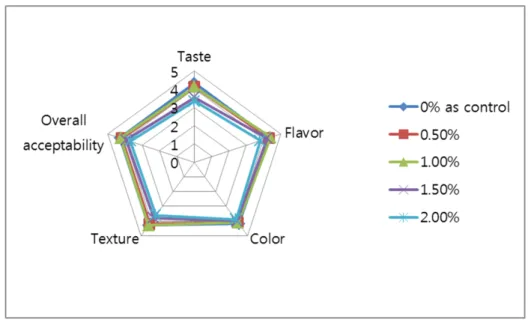
The Yogurt was prepared with Aronia melanocarpa (black chokeberry) powder at concen- trations of 0% (as control), 0.5%, 1.0%, 1.5%, and 2.0%, respectively, and the results were summarized in Fig. 3.
The scores of taste in Yogurt with Aronia melanocarpa (black chokeberry) powder (0.5%,
Fig. 2. Comparison of the sensory attributes of market milk added with Aronia melanocarpa (black chokeberry) powder (control as 0%, 0.5%, 1.0%, 1.5%, and 2.0%).
Fig. 3. Comparison of the sensory attributes of Yogurt added with Aronia melanocarpa (black chokeberry) powder (control as 0%, 0.5%, 1.0%, 1.5%, and 2.0%).
1.0%, 1.5%, and 2.0%) ranged from 4.11 points to 3.33 point, which were lower than those for Yogurt added with Aronia melanocarpa (black chokeberry) powder (control as 0%) (4.33 points). The scores of color in Yogurt with Aronia melanocarpa (black chokeberry) powder (0.5%, 1.0%, 1.5%, and 2.0%) ranged from 4.3 points to 3.8 point, which was comparable to that of Yogurt added with Aronia melanocarpa (black chokeberry) powder (control as 0%) showed 4.3 points. The scores of flavor in Yogurt with Aronia melanocarpa (black choke- berry) powder (0.5%, 1.0%, 1.5%, and 2.0%) ranged from 4.1 points to 3.9 point, whereas that of Yogurt added with Aronia melanocarpa (black chokeberry) powder (control as 0%) showed 4.2 points. The scores of texture in Yogurt with Aronia melanocarpa (black chokeberry) powder (0.5%, 1.0%, 1.5%, and 2.0%) ranged from 4.2 points to 3.6 point, whereas that of Yogurt added with Aronia melanocarpa (black chokeberry) powder (control as 0%) showed 4.3 points. The scores of overall acceptability in Yogurt with Aronia melanocarpa (black chokeberry) powder (0.5%, 1.0%, 1.5%, and 2.0%) ranged from 4.2 points to 3.7 point, whereas that of Yogurt added with Aronia melanocarpa (black chokeberry) powder (control as 0%) showed 4.3 points. Consequently, the sensory attributes decreased with increasing amounts of added Aronia melanocarpa (black chokeberry) powder. Among the treated group, the high scores were received by Aronia melanocarpa (black chokeberry) powder-containing Yogurt with 0.5%, 1.0%, and 1.5% compared with the control group (0%).
To summarize the results of this study, the scores of taste, flavor, color, and overall acceptability decreased in proportion to the added amount of Aronia melanocarpa (black chokeberry) powder.
3. The sensory attributes of Kefir added with Aronia melanocarpa (black chokeberry) powder
Kefir was prepared with Aronia melanocarpa (black chokeberry) powder at concentrations
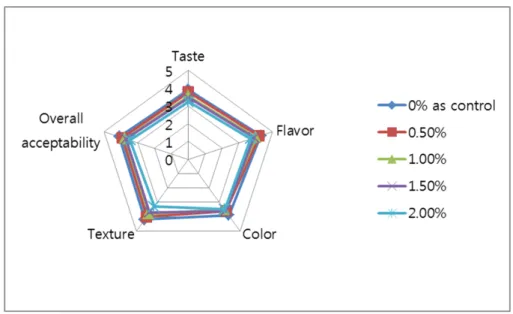
of 0% (as control), 0.5%, 1.0%, 1.5%, and 2.0%, respectively, and the results were summarized in Fig. 4.
According to statistical analysis of the sensory attributes, there was not any statistical difference in color and flavor, but in taste, texture and overall acceptability between control group and treated group (p<0.05).
The scores of taste in Kefir with Aronia melanocarpa (black chokeberry) powder (control as 0%, 0.5%, 1.0%, 1.5%, and 2.0%) showed 3.88, 3.77, 3.55, 3.44, and 3.22, respectively. The scores of color in Kefir with Aronia melanocarpa (black chokeberry) powder (control as 0%, 0.5%, 1.0%, 1.5%, and 2.0%) showed 4.3, 4.2, 4.0, 3.9, and 3.7, respectively. The scores of flavor in Kefir with Aronia melanocarpa (black chokeberry) powder (control as 0%, 0.5%, 1.0%, 1.5%, and 2.0%) showed 3.9, 3.6, 3.5, 3.6, and 3.5, respectively. The scores of texture in Kefir with Aronia melanocarpa (black chokeberry) powder (control as 0%, 0.5%, 1.0%, 1.5%, and 2.0%) showed 4.2, 4.0, 3.8, 3.7, and 3.3, respectively. And the scores of overall acceptability scores in Kefir with Aronia melanocarpa (black chokeberry) powder (control as 0%, 0.5%, 1.0%, 1.5%, and 2.0%) showed 4.1, 3.92, 3.74, 3.69, and 3.45, respectively.
Consequently, among the treated group compared with the control group (0%), the scores of taste, flavor, texture and overall acceptability were the same or lower in Aronia melano- carpa (black chokeberry) powder-containing Kefir with 0.5%, 1.0%, 1.5%, and 2%.
In general, since Aronia melanocarpa (black chokeberry) had a astringent taste in itself, more than 3% Aronia melanocarpa (black chokeberry) juice could not be used for making various dairy products including Yogurt (Nguyen and Hwang, 2016). According to a study by Nguyen and Hwang (2016), they reported that there were not any statistical differences in several sensory attributes between yogurt added with Aronia melanocarpa (black chokeberry) and normal yogurt (control as 0%). the results of this study showed a similar tendency in previous study (Nguyen and Hwang, 2016).
Therefore, future studies will need to find out not only how to maintain a good sensory
Fig. 4. Comparison of the sensory attributes of Kefir added with Aronia melanocarpa (black chokeberry) powder (control as 0%, 0.5%, 1.0%, 1.5%, and 2.0%).
attributes of various dairy products added with Aronia melanocarpa (black chokeberry) powder, but also how to improve human health.
Acknowledgements
This research was supported by Basic Science Research Program through the National Research Foundation of Korea (NRF) funded by the Ministry of Education (NRF-2017R1D1 A1B03035427), and this paper was written as part of Konkuk University’s research support program for its faculty on sabbatical leave in 2018.
References
Borowska, S. and Brzoska, M. M. 2016. Chokeberries (Aronia melanocarpa) and their products as a possible means for the prevention and treatment of noncommunicable diseases and unfavorable health effects due to exposure to xenobiotics. Compr. Rev. Food Sci. Food Saf. 15:982-1017.
Borowska, S., Brzoska, M. M., Galazyn-Sidorczuk, M. and Rogalska, J. 2017. Effect of an extract from Aronia melanocarpa L. berries on the body status of zinc and copper under chronic exposure to cadmium: An in vivo experimental study. Nutrients 9:E1374.
Chrubasik, C., Li, G. and Chrubasik, S. 2010. The clinical effectiveness of chokeberry: A systematic review. Phytother. Res. 24:1107-1114.
Jurikova, T., Mlcek, J., Skrovankova, S., Sumczynski, D., Sochor, J., Hlavacova, I., Snopek, L., and Orsavova, J. 2017. Fruits of black chokeberry Aronia melanocarpa in the prevention of chronic diseases. Molecules 22:E944.
Kim, D. H., Lim, H. W., Kim, S. H., Lee, J. M., Chon, J. W., Song, K. Y., Bae, D., Kim, J., Kim, H. and Seo, K. H. 2018. Antibacterial activity of crude Aronia melanocarpa (black chokeberry) extracts against Bacillus cereus, Staphylococcus aureus, Cronobacter sakazakii, and Salmonella Enteritidis in various dairy foods: Preliminary study. J. Milk Sci.
Biotechnol. 36:155-163.
Kim, H. S., Kim, Y., Chon, J. W., Kim, D. H., Song, K. Y., Kim, H. and Seo, K. H. 2017.
Organoleptic evaluation of the high-protein Yogurt containing the edible insect Oxya chinensis sinuosa (Grasshopper): A preliminary study. J. Milk Sci. Biotechnol. 35:266-269.
Kim, Y., Chon, J. W., Song, K. Y., Kim, D. H., Kim, H. and Seo, K. H. 2017. Sensory profiles of protein-fortified Kefir prepared using edible insects (silkworm pupae, Bombyx mori):
A preliminary study. J. Milk Sci. Biotechnol. 35:262-265.
Kokotkiewicz, A., Jaremicz, Z. and Luczkiewicz, M. 2010. Aronia plants: A review of traditional use, biological activities, and perspectives for modern medicine. J. Med. Food.
13:255-269.
Nguyen, L. and Hwang, E. S. 2016. Quality characteristics and antioxidant activity of yogurt supplemented with aronia (Aronia melanocarpa) juice. Prev. Nutr. Food Sci. 21:330-337.
Sic Zlabur, J., Dobricevic, N., Pliestic, S., Galic, A., Bilic, D. P. and Voca, S. 2017. Antioxidant potential of fruit juice with added chokeberry powder (Aronia melanocarpa). Molecules 22:E2158.