콩과 천마 분말을 첨가한 국수의 품질특성
권용환1․박은숙1․김종권1․Krishna Hari Dhakal1․정연신2․황영현1*
1경북대학교 식물생명과학부․2경북대학교 농업과학기술연구소
Quality Characteristics of Noodles Added with Soybean and Gastrodine Rhisoma Powder
Kwon Young Hwan1, Eun-Suk Park1, Jong-Kwon Kim1, Krishna Hari Dhakal1, Yeon-Shin Jeong2 and Young-Hyun Hwang1*
1
Division of Plant Biosciences, Kyungpook National University, Daegu 702-701, Korea
2
Institute of Agricultural Science and Technology, Kyungpook National University, Daegu 702-701, Korea
Abstract
To develop the functional noodles, powders of soybean and Gastrodine rhisoma were mixed with wheat powder.
When 0-5% of soybean powder was mixed with wheat one, the characteristics of noodles was changed as follows;
Along with the increasing of mixed soybean powder, L(brightness) and a(redness) value was decreased. Hardness showed increasement in all noodles added with soybean powder but, on the contrary, Cohesiveness was decreased.
The content of isoflavones in noodles was increased along with the increament of mixing ratio of soybean powder.
Sensory evaluation showed that the noodles with 5% of sobyean powder was significanly higher than those of no-soybean powder. At the same time, the characteristics of noodles added with Gastrodine rhisoma was evaluated.
The results were as follows; As in soybean powder, L(brightness) and a(redness) value was decreased along with the increasing of mixed Gastrodine rhisoma. Compared with no-powder, hardness and Chewiness was significantly increased in 0.5% and 1.0% in soybean powder, and 0.5% in Gastrodine rhisoma one, respectively.
Sensory evaluation showed that the noodles with 1.0% of Gastrodine rhisoma powder was significanly higher than those of no-soybean powder. Considering together with sensory evaluation and economic aspect, noodles with 5% of soybean powder and 0.5% of Gastrodine rhisoma to be the best ones.
Key words:Gastrodine Rhisoma, Soybean, Functional noodle, Isoflavone 서 론
1)
콩[Glycine max (L.) Merr.]은 한반도를 포함하는
*Corresponding author. E-mail : [email protected], Phone : 82-53-950-5712, Fax : 82-53-950-6880
(Received October 12. 2010; Examined November 11, 2010;
Accepted November 22, 2010)
만주지방이 원산지로 우리나라에서는 오래 전부터 이용되어 온 주요 식량자원의 하나로서 곡류를 주식 으로 하는 우리나라 사람들에게 양질의 단백질과 지 방질을 공급하는데 중요한 역할을 해 왔으며, 콩의 isoflavone, oligosaccharides, phytate, saponin, pinitol 등 기능성 성분이 암, 비만 등의 각종 생활습관성 질환
에 대한 예방효과가 밝혀지면서 중요한 기능성 식품 의 하나로 알려지고 있다(Hong et al., 2003).
천마(Gastrodia elata Blume)는 주로 참나무류 등 활엽수의 썩은 그루터기주변에서 목질부에 기생하고 있는 뽕나무 버섯균과 편리공생하는 난과 식물에 속 하는 다년생 초본으로 잎이 없으며 땅속의 괴경이 한약 재료로 이용되며, 한국, 중국, 일본 등 동북아 일대 고산지대에 자생되는데, 고등식물이면서도 엽 록소가 없는 단자엽 식물로서 한방에서 뇌신경계통의 치료제로 사용하여 온 약제이다(Kwon et al., 2005).
주로 고혈압, 두통, 마비, 신경성 질환, 당뇨병 등의 심각한 성인병뿐만 아니라 스트레스, 피로 등의 증상 에 대하여 효능이 있는 것으로 알려져 있는 천마는 다양한 약리성분을 함유하고 있어 강장, 고혈압, 당뇨, 두통 및 신경쇠약에 효능이 있을 뿐 아니라 항혈전작 용 및 혈소판작용, 항산화작용, 암세포 생육 저해효능, 항경련작용 및 신경전달 조절적용이 밝혀지고 있다 (Kwon et al., 2005). 천마에 대한 연구는 약리성분에 대한 연구뿐만 아니라 재배방법(Kwon et al., 2005), 천마 종자의 발아조건(Hong et al., 2004), 건조방법에 따른 특성(Lee et al., 2002a)과 건조방법에 따른 향기 패턴(Lee et al., 2002b), 천마분말을 이용한 스펀지 케이크의 제조(Kang, 2007) 등 다양한 분야에서 이루 어지고 있다.
국수는 밀가루를 주원료로 하여 소금과 물을 넣어 반죽한 후에 면대를 만들고 가늘고 길게 성형한 후에 일정한 크기로 잘라 만든 식품으로 우리나라의 식생 활에서 중요한 위치를 차지하고 있으며, 식품의 편의 화 추세에 따라 밀 가공식품의 수요량이 급속하게 증가하고 있다. 국내 면류 시장은 냉장 유통 시스템이 보편화되고 건조 등 열을 이용한 조작에 의한 영양 성분, 맛, 조직감 등의 변화를 최소화하며 조리시간을 단축할 수 있는 편의성을 제공하는 장점 때문에 국수 제품에 대한 관심이 고조 되고 있다(Park and Cho, 2004). 최근 소비자들의 건강에 대한 관심의 증가로 건강지향적인 식품을 선호함에 따라 밀가루에 부족한 영양성분을 강화하고 기능성을 첨가하기 위하여 지역 특산물을 첨가한 국수들이 제조되어 지역 축제나 지 역 음식점에서 향토음식으로 판매되고 있는데(Kim
et al., 2005), 이는 제조 방법이 간단하고 소규모의 시설을 갖추어도 제조가 가능하므로 지역민들이 손쉽 게 제조하여 지역 음식으로 판매가 가능한 품목 중 하나이기 때문이다(Kim et al., 2007).
이에 본 연구에서는 지역 특산물을 이용한 기능성 식품으로서 새로운 국수 제품의 개발을 위해 경북지 역에서 많이 재배되고 있는 천마와 콩 분말을 첨가하 여 국수를 제조한 후, 품질 특성을 분석함으로써 제품 개발 및 생산을 위한 기초자료를 얻고자 하였다.
재료 및 방법 가. 실험 재료
콩 분말은 경북대학교 농업생명대학 식물유전학연 구실에서 육성하여 기능성 성분인 isoflavone 함량이 높은 아가콩을 사용하였으며, 콩을 분쇄 후 121℃에서 15분동안 삶아서 사용하였다. 천마는 상주시 골티농 원에서 제공받아서 사용하였다. 밀가루는 시판하는 1등급 중력분(CJ 백설밀가루)를 구입하여 사용하였 고, 소금은 순도 100%의 정제염(샘표, 신안바다 꽃소 금)을 사용하였다.
나. 국수의 제조
아가콩-천마 국수의 적절한 배합비를 얻기 위해 아 가콩 국수, 천마국수를 제조하여 적절한 배합비를 찾 아 최종적으로 아가콩-천마국수를 제조하였다. 이 때 아가콩 분말은 1, 3, 5, 7%, 천마분말은 0.5, 1, 1.5, 2%로 첨가량을 결정하였다(Table 1). 국수 제조 시
Table 1. Mixing ratios of wheat, soybean, and Gastrdine rhisoma powder.
Noodle materials Control Mixing ratio
T1 T2 T3 T4
Wheat powder(g) 100 98.5 96 93.5 91
Soybean powder (g)/
Gastrodine rhisoma(g) 0 1/0.5 3/1 5/1.5 7/2
Water (ml) 45 45 45 45 45
Salt (g) 3 3 3 3 3
밀가루의 양은 아가콩 분말과 천마분말의 첨가비율에 따라 조정하였다. 물은 45g, 소금은 3g 씩 첨가하여 반죽하였다. 반죽 후 냉장실에서 3시간 정도 숙성 후 가정용 국수 제조기(Korea, 벧엘자동국수기 BE-9500) 를 이용하여 폭 2mm로 절단하여 시료로 이용하였다.
다. 국수의 색도측정
국수의 색도는 색차계(Minolta, CR-200, Tokyo, Japan)로 측정하여 밝기(L, lightness), 적색도(a, redness), 황색도(b, yellowness) 값을 5회 측정하여 평 균값으로 나타내었다.
라. 국수의 조직감 측정
건면 10g을 끓는물에서 3분동안 삶은 후 건져서 냉수에 1분동안 식힌 후 2분간 방치한다. 그 후 Rheometer(Sun compack 100, Japan)를 사용하여 조직 감을 측정하였다. 조직감은 경도(hardness), 응집성 (cohesiveness), 탄력성(springness), 씹힘성(chewiness), 검섬(gumminess)을 8회 반복측정하여 평균값으로 나 타내었다. 기기의 측정조건은 표 2에 나타내었다.
Table 2. Condition of Rheometer.
Parameters Condition
Test type Mastication test
Sample height(mm) 4.00
Sample width(mm) 2.00
Sample depth(mm) 40.00
Plunger diameter(mm) 25.00
Load cell(kg) 2.00
Table speed(mm/min) 60.00
Deformation(%) 50.00
마. 국수의 이소플라본 분석
아가콩이 첨가된 아가콩국수와 아가콩-천마국수의 isoflavone 함량 분석은 건조된 시료를 200 mesh로 분쇄한 다음 0.2g 을 80% ethanol 10ml과 test-tube에 넣어 뚜껑을 막고, 50℃ 초음파 세정기에서 1시간동안 추출한 다음 shaking incubator에서 50℃, 150rpm에서 15시간 추출 후 0.45㎛ syringe filter로 여과하였다.
얻어진 여과액을 HPLC 분석시료로 사용하였으며,
HPLC 분석은 표 3과 같은 조건에서 실시하였다.
Table 3. Operating condition of HPLC for analysis of isoflavone.
Items Conditions
Instrument Waters 1525 series HPLC / (Symmetry C18 5㎛
4.6*150mm) : WAT045905
Mobile phase A: acetonitrile, B: HPLC water(1% acetic acid), (A: 5%
(1min), 5→35% (50min), 35→5% (5min), 5%(15min) Flow rate 1.0mL/min
Colum temp 30℃
Injection volume 10㎕
UV detector 254nm (Waters 2487 Dual λ Absorbance Detector)
바. 국수의 조리실험
1) 국수 적정 끓이는 시간
국수면의 중심부의 분상질이 없어질 때까지 끓여서 적정시간을 측정한다.
2) 조리 후 무게 증가량
국수 20g을 250ml의 끓는물에서 적정시간동안 조 리 후 건저내어 일정시간 냉수에 식히고 체 위에서 2분간 방치하여 물기 제거 후 무게를 잰다.
3) 조리 후 부피
국수 20g을 150ml의 증류수가 체워져있는 250ml 용량의 메스실린더에 넣어 증가된 물의 부피를 측정 한다.
4) 국수 삶은 물의 탁도
조리 시 나온 국물을 1시간 동안 상온에서 식힌 후 675nm에서 흡광도를 측정하였다.
사. 관능검사
관능검사 패널을 경북대학교 농업생명과학대학 학 부생 및 대학원생 총 15명을 대상으로 실시하였다.
관능검사용 국수는 국수면 100g을 물 400ml에 적정시 간동안 삶은 후 건저 내어 냉수에 식힌 후 육수에 담아 제공하였다. 관능검사는 외관, 냄새, 맛, 조직감, 전반적인 기호도에 대하여 조사하였고, 7점 평점법을 이용하였다
결과 및 고찰 가. 콩분말을 첨가한 국수의 품질특성
1) 일반성분
아가콩 분말의 일반성분은 조단백 32.7%, 조지방 13.8%, 조섬유 14.5%이다. 그 외 성분은 표 4와 같다.
Table 4. Chemical composition of Agakong.
Components Content (%)
Moisture 4.2
Protein 32.7
Oil 13.8
Ash 4.8
Fiber 14.5
Carbohydrate 30.0
2) 국수의 색도측정
표 5는 아가콩분말을 첨가하여 제조한 국수의 색도 를 측정하여 나타내었다. L값(명도)은 대조군보다 모 든 콩분말 첨가 국수가 낮아지는 결과가 나타났다.
a값(적색도)은 콩분말 첨가량이 증가할수록 적색이 붉어지는 경향을 나타내었다. 이는 볶음콩가루가 붉 은색을 띄어서 이에 영향을 받은 것으로 사료된다.
Table 5. Color of soybean powder added noodle.
Sample L* a* b*
Control 81.2±0.52a -2.9±0.18e 17.4±1.04c 1% soybean powder 79.4±0.39b -1.8±0.21d 17.1±0.69c 3% soybean powder 76.6±0.88c -0.3±0.09c 18.9±0.65ab 5% soybean powder 72.4±0.49d 0.9±0.29b 19.4±0.37a 7% soybean powder 71.9±0.65d 1.6±0.27a 18.0±0.63bc
*L=Lightness, a=redness (+), greenness (-) and b=yellowness
Same letter in each column are not significantly different at 5% level by DMRT
Table 6. Textural properties of soybean powder added noodle.
Sample Hardness (g/cm2) Cohesiveness (%) Springness (%) Chewiness (g) Gummiess (g)
Control 136.3±23.02b 81.9±11.27a 91.5±7.77NS 268.3±70.42NS 294.0±69.63NS
1% soybean powder 150.5±9.53ab 75.2±4.59ab 90.4±5.55 308.2±44.64 341.2±44.29
3% soybean powder 147.2±21.51ab 70.0±11.94bc 90.9±5.84 272.3±46.76 301.1±55.68
5% soybean powder 151.6±18.4ab 77.0±6.59ab 91.8±4.42 301.5±62.03 331.2±82.29
7% soybean powder 156.4±5.93a 63.2±14.27c 87.0±4.09 313.6±46.96 361.0±57.12
Same letter in each column are not significantly different at 5% level by DMRT
NS=not significant
3) 국수의 조직감 측정
표 6은 아가콩 분말을 첨가하여 제조한 국수의 조직 감을 측정하여 나타내었다. 콩분말을 첨가한 국수의 조직감 측정결과 경도(Hardness)는 대조군에 비하여 모든 콩분말을 첨가한 국수가 증가하는 경향을 나타 내어 콩 첨가량이 증가 될수록 증가하하여 Hong 등 (2003)이 대두분말을 첨가한 제면특성의 결과와 비슷 하였다. 응집성(Cohesiveness)은 콩분말이 첨가된 모 든 국수에서 감소하였다. 탄력성(springness), 씹힘성 (Chewiness), 검섬(Gumminess)에서는 유의적 차이가 나타나지 않았다.
4) 국수의 이소플라본 측정
표 7은 아가콩 분말을 첨가한 국수의 이소플라본 함량을 측정하였다. 대조군을 본 실험에서 사용한 아 가콩으로 하였다. 아가콩분말 첨가량이 증가할수록 이소플라본의 함량이 증가하여 매일 한번정도는 국수 를 식사로 하였을 경우 건강을 지키기 위해 필요한 양의 isoflavone을 섭취할 수 있을 것으로 보여진다.
Table 7. Isoflavone content in soybean added noodle.
(ug/g)
Noodles Agakong 1%
soybean noodle
soybean3%
noodle
soybean5%
noodle
soybean7%
noodle Total
isoflavone(ug/g) 10,469.8 414.3 468.4 524.4 602.5
5) 국수의 조리실험
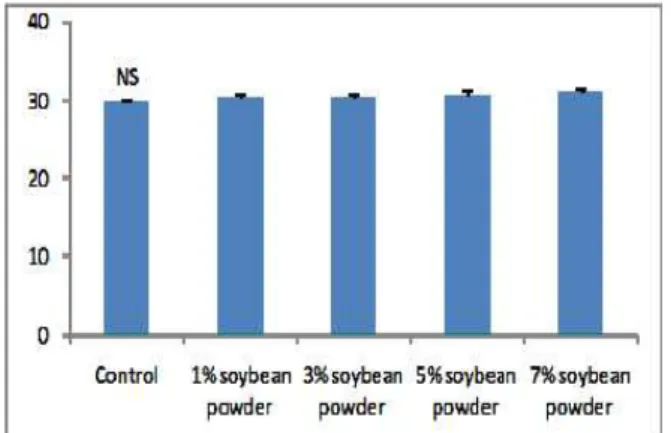
콩분말을 첨가한 국수의 조리 후 무게와 부피의 변화량을 보면 그림 1과 2에서와 같이 군간의 유의적 차이는 나타나지 않았으나 대조군에 비하여 콩분말을
첨가한 국수 모두가 증가하여 Hong 등(2003)이 대두 분말을 첨가하였을 때 흡수력이 증가한다는 결과 일 치하였다.
NS
0 10 20 30 40
Control 1% soybean powder
3% soybean powder
5% soybean powder
7% soybean powder
Fig. 1. Weigh of soybean powder added noodle after cooking. Ns= not significant
NS
0 10 20 30 40
Control 1% soybean powder
3% soybean powder
5% soybean powder
7% soybean powder Fig. 2. Volume of soybean powder added noodle after cooking. Ns= not significant
Table 8. Sensory evaluation of soybean powder added noodle.
Control 1% soybean noodle 3% soybean noodle 5% soybean noodle 7% soybean noodle
Color 5.47±1.19a 3.93±0.96b 4.33±1.23b 4.07±1.44b 3.47±1.51b
Savory aroma 2.80±1.32b 4.13±1.30a 4.53±0.83a 4.93±1.28a 4.73±1.62a
Fishy aroma 2.80±1.57NS 3.33±1.18 2.87±1.13 3.40±1.50 3.27±1.28
Delicate flavor taste 3.13±1.68a 3.93±1.33ab 4.60±0.99b 4.40±1.55b 4.53±1.77b
Wheat powder taste 5.20±1.21a 4.20±0.86b 3.20±0.94bc 3.20±1.43c 3.40±1.45c
Fishy taste 2.33±1.29NS 3.53±1.36 3.33±1.11 3.80±1.57 3.33±1.54
Slightly wet 4.13±1.36NS 3.93±1.03 4.27±0.80 4.07±1.16 3.47±1.25
Adhesiveness 4.13±1.30NS 4.27±0.88 4.07±1.33 4.27±1.03 4.20±1.42
Cohesiveness 4.07±1.10NS 4.53±1.06 4.80±1.04 4.60±0.99 4.27±1.98
Overall acceptability 3.47±0.92b 4.20±0.77ab 4.60±0.99a 4.87±1.60a 3.20±1.97b
Same letter in each column are not significantly different at 5% level by DMRT
Ns=not significant
그림 3에서 보는 바와 같이 콩분말을 첨가한 국수의 수분 함수율은 대조군에 비하여 콩 분말을 첨가한 국수에서 모두 증가하였다. 국수의 수분흡수율은 밀 가루의 단백질함량에 따라 증가한다는 보고가 있는데 (Hong et al., 2003) 콩분말을 첨가함으로써 단백질의 함량이 증가하므로 이러한 결과가 나타난 것으로 사 료된다.
b a a a a
0 50 100 150
Control 1% soybean powder
3% soybean powder
5% soybean powder
7% soybean powder
Fig. 3. Moisture weight of soybean powder added noodle after drying.
Same letter in each column are not significantly different at 5% level by DMRT
6) 국수의 관능평가
아가콩 분말을 첨가한 국수의 관능평가 결과는 표 8에서 보는 바와 같이 색상에서는 대조군의 가장 높은 점수를 받았고, 구수한 냄새는 대조군에 비하여 콩분 말을 첨가한 국수가 유의적으로 높았고 그 중에서 5%콩국수의 점수가 가장 높았다. 구수한 맛은 대조군
에 비하여 콩분말 첨가 국수에서 유의적으로 높은 점수를 받았고 콩분말을 첨가함으로써 밀가루맛이 작아지는 결과가 도출되었다. 이러한 결과를 토대로 전체적인 기호도에 미친 패널들의 평가는 대조군에 비하여 3%, 5%콩국수에서 유의적으로 높았다 이는 콩분말을 첨가하면서 구수한 냄새와 맛은 향상되고, 국수의 기호도를 떨어트릴 수 있는 밀가루 맛은 감소 되면서 콩국수의 전체적인 기호도가 높아진 것으로 생각된다.
나. 천마 분말을 첨가한 국수의 품질특성 1) 일반성분
천마분말의 일반성분은 표 9에서 보는 바와 같이 탄수화물이 80.5%로 대부분을 차지하였고, 조단백, 조섬유가 4.2%, 4.0%로 분석 되었다.
Table 9. Chemical composition of Gastrodine Rhisoma.
Components Content (%)
Moisture 7.8
Protein 4.2
Oil 0.4
Ash 3.2
Fiber 4.0
Carbohydrate 80.5
2) 국수의 색도측정
천마분말을 첨가한 국수의 색도측정 결과를 살펴 보면 표 10에서와 같이 나타내었는데, 콩국수와 같은 경향을 나타내었다. L값(명도)은 대조군보다 천마분 말의 함량이 증가할 수록 낮아지는 결과가 나타났고, a값(적색도)은 천마분말 첨가량이 증가할수록 적색이
Table 11. Textural properties of Gastrodine Rhisoma powder added noodle.
Sample Hardness (g/cm2) Cohesiveness (%) Springness (%) Chewiness (g) Gumminess (g)
Control 134.0±20.86b 81.4±7.16a 94.3±2.62a 266.9±56.78b 283.6±59.54c
0.5% Gastrodine rhisoma powder 161.9±20.46a 72.1±5.90bc 90.9±5.87a 339.0±55.74a 372.9±58.50a 1% Gastrodine rhisoma powder 159.6±18.52a 67.0±7.95c 85.9±7.43b 306.0±53.50ab 348.9±46.95ab 1.5% Gastrodine rhisoma powder 149.1±11.80ab 72.0±7.50bc 89.6±4.65ab 295.4±48.18ab 317.0±35.70bc 2% Gastrodine rhisoma powder 133.1±12.56b 76.6±5.01ab 92.4±4.05a 263.2±32.34b 284.3±28.54c Same letter in each column are not significantly different at 5% level by DMRT
Table 10. Color of Gastrodine Rhisoma powder added noodle.
Sample L* a* b*
Control 80.0±0.53NS -3.0±0.26e 17.2±0.45NS 0.5% Gastrodine rhisoma powder 80.0±0.38 -2.8±0.51de 16.8±0.21 1% Gastrodine rhisoma powder 79.8±0.32 -2.7±0.18cd 17.1±1.02 1.5% Gastrodine rhisoma powder 79.7±0.45 -2.5±0.16b 17.3±1.02 2% Gastrodine rhisoma powder 79.4±0.18 -2.1±0.14a 16.9±0.22
*L=Lightness, a=redness (+), greenness (-) and b=yellowness
Same letter in each column are not significantly different at 5% level by DMRT Ns=not significant
붉어지는 경향을 나타내었으나, b값(황색도)은 유의 적 차이가 나타나지 않았다. 이러한 결과는 마 분말을 첨가한 국수의 품질 특성을 연구한 Ahn과 Yoon(2008) 의 결과와는 비슷한 경향이었으나 Chung과 Kwon (1998)의 결과와는 다소 차이를 나타내었다.
3) 국수의 조직감 측정
천마분말이 첨가된 국수의 조직감 측정결과는 표 11에서 보는 바와 같이 경도는 0.5%, 1%천마국수에서 유의적 차이를 나타내었고, 응집성과 탄력성은 대조 군에 비하여 천마분말 첨가국수가 낮아지는 결과가 도출되었는데, 그 중 응집성은 2%천마국수를 제외한 모든 국수에서 유의적 차이가 나타났고, 탄력성은 1%
천마군에서 유의적인 차이가 나타났다. 씹힘성, 검성 은 대조군에 비하여 천마분말 첨가국수가 높아지는 경향을 보였으며, 씹힘성은 0.5%천마국수에서, 검성 은 0.5%, 1%천마국수에서 유의적 차이를 나타내었다.
이러한 결과는 마 분말을 첨가하여 만든 국수를 연한 Chung과 Kwon(1998) 및 Ahn과 Yoon(2008)의 결과와 같이 마 분말이 첨가 될수록 약한 경도와 탄성으로 부적당한 국수가 제조되기 쉽기 때문에 과량 첨가하 는 것은 적절하지 않다고 판단되었다.
4) 국수의 조리실험
천마분말을 첨가한 국수의 조리 후 무게, 부피 및 수분 흡수의 변화를 살펴보면 그림 4, 5, 6에서와 같이 대조군 에 비하여 유의적인 차이가 나타났다. 이는 콩 분말을 첨가한 실험(그림 1, 2, 3)과 마분말을 첨가한 국수와 동일한 결과를 나타내었다(Ahn and Yoon, 2008).
c c bc ab a
0 10 20 30 40
Control 0.5%
Gastrodine rhisoma powder
1%
Gastrodine rhisoma powder
1.5%
Gastrodine rhisoma powder
2%
Gastrodine rhisoma powder
Fig. 4. Weight of Gastrodine Rhisoma powder added noodle after cooking.
SaSame letter in each column are not significantly different at 5% level by DMRT
c bc abc ab a
0 10 20 30 40
Control 0.5%
Gastrodine rhisoma powder
1%
Gastrodine rhisoma powder
1.5%
Gastrodine rhisoma powder
2%
Gastrodine rhisoma powder
Fig. 5. Volume of Gastrodine Rhisoma powder added noodle after cooking.
Same letter in each column are not significantly different at 5% level by DMRT
Table 12. Sensory evaluation of Gastrodine Rhisoma pow der added noodle.
Control 0.5% Gastrodine rhisoma
powder added to noodle 1% Gastrodine rhisoma
powder added to noodle 1.5% Gastrodine rhisoma
powder added to noodle 2% Gastrodine rhisoma powder added to noodle
Color 5.5±1.30a 5.1±1.22a 5.0±1.25a 4.4±1.55ab 3.8±1.82b
Gastrodine rhisoma's aroma 2.2±1.57b 3.0±1.46ab 3.1±1.50a 4.1±2.00ab 3.2±1.60a
Unpleasent taste 3.8±1.66NS 4.3±0.96 4.1±1.10 4.2±1.42 4.1±1.73
Wheat powder taste 3.6±1.59NS 4.5±1.19 3.9±1.58 4.0±1.68 4.0±1.46
Slightly wet 4.3±1.33NS 4.5±0.74 4.4±1.06 4.4±0.91 4.4±1.06
Adhesiveness 4.1±1.77NS 4.3±0.89 4.7±1.11 4.9±0.83 4.7±1.40
Cohesiveness 4.3±1.29NS 4.4±0.99 4.7±0.96 4.7±1.03 5.1±1.33
Overall acceptability 4.2±0.94b 4.6±1.18ab 5.1±0.96a 4.5±0.99ab 3.8±1.20b
Same letter in each column are not significantly different at 5% level by DMRT Ns=not significant
c bc ab a ab
0 50 100 150 200
Control 0.5%
Gastrodine rhisoma powder
1%
Gastrodine rhisoma powder
1.5%
Gastrodine rhisoma powder
2%
Gastrodine rhisoma powder
Fig. 6. Moisture weight of Gastrodine Rhisoma powder added noodle after drying.
Same letter in each column are not significantly different at 5% level by DMRT
5) 국수의 관능평가
천마분말을 첨가한 국수의 관능평가 결과는 표 12 에서 보는 바와 같이 색상은 대조군에 비하여 2% 천마 국수에서 유의적으로 낮은 점수를 받았고, 전체적은 기호도는 대조군에 비하여 유의적으로 1%천마에서 높게 나타났다. 이는 Ahn 과 Yoon(2008)이 마 분말을 첨가한 국수와 상이한 결과를 나타내었는데, 이는 마 와 천마는 외형적인 특징은 비슷하나 내부의 물리, 화학적 특성은 상이하기 때문인 것으로 보여진다.
다. 콩, 천마 분말을 첨가한 국수의 품질특성
이상의 실험결과를 바탕으로 적정첨가량을 결정하 는데 상업성을 고려해야하므로 소비자의 기호도를 가장 충족시킬 수 있는 관능평가 결과에 중점을 두고 결정하였다. 콩분말 적정 첨가량은 5%로 정했고, 그 다음으로 천마분말 적정 첨가량은 1% 였으나 경제성 을 고려하여 0.5%, 1% 함유량 모두 고려하여 실험
을 진행하였다.
1) 국수의 색도측정
표 13은 아가콩 천마분말 혼합첨가 국수의 색도측 정 결과이다. 아가콩+천마분말 국수는 L값(명도)은 5%콩+1%천마분말국수에서 가장 높았고, a값(적색 도)과 b값(황색도)에서는 5%콩+0.5%천마국수에서 가장 높은 값을 나타내었다.
Table 13. Color of soybean and Gastrodine Rhisoma powder added noodle.
Sample L* a* b*
Control 80.2±0.14a -2.7±0.29c 16.9±0.53b 5% soybean +0.5% Gastrodine rhisoma 70.2±0.70b 1.8±0.27a 18.9±0.40a 5% soybean +1% Gastrodine rhisoma 71.4±0.80b 1.2±0.33b 18.5±0.34a
*L=Lightness, a=redness (+), greenness (-) and b=yellowness
Same letter in each column are not significantly different at 5% level by DMRT
2) 국수의 조직감 측정
콩과 천마분말이 첨가된 국수의 조직감 측정결과 (표 14)에서는 경도와 탄력성에서는 유의적 차이가 나타나지 않았고, 응집성과 씹힘성에서는 대조군과 비교하여 5%콩과 1%천마분말을 첨가한 국수에서 유 의적 차이가 나타났고, 검성에서는 대조군에 비하여 두 첨가국수가 모두 유의적인 차이를 보였다.
Table 14. Textural properties of soybean and Gastrodine Rhisoma powder added noodle.
Sample Hardness
(g/cm2) Cohesiveness
(%) Springness
(%) Chewiness
(g) Gumminess
(g)
Control 165.9±19.24NS 73.0±6.81a 92.2±4.96NS 303.1±52.21b 328.4±49.92b
5%soybean+0.5% Gastrodine rhisoma 181.2±13.82 74.8±3.88a 92.1±3.42 351.2±32.03ab 382.1±39.47a 5%soybean+1%Gastrodine rhisoma 180.6±18.84 62.6±10.01b 87.3±6.79 380.5±74.79a 433.6±62.77a Same letter in each column are not significantly different at 5% level by DMRT
NS= not significant
3) 국수의 이소플라본 측정
표 15는 아가콩과 천마분말을 혼합하여 만든 국수 의 이소플라본 함량 측정이다. 대조군을 본 실험에서 사용한 아가콩으로 하였다. 콩분말은 동일하게 5%를
첨가하고 천마분말의 함량을 0.5%, 1%로 달리했다.
천마분말이 증가한 국수에서 이소플라본의 함량이 높게 측정되어, 콩5%+천마0.5% 국수에서는 527.8ug/g, 콩5%+천마1% 국수는 531.9ug/g로 나타났다.
Table 15. Isoflavone content in different types of noodles.
Noodles Agakong 5% soybean + 0.5%
Gastrodine Rhisoma 5% soybean + 1%
Gastrodine Rhisoma
total(ug/g) 10730.4 527.8 531.9
4) 국수의 조리실험
콩, 천마분말을 첨가한 국수의 조리 후 무게는 유의 적 차이가 없었다(그림 7).
NS
0 10 20 30 40
Control 5% soybean+0.5%
Gastrodine rhisoma powder
5% soybean+1%
Gastrodine rhisoma powder
Fig. 7. Weight of soybean and Gastrodine Rhisoma powder added noodle after cooking.
Ns= not significant
콩, 천마분말을 첨가한 국수의 조리 후 부피는 대조 군에 비하여 5%콩+0.5%천마분말 첨가 국수에서 유 의적으로 증가하였다(그림 8).
콩, 천마분말을 첨가한 국수의 수분 흡수율은 대조
군에 비하여 5%콩+0.5%천마분말 첨가 국수에서 유 의적으로 증가하였다(그림 9).
b
a
b
0 10 20 30 40
Control 5% soybean+0.5%
Gastrodine rhisoma powder
5% soybean+1%
Gastrodine rhisoma powder
Fig. 8. Volume of soybean and Gastrodine Rhisoma powder added noodle after cooking.
Same letter in each column are not significantly different at 5% level by DMRT
b
a b
0 50 100 150 200
Control 5% soybean+0.5%
Gastrodine rhisoma powder
5% soybean+1%
Gastrodine rhisoma powder
Fig. 9. Moisture weight of soybean and Gastrodine Rhisoma powder added noodle after drying.
Same letter in each column are not significantly different at 5% level by DMRT
콩과 천마 분말의 첨가로 무게와 부피증가율이 높 아진 것은 제품 생산 업체로서는 수율이 높아져 바람 직한 현상으로 여겨지며, 또 상대적으로 조리하는 시 간과 섭취 후 소화 시간을 단축할 수 있는 장점이 있으나 제품의 관능적인 특성이 소비자에게 선호되어 야 할 것으로 보여진다.
5) 국수의 관능평가
아가콩, 천마분말을 첨가한 국수의 관능평가 결과 는 그림 10과 같다. 콩, 천마 분말을 첨가한 국수에서 모두 구수한 냄새와 맛이 높아졌고, 이러한 영향을 국수 밀가루 자체의 맛이 낮아지는 결과가 도출되었
다. 전체적인 기호도는 5%콩+0/5%천마분말 국수에 서 가장 높은 점수를 받았다. 이는 마분말을 첨가한 국수의 경우(Ahn and Yoon, 2008)와 같은 결과로 첨가 량이 증가할 수록 외관에 대한 기호도는 감소하나 종합적인 기호도는 좋게 평가되는 것으로 나타났다.
0 1 2 3 4 5 6
Color
Savory aroma
Gastrodine rhisoma's aroma
Delicate flavor taste
Unpleasent taste Wheat
powder taste Adhesiveness Cohesiveness
Overall acceptability
Control
5% soybean+
0.5% Gastrodine rhisoma 5% soybean+
1% Gastrodine rhisoma
Fig. 10. Panel test result of soybean and Gastrodine Rhisome powder added noodle.
요 약 1. 콩분말을 첨가한 국수의 품질특성
o 색도 - 콩분말을 첨가량이 증가할수록 L(밝기)값 은 감소, a(적색도)값은 감소함.
o 조직감 - 경도는 콩분말을 첨가한 모든 국수에서 증가, 응집성은 감소함.
o 이소플라본 함량 - 콩분말 첨가량이 증가할수록 증가함.
o 관능평가 - 전체적인 기호도가 대조군에 비하여 3,5% 콩분말 국수가 유의적으로 높음.
2. 천마 분말을 첨가한 국수의 품질특성
o 색도 - 천마분말을 첨가량이 증가할수록 L(밝기) 값은 감소, a(적색도)값은 감소함.
o 조직감 - 경도는 대조군에 비하여 0.5, 1% 천마국 수에서 유의적으로 증가, 씹힘성은 0.5% 천마국 수에서 유의적으로 증가함.
o 관능평가 - 전체적인 기호도가 대조군에 비하여 1% 천마분말 국수가 유의적으로 높음.
3. 콩, 천마 분말을 첨가한 국수의 품질특성
o 최종 적정혼합 비율 - 콩분말은 소비자의 기호성 을 고려하여 5%로 결정함.
o 천마분말 - 0.5, 1%에서 품질특성에 따른 유의적 차이가 나타나지 않았으므로 상업성을 고려하여 0.5%로 결정함
인용문헌
1. Ahn Jang-Woo and Jong-Young Yoon. 2008.
Quality characteristics of noodles added with Dioscorea japonica powder. Korean J. Food Sci.
Technol. 40(5):528-533.
2. Chung, Koo Min and Chong-Suk Kwon. 1998.
Properties of dried wheat flour noodles blended with chinese-yam powd. Bulletin of Institute of Agricultural Science and Technology, Andon Natl.
Univ. 5:89-98.
3. Hong In-Pyo, Sung-Hee Nam, I-Yeon Jung, Gyoo-Byung Sung, Hack-Woo Nam, Jong-Chun Cheong, Jeong-Sik Park, Hyeon Hur and Min-Woong Lee. 2004. Studies on the conditions of seed germination of Gastrodiae elata. The Korean Journal of Mycology. 32(1):39-44.
4. Hong, Yae-Moon, Joo-Sook Kim, Dong-Won Kim and Woo-Jung Kim. 2003. Effect of whole soy flour on the properties of wet noodle. Korean J. Food
& Nutr. 16(4):417-422.
5. Kang Chang-Soo. 2007. Qualitative Characteristics of sponge cakes with addition of Gastrodiae
rhizoma powder. The Korean Journal of Culinary Research. 13(4):211-219.
6. Kim Haeng-Ran, Ji-Hyun Lee, Yang-Suk Kim, and Kyung-Mi Kim. 2007. Physical and sensory characteristics of Wet noodles prepared by adding Ge-geol radish powder. Korean J. Food Sci. Techol.
39:283-288.
7. Kim Haeng-Ran, Jin-Sun Hong, Jeong-Sil Choi, Gwi-Jung Han, Tae-Young Kim, Sang-Bum Kim, and Hye-Kyung Chun. 2005. Properties of wet noodle changed by the addition of sanghwang mushroom (Phellinus linteus) Powder and Extract.
Korean J. Food Sci. Techol. 37:579-583.
8. Kwon, Young Hwan, Jeong Dong Lee, Do Chul Jung, Se Jin Yoon and Young Hyun Hwang. 2005.
Effects of Shading and Mixing Ratio of Recycling Spawn bed Logs on the Yield of Gastrodia elata Blume. Korean J. Plant Res. 18(3):512-517.
9. Lee Boo-Yong, Hyeon-Son Choi and Jin-Bong Hwang. 2002a. Analysis of food components of Gastrodiae rhizoma and changes in several characteristics at the various drying conditions.
Korean J. Food Sci. Technol. 34(1):37-42.
10. Lee Boo-Yong, Hyeon-Son Choi and Jin-Bong Hwang. 2002b. Analysis of aroma pattern of Gastrodiae rhizoma the drying conditions. Korean J. Food Sci. Technol. 34(1):13-17.
11. Park Shin-In and Eun-Jung Cho. 2004. Quality characteristics of noodle added with chlorella extract. Korean J. Food Nutr. 17:120-127.