Background : Although the prevalence of antibiotic resistance may vary according to region, there is no guidance developed in Korea on the use of empirical antibiotics for the treatment of hospital- acquired pneumonia (HAP). The purpose of this study was to investigate the patterns of empiric antibiotic therapy and resistance of the isolated pathogens to the empirical antibiotics in the man- agement of HAP in Korea.
Methods : A retrospective analysis was conducted using the electronic medical records of the HAP patients January 2014-December 2015 in Korea. The patterns of prescribing empirical antibiotics and resistance of the isolated pathogens to the empirical antibiotics were examined.
Results : A total of 170 patients was analyzed. Piperacillin/tazobactam was the key agent in the empirical antibiotics. The most common pathogen was Staphylococcus aureus (27.9%) followed by Acinetobacter baumannii (21.6%), Klebsiella pneumoniae (11.1%), Pseudomonas aeruginosa (6.3%), Stenotrophomonas maltophilia (5.8%), Enterobacter aerogenes (5.3%), and Escherichia coli (5.3%). The resistance rates of S. aureus to ciprofloxacin was 76%. E. coli had high level of resistance rate to
국내 병원획득 폐렴 원인균의 경험적 항균제에 대한 내성 현황
오다현
a, 김윤숙
a, 천부순
b,�인제대학교 해운대백병원 약제부
a, 인제대학교 약학대학
bThe Status of Resistance to Empirical Antibiotics Among Pathogens Causing Hospital-Acquired Pneumonia in Busan, Korea
Da Hyun Oh
a, Yoonsook Kim
a, and Pusoon Chun
b,�Division of Pharmacy, Inje University Haeundae Paik Hospital, Haeundae-ro 875, Haeundae-gu, Busan 48108, Republic of Korea
aCollege of Pharmacy, Inje University, 197 Inje-ro, Gimhae, Gyeongnam 50834, Republic of Korea
b투고일자 2017.7.8; 심사완료일자 2017.8.18; 게재확정일자 2017.12.28
�교신저자 천부순 Tel:055-320-3886 E-mail:[email protected]
Original Article
ciprofloxacin (80%) and low resistance rate to imipenem (10%). K. pneumoniae and P. aeruginosa showed very high level of sensitivity to imipenem (100%) and cefepime (91.7%), respectively. To piperacillin/tazobactam, E. coli, E. erogenes, K. pneumoniae, and P. aeruginosa showed high level of sensitivity (52.4-100%). A. baumannii exhibited high-level resistance rates (63.4-85.4%) to the empirical antibiotics, including cefepime, ceftazidime, ciprofloxacin, imipenem, and piperacillin/tazobactam.
Conclusion : The empirical antibiotic therapy was appropriate for the initial treatment of HAP owing to the adequate antibiotic coverage. Piperacillin/tazobactam was used in most patients and the most common pathogens including Pseudomonas aeruginosa had high level of sensitivity to the drug.
The high level of resistance of A. baumannii to the empirical antibiotics is one of the major challenges in treating HAP.
[Key words] Antibiotic resistance, Empirical antibiotics, Hospital-acquired pneumonia
폐렴은 호흡기 감염 질환 중 대표적인 질환이다. 국내 폐렴에 의한 사망률은 꾸준한 증가추세에 있으며 2015 년에 폐렴은 감염으로 인한 사망원인 중 1위, 전체 사 망원인으로는 4위였다.
1)병원획득 폐렴(Hospital-acquired pneumonia, HAP)은 지역사회가 아닌 원내감염에 의해 발생한 폐 렴으로 입원하기 이전에는 감염이 없었던 사람에게서 입원 48시간 이후 발생한 폐렴을 일컫는다. 병원획득 폐렴의 주요 원인균으로 미국에서는 그람 음성균인 Pseudomonas aeruginosa, Acinetobacter bau- mannii, 그리고 Escherichia coli, Klebsiella spp., Enterobacter spp. 등의 Enterobacteriaceae와 그람 양성균인 Staphylococcus aureus가 보고되었으며 S.
aureus 중에는 methicillin-resistant S. aureus (MRSA)가 반 이상이었다.
2)병원획득 폐렴 환자가 발 생하면 원인균 진단이 이루어지기 전에 경험적 항균제 치료를 시작하는 것이 권장된다. 2016년에 발표된 미 국흉부학회(The American Thoracic Society)와 미국 감염학회(Infectious Diseases Society of America) 의 IDSA/ATS 가이드라인은 병원획득 폐렴 환자에게 경험적 항균제를 사용할 때 S. aureus, P. aerugi- nosa, 기타 그람 음성균에 효과적인 약물을 선택하도 록 권고하며 특히, 지난 90일 이내에 정맥주사용 항균
제를 사용한 환자, 폐렴이나 패혈증 쇽으로 인해 기계
환기보조치료를 받은 환자는 다제내성균에 감염이 되
었거나 다제내성균의 집락을 형성하였을 위험이 높으
므로 경험적 항균제를 선택할 때 다제내성균을 고려할
것을 강조하고 있다. 환자가 MRSA 감염에 대한 위험
(예: 지난 90일 이내에 정맥주사용 항균제의 사용) 및
사망위험이 높은 요소(예: 폐렴이나 패혈증 쇽으로 기
계환기보조치료를 필요로 함)를 가지지 않는 경우
piperacillin-tazobactam, cefepime, levofloxacin,
imipenem, 혹은 meropenem 중 한 개 약물을 사용할
것을 권고한다. 반면, 환자가 사망위험이 높은 요소를
가지지는 않으나 MRSA 감염에 대한 위험을 가지는
경우는 piperacillin-tazobactam, cefepime, cef-
tazidime, ciprofloxacin, levofloxacin, imipenem,
혹은 meropenem에 vancomycin이나 linezolid를 추
가하여 사용할 것을 권고한다. 한편, 폐렴 혹은 패혈증
쇽으로 기계환기보조치료가 필요한 등으로 사망위험이
높은 경우, 그람 음성균 감염의 위험이 높은 폐질환을
가지는 경우(예, 기관지확장증 혹은 낭포성섬유증), 지
난 90일 이내에 정맥주사용 항균제를 사용했고 그람
음성균 감염의 위험이 증가하는 환자의 경우는 다제내
성균을 고려하여 P. aeruginosa 및 기타의 그람 음성
균에 대해 항균력을 가지는 다른 계열의 두 가지 약물
에 MRSA에 항균력을 가지는 약물인 vancomycin이 나 linezolid를 추가하여 사용할 것을 권고한다. 이 경 우 P. aeruginosa 및 기타의 그람 음성균에 항균력을 가지는 약물로 piperacillin-tazobactam, cefepime, ceftazidime, ciprofloxacin, levofloxacin, imipenem, meropenem, amikacin, gentamicin, tobramycin 중 계열이 다른 두 가지 약물을 사용하고 β -lactams 항균제를 두 개 사용하는 것은 피할 것을 권고한다.
2)항균제 내성균의 출현은 병원획득 폐렴 치료에 있어 항균요법의 실패를 초래하고 폐렴 환자의 사망률을 증 가시키는 가장 주된 원인중의 하나이다. 특히 급증하는 다제내성균에 의한 감염은 초기 경험적 항균요법의 선 택에 신중을 요한다.
2)-5)병원획득 폐렴에서 폐렴의 발 생 시기는 다제내성균 감염에 대한 주요 위험인자로 입 원 후 5일이상이 경과한 후 발생한 폐렴의 경우 다제내 성균 감염의 위험이 높으며 환자의 사망률과 이환률도 증가하는 것으로 보고되기도 했다.
6),7)항균제 내성균의 발생과 확산은 시기와 지역에 따라 차이를 보인다. 2009-2011년 사이 K. pneumoniae의 cefotaxime, ceftazidime, ceftriaxone 등 3세대 cephalosporins에 대한 내성률이 우리나라의 경우 41.7%이었던 반면 미국은 23%이었던 것으로 보고되 었다. 동일한 기간에 K. pneumoniae의 doripenem, ertapenem, imipenem, meropenem 등 carbapen- ems에 대한 내성률은 우리나라에서는 0.3%이었던 것 으로 보고되었으나 미국의 경우는 11%로 보고되었으 며, MRSA의 경우는 우리나라에서 70.6%, 미국에서는 51.3%이었던 것으로 보고되었다.
8)그럼에도 불구하고 병원획득 폐렴의 치료에 있어 경험적 항균제의 사용에 관한 국내 지침서는 따로 없는 실정으로 국내 임상현장 에서는 IDSA/ATS 가이드라인을 따르고 있다. 따라서 본 연구는 병원획득 폐렴의 치료를 위해 국내 병원에서 사용하는 경험적 항균제의 처방양상을 알아보고 경험 적 항균제에 대한 다빈도 원인균의 내성현황을 파악하 고자 수행되었다.
연구방법
1. 대상환자 및 조사항목
2014년 1월 1일부터 2015년 12월 31일까지의 기간 동안 부산에 위치한 800병상 이상 종합병원인 2개의 대학병원에서 수행되었다. 본 연구는 입원 당시에는 폐렴이 없었으나 입원 48시간 이후에 폐렴이 발생한 환자로 원인균의 진단 결과 및 투여한 경험적 항균제 에 대한 원인균의 내성 검사 결과를 가지는 환자를 대 상으로 하였다. 원내감염에 의해 발생한 폐렴 중 기도 삽관 후 48시간 이후에 발생한 기계환기관련 폐렴 (Ventilator- Associated Pneumonia, VAP)은 연구 대상에서 제외했다. 본 연구는 인제대학교 생명윤리위 원회(Institutional Review Board)의 승인을 얻은 후 수행되었다(과제번호: 2-1041024-AB-N-01- 20160203-HR-345).
2. 자료수집 및 평가
전자의무기록(electronic medical record, EMR)을 후향적으로 검토하여 자료를 수집하였다. 환자의 성 (sex), 나이, 입원 당시의 주 진단명, 폐렴 발생까지의 입원기간, 원인균 진단 전에 사용한 항균요법 자료를 수집하여 경험적 항균제의 처방양상을 조사하였으며 환자의 성, 나이, 폐렴 발생까지의 입원기간과 사용한 항균제 개수와의 관련성을 분석했다. 다빈도로 진단된 원인균과, 경험적 항균제에 대한 다빈도 원인균의 내성 검사 결과를 수집하여 사용한 경험적 항균제에 대한 원 인균의 내성 현황을 파악하고, 폐렴 발생까지의 입원기 간과 원인균과의 관련성을 분석하였다. ‘폐렴 발생까 지의 입원기간’ 은 입원 후 5일 이상 경과 후 폐렴이 발 생한 경우를“후기 발현(late onset)” 으로, 그 이전에 발생한 폐렴을“조기 발현(early onset)” 으로 정의하였 다.
7)3. 통계분석
수집된 자료의 통계분석은 SPSS(ver. 24, IBM Corp. Armonk, NY, USA)를 이용하여 수행하였다.
연속형 변수는 평균과 표준편차로 나타내었고 범주형
변수는 절대수치와 백분율로 나타냈다. 두 집단 간 평
균을 비교하기 위해 독립표본 T 검정을 사용했으며 세
집단 간 평균을 비교하기 위해서는 일원배치 분산분석
후 본페로니 보정을 사용하여 다중비교를 수행하였다.
폐렴의 발현 시기와 사용한 경험적 항균제 개수, 다빈 도 원인균, 다빈도 원인균의 사용한 경험적 항균제에 대한 내성 등의 연관성을 분석하기 위해 피셔의 정확한 검정법을 수행하였다. 조기 발현과 후기 발현에서 다빈 도 원인균의 사용한 경험적 항균제에 대한 내성률을 비 교하기 위해 크루스칼-왈리스 검정과 맨-위트니의 U 통계량 분석을 수행하였다. 통계적 유의수준은 p 0.05로 설정하였다.
연구결과
1. 대상 환자 특성
2014년 1월 1일부터 2015년 12월 31일까지의 기간에 폐렴 상병으로 항균제를 투여 받은 환자 중 원인균의 진단 결과 및 투여한 항균제에 대한 원인균의 내성 검 사 결과를 가지는 환자는 170명이었다. 환자의 평균 나 이는 67.0±15.6세이었으며 63.5%가 65세 이상이었 다. 남성 환자가 61.2%로 여성 환자보다 많았으며 평 균 나이에 있어 남녀 두 군 간에 유의한 차이는 없었다 (p=0.560). 원인균의 진단 전 경험적 치료를 위해 항균 제를 1개만 투여한 환자가 57.6%로 가장 많았으며 2개 를 투여한 환자는 34.7%, 3개를 투여한 환자는 7.6%
이었다. 환자의 80%가 후기 발현 폐렴이었으며 환자의
나이와 폐렴의 발현 시기 간에 통계적으로 유의한 관련 성은 없었다(p=0.192). 또한, 전체 환자의 나이는 사용 한 경험적 항균제의 개수와 인과성이 없었으며 이러한 경향은 전체 환자를 65세 이상과 미만, 남성과 여성, 조기 발현과 후기 발현으로 분류하여 수행한 하위 분석 에서도 관찰되었다(Table 1). 입원 당시 환자의 주요 진단명을 살펴보았을 때 뇌출혈 및 뇌경색이 전체의 약 44%로 가장 많았고 그 뒤를 이어 암이 전체의 약 30%
이었다(Fig. 1).
2. 경험적 항균요법의 약물구성 및 사용 빈도
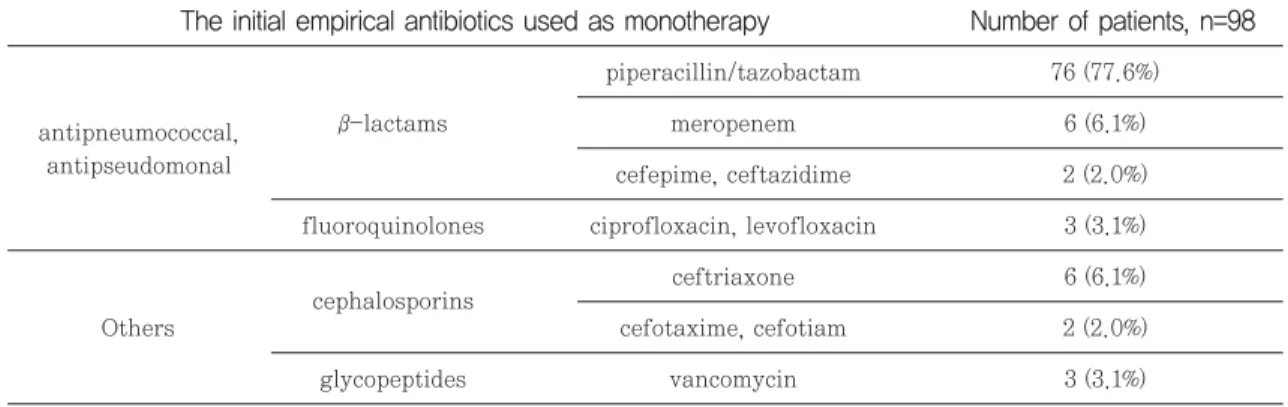
경험적 치료를 위해 항균제를 1개만 사용한 경우 77.6%가 piperacillin/tazobactam 단독요법이었다 (Table 2). 2제요법의 경우는 piperacillin/tazobac- tam과 ciprofloxacin (62.7%) 혹은 levofloxacin (11.9%)의 병용이 거의 대부분이었다(Table 3). 3제요 법의 경우는 모든 항균요법이 piperacillin/tazobac- tam을 사용하였으며 38.5%가 MRSA에 효과를 가지 는 약물을 포함했다(Table 4).
3. 진단된 원인균의 경험적 항균제에 대한 감수성 및 내성
원인균의 진단 결과와 사용한 경험적 항균제에 대한 원인균의 감수성 검사 결과를 보여주는 환자 170명에
p- value 3 (n=13)
2 (n=59) 1 (n=98)
Total (n=170)
The number of the initial empirical antibiotics Table 1 Patient characteristics according to the number of the initial empirical antibiotics
Age of total subjects 67.0±15.6 67.7±14.3 65.0±18.1 70.1±12.8 0.956
Subjects aged≥65 years (N) 76.2±7.4 (108) 75.8±7.1 (64) 76.6±8.3 (35) 77.2±6.1 (9) 0.803 Subjects aged 65 years (N) 50.9±12.9 (62) 52.4±11.7 (34) 48.1±14.9 (24) 54.0±7.8 (4) 0.408 Age of male subjects (N) 66.4±14.2 (104) 66.1±12.8 (60) 66.2±16.6 (36) 70.0±13.8 (8) 0.758 Age of female subjects (N) 67.8±17.8 (66) 70.3±16.3 (38) 63.2±20.6 (23) 70.2±12.6 (5) 0.309 Age of early onset subjects (N) 70.1±15.7 (34) 70.8±14.2 (17) 67.9±18.7 (14) 76.0±10.0 (3) 0.709 Age of late onset subjects (N) 66.2±15.6 (136) 67.0±14.3 (81) 64.1±18.1 (45) 68.3±13.5 (10) 0.543
Age is expressed as mean±SD in years; (N) denotes the number of patients in each subgroup
게서 발견된 균은 24종이었으며 190건의 감수성 결과 가 분석되었다. 총 24종의 균 중 가장 빈번하게 분석된 균은 Staphylococcus aureus (53/190, 27.9%)이었으 며 그 뒤를 이어 Acinetobacter baumannii (41/190, 21.6%), Klebsiella pneumoniae (21/190, 11.1%), Pseudomonas aeruginosa (12/190, 6.3%), Steno- trophomonas maltophilia (11/190, 5.8%), Entero- bacter aerogenes (10/190, 5.3%), Escherichia coli (10/190, 5.3%)의 순이었다. 병원 별 다빈도 분석균을 살펴보았을 때 A 병원과 B 병원 모두에서 S. aureus 가 가장 빈번하게 분석되었으며 A. baumannii와 K.
pneumoniae가 그 뒤를 이었다(Fig. 2). 그 외 Staphylococcus epidermidis (3.2%), Streptococcus pneumoniae (2.6%), Haemophilus influenza (1.1%), Staphylococcus haemolyticus (1.1%) 등 18종의 균 이 사용한 경험적 항균제에 대한 감수성 결과를 보여주 었다. S. aureus는 cipro-floxacin과 clindamycin에 대해 높은 내성률(76-77%)을 가지고 teicoplanin, trimethoprim/sulfamethoxazole, vancomycin에 대해 높은 감수성을 보였다(Fig. 3). S. maltophilia는 levofloxacin에 대해 45.5%의 내성률을 보인 반면 trimethoprim/sulfamethoxazole에 대해서는 100%
Fig. 1 The principal diagnosis at the time of hospital admission. Others includes degenerative scoliosis, food poisoning, Guillain-Barre Syndrome, hydrocephalus, and hyponatremia, etc.
Number of patients, n=98 The initial empirical antibiotics used as monotherapy
Table 2 The frequency of the initial empirical antibiotics used as monotherapy
piperacillin/tazobactam 76 (77.6%)
β-lactams meropenem 6 (6.1%)
cefepime, ceftazidime 2 (2.0%)
fluoroquinolones ciprofloxacin, levofloxacin 3 (3.1%)
cephalosporins ceftriaxone 6 (6.1%)
Others cefotaxime, cefotiam 2 (2.0%)
glycopeptides vancomycin 3 (3.1%)
antipneumococcal, antipseudomonal
Number of patients, n=59
Drug 1 Drug 2
The initial empirical antibiotics used as dual therapy Table 3 The frequency of the initial empirical antibiotics used as dual therapy
antipneumococcal, antipseudomonal
antipneumococcal, antipseudomonal
antipneumococcal, antipseudomonal
other cefotaxime, ceftriaxone other
cefepime ciprofloxacin meropenem
piperacillin/tazobactam meropenem
ceftazidime
piperacillin/tazobactam other for MRSA piperacillin/tazobactam antipneumococcal,
antipseudomonal
ciprofloxacin 37 (62.7%)
levofloxacin 7 (11.9%)
cefepime 2 (3.4%)
meropenem 1 (1.7%)
1 (1.7%) 1 (1.7%) 3 (5.1%) 1 (1.7%) 1 (1.7%)
1 (1.7%)
cefazolin 1 (1.7%)
moxifloxacin 1 (1.7%)
ampicillin, clindamycin 2 (3.4%) trimethoprim/
sulfamethoxazole teicoplanin vancomycin
MRSA: Methicillin-resistant Staphylococcus aureus
Number of patients,
Drug 1 Drug 2 Drug 3 n=13
The initial empirical antibiotics used as dual therapy Table 4 The frequency of the initial empirical antibiotics used as triple therapy
antipneumococcal, antipseudomonal
antipneumococcal, antipseudomonal
piperacillin/
tazobactam
piperacillin/
tazobactam
ciprofloxacin imipenem levofloxacin antipneumococcal,
antipseudomonal
antipneumococcal, antipseudomonal
ciprofloxacin
levofloxacin
for MRSA
antipneumococcal,
antipseudomonal cefepime, meropenem
vancomycin 3 (23.1%) 1 (7.7%) teicoplanin 1 (7.7%) meropenem 2 (15.4%)
moxifloxacin 1 (7.7%) 2 (15.4%)
antipneumococcal, antipseudomonal
other piperacillin/
tazobactam other ceftriaxone other piperacillin/
tazobactam
antipneumococcal, antipseudomonal
cefepime
levofloxacin
other cefotiam,
ceftriaxone 2 (15.4%)
clindamycin 1 (7.7%)
MRSA: Methicillin-resistant Staphylococcus aureus
의 감수성률을 나타내었다. 그 외 다빈도로 분석된 그람 음성균 중 A. baumannii는 cefepime, ceftazidime, ciprofloxacin, imipenem, piperacillin/tazobac- tam, trimethoprim/sulfamethoxazole에 대해 높은 내성률(63.4-85.4%)을 보인 반면 E. erogenes은 동 일한 항균제에 대해 높은 감수성률(90-100%)을 나타 냈다. E. coli는 ciprofloxacin에 대해 높은 내성률 (80%)을 보였으나 imipenem과 piperacillin/
tazobactam에는 매우 우수한 감수성률(90-100%)을 나타냈다. K. pneumoniae는 타 약물에 비해 imipen- em에 대해서 매우 높은 감수성률(100%)을 보였으며, P. aeruginosa는 ceftazidime, ciprofloxacin, imipenem, piperacillin/tazobactam에 대해 비교적
우수한 감수성률(50-75%)을 보였으며 cefepime에 대 해서는 높은 감수성률(91.7%)을 나타냈다(Table 5). 본 연구에서 분석된 폐렴의 80%가 후기 발현 폐렴이었으 나 다빈도 원인균의 발현율은 조기 발현과 후기 발현에 따라 통계적으로 유의한 차이를 보이지는 않았다(Fig.
4). 또한, 폐렴의 발생 시기와 사용한 경험적 항균제의 개수 간에도 유의한 연관성은 발견되지 않았다(Fig.
5). 경험적 항균제로 사용된 cefepime, ceftazidime, ciprofloxacin, imipenem, piperacillin/tazobac- tam, trimethoprim/sulfamethoxazole에 전체에 대 한 다빈도 원인균의 내성률을 폐렴의 발생시기에 따라 분석했을 때, 조기 발현 폐렴의 경우 A. baumannii가 이들 모든 항균제에 대해 가장 높은 내성률(30.2%)을 Fig. 2 The most frequently isolated organisms. Data are expressed as a percentage of the total cases
Fig. 3 Resistance of Staphylococcus aureus to antibiotics
나타냈으며 그 뒤를 이어 E. Coli와 P. aeruginosa가 각각 22.8%와 17.5%의 내성률을 보였다(p=0.000). 후 기 발현 폐렴의 경우는 A. baumannii가 27.2%의 가 장 높은 내성률을 보였으며 뒤를 이어 S. aureus, E.
coli, K. pneumoniae, P. aeruginosa가 유사한 내성 률(15.7 -19.0%)을 나타냈다(p=0.004). 이들 경험적 항균제 전체에 대한 다빈도 원인균의 내성률을 조기 발 현과 후기 발현으로 분류하여 비교했을 때 폐렴의 발생 Fig. 4 The most frequently isolated pathogens and onset time of hospital-acquired pneumonia. Data are expressed
as a percentage of the total cases. The numbers of the total cases of each organism were as follows: 41 for A.
baumannii; 11 for S. maltophilia; 10 for E. aerogenes; 10 for E. Coli; 21 for K. pneumoniae; 12 for P. aeruginosa; 53 for S. aureus.
Pseudomonas aeruginosa Number of cases (%) Klebsiella
pneumoniae Number of
cases (%) Enterobacter
aerogenes Number of cases (%) Escherichia
coli Number of
cases (%) Acinetobacter
baumannii Number of cases (%)
S I R S I R S I R S I R S I R
The initial empirical antibiotics used as
dual therapy
Table 5 The susceptibility and resistance of the most frequently isolated gram negative organisms to the ini- tial empirical antibiotics
Cefepime
Ceftazidime
Ciprofloxacin
Imipenem
9 (22)
9 (22)
6
(14.6) 0 35 (85.4)
2
(20) 0 8
(80) 10
(100) 0 0 11
(52.4) 2 (9.5)
8 (38.1)
9
(75) 0 3
(25) 11
(26.8) 0 30 (73.2)
9
(90) 0 1
(10) 10
(100) 0 0 21
(100) 0 0 7
(58.3) 0 5 (41.7) 11
(26.8) 0 30 (73.2)
10
(100) 0 0 9
(90) 0 1
(10) 11 (52.4)
3 (14.3)
7 (33.3)
7 (58.3)
3 (25)
2 (16.7) Trimethoprim/
sulfamethoxazole
15
(36.6) 0 26 (63.4)
6
(60) 0 4
(40) 9
(90) 0 1
(10) 11 (52.4)
6 (28.6)
4
(19) 0 0 12
(100) Piperacillin/
tazobactam
3 (7.3)
29 (70.7)
5
(50) 0 5
(50) 9
(90) 0 1
(10) 9
(42.9) 0 12 (57.1)
8 (66.7)
2 (16.7)
2 (16.7) 3
(7.3) 29 (70.7)
5
(50) 0 5
(50) 9
(90) 0 1
(10) 9
(42.9) 0 12 (57.1)
11 (91.7)
1 (8.3) 0