Human Immunodeficiency Virus-Associated Multiple Cerebral Aneurysmal
Vasculopathy in a Young Adult: A Case Report
젊은 성인에게서 인간면역결핍바이러스와 관련하여 발생한 다발성 대뇌 동맥류 혈관병증: 증례 보고
Dasom Kim, MD , Jin Wook Baek, MD* , Young Jin Heo, MD, Hae Woong Jeong, MD
Department of Diagnostic Radiology, Inje University Busan Paik Hospital, Busan, Korea
Human immunodeficiency virus (HIV)-associated vasculopathy comprises several forms of arte- riopathy without evidence of a secondary cause. HIV-associated cerebral aneurysmal vasculop- athy is a rare condition, but is being increasingly recognized. Herein, we report a case of HIV- associated multiple cerebral aneurysmal vasculopathy with cerebral infarction in a young adult.
Index terms HIV; Vascular Diseases; Aneurysm
INTRODUCTION
Human immunodeficiency virus (HIV)-associated vasculopathy comprises several forms of arteriopathy without evidence of a secondary cause and includes the patholo- gy of extracranial large arteries, intracranial medium-sized arteries with or without an- eurysm formation, and small vessel disease (1). HIV-associated cerebral aneurysmal vasculopathy is a rare condition but is increasingly recognized (2). We report a case of HIV-associated multiple cerebral aneurysmal vasculopathy with cerebral infarction in a young adult.
CASE REPORT
Received April 7, 2018 Revised July 2, 2018 Accepted July 11, 2018
*Corresponding author Jin Wook Baek, MD Department of Diagnostic Radiology, Inje University Busan Paik Hospital, 75 Bokji-ro, Busanjin-gu, Busan 47392, Korea.
Tel 82-51-890-8851 Fax 82-51-896-1085 E-mail [email protected] This is an Open Access article distributed under the terms of the Creative Commons Attribu- tion Non-Commercial License (https://creativecommons.org/
licenses/by-nc/4.0) which permits unrestricted non-commercial use, distri-bution, and reproduc- tion in any medium, provided the original work is properly cited.
ORCID iDs Jin Wook Baek https://
orcid.org/0000-0003-4632-4951 Dasom Kim
https://
orcid.org/0000-0002-8501-9389
to the emergency department of our institution for evaluation of left side weakness and tin- gling sensations in his left leg and cheek. These symptoms had been present for 3 days, and the patient reported having a headache for past 2 weeks. Seropositivity for HIV had been dis- covered 3 months prior and the CD4 count at initial diagnosis was 9 cells/mm3; the patient had been treated with antivirals for HIV as well as antibiotics for the past 2 months.
Computed tomography was performed, which revealed no parenchymal abnormality (not shown). For further evaluation, brain magnetic resonance imaging (MRI) was recommend- ed, but patient refused this examination for financial reasons. Thereafter, the patient was discharged and followed up at the neurologic outpatient department.
During the follow-up period, the patient’s symptoms improved over 2 weeks without any new treatment other than the previously prescribed treatment for AIDS. The patient agreed Fig. 1. HIV-associated multiple cerebral aneurysmal vasculopathy in a 34-year old man, presenting with left side weakness and tingling sensation in left leg and cheek.
A. MRI demonstrates subacute infarction in the right thalamus. The lesion shows high signal intensity in the diffusion weighted image (left upper panel) without remarkable signal change on apparent diffusion coeffi- cient map (right upper panel), high signal intensity in the fluid attenuation inversion recovery images (left lower panel), and subtle heterogeneous contrast enhancement (right lower panel).
A
to undergo brain MRI, which revealed subacute infarction in the right thalamus (Fig. 1A).
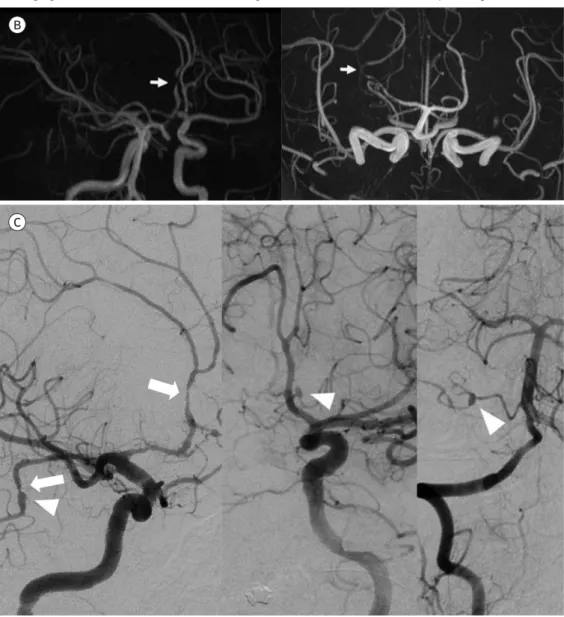
Three-dimensional time-of-flight MR angiography images showed stenosis at right A2 seg- ment and luminal irregularity at right P2 segment (Fig. 1B). To exclude cerebrovascular ab- normalities, conventional angiography was performed after readmission, which revealed multifocal stenosis and aneurysmal dilatation involving right A2, branch of A2, P2, anterior inferior cerebellar artery, and branch of left A2 (Fig. 1C). The CD4 count at admission was 34 cells/mm3, and a cerebrospinal fluid study was not performed. Blood tests for bacterial, fun- gal, and viral (other than HIV) infections failed to identify additional infectious sources; all vasculitis-related laboratory findings were within normal parameters.
Fig. 1. HIV-associated multiple cerebral aneurysmal vasculopathy in a 34-year old man, presenting with left side weakness and tingling sensation in left leg and cheek.
B. 3-dimensional time-of-flight MRI reveals stenosis at right A2 (arrow in left panel) and P2 segment (arrow in right panel).
C. Right internal carotid artery (left panel), left internal carotid artery (center panel), and right vertebral ar- tery (right panel) angiograms show multifocal stenosis (arrows) and aneurysmal dilatation (arrowheads) in- volving right A2, branch of A2, branch of left A2, right anterior inferior cerebellar artery, and right P2.
B
C
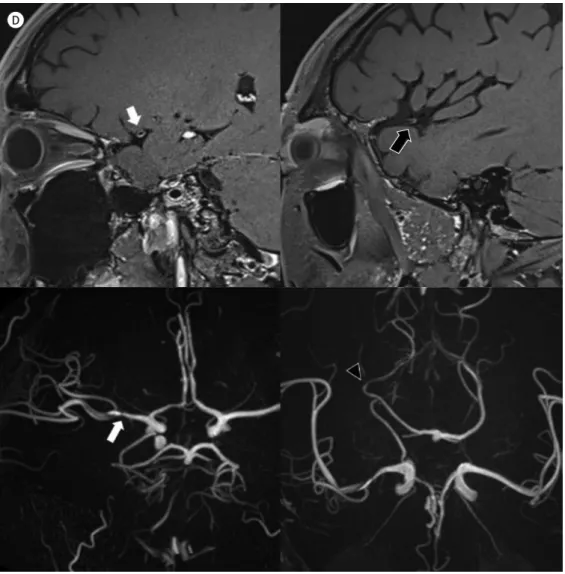
Follow-up plaque MRI after 3 months showed partial improvement in the stenotic lesions in right A2 and P2 and new stenotic lesions at right M1 and M2 (Fig. 1D).
DISCUSSION
Fig. 1. HIV-associated multiple cerebral aneurysmal vasculopathy in a 34-year old man, presenting with left side weakness and tingling sensation in left leg and cheek.
D. Sagittal contrast-enhanced T1 plaque MRI (upper panel) after 3 months reveals eccentric wall thickening with enhancement of stenotic right M1 (white arrow) and M2 (black arrow). 3-dimensional time-of-flight MRI (lower panel) reveals new stenotic lesions in right M1 (white arrow) and partially improved stenotic le- sions in right P2 (black arrowhead).
D
The actual incidence of cerebral vasculopathy in HIV infection is difficult to estimate be- cause of the high association with opportunistic infections of the central nervous system (CNS) involving cerebral vessels. The actual incidence may be underestimated because pa- tients are asymptomatic in many cases (5). Aneurysmal vasculopathy associated with HIV infection is usually related to fusiform dilatation and occurs in young adults (6). According to a recent systematic review of HIV-associated cerebral aneurysmal vasculopathy cases (16 adults) reported in the literature, the commonly affected arteries were middle cerebral artery (68.8%) followed by the anterior cerebral artery (62.5%) in adults. The internal carotid artery and posterior carotid artery were equally affected (37.5%). Fusiform aneurysms were re- ported in 75% of adult cases, and saccular types accounted for 12.5% of cases. The adult pa- tients were aged 20–54 years (median: 36.5 years). Weakness (50%) was the most common presenting symptom followed by headache, confusion, and speech disorders (5).
HIV-associated vasculopathy has a predilection for medium and large vessels. Extracranial aneurysms in HIV patients are mostly multiple and have a predilection for atypical locations, including the aorta, carotid, popliteal, and femoral vessels (7). The etiology and exact mecha- nism of HIV-associated vasculopathy remains unknown. Continuous exposure of HIV virion or viral particles can cause direct damage to the endothelium, leading to endothelial dys- function. Indirect damage can arise from circulating infected monocytes with related cyto- kines. Subsequent events can lead to the progression of damage and propagation of athero- genesis, which cause remodeling of the vessel wall, involving intimal hyperplasia and fragmentation of the elastic lamina (8).
In adults, the histopathology of HIV-associated cerebral aneurysms reveals luminal throm- bosis and fibrosis, with concentric hyalinization of the intima layer, atrophy of the media, as well as thickening and fragmentation of the elastic lamina, which can cause intracranial ves- sels ectasia (6). Most HIV-related aneurysms have distinct histopathological features different from atherosclerotic and mycotic aneurysms (5). Mycotic aneurysms are usually fusiform and located in distal arterial branches. In the antibiotic era, they were typically caused by he- matogenous seeding of previously damaged arteriosclerotic vessels (3).
Optimal therapy for HIV aneurysmal vasculopathy remains undefined. There are several case reports of aneurysms that were resolved or had their progression halted by antiretrovi- ral therapy (ART) (4). One of these cases was an atypical arteriopathy in a pediatric patient presenting with a single aneurysm with angiographic evidence of active vasculitis. The oth- ers were more typical HIV arteriopathies (4). Cerebral infarct is described as a complication of HIV infection, and vasculitis from opportunistic or HIV infection can cause stroke (9). Ce- rebral infarction in HIV patients may result from endocarditis, vasculitis, or opportunistic infection/neoplasms (10). Stroke-like clinical presentation in HIV patients is unusual (1–5%), but cerebral infarction has a much higher prevalence (4–34%) in adult autopsy series (8, 10).
It is unclear whether HIV itself causes cerebral infarction, and few studies have assessed ce- rebral infarction in the absence of potential causes, such as other opportunistic infections, lymphoma, or emboli from nonbacterial infective endocarditis. According to a pathological study of a cerebral infarct patient without evidence of non-HIV CNS infection, CNS lympho- ma, or cardioembolic sources at autopsy, cerebral infarcts were uncommon in the absence
groups, irrespective of drug use, hepatitis serology, or syphilis serology (10).
Stroke risk can increase not only with HIV infection, but also with its treatment. ART may cause arterial injury, causing increased concentration of markers of endothelial dysfunc- tion, which paradoxically could increase the risk of stroke in the long term, as a result of en- dothelial and metabolic side effects (8). According to a previous study, ART has little effect on HIV-related endothelial dysfunction and inflammation, although it can reduce the virulence of HIV (8).
Our patient presented with a headache 4 weeks after initiation of ART and neurological symptoms 6 weeks after ART. There was no evidence of other opportunistic CNS infection or other causes of stroke. Contrast-enhanced T1-weighted plaque MRI demonstrated stenosis with wall thickening and enhancement of the involved intracranial arteries, which can be in- terpreted as inflammatory changes in the vessel wall. In our patient, further progression did not stop with immunosuppressive or anti-HIV medication. Clinical manifestations and MRI findings suggested that HIV-associated cerebral vasculitis was the most likely cause of brain ischemia in our patient. The long-term effect of ART on stroke incidence is also unclear, and may take time to be established. Therefore, close surveillance is essential for HIV pa- tients receiving ART (8).
In conclusion, HIV-related cerebral vasculopathy is a rare cerebrovascular complication of HIV infection with characteristic histopathological features. The actual incidence of this condition may be underestimated because patients are asymptomatic in many cases and there may be secondary opportunistic infection. Notably, HIV infection may be associated with ART, which can increase the risk of stroke. Earlier surveillance in patients with neuro- logical symptoms may reveal an early disease state. Moreover, clinicians and neuroradiolo- gists should consider this condition in their diagnosis and recommend vascular imaging for HIV patients presenting with neurological signs and symptoms.
Conflicts of Interest
The authors have no potential conflicts of interest to disclose.
REFERENCES
1. Connor MD. Treatment of HIV associated cerebral vasculopathy. J Neurol Neurosurg Psychiatry 2009;
80:831
2. Nair R, Robbs JV, Naidoo NG, Woolgar J. Clinical profile of HIV-related aneurysms. Eur J Vasc Endovasc Surg 2000;20:235-240
3. Goldstein DA, Timpone J, Cupps TR. HIV-associated intracranial aneurysmal vasculopathy in adults. J Rheumatol 2010;37:226-233
4. Ake JA, Erickson JC, Lowry KJ. Cerebral aneurysmal arteriopathy associated with HIV infection in an adult.
젊은 성인에게서 인간면역결핍바이러스와 관련하여 발생한 다발성 대뇌 동맥류 혈관병증: 증례 보고
김다솜 · 백진욱* · 허영진 · 정해웅
인간면역결핍바이러스(human immunodeficiency virus; 이하 HIV)와 연관된 혈관병증은 2차적인 원인 없이 여러 군데의 동맥을 침범하는 동맥병증을 포함한다. 인간면역결핍바이러 스(HIV)와 연관된 대뇌 동맥류 혈관병증은 드문 질환이나 최근 증가하는 추세로 알려져 있 다. 저자들은 젊은 성인에게서 인간면역결핍바이러스(HIV)와 관련하여 발생한 다발성 대뇌 동맥류 혈관병증의 증례를 보고하고자 한다.
8. Benjamin LA, Bryer A, Emsley HC, Khoo S, Solomon T, Connor MD. HIV infection and stroke: current per- spectives and future directions. Lancet Neurol 2012;11:878-890
9. Gillams AR, Allen E, Hrieb K, Venna N, Craven D, Carter AP. Cerebral infarction in patients with AIDS. AJNR Am J Neuroradiol 1997;18:1581-1585
10. Connor MD, Lammie GA, Bell JE, Warlow CP, Simmonds P, Brettle RD. Cerebral infarction in adult AIDS pa- tients: observations from the edinburgh HIV autopsy cohort. Stroke 2000;31:2117-2126