Brief Report
388 Ann Dermatol
Received June 16, 2017, Accepted for publication July 21, 2017
Corresponding author: Won-Soo Lee, Department of Dermatology and Institute of Hair and Cosmetic Medicine, Yonsei University Wonju College of Medicine, 20 Ilsan-ro, Wonju 26426, Korea. Tel: 82-33-741-0622, Fax: 82-33-748-2650, E-mail: [email protected]
ORCID: https://orcid.org/0000-0001-7198-1334
This is an Open Access article distributed under the terms of the Creative Commons Attribution Non-Commercial License (http://creativecommons.org/
licenses/by-nc/4.0) which permits unrestricted non-commercial use, distribution, and reproduction in any medium, provided the original work is properly cited.
Copyright © The Korean Dermatological Association and The Korean Society for Investigative Dermatology SI, Gilcrest BA, Paller AS, Leffell DJ, Wolff K, editors.
Fitzpatrick's dermatology in general medicine. 8th ed. New York: McGraw-Hill, 2012:197-231.
3. Kong TS, Han TY, Lee JH, Son SJ. Correlation between severity of atopic dermatitis and sleep quality in children and adults. Ann Dermatol 2016;28:321-326.
https://doi.org/10.5021/ad.2018.30.3.388
Quality of Life with Alopecia Areata versus Androgenetic Alopecia Assessed Using Hair Specific Skindex-29
Myungsoo Jun, Dong In Keum, Solam Lee, Beom Jun Kim, Won-Soo Lee
Department of Dermatology and Institute of Hair and Cosmetic Medicine, Yonsei University Wonju College of Medicine, Wonju, Korea
Dear Editor:
Hair loss influences patient quality of life (QoL) according to diverse factors. Various prior studies aimed to minimize the negative effects of hair loss on patient emotions. It has been known that androgenetic alopecia (AGA) had a sig- nificant negative impact on QoL, especially in case of se- vere disease, extended disease duration, and younger age1. In other study, degraded QoL was observed espe- cially in female patients <50 years old with moderate to severe disease2. Despite many studies on hair loss patients’
QoL with consistent outcomes3,4, no study has examined the difference between the two diseases.
Since it was first proposed in 1996, Skindex-29 has been widely used to assess the QoL of patients with skin dis- orders5,6. Here we used Hair Specific Skindex-29 to identi- fy the negative effects of alopecia areata (AA) and AGA.
We ultimately aimed to identify the differences in QoL be- tween two diseases and the factors influencing such differences.
A total of 541 patients (380 AGA and 161 AA) who visited Wonju Severance Christian Hospital between March 2012 and February 2017 were included. All subjects were diag- nosed with alopecia by a dermatologist. Patients were div- ided into subgroups according to their age, sex, onset age, initial or recurrence, and duration of disease, and the Hair
Specific Skindex-29 score was compared. Ultimately, we aimed to determine whether Hair Specific Skindex-29 scores differed between AA and AGA. This study was ap- proved by the Insitutional Review Board of Yonsei University Wonju Severance Christian Hopistal (IRB no.
CR317014). Informed consent was obtained from all en- rolled subjects.
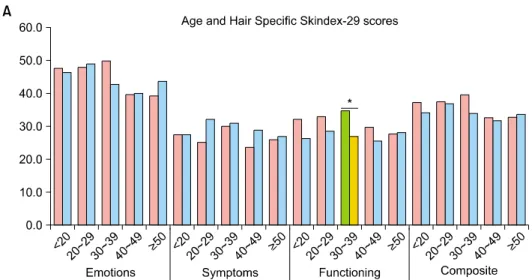
AA patients showed markedly deteriorated QoL in func- tioning than AGA patients (p=0.013, Fig. 1A), and AGA patients were more likely to report symptomatic QoL de- pression (p=0.033). When concerning age groups, the functional impairment in AA patients in their 30s was sig- nificantly higher (p=0.025, Fig. 2A, B). The QoL of AA and AGA patients did not show any significant difference by sex. AGA patients whose onset age was ≤20s were more likely to experience lower symptomatic QoL. In pa- tients with an onset age of 30s, however, AA patients showed significantly lower QoL as evidenced by function, emotion, and composite scores. The AA patients with a duration ≥5 years showed a lower mean QoL shown by functional and composite scores (Fig. 2C, D). In contrast, AGA patients with a disease duration of 1∼5 months were more likely to have lower symptomatic QoL (p=0.018). Patients with mild AGA (M1, C1, V1, and F1 on basic and specific [BASP] classification7) had sig-
Brief Report
Vol. 30, No. 3, 2018 389 Fig. 1. (A) Comparison of Hair Specific Skindex-29 score between patients with alopecia areata (AA) and androgenetic alopecia (AGA).
(B∼D) Comparison of Hair Specific Skindex-29 scores before versus after treatment in patients with (B) mild, (C) moderate, or (D) severe AA or AGA. *Statistically significant difference (p<0.05).
nificantly higher symptomatic scores than mild AA (<30% of the scalp), while the decrease in functioning QoL was prominent in AA (p=0.017 and 0.010, re- spectively). Compared to moderate AGA with M2, C2, V2, and F2 and moderate AA (30% to 90% of scalp), the func- tional and composite scores were higher in AA (p=0.003 and 0.028, respectively). Patients with mild AA had higher functioning scores before treatment, and they remained significant after treatment (p=0.028 and 0.036, re- spectively; Fig. 1B∼D). Severe AA (≥90% scalp involve- ment) and severe AGA with M3, C3, V3, F3, and every U type showed no significant QoL difference before treatment. However, symptom scores of severe AGA were significantly higher than post-treatment AA (p=0.037).
According to the result of our study, AA and AGA have a
significant negative impact on patient QoL. The function- ing score of Hair Specific Skindex-29 was higher in AA, while the symptoms score was significantly higher in AGA. AA with an onset age of 30s showed poor QoL score, while in AGA patients with an onset age ≤20s had a greater QoL impairment. Lower QoL indices were ob- served when AA duration was prolonged, and the AGA only recently started. It has been consistently observed that QoL is deteriorated by hair loss occurring at ≤30 years of age. This similar result to the QoL studies related to other skin disorders suggests that older patients may have improved coping mechanisms compared to their younger counterparts8,9.
We objectively identified the negative effects of AA and AGA on patients’ QoL. The impact of two diseases is sig-
Brief Report
390 Ann Dermatol
Fig. 2. Comparison of Hair Specific Skindex-29 scores by (A) subjects' age, (B) onset age, (C) duration of illness, and (D) disease severity between alopecia areata (AA) and androgenetic alopecia (AGA). *Sta- tistically significant difference (p< 0.05).
nificantly different according to age, onset age, and dis- ease duration, suggesting that a personalized approach to QoL is required. This was a preliminary study with a limi- tation of having excluded information about factors influ- encing QoL such as socialization frequency or marital status. Further investigations are needed to determine the effect of these factors on QoL in AA and AGA patients.
CONFLICTS OF INTEREST
The authors have nothing to disclose.
REFERENCES
1. Han SH, Byun JW, Lee WS, Kang H, Kye YC, Kim KH, et al.
Quality of life assessment in male patients with androgenetic alopecia: result of a prospective, multicenter study. Ann
Dermatol 2012;24:311-318.
2. Shi Q, Duvic M, Osei JS, Hordinsky MK, Norris DA, Price VH, et al. Health-Related Quality of Life (HRQoL) in alopecia areata patients-a secondary analysis of the National Alopecia Areata Registry Data. J Investig Dermatol Symp Proc 2013;16:S49-S50.
3. Girman CJ, Rhodes T, Lilly FR, Guo SS, Siervogel RM, Patrick DL, et al. Effects of self-perceived hair loss in a community sample of men. Dermatology 1998;197:223- 229.
4. Zhuang XS, Zheng YY, Xu JJ, Fan WX. Quality of life in women with female pattern hair loss and the impact of topical minoxidil treatment on quality of life in these patients. Exp Ther Med 2013;6:542-546.
5. Chren MM, Lasek RJ, Quinn LM, Mostow EN, Zyzanski SJ.
Skindex, a quality-of-life measure for patients with skin disease: reliability, validity, and responsiveness. J Invest
Brief Report
Vol. 30, No. 3, 2018 391 Fig. 2. Continued.
Dermatol 1996;107:707-713.
6. Fernandez-Peñas P, Jones-Caballero M, Espallardo O, García-Díez A. Comparison of Skindex-29, Dermatology Life Quality Index, Psoriasis Disability Index and Medical Out- come Study Short Form 36 in patients with mild to severe psoriasis. Br J Dermatol 2012;166:884-887.
7. Lee WS, Ro BI, Hong SP, Bak H, Sim WY, Kim DW, et al. A new classification of pattern hair loss that is universal for
men and women: basic and specific (BASP) classification. J Am Acad Dermatol 2007;57:37-46.
8. Hagen SL, Grey KR, Korta DZ, Kelly KM. Quality of life in adults with facial port-wine stains. J Am Acad Dermatol 2017;76:695-702.
9. Klein R, Moghadam-Kia S, Taylor L, Coley C, Okawa J, LoMonico J, et al. Quality of life in cutaneous lupus erythematosus. J Am Acad Dermatol 2011;64:849-858.