185 https://doi.org/10.9713/kcer.2019.57.2.185
PISSN 0304-128X, EISSN 2233-9558
Deactivation of Porous Photocatalytic Particles During a Wastewater Treatment Process
Young-Sang Cho† and Soyoung Nam
Department of Chemical Engineering and Biotechnology, Korea Polytechnic University, 237, Siheung-si, Gyeonggi-do, 15073, Korea (Received 28 October 2018; Received in revised form 12 December 2018; accepted 21 December 2018)
Abstract − Deactivation of porous photocatalytic materials was studied using three types of microstructured particles:
macroporous titania particles, titania microspheres, and porous silica microspheres containing CNTs and TiO2 nanopar- ticles. All particles were synthesized by emulsion-assisted self-assembly using micron-sized droplets as micro-reactors.
During repeated cycles of the photocatalytic decomposition reaction, the non-dimensionalized initial rate constants (a) were estimated as a function of UV irradiation time (t) from experimental kinetics data, and the results were plotted for a regression according to the exponentially decaying equation, a = a0 exp(-kdt). The retardation constant (kd) was then compared for macroporous titania microparticles with different pore diameters to examine the effect of pore size on pho- tocatalytic deactivation. Nonporous or larger macropores resulted in smaller values of the deactivation constant, indi- cating that the adsorption of organic materials during the photocatalytic decomposition reaction hinders the generation of active radicals from the titania surface. A similar approach was adopted to evaluate the activation constant of porous sil- ica particles containing CNT and TiO2 nanoparticles to compare the deactivation during recycling of the photocatalyst.
As the amount of CNTs increased, the deactivation constant decreased, indicating that the conductive CNTs enhanced the generation of active radicals in the aqueous medium during photocatalytic oxidation.
Key words: Photocatalytic particles, Porous materials, Self-assembly, Deactivation of catalyst
1. Introduction
The environmental problems caused by wastewater containing dye molecules have become serious issues in the textile industry [1].
The wastewater generated from dye factories is discarded into rivers without decoloring in some cases, causing a high value of COD and chromacity in aqueous medium [2]. Thus, the polluted water should be treated properly before sewage advanced treatment to reduce the above contamination factors by an optimum wastewater treatment system. Various methods have been reported for the removal of organic dyes by adsorption onto a solid surface or degradation of the contaminants by a chemical reaction [3,4]. In particular, the adsorp- tion of dye molecules on bubbles has been developed to reduce the chromaticity of wastewater [5]. However, an additional surface active agent is essential to generate bubbles, causing further contamination of wastewater. While some researchers have developed an electroly- sis technique to remove contaminants from wastewater, it has been reported that the complete reduction of COD is still challenging by these approaches [6]. However, photocatalytic decomposition can be considered effective, since external UV sources can be replaced with solar radiation to reduce the energy cost in countries near the equator such as India [7].
Thus far, photocatalytic purification systems have been devel- oped in two forms, slurry type reactors and fixed bed reactors, for practical use [8,9]. The photocatalytic materials in both types of sys- tems can be deteriorated by catalyst poisoning due to the adsorbed or degraded contaminant on the porous surface, causing a decline of the photocatalytic efficiency during repeated use of the system [10]. Thus, depressed photocatalytic activity should be considered when deter- mining the optimum photocatalytic materials before implementing a purification system. In a slurry-type photocatalytic reactor, catalytic particles with long life-time should be chosen to use the purification system for a prolonged period, thus enabling long term repeated operation of the reactor.
The depression of catalytic activity during the operation of a cata- lytic reaction (poisoning) is a common phenomenon in reaction engineering. To overcome this problem, regular heating of the cata- lytic materials under an inert gas is a potential route to obtain ‘clean’
particles before reuse. The photocatalytic materials in a wastewater treatment system usually can be washed with clean water to remove the adsorbed materials to facilitate the generation of active radicals under UV irradiation. However, in-depth study of the depression of photocatalytic activity during repeated use is still important to determine the safety factor and the washing period of the photocatalytic materials.
Photocatalytic materials generally have been developed in the form of nanoparticles or a porous medium to obtain a large surface- to-volume ratio, thereby enhancing the photocatalytic activity. How- ever, the photocatalytic nanoparticles are inadequate because of the difficulty of the separation of the particulate materials from the aque-
†To whom correspondence should be addressed.
E-mail: [email protected]
This is an Open-Access article distributed under the terms of the Creative Com- mons Attribution Non-Commercial License (http://creativecommons.org/licenses/by- nc/3.0) which permits unrestricted non-commercial use, distribution, and reproduc- tion in any medium, provided the original work is properly cited.
ous medium after the purification step. On the other hand, porous materials with micrometer size can be used in a slurry-type photocat- alytic reactor, since gravitational sedimentation can be employed for separating the photocatalyst after removing the contaminant under UV irradiation. In this study, we synthesized various types of porous particles with photocatalytic activity by self-assembly to compare their recycle efficiency during repeated use.
In the present study, we used three different types of microstruc- ture particles as photocatalytic materials for the removal of organic contaminants in a wastewater treatment process under UV irradia- tion. The particles were synthesized by an emulsion-assisted self- organization process, which is beneficial in terms of laboratory-scale production of porous materials as well as obtaining a sufficient amount of the material after scale-up. During repeated use of the photocata- lytic particles, the rate constants of the decomposition reaction were measured to investigate the decrease of the reaction rate due to the poisoning of the catalyst. The retardation of the reaction kinetics was estimated in order to choose the optimum photocatalytic particles among macroporous titania particles, titania microspheres, and porous silica-CNT microparticles containing TiO2 nanoparticles.
2. Experimental
2-1. Materials
Titanium diisopropoxide acetylacetonate (TDIP, 75 wt.% in iso- propanol), which was used as a precursor for the synthesis of macro- porous titania particles, was purchased from Sigma-Aldrich. For the gelation of the precursors inside emulsion droplets, hydrochloric acid (0.1 N) was bought from Sigma-Aldrich. N-tetradecane (98%) was used as a continuous phase and bought from Sigma-Aldrich.
Sodium silicate (water glass, Na2O(SiO2)x·xH2O) was purchased from Sigma-Aldrich as a silica precursor, and sodium ions were removed using an ion exchange resin (Amberlite IR 120, H+ form, Sigma-Aldrich). Multi-walled carbon nanotubes and titania nanopar- ticles were purchased from US Research Nanostructures for the preparation of composite microspheres with silicic acid.
Styrene (99%) and α,α’-azobis(isobutyronitrile (AIBN, 99%) were used as a monomer and an initiator, respectively, for dispersion polymerization and purchased from Daejung Chemicals and Sigma- Aldrich, respectively. 2-(methacryloyloxy) ethyltrimethylammonium chloride (MTC, 72% aq) and polyvinylpyrrolidone (PVP K30, MW
= 40,000) were used as a cationic monomer and a particle stabilizer, respectively, and purchased from Aldrich Chemicals and Junsei Chemicals. Ethanol (99.9%, HPLC grade) was used as a reaction solvent and bought from Daejung Chemicals.
Methylene blue trihydrate was used as a model contaminant during the photocatalytic decomposition reaction and was purchased from Samchun Chemicals.
2-2. Synthesis of monodisperse polystyrene nanospheres Dispersion polymerization was carried out for the synthesis of
polystyrene nanospheres with 220, 580, and 800 nm diameter [11,12].
The reaction medium, ethanol dissolving polyvinylpyrrolidone (PVP), was added to a batch-type reaction where the temperature was main- tained at 70 °C. A proper amount of the aqueous solution of MTC was then added to the reactor, and the stirrer was rotated at 170 rpm.
Nitrogen purging was performed for 1.5 hour hours, followed by the addition of AIBN for the polymerization reaction. After 19 hours, the resulting polystyrene nanospheres were washed by repeated cen- trifugation and sonication and redispersed in ethanol for further use.
2-3. Synthesis of macroporous titania microparticles by emul- sion-assisted self-assembly
Polystyrene nanospheres with 220, 580, or 800 nm diameter were redispersed in fresh ethanol by repeated centrifugation and sonica- tion, and the solid concentration was adjusted as 30 wt.%. The titania precursor was prepared by mixing 0.01N hydrochloric acid solution (1.6874 g) with 30 polystyrene beads dispersed in ethanol (7.5 g) by stirring for 30 minutes. The dropwise addition of 3.25g of TDIP was then performed under vigorous stirring for 1 hour. Finally, H2O (4.268 g) was added to the mixture by stirring for another 30 min- utes to finish the preparation of the dispersed phase. Before emulsifi- cation, a continuous phase was prepared by dissolving the emulsion stabilizer, ABIL EM90, in tetradecane (3 wt.%). Mechanical homog- enization was then carried out by mixing the dispersed and continu- ous phases at a 1:3 volume ratio using a homogenizer (witeg Labortechnik GmbH) for 1 minute. The resulting emulsion droplets were evaporated by heating the complex fluid system at 90 °C for 1 hour during mild stirring to produce organic-inorganic composite particles. After washing the particles using hexane and drying at room temperature, calcination was performed using a box furnace (Hantech) at 500 °C for 5 hours to produce macroporous titania par- ticles by removing the polymeric templates.
2-4. Synthesis of porous silica-CNT microparticles contain- ing titania nanoparticles
Dilute aqueous solution of sodium silicate (water glass dissolved in water by 1:2 volume ratio) was purified by the removal of sodium ions using an ion exchange resin (Amberlite IR120, Aldrich Chemi- cals). The resulting silicic acid solution was then mixed with an aqueous dispersion of MW CNTs (multi-walled carbon nanotubes) and TiO2 nanoparticles in a volume ratio of 3:1:2 or 3:3:2. The result- ing mixture was emulsified with tetradecane dissolving Abil EM90 (3 wt.%) by mechanical homogenization, followed by self-organiza- tion by heating at 95 °C.
2-5. The photocatalytic decomposition of methylene blue and recycling of the photocatalytic particles
Macroporous titania microparticles were resuspended in an aque- ous medium with a fixed concentration of 0.0002 g/ml. The aqueous solution containing dissolved methylene blue (0.000005 g/ml) was then mixed with the titania suspension at a 1:1 volume ratio, fol-
lowed by equilibration for 30 minutes under a dark condition. For the photocatalytic reaction, UV light was irradiated using eight UV lamps (F10T8 BLB, 10 W, peak wavelength at 352 and 369 nm, Sankyo Denki). During the reaction, a small amount of the sample was col- lected for measurement of the concentration of the dye molecules using a UV-visible spectrometer at fixed time intervals.
After the photocatalytic decomposition reaction, sedimentation of the macroporous titania microparticles was performed under gravita- tional force. The supernatant containing a trace amount of the organic contaminant was then carefully removed and a fresh aqueous solu- tion containing 0.000005 g/ml of methylene blue was added for fur- ther photocatalytic decomposition reaction under UV irradiation during mild stirring.
2-6. Characterization
The particle size and distribution of polystyrene suspension was measured by a particle size analyzer (ZETA PLUS, Marlvern Instru- ments). The morphology of the porous ceramic particles was observed using a field emission scanning electron microscope (FE-SEM, Hita- chi-S4700). The composition of the powder materials synthesized by emulsion-assisted self-assembly was analyzed by a Nicolet FT-IR spectrometer (Thermo Fisher Scientific co. Ltd). The UV-visible spectrum of the aqueous methylene blue solution during photocata- lytic decomposition was measured using a UV-visible spectrometer (Model: OPTIZEN POP).
3. Results and Discussion
In this study, the self-assembly scheme using emulsion droplets generated by mechanical homogenization was applied for the syn- thesis of spherically porous ceramic particles with photocatalytic activity. The fabrication process of each type of particle is shown schematically in Fig. 1(a) and Fig. 1(b). By supplying thermal energy, the complex fluid system was evaporated to remove the volatile medium until the self-assembled particles were produced. Macropo- rous titania particles could be obtained from tiny emulsion droplets as a micro-reactor by the self-organization of precursors and polysty- rene nanospheres and subsequent calcination, as displayed in Fig.
1(a). The fabrication process of porous silica containing CNTs and TiO2 nanoparticles is described schematically in Fig. 1(b). An aque- ous silicic acid solution containing MW-CNTs was mixed with the TiO2 nanoparticle suspension, and the resulting mixture was emulsi- fied with the continuous phase, followed by self-organization due to the inward capillary force during heating, which could lead to the formation of spherical porous silica microparticles containing CNTs and TiO2 nanoparticles.
The resulting photocatalytic particles were resuspended in an aqueous medium containing an organic dye (methylene blue) for the decomposition reaction during UV irradiation under mild stirring.
After the photocatalytic reaction for a fixed time interval, the UV illumination and stirring were stopped, followed by sedimentation of
the photocatalytic particles on the bottom of the batch-type photocat- alytic reactor. A fresh aqueous solution containing the organic dye was then poured into the reactor for the second stage of the wastewa- ter treatment. During the second stage, the photocatalytic particles were resuspended by mild stirring and UV light was irradiated again during the photocatalytic decomposition reaction, as shown sche- matically in Fig. 1(c).
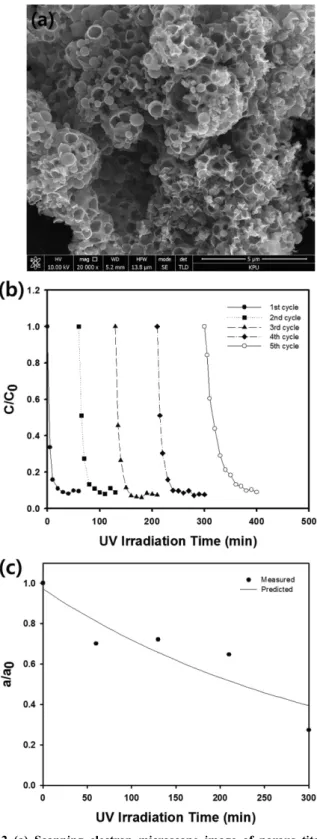
Fig. 2(a) presents a scanning electron microscope image of the porous titania microparticles having macropores with 800 nm diam- eter. The morphology of the porous titania particles is spherical with a number of air cavities, which were formed after removal of the polystyrene nanospheres by calcination. After dispersing these porous titania microparticles in the aqueous solution of methylene blue, photocatalytic decomposition of the organic dye was performed under UV irradiation. In the first cycle of the water purification pro- cess, the change of the dimensionless concentration (C/C0) of methy- lene blue was measured as a function of UV irradiation time, as shown in the graph in Fig. 2(b). The dimensionless concentration decreased quite rapidly when fresh porous particles were used as a photocatalyst. However, the decay rate of the concentration of meth- Fig. 1. Schematic for the fabrication of (a) macroporous titania parti- cles and (b) porous silica particles containing CNTs and TiO2 nanoparticles by emulsion-assisted self-assembly.
ylene blue decreased as the porous particles were used repeatedly as a photocatalyst, as shown in the graph in Fig. 2(b). In the fifth cycle, slow decomposition of the organic dyes was clearly observed, indi-
cating that the adsorbed concentration of the dye molecules on the particle surface became saturated and poisoning might occur due to the repeated use of the photocatalyst. The retardation of the photocat- alytic activity could be quantitatively analyzed by measuring the ini- tial rate constant of the photocatalytic decomposition reaction for each cycle, assuming that the rate of the decomposition reaction can be expressed according to the following first order reaction:
(1)
Here, kr and a denote the apparent rate constant of the photocat- alytic decomposition reaction and catalyst activity, respectively.
To estimate the deactivation constant, the rate constant kr in the initial stage of the decomposition reaction for each cycle could be estimated by assuming the first order reaction kinetics. The values of kr were then non-dimensionalized to obtain the deacti- vation constant a for each cycle, and the resulting values were plotted to obtain the regression curve by fitting the data according to the following exponentially decaying function:
(2) Here, kd is the retardation constant, a quantitative value to repre- sent the deactivation rate of the photocatalytic particles, and a0
denotes a simple pre-exponential factor. Although the deactiva- tion constant a decreased during repeated cycles, a rapid decreas- ing trend of the dimensionless concentration could be observed until the fifth cycle, as can be confirmed from the graph in Fig.
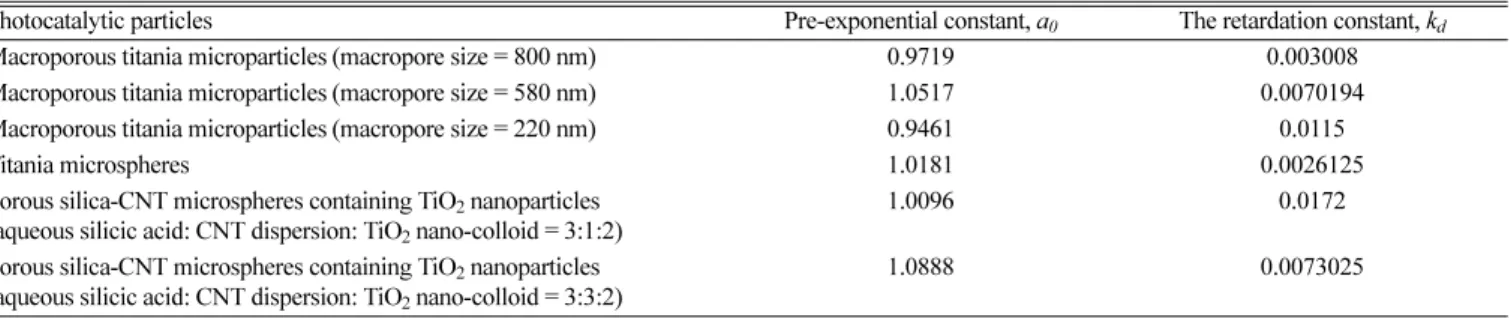
2(b). Fig. 2(c) presents the resulting value of the initial dimen- sionless reaction rate a as a function of UV irradiation during the repeated use for five cycles. For the porous titania microparticles having macropores with 800 nm diameter, the values of a0 and kd were estimated as 0.9719 and 0.003008, respectively, as sum- marized in Table 1.
We studied the effect of the macropore size of the porous titania particles on the photocatalytic deactivation by measuring the retarda- tion constant kd of the photocatalytic particles with different pore size. Thus, the polystyrene beads with 580 nm diameter were also utilized as sacrificial templates for the synthesis of the macroporous titania microparticles displayed in the SEM image of Fig. 3(a). As shown in the electron microscope image, the microstructure of the spherical porous titania particles could be adjusted by controlling the size of the macropores. These porous titania particles were also adopted as a photocatalyst for the removal of methylene blue by UV irradiation, and the results are included in the graph in Fig. 3(b) for five repeated cycles of the porous particles during the water purifica- tion process. Similar to the results from the porous particles having macropores with 800 nm diameter, the decay rate of the concentra- tion (C/C0) of methylene blue became slower with repeated use of the photocatalytic particles progressing from the first to the fifth cycle.
The decaying tendency of the initial rate constant of the decomposi- tion reaction could be measured by assuming a first-order reaction,
dC ---dt =–kraC
a=a0 exp(–kdt)
Fig. 2. (a) Scanning electron microscope image of porous titania microparticles having macropores with 860 nm diameter. Scale bar indicates 5 µm. (b) The change of concentration of methy- lene blue as a function of UV irradiation time during recy- cling of the photocatalytic particles. (c) The change of the initial rate of decomposition reaction of methylene blue (a/a0) as a function of UV irradiation time.
and the results could be also fitted using the exponentially decaying function, as shown in the graph in Fig. 3(c). In this case, the values of a0 and kd could be estimated as 1.0517 and 0.0070194, respectively, indicating that the photocatalytic activity of the porous photocata- lytic particles during recycling can be decreased by decreasing the size of the macropores. Since the adsorbed organic molecules on the particle surface with smaller macropores having a complicated mor- phology are difficult to desorb, the amount of active radicals can be decreased from the surface of titania due to the remnant organic material on the surfaces, causing deactivation of the photocatalytic activity after the second cycle. Thus, the deactivation constant kd
decreased when the size of the macropores of the porous titania parti- cles decreased, as summarized in Table 1.
In this study, the size of the macropores in the porous titania parti- cles could be reduced to 200 nm to obtain porous titania particles with larger surface area, as shown in the SEM image in Fig. 4(a). For each particle, the number of macropores increased compared to the porous particles shown in the SEM image in Fig. 2(a), due to the reduction of the pore size. Fig. 4(b) presents the change of the dimen- sionless concentration (C/C0) of methylene blue as a function of UV irradiation time for five repeated uses of the macroporous titania par- ticles shown in Fig. 4(a) as a photocatalyst. This indicates that the decay rate of the methylene blue concentration become slower with repeated cycles. Fig. 4(c) presents the change of the initial rate of decomposition reaction of methylene blue (a/a0) as a function of UV irradiation time, which shows the increase of the decaying rate of the photocatalytic activity compared to the porous titania microparticles with larger pores. From the size distribution of macroporous titania microparticles in Fig. 4(d), the average diameter of the porous parti- cles was estimated as 0.538 μm.
In this study, the initial dose of the model contaminant, methylene blue, was maintained at a relatively low value (0.000005 g/ml). In our previous study, a much higher concentration (0.00002 g/ml) of organic dye was applied to macroporous titania microparticles hav- ing different pore diameter to examine the effect of macropore size on reducing the concentration of methylene blue [13]. There existed an optimum size of macropores for removal of the contaminant after 1 hour of UV irradiation, since the specific surface area as well as the mass transfer rate of the due molecules depends on the size of the macropores. On the contrary, much lower concentration was applied for three types of macroporous titania microparticles to examine the Table 1. The values of a0 and kd of photocatalytic particles used in this study
Photocatalytic particles Pre-exponential constant, a0 The retardation constant, kd
Macroporous titania microparticles (macropore size = 800 nm) 0.9719 0.003008
Macroporous titania microparticles (macropore size = 580 nm) 1.0517 0.0070194
Macroporous titania microparticles (macropore size = 220 nm) 0.9461 0.0115
Titania microspheres 1.0181 0.0026125
Porous silica-CNT microspheres containing TiO2 nanoparticles (aqueous silicic acid: CNT dispersion: TiO2 nano-colloid = 3:1:2)
1.0096 0.0172
Porous silica-CNT microspheres containing TiO2 nanoparticles (aqueous silicic acid: CNT dispersion: TiO2 nano-colloid = 3:3:2)
1.0888 0.0073025
Fig. 3. (a) Scanning electron microscope image of porous titania micro- particles having macropores with 580 nm diameter. Scale bar indicates 3 µm. (b) The change of concentration of methylene blue as a function of UV irradiation time during recycling of the photocatalytic particles. (c) The change of the initial rate of decomposition reaction of methylene blue (a/a0) as a function of UV irradiation time.
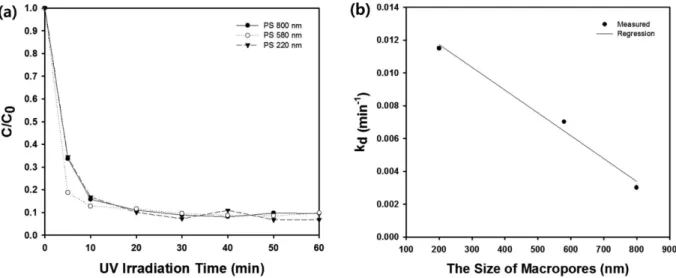
deactivation of the photocatalytic activity during repeated use of the photocatalytic particles in this study. Due to the diluted condition of the organic dye, the decreasing trends of the dimensionless concen- tration of methylene blue were similar for the three kinds of macrop- orous titania microparticles with different macropore sizes (220, 580, and 800 nm) during the first cycle of the photocatalytic decom- position reaction. However, the difference in the rate of the decom- position reaction became larger for the three types of macroporous titania microparticles from the second cycle of the UV-assisted wastewa- ter treatment. This indicates that the photocatalytic deactivation depends strongly on the size of the macropores. To confirm this, the reduction of the photocatalytic activity was plotted as a function of UV irradiation time, using the exponentially decaying function with a0 and kd values of 0.9461 and 0.0115, respectively. The results show that poisoning of the photocatalytic particles became serious as the size of the macropores decreased from 800 to 220 nm. This trend is
presented in the graph shown in Fig. 5(b) where the retardation con- stant kd is plotted as a function of the size of macropores in the porous titania particles having the pore diameter of 200 nm shown in the SEM image of Fig. 5(a). As the pore size decreased, the retarda- tion constant kd decreased linearly, as shown in the graph in Fig. 5(b).
Since the mass transfer of dye molecules between the bulk solution phase and the surface of the porous particles can be inhibited through the narrow channels generated by smaller macropores, the decreas- ing behavior of kd as a function of the diameter of the macropores can be explained qualitatively. It is thus advantageous to use porous titania particles with larger macropores when the photocatalytic par- ticles are used repeatedly during the water treatment process, although the porous particles with larger macropores are less effective for remov- ing dye molecules in the first photocatalytic decomposition step with a relatively high concentration of the organic contaminant [13].
The deterioration of the photocatalytic activity of the macropo- Fig. 4. (a) Scanning electron microscope image of porous titania microparticles having macropores with 220 nm diameter. Scale bar indicates
3 µm. (b) The change of concentration of methylene blue as a function of UV irradiation time during recycling of the photocatalytic particles. (c) The change of the initial rate of the decomposition reaction of methylene blue (a/a0) as a function of UV irradiation time.
(d) Size distribution of macroporous titania microparticles in Fig. 4(a).
Fig. 5. (a) The change of dimensionless concentration of methylene blue as a function of UV irradiation time during the first cycle of the pho- tocatalytic decomposition. Three types of macroporous titania microparticles having macropores with diameter of 220, 580, and 800 nm were used as photocatalytic particles. (b) The change of deactivation constant of the porous titania microparticles as a function of the size of the macropores.
Fig. 6. (a) Scanning electron microscope image of titania microspheres synthesized by emulsion-assisted self-assembly. Scale bar indicates 500 nm.
(b) The change of the concentration of methylene blue as a function of UV irradiation time during recycling of the photocatalytic particles.
(c) The change of the initial rate of the decomposition reaction of methylene blue (a/a0) as a function of UV irradiation time. (d) Size distribution of titania microspheres.
rous titania microparticles with small macropores can be explained by the decrease of the active radicals generated by the photocatalytic mechanism during UV irradiation due to the increase of the adsorbed amount of organic molecules on the particles that block the surface of the porous particles and hinder splitting of the electrons and holes from the titania surface.
In addition to the macroporous titania microparticles, titania microspheres synthesized by the same emulsion-assisted self-assem- bly scheme without using polystyrene nanospheres were also adopted as photocatalytic particles in a slurry-type reactor to investigate the decrease of the photocatalytic activity during recycling. When tita- nia microspheres without macropores, shown in the SEM image of Fig. 6(a), were used as a photocatalyst, the removal of the organic dye, methylene blue, was not as effective as the results from the porous titania particles. This is a result of the amount of hydroxyl radicals generated by the photocatalytic effect under UV irradiation not being sufficient for the complete removal of the dye molecules due to the decreased surface area of the nonporous titania micro- spheres compared to that of the macroporous titania shown in the SEM images of Figs. 2(a), 3(a), and 4(a). This can be confirmed from the graph in Fig. 6(b) showing the change of the dimensionless concentration (C/C0) as a function of UV irradiation time during four repeated cycles. From the initial reaction rate obtained from each cycle, the dimensionless value of the initial reaction rate a was plot- ted as a function of UV irradiation time, and the regression curve was obtained by using Equation (2), as displayed in the graph in Fig. 6(c).
In this case, the values of a0 and kd were estimated as 1.0181 and 0.0026125, respectively, and the deactivation constant of titania microspheres was thereupon predicted to be much lower compared to that of macroporous titania microparticles. It is thought that the photocatalytic activity of titania microspheres decreased slowly compared to the decay rate from the macroporous particles, since the adsorbed organic molecules on the surface of the microspheres can be desorbed more easily compared to the macroporous titania micro- particles having more complicated surface morphologies.
The size distribution of the titania microspheres is displayed in Fig. 6(d), which shows the average particle size is 270 nm. Since polystyrene nanospheres were not included during self-assembly, the mean diameter of the particles decreased compared to the size of the macroporous titania microparticles.
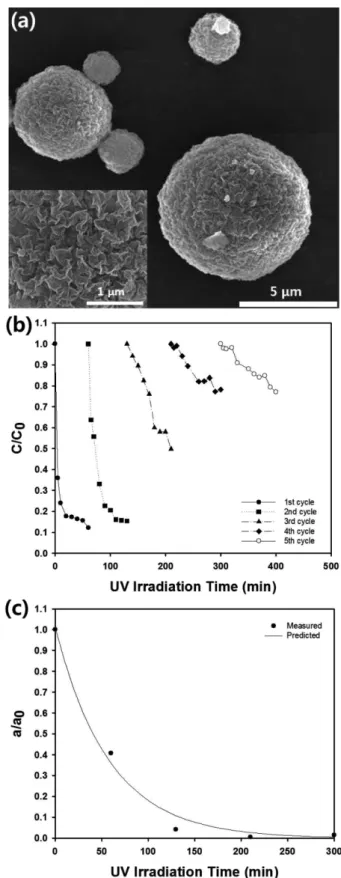
In addition to evaluating porous titania particles, the recycling effi- ciency of composite microparticles of silica-CNT containing titania nanoparticles was also studied by measuring the concentration of organic contaminant as a function of UV irradiation time during the water purification process. The photocatalytic particles were fabri- cated by mixing an aqueous sodium silicate solution (water glass), CNT dispersion, and titania nano-colloid at a volume ratio of 3:1:2 during the preparation step. The morphology of the composite microparti- cles was porous spherical particles of silica containing CNTs and titania nanoparticles, as shown in the SEM image in Fig. 7(a). Due to the inward capillary pressure acting on shrinking water droplets, the
Fig. 7. (a) Scanning electron microscope image of porous silica-CNT microspheres containing titania nanoparticles. Scale bar indi- cates 5 µm. The volume ratio of aqueous sodium silicate solu- tion, CNT dispersion, and titania nano-colloid was 3:1:2 during the preparation of the porous particles. (b) The change of concentration of methylene blue as a function of UV irradi- ation time during recycling of the photocatalytic particles.
(c) The change of the initial rate of the decomposition reac- tion of methylene blue (a/a0) as a function of UV irradia- tion time.
resulting spherical particles showed porous surface morphology as a result of the folding and crumpling of the thin silica layer formed by condensation of silicic acid obtained from water glass dissolved in emulsion droplets. The morphology of the porous surface of spheri- cal silica-CNT-titania can be observed from the inset SEM image in Fig. 7(a), which indicates that droplet shrinkage took place simulta- neously during the condensation reaction of the silica precursor.
The results illustrating the photocatalytic decomposition of meth- ylene blue during five repeated cycles are presented in the graph in Fig. 7(b) as a function of the UV irradiation time. They indicate that the removal of the organic contaminant became difficult with repeated cycles, since the initial removal rate a of methylene blue decreased exponentially as a function of UV irradiation time, as shown in the graph in Fig. 7(c). The experimental data could be fitted using the exponential function in Equation (1) with a0 and kd values of 1.0096 and 0.0172, respectively. Compared to the retardation constant of macroporous titania microparticles, the kd value of porous silica- CNT microspheres containing TiO2 nanoparticles was estimated to be much larger, since only a small portion of the surface of the micro-
spheres is covered with titania nanoparticles, whereas the whole sur- face of porous titania shown in the SEM images in Figs. 2(a), 3(a), and 4(a) is composed of the photocatalytic material. Thus, the photo- catalytic activity of the composite microspheres shown in the SEM image in Fig. 7(a) decreased much more rapidly than the deactiva- tion rate of the macroporous titania particles and the titania micro- spheres.
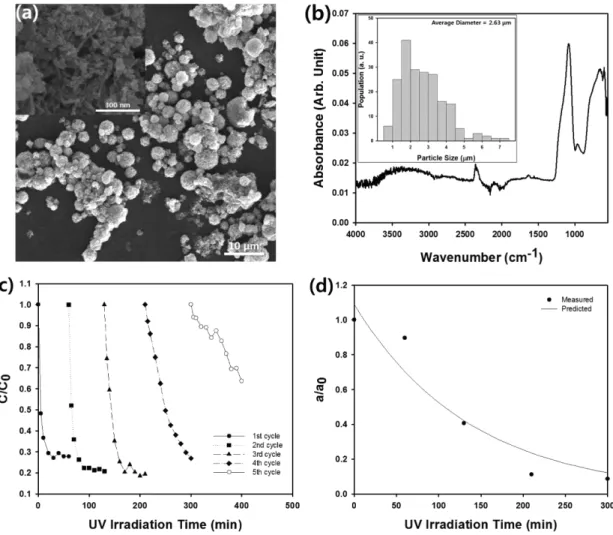
To enhance the recyclability of the porous spherical silica-CNT composite microparticles containing TiO2 nanoparticles, their syn- thesis conditions were adjusted by changing the mixing composition to aqueous sodium silicate solution, CNT dispersion, and titania nano-colloid with a volume ratio of 3:3:2. Fig. 8(a) presents an SEM image of the resulting particles, which were used as a photocatalyst to examine the recycling efficiency during the photocatalytic decom- position reaction. Although morphology of the particles was similar to the results displayed in the SEM image of Fig. 7(a), the nanostruc- ture of CNTs could be observed from the surface of the porous parti- cles. This indicates that an excess amount of CNTs was well-organized with other materials, such as silica and TiO2 nanoparticles, as dis-
Fig. 8. (a) Scanning electron microscope image of porous silica-CNT microspheres containing TiO2 nanoparticles. Scale bar indicates 10 µm.
The volume ratio of aqueous sodium silicate solution, CNT dispersion, and titania nano-colloid was 3:3:2 during the preparation of the porous particles. (b) FT-IR analysis results of porous silica-CNT microspheres containing TiO2 nanoparticles. The inset figure shows the size distribution of the particles. (c) The change of concentration of methylene blue as a function of UV irradiation time during recycling of the photocatalytic particles. (d) The change of the initial rate of the decomposition reaction of methylene blue (a/
a0) as a function of UV irradiation time.
played in the inset SEM image in Fig. 8(a). To confirm the existence of CNTs and TiO2 nanoparticles inside the composite microspheres shown in Fig. 8(a), an FT-IR analysis was , and the analysis results are provided in Fig. 8(b). From the sample, the characteristic peaks of silica can be found at wavelengths of 450 and 800 cm-1, which are assigned to rocking and bending vibration of the Si-O bond, respec- tively. The inclusion of TiO2 nanoparticles also can be confirmed from the FT-IR data at wavelengths of 621, 594, and 549 cm-1, indi- cating that photocatalytic materials were successfully prepared [14].
The existence of CNTs inside the particles can be also confirmed by the peak at a wavelength of 1,582 cm-1 due to C-O stretching vibra- tion, indicating that CNTs are in an oxidized state [15]. The inset graph in Fig. 8(b) presents the size distribution of the composite par- ticles with the average diameter of the particles being 2.63 μm, which is comparable to the size of the macroporous titania microparticles.
When the amount of CNTs in porous silica-CNT microspheres containing TiO2 nanoparticles increased, the removal rate of the organic dye was improved during the repeated water purification process, as shown in the graph in Fig. 8(c). For this sample, the ini- tial rate constant of the decomposition reaction was estimated assuming first-order kinetics, and plotted with curve fitting, as dis- played in the graph in Fig. 8(d). The regression was performed using the exponentially decaying function with a0 and kd having values of 1.0888 and 0.0073025, respectively. Thus, it was confirmed that the recycling efficiency during the water treatment process was enhanced as the concentration of carbon nanotubes increased in the porous com- posite particles. Since the conductive nature of CNTs promotes the splitting of electrons and holes from the titania surface under UV irradiation, the photocatalytic activity can be maintained during repeated use of the photocatalytic particles having an excess amount of CNTs [16]. In addition, the photocatalytic activity can be increased and maintained during repeated cycles, since the CNTs have photo- catalytic activity [17].
Various parameters such as the apparent rate constant kr and the retardation constant kd were adjusted to predict the change of the concentration of organic contaminants (C/C0) dissolved in an aque- ous medium by photocatalytic decomposition, using the first-order reaction kinetics. The degradation of the photocatalytic activity during a water treatment process was also considered using the deg- radation constant kd in the rate equation of the first-order reaction according to the following equation, which can be obtained by com- bining Equations (1) and (2).
(3)
Here, kr denotes the apparent rate constant of the photocatalytic decomposition reaction, when the deactivation of the photocata- lytic particles is neglected. C stands for the concentration of the reactant, in this case dye molecules, dissolved in an aqueous medium.
The reduction of the apparent rate constant due to the deactivation of the photocatalytic particles with increasing reaction time is
included in the above equation by multiplying the term a0 exp(-kdt).
When the photocatalytic activity of particles is degraded seriously as a function of the reaction time, the retardation constant kd has a large value, which corresponds to a small time constant, as mea- sured in this study for the macroporous titania microparticles and presented in Table 1. Ideally, ao should be 1, whereas the value deviated slightly from unity, since the experimental data are not fit perfectly by an exponentially decaying function during the regression of the initial reaction rate.
Equation (3) was solved by Dutta using the Runge-Kutta method to study the photocatalytic deactivation of commercial titania nanoparti- cles to decompose an organic dye, Reactive Red 198, in an aqueous medium [18]. In his batch type photocatalytic reactor, the term kd
was estimated as 0.1034 min-1, which is much larger compared to our result. This indicates that the photocatalytic deactivation of nanoparticles is a much more serious phenomenon compared to the case of porous particles.
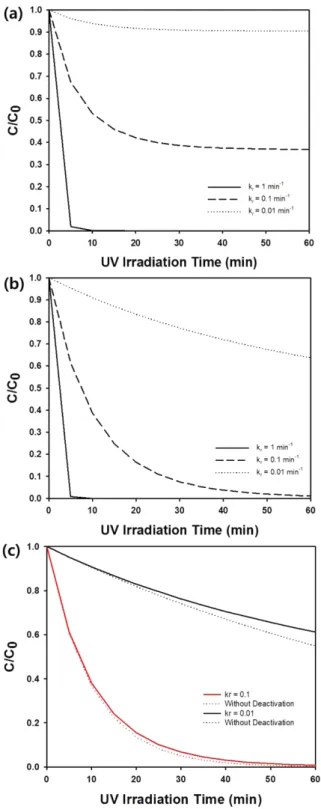
To obtain the solution C/C0, the above equation can be solved ana- lytically in the following form, and the results can be plotted as a function of UV irradiation time, as shown in the graphs in Figs. 9(a) and 9(b).
(4)
Fig. 9(a) presents the change of the dimensionless concentration (C/C0) as a function of the UV irradiation time for kr = 0.1 min-1 and kd = 0.01 min-1. Due to the relatively large value of the retardation constant kd, the dimensionless concentration decreased to about 0.4, when the apparent rate constant was 0.1 min-1, as shown in the graph in Fig. 9(a). However, the dimensionless concentration could be reduced to the desired value close to 0 under the same apparent rate constant, as the retardation constant decreased to 0.01 min-1, as dis- played in the graph in Fig. 9(b). It can then be concluded that the retardation constant kd plays a crucial role for the removal rate of the organic contaminant by the photocatalytic decomposition reaction, since the constant contains the deactivation rate of the photocatalytic particles during the water treatment process.
Neglecting the deactivation of the photocatalytic particles (a = 1), the first-order kinetics can be expressed simply as the following equations:
(5)
(6) In a real situation, the dimensionless concentration of an organic contaminant C/C0 is higher than the result calculated by Equation (6) due to deactivation of the photocatalytic particles during repeated use in the water purification process. Thus, the solution obtained by Equation (4) can be more feasible for predicting the change of the concentration of the organic pollutant during photocatalytic decomposition in a batch-type reactor. Fig. 9(c) shows the change dC
---dt =– akr 0Cexp(–kdt)
( )
⎥⎦
⎢ ⎤
⎣
⎡ − −
= 0exp a0 exp( k t) 1 k
C k
C d
d r
C dt k dC=− r
)
0exp( kt C
C= − r
of the dimensionless concentrations, which were calculated using Equations (4) and (6), as a function of the UV irradiation time.
For comparison, the solutions with and without deactivation of the photocatalytic particles were plotted together for the apparent rate constant kr = 0.1 and 0.01 min-1. For the cases with deactivation, the retardation constant kd was fixed at 0.075 min-1, which is applica- ble to titania nanoparticles as a photocatalyst [17]. When the apparent rate constant was relatively small (kr = 0.01 min-1), the difference between the concentration with and without deactivation became larger as the UV irradiation time increased, whereas the difference was negligible for the case of the larger value of the apparent rate constant (kr = 0.1 min-1), as displayed in the graph in Fig. 9(c). Thus, it can be concluded that the deactivation of the photocatalytic par- ticles is a significant factor for a batch-type photocatalytic reactor system having a relatively small apparent rate constant.
The application of our porous microparticles is not limited to envi- ronmental applications involving water purification. For instance, porous silica microparticles containing CNTs can be potentially applied to energy materials, such as photovoltaic cells and lithium ion batteries, as discussed by other research groups [19,20]. Thus, further studies are under consideration to develop other application areas using the porous particles in this study.
Several methods have been proposed thus far to overcome photo- catalytic deactivation by washing photocatalytic particles with fresh water or hydrogen peroxide solution. Alternatively, high tempera- ture calcination also has been applied to photocatalytic particles for regeneration of the catalytic materials [21]. Through such approaches, the deactivation of the catalyst can be prevented and the removal efficiency of the organic contaminants can be maintained at a high value during repeated cycles of the photocatalytic decomposition reaction. The regeneration of our porous photocatalytic particles for enhancing the removal efficiency of dye molecules is under consid- eration for further study.
Acknowledgments
This research was supported by the Basic Science Research Pro- gram through the National Research Foundation of Korea (NRF) funded by the Ministry of Science, ICT & Future Planning (NRF- 2017R1C1B5017174) and the Priority Research Centers Program through the National Research Foundation of Korea (NRF) funded by the Ministry of Education (NRF-2017R1A6A1A03015562). with This research was supported by Basic Science Research Program through the National Research Foundation of Korea (NRF) funded by the Ministry of Science, ICT & Future Planning (NRF-2017R1C1B5017174), Priority Research Centers Program through the National Research Foundation of Korea (NRF) funded by the Ministry of Education (NRF-2017R1A6A1A03015562), and the Industrial core technology development program (10077545, Development of icephobic coat- ing materials for extreme environment) funded by the Ministry of Trade, industry & Energy (MI, Korea).
Fig. 9. (a) The change of the dimensionless concentration of organic contaminant as a function of UV irradiation time. The appar- ent rate constant kr was changed from 0.01 to 0.1 min-1, whereas the retardation constant kd was fixed at 0.1 min-1, calculated using Equation (4). (b) The change of the dimen- sionless concentration of organic contaminant as a function of UV irradiation time. The apparent rate constant kr was changed from 0.01 to 0.1 min-1, whereas the retardation constant kd was fixed at 0.01 min-1, calculated using Equa- tion (4). (c) The change of dimensionless concentration as a function of UV irradiation time. The results obtained using Equation (4) were calculated assuming kd = 0.075 min-1 and plotted with the graph obtained from Equation (6) for com- parison.
4. Conclusion
Three kinds of porous photocatalytic particles were synthesized from emulsion droplets as micro-reactors combined with evapora- tion-driven self-assembly. The resulting macroporous titania micro- particles, titania microspheres, and porous silica-CNT composite microspheres containing TiO2 nanoparticles were applied to a photo- catalytic decomposition reaction to compare their recycle efficiency during repeated uses in a batch-type photocatalytic reactor. For porous titania microparticles, the recycle efficiency increased as the size of macropores increased, since the mass transfer rate of the adsorbed contaminant can be enhanced on the surface of the porous particles with larger pore size during the photocatalytic decomposi- tion reaction. Since the porous architecture of the photocatalytic par- ticles promotes the adsorption of organic molecules on the particle surface, the generation of active radicals from titania can be hin- dered during the photocatalytic reaction. Thus, the deactivation con- stant of titania microspheres was much smaller than that of porous titania particles. For porous silica microspheres containing CNTs and TiO2 nanoparticles, enhanced recycle efficiency was observed when the amount of CNTs inside the particles was increased, since CNTs promote the splitting of electrons and holes for the generation of active radicals, and the CNTs also have photocatalytic activity, which enhances the maintenance of the photocatalytic activity.
Acknowledgments
This research was supported by Basic Science Research Program through the National Research Foundation of Korea (NRF) funded by the Ministry of Science, ICT & Future Planning (NRF-2017R1C1B5017174), Priority Research Centers Program through the National Research Foundation of Korea (NRF) funded by the Ministry of Education (NRF-2017R1A6A1A03015562), and the Industrial core technology development program (10077545, Development of icephobic coat- ing materials for extreme environment) funded by the Ministry of Trade, industry & Energy (MI, Korea).
Notations
C : concentration of organic dyes t : UV irradiation time
kr : apparent rate constant a : catalyst activity a0 : initial catalyst activity
kd : deactivation constant of photocatalyst
References
1. Kant, R., “Textile Dying Industry an Environmental Hazard,”
Natural Sciences, 4(1), 22-26(2012).
2. Jin, Y. Z., Zhang, Y. F., and Li, W., “Microelectrolysis Technol-
ogy for Industrial Waste Water Technology,” J. Environ. Sci., 15(3), 334-338(2003).
3. Yagub, M. T., Sen, T. K., Afroze, S., and Ang, H. M., “Dye and Its Removal From Aqueous Solution by Adsorption: A Review,”
Adv. Colloid Interf. Sci., 209, 172-184(2014).
4. Tichonovas, M., Krugly, E., Racys, V., Hippler, R., Kauneliene, V., Stasiulaitiene, I., and Martuzevicius, D., “Degradation of Various Textile Dyes as Wastewater Pollutants Under Dielectric Barrier Discharge Plasma Treatment,” Chem. Eng. J., 229(1), 9-19(2013).
5. Shah, G. N. and Lemilch, R., “Separation of Dyes in Nonfoam- ing Adsorptive Bubble Columns,” Ind. Eng. Chem. Fundamen- tals, 9(3), 350-355(1970).
6. Chopra, A. K., Sharma, A. K., and Kumar, V., “Overview of Elec- trolytic Treatment: An Alternative Technology for Purification of Waste Water,” Arch. Appl. Sci. Res., 3(5), 191-206(2011).
7. Zacharakis, A., Chatzisymeon, E., Binas, V., Frontistis, Z., Venieri, D. and Mantzavinos, D., “Solar Photocatalytic Degradation of Bisphenol A on Immobilized ZnO or TiO2,” Int. J. Photoenergy, 2013, 1-9(2013).
8. Cho, Y.-S., Oh, I.-A., and Jeong, N. R., “Fabrication of Porous Titania Particles from Water-in-oil Emulsion Droplets for the Application of Photocatalyst,” J. Dispers. Sci. Technol., 37, 676-686(2016).
9. Cloteaux, A., Gérardin, F., Thomas, D., Midoux, N., André, J.-C.,
“Fixed Bed Photocatalytic Reactor for Formaldehyde Degrada- tion: Experimental and Modeling Study,” Chem. Eng. J., 249(1), 121-129(2014).
10. Katz, A., McDonagh, A., Tijing, L. and Shon H. K., “Fouling and Inactivation of Titanium Oxide-based Photocatalytic Systems,”
Crit. Rev. Environ. Sci. Technol., 45(17), 1880-1915(2015).
11. Cho, Y.-S., Shin, C. H. and Han, S., “Dispersion Polymerization of Polystyrene Particles Using Alcohol as Reaction Medium,”
Nanoscale Res. Lett., 11, 46-55(2016).
12. Cho, Y.-S. and Roh, S. H., “Sol-gel Synthesis of Porous Titana Fibers by Electr-spinning for Water Purification,” J. Dispers. Sci.
Technol., 39(1), 33-44(2018).
13. Oh, I.-A., Shin, C. H. and Cho, Y.-S., “Photocatalytic Properties of Spherical Porous Titania Particles Synthesized by Emulsion- assisted Self-assembly,” Korean J. Met. Mater., 54(8), 573-54(2016).
14. Hema, M., Arasi, A. Y. and Anderson, R., “Titania Nanoparticles Synthesized by Sol-gel Technique,” Chem. Sci. Trans., 2(1), 239- 245(2013).
15. Mocan, L., Tabaran, F. A., Mocan, T., Bele, C., Orza, A. I., Lucan, C., Stiufiuc, R., Manaila, I., Iulia, F., Dana, L., Zaharie, F., Osian, G., Vlad, L. and Iancu, C., “Selective Ex-vivo Photothermal Abla- tion of Human Pancreatic Cancer with Albumin Functionalized Multiwalled Carbon Nanotubes,” Int. J. Nanomed., 6, 915-928 (2011).
16. Djokic, V. R. and Janackovic, D. T., “Preparation of TiO2/carbon Nanotubes Photocatalysts: the Influence of the Method of Oxi- dation if the Carbon Nanotubes on the Photocatalytic Activity of the Nanocomposites,” Ceram. Int., 38(8), 6123-6129(2012).
17. Jiang, T. and Yin, H., “Carbon Nanotube/TiO2 Nanotubes Com- posites Photocatalysts for Efficient Degradation of Methyl Orange Dye,” Particuology, 11(6), 737-742(2013).
18. Dutta, S., “Dynamic Simulation of Batch Photocatalytic Reactor (BPR) for Waste Water Treatment,” J. Inst. Eng. Ser. E., 93(1), 25- 30(2012).
19. Gueon, D., Hwang, J. T., Yang, S. B., Cho, E., Sohn, K., Yang, D.-K. and Moon, J. H., “Spherical Macroporous Carbon Nano- tube Particles with Ultrahigh Sulfur Loading for Lithium-sulfur Battery Cathodes,” ACS Nano., 12(1), 226-233(2018).
20. Kim, C., Kim, K. and Moon, J. H., “Highly N-doped Micropo- rous Carbon Nanospheres with High Energy Storage and Con-
version Efficiency,” Sci. Rep., 7, 14400(2017).
21. Ghandi, V. G., Mishra, M. K. and Joshi, P. A., “A Study on Deac- tivation and Regeneration of Titanium Dioxide During Photocat- alytic Degradation of Phthalic Acid,” J. Ind. Eng. Chem., 18, 1902- 1907(2012).