www.kafm.or.kr
610
서 론신체 활동은 심폐 기능, 만성 질환, 근골격계 질환 등의 신체 건강 에 좋은 영향을 미치는 것뿐만 아니라 정신 건강에 미치는 영향도 큰 것으로 알려져 있다. 삶의 질을 중요시하는 현대 사회에서는 정신 건강을 위한 예방 및 치료에 전반적으로 관심이 높다. 정신 질환 중 에서 가장 흔한 우울증은 전 세계적으로 유병률이 점점 높아지는 것으로 알려져 있고 이에 Diagnostic and Statistical Manual of Mental Disorders, Fifth Edition (DSM-5)에서는 기존의 기분 장애로 분류되 었던 부분을 우울 장애로 따로 분류하였다.1) 한국 일반 성인의 주요
정신질환실태를 파악하기 위해 5년마다 실시되는 정신질환실태 역 학조사에 따르면 2011년 보고 시 우울증의 평생 유병률이 6.7%에 달 하였으며 기존의 조사에 비해 높아졌다.2)
약물 치료를 하는 경우에도 비약물적 방법을 병행하며 그 중 많 이 행해지는 것 중의 하나가 운동이다. 운동이 우울증에 미치는 영 향에 대한 연구는 1세기 이상 전부터 존재하였다.3) 신체 활동과 임상 적 우울증에 관련된 광범위한 메타 분석 연구들 또한 많이 보고되 어 왔으며,4-9) 신체 활동이 우울증 예방에 있어 효과적이라는 종단
연구도 있다.10,11) 우울증을 가진 사람이 그렇지 않은 사람에 비해 활
동적이며 유산소 운동이 증가할수록 우울 증상이 뚜렷이 감소하는 Received May 2, 2016 Revised October 25, 2016
Accepted October 25, 2016 Corresponding author So-Hee Kim Tel: +82-32-509-5555, Fax: +82-32-517-4814 E-mail: [email protected]
Copyright © 2017 The Korean Academy of Family Medicine
This is an open-access article distributed under the terms of the Creative Commons At- tribution Non-Commercial License (http://creativecommons.org/licenses/by-nc/4.0) which permits unrestricted noncommercial use, distribution, and reproduction in any medium, provided the original work is properly cited.
Brief
Communication
https://doi.org/10.21215/kjfp.2017.7.4.610 eISSN 2233-9116
Korean J Fam Pract. 2017;7(4):610-613
Korean Journal of Family Practice
KJFP
신체 활동과 우울증의 연관성: 국민건강영양조사 2014년 자료 이용
김소희*, 전무경, 강병두
부평세림병원 가정의학과
Associations between Physical Activity and Depression: Korean National Health and Nutrition Examination Survey 2014
So-Hee Kim*, Mu-Kyung Jeon, Byeong-Du Kang
Department of Family Medicine, Bupyeong Serim Hospital, Incheon, Korea
Background: In modern societies, depression is a significant public disease, and the importance of physical activity to prevent and recover from depression has been widely known. The aim of this study was to investigate the association between physical activity categories and depression.
Methods: We analyzed data of 3,739 participants aged 19 to 65 years from the Korean National Health and Nutrition Examination Survey 2014. We divided the participants into depression and non-depression groups according to 9-item Patient Health Questionnaire score and analyzed these scores using t-test and chi-square test. The odds ratio of depression in each physical activity group was calculated using a multivariable logistic regression analysis. Results were controlled for age, sex, income, occupation, sleep hours, stress, body mass index, and self-body cognition.
Results: After adjusting for the risk factors, the odds ratio of depression across the physical activity categories were 2.192 for the high-intensity work- related group (P<0.001), 1.464 for the moderate-intensity work-related group (P=0.001), and 0.812 for the moderate-intensity exercise-related group (P=0.044).
Conclusion: The prevalence of depression increased in the work-related physical activity group and decreased in the exercise-related physical activity group. The findings of this study suggest that exercise-related physical activity has a protective effect against depression.
Keywords: Physical Activity; Patient Health Questionnarie-9; Depression
www.kafm.or.kr 김소희 외. 국민건강영양조사를 이용한 신체 활동과 우울증의 연관성
Korean J Fam Pract. 2017;7(4):610-613
611
Korean Journal of Family Practice
KJFP
것으로 나타나지만 지속적으로 하는 일상적인 신체 활동은 우울 증 상의 예방에 효과가 없고 우울증과 관련된 증상이 오히려 증가하는 것으로 나타났다.12)
이에 본 연구는 신체 활동을 분류하여 일상적인 일과 관련된 신 체 활동과 여가 및 운동에 관련된 신체 활동이 우울증과 어떤 관련 성이 있는지에 대하여 국민건강영양조사 자료를 바탕으로 연구해 보고자 하였다.
방 법
1. 연구 대상자
본 연구는 제6기 2차년도(2014년) 국민건강영양조사 자료를 분석 하였다. 조사에 참여한 7,550명 중 만 19세 미만 1,574명과 만 66세 이 상 1,474명을 제외하였다. 2014년도에 추가된 조사 항목인 우울증 선 별도구 9-item Patient Health Questionnaire (PHQ-9) 항목에 모름 또 는 무응답으로 기재한 727명을 제외하였고, 또한 2014년도에 추가된 신체 활동 세분화 항목을 비롯한 본 연구에 필요한 다른 항목들에 모름 또는 무응답으로 기재한 36명을 제외하여 총 3,739명을 연구 대 상으로 하였다.
2. 연구 변수 측정
건강설문 조사표를 통해 평소 신체 활동과 PHQ-9 score를 조사하 였다. 나이, 성별, 거주지역, 교육수준, 직업유무, 소득수준, 평균 수면 시간, 스트레스, 자기체형 인식, 체질량 지수(body mass index, BMI;
kg/m2), 흡연, 음주 등을 변수로 고려하였다. 신체 활동은 고강도와 중강도로 나누어 고강도 활동은 격렬한 신체 활동으로 숨이 많이 차거나 심장이 매우 빠르게 뛰는 활동으로 정의하고, 중강도 활동은 중간 정도의 신체 활동으로 숨이 약간 차거나 심장이 약간 빠르게 뛰는 활동으로 정의하였다. 고강도와 중강도의 신체 활동에서 각각 일에 관련된 활동과 여가 및 운동에 관련된 활동으로 나누어 각각 의 여부를 질문하였다. PHQ-9는 주요우울장애의 선별 도구로 널리 쓰이고 있으며 민감도와 특이도가 높은 것으로 알려져 있다. 우울한 기분, 일에 대한 흥미나 즐거움의 감소, 체중이나 식욕의 심한 변화, 수면장애, 안절부절못하거나 둔하고 느려짐, 기억력 감소, 에너지가 부족하고 피로감, 무가치감이나 부적절한 죄책감, 죽음이나 자살 생 각의 9가지 문항으로 구성되어 있다.13) 각 항목에 0점에서 3점씩 총 0 점에서 27점으로 합산하였으며, 우울증으로 판단할 수 있는 5점을 기준으로 하였다. 거주지역은 동과 읍, 면으로 분류하여 도시와 시골 로 구분하였으며 교육수준은 2/3년제 대학 재학 이상을 고학력으로 구분하였다. 소득수준은 사분위로 구분하여 하위 1분위를 기준으
로 분류하였다. 평균 수면시간은 7시간 이상과 미만으로 나누었으며 스트레스는 없음, 약간 있음과 많이 있음, 아주 많이 있음을 기준으 로 하위와 상위로 구분하였다. 자기체형 인식은 매우 비만 항목으로 기재한 경우와 나머지로 구분하였다. 가벼운 옷차림으로 신발을 벗 은 후 키(m)와 체중(kg)을 측정하였고, BMI는 체중을 키의 제곱으로 나누어 계산하였으며 BMI 25 kg/m2 이상을 비만군으로 구분하였다.
흡연은 현재 흡연자와 비흡연자로 구분하였고, 음주는 한달에 한 번 이상 음주와 비음주로 구분하였다.
3. 통계 분석
연구 대상자의 기본 특성은 평균과 표준편차, 또는 비율(%)로 표 시하였으며, 우울증 유무에 따른 기본 특성의 차이에서 연속형 변 수는 독립 t-검정, 범주형 변수는 카이 제곱 검정을 사용하였다 신체 활동 정도와 우울증 발생 위험 간의 관계는 다변량 로지스틱 회귀분 석을 사용하였다. 분석모형 1에서는 나이와 성별을 보정하였고 분석 모형 2에서는 나이, 성별에 더하여 직업유무, 소득수준을 보정하였 으며 분석모형 3에서는 분석모형 2에서 보정한 항목에 더하여 수면 시간, 스트레스, BMI, 자기체형 인식을 보정하였다. 모든 통계적 분석 은 IBM SPSS ver. 24.0 (IBM Co., Armonk, NY, USA)을 이용하였으며, P 값이 0.05보다 작은 경우에 통계적으로 유의한 것으로 정의하였다.
결 과
1. 연구 대상자의 기본적 특성
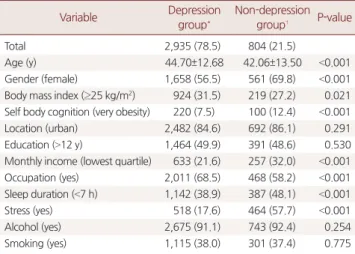
Table 1은 연구 대상자의 기본적 특성을 나타내었다. 대상자 3,739 명 중 PHQ-9 score 5점 이상(우울증군)은 총 804명(21.5%)이었고, 5점
Brief
Communication
Korean Journal of Family Practice
Table 1. General characteristics of subjects according to PHQ-9 score
Variable Depression
group*
Non-depression group† P-value
Total 2,935 (78.5) 804 (21.5)
Age (y) 44.70±12.68 42.06±13.50 <0.001
Gender (female) 1,658 (56.5) 561 (69.8) <0.001
Body mass index (≥25 kg/m2) 924 (31.5) 219 (27.2) 0.021 Self body cognition (very obesity) 220 (7.5) 100 (12.4) <0.001
Location (urban) 2,482 (84.6) 692 (86.1) 0.291
Education (>12 y) 1,464 (49.9) 391 (48.6) 0.530 Monthly income (lowest quartile) 633 (21.6) 257 (32.0) <0.001 Occupation (yes) 2,011 (68.5) 468 (58.2) <0.001 Sleep duration (<7 h) 1,142 (38.9) 387 (48.1) <0.001
Stress (yes) 518 (17.6) 464 (57.7) <0.001
Alcohol (yes) 2,675 (91.1) 743 (92.4) 0.254
Smoking (yes) 1,115 (38.0) 301 (37.4) 0.775
Values are presented as mean±standard error of number (%). Analyzed by t-test (continuous variable) and by chi-square test (categorical variable).
*9-item Patient Health Questionnaire (PHQ-9) score 0–4; †PHQ-9 score 5–27.
So-Hee Kim, et al. Associations between Physical Activity and Depression
www.kafm.or.kr
612
Korean J Fam Pract. 2017;7(4):610-613Korean Journal of Family Practice
KJFP
미만(비우울증군)은 총 2,935명(78.5%)이었다. 평균 나이는 각각 44.70±12.68세와 42.06±13.50세로 유의하게 차이가 있었다(P<0.001).
여성의 비율은 우울증군에서 유의하게 높았다(P<0.001). BMI에서 비만에 해당하는 비율은 비우울증군에서 더 높았으며(P=0.021) 자 기체형 인식에서 비만에 해당하는 비율은 우울증군에서 더 높았다 (P<0.001). 거주지역, 교육 정도, 흡연, 음주는 두 군에서 유의한 차이 가 없었다(P>0.05). 소득이 낮은 자들, 현재 직업이 없는 자들은 우울 증군에서 비율이 더 높았으며(P<0.001) 수면시간이 7시간 미만과 스 트레스를 받는 자들도 우울증군에서 비율이 더 높았다(P<0.001).
2. 신체 활동과 우울증의 상관 관계
Table 2는 우울증에 영향을 줄 수 있는 다른 변수들을 통제한 상 태에서 신체 활동과 우울증의 관계를 분석한 결과이다. 나이와 성별 을 통제한 분석모형 1에서 우울증은 고강도 일과 교차비 1.868 (95%
CI, 1.235–2.827), 중강도 일과 교차비 1.533 (95% CI, 1.239–1.896)으로 나타나 일과 관련된 신체 활동은 고강도, 중강도 모두 우울증 발생 과 관련성을 보였다(각 P=0.003, P<0.001). 중강도 운동과는 교차비 0.755 (95% CI, 0.626–0.910)로 나타나 일이 아닌 여가나 운동과 관련 된 신체 활동에서는 우울증 발생이 낮아진 것으로 나타났다 (P=0.003). 나이, 성별, 수입, 직업을 통제한 분석모형 2에서도 고강도 일과 교차비 1.967 (95% CI, 1.296–2.983), 중강도 일과 교차비 1.523 (95% CI, 1.229–1.888), 중강도 운동과 교차비 0.763 (95% CI, 0.632–
0.921)으로 나타나 비슷한 결과를 보였고 통계적으로 유의하였다(각 P<0.001, P<0.001, P=0.005). 추가로 수면시간, 스트레스, BMI, 자기체 형 인식을 통제한 분석모형 3에서 우울증은 고강도 일과 교차비 2.192 (95% CI, 1.377–3.488), 중강도 일과 교차비 1.464 (95% CI, 1.158–
1.851), 중강도 운동과 교차비 0.812 (95% CI, 0.662–0.994)로 나타나 분 석모형 1, 2와 큰 차이가 없었고, 역시 통계적으로 유의하였다(각 P<0.001, P=0.001, P=0.044).
고 찰
본 연구는 신체 활동과 우울증의 관련성을 알아보았으며 신체 활 동의 분류에 따라 우울증에 미치는 영향이 서로 다른 결과가 나왔다.
신체 활동이 우울 증상을 어떻게 감소시키는지에 대한 메커니즘 은 엔도카나비노이드 시스템, 뇌의 신경전달물질, 뇌혈류, 항염증성 사이토카인, 시상하부-뇌하수체-부신축(hypothalamic–pituitary–
adrenal axis function) 등의 생화학적, 생리학적인 것으로 해석하는 연
구들이 있다.4,12) 엔토카나비노이드 시스템은 카나비노이드 수용체
로 이루어져 있으며 스트레스에 대한 각종 생리학적 반응들을 방어 해주는 역할을 한다. 운동은 이러한 엔도카나비노이드 시스템을 활 성화시키며 기분을 좋아지게 한다.14) 또한 유산소 운동은 시상하부- 뇌하수체-부신축의 조절에 관련하여 스트레스에 대한 코티졸 반응 을 낮게 만들어 우울증과 관련한 방어효과가 있다.15) 사이토카인은 각종 질환들에서 중요한 역할을 하는 전달 물질인데 염증성 사이토 카인은 우울증을 증가시킬 수 있는 것으로 알려져 있다.16) 규칙적인 운동은 염증성 사이토카인을 감소시키고 근골격계 세포에서 항염 증성 사이토카인의 발현을 증가시켜 우울증을 개선시킬 수 있다.17) 또한 자기 효능감, 성취감, 자부심, 자기결정력 강화 등과 관련있는 심 리학적인 메커니즘 가설에 대한 연구도 있다.6,10,18)
본 연구는 몇 가지 제한점이 있다. 첫째, 전향적 연구가 아니고 단 면 연구에 해당하여 신체 활동과 우울증의 인과 관계를 명확히 설 Table 2. Odds ratio and 95% confidence intervals for depression according to the presence of physical activity
Model Odds ratio (95% confidence interval)
Work 1 Work 2 Exercise 1 Exercise 2
Model 1
Depression (–) 1 1 1 1
Depression (+) 1.868 (1.235–2.877) 1.533 (1.239–1.896) 0.798 (0.622–1.023) 0.755 (0.626–0.910)
P-value 0.003 <0.001 0.074 0.003
Model 2
Depression (–) 1 1 1 1
Depression (+) 1.967 (1.296–2.983) 1.523 (1.229–1.888) 0.825 (0.642–1.060) 0.763 (0.632–0.921)
P-value <0.001 <0.001 0.132 0.005
Model 3
Depression (–) 1 1 1 1
Depression (+) 2.192 (1.377–3.488) 1.464 (1.158–1.851) 0.798 (0.610–1.044) 0.812 (0.662–0.994)
P-value <0.001 0.001 0.100 0.044
Analyzed by multivariable logistic regression analysis after adjusting variables. Model 1 was adjusted for age, gender; Model 2 was adjusted for age, gender, monthly income and occupation; Model 3 was adjusted for age, gender, monthly income, occupation, sleep hours, stress, body mass index and self body cognition.
Work 1, high-intense work; Work 2, moderate-intense work; Exercise 1, high-intense exercise; Exercise 2, moderate-intense exercise.
www.kafm.or.kr 김소희 외. 국민건강영양조사를 이용한 신체 활동과 우울증의 연관성
Korean J Fam Pract. 2017;7(4):610-613
613
Korean Journal of Family Practice
KJFP
명할 수 없다. 둘째, 자가기입식 설문지를 통해 조사한 자료이므로 주 관적이거나 부정확한 응답이 포함되어 있을 수 있다. 셋째, 본인의 의 지와 관계없이 신체 활동을 할 수 없는 다양한 질병들을 가지고 있 는 경우를 고려하지 못하였다. 넷째, 주요우울장애를 진단하는 데 있 어 PHQ-9 score의 cut-off point의 적합성에 관한 연구는 아직 논란이 있다는 점이다.19) 이러한 한계점에도 불구하고 본 연구는 표본자료 로서 신뢰성 있는 국민건강영양조사 자료를 이용한 점과 기존의 국 민건강영양조사 원시자료 연구들은 최근 우울 증상 유무의 한 가지 항목으로만 우울증을 판단하였으나 제6기 2차년도(2014년)부터 추 가된 우울증 선별도구 PHQ-9를 사용하여 우울증 판단을 하였고 세 분화된 신체 활동 항목을 바탕으로 연구했다는 점에서 의미가 있다.
결론적으로 한국 성인에서 신체 활동은 정신 건강과 밀접한 관련 성이 있다. 신체 활동을 좀 더 세분화하고 수치화하여 우울증에 미 치는 영향과 관련된 추가적인 역학적 연구가 필요할 것으로 보인다.
요 약
연구배경:
현대 사회에서 우울증은 중요한 질환이며 우울증 예방 과 회복에 관련하여 신체적인 활동의 중요성은 널리 알려져 있다. 이 에 본 연구는 신체 활동을 분류하여 우울증과의 연관성을 분석해 보고자 하였다.방법:
국민건강영양조사 제 6기 2차년도(2014년)의 만 19세 이상 만 65세 이하의 참여자 중 3,739명을 대상으로 연구하였다. PHQ-9 score 에 근거하여 우울증군과 비우울증군으로 나누고, 이 두 군에 대해 각 요인을 독립 T검정, 카이 제곱 검정으로 분석하였다. 우울증에 영 향을 줄 수 있는 변수들인 나이, 성별, 수입 정도, 직업 유무, 수면시 간, 스트레스, BMI, 자기체형 인식 항목을 혼란 변수로 통제한 후, 다 변량 로지스틱 회귀분석을 사용하여 신체 활동과 우울증 발생 간의 교차비를 구하였다.결과:
혼란 변수를 통제한 후 신체 활동 정도와 우울증을 분석한 결 과, 우울증은 고강도 일과 교차비 2.192 (P<0.001), 중강도 일과 교차 비 1.464 (P=0.001), 중강도 운동과 교차비 0.812 (P=0.044)로 나타났다.결론:
일과 관련된 신체 활동 군에서는 우울증의 유병률이 높았으 며, 여가 및 운동과 관련된 신체 활동 군에서는 우울증의 유병률이 낮았다. 여가 및 운동과 관련된 신체 활동은 우울증에 예방적인 효 과가 있다.중심단어:
신체활동; 한글판 우울증선별도구; 우울증REFERENCES
1. Uher R, Payne JL, Pavlova B, Perlis RH. Major depressive disorder in DSM- 5: implications for clinical practice and research of changes from DSM-IV.
Depress Anxiety 2014; 31: 459-71.
2. Seoul National University College of Medicine. The epidemiological survey of mental disorders in Korea 2011. Sejong: Ministry of Health and Welfare;
2012.
3. Franz SL, Hamilton GV. Effect of exercise upon the retardation in condition of depression. Am J Insanity 1905; 62: 239-56.
4. Deslandes A, Moraes H, Ferreira C, Veiga H, Silveira H, Mouta R, et al. Exer- cise and mental health: many reasons to move. Neuropsychobiology 2009;
59: 191-8.
5. Dunn AL, Trivedi MH, O’Neal HA. Physical activity dose-response effects on outcomes of depression and anxiety. Med Sci Sports Exerc 2001; 33:
S587-97; discussion 609-10.
6. Lawlor DA, Hopker SW. The effectiveness of exercise as an intervention in the management of depression: systematic review and meta-regression analysis of randomised controlled trials. BMJ 2001; 322: 763-7.
7. Craft LL, Landers DM. The effect of exercise on clinical depression and de- pression resulting from mental illness: a meta-analysis. J Sport Exerc Psychol 1998; 20: 339-57.
8. Stathopoulou G, Powers MB, Berry AC, Smits JAJ, Otto MW. Exercise inter- ventions for mental health: a quantitative and qualitative review. Clin Psy- chol Sci Pract 2006; 13; 179-93.
9. Pinquart M, Duberstein PR, Lyness JM. Effects of psychotherapy and other behavioral interventions on clinically depressed older adults: a meta-analy- sis. Aging Ment Health 2007; 11: 645-57.
10. Martinsen EW. Physical activity in the prevention and treatment of anxiety and depression. Nord J Psychiatry 2008; 62 Suppl 47: 25-9.
11. aan het Rot M, Collins KA, Fitterling HL. Physical exercise and depression.
Mt Sinai J Med 2009; 76: 204-14.
12. Paluska SA, Schwenk TL. Physical activity and mental health: current con- cepts. Sports Med 2000; 29: 167-80.
13. Spitzer RL, Williams JBW, Kroenke K, and colleagues (with an education grant from Pfizer Inc.). Patient Health Questionnaire-9 (PHQ-9) [Internet].
2014 [cited 2016 Apr 27]. Available from: http://www.med.cuhk.edu.hk/
eng/students/student_wellness/images/PHQ9.pdf.
14. Raichlen DA, Foster AD, Seillier A, Giuffrida A, Gerdeman GL. Exercise-in- duced endocannabinoid signaling is modulated by intensity. Eur J Appl Physiol 2013; 113: 869-75.
15. Zschucke E, Renneberg B, Dimeo F, Wüstenberg T, Ströhle A. The stress- buffering effect of acute exercise: evidence for HPA axis negative feedback.
Psychoneuroendocrinology 2015; 51: 414-25.
16. Lotrich FE. Inflammatory cytokine-associated depression. Brain Res 2015;
1617: 113-25.
17. Peake JM, Della Gatta P, Suzuki K, Nieman DC. Cytokine expression and secretion by skeletal muscle cells: regulatory mechanisms and exercise ef- fects. Exerc Immunol Rev 2015; 21: 8-25.
18. Daley A. Exercise and depression: a review of reviews. J Clin Psychol Med Settings 2008; 15: 140-7.
19. Moriarty AS, Gilbody S, McMillan D, Manea L. Screening and case finding for major depressive disorder using the Patient Health Questionnaire (PHQ-9): a meta-analysis. Gen Hosp Psychiatry. 2015; 37: 567-76.