서 론
중앙암등록본부 발표에 따르면 2011년 사망원인 중 암 사망률은 27%로 1위를 차지하고 이는 사망원인 중 두 번째인 뇌혈관질환(9.9%) 에 의한 사망률보다 2배 이상의 높은 사망률을 기록했다. 이 중 식생 활 및 생활습관의 서구화로 꾸준히 증가하고 있는 대장암의1) 조발생
률은 10만 명당 56.1명으로 갑상선암(81명/10만 명), 위암(63.1명/10만 명)에 이어 세 번째로 흔하게 발생하였으며 조사망률은 10만 명당 15.3명으로 폐암, 간암, 위암에 이어 4번째로 높았다.1-3) 하지만 대장암 의 5년 생존율은 1996-2000년이 59%였던 것에 비해 2001-2005년에는 68.5%, 2007-2011년까지는 75.8%로 점차 증가하고 있다. 2007년부터 2011년까지 전체 대장암 환자의 5년 상대 생존율은 73.8%로 이를 요
Original Article
무증상 한국 성인에서 Aspartate Aminotransferase/Alanine Aminotranferase 비율과 선종성 대장용종의 관계
류보석, 김은기*, 윤영보, 박찬욱, 박주화, 고 준, 서해원
청주한국병원 가정의학과
The Relationship between Aspartate Aminotransferase/Alanine Aminotranferase Ratio and Adenomatous Colorectal Polyp in Asymptomatic Korean Adults
Bo-Seok Ryu, Eun-Ki Kim*, Young-Bo Yun, Chan-Wook Park, Joo-Wha Park, Jun Ko, Hae-Won Seo
Department of Family Medicine, Hankook General Hospital, Cheongju, KoreaBackground: An adenomatous colorectal polyp is considered a precursor to colon cancer. Therefore, early detection and removal of adenomatous colorectal polyps are important for the prevention of colorectal cancer. This study aimed to analyze the usefulness of the aspartate aminotransferase (AST)/alanine aminotransferase (ALT) ratio as a predictor of adenomatous colorectal polyps.
Methods: We analyzed data for 642 asymptomatic Korean adults who underwent a colonoscopy at a health promotion center in Cheongju between June and December 2013. Chi-square tests and independent t-tests were performed to compare the means and proportions of variables between the groups with or without adenomatous colorectal polyps. Multivariate logistic regression was conducted to assess the correlation between adenomatous colorectal polyps and the AST/ALT ratio.
Results: The prevalence of adenomatous colorectal polyps was 23.1% (n= 148). ALT and gamma glutamyl transferase were significantly higher in the group with adenomatous colorectal polyps (P< 0.001); there was no significant difference in AST (P= 0.92). The prevalence of adenomatous colorectal polyps was higher in the AST/ALT < 1 group (odds ratio, 2.52; 95% confidence interval [CI], 1.01-6.29; P= 0.04). The prevalence of adenomatous colorectal polyps decreased with an increase in the AST/ALT ratio (odds ratio, 0.009; 95% CI, 0.001-0.06; P< 0.001). In the group with a high risk of advanced neoplasia, the AST/ALT ratio was not statistically significant (P= 0.75).
Conclusion: This study demonstrated that an increased prevalence of adenomatous colorectal polyps is associated with a decreased AST/ALT ratio among asymptomatic Korean adults.
Keywords: Aspartate Aminotransferase/Alanine Aminotransferase Ratio; Adenomatous Colorectal Polyp; Advanced Neoplasia
http://www.kafm.or.kr/kjfp.2015.5.3.259pISSN 2233-9019 · eISSN 2233-9116 Korean J Fam Pract. 2015;5(3):259-265
KJFP
Korean Journal of Family PracticeReceived February 27, 2015 Accepted August 28, 2015 Corresponding author Eun-Ki Kim
Tel: +82-43-222-7000, Fax: +82-43-255-7007 E-mail: [email protected]
Copyright © 2015 The Korean Academy of Family Medicine
This is an open-access article distributed under the terms of the Creative Commons At- tribution Non-Commercial License (http://creativecommons.org/licenses/by-nc/3.0) which permits unrestricted noncommercial use, distribution, and reproduction in any medium, provided the original work is properly cited.
Bo-Seok Ryu, et al. AST/ALT Ratio and Adenomatous Colorectal Polyp
Korean Journal of Family Practice
KJFP
약 병기별로 살펴보았을 때 암이 발생한 장기를 벗어나지 않은 국한 성인 경우에 93.8%, 주위 장기나 인접조직 또는 림프절을 침범한 국 소 진행형 대장암은 57%, 발생 장기 외 다른 부위에 전이된 경우에 5.8%로 암의 병기가 진행될수록 5년 상대 생존율이 감소하는 것을 알 수 있다.3)
대장암의 발생에는 크게 두 가지 학설이 받아들여지고 있으며 선 종성 용종에서 악성화한다는 adenoma-carcinoma sequence와 선종 조직이 없는 대장점막에서 직접적으로 침습이 이루어져 발생한다는 de novo theory가 있다. 이처럼 대장암은 용종의 형태를 취하지 않고 서도 발생할 수 있으나 대부분의 경우에 샘종-암화 과정을 거치고4-6) 조기진단이 생존율 향상에 미치는 영향이 크기 때문에 전암 병소인 샘종을 제거해주거나 대장용종 발생 위험인자들을 파악하는 것은 대장암의 예방에 있어서 매우 중요한 의미를 갖는다.
대장암의 선별검사는 대변잠혈검사, 이중강조 대장조영술, 가상 대장내시경(computed tomography angiography) 및 대장내시경이 이 용되고 있으며, 이 중 내시경적 검사는 대장을 직접 관찰하여 정확한 검사가 가능할 뿐만 아니라 조직검사 및 치료적 시술이 가능한 장점 이 있다.1) 대장용종의 발생 위험인자로는 비만, 음주, 흡연, 신체활동 부족, 고혈당, 고중성지방혈증, 연령 등이 있다.7-13) 또한 비만과 당대사 이상, 고혈압, 고중성지방혈증 등을 특징으로 하는 대사증후군14-16) 과 대사증후군의 간발현으로 여겨지는 비알콜성 지방간질환이 대 장용종의 유병과 관련이 있으며,17) 대사증후군과 alanine aminotrans- ferase (ALT)와 aspartate aminotransferase/ALT (AST/ALT) ratio가 유의 한 상관관계가 있다는 연구결과가 있다.18)
본 연구는 이러한 결과들을 토대로 일차 진료 및 건강검진상 흔하 게 접할 수 있는 간효소 수치 및 AST/ALT 비율과 선종성 대장용종과 의 상관관계를 살펴보고, 진행생성물 발생의 고위험군과의 관계를 분석하여 선종성 용종발생 예측에 있어서 AST/ALT 비율의 유용성 에 대해 알아보고자 하였다.
방 법
1. 연구대상
2013년 6월부터 12월까지 청주 한국병원 검진센터에서 대장내시 경검사를 시행한 무증상 성인 768명 중 대장암으로 진단된 1명과 간 질환의 과거력을 가진 8명, hepatitis B surface antigen 양성자 및 anti- hepatitis C virus 양성인 30명과 Aronchick Bowel Preparation Scale상 4-5점에 해당하는 장 정결이 불량하여 재검사가 필요한 87명을 제외 한 642명을 대상으로 하였다.
2. 연구방법
키, 체중은 가벼운 가운만을 착용한 채로 측정했으며 체중(kg)을 신장(m)의 제곱한 값으로 나누어 체질량지수(body mass index, BMI) 를 산출하였고, 허리둘레(waist circumference)는 직립상태에서 숨을 편안히 내쉰 후 최하위늑골과 장골능 중간 부위를 0.1 cm 단위까지 측정하였다. 과거력 및 현병력, 흡연 유무, 음주, 신체활동 정도를 파 악하기 위한 설문은 가정의학과 전공의들이 1:1로 문진하였다. 흡연 은 흡연 중인 군, 중단한 군, 흡연을 한 적이 없는 군으로 나누었고, 음 주항목은 술의 종류와 상관없이 하루 평균 30 g 이상의 알코올을 섭 취한 군과 30 g 미만으로 섭취한 군으로 분류하였으며, 신체활동은 평소보다 숨이 더 찰 정도의 활동을 하루 30분 이상 시행한 날이 주 당 3일 이상인 군과 3일 미만인 군으로 나누었다. 혈압은 5분 이상 휴 식을 취한 후 Baumanometer Standby 0250 model (WA Baum Co., Co- piague, NY, USA)로 측정하였고, 혈청학적 검사는 8시간 이상 금식 후 채혈하여 Toshiba TBA-200FR (Toshiba Medical Systems Co. Ltd., To- kyo, Japan) 기기로 분석하였다.
대장내시경검사는 CF-Q150L이나 CF-Q150I (Olympus Optical Co.
Ltd., Tokyo, Japan)로 4명의 가정의학과 전문의들이 맹장 및 말단 회 장부까지 관찰하였으며, 진행신생물 발생의 고위험군은 (1) 선종성 용종의 개수가 3개 이상, (2) 10 mm 이상의 선종성 용종, (3) 조직검사 상 관상융모상 또는 융모상 선종, (4) 고도이형성을 동반한 선종성 용 종, 또는 10 mm 이상의 톱니모양용종 중 한 가지 이상의 소견이 진단 된 경우19)로 하였다.
3. 통계분석
통계프로그램은 SPSS ver. 13.0 (SPSS Inc., Chicago, IL, USA)을 이용 했다. 일반적 특성 및 혈액검사상의 특성은 평균± 표준편차와 빈도 (백분율)로 표시하였다. 선종성 용종 보유군과 선종성 용종이 없는 군, AST/ALT 비율이 1 이상인 군과 1 미만인 군, 이들 군들 간의 차이 를 chi-squre test와 independent t-test로 분석하였고, 단변량분석에서 유의한 인자들에 대해 multivariate logistic regression을 이용해 교차 비와 통계적 유의성을 확인하였다. P-value가 0.05 미만인 항목에 대 해 통계적으로 유의하다고 판단하였으며 유의수준은 95%로 하였다.
결 과
1. 연구대상자들의 일반적 특성
대상자 642명 중 용종이 발견된 대상자는 319명(49.7%)이었고, 이 들 중 선종성 용종 보유군은 148명(46.4%)이었다. 성별은 남성(61.1%) 이 여성(38.9%)보다 많았고 평균 연령은 48.48±10.405세였다. 흡연을
류보석 외. AST/ALT 비율과 선종성 대장용종 Korean Journal of Family Practice
KJFP
한 적이 없는 군이 51.2%, 중단한 군이 20.2%, 흡연 중인 군이 28.5%였 고, 알코올을 30 g/일 이상 섭취군은 87명(13.6%)이었고 30 g/일 미만 섭취군은 555명(86.4%)이었다. 신체활동은 평소보다 숨이 더 찰 정도 의 중간 정도 이상의 활동을 3일/주 이상 하는 군이 38.3%, 3회 미만 인 군이 61.7%였다. BMI는 23.75±3.13 kg/m2, 허리둘레는 82.15±9.314 cm였다.
혈청학적 검사의 평균은 AST 30.11±17.395 IU/L, ALT 29.3±19.124 IU/L, gamma glutamyl transferase (γGTP) 42.92±48.766 IU/L였고, total cholesterol은 204.41±36.531 mg/dL, low density lipoprotein (LDL) cho- lesterol 129.64±33.95 mg/dL, triglyceride (TG) 110±75.078 mg/dL, fast- ing blood sugar (FBS)는 98.65± 20.786 mg/dL, uric acid 5.36±1.397 mg/
dL였다. Systolic blood pressure (SBP)는 115.2±11.396 mm Hg, diastolic blood pressure (DBP)는 73.75±8.323 mm Hg로 측정되었다(Table 1).
2. 선종성 용종 보유군의 특성
선종성 용종 보유군은 148명으로 유병률은 23.1%였다. 성별에 따 라 남성에서 74.3%, 여성에서 25.7%로 선종성 용종이 없는 군(남성 57.1%, 여성 42.19%)에 비해 남성의 비율이 더 높았으며(P<0.001), 선 종성 용종 보유군의 평균 나이는 53.98±10.451세로 대조군(46.83±
9.819세)에 비해 많았다(P<0.001).
선종성 용종 보유군에서 흡연군(38.5%) 및 금연군(31.1%)의 비율이 대조군(25.5%, 17.0%)보다 많았고(P<0.001), 30 g/일 이상 음주군의 비 율도 선종 보유군(24.3%)에서 대조군(10.3%)보다 유의하게 높았다 (P<0.001). 신체활동은 선종 보유군에서 3회/주 이상 운동하는 비율 (27.7%)이 대조군(41.5%)에 비해 낮았다(P= 0.002). 허리둘레는 선종 성 용종 보유군이 83.7±9.48 cm로 대조군(81.68±9.223 cm)에 비해 높 았으나(P= 0.021), BMI 항목은 통계적으로 유의하지 않았다.
AST의 평균 수치는 유의한 차이가 없었으나, ALT와 γGTP는 선종 성 용종 보유군에서 각각 35.58± 23.443 IU/L, 55.61±65.737 IU/L로 대 조군(27.42±17.212 IU/L, 39.12±41.721 IU/L)에 비해 높았다(P<0.001).
AST/ALT 비율은 선종성 용종 보유군에서 0.833 ± 0.234로 대조군 (1.268± 0.465)에 비해 낮게 나왔다(P<0.001). 선종성 용종 보유군에 서 AST/ALT 비율이 1 이하인 대상자는 81.8%로 대조군(25.7%)에 비 해 많았다(P<0.001). FBS는 선종성 용종 보유군에서 102.79± 28.99 mg/dL로 97.40 ±17.449 mg/dL인 대조군에 비해 유의하게 높았다 (P= 0.03). Total cholesterol, HDL, LDL, TG, uric acid, high sensitive C- reactive protein, SBP 및 DBP는 통계적으로 유의한 차이를 보이지 않 았다(Table 2).
3. Aspartate Aminotransferase/Alanine Aminotransferase 비율이 1 이상인 군과 1 미만인 군의 임상적 차이
AST/ALT 비율이 1 미만인 군에서 남성, 흡연, 30 g/일 이상의 알코 올을 섭취하는 군의 비율이 1 이상인 군에 비해 유의하게 높았다. 또 한 BMI, 허리둘레, ALT, γGTP, LDL cholesterol, TG, FBS, uric acid 수치 가 유의하게 높았다. AST/ALT 비율이 1 미만인 군에서 선종성 용종 보유군의 비율은 48.8%로, 이는 1 이상인 군에서 선종성 용종을 가 진 대상자의 비율(6.9%)보다 유의하게 높았다(P<0.001) (Table 3).
4. Aspartate Aminotransferase/Alanine Aminotransferase 비율과 선종성 대장용종과의 관계
단변량분석에서 선종성 대장용종의 유병과 유의한 것으로 분석 Table 1. The general characteristics of study subjects
Characteristic Category Total (N= 642)
Gender Male 392 (61.1)
Female 250 (38.9)
Age (y) 48.48± 10.405
Smoking Non-smoker 329 (51.2)
Current smoker 183 (28.5)
Ex-smoker 130 (20.2)
Alcohol drinking <30 g/d 555 (86.4)
≥ 30 g/d 87 (13.6)
Exercise (frequency/wk) <3 396 (61.7)
≥ 3 246 (38.3)
Body mass index (kg/m2) 23.758± 3.130
Waist circumference (cm) 82.15± 9.314
AST (IU/L) 30.11± 17.395
ALT (IU/L) 29.30± 19.124
Gamma glutamyl transferase (IU/L) 42.92± 48.766
AST/ALT ratio 1.167± 0.461
AST/ALT ratio <1 248 (38.6)
≥ 1 394 (61.4)
Total cholesterol (mg/dL) 204.41± 36.531
High density lipoprotein cholesterol (mg/dL)
56.50± 14.118
Low density lipoprotein cholesterol (mg/dL) 129.64± 33.950
Triglyceride (mg/dL) 110.00± 75.078
Fasting blood sugar (mg/dL) 98.65± 20.786
Uric acid (mg/dL) 5.360± 1.397
High sensitive C-reactive protein (mg/dL) 0.139± 0.244
Systolic blood pressure (mm Hg) 115.20± 11.396
Diastolic blood pressure (mm Hg) 73.75± 8.323
Polyp Yes 319 (49.7)
No 323 (50.3)
Polyp no. 0.89± 1.239
Polyp size (cm) <0.5 264 (82.8)
0.5-0.9 45 (14.1)
≥ 1.0 10 (3.1)
Polyp biopsy Non-adenomatous 171 (53.6)
Adenomatous 148 (46.4) Values are presented as number (%) or mean± standard deviation. Data are an- alyzed by frequency and descriptive analysis.
AST, aspartate aminotransferase; ALT, alanine aminotransferase.
Bo-Seok Ryu, et al. AST/ALT Ratio and Adenomatous Colorectal Polyp
Korean Journal of Family Practice
KJFP
된 인자들을 보정한 후 multivariate logistic regression을 시행하였다.
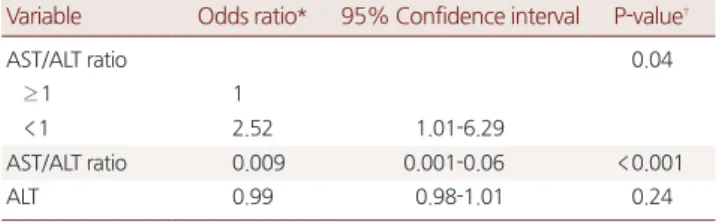
AST/ALT 비율이 1 미만인 군이 1 이상인 군에 비해 선종성 대장용 종 발생률이 높았고(odds ratio, 2.52; 95% confidence interval [CI], 1.01- 6.29), AST/ALT 비율이 증가함에 따라 선종성 대장용종 발생위험은 감소하였다(odds ratio, 0.009; 95% CI, 0.001-0.06) (Table 4).
5. Aspartate Aminotransferase/Alanine Aminotransferase 비율과 진행생성물 고위험군과의 관계
148명의 선종성 대장용종 보유군 중에서 진행생성물 발생 고위험 군 35명에 대해 다중회귀분석을 시행하였으나 AST/ALT 비율과의 관 계는 통계적으로 유의하지 않았다(Table 5).
Table 2. Clinical and laboratory characteristics of the subjects by ade- nomatous colorectal polyps
Characteristic Adenomatous polyp
P-value*
Yes (n= 148) No (n= 494)
Total 23.1% 76.9%
Gender <0.001
Male 110 (74.3) 282 (57.1)
Female 38 (25.7) 212 (42.9)
Age (y) 53.98± 10.451 46.83± 9.819 <0.001
Smoking <0.001
Non smoker 45 (30.4) 284 (57.5)
Current smoker 57 (38.5) 126 (25.5)
Ex-smoker 46 (31.1) 84 (17.0)
Alcohol drinking <0.001
<30 g/d 112 (75.7) 443 (89.7)
≥ 30 g/d 36 (24.3) 51 (10.3)
Exercise (frequency/wk) 0.002
<3 107 (72.3) 289 (58.5)
≥ 3 41 (27.7) 205 (41.5)
Body mass index (kg/m2) 23.952± 3.054 23.700± 3.153 0.39 Waist circumference (cm) 83.70± 9.480 81.68± 9.223 0.021
AST (IU/L) 29.92± 26.520 30.16± 13.554 0.92
ALT (IU/L) 35.58± 23.443 27.42± 17.212 <0.001 Gamma glutamyl transferase
(IU/L)
55.61± 65.737 39.12± 41.721 <0.001
AST/ALT ratio 0.833± 0.234 1.268± 0.465 <0.001
AST/ALT ratio <0.001
<1 121 (81.8) 127 (25.7)
≥ 1 27 (18.2) 367 (74.3)
Total cholesterol (mg/dL) 207.57± 35.069 203.47± 36.940 0.23 High density lipoprotein
cholesterol (mg/dL)
55.91± 14.384 56.68± 14.048 0.56
Low density lipoprotein cholesterol (mg/dL)
132.32± 34.712 128.83± 33.712 0.27
Triglyceride (mg/dL) 119.91± 77.180 107.03± 74.259 0.07 Fasting blood sugar (mg/dL) 102.79± 28.990 97.40± 17.449 0.03 Uric acid (mg/dL) 5.552± 1.381 5.302± 1.398 0.06 High sensitive C-reactive
protein (mg/dL)
0.159± 0.284 0.133± 0.230 0.26
Systolic blood pressure (mm Hg)
116.78± 11.522 114.1± 1.326 0.05
Diastolic blood pressure (mm Hg)
74.64± 7.645 73.49± 8.505 0.14
Values are presented as number (%) or mean± standard deviation.
AST, aspartate aminotransferase; ALT, alanine aminotransferase.
*Analyzed by chi-square test and independent t-test, and statistically significant P<0.05 are shown.
Table 3. Clinical and laboratory characteristics of the subjects in differ- ent levels of AST/ALT ratio
Characteristic AST/ALT ratio≥ 1 (n= 394)
AST/ALT<1
(n= 248) P value*
Gender <0.001
Male 197 (50.0) 195 (78.6)
Female 197 (50.0) 53 (21.4)
Age (y) 47.98± 10.661 49.28± 9.954 0.12
Smoking <0.001
Non smoker 241 (61.2) 88 (35.5)
Current smoker 95 (24.1) 88 (35.5)
Ex-smoker 58 (14.7) 72 (29.0)
Alcohol drinking 0.001
<30 g/d 355 (90.1) 200 (80.6)
≥ 30 g/d 39 (9.9) 48 (19.4)
Exercise (frequency/wk) 0.09
<3 233 (59.1) 163 (65.7)
≥ 3 161 (40.9) 85 (34.3)
Body mass index (kg/m2) 23.062± 2.952 24.863± 3.091 <0.001 Waist circumference (cm) 79.87± 8.731 85.76± 9.083 <0.001
AST (IU/L) 29.89± 19.231 30.45± 14.022 0.69
ALT (IU/L) 22.84± 17.138 39.56± 17.591 <0.001 Gamma glutamyl
transferase (IU/L)
34.76± 44.464 55.88± 52.451 <0.001
AST/ALT ratio 1.412± 0.426 0.780± 0.125 <0.001 Total cholesterol (mg/dL) 200.84± 35.547 210.10± 37.416 0.002 High density lipoprotein
cholesterol (mg/dL)
59.19± 14.626 52.23± 12.126 <0.001
Low density lipoprotein cholesterol (mg/dL)
125.33± 32.663 136.48± 34.888 <0.001
Triglyceride (mg/dL) 95.39± 62.818 133.23± 86.413 <0.001 Fasting blood sugar (mg/dL) 95.51± 15.805 103.63± 26.139 <0.001 Uric acid (mg/dL) 5.055± 1.311 5.844± 1.395 <0.001 High sensitive C-reactive
protein (mg/dL)
0.126± 0.217 0.160± 0.281 0.09
Systolic blood pressure (mm Hg)
114.58± 11.518 116.19± 11.150 0.08
Diastolic blood pressure (mm Hg)
73.12± 8.426 74.76± 8.072 0.02
Adenomatous polyp <0.001
Yes 27 (6.9) 121 (48.8)
No 367 (93.1) 127 (51.2)
Values are presented as number (%) or mean± standard deviation.
AST, aspartate aminotransferase; ALT, alanine aminotransferase.
*Analyzed by chi-square test and independent t-test, and statistically significant P<0.05 are shown.
류보석 외. AST/ALT 비율과 선종성 대장용종 Korean Journal of Family Practice
KJFP
고 찰
본 연구는 일반적으로 대장의 선종성 용종의 발생에 연관이 있다 고 알려진 위험요인뿐만 아니라 AST/ALT 비율과의 관계를 알아보 고, 위험요인들을 보정하여 AST/ALT 비율과 선종성 대장용종 간의 관계를 알아보기 위해 시도되었다. 선종성 대장용종 유병군의 일반 적인 특성에서 성별 및 나이에 따른 차이를 보면 남성에서, 그리고 나 이가 많을수록 유병률이 증가한다는 결과가 나왔고 이는 Choe 등20) 의 결과와 일치하였다.
대장암의 발생에 있어서 흡연은 수많은 발암물질에 노출되게 하 고,21) 알코올을 섭취하는 경우 대장점막을 자극하여 손상을 주며, 대 사산물인 아세트알데하이드 자체가 발암물질로서 역할을 할 수 있 다고 알려져 있다.22) 신체활동은 인슐린저항성을 개선시키고, 장의 연동운동을 항진시켜 대변의 장내 통과시간이 짧아짐으로써 대변 내 발암물질과 장점막이 접촉할 시간을 줄여줌으로써 암에 대한 예 방인자로 작용한다고 한다.23) Park 등16)의 연구에서도 흡연과 음주는 대장용종의 발생을 증가시키고 운동량에 있어서는 역의 관계가 있 음을 보고 하였는데, 본 연구에서도 같은 결과가 나왔다.
비만은 대사증후군의 주요 병인일 뿐만 아니라 대종용종 발생의
위험인자15,16)이고 특히 복부비만과 관련이 있는데, 이는 체지방의 증
가로 인한 고인슐린혈증과 인슐린저항성에 의해 증가된 인슐린과 인 슐린양 성장인자가 대장암 발생과 관련 있는 것으로 알려져 있다.12-
14) 하지만 어떠한 비만지표가 대장용종의 발생과 관련성이 높은지에 대해서는 다양한 연구결과가 있다. BMI가 증가할수록 용종 발생률 이 증가한다24)는 보고도 있고, Kim 등12)에서는 허리-엉덩이둘레 비 가 관련성이 높다고 보고했다. 본 논문의 경우 BMI와 선종성 용종 유병과는 관련성이 없었고, 선종성 대장용종 보유군에서 허리둘레 가 유의하게 크게 나왔다. 이는 대장용종의 발생에 있어 내장지방이 중요하며 근육량이 많은 경우에 BMI가 체내 지방량을 정확히 반영
하지 못한다는 점으로 설명할 수 있겠다.
Nam 등25)의 연구에 따르면 간 표지자 중 ALT 및 γGTP는 선종성 용종 발생의 위험인자인 대사증후군과 관련이 높다고 보고하고 있 다. 혈청 ALT 농도가 인슐린저항성과 연관성이 있고,26) γGTP는 산화 스트레스를 반영하는 표지자로 2형 당뇨병 환자에서 유의하게 증가 되어 있다고 한다.27) Lu 등18)은 AST/ALT비가 알콜성 간질환과 비알 콜성 지방간질환의 감별에 도움을 주는 수치로 1 미만인 경우 비알 콜성 지방간염, 2 이상인 경우엔 알코올성 간질환을 의심할 수 있고, 인슐린저항성과 역의 상관관계를 가지고 있으며 대장용종 발병의 위험인자인 대사증후군의 유병과 관련이 있다고 보고하였다. 본 연 구의 단변량분석에서 AST는 선종성 용종 유병과 상관관계가 없었으 며, ALT, γGTP는 의미 있는 관계를 보였다. AST/ALT 비율은 단변량 분석 및 다중회귀분석에서도 역의 상관관계를 보였다.
본 연구의 제한점으로는 첫째, 일개 종합병원 검진센터의 수검자 만을 대상으로 했기 때문에 지역사회 전체를 대표할 수 없다는 점이 다. 둘째, 선종성 대장용종 발생과 관련이 있는 적색육이나 가공육, 정제된 탄수화물 섭취 등의 식습관28)에 대한 조사가 이뤄지지 않았 다는 점이다. 셋째, 흡연, 음주, 신체활동 항목의 조사가 설문에 의존 하여 주관성이 개입되기 쉽고 정량화가 어렵다는 점이다. 넷째, 시간 경과에 따라 정상 점막에서 용종이 발생하고 크기가 증가하기 때문 에 이전 대장내시경검사 시점도 고려되었어야 한다는 점이다. 다섯 째, 진행 생성물 발생 고위험군의 대상자의 수가 적어 통계적으로 유 의한 결과를 얻지 못했다는 점이다.
이러한 제한점에도 본 연구는 염증성 용종이나 증식성 용종 등을 배제하고 선종성 용종 보유군만을 분석하였고, 대상군에서 선종성 용종 발생에 관련이 있는 항목을 분석하여 교란변수를 최소화해 AST/ALT 비율과의 관계를 직접적으로 분석했다는 장점이 있겠다.
Table 4. Multivariate logistic regression for adenomatous polyp by ALT
& AST/ALT ratio
Variable Odds ratio* 95% Confidence interval P-value†
AST/ALT ratio 0.04
≥ 1 1
<1 2.52 1.01-6.29
AST/ALT ratio 0.009 0.001-0.06 <0.001
ALT 0.99 0.98-1.01 0.24
AST, aspartate aminotransferase; ALT, alanine aminotransferase.
*Adjusting for sex, age, smoking, alcohol drinking, exercise, waist circumfer- ence, gamma glutamyl transferase, and fasting blood sugar. †Analyzed by multi- variate logistic regression and statistically significant P<0.05 are shown.
Table 5. Multivariate logistic regression for adenomatous polyp with high risk findings of advanced neoplasia* by ALT & AST/ALT ratio
Variable Odds ratio† 95% Confidence interval P-value‡
AST/ALT ratio 0.09
≥ 1 1
<1 3.32 0.84-13.08
AST/ALT ratio 0.72 0.09-5.65 0.75
ALT 1.01 0.99-1.03 0.16
AST, aspartate aminotransferase; ALT, alanine aminotransferase.
*High risk findings of advanced neoplasia are confined to 3 or more adenomas, or any adenoma larger than 10 mm, or any tubulovillous or villous adenoma, or any adenoma with high-grade dysplasia, or any serrated polyp larger than 10 mm. †Adjusting for sex, age, smoking, alcohol drinking, waist circumference, systolic blood pressure. ‡Analyzed by logistic regression and statistically significant P<0.05 are shown.
Bo-Seok Ryu, et al. AST/ALT Ratio and Adenomatous Colorectal Polyp
Korean Journal of Family Practice
KJFP
요 약
연구배경:
대장암의 전구병변인 선종성 대장용종의 조기진단 및 제 거는 대장암의 예방에 중요하다. 본 연구에서는 선종성 대장용종의 발생 예측인자로서 aspartate aminotransferase/alanine aminotransfer- ase (AST/ALT) 비율의 유용성에 대해 알아보고자 하였다.방법:
2013년 6월부터 12월까지 청주 한국병원 건강검진센터를 통해 대장내시경검사를 시행한 무증상 성인 642명을 대상으로 연구하였 다. 선종성 대장용종이 없는 494명을 대조군으로 하여 선종성 용종 보유군 과의 차이를 chi-square test와 independent t-test로 분석하였 다. 통계적으로 유의한 차이를 보인 인자들를 보정하여 AST/ALT 비 율과 선종성 대장용종의 관계를 다변량 로지스틱회귀분석을 통해 평가하였다.결과:
선종성 용종 보유군은 148명으로 23.1%의 유병률을 보였다. 선 종성 용종 보유군에서 ALT 및 gamma glutamyl transferase가 유의하 게 높았으나(P<0.001), AST는 유의한 차이를 보이지 않았다(P= 0.92).AST/ALT 비율이 1 이상인 군에 비해 1 미만인 군의 선종성 대장용종 발병 위험도는 높았으며(odds ratio, 2.52; 95% confidence interval [CI], 1.01-6.29; P= 0.04), AST/ALT 비율이 증가할수록 선종성 대장용종의 발생빈도는 감소하였다(odds ratio, 0.009; 95% CI, 0.001-0.06; P<0.001).
AST/ALT 비율과 진행생성물 발생 고위험군 간의 통계학적 유의성은 없었다(P= 0.75).
결론:
무증상 성인에서 AST/ALT 비율과 선종성 대장용종의 유병은 유의한 상관관계가 있었다.중심단어:
Aspartate Aminotransferase/Alanine Aminotransferase 비 율; 선종성 대장용종; 진행생성물REFERENCES
1. Lee SH, Park YK, Lee DJ, Kim KM. Colonoscopy procedural skills and train- ing for new beginners. World J Gastroenterol 2014;20:16984-95.
2. Jung KW, Won YJ, Kong HJ, Oh CM, Lee DH, Lee JS. Cancer statistics in Korea: incidence, mortality, survival, and prevalence in 2011. Cancer Res Treat 2014;46:109-23.
3. National Cancer Information Center. Cancer statistics 2012 [Internet]. Goy- ang: National Cancer Information Center; c2012 [cited 2014 Jan 2]. Avail- able from: http://www.cancer.go.kr.
4. Lee SH, Lee DJ, Kim KM, Park SB, Kim BT, Joo NS, et al. Colon cancer and polyp. Korean J Fam Pract 2014;4:15-27.
5. Levine JS, Ahnen DJ. Clinical practice: adenomatous polyps of the colon. N Engl J Med 2006;355:2551-7.
6. Morimoto LM, Newcomb PA, Ulrich CM, Bostick RM, Lais CJ, Potter JD.
Risk factors for hyperplastic and adenomatous polyps: evidence for malig- nant potential? Cancer Epidemiol Biomarkers Prev 2002;11(10 Pt 1):1012-8.
7. Honjo S, Kono S, Shinchi K, Wakabayashi K, Todoroki I, Sakurai Y, et al. The relation of smoking, alcohol use and obesity to risk of sigmoid colon and rec- tal adenomas. Jpn J Cancer Res 1995;86:1019-26.
8. Kim MC, Kim DH, Jeong TH. Risk factors of colorectal polyps in Korean adults. J Korean Acad Fam Med 2002;23:890-6.
9. Nam JH, Yang CH. Clinical characteristics and risk factors of colon polyps in Gyeongju and Pohang area. Korean J Gastroenterol 2008;52:142-9.
10. Kang YH. Prevalence and risk factors of colonic polyps in colonoscopy ex- aminees. J Korea Acad-Ind Coop Soc 2013;14:4335-41.
11. Park YH, Yu JH, Lee TY. An analysis on risk factors of colon polyps with health examination examinees. J Korea Acad-Ind Coop Soc 2014;15:1641-9.
12. Kim CS, Kim MC, Cheong HK, Jeong TH. The association of obesity and left colonic adenomatous polyps in Korean adult men. J Prev Med Public Health 2005;38:415-9.
13. Chung YW, Han DS, Park YK, Son BK, Paik CH, Lee HL, et al. Association of obesity, serum glucose and lipids with the risk of advanced colorectal ade- noma and cancer: a case-control study in Korea. Dig Liver Dis 2006;38:668- 72.
14. Chen FP, Wang HM, Chiang FF, Lin CC, Huang SC, Huang YC. The meta- bolic syndrome is associated with an increased risk of colorectal polyps inde- pendent of plasma homocysteine. Ann Nutr Metab 2014;64:106-12.
15. Kim BC, Shin A, Hong CW, Sohn DK, Han KS, Ryu KH, et al. Association of colorectal adenoma with components of metabolic syndrome. Cancer Causes Control 2012;23:727-35.
16. Park HY, Kim JR, Seo JY, Shin KS, Yoo BW, Cho YJ, et al. The association be- tween colon polyp and the metabolic syndrome in asymptomatic Korean adults. Korean J Health Promot 2013;13:87-92.
17. Shen H, Lipka S, Kumar A, Mustacchia P. Association between nonalcoholic fatty liver disease and colorectal adenoma: a systemic review and meta-anal- ysis. J Gastrointest Oncol 2014;5:440-6.
18. Lu Q, Liu X, Liu S, Xie C, Liu Y, Ma C. The relationship between AST/ALT ratio and metabolic syndrome in Han young adults: AST/ALT ratio and metabolic syndrome. In: Antiq M, editor. Recent advances in cardiovascular risk factors. Rijeka: InTech; 2012. p. 247-54.
19. Hong SN, Yang DH, Kim YH, Hong SP, Shin SJ, Kim SE, et al. Korean guide- lines for post-polypectomy colonoscopic surveillance. Korean J Gastroenter- ol 2012;59:99-117.
20. Choe SE, Lee SY. Characteristics and risk factors on colorectal polyps by the gender in health screen examinees. J Korean Biol Nurs Sci 2011;13:164-73.
21. Lee WC, Neugut AI, Garbowski GC, Forde KA, Treat MR, Waye JD, et al.
Cigarettes, alcohol, coffee, and caffeine as risk factors for colorectal adeno- matous polyps. Ann Epidemiol 1993;3:239-44.
22. Kim DH, Ahn YO, Lee BH, Tsuji E, Kiyohara C, Kono S. Methylenetetrahy- drofolate reductase polymorphism, alcohol intake, and risks of colon and rectal cancers in Korea. Cancer Lett 2004;216:199-205.
23. Nilsen TI, Vatten LJ. Prospective study of colorectal cancer risk and physical activity, diabetes, blood glucose and BMI: exploring the hyperinsulinaemia hypothesis. Br J Cancer 2001;84:417-22.
24. Murphy TK, Calle EE, Rodriguez C, Kahn HS, Thun MJ. Body mass index and colon cancer mortality in a large prospective study. Am J Epidemiol 2000;152:847-54.
류보석 외. AST/ALT 비율과 선종성 대장용종 Korean Journal of Family Practice
KJFP
25. Nam SM, Yu HY, Lee MY, Koh JH, Shin JY, Shin YG, et al. Alcohol consump- tion, liver enzymes, and prevalence of metabolic syndrome in Korean adult men. J Korean Diabetes Assoc 2007;31:253-60.
26. Vozarova B, Stefan N, Lindsay RS, Saremi A, Pratley RE, Bogardus C, et al.
High alanine aminotransferase is associated with decreased hepatic insulin sensitivity and predicts the development of type 2 diabetes. Diabetes
2002;51:1889-95.
27. Lee MY, Weon CS, Ko CH, Lee BJ, Lee Y, Kim MJ, et al. Relations between serum gamma-glutamyltransferase and prevalence of diabetes mellitus. Ko- rean J Med 2004;67:498-505.
28. Yang SY, Kim YS, Song JH, Chung SJ, Lee IH, Hong KJ, et al. Dietary risk fac- tors in relation to colorectal adenoma. Korean J Gastroenterol 2012;60:102-8.