Factors Affecting Survival in Patients Undergoing Palliative Spine Surgery for Metastatic Lung and Hepatocellular Cancer: Dose the Type of Surgery
Influence the Surgical Results for Metastatic Spine Disease?
Kee-Yong Ha, MD, Young Hoon Kim, MD, Ju-Hyun Ahn, MD, Hyung-Youl Park, MD
Department of Orthopedic Surgery, Seoul St. Mary’s Hospital, College of Medicine, The Catholic University of Korea, Seoul, Korea
Background: Surgical treatment for metastatic spine disease has been becoming more prominent with the help of technological advances and a few favorable reports on the surgery. In cases of this peculiar condition, it is necessary to establish the role of sur- gery and analyze the factors affecting survival.
Methods: From January 2011 to April 2015, 119 patients were surgically treated for metastatic spine lesions. To reduce the bias along the heterogeneous cancers, the primary cancer was confined to either the lung (n = 25) or the liver (n = 18). Forty-three patients (male, 32; female, 11; mean age, 57.5 years) who had undergone palliative surgery were enrolled in this study. Posterior decompres- sion and fusion was performed in 30 patients (P group), and anteroposterior (AP) reconstruction was performed in 13 patients (AP group) for palliative surgery. Pre- and postoperative (3 months) pain (visual analogue scale, VAS), performance status (Karnofsky performance score), neurologic status (American Spinal Injury Association [ASIA] grade), and spinal instability neoplastic score (SINS) were compared. The survival period and related hazard factors were also assessed by Kaplan-Meier and Cox regression analysis.
Results: Most patients experienced improvements in pain and performance status (12.3% ± 17.2%) at 3 months postoperatively.
In terms of neurologic recovery, 9 patients (20.9%) graded ASIA D experienced neurological improvement to ASIA E while the re- mainder was status quo. In an analysis according to operation type, there was no significant difference in patient demographics.
At 12 months postoperatively, cumulative survival rates were 31.5% and 38.7% for the P group and the AP group, respectively (p
> 0.05). Survival was not affected by the pre- and postoperative pain scale, Tokuhashi score, neurologic status, SINS, or operation type. Preoperative Karnofsky performance score (hazard ratio, 0.93; 95% confidence interval [CI], 0.89 to 0.96) and improvement of performance status after surgery (hazard ratio, 0.95; 95% CI, 0.92 to 0.97) significantly affected survival after operation.
Conclusions: There was no significant difference in surgical outcomes and survival rates between posterior and AP surgery for metastatic lesions resulting from lung and hepatocellular cancer. Preoperative Karnofsky score and improvement of performance status had a significant impact on the survival rate following surgical treatment for these metastatic spine lesions.
Keywords: Neoplasm metastasis, Spine, Prognosis
Copyright © 2015 by The Korean Orthopaedic Association
This is an Open Access article distributed under the terms of the Creative Commons Attribution Non-Commercial License (http://creativecommons.org/licenses/by-nc/4.0) which permits unrestricted non-commercial use, distribution, and reproduction in any medium, provided the original work is properly cited.
Clinics in Orthopedic Surgery • pISSN 2005-291X eISSN 2005-4408 Received April 5, 2015; Accepted June 21, 2015
Correspondence to: Young Hoon Kim, MD
Department of Orthopedic Surgery, Seoul St. Mary’s Hospital, College of Medicine, The Catholic University of Korea, 222 Banpo-daero, Seocho-gu, Seoul 137-701, Korea
Tel: +82-2-2258-6118, Fax: +82-2-535-9834, E-mail: [email protected]
Metastatic lesions are the most common spinal column tumors, arising from cancerous lesions including the lung, prostate, breast, kidney, and gastrointestinal system.1-3) Despite its frequency, there is no consensus as to which therapeutic modality or aggregate of modalities, be it ra- diotherapy (RT) or surgery, is the ideal strategy to best ad- dress this complex disease process.4,5)
Loblaw et al.,4) in their comprehensive systematic reviews, stated that patients with bony compression, spe- cifically high-grade compression fractures of the vertebral body or bony collapse of the spinal column, and particu- larly those with mild to moderate paraparesis, who were treated with RT seemed less likely to recover ambulation compared with paretic patients without bony compression, i.e., soft tissue epidural disease. The evidence amassed precluded any conclusions but managed to produce clini- cal practice guidelines for treatment and highlighted the potential of surgery for malignant epidural spinal cord compression.4,5) In their randomized control trial, Patchell et al.6) concluded that direct decompressive surgery plus postoperative RT was more favorable than treatment with RT alone for patients with spinal cord compression caused by metastatic cancer. This was subsequently followed by similar prospective studies that, although cautioning against potential morbidity, supported this claim.7-10)
Despite the abundance of evidence, many questions still remain about surgery for metastatic spine disease re- garding which patients should be advised to undergo it, its appropriate timing, and the optimal surgical procedure.1) Surgery for decompression and stabilization of the affected spine has proven to be a vital strategy that significantly impacts the patient’s neurologic function, pain relief, and quality of life.6-10) In conjunction with this, scoring systems
have been developed and validated to serve as decision- making guides and to emulate a model of consistency in dealing with this complex disease process.11-16) Treatment strategies and combinations thereof have also been pro- posed and modified in light of advancements17-19) and are continually being improved as we learn more of the meta- static process and refine our technique in addressing it.
However, despite the progression in our capability to handle these tumors, much can still be done in terms of reducing morbidity and increasing the effectiveness of sur- gical options. Therefore, by comparing results of different surgical strategies and analyzing factors affecting survival of metastatic lung and hepatocellular cancer, we hope to determine if surgery type and other factors such as preop- erative performance status and predictive score systems significantly influence the outcomes of metastatic spine disease.
METHODS
This study is a retrospective cohort review of patients seen and managed at a tertiary hospital from January 2011 to April 2015. One hundred nineteen patients that were sur- gically treated for metastatic spine lesions were considered for this study. Excluded from this study were patients who underwent any bone cement augmentation procedure and those with metastatic spine lesions from primaries other than the lung or the liver. Included were patients with metastasis from either the lung or liver who underwent palliative surgery for a neurologic deficit or pain related to mechanical instability. This was done to reduce the bias along heterogeneous primary cancers. Additionally, these two cancers were documented to have a poorer prognosis,
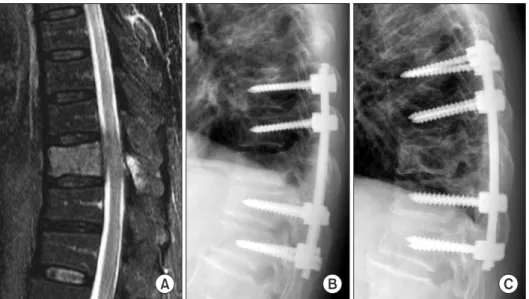
Fig. 1. A 45-year-old man was diagnosed with non-small cell lung cancer. He pre- sented with intractable back pain and progressive lower extremity weakness (Karnofsky performance status 30% and Frankel D). (A) Initial evaluation revealed impending spinal cord injury by pathologic fracture at T10 (spinal instability neo pla- stic score 15). (B) Anteroposterior re con- struction surgery was done. (C) Post opera- tive radiotherapy was also applied for this local lesion. At 18 months post operatively, he still lives actively by him self (Karnofsky performance status 90%).
A B C
both in medical literature and as reflected in their Toku- hashi point scores. A total of 43 patients were included in the final analysis.
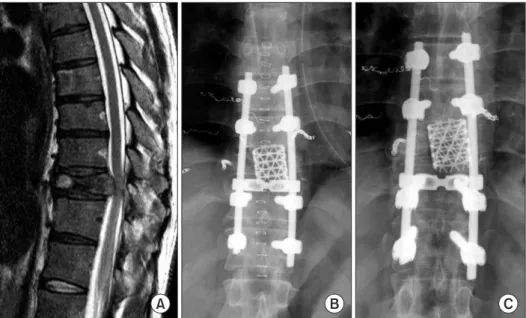
The decision for surgical intervention and/or RT was made by a multi-disciplinary team, which included an oncologist, a radio-oncologist, and a spine surgeon, with options discussed with patients and their family. Decom- pression, through debulking or excision, was performed for each patient and augmented with either posterior only or anteroposterior (AP) reconstruction. The decision regarding instrumented stabilization was based on a com- bined assessment of patient symptoms, static and dynamic imaging, the surgeon’s opinion, and inherent or potential instability brought about by the disease process, as well as patient co-morbidities and overall health. Posterior only surgery was kept to a minimum, providing indirect decompression to any anterior mass and mechanical sta- bility (Fig. 1); while AP surgery involved a more extensive excision or debulking of the metastatic lesions (Fig. 2).
Postoperative RT for the operated lesion was performed in 34 of 43 patients (79.1%) and was started at 3 weeks after surgery to allow for wound healing.
Demographic factors and data for each enrolled par- ticipant were recorded, including age, location of the lesion, primary cancer type, and type of surgery performed. In ad- dition, the preoperative Tokuhashi score, spinal instability neoplastic score (SINS), visual analogue scale (VAS), perfor- mance status using Karnofsky score, and neurologic status in terms of American Spinal Injury Association (ASIA) grade, were obtained. VAS, performance status and neurologic sta- tus at the immediate postoperative and 3-month postopera- tive periods were also recorded. Survival rates in months after
surgery were documented. Perioperative complications were also taken into consideration.
The data was analyzed using IBM SPSS ver. 21.0 (IBM Co., Armonk, NY, USA). A p-value of less than 0.05 was considered as statistically significant. Continuous data are expressed as means and standard deviations, and categorical data are expressed as frequencies for popula- tions according to primary cancer type and again by type of surgery performed. The unpaired t-test was used to de- termine if there was a difference between the two groups in each analysis. The survival period and related hazard factors were also assessed by Kaplan-Meier and Cox re- gression analysis, where subjects were followed from study enrollment until mortality or the data was censored due to loss of follow-up or the end of the study.
RESULTS
A total of 43 patients were included in the study, 32 males and 11 females, with a mean age of 58.0 ± 12.6 years (range, 35 to 84 years). Twenty-five patients had lung pri- maries, all of which were non-small cell, and 18 subjects had cancer of the liver as the primary cancer. Posterior decompression and fusion was performed in 30 patients (P group), and AP reconstruction was performed in 13 patients (AP group). Most of the lesions were located in the thoracic spine, constituting half of the metastases iden- tified, followed by lumbar and cervical lesions. There was no significant difference in patient demographics between lung cancer and hepatocellular cancer patients (Table 1), nor was there any significant difference in patient demo- graphics between P and AP surgery groups (Table 2). All
Fig. 2. A 73-year-old man was diagnosed with non-small cell lung cancer. He pre- sented with intractable back pain and progressive lower extremity weakness (Karnofsky performance status 70% and Frankel E). (A) Initial evaluation revealed impending spinal cord injury at T10 (spi- nal instability neoplastic score 7). (B) Posterior decompression and fusion was done. (C) Postoperative radiotherapy was also applied for this local lesion. At 9 months postoperatively, he still lives acti- vely by himself (Karnofsky perfor mance status 80%).
A B C
patients were documented to have better pain scores at 3-month follow-up. In terms of performance status, 28 pa- tients (65.1%) reported improved levels of functional ca- pacity, while levels of 11 patients (25.6%) remained consis- tent, and those of the other 4 (9.3%) declined. Neurologic outcomes showed that 9 patients (20.9%) had improved by one ASIA grade, while the rest of the 34 subjects (79.1%) showed neither progression nor worsening of neurologic symptoms. In our series, neurologic recovery only oc- curred in patients with ASIA grade D (6 patients in the P group, 3 in the AP group). In patients with grade C or below, neurologic recovery was not observed. No revision surgeries for the operated levels were done, and neurologic status was maintained during the follow-up period.
When comparing groups according to primary can- cer, there was no significant difference in improvement of performance status. Moreover, the mean survival periods, as measured until the last follow-up, were 8.9 and 8.2 months in lung and hepatocellular cancer, respectively, and
Table 1. Demographics of Patients Classified by Primary Cancer
Variable Lung cancer
(n = 25) Hepatocellular cancer
(n = 18) p-value
Age (yr) 60.3 ± 12.2 54.7 ± 12.8 0.157
Initial visual analogue scale 6.7 ± 2.0 6.8 ± 2.0 0.690
Location C:6, D:13, L:6 D:8, L:10 -
Performance status (%, Karnofsky) 67.2 ± 17.4 67.2 ± 16.7 0.990
Initial Tokuhashi score 5.9 ± 1.9 6.1 ± 1.8 0.745
Spinal instability neoplastic score 11.4 ± 3.7 10.2 ± 2.6 0.234
Values are shown as mean ± standard deviation.
C: cervical, D: dorsal, L: lumbar spine.
Table 2. Demographics of Patients Classified by Operation Type
Variable Posterior surgery
(n = 30) Anteroposterior surgery
(n = 13) p-value
Age (yr) 59.1 ± 13.9 55.2 ± 9.0 0.358
Initial visual analogue scale 6.8 ± 2.2 6.5 ± 1.9 0.557
Location C:2, D:18, L:10 C:3, D:5, L:5 -
Performance status (%, Karnofsky) 66.3 ± 17.1 69.2 ± 17.1 0.592
Initial Tokuhashi score 5.8 ± 1.9 6.5 ± 1.8 0.217
Spinal instability neoplastic score 10.9 ± 3.3 10.9 ± 3.6 0.960
Values are presented as mean ± standard deviation.
C: cervical, D: dorsal, L: lumbar spine.
Fig. 3. Kaplan-Meier analysis revealed cumulative survival rates to be 34.7% for lung cancer patients and 33.7% for hepatocellular cancer (HCC) patients at 12 months postoperatively. There was no statistically significant difference (p > 0.05, log-rank test).
0 5 10 15 20 25
1.0
0.8
0.6
0.4
0.2
30
Cumulativesurvivalrate
Observation time (mo) 0.0
Survivorship by primary cancer
Lung cancer HCC Primary cancer
the difference was found to be statistically insignificant. At 12 months postoperation, cumulative survival rates were 34.7% for lung cancer and 33.7% for hepatocellular cancer (log-rank test, p > 0.05) (Fig. 3). In terms of surgery type, mean survival period until last follow-up was 7.8 and 10.4 months for the P and AP groups, respectively, but the dif- ference was not found to be statistically significant (p = 0.276). Moreover, there was no significant difference in improvement of performance status after operation be- tween the groups (Table 3). At 12 months postoperatively, cumulative survival rates were 31.5% and 38.7% in the P group and AP group, respectively (log-rank test, p > 0.05) (Fig. 4). For the analysis of hazard factors, data for a total of 43 patients were evaluated with Cox regression analysis.
The pre- and postoperative pain scale, Tokuhashi score, neurologic status, SINS, and operation type were not sta- tistically shown to affect overall patient survivorship (p >
0.05). However, preoperative Karnofsky performance score and improvement of performance status at 3 months post- operatively were shown to significantly influence survival after surgery. The relative risk of morbidity was found to be 7% lower among subjects with higher preoperative Karnofsky performance scores, holding constant all of the variables in the model and accounting for potential differ- ences in follow-up between the groups (hazard ratio, 0.93;
95% confidence interval [CI], 0.89 to 0.96). The relative risk of morbidity was also found to be 5% lower among subjects with improved performance ratings after surgery (hazard ratio, 0.95; 95% CI, 0.92 to 0.97).
There were no documented acute complications related to the operations. One patient had suffered from wound dehiscence at postoperative 3 weeks and under- went surgical debridement but had an otherwise unevent- ful follow-up period.
DISCUSSION
The goals of surgical treatment for patients with meta- static spine tumors are, as much as possible, to provide a cure, to offer palliation and early return to activity in the absence of a cure, and to ensure a stable spinal column and normal or improved neurologic function in either case.2) This concept, which was not readily apparent in the past decade,6-10) has undergone a steady evolution and has redefined the way we approach metastatic spine disease.
Loblaw et al.4,5) was among the first to consolidate the data on the utility of RT for the treatment of metastatic spine disease and opened speculation to the inherent benefit of surgery. Patchell et al.6) later stepped out of convention and highlighted the role of direct decompressive surgery com- bined with postoperative RT in what was previously a RT- dominant first-line treatment for patients with spinal cord compression caused by metastatic cancer. Since this land- mark study, many trials have followed suit, with Falicov et Table 3. Comparison of Clinical Results by Operation Type
Variable Posterior surgery
(n = 30) Anteroposterior surgery
(n = 13) p-value
Survival after surgery (mo) 7.8 ± 8.5 10.4 ± 9.3 0.276
Improvement of performance status (%)* 12.3 ± 15.9 12.3 ± 20.5 0.539
Visual analogue scale at 3 months postoperatively 3.9 ± 1.6 3.8 ± 1.3 0.948
Frankel grade improvement 6 Patients (20%) with Frankel D 3 Patients (23%) with Frankel D - Data are shown as mean ± standard deviation.
*Performance status at 3 months postoperatively: preoperative performance.
Fig. 4. Kaplan-Meier analysis revealed cumulative survival rates to be 31.5% for patients who underwent posterior surgery and 38.7%
for those who underwent anteroposterior (AP) surgery at 12 months postoperatively. There was no statistically significant difference (p >
0.05, log-rank test).
0 5 10 15 20 25
1.0
0.8
0.6
0.4
0.2
30
Cumulativesurvival
Observation time (mo) 0.0
Survivorship by operation type
Posterior AP Operation type
al.,7) in their prospective study of 85 patients, concluding that surgery for these patients offers decreased pain and improved quality of life with low rates of surgical compli- cations, and Ibrahim et al.,8) with a multi-center prospec- tive study, stating similar results, that surgical treatment was effective in providing better pain control, enabling patients to regain or maintain mobility, and offering im- proved sphincter control. Consequently, the prospective study on surgical outcomes and survival in 118 patients with metastatic disease to the spine by Quan et al.10) saw the potential for immediate and prolonged improvement in pain, function, and quality of life in these patients and affirmed its inclusion in the decision-making process for treatment. Li et al.,9) building on these realizations, studied outcomes of en bloc and debulking surgery retrospectively, stating that although the difference in median survival time between the two groups was more than 12 months (40.93 and 24.73 months, respectively), it was not found to be statistically significant. The implication of a shorter life expectancy no longer hinders what can be offered in terms of quality of life, pain reduction, and maximized function.
This study hoped to further these motives by determining the best possible surgical approach, if any, and to deter- mine possible hazard factors that could influence patient survivorship.
Reviewing the literature for metastatic spine dis- ease, most studies categorize surgery or operation type as either an en bloc or a debulking procedure with little or no documentation of the stabilization employed after tumor removal.6-10) Evidence-based treatment algorithms and expert consensus has defined instability as the loss of spinal integrity resulting from a neoplastic process that is associated with movement-related pain, symptomatic or progressive deformity, and/or neural compromise under physiologic loads.15,16) However, the debate on the optimal augmentation procedure is still, largely, unresolved.20,21) In this study, stabilization of the spine through posterior only instrumentation compared with combined AP instru- mentation did not yield any significant effect on overall survivorship in the patient population, nor did it signifi- cantly affect other outcome measures. Perhaps in a similar vein as that reported by Li et al.,9) the surgical approach and stabilization for metastatic spine disease did not influ-
ence the overall results regarding survival. In this series, minimal debulking versus aggressive en bloc resection and posterior only versus combined AP surgery were not the main considerations prior to the procedure. Rather, a multidisciplinary model was employed, focusing on each patient’s capacity to handle the circumstances of surgery and the potential for functional recovery.
The Karnofsky performance score was primarily developed to allow physicians to evaluate a patient's abil- ity to survive chemotherapy for cancer, but it has since been expanded in oncological randomized controlled and observational trials as a measure of quality of life.22) Higher scores, i.e., values approximating near normal, little or no complaints, and minimal or no signs of disease, were revealed to be predictive of a lower relative hazard of morbidity. In this study, preoperative Karnofsky score and improvement of performance status at 3 months postoper- atively had a significant effect on the overall survivorship of the patient population. This can be attributed to the fact that surgical decompression allows patients to regain or remain ambulatory for the remainder of their lives,6-8,10) lending itself to functional independence and, indirectly, to increased survival time.
The relatively small number of patients in this ret- rospective observational study may be limiting in terms of the implications of the study. A larger, prospective, and even randomized trial, e.g., also including other cancer types, may yield a more stabilized model, with other fac- tors brought into statistical significance. Another limita- tion is that decision-making was done using a team-based multi-disciplinary approach and biased healthier and younger patients towards AP surgery.
In conclusion, there was no significant difference in surgical outcomes and survival rates between posterior and AP surgery for metastatic lesions resulting from lung and hepatocellular cancer. Preoperative Karnofsky score and improvement of performance status had a significant impact on the survival rate following surgical treatment for these metastatic spine lesions.
CONFLICT OF INTEREST
No potential conflict of interest relevant to this article was reported.
REFERENCES
1. Daffner SD. Spinal tumors. In: Fynn JM; American Acad-
emy of Orthopaedic Surgeons, eds. OKU 10: orthopaedic knowledge update. Rosemont: American Academy of Or- thopaedic Surgeon; 2011. 553-64.
2. Lewandrowski KU, Anderson ME, McLain RF. Tumors of the spine. In: Herkowitz HN, Garfin SR, Eismont FJ, Bell GR, Balderston RA, eds. Rothman-Simeone the spine. 6th ed. Philadelphia, PA: Elsevier Sounders 2011. 1480-512.
3. Gardocki RJ, Camillo FX. Tumors of the spine. In: Canale ST, Beaty JH, eds. Campbell's operative orthopaedics. 12th ed. St. Louis: Elsevier/Mosby; 2013. 2033-50.
4. Loblaw DA, Perry J, Chambers A, Laperriere NJ. Systematic review of the diagnosis and management of malignant ex- tradural spinal cord compression: the Cancer Care Ontario Practice Guidelines Initiative's Neuro-Oncology Disease Site Group. J Clin Oncol. 2005;23(9):2028-37.
5. Loblaw DA, Mitera G, Ford M, Laperriere NJ. A 2011 up- dated systematic review and clinical practice guideline for the management of malignant extradural spinal cord com- pression. Int J Radiat Oncol Biol Phys. 2012;84(2):312-7.
6. Patchell RA, Tibbs PA, Regine WF, et al. Direct decompres- sive surgical resection in the treatment of spinal cord com- pression caused by metastatic cancer: a randomised trial.
Lancet. 2005;366(9486):643-8.
7. Falicov A, Fisher CG, Sparkes J, Boyd MC, Wing PC, Dvorak MF. Impact of surgical intervention on quality of life in patients with spinal metastases. Spine (Phila Pa 1976).
2006;31(24):2849-56.
8. Ibrahim A, Crockard A, Antonietti P, et al. Does spinal surgery improve the quality of life for those with extradural (spinal) osseous metastases? An international multicenter prospective observational study of 223 patients. Invited submission from the Joint Section Meeting on Disorders of the Spine and Peripheral Nerves, March 2007. J Neurosurg Spine. 2008;8(3):271-8.
9. Li H, Gasbarrini A, Cappuccio M, et al. Outcome of exci- sional surgeries for the patients with spinal metastases. Eur Spine J. 2009;18(10):1423-30.
10. Quan GM, Vital JM, Aurouer N, et al. Surgery improves pain, function and quality of life in patients with spinal metastases: a prospective study on 118 patients. Eur Spine J.
2011;20(11):1970-8.
11. Tokuhashi Y, Matsuzaki H, Oda H, Oshima M, Ryu J.
A revised scoring system for preoperative evaluation of metastatic spine tumor prognosis. Spine (Phila Pa 1976).
2005;30(19):2186-91.
12. Putz C, Wiedenhofer B, Gerner HJ, Furstenberg CH. Toku-
hashi prognosis score: an important tool in prediction of the neurological outcome in metastatic spinal cord compres- sion. A retrospective clinical study. Spine (Phila Pa 1976).
2008;33(24):2669-74.
13. Tokuhashi Y, Ajiro Y, Umezawa N. Outcome of treatment for spinal metastases using scoring system for preoperative evaluation of prognosis. Spine (Phila Pa 1976). 2009;34(1):
69-73.
14. Papastefanou S, Alpantaki K, Akra G, Katonis P. Predic- tive value of Tokuhashi and Tomita scores in patients with metastatic spine disease. Acta Orthop Traumatol Turc. 2012;
46(1):50-6.
15. Fisher CG, DiPaola CP, Ryken TC, et al. A novel classifica- tion system for spinal instability in neoplastic disease: an evidence-based approach and expert consensus from the Spine Oncology Study Group. Spine (Phila Pa 1976). 2010;
35(22):E1221-9.
16. Fourney DR, Frangou EM, Ryken TC, et al. Spinal insta- bility neoplastic score: an analysis of reliability and valid- ity from the spine oncology study group. J Clin Oncol.
2011;29(22):3072-7.
17. Kim HJ, Buchowski JM, Moussallem CD, Rose PS. Modern techniques in the treatment of patients with metastatic spine disease. Instr Course Lect. 2013;62:375-82.
18. Molina CA, Gokaslan ZL, Sciubba DM. Diagnosis and man- agement of metastatic cervical spine tumors. Orthop Clin North Am. 2012;43(1):75-87.
19. Feiz-Erfan I, Fox BD, Nader R, et al. Surgical treatment of sacral metastases: indications and results. J Neurosurg Spine. 2012;17(4):285-91.
20. Wiedenhofer B, Mohlenbruch M, Hemmer S, Lehner B, Klockner K, Akbar M. Vertebral stability in management of spinal metastases: criteria and strategies for operative inter- ventions. Orthopade. 2012;41(8):623-31.
21. Horn L, Pao W, Johnson DH. Neoplasms of the lung. In:
Longo DL, Fauci AS, Kasper DL, Hauser SL, Jameson JL, Loscalzo J, eds. Harrison's principles of internal medicine.
18th ed. New York: McGraw-Hill; 2012. 737-53.
22. Karnofsky DA, Burchenal, JH. The clinical evaluation of chemotherapeutic agents in cancer. In: MacLeod CM, ed.
Evaluation of chemotherapeutic agents. New York: Colum- bia University Press; 1949. 196-7.